INTRODUCTION
The hippocampus (HIPPO) is a part of a mam� malian limbic brain that plays a crucial role in the response to neuroendocrine stress by mediating feedback inhibition of the hypothalamic�pituitary�hypothalamic�pituitary� adrenal (HP�) a�is (�apolsky et al�� ����)� �tressHP�) a�is (�apolsky et al�� ����)� �tress a�is (�apolsky et al�� ����)� �tress� �tress hormones adapt and modulate brain functions by changing the structure of neurons� but they may also influence neuronal damage or suppress neurogenesis and cell survival (Czeh et al�� 200�)� �part from the�part from the glucocorticoid receptor� which is the main molecu� lar regulator of the feedback response� mitogen�acti� vated protein kinases (��P�s) are also sensitive to��P�s) are also sensitive to�P�s) are also sensitive to stress and activated by it (�eller et al�� 2003)�
The ��P�s are widely distributed throughout the brain and have important roles in regulation of synaptic plasticity� memory formation� and neuro� transmission (�weatt� 200�)� The c��un�N�terminalThe c��un�N�terminal kinase (�N�) subfamily belongs to the ��P�s and is comprised of three isoforms (�N��� �N�2� and �N�3)� In response to e�ternal stimulation� acti�In response to e�ternal stimulation� acti�
vated �N�s phosphorylate numerous transcription factors� including c�jun (Whitmarsh et al�� ����) and activating transcription factor 2 (Gupta et al�� ���5)� enhancing their transcriptional activity and thereby influencing a wide range of cellular signals� �oreover� activated �N�s have been mainly con� sidered as degenerative signal transducers and effi� cient activators of apoptosis in the nervous system (Waetzig et al�� 2004)� The molecular mechanism� The molecular mechanism The molecular mechanism by which �N�s channel prodegenerative signals is mediated through activation of pro�apoptotic mol� ecules� inactivation of anti�apoptotic molecules� and pathological release of cytochrome c (Putcha et al�� 2003; �chroeter et al�� 2003)�
To prevent cellular damage� cells activate the transcription of heat shock proteins (H�Ps) which ensure the coordinated regulation of protein trans� location� import� and folding (Clarke� ����) and limit cellular damage by their ability to prevent pro� tein aggregation and restore the function of dena� tured proteins (Parsell et al�� ���3)� �s a member of the H�P family� Hsp70 is also activated by stress�
StreSS-induced phoSphorylation of c-Jun-n-terminal kinaSeS and nuclear tranSlocation of hSp70 in the WiStar rat hippocampuS �� �DžIć�� �N� D�ORD�evIć�� ��RI�� �R�TIć-De�ON�CO�2� and ��RI�� B� R�DO�čIć�
1Laboratory of Molecular Biology and Endocrinology,Vinča Institute, ��00� Belgrade� �erbia 2Faculty of Life Sciences, University of Manchester, �anchester ��3 �PT� england� U��.
Abstract — Glucocorticoids are key regulators of the neuroendocrine stress response in the hippocampus� Their action is partly mediated through the subfamily of ��P�s termed c��un�N�terminal kinases (�N�s)� whose activation correlates with neurodegeneration� The stress response also involves activation of cell protective mechanisms through various heat shock proteins (H�Ps) that mediate neuroprotection� We followed both �N�s and Hsp70 signals in the cytoplasmic and nuclear compartments of the hippocampus of Wistar male rats e�posed to acute� chronic� and combined stress� The activ� ity of �N�� was decreased in both compartments by all three types of stress� while the activity of cytoplasmic �N�2/3 was elevated in acute and unaltered or lowered in chronic and combined stress� Under all stress conditions� Hsp70 trans� location to the nucleus was markedly increased� The results suggest that neurodegenerative signaling of �N�s may be counteracted by increase of nuclear Hsp70� especially under chronic stress�
Key words: Wistar rat� neuroendocrine stress� hippocampus� �N�� Hsp70
UDC 577�25:��2����:5�:5���4����
�oreover� Hsp70 mediates neuroprotection� and its overe�pression was shown to protect hippocampal neurons from cytoto�ic effects of stress (Beaucamp et al�� ����)� One of the mechanisms through which Hsp70 prevents cytoto�ic stress effects is by its abil� ity to suppress �N� activation (Gabai et al�� ���7; �osser et al�� ���7)� thus inhibiting the pro�apoptot� ic signals mediated by �N�s (Tournier et al�� 2000)� Considering the opposite roles of �N�s and Hsp70 in regulation of the stress response� we stud� ied e�pression levels of these proteins and their cyto� plasmic�nuclear translocation in the hippocampus of Wistar male rats e�posed to acute� chronic� or combined neuroendocrine stress�
��TeRI�l� �ND �eTHOD� Animal care and treatment
�ll e�periments were performed on adult (3�month� old) Wistar male rats (body mass 330�400 g) housed in four per standard�size cages and offered food (commercial rat pellets) and water ad libitum� light was kept on between 07�00 am and 07�00 pm� and room temperature (RT) was kept at 20 ± 2°C� For the stress e�periments� animals were divided into four groups: group I consisted of unstressed animals (control group); group II animals were e�posed to acute immobilization for 30 min; group III animals were subjected to chronic isolation stress by hous� ing them individually for 2� days; and group Iv was e�posed to chronic isolation for 2� days� followed by 30�min immobilization�
Preparation of cytoplasmic and nuclear extracts
�nimals were sacrificed by rapid decapitation and the hippocampus (HIPPO) area was removed and immediately frozen in liquid nitrogen until fur� ther preparation� Frozen tissues were weighed and homogenized (�: 2 = tissue mass:vol) in ice�cold 20 m� Tris�HCl (pH 7�2) buffer containing �0 % glyc� erol� 50 m� NaCl� � m� eDT�� � m� eGT��2 m� DTT� and protease inhibitors (20 m� Na2�oO4� 0��5 m� spermine� 0��5 m� spermidine� 0�� m� P��F� 5 µg/ml antipain� 5 µg/ml leupeptin� 5 µg/ml aprotinin� �0 µg/ml trypsin inhibitor� and 3 m� benzamidine) and phosphatase inhibitors (20 m�
β�glycerophosphate� 5 m� Na4P2O7��0H2O� 2 m� Na3vO4� and 25 m� NaF) by 20 strokes of a Potter� elvehjem teflon�glass homogenizer� �amples were centrifuged for �0 min at 2�000 g at 4°C� the super� natants were ultracentrifuged for � h at �05�000 g and the final supernatants were used as the cyto� plasmic fraction� Pellets were washed (three times) in 0�5 ml of homogenization buffer and centrifuged for �0 min at 2�000 g at 4°C� The final pellets were weighed� resuspended (�: � = mass: vol) in the same buffer supplied with 0�5 � �Cl� incubated for � h in an ice�bath (with frequent vorte�ing)� and centri� fuged for �0 min at ��000 g at 4°C� The supernatant was used as a nuclear e�tract (�pencer et al�� 2000)�
Corticosterone assay
Blood from each animal was collected at the time of sacrifice� �erum was prepared by �5�min centrifuga� tion at 3�000 rpm� The corticosterone (CORT) level was determined using the OCTeI� Corticosterone eI� kit according to the manufacturers’ instructions (�merican laboratory Products Co�)� �bsorbance at 450 nm (reference �50 nm) was determined with a microplate reader (Wallac� vICTOR2 �420�
Perkinelmer)� The CORT concentration (ng/ml) was determined using a standard curve�
Western blot detection of JNKs and their phosphorylated isoforms
Table 1. Stress-induced changes in serum corticosterone level of Wistar males: he total number of animals in each experimental group [control (Ctrl), acute (A), chronic (C) or combined stress (C+A)] is indicated above, while means ± SEM for serum corticoste-rone are given below. Diferences are statistically signiicant at **p<0.01 and ***, ###p<0.001 (* stress vs. control, # acute vs. chronic or combined).
�N�� and Hsp70 (N27F3�4) antibody (�anta Cruz Biotechnology) to detect Hsp70� β�actin� which was used as a loading control� was detected using rabbit polyclonal anti�β�actin (ab�227� �bcam)� Densitometry of protein bands on X�ray film was performed using Image � �nalysis PC software�
Statistical analysis
Data are presented as means ± �e� from four to si� independent measurements� Data were analyzed by one�way �NOv� followed by the Tukey post hoc test� values were considered statistically significant if the p value was less than 0�05�
Re�UlT�
corticosterone level in different stress conditions:
Given that the level of corticosterone (CORT) in the blood serum is the major determinant of the stress response of the HP� a�is� we measured its concen� tration in each of the Wistar male rats subjected to different stress conditions using a commercial CORT kit (Table �)� �s e�pected� acute (30�min) e�posure to high�intensity physical�emotional�psy� chosocial stress such as that caused by immobili� zation resulted in a significant increase of serum CORT levels� Contrary to this� chronic isolation for 2� days (low�intensity but long�term psychosocial stress) led to a significant decrease of CORT serum levels� When the chronically stressed animals were subsequently subjected to acute immobilization (i�e�� combined stress)� serum CORT increased to a level similar to that observed after acute stress (Table �)� The results shown in Table � indicate that acute and combined stress result in a major increase� whereas
chronic stress led to a significant decrease of CORT concentration in the blood serum�
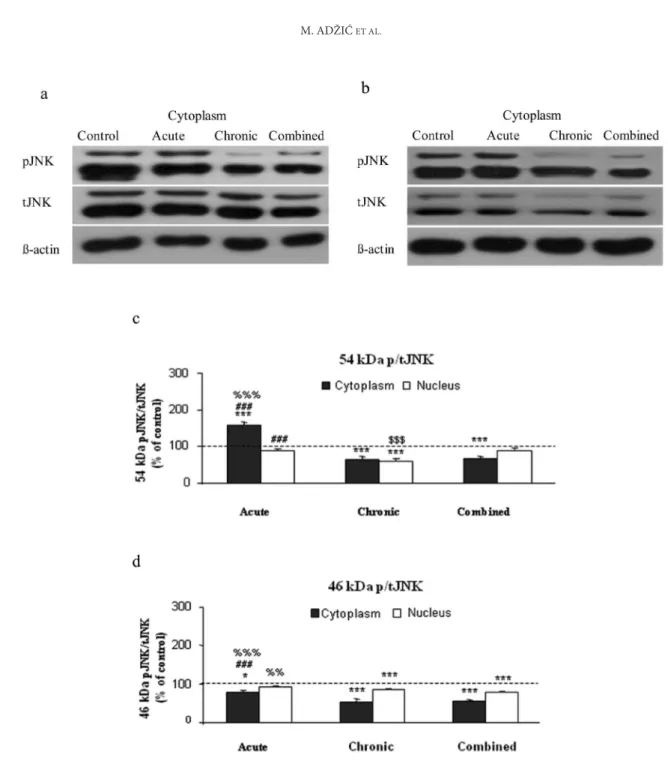
effect of stress on Jnk �ctivit��Jnk �ctivit�� We estimated �N�� (4� kDa) and �N�2/3 (54 kDa) activity by following their phosphorylation at residues Thr��3/Tyr��5� which are crucial for activation of these kinases in the cytoplasmic and nuclear fractions of the HIPPO under stress (Figs� �a and �b)� The ratio of p�N�� The ratio of p�N��The ratio of p�N�� to (total) t�N�� (p�N��/t�N��) indicates that cyto� plasmic and nuclear �N�� phosphorylation was low in all types of stress in relation to the control� Only in the case of acute stress was the phosphorylation of nuclear �N�� not significantly changed (Figs� �b and �d)� In contrast� the activation of cytoplasmic �N�2/3 was markedly increased in acute stress� while it was unaltered or lower in other types of stress (Figs� �a and �c)�
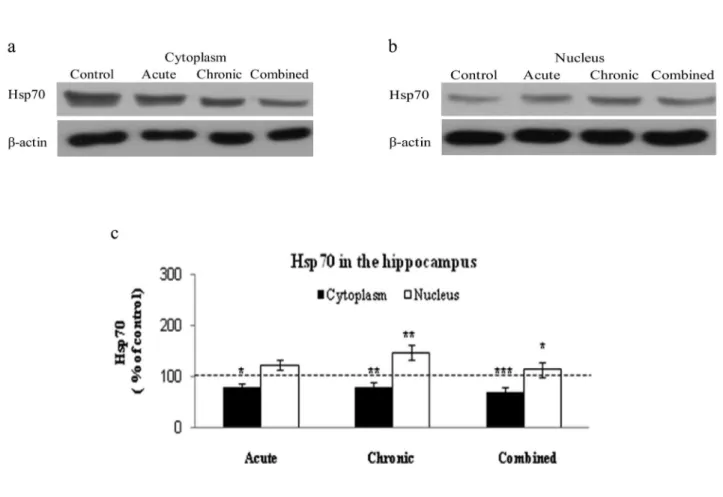
effect of stress on hs�70�hs�70� In parallel with �N� activity� we investigated cytoplasmic and nuclear levels of Hsp70 in acute� chronic� and combined stress� The cytoplasmic level of Hsp70 was signifi� cantly decreased under all stress conditions (Figs� 2a and 2c)� Increase in the nuclear level of Hsp70 indicated its cytoplasmic�nuclear translocation in all three types of stress� the most prominent elevation occurring under chronic stress (Figs� 2b and 2c)�
DI�CU��ION
It has been postulated that regulation of the adaptive vs� the maladaptive CN� response to stress involves multiple cellular signaling pathways (Chrousos et al�� 2007)� �ctivation and feedback at the level of�ctivation and feedback at the level of the HP� a�is are crucial steps in the response to
Treatment →
Parameter ↓ Control(Ctrl) immobilization�cute (�)(�) Chronic (C)isolation (C) CombinationC+�
Number of animals �55 �5 �55 �55
Corticosteronee
stress� and adrenal glucocorticoids (GCs) are impor� tant effectors in this system (�unck et al�� ���4)� The action of GCs are coordinated with the activ� ity of several other stress�sensitive systems� such as mitogen�activated protein kinases (��P�s) (�eller��P�s) (�eller�P�s) (�eller et al�� 2003)and heat shock proteins (H�Ps) (Parsell(Parsell
et al�� ���3)� For e�ample� members of the subfamily� For e�ample� members of the subfamily of ��P�s termed �N�� and �N�3 kinases – which are associated with CN� development or neuronal apoptosis and degeneration� respectively (Waetzig et al�� 2004) – are both of great importance for GC signaling under stress (�džić et al�� �under review’)��under review’)�under review’)�
In response to stress� cells also rapidly activate heat shock proteins (H�Ps)� among which Hsp70� among which Hsp70 has been associated with inhibition of cell death by apoptosis (Beere et al�� 200�)� The interactions between these two opposing pathways� the �N�s and the H�Ps� can be viewed as determinants of the biological consequences of stress� i�e�� adaptation vs� maladaptation�
Taking into account that the hippocampus� as a part of the brain ”limbic system”� is included in regulation of HP� a�is activity and presents the primary neuronal target for the GC feedback reac� tion (also involving the �N� and H�P pathways)� we characterized the effects of brief (acute immobiliza� tion)� prolonged (2��day isolation)� and combined stress on corticosterone (CORT) levels in the blood
serum and on activation of �N��� �N�2� �N�3� and Hsp70 in the cytoplasm and nucleus of the rat hip� pocampus�
Our results showed that acute immobilization induces a 4�5�fold increase in the level of blood serum CORT� which is considered as a �normal’ CN� stress response (�cewan� ����) (Table �)� long� term social isolation was used as a possible mala� daptive chronic stress� and we found a low level of CORT in the blood serum of isolated animals� This finding is in accordance with other authors’ pub� lished observations showing HP� a�is hypoactivity in stress conditions caused by isolation (�alkesman�alkesman et al�� 200�)� Finally� the ability to retain �normal’)� Finally� the ability to retain �normal’ stress signaling after chronic stress was approached by a combination of the two models mentioned
above� We found increased CORT in combined stress� which indicated that HP� a�is activity was not terminally compromised by the previous e�pe� rience of chronic stress and could be resumed after subsequent acute stress (Table �)�
In this respect� our results showed reduced �N�� activity in both cytoplasmic and nuclear compart� ments of the HIPPO in chronic and combined stress (Fig� �)� This finding is consistent with the notion that �N� activity is negatively regulated by high CORT levels in the above�mentioned treatments� However� we also observed induction of �N�2/3 activity in HIPPO under acute stress� which is in agreement with recently published reports indicat� ing activation of �N� in these conditions (�hen et al�� 2004)� In chronic stress� despite low levels of CORT� �N� function is diminished� indicating that other pathways may regulate �N�� perhaps through �kt signaling and reactive o�ygen species (RO�)�
Because �N�2/3 isoforms are activated in hippo� campal formations that play a critical role in learn� ing and memory (eichenbaum� 200�)� it is possible that the �N� signaling pathway may also be involved in the formation of emotional memory� which is especially associated with acute stress� The rapid activation of �N�2/3 isoforms in response to acute stress could be e�plained by non�genomic effects of GCs through corticosteroid membrane receptors that activate a P�C�dependent signaling mechanism and phosphorylation of ��P� family members (Tasker et al�� 200�)� On the other hand� the low �N� activity under chronic stress may reflect activation of genomic effects of GCs through the GR� which transcriptionally regulates ��P� phosphatase�� (��P��) (Clark et al�� 2003)� or through non�tran� scriptional mechanisms mediated by direct GR��N� interactions (Bruna et al�� 2003)� The changes in activity of �N�2/3 isoforms in the hippocampus cor� relates with blood serum CORT variations� which indicates that these changes could be either cause or consequence of CORT variations� suggesting possible mutual regulation of hippocampal �N�2/3 phosphorylation and the serum CORT level�
These reports prompted us to investigate in addition to �N�� Hsp70 as a possible protective ele�
ment and its subcellular distribution in the HIPPO in response to stress� Our results indicated that hippocampal cytoplasmic Hsp70 was decreased by all three stresses in a stress�type–independ� ent manner� Contrary to this� nuclear Hsp70 in the HIPPO revealed stress�type dependence� since under low CORT its level was significantly elevated� The prevalence of Hsp70 in the nuclear compart� ment obtained in our e�periments could indicate specific nuclear roles for it� roles such as possiblepossible regulation of steroid receptor (i�e�� glucocorticoid receptor) binding to the promoter or removal from it and enhancement of nuclear mobility of steroid receptors� thus influencing transcriptional activity (�tavreva et al�� 2004; elbi et al�� 2004)� These results are in accordance with observations from our labo� ratory indicating elevated GR phosphorylation at serine 232� which activates transcriptional activity of the GR in the nuclear compartment of the HIPPO under chronic stress� implying the possibility of its stabilization at GRes by H�Ps (�džić et al�� �under review’)� Considering the fact that GR transcrip� tionally regulates ��P� phosphatase�� (��P��) and that low activity of �N�2/3 isoforms is found under chronic stress� it seems that the mechanism of downregulation of �N�2/3 may possibly involve stabilization of the GR with Hsp70 in the nuclear compartment of the HIPPO�
To sum up� decreased activity of almost all �N� isoforms in both cell compartments under all types of stress could lead to interruption of �N� signal� ing� which may influence neurodegeneration or neural cell remodeling (neural plasticity)� especially in response to chronic stress� On the other hand� nuclear translocation of Hsp70 could represent a possible adaptive mechanism countering �N� action in stress situations�
Acknowledgments —This work was supported by the �inistry of �cience and Technological Development of �erbia (Project �43042B)�
ReFeReNCe�
Beere, H. M., and D. R. Green (200�)� �tress management – heat shock protein�70 and the regulation of apoptosis�
Trends., Cell. Biol.11 (1), ���0�
Bruna, A., Nicolas, M., Munoz, A., Kyriakis, J. M., and C.Caelles
(2003)� Glucocorticoid receptor��N� interaction medi� ates inhibition of the �N� pathway by glucocorticoids�
EMBO J.22, �035��044�
Chrousos, G. P., and T. Kino (2007)� Glucocorticoid action net� works and comple� psychiatric and/or somatic disorders�
Stress10 (2), 2�3�2���
Clark, A. R., and M.Lasa (2003)� Crosstalk between glucocor� ticoids and mitogen�activated protein kinase signaling pathways� Curr. Opin. Pharmacol.3, 404�4���
Clarke, A. R. (����)� �olecular chaperones in protein folding and translocation� Curr. Opin. Struct. Biol. 6, 43�50�
Czeh, B., Michaelis, T., and T.Watanabe (200�)� �tress�induced�tress�induced changes in cerebral metabolites� hippocampal volume� and cell proliferation are prevented by antidepressant treatment with tianeptine� Proc. Natl. Acad. Sci. USA98,
�27����2�0��
Eichenbaum, H. (200�)� � cortical�hippocampal system for declarative memory� Nat. Neurosci.4, �057��05��
Elbi, C, Walker, D. A., Romero, G., Sullivan, W. P., Toft, D. O., Hager, G. L., and D. B. DeFranco (2004)� �olecular chaperones function as steroid receptor nuclear mobility nuclear mobilitynuclear mobility factors� Proc. Natl. Acad. Sci. USA101, 2�7��2����
Gabai, V. L., Meriin, A. B., Mosser, D. D., Caron, A. W., Rits, S., Shifrin, W. I., and M. Y.Sherman (���7)� Hsp70 prevents activation of stress kinases� � novel pathway of cellular thermotolerance� J. Biol. Chem. 272, ��033���037�
Gupta, S., Campbell, D., Derijard, B., and R. J. Davis (���5)� Transcription factor �TF2 regulation by the �N� signal transduction pathway� Science267, 3���3�3�
Laemmli, U. K. (��70)� Cleavage of structural proteins during the assembly of the head of bacteriophage T4� Nature
227, ��0���5�
Lowry, O. H., Rosebrough, N. J., Farr, A. L., and R. J. Randall
(��5�)� Protein measurement with the Folin phenol rea� gent� J. Biol. Chem.193, 2�5�2�7�
Malkesman, O., Maayan, R., Weizman, A., and A. Weller (200�)� �ggressive behavior and HP� a�is hormones after social isolation in adult rats of two different genetic animal models for depression� Behav. Brain. Res. 175, 40��4�4�
McEwen, B. S. (����)� Protective and damaging effects of stress mediators: central role of the brain� N. Engl. J. Med.338,
�7���7��
Meller, E., Shen, C., Talia, A. N., Jensen, C., Tsimberg, Y., Chen, J., and R. J.Gruen (2003)� Region�specific effects of acuteRegion�specific effects of acute and repeated restraint stress on the phosphorylation of mitogen�activated protein kinases� Brain Res. 979,
57��4�
Mosser, D. D., Caron, A. W., Bourget, L., Denis-Larose, C., and
B. Massie (���7)� Role of the human heat shock protein Hsp70 in protection against stress�induced apoptosis�
Mol. Cell. Biol. 17, 53�7�5327�
Munck, A, Guyre, P. and N.Holbrock (���4)� Physiological func� tions of glucocorticoids during stress and their regula� tion to pharmacological actions� Endocr. Rev.5, 25�4��
Parsell, D. A., and S. Lindquist (���3)� The function of heat� shock proteins in stress tolerance: degradation and reactivation of damaged proteins� Annu. Rev. Genet. 27,
437�4���
Putcha, G. V., Le, S., Frank, S., Besirli, C. G., Clark, K., Chu, B., Alix, S., Youle, R. J., LaMarche, A., Maroney, A. C., and E. M.Johnson, Jr. (2003)� �N��mediated BI� phosphoryla� tion potentiates B�X�dependent apoptosis� Neuron38,
������4�
Sapolsky, R. M., Krey, L. C., and B. S.McEwen (����)� The neu�The neu� roendocrinology of stress and aging: the glucocorticoid cascade hypothesis� Endocr. Rev.7, 2�4�30��
Schroeter, H., Boyd, C. S., Ahmed, R., Spencer, J. P., Duncan, R. F., Rice-Evans, C., and E.Cadenas (2003)� c��un N�terminal kinase (�N�)�mediated modulation of brain mitochon� dria function: new target proteins for �N� signaling in mitochondrion�dependent apoptosis� Biochem. J. 372,
35��3���
Shen, C. P., Tsimberg, Y., Salvadore, C., and E. Meller (2004)� �cti� vation of erk and �N� ��P� pathways by acute swim stress in rat brain regions� BMC Neurosci.20, ���3�
Spencer, R. L., Kalman, B. A., Cotter, C. S., and T.Deak (2000)� Discrimination between changes in glucocorticoid recep� tor e�pression and activation in rat brain using western blot analysis� Brain Res.868, 275�2���
Stavreva, D. A., Muller, W. G., Hager, G. L., Smith, C. L., and J. G. McNally (2004)� Rapid glucocorticoid receptor e�change at a promoter is coupled to transcription and regulated by chaperones and proteasomes� Mol. Cell. Biol.24, 2��2� 2��7.
Sweatt, J. D. (200�)� The neuronal ��P kinase cascade: a bio� chemical signal integration system subserving synaptic plasticity and memory� J. Neurochem.76, ���0�
Tasker, J. G., Shi, D., and R.Malcher-Lopes (200�)� �inireview: rapid glucocorticoid signaling via membrane�associated receptors� Endocrinology147 (12), 554��555��
Tournier, C.,Hess, P., Yang, D. D., Xu, J., Turner, T. K., Nimnual, A., Bar-Sagi, D., Jones, S. N., Flavell, R. A., and R. J. Davis (2000)� Requirement of �N� for stress�induced activation of the cytochrome c-mediated death pathway�
Science 288, �70��74�
Waetzig, V., V.,, and T. Herdegen (2004)� Neurodegenerative andNeurodegenerative and physiological actions of c��un N�terminal kinases in the mammalian brain� Neurosci. Lett.361, �4��7�
ФосФорилација c-Jun-терминалних киназа и нуклеарни транспорт hSp70 протеина у хипокампусу WiStar пацова изложених стресу
М� Аџић�� АнА ЂорЂевић�� МАријА Крстић-ДеМонАКос2 и МАријА Б� рАДојчић�
1Лабораторија за молекуларну биологију и ендокринологију, Институт “Винча”, ��00� Београд� србија 2Faculty of Life Sciences, University of Manchester, �anchester� ��3 �PT� england� U���
Глкокортикоиди с кљни реглатори одго� вора хипокапса на нероендокрини стрес� Њихово деловање је повезано са активацијо под� фаилије итоген�активираних киназа (��P�)� названо c��un�N�териналне киназе (�N�) ија активација корелише са појаво неродегенера� ције� одговор на стрес такодје кљје актива� циј ћелијских протективних еханизаа преко ланова протеина топлотног шока (H�P) који с едијатори неропротекције� У ово рад пра� тили со сигнале �N� и Hsp70 цитоплази и једр хипокапса Wистар пацова који с излага� ни актно� хронино или кобиновано стре�
![Table 1. Stress-induced changes in serum corticosterone level of Wistar males: he total number of animals in each experimental group [control (Ctrl), acute (A), chronic (C) or combined stress (C+A)] is indicated above, while means ± SEM for serum cortico](https://thumb-eu.123doks.com/thumbv2/123dok_br/18257565.343028/3.918.97.820.1002.1122/stress-induced-changes-corticosterone-experimental-combined-indicated-cortico.webp)