Experimental study of simple harmonic motion of a spring-mass system
as a function of spring diameter
(Estudo experimental do movimento harmˆonico simples de um sistema massa-mola em fun¸c˜ao do diˆametro da mola)
C.A. Triana
1, F. Fajardo
Departamento de F´ısica, Universidad Nacional de Colombia, Bogot´a, Colombia Recebido em 23/1/2013; Aceito em 14/3/2013; Publicado em 30/10/2013
The simple harmonic motion of a spring-mass system generally exhibits a behavior strongly influenced by the geometric parameters of the spring. In this paper, we study the oscillatory behavior of a spring-mass sys-tem, considering the influence of varying the average spring diameter Φ on the elastic constantk, the angular frequencyω, the damping factorγ, and the dynamics of the oscillations. It was found that the elastic constantk
is proportional to Φ−3, while the natural frequencyω
0is proportional to Φ−3/2, andγdecreases as Φ increases. We also show the differences obtained in the value of the angular frequencyωwhen the springs are considered as ideal (massless), taking into account the effective mass of the spring, and considering the influence of the damp-ing of the oscillations. This experiment provides students with the possibility of understanddamp-ing the differences between theoretical models that include well-known corrections to determine the frequency of oscillations of a spring-mass system.
Keywords: spring-mass system, Hooke’s law, elastic constant, simple harmonic motion, damping.
O movimento harmˆonico simples de um sistema massa-mola geralmente mostra um comportamento que ´e fortemente determinado pelos parˆametros geom´etricos da mola. Neste trabalho estuda-se o comportamento os-cilat´orio de um sistema massa-mola considerando o efeito da varia¸c˜ao do valor m´edio do diˆametro Φ da mola na constante el´asticak, a frequˆencia angularω, o fator de amortecimentoγ e a dinˆamica das oscila¸c˜oes. N´os encontramos que a constante el´asticak´e proporcional a Φ−3, enquanto a frequˆenciaω
0´e proporcional a Φ−3/2, e queγdiminui quando Φ aumenta. Tamb´em se mostram as diferen¸cas encontradas no valor da frequˆencia angular
ωquando as molas s˜ao consideradas ideais (sem massa), levando em conta a massa efetiva da mola, e levando em conta o amortecimento das oscila¸c˜oes. Esta experiˆencia oferece aos estudantes a possibilidade de compreender as diferen¸cas nos modelos te´oricos que levam em conta corre¸c˜oes que s˜ao bem conhecidas para determinar a frequˆencia das oscila¸c˜oes de um sistema massa-mola.
Palavras-chave:sistema massa-mola, lei de Hooke, constante el´astica, movimento harmˆonico simples, amortec-imento.
1. Introduction
The study of the movement experienced by a mass sus-pended from the free end of a spring is a topic discussed in most introductory physics courses, from both theo-retical and experimental outlooks. The physics of the spring-mass system oscillations have been widely stud-ied in a great variety of texts, in which the relation-ship between the period and the oscillation frequency is shown in detail [1]. Similarly experiments allow ob-serving the dependence of the oscillatory systems on the mechanical forces as established by Hooke’s law [2]. Some studies included corrections in order to take into account the influence of the spring mass on the oscilla-tions of the spring-mass system [3, 4]. Likewise,
stud-ies of the behavior of the oscillations of systems con-structed of plastic and non-helical springs have been carried out [5, 6]. Previous studies have dealt with the influence of changing the natural lengthl0of the spring
(for a fixed diameter) on the behavior of the elastic constant k, the angular frequencyω and the damping factorγ of the oscillations [7].
In this work we study the influence of varying the average spring diameter Φ, for a fixed length, on the be-havior of the elastic constantk, the angular frequency
ω, and the dampingγ of the oscillatory motion, which are the principal variables that determine the simple harmonic motion of the spring-mass system. A point that should be emphasized is that this kind of
experi-1E-mail: [email protected].
ment allows showing students that some variables that characterize a real physical system depend on the size of the system under consideration. It is important that students ask, for example, how the behavior of the oscil-latory dynamics depends on the size of the spring used in the experimental arrangement. In other words, it is very important that students take into account that the change of size or geometry of one part of the physical system could have a large influence on the behavior of other physical variables that characterize its dynamic behavior. For the foregoing reasons, this experimental study is an excellent one for general physics courses. The paper is organized as follows: in section 2, a fast review of the theoretical concepts on which the work is based is performed; section 3 describes the device and the experimental procedure; in section 4, the discus-sion of results is addressed; and finally the concludiscus-sions of this work are presented.
2.
Theoretical framework
Previous studies have shown that the longitudinal elas-tic constantk of a helical spring is determined by the diameter dof the wire, the average spring diameter Φ (which hereafter will be referred simply as the diameter Φ), the number of windingsN, and the shear modulus
G, which involves specific characteristics of the material of which the spring is manufactured [8]. In agreement with that result, it is possible to calculate the spring’s elastic constantkthrough the ratio
k= Gd
4
8Φ3N, (1)
Eq. (1) allows one to determine the behavior of the elastic constant kas a function of the spring diameter Φ, and will be used to compare with our experimen-tal results. Taking into account that we are studying the case of small oscillations, we have that the natural frequencyω0of oscillation of the spring-mass system is
given by
ω0= √
k
m, (2)
wheremis the mass suspended from its free end. Equa-tion (2) describes the behavior of an isolated system in which there are no dissipative forces and the spring has no mass (massless spring). In the case of a real physical system, one must take into account the equivalent mass
M/3 of the spring [9, 10], then the angular frequency
ωe of the system oscillations taking into account this correction can be calculated by
ωe=
√
k
((M/3) +m). (3)
The principle of conservation of mechanical energy allows us to relate the angular frequencyωto the
oscil-lation periodT of the system, which in its fundamental mode [11] is given by ω = 2π/T. The amplitude of the oscillations decreases as energy is dissipated due to the presence of non-conservative forces of friction in the medium in which the system is immersed. There-fore, the oscillatory behavior of a real physical system disappears after a certain time interval. Thus, a more realistic description of the behavior of the spring-mass oscillating system is determined by a damped oscilla-tion, defined by an equation of motion of the form [12]
x=A0e− γ·t
2 cos(ωt+ϕ), (4)
whereA0is the initial amplitude of the oscillations and
ϕis the initial phase. The damping factorγresponsible for the decrease in the amplitude of the oscillation as a function of time is defined by γ =b/m, b being the damping coefficient and m the mass suspended from the free end of the spring. Taking into consideration the damping, which makes the oscillation frequency of the system slightly smaller than the value defined by Eq. (2), the angular frequency is determined by
ω= √ ω2 0− γ2 4 = √ k m− b2
4m2, (5)
where ω2
0 = k/m corresponds to the frequency in the
absence of dissipative forces. Equation (5) suggests that the higher the damping factorγ, the greater will be the attenuation of the amplitude A of the oscillations of the spring-mass system. In this paper we will show the difference obtained in determining the frequency of oscillations according to theoretical models defined by Eqs. (2), (3) and (5) as a function of the spring diame-ter Φ.
3.
Experimental procedure
Figure 1 shows a photograph of the experimental setup used to measure thek,ω andγvariables as a function of the spring diameter Φ. The experimental measure-ments were carried out using a series of eight springs of different diameters, made of a steel wire with a di-ameter ofd= 8.1×10⁻⁴ m. All springs had a natural
length of l0 = 10.1×10⁻² m and had no separation h
between their coils (step h= 0). The number of coils for the springs was chosen to beN = 124. Table 1 sum-marizes the main characteristics of the springs used in this experiment. The cost of the springs was less than 10 dollars, so this is an experiment that requires low-cost materials. Using a tape measure, the measure-ment of the elongation ∆x experienced by the spring was carried out when massesm were suspended at its free end (see Fig. 1a). Performing a graphical analy-sis of the applied force F = mg as a function of the elongation ∆x experienced by the spring, the elastic constant k was determined. The oscillation period T
measureT, a massm= 0.182 kg was suspended at the free end of the spring, and it was elongated by a length ∆x= 1.5×10⁻² m from the equilibrium position, and
then it was allowed to oscillate freely. In order to ob-tain a more accurate value, the periodT was obtained by means of averaging ten measurements. By replac-ing this value in the expression ω = 2π/T, the value of the angular frequency ω was found. Using a digital force sensor Vernier Dual Force DFS-BTA, the forceF
of the spring-mass system was measured (see Fig. 1b). Adjusting the envelope of the oscillation by means of a decreasing exponential, the damping factor γ was de-termined.
Figure 1 - (a) Photograph of the experimental setup used to mea-sure thekandωvariables as a function of the diameter Φ of the spring. Note that the spring’s upper coil is set between two plates in order to minimize external vibrations. (b) Experimental setup used to measure the force F in the spring-mass system with a Vernier sensor.
Table 1 - Diameters Φ and massMof the springsa,bused to study
the influence of Φ on the oscillations of a spring-mass system.
Spring Diameter Φ (±0.01×10⁻²m)
MassM
(±0.01×10⁻³kg)
1 0.82 12.87
2 0.96 15.31
3 1.03 16.17
4 1.20 19.31
5 1.28 20.83
6 1.36 21.87
7 1.44 23.36
8 1.54 25.09
aAll springs have a natural lengthl
0= 10.1×10⁻²m
(N= 124 coils).
bThe spring coils are in contact, without separationh
between their coils (steph= 0).
4.
Results and data analysis
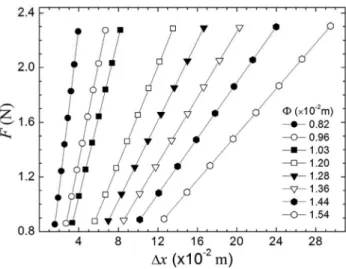
Figure 2 shows the elongation ∆x experienced by the springs when the masses that exerted the external forcesF are suspended at their free end. We highlights that in all figures presented in this paper the error ob-tained in the calculation or in the measurement process are smaller that the point size. A close look shows that the initial value of the applied force is not the same for all springs, but increases as a function of the di-ameter Φ. This is because to the mass m suspended from the free end of the springs the fraction M/3 of the spring’s massM was added; springs having higher diameter Φ have greater mass M (see Table 1). This issue was done to graphically highlight the correction to the spring massM/3, defined in Eq. (3), which be-comes more noticeable as the spring diameter increases. The above procedure does not alter the slopes of the lines shown in Fig. 2, and allows seeing the effect of the correction in order to take into account the spring’s mass. It can clearly be observed in Fig. 2 that the slopes of the straight lines that determine the elonga-tion ∆xproduced by the applied forceFincrease as the spring diameter Φ decreases. This result implies that the spring’s elastic constant, defined ask =F/∆x, is greatest for springs with smaller diameters Φ.
Figure 2 - Applied forceF as a function of the spring elongation ∆xtaking as a parameter the spring diameter Φ.
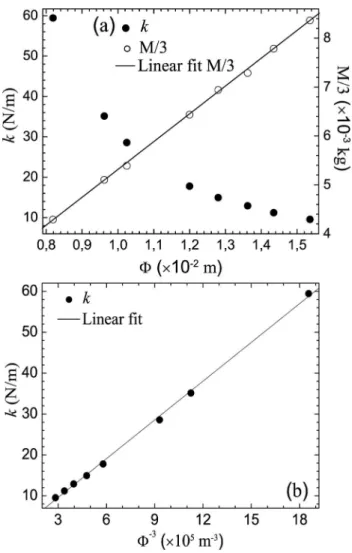
Figure 3a shows the variation of the elastic constant
(which corresponds to a linear correlation coefficient of adjustment of 0.99), indicates that the results obtained fit perfectly with that established by Eq. (1).
Figure 3 - Variation of the spring’s elastic constantk(filled cir-cles) and the effective spring massM/3 (empty circles) as a func-tion of the spring diameter Φ (a), and linear fit between the spring’s elastic constantkand Φ−3(b).
The functional relationship between the spring’s elastic constant k and the spring diameter Φ is given by
k= 3.16×10−
5
Φ3 , (6)
where the quantity 3.16×10⁻⁵corresponds to the
con-stant value Gd4/
8N defined in Eq. (1), which in-volves the diameterdof the wire with which the spring was manufactured, the number of coils N, and the shear modulus G. Taking into account that 3.16 ×
10−5=Gd4/8N and substituting the values of d and
N, a value of G = 72×109 N/m2 is found for the
shear modulus. This result is slightly lower than the shear modulus reported in the literature for steel [13], where G = 79×109 N/m2. We believe that this
dif-ference is due to the fact that the value of G found in our paper was obtained from a series of springs in
which the diameter Φ varied, whereas the value of G
reported in the literature is for a straight wire. In the springs’ design, a relationship known as spring indexC
is defined, which is given by C = Φ/d. Depending on this value, a series of second-order approximations in the calculation of the elastic constant is generated, as shown in previous theoretical studies with regard to the shear modulus G[14]. In our case, the spring indexes areC= 10.1 andC= 18.9 for the spring of lowest and highest diameter Φ respectively. These values of the spring index C suggest that as the diameter becomes smaller, the higher-order terms in the calculation of the elastic constant may have more influence on the oscil-latory behavior of the system.
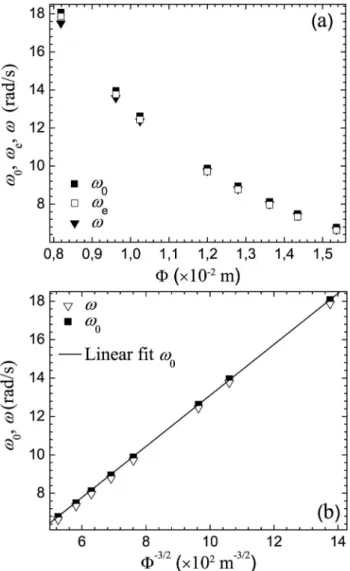
Figure 4a shows a comparison in the behavior of the angular frequencies ω, ω0 and ωe as a function of the spring diameter Φ. Theω value was calculated by re-placing the periodT in the expressionω= 2π/T, while
ω0 was calculated by means of Eq. (2). Theωe value was determined through Eq. (3), in which the correc-tion to the spring massM/3 was performed. In all cases the oscillations were induced by suspending a constant mass m= 0.182 kg and applying an initial amplitude ofA0= 1.5×10⁻²m. The results clearly show that the
frequencies ω, ω0 and ωe are greatest for small values of the spring diameter Φ and decrease as Φ increases. This behavior is in complete agreement with the anal-ysis performed in Fig. 3, since if the spring diameter Φ decreases, then the value of its elastic constant k will be greater. As established by Eqs. (2), (3) and (5) the frequenciesω,ω0 andωeare highest for the greatestk,
i.e. for springs with small diameter Φ.
Another important issue that can be seen in Fig. 4a is that the values of the frequencies are not equal, since
ω0 > ωe > ω. This behavior is due to the fact that the ω0 value corresponds to the frequency determined
in the absence of retarding forces, while the frequency
ωe includes the spring mass correction M/3. On the other hand, ω corresponds to a real physical system that experiences damped oscillations and compressive forces that tend to keep the spring coils together, an effect that is greater as the spring’s diameter becomes smaller [15]. The fit shown in Fig. 4b shows the lin-ear relationship between the angular frequencyω0and
Φ−3/2, with a linear correlation coefficient of
adjust-ment of 0.99. The functional relationship between the variables in Fig. 4b is given by
ω0=
0.013 Φ3/2 =
B
Φ3/2, (7)
where by the substitution of Eq. (1) into Eq. (2) it is found thatB =√
Gd4/8 Nm. Taking the value of the
shear modulusG= 72×109N/m2previously calculated
and replacing the values d, N and m in Eq. (7), it is obtained that B =√Gd4/8 Nm = 0.0132, giving us a
Figure 4 - Comparison of the behavior of the angular frequencies
ω,ω0 and ωe as function of the spring diameter Φ (a). Note the linear fit between the natural frequencyω0 and Φ−3/2 and
an apparent linear relationship between the angular frequencyω
and Φ−3/2 (empty triangles), which is not correct according to
Eq. (5) (b).
In Fig. 4b, the angular frequency ω as function of the spring diameter Φ−3/2 is also shown, and it is
possible to think that an apparent linear relationship between the variables ω and Φ−3/2 exists. However,
we recall that ω is a value determined experimentally from measurements of periodT of the oscillations, and thereforeωimplicitly has the effect of damping. Conse-quently, in agreement with that established by Eq. (5),
ω cannot be in a linear dependence with Φ−3/2.
The oscillatory dynamic of the spring-mass system addressed in this paper corresponds to a real physi-cal system, where the amplitude of the oscillations de-creases gradually and disappears after a certain inter-val of time. Consequently, there is a damped harmonic motion around an equilibrium position with decreas-ing amplitude, in which the action of non-conservative forces leads to the dissipation of energy into the medium in which the system is immersed. Figure 5a shows the damping experienced by the spring-mass system with
the highest value ofγ,i.e.for the spring with the small-est diameter Φ. Also, the envelope of the oscillatory curve is shown, which corresponds to the exponential factor defined in Eq. (4), from which the value γ1 is
obtained. For the springs with other diameters, only the envelope of the oscillatory curve is shown. In all cases, the experimental points, obtained by measuring the force F as a function of the time t, were fit ac-cording to the theoretical prediction given by Eq. (4), relating the valuesγi (i = 1, ...,8) to the Φ values or-ganized from smallest to largest diameter, according to the data summarized in Table 1. The results show that for the system built with the spring of the smallest di-ameter, which has the highest damping factorγ1, the
amplitude of the oscillations decreases rapidly in a time oft≈300 s, while the systems built with springs with
lower damping factorsγirequire a much longer time for the oscillatory motion to vanish.
Figure 5 - AmplitudeAof the oscillations as a function of time
tfor the spring with smallest diameter Φ and the highest damp-ing factorγ1. For the other springs, only the envelope of the oscillations is shown and the damping factorγi (i = 1, ...,8) is indicated, which corresponds to the springs arranged from the smallest to largest diameter (a). Amplification of the amplitude
Figure 5b shows an amplification of the oscillations shown in Fig. 5a for the spring with the smallest diam-eter Φ (i.e. the system with the largestγ). The black points in the oscillation correspond to the experimental values and the solid curve to the theoretical fit obtained by means of Eq. (4). An analysis of the results shows a correspondence of 99.9% between the experimental data fit with respect to the values obtained theoreti-cally by using Eq. (4). It is found that the amplitude
A of the oscillations (in meters) decreases in time ac-cording to the relationship
A= (1.5×10⁻²)e−γit2 , (8)
where the quantityA0 = 1.5×10⁻² m corresponds to
the initial amplitude provided to the spring-mass sys-tem to induce the oscillations.
Figure 6 shows the variation of the damping factor
γas a function of the spring diameter Φ. Note that the damping factorγ given by Eq. (8) is greater for small values of the springs’ diameter and decreases as Φ in-creases. This can be explained by taking into account that the springs with smaller diameter Φ have a larger elastic constantk, and therefore have higher damping factors γ. It is important to clarify that the spring constant is independent of the damping factor, because if, for example, we take the same spring-mass system and make the mass oscillate in two different media, two different values for the damping constant γ would be obtained, but the spring constant would be the same. The results obtained show that the spring’s diameter considerably influences the behavior of thek,ω,and γ variables of the simple harmonic motion. Note that these variables decrease as the spring’s diameter Φ in-creases, as shown in Figs. 3, 4 and 5, in accordance with predictions that can be made from Eqs. (1), (2), (3), (4) and (5). An issue to note in Fig. 6 is that at first glance there is an apparent linear relationship be-tween the damping factorγand the spring diameter Φ. However we believe that not is appropriate to make this generalization, because the obtained correlation coeffi-cient of the linear adjustment is 0.86 which is far form the ideal value.
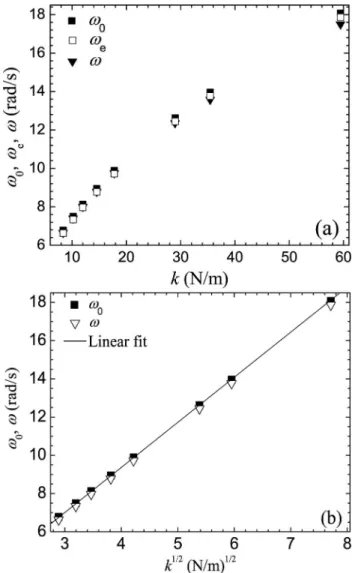
Figure 7a shows the behavior of the angular frequen-cies ω, ω0, andωe as a function of the spring’s elastic constant k. Observe that the frequencies increase as thekvalue increases (or likewise as Φ decreases), as is established by Eqs. (2), (3) and (5). Again we empha-size that the differences in the values of the frequencies (ω0 > ωe > ω) are becauseω0 corresponds to the
nat-ural frequency, whileωe includes the correction to the spring mass M/3 and ω corresponds to a damped os-cillation under the effect of dissipative forces.
Figure 6 - Variation of the damping factorγ of the oscillations as a function of the spring’s diameter Φ.
Figure 7 - Behavior of the angular frequenciesω,ω0 andωe as a function of the spring’s elastic constantk(a). The linear fit between the natural frequency ω0 and k1/2 (full squares) and an apparent linear relationship between the angular frequency
The linear fit shown in Fig. 7b shows that the nat-ural frequency ω0 is directly proportional to
√
k (full squares), as is established by Eq. (2). The linear corre-lation coefficient of adjustment is 0.99, and allows one to determine that the functional relationship between the variables is given by
ω0= 2.34 √
k, (9)
where the value 2.34 = 1/√m. Replacing the mass
m = 0.182 kg, suspended from the free end of the spring, we obtain a value of 1/√m= 2.344, giving us a difference of 0.2% as compared with the result ob-tained in Eq (9). It is important to note, in Fig. 7b, that it gives the impression that there exists a linear relationship between the angular frequency ω and √k
(empty triangles); nevertheless this interpretation is not correct, since in agreement with Eq. (5) the angular frequencyωmust involve the termγ2/
4, which is asso-ciated with the damping of the system.
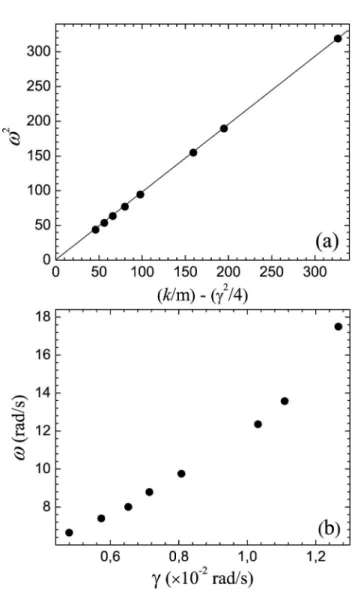
Figure 8a shows the graphical representation of Eq. (5), i.e. the behavior of ω2 as a function of
(k/m)−(γ2/4), which is plotted taking into
consid-eration the experimental values of ω, k and γ. Note that the functional relationship between the variables is linear, with slope 0.99 and intercept 0.9. These re-sults are very close to those established by Eq. (5), where the slope and intercept are equal to 1 and 0, re-spectively. The small differences between experimental and theoretical values may be due to measurement un-certainties or to the influence of small effects that have not been taken into account in Eq. (5), such as the compression effects on the spring’s coils [16]. It is im-portant to note that theω,k, andγvariables shown in Fig. 8a have all been determined experimentally, and show a linear correlation coefficient of adjustment be-tween them of 0.99. Figure 8b shows that the value of the angular frequency ω increases as the damping fac-tor γ increases. This behavior is due to the fact that the springs that have a higher damping factor have a higher elastic constant k, and therefore oscillate with higher angular frequency. This result can be corrobo-rated taking into account that the values of the springs’ elastic constantkcorrespond to powers of 101, while the values of the damping factorγcorrespond to powers of 10−2. This proves that in our experiment the quantity;
(k/m)>>(γ2/
4), and therefore Eq. (5) is always ful-filled taking positive values of the angular frequencyω.
5.
Conclusions
The experimental study of simple harmonic motion of a spring-mass system shows that the principal physical variables that characterize the oscillations, such ask,ω,
ω0,ωe, andγ, are strongly influenced by the spring’s di-ameter Φ. The results obtained indicate that decreases in the spring’s diameter Φ lead to increases in the
elas-tic constantk, the angular frequencyω and the damp-ing factor γ. The experiment is also very instructive for comparing the results of different models for finding the angular frequencies of the spring-mass oscillator, which involve the massless spring ideal approximation, a spring mass correctionM/3, and the damping of the oscillations. This experiment, which uses low-cost ma-terials, can be utilized so that through graphical anal-ysis students can find a great variety of functional re-lationships between the variables that characterize the simple harmonic motion of a spring-mass system, mak-ing it an excellent practice or project for physics labo-ratory courses at the undergraduate level. One sugges-tion for carrying out this experiment is to use plastic springs such as are used in book binding, since they are available in a wide variety of diameters. Also, similar studies for other oscillating systems can be carried out.
References
[1] A.P. French, Vibrations and Waves (Norton, New York, 1964).
[2] S.Y. Mak, Am. J. Phys.55, 994 (1987).
[3] F.W. Sears, Am. J. Phys.37, 645 (1969).
[4] J.M. Bowen, Am. J. Phys.50, 1145 (1982).
[5] F.A. McDonald, Am. J. Phys.48, 189 (1980).
[6] P. Ferreira e J.P. Rino, Revista Brasileira de Ensino de F´ısica28, 195 (2006).
[7] C.A. Triana and F. Fajardo, Eur. J. Phys. 33, 219 (2012).
[8] J.E. Shigley and C.R. Mischke,Mechanical Engineer-ing Design (McGraw-Hill, New York, 1989), 5th ed.
[9] T.W. Edwards and R.A. Hultsch, Am. J. Phys.40, 445 (1972).
[10] R. Resnick, D. Halliday and K.S. Krane, Physics for Students in Science and Engineering(New York:Wiley, 1992).
[11] M. Leclerc, Am. J. Phys.55, 178 (1987).
[12] S.F. Crawford, Waves, Berkeley Physics Series (New York: McGraw-Hill, 1968), v. 3.
[13] H. Eskandari, Mater. Des.24, 143 (2003).
[14] P. Mohazzabi and J.P. McCrickard, Am. J. Phys. 57, 639 (1989).
[15] P. Froehle, Phys. Teach.37, 369 (1999).