Fernandina old Wall of Lisbon – Characterization towards its
preservation
Leandro Gomes1, Paulina Faria2, Vitor Silva1, António Santos Silva3
(1) Dept. of Civil Engineering, Faculty of Sciences and Technology – NOVA University of Lisbon, [email protected]; [email protected]
(2) CERIS and Dept. of Civil Engineering, Faculty of Sciences and Technology – NOVA University of Lisbon, [email protected]
(3) Dept. of Materials, National Laboratory for Civil Engineering - Lisbon, [email protected]
Abstract
The Fernandina Wall of Lisbon started to be built in 1373 and had an extension of 4.69 km in the old city. This Wall in nowadays completely “emerged” and surrounded by the city. Several interventions mainly performed on old buildings confining with, or including, the Wall have been held in the last years. Nevertheless, so far there is a lack of information on the original materials and the ones applied in the history of interventions. Seven sections of the Wall were inspected, and the constitutive materials extracted from rammed earth, rubble stone and regular stone masonries to be characterized in laboratory. In situ non-destructive testing on two wall sections allowed to preliminary characterize original and more recent materials and start gathering results for a heritage database that will record data relating to the history, properties and performance of materials, aiming supporting future interventions.
Introduction
The historical and architectural Portuguese heritage is composed of several monuments, buildings and other structures that includes the Fernandina Wall, in Lisbon. The Wall construction intended to ensure the defense of the city due to intense and continuous growth because the Moorish Fence could no longer ensure the protection of the historical and commercial parishes that made part of the city in the 14th century. Built during the reign of king D. Fernando, in the second half of the 14th century, the Fernandina Wall construction began in 1373 and its completion was in 1375, although there are some documents that mentions that the full completion was in 1378 [1]. The general and original design of this Wall is composed by what is similar to two large circles that are involving the central circle where Moorish Fence is located [2]. It is composed by 76 towers and 35 entrances, with an extension of 4.69 km, having two main sections:
East, limited between St. George’s Castle and Terreiro do Trigo Street, and West, starting also at the St. George’s Castle and finishing at Misericórdia Street (Figure 1).
Figure 1 – Lisbon’s city plan with Moura Wall in the central area, Fernandina’s Wall outlined [1] and surveyed sections: (1) – Jogo da Pêla Tower, (2) – Santana’s Street building, (3) – Independence Palace, (4) – Gil Vicente’s School, (5) – Rosa Palace, (6) – Bragança Terraces
Residence, and (7) – Corpo Santo Hotel
The Fernandina Wall is nowadays completely “emerged” and surrounded by the city. Defining an area of 101 hectares around the 14th century city, nowadays there are elements of this structure, such as main walls, towers, small towers (in Portuguese known by “cubelos”), entrances and a few small doors (in Portuguese called “postigos”), integrated into conventional buildings, hotels, schools and other infrastructures. Those elements do not have the same material composition. In total and according to Vieira da Silva [1] 86.000 m3 of masonry are estimated in is construction. Its average height is 8 m and the thickness is between 1.75 and 2.00 m, according [2].
Several interventions mainly performed on old buildings confining with, or including, sections of the Wall have been held in the last years. Nevertheless, so far, there is a lack of information on the original materials and the ones applied in the history of interventions.
This paper presents the first results of an experimental campaign performed to overcome this lack in information, with an overview of the sections of the Wall inspected
and where masonry and render mortar samples were extracted, with preliminary results of physical and mechanical in situ non-destructive tests.
Surveyed sections of the Fernandina Wall of Lisbon
Previous studies about the Fernandina´s Wall of Lisbon have not been centred in the materials characterization and on the identification of their building construction techniques. In order to improve this kind of information several sectors of this Wall were inspected, being the description presented in the following sections.
1. Jogo da Pêla Tower
This Tower is one of the few remaining towers that composed this Wall (Figure 2). It is located very closed to Martim Moniz Square (Figure 1 (1)), and on the West section of the Wall. Its transversal dimensions are 6 m x 8 m with a height of 11.30 m. Figure 2 presents an example of the changes occurred in this Tower in last 70 years. In the past, shops and a factory have been installed there. In the last years, the annexed volumes had been demolished and a provisional coverage was placed by the Lisbon city council heritage, that has developed interventions of geological and archaeological nature [3-4] that helped this research.
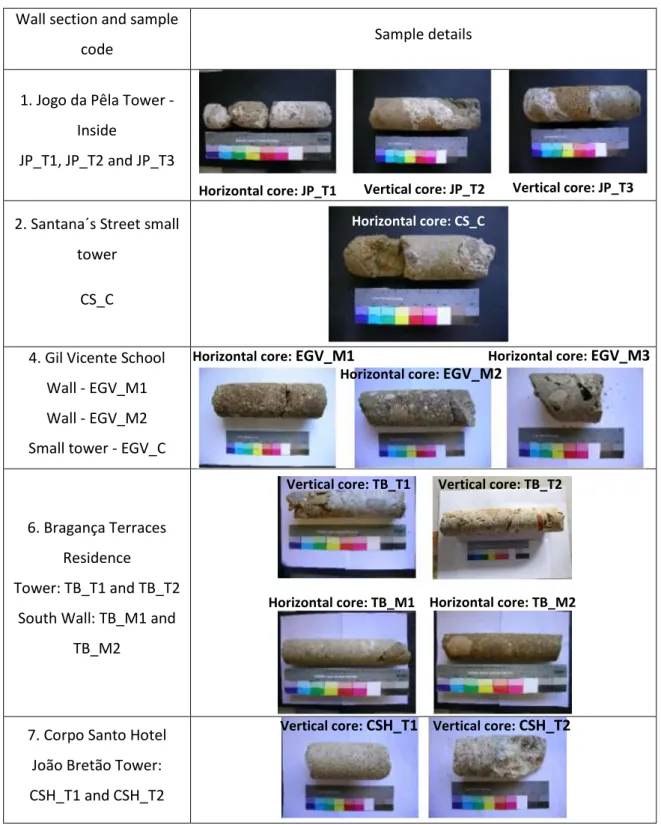
On the top of the Tower there is a void, with about 2.5 m x 3 m, that is rendered, were some samples were extracted horizontally and vertically to know the stratigraphy of this rubble stone masonry. The visual analysis of the core samples extracted (Table 1) revealed that the inner nucleus of the tower is composed by a rubble limestone masonry with a lime mortar with red ceramic aggregates, apart from siliceous sand. Different limestone types could be observed (Table 1).
Table 1 – Samples s extracted from surveyed sites Wall section and sample
code Sample details
1. Jogo da Pêla Tower - Inside
JP_T1, JP_T2 and JP_T3
2. Santana´s Street small tower
CS_C
4. Gil Vicente School Wall - EGV_M1 Wall - EGV_M2 Small tower - EGV_C
6. Bragança Terraces Residence Tower: TB_T1 and TB_T2
South Wall: TB_M1 and TB_M2
7. Corpo Santo Hotel João Bretão Tower: CSH_T1 and CSH_T2
Horizontal core: JP_T1 Vertical core: JP_T2 Vertical core: JP_T3 Horizontal core: CS_C
Horizontal core: EGV_M1
Horizontal core: EGV_M2
Horizontal core: EGV_M3
Vertical core: TB_T1 Vertical core: TB_T2
Horizontal core: TB_M1 Horizontal core: TB_M2
2. Tower at Santana’s Street Building
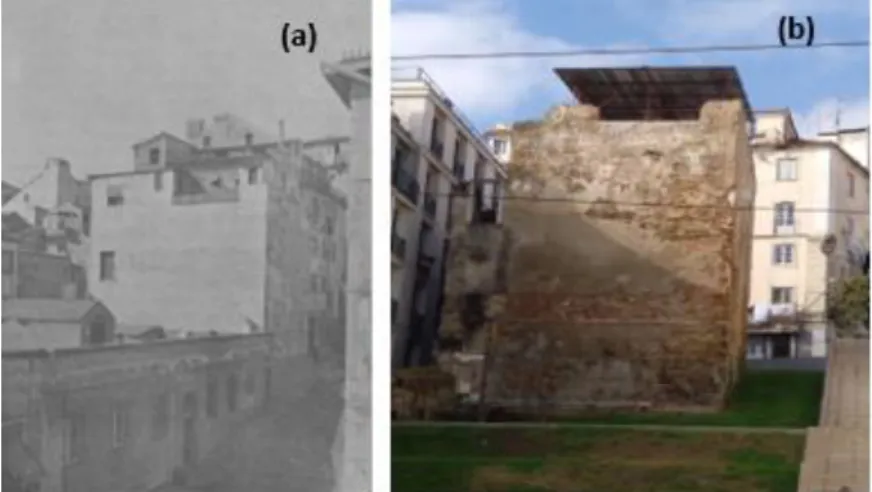
This tower is located inside a building at Santana’s Street 131-137 (Figures 1 (2) and 3). It is a small tower named “Norte do Mosteiro da Encarnação”, which is part of the West section of the Wall, with dimensions of 8 m x 8 m and a height of about 11 m.
Figure 3 – (a) Santana’s Street in 1949 [1] and (b) wall masonry of the tower inside the building
The tower façade visible in the building (Figure 3 (b)) was built in rubble stone masonry and has regular stone masonry in the visible corner. A horizontal sample core was extracted at a height corresponding to the first floor of the building (Table 1).
The sample observation confirms the use of rubble stone technique. There is an intervention going on, with supervision of the Municipality, on the only private apartment with access to the top of the small tower.
3. Independence Palace
This Palace is classified as a national Portuguese monument and is located at São Domingos Square (Figure 1 (3)) very closed to the popular Rossio Square. Presently, it is the headquarters of Historical Society of the Independence of Portugal. In the back part of the palace there is a garden and a section of the Fernandina Wall with around 20 meters long (Figure 4). This wall section have been subjected to intensive weathering exposure and to several interventions, such as a staircase on its top and the repair with different mortars - Figure 4. Although it was not possible to extract any core sample from this section, the façade that is visible seems to be a rubble limestone masonry.
Figure 4 – Wall section at the north of Independence Palace garden: (a) general view and (b) detail of the wall
4. Gil Vicente’s school
The walls of the garden of Gil Vicente´s School presents one of the most protected and preserved sections of the Fernandina Wall, with a well preserved section of about 50 m, with small towers and large walls. Sited on the eastern section of the Fernandina Wall (Figure 1 (4)), it was the only surveyed site visited in the East section. The building techniques used includes stone masonry, mainly in the small towers base and corners, as well as rammed earth in other areas of the small towers (Figure 5 (a)) and on a Wall section that could be observed (Figure 5 (b)). It was possible to induce that the rammed earth was air lime stabilized because white friable nodules could be easily observed on the rammed earth surface, dispersed within the earthen matrix. The stabilization of rammed earth with air lime was a common technique on Portuguese defensive structures like castles and fortresses [5]. The rammed earth section presented a very eroded render with lack of cohesion that was falling, exposing the rammed earth technique (Figure 5 (b)).
Figure 5 – Gil Vicente’s School: (a) small tower with stone masonry corners and rammed earth and (b) rammed earth section of the Wall
Two samples were extracted, one from the wall and another from the small tower. The observation of these samples confirms that they are built with rammed earth technique. Also, an intervention held in 2016 [6] in the construction of a car parking in the opposite side of this Wall section confirms this technique.
5. Rosa Palace
This palace is located at the beginning of the western section of the Fernandina Wall, very closed to the St. George Castle (Figure 1 (5)). In this section it is possible to find some different construction characteristics, including the foundations on geological substrate and a tunnel excavated inside of the Wall. Figure 6 (a) shows a section of the Wall and Figure 6 (b) the palace façade facing south. Due to the masonry characteristics (a rubble stone masonry) it was not possible to extract core samples from Rosa Palace. The palace, with a very impressive area, will soon be transform into a historical hotel.
Figure 6 – Rosa Palace: (a) Wall section and (b) south façade of the palace 6. Bragança Terrace Residences
These residences belongs to an apartment complex designed by the famous Portuguese architect Siza Vieira, located in the old city centre of Lisbon, very closed to Cais do Sodré Square (Figure 1 (6)). This complex built in 2003 in the surrounding area of the old fortress, has one of the best places to see sections of the Wall in two distinct structures: main walls (Figure 7 (a)) and one tower called “Conde Vimioso Tower” (Figure 7 (c)). The tower presents a base where the ground foundation is being exposed. The upper levels of the Tower present stone masonry. The Wall sector facing west is long (more than 20 m) and could not be accessed due to a building that is being retrofitted in its back. The Wall sector facing south (with about 10 m long) presents lack of cohesion, significant thickness lacunae (Figure 7 (b)), efflorescence’s and biological development. This is partially covered by the new buildings, being always in the shadow, and since the last couple of years it seems to have the rear surface waterproofed by construction works that have been performed in the adjacent building. Therefore, the microclimate of the Wall section has completely changed, being this part very damaged nowadays. There is also a low high remain of the Wall exposed to east and west with more than 10 m long. After the conclusion of the construction of this apartments complex, a replica of an original Wall sector was made following the continuity of the east-west exposed wall and the original plan of the Fernandina´s Wall, with more than 10 m long, using hydrated air lime-stabilized rammed earth technique [7] (Figure 7 (d)), and being also covered by the building. Two core samples were extracted vertically from the top of the tower and another two from the Wall sector facing south (Table 1). The tower seems to be mainly filled with rubble stone, including ceramic fragments and different types of limestones,
namely Lisbon’s Miocene fossiliferous limestone. The wall samples observation confirmed that it was built with rammed earth technique.
Figure 7 – Fernandina Wall in Bragança Terraces Residence: (a) rammed earth wall section facing West showing the holes of the originally used formwork; (b) rammed earth wall section exposed to south but presently under a building; (c) part of the tower with stone masonry; (d)
remains of an old Wall section and its replica 7. Corpo Santo Hotel
According to Vieira da Silva [2], this part of the city is lacking in studies about the Fernandina Wall. Nevertheless, when Corpo Santo Hotel start being built, an archaeological and restoration campaign was performed and important data was collected [8-9], having the Hotel won an international prize for this preservation. This part of the Wall was built to protect attacks from pirate ships entering the Tagus river (Figure 1 (7)). Nowadays, the hotel offers a large room where remains of the João Bretão Tower and a section of the adjacent Wall are visible (Figure 8). Two core samples were extracted from the top of João Bretão Tower. These samples allowed to observe the top layers of the rubble stone masonry walls of the tower.
In situ testing methods
During the sampling campaign it was possible to perform some in situ testing in Jogo da Pêla Tower and in Bragança Terraces Residence.
Pendular sclerometer test
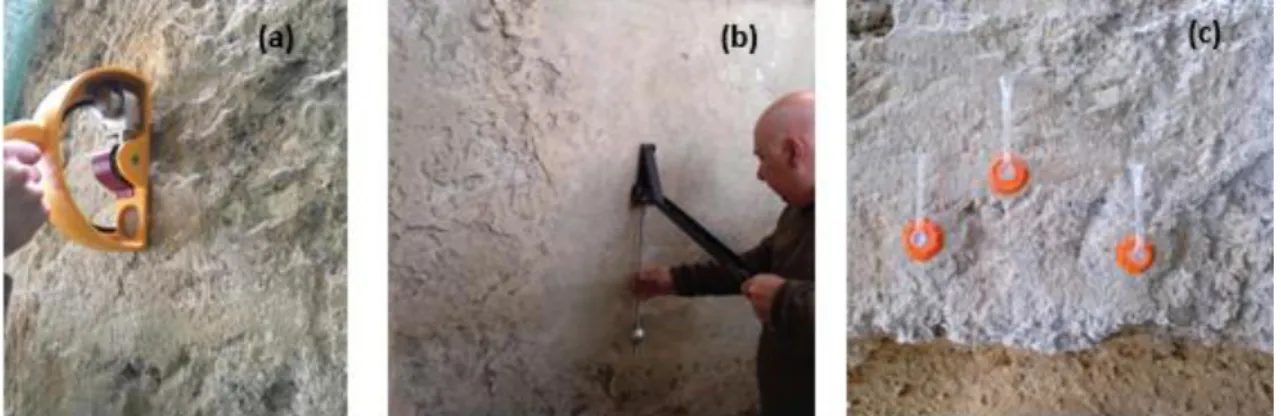
Pendular sclerometer was carried out according ASTM C805-08 standard [10]. This test consists on the register of a directly measured rebound value that pendulum causes in a contact with a vertical surface (Figure 9 (a)). To do this type of testing the equipment should be vertical and with a stable and firm position to be dropped through a spring producing an impact in the wall [11].
Martinet Baronnie – Sphere impact test
This test uses the Martinet Baronnie apparatus [12]. Consists on the application of a steel sphere with 50 mm of diameter causing an impact with the energy of 3 Joules [13].This impact resistance is evaluated by measuring the diameter caused in the surface that is being considered and if there is cracking or not (Figure 9 (b)).
Karsten tubes – Water absorption test
The water absorption test under low pressure was performed based on EN 16302 standard [14] specific for cultural property materials, with Karsten graduated tubes with a scale of 0 to 4 ml of water capacity [11] (Figure 9 (c)).
Figure 9 – In situ tests: (a) Pendular sclerometer in Bragança Terraces Residence wall section facing south; (b) Sphere impact test at a wall facing East inside Jogo da Pela Tower and (c)
Karsten tubes test at a wall section facing East at Bragança Terraces Residence
A defined area of water contacts with the test surface by the application of a waterproof plasticine. The water volume absorbed during short intervals of time is registered; in the
present case, up to 30 min or when all the 4 ml were absorbed due to the type of porous materials in presence. Results are expressed by absorption curves [14].
Results and discussion
Surface hardness by pendular sclerometer
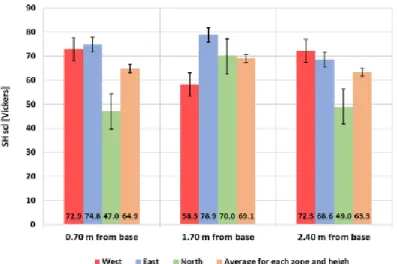
Figure 10 presents the pendular sclerometer results for the different analysed zones of the West, East and North walls of Jogo da Pêla Tower, and in Figure 11 the same for theEast exposed Wall section base and replica in Bragança Terraces Residence, south exposed Wall section base, upper level and recently sample with render.
Figure 10 - Pendular sclerometer results in Jogo da Pêla Tower
The surface hardness values in Jogo da Pêla Tower revealed different trends, depending on the render zone tested, being the average values between 63-69 Vickers (Figure 10). For Bragança Terraces Residence, it can be observed that surface hardness of both original and replica of the East Wall section are quite similar - 56 Vickers. The same for base and upper level of South Wall section, with 70-73 Vickers, presenting the recently rendered sample a lower value (56 Vickers), inducing compatibility with the original Wall (Figure 11).
Although the Jogo da Pêla Tower sections were rendered rubble stone masonry, results are not significantly different from rammed earth wall sections of Bragança Terraces Residence. The results presented by [12] applied on earth plasters reveals average values between 35-45 Vickers.
Sphere impact
The values of diameter of the concavity resulting from the sphere impact test, using the Martinet-Baronnie equipment, can be observed in Figure 12. At Bragança Terraces Residence it was only possible to test the lime-stabilized rammed earth replica, 20 cm and 60 cm from the ground, obtained 14.6 mm and 13.8 mm respectively. These values, unlike to the results presented by [12], that reveals larger diameters, between 18-21 mm, and lower mechanical resistance. In [13] Veiga et al. analysed by the same methods the surface hardness of two panels of different renders and obtained a sphere impact diameter of 15 mm and 12 mm for hydraulic lime and white cement, respectively.
Water permeability under low pressure
Water absorption under low pressure by Karsten tubes was performed on two zones of the North and East walls of the interior hole in the Jogo da Pêla Tower. Zero absorption was registered after the 30 minutes test period, showing that the existing plaster blocked the waster ingress. There is no data on the plaster formulation, application or eventual surface treatment; therefore, it was not possible to justify this behaviour. Results for the water absorption are presented in Figure 13 for two different surfaces in Bragança Terraces Residence: south exposed original rammed earth wall and replica.
Figure 13 – Water absorption by three Karsten tubes at Bragança Terraces Residence: (a) south exposed rammed earth wall; (b) rammed earth replica
In both cases of Figure 13 two tubes register a low absorption with time and one tube a much faster absorption. There were no visible cracks but, in both cases, eventual microcracking may justify the behaviour of one of the tubes absorptions. For the other two tubes, the water absorption of the replica was faster in comparison with the original rammed earth wall (Figure 13). Presently it is not known if the original rammed earth is lime stabilized and with which lime content; but the stabilization of the replica rammed earth seems to be high. Therefore, the faster water absorption of the replica may be justified by that lime stabilization that interrupts the clay lamella connections. Therefore, clay lamella seems to be more efficient on blocking the water migration in comparison to a lime stabilization of the rammed earth. Another possible reason for the slow absorption rate in the original rammed earth is that it may be partially saturated, due to rising water migration, the humid environment (under the building and without direct sunlight and with a waterproofing membrane located in their back. Tubes b and c for the old Wall section (Figure 13 (a)) revealed that the water absorption only started after a 6 or more minutes compared to similar tubes on the replica (Figure 13 (b). The results in Figure 13 (a) could have been improved and made as in [15] which the water
capillarity coefficient obtained for earth rammed material was performed during more time.
Conclusions
The inspection campaign made on several sections of the Fernandina´s Wall of Lisbon have shown their different compositions, environments, exposure, maintenance and interventions carried on and needed. Fortunately, all those cases are being followed by experienced professionals of Lisbon Municipality and Portuguese Cultural Directorate what is a very good prognostic for the future. Furthermore, most of the private owners have now conscience of the cultural significance of the sections they are “guardians” and seem to be receptive to adequate interventions. This was very perceptible in the cases of the hotels (existent and in project), the private building with their small tower and the apartments complex. The later seems to be one of the most significant remains of rammed earth sections of the Wall and needing intervention soon. Public cases may have more problems for maintenance because of lack of financial support, such as the school and the Independence palace.
The in situ tests performed in the different sites proved to be rather adequate, being easy and quick to interpret, despite not having results for various materials in all visited sites the results obtained shows consistent values for the analysed material. The work will carry on with further in situ testing analysis and the chemical/mineralogical and physical testing on the extracted samples. These analyses can identify the components and the characteristics of original and more recent materials, such as mortars and stone masonry, and eventually help to localize their origin, preparation and application techniques. The gathered survey, namely of degradation of original and recent materials, and its causes, is expected to be useful to support decisions on future interventions, namely on the definition of repair mortars that need to be compatible and assure efficient conservation of sections that are being accessible of the old wall. The data will soon be available in DB-Heritage project database [16].
Acknowledgments
The authors wish to thank Manuela Leitão from Lisbon Municipality for all the support and fruitful informations, to Luís Almeida and Nuno Garcia for their collaboration in carrying out of the samples extraction. Acknowledgments are also due to Centro de Arqueologia de Lisboa, Direção Geral do Património Cultural and the owners for the
possibility of inspecting and testing each surveyed section. The authors are very grateful to the DB-HERITAGE project (ref. PTDC/EPH-PAT/4684/2014) which supports this research.
References
[1] Oliveira E (1887) Elementos para a História do Município de Lisboa. Câmara Municipal de Lisboa, Lisboa
[2] Vieira da Silva A (1987) A Cerca Fernandina de Lisboa. Publicações Culturais da Câmara de Lisboa, Lisboa
[3] Leitão, M (2014) As muralhas de Lisboa. Gabinete de Estudos Olisiponenses DMC/DPC/CML. Rossio – Estudos de Lisboa Nº 3
[4] Brito, R (1998) Contribuição geológica para a recuperação da Torre do Jogo da Pêla (Muralha Fernandina de Lisboa). MSc Thesis, FC, Universidade de Lisboa
[5] Cotrim Coradinho M (2018), Castelo de Paderne – Caracterização histórica e material. MSc thesis, FCT, Universidade NOVA de Lisboa.
[6] Oliveira J, Manso C (2018) Intervenção Arqueológica – Parque de Estacionamento da Graça. Arqueologia e Património
[7] Varandas J (2004) Terraços de Bragança: Construção em taipa de réplica da muralha fernandina de Lisboa. Pedra & Cal 24, pp. 26
[8] Pedrosa F (2015) A torre de João Bretão na muralha Fernandina de Lisboa. Arquivo Municipal de Lisboa. Um acervo para a história II.
[9] Rocha A (2015) A Muralha de D. Dinis e a Cidade de Lisboa. Fragmentos arqueológicos e evolução histórica. Lisboa: Museu do Dinheiro/Banco de Portugal
[10] ASTM C805 (2008) Standard test method for rebound hammer of hardened concrete. ASTM Standards: United States
[11] Faria P, Silva V, Jamu N, Dias I, Gomes I (2013) Evaluation of air lime and clayish earth mortars for earthen wall renders. Vernacular Heritage and Earthen
ArchitectureContributions for Sustainable Development, CRC Press/Taylor & Francis Group, pp. 407-413
[12] Santos T, Faria P, Silva V (2019) Can an earth plaster be efficient when applied on different masonries? Journal of Building Engineering 23. pp. 314-323
[13] Veiga M, Velosa A, Magalhães A (2009) Experimental applications of mortars with pozzolanic additions: Characterization and performance evaluation. Constructions and Building Materials 23, pp. 318-327
[14] EN 16302 (2013) Conservation of Cultural heritage – Test methods: Measurement of water absorption by pipe method, CEN: Brussels
[15] Faria P, Rocha M, Silva V, Pereira C (2012) The monitoring of rammed earth experimental walls and characterization of rammed earth samples. RESTAPIA 2012 – International Conference on Rammed Earth Conservation. Taylor & Francis Group, London, pp. 91-97
[16] http://dbheritage.lnec.pt/
GOMES L., FARIA P., SILVA V., SANTOS SILVA A. (2019), Fernandina old Wall of Lisbon – Characterization towards its preservation. HMC2019 - 5th Historic Mortars Conference, 19-21 June 2019, Pamplona. RILEM Proceeedings PRO 130, José Ignacio Álvarez, José María Fernández, Íñigo Navarro, Adrián Durán, Rafael Sirera (Eds.), ISBN:
978-2-35158-221-3, e-ISBN: 978-2-35158-222-0, 681-694.
![Figure 1 – Lisbon’s city plan with Moura Wall in the central area, Fernandina’s Wall outlined [1]](https://thumb-eu.123doks.com/thumbv2/123dok_br/19281571.987689/2.892.125.769.194.628/figure-lisbon-moura-wall-central-fernandina-wall-outlined.webp)