DOI: http://dx.doi.org/10.1590/1980-5373-MR-2017-0329
Birefringence, Photo luminous, Optical Limiting and Third Order Nonlinear Optical
Properties of Glycinium Phosphite (GlP) Single Crystal: A potential Semi Organic Crystal
for Laser and Photonics Applications
Rajesh Krishnana*, Mani Ayyanarb, Anandan Kasinathana, Praveen Kumarb
Received: March 30, 2017; Revised: October 14, 2017; Accepted: November 23, 2017
Glycinium Phosphite (GlP) has been synthesized and characterized successfully. The fluorescence
spectrum of the compound showed one broad peak at 282 nm. Linear absorption value was calculated by Optical Limiting method. Birefringence study was carried out and the birefringence of the crystal is found to be depending on the wavelength in the entire visible region. Third order nonlinear optical property of the crystal was carried out by Z-Scan technique and non linear refractive index and third order susceptibility was calculated. Thermal stability of the crystal was found using TG and DTA thermal analyzer and the results shows that the crystals have good thermal stability. The crystal was also analyzed by photo conductivity analyzer to determine the optical conductivity of the crystal.
Keywords: Optical Limiting, Thermal, Z-Scan, Photo luminous, birefringence.
*e-mail: [email protected]
1. Introduction
Extensive research have been carried out on organic Nonlinear optical materials for laser applications1-3,
frequency doubling services4, opto-electronics and fiber optic
communications5, optical information and optical data storage
devices6. Due to the presence of π - π bonds in the organic
materials provides an excellent nonlinear optical property, which intern satisfies the needs of the above mentioned technological applications. A large number of materials have been found to exhibit laser induced refractive index changes such as fullerenes, liquid crystals, and organic materials and their derivatives. Among organic materials, Amino acids and their derivatives have recently attracted much attention due to their high tendency to crystallize in asymmetric structure and for their synthetic flexibility that can offer the modification of nonlinear properties. The nonlinear optical properties of this type of materials can be improved by following suitable synthetic procedures to design molecules with delocalize π electrons, donor-accepter-donor and acceptor-donor-acceptor properties7-9. Semi organic materials plays and major role
in many potential NLO applications instead of organic materials. The NLO properties and optical limiting behaviors of semi organic materials are enhanced by combining the organics with the inorganic. From the various classes of organic compounds, Glycine based material plays a major role in the optoelectronics and photonics applications. Many Glycine derivative organic materials exhibit interesting NLO efficiency10,11. Under the perturbation of the external
electric field this conjugation of π-electron was affected by electron donor and acceptor group, which results the higher
rate of NLO property. Glycine is the simplest amino acid; it forms many useful new compounds with other organic as well as inorganic materials. Glycine Phosphite is one of the interesting semi organic materials in glycine derivative series. The structure of Glycine Phosphite was reported by Averbuch-Pouchot12. In our previous publication on
the GlP crystal we reported the electrical and mechanical properties of the material13. are In the present research, we
are focusing on various optical properties of the crystal such as photoconductivity, birefringence, photo luminous, optical limiting and third order NLO efficiency of the crystal for the first time. Thermal behaviors and thermal stability of crystal also discussed in this work.
2. Experimental
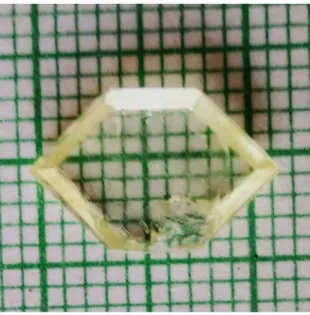
Single crystals of GlP were grown from aqueous solution by employing slow solvent evaporation technique. The source materials taken in equimolar ratio; calculated parent compounds were dissolved in double distilled water and mixed well using a magnetic stirrer continuously for 9 hours. Then the purified saturated solution was allowed to evaporate at room temperature. Synthesized salt was purified by adopting the repeated recrystallization method. The successfully recrystalized salt was further used for growing bulk crystal. Good optical quality crystal was harvested in a period of 27 days. The solubility of GlP is found to be high in aqueous solution than the other organic polar solvents; hence distilled water was selected to grow good quality crystals. The Photograph of as grown crystal of GlP is given in the figure 1.
3. Result and Discussions
3.1 Single crystal X-ray diffraction study
Single crystal X-ray diffraction analysis was carried out on GlP single crystal for finding the cell parameters
and crystal structure of glycinium Phosphite crystal using Enraf Nonius CAD-4/MACH 3 diffractometer, with MoKα radiation. The glycinium Phosphite crystal is crystallize in monoclinic crystal system with the space group P21. The lattice parameters are a = 9.619 Å; b = 8.467 Å; c = 7.621 Å, α = γ and β= 100.11. Cell parameters and space group of the grown crystal found from single XRD are in good agreement with the reported value12.
3.2 Birefringence study
Birefringence analysis is precise technique to find the optical perfection and optical homogeneity in crystals14 phase
matching angles are also can be found using birefringence15.
Since, optical perfection is important characteristics of a material for which, it can be used in optoelectronics devices. The birefringence values have been calculated by finding absolute fringe orders using the relation:
Where, λ is wave length, t is the thickness of the crystal and K is the order of fringe. Figure 2 shows the variation of birefringence with the wavelength and it shows that the birefringence values are lies in between 0.028 to 0.084 in the wavelength ranging from 241 nm to 710 nm. The slight variation in birefringence over a wide range of wavelength indicates that the crystal is suitable material for second and third harmonic generation device fabrication16. The
obtained birefringence values were found to be positive integer and it is increase with increasing wavelength, which illustrated the grown GlP crystal possess positive dispersion
of birefringence17. A minimum dispersion in birefringence
can be the key factor in frequency conversion process such as second and third harmonic generations18.
Figure 1. Photograph of GLP crystal.
n
K
t
m
D
=
Figure 2. Plot of Birefringence verses Wavelength.
3.3 Photo Luminous (PL) Study
Photoluminescence (PL) is the phenomenon in which electronic states of solids are excited by light of particular energy and the excitation energy is released as light. The photon energies reflect the variety of energy states that are present in these materials. The PL spectra were recorded using a Fluoromax‐4 spectrofluorometer. The fluorescence spectrum of GlP crystal is shown in figure 3. It shows that
there is a strong emission peak at 282 nm, it due to the shift of Phosphite ions from their excited state to ground state. It can be noted that the emission line at 282 nm shows a strong and broad bandwidth with the FWHM of 28 nm. The maximum value of full width half maximum is an additional beneficial to the development of tunable or ultrafast lasers19
3.4 Optical Limiting
The increase in the usage of low power lasers in various applications needs for the design of optical limiters with high efficiency20. Linear optical absorption of the crystal was examined
in the air atmosphere at room temperature (~28 ºC) by optical limiting experiment. Well cut and polished surface of the crystal is subjected to light, and the focal length is about 8 cm.
The low intense laser light form the laser source is subjected to the sample and the output power was measured. A power meter detector is used to monitor the input and measure the output power of laser. This process is repeated for several input powers and the corresponding outputs readings were recorded. A graph is drawn between input and output power and is shown in figure 4. By finding the output power, focal length and power output of the laser source linear absorption was calculated. The linear absorption of the GlP crystal was calculated to be 3.21 J/cm-1.
3.5 Thermal Analysis
Phosphite (GlP) Single Crystal: A potential Semi Organic Crystal for Laser and Photonics Applications
Figure 3. Emission spectrum of GLP.
Figure 4. Optical Limiting Plot.
(DTA) by using NETZSCH STA 409 CCD from 25°C to 600°C as heating rate of 20 °C/min in a nitrogen atmosphere. Figure 5 illustrates the changes in TG and DTA curve of GLP crystal. The DTA curve implies that the crystal undergoes an endothermic transition of two significant peaks at 154°C and 337 °C, where the material begins to melt. The first peak of endothermic represents the temperature at which the melting terminates which corresponds to its melting point. The TG curve of this crystal indicates that the material is stable upto to 341°C and above this temperature the weight loss is not due to self degradation of GlP but merely its evaporation after its melting. The sharpness of the endothermic peak shows good degree of crystallinity of the grown crystal and thermodynamically stable in all atmospheres at room temperature.
Further, by adopting the Coats-Red fern integral method21, the obtained weight loss data at all temperatures
were used to evaluate the thermal decomposition kinetics such as activation energy (Ea), enthalpy of activation (∆H), entropy of activation (∆S) and Gibb's free energy (∆G*). The calculated values of Ea, A, ∆S, ∆H and ∆G* of the GLP
crystal are presented in Table 1.
Figure 5. TG and DTA Curve of GIP.
Table 1. Kinetic parameters of GlP crystal
S.No Kinetic parameters Values
1. Activation energy Ea[kJ/mol] 54.56
2. Frequency factor A [ks-1] 5.02
3. Entropy of activation ∆S[kJ/mol.k] -68.52 4. Enthalpy of activation ∆H[kJ/mol] 56.21 5. Gibb’s free energy ∆G*[kJ/mol] 14.57
From the calculated data one can noted that the enthalpy of activation is almost equal to activation energy, suggesting that GlP crystal is in condensed phase between 145°C to 340°C. The positive value of ∆G* shows that the reaction involved in the decomposition of GlP is non spontaneous and the decomposition occurred in a single step after the melting point. The thermal and kinetic data present in this study may help to find out new applications based on GlP crystal in the field of quality control, purity analysis,22,23 and
thermal decomposition optimization.
3.6 Third order nonlinear optical measurement
The nonlinear refractive index of the materials was determined by the Z-scan technique24. This technique based
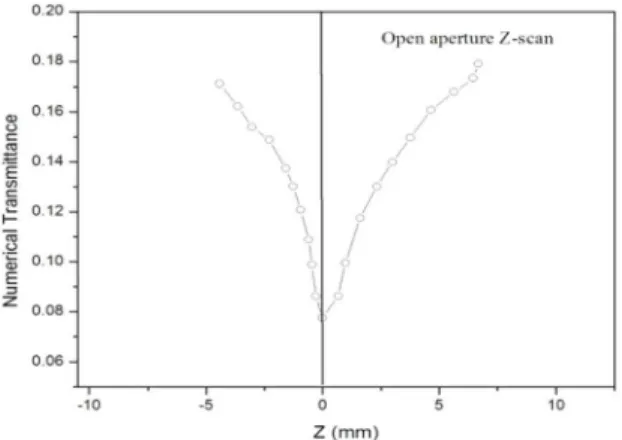
on the fact that the intensity of light changes along the axis of the convex lens and is maximum at the focus. Hence, by moving the sample through the focus, the nonlinear refraction can be estimated by observing the spot size variation at the plane of finite aperture and detector combination. The experiment was done at an air-cooled Ar ion laser beam of 488 nm and 514 nm wavelength with an average power of 10 mW. The laser beam was focused to a beam waist of 20 µm with a lens of 5 cm focal length. The transmission for the samples was measured with aperture and without aperture in the far-field of the lens, as the sample moved through the focal point.
absorption, RSA25. The calculated nonlinear refractive index
and absorption coefficient of GlP crystal are 4.21 × 10⁻⁷cm2/W
and 5.62 × 104 cm/W, respectively. Third order non linear
optical Susceptibility (χ3) was calculated and it take the value of 2.325 × 10⁻⁴ esu.
4. Conclusions
Semi organic Glycinium Phosphite (GlP) single crystal was grown by slow evaporation technique with good optical quality. The crystal crystallizes in monoclinic crystal system. Solubility of the crystal is high in aqueous solution than polar solvents. The minimum dispersion of the birefringence in the visible region suggests that the crystal is suitable for second and third order harmonic generation frequency conversions. Emission spectra shows that there is sharp peak at 282 nm with broad full width half maximum value. This suggests the crystal can be useful in ultrafast lasers. Optical limiter has been used to find out the linear absorption coefficient of the crystal. The linear absorption of the GlP crystal was found to be 3.21 J/cm-1. The crystal is thermally stable upto 341 ºC,
this shows good degree of crystallinity of the grown crystal and it is thermodynamically stable in all atmospheres at room temperature. Activation energy, enthalpy of activation and Gibb's Free energy of the crystal was calculated using the thermal data. It is found that activation energy and enthalpy are almost equal it is due to the condense state of the crystal between 145 ºC to 340 ºC. Gibb's free energy holds the positive value. Second and third order SHG measurement show the crystal is a well suitable material for harmonic generation efficiency operations. The calculated nonlinear refractive index and absorption coefficient of GlP crystal from the z-scan technique are 4.21 × 10⁻⁷cm2/W and 5.62 × 104 cm/W,
respectively. Third order non linear optical Susceptibility (χ3) was calculated and it take the value of 2.325 × 10⁻⁴ esu.
GlP crystal exhibits positive photoconductivity.
5. References
1. Xu D, Xue D. Chemical bond simulation of KADP single-crystal
growth. Journal of Crystal Growth. 2008;310(7-9):1385-1390.
2. Ren X, Xu D, Xue D. Crystal growth of KDP, ADP and KADP. Journal of Crystal Growth. 2008;310(7-9):2005-2009.
3. Xue D, Ratajczak H. Constituent chemical bonds and nonlinear
optical coefficients of Na2SeO4·H2SeO3·H2O molecular crystal. Chemical Physics Letters. 2003;371(5-6):601-607.
4. Anandha Babu G, Perumal Ramasamy R, Ramasamy P, Krishna Kumar V. Synthesis, Crystal Growth, and Characterization of an Organic Nonlinear Optical Donor-π-Acceptor Single Crystal:
2-Amino-5-nitropyridinium-Toluenesulfonate. Crystal Growth & Design. 2009;9(7):3333-3337.
5. Xue D, Zhang S. Chemical bond analysis of the correlation between crystal structure and nonlinear optical properties of complex crystals. Physica B: Condensed Matter. 1999;262(1-2):78-83.
6. Mohan Kumar R, Rajan Babu D, Jayaraman D, Jayavel R, Kitamura K. Studies on the growth aspects of semi-organic
L-alanine acetate: a promising NLO crystal. Journal of Crystal Growth. 2005;275(1-2):e1935-e1939.
Figure 6. Z-Scan Open aperture.
3.7 Photo conductivity study
Photoconductivity property of the GlP crystal was carried out using Keithley 485 picoammeter. The experiment was performed at room temperature. Electrical contacts between parallel plates were made at a spacing of about 0.11 cm on the samples using silver coatings. The Direct Current (DC) input was increased gradually and the corresponding dark currents were measured from the electrometer. The sample was illuminated with a halogen lamp of 100 W powers and the corresponding photocurrent was recorded for the applied voltage. The variations of photocurrent (Ip) and dark current (Id) with applied voltage are shown in Figure 7. Both photo current and dark current of GLP crystal increase linearly with applied field. It is observed from the plot that the dark current is less than photocurrent, thus suggesting that GlP
exhibits positive photoconductivity. In general positive photoconductivity is attributed to generation of mobile charge carriers caused by the absorption of photons26.
Phosphite (GlP) Single Crystal: A potential Semi Organic Crystal for Laser and Photonics Applications
7. Vijayakumar S, Babu M, Kalluraya B, Chandrasekharan K.
Third-order nonlinear optical response of newly synthesized accepter/donor substituted propylidene aryloxy acet hydrazide.
Optik - International Journal for Light and Electron Optics. 2012;123(1):21-25.
8. Serbutoviez C, Bosshard C, Knopfle G, Wyss P, Pretre P, Guenter P, et al. Hydrazone Derivatives, an Efficient Class
of Crystalline Materials for Nonlinear Optics. Chemistry of Materials. 1995;7(6):1198-1206.
9. Albota M, Beljonne D, Brédas JL, Ehrlich JE, Fu JY, Heikal AA, et al. Design of Organic Molecules with Large Two-Photon Absorption Cross Sections. Science. 1998;281(5383):1653-1656.
10. Lenin M, Chandrasekar M, Udhayakumar G. Growth and characterization of nonlinear optical single crystal: Glycine zinc sulfate. International Journal of Chem Tech Research. 2014;6(5):2683-2688.
11. Sivanesan T, Natarajan V, Pandi S. Growth and Characterization of L-Glycine Formate Single Crystal. Asian Journal of Chemistry. 2010;22(6):4229-4233.
12. Averbuch-Pouchot MT. Structures of glycinium phosphite and glycylglycinium phosphite. Acta Crystallographica Section C. 1993;C49:815-818.
13. Rajesh K, Mani A, Praveen Kumar P. Growth and Characterization
of L-Glycinium Phosphate: A Promising Crystal for Opto - Electronics Applications. Mechanics, Material Science & Engineering. 2017;9:73-78.
14. Kar S, Verma S, Bartwal KS. Structural and optical investigations
on Mn doped Li2B4O7 crystals. Crystal Research & Technology. 2009;44(3):305-308.
15. Fischer DW, Ohmer MC, Schunemann PG, Pollak TM. Direct measurement of ZnGeP2 birefringence from 0.66 to 12.2 µm using polarized light interference. Journal of Applied Physics. 1995;77(11):5942-5945.
16. Krishnan P, Gayathri K, Rajakumar PR, Jayaramakrishnan
V, Gunasekaran S, Anbalagan G. Studies on crystal growth,
vibrational, optical, thermal and dielectric properties of new organic nonlinear optical crystal: Bis (2,3-dimethoxy-10-oxostrychnidinium) phthalate nonahydrate single crystal.
Spectrochimica Acta Part A: Molecular and Biomolecular Spectroscopy. 2014;131:114-124.
17. Fork RL, Martinez OE, Gordon JP. Negative dispersion using pairs of prisms. Optics Letters. 1984;9(5):150-152.
18. Yariv A, Yeh P. Optical Waves in Crystals: Propagation and Control of Laser Radiation. New York: Wiley; 1984.
19. Ning K, Zhang Q, Zhang D, Fan J, Sun D, Wang X, et al.
Crystal growth, characterization of NdTaO4: A new promising stoichiometric neodymium laser material. Journal of Crystal Growth. 2014;388:83-86.
20. Dehghani Z, Nadafan M, Saievar Iranizad E. The effect of external applied fields on the third order nonlinear susceptibility
of ferronematics. Journal of Molecular Liquids. 2015;204:70-75.
21. Coats AW, Redfern JP. Kinetic Parameters from Thermogravimetric
Data. Nature. 1964;201(4914):68-69.
22. Giron D. Applications of Thermal Analysis and Coupled Techniques in Pharmaceutical Industry. Journal of Thermal Analysis and Calorimetry. 2002;68(2):335-357.
23. El-Ries MA, Abo-Attia FM, El-Bayoumi A, Eman GS. Thermal
characterization of lefluomide. Insight Pharmaceutical Sciences. 2011;1(2):18-23.
24. Sheik-Bahae M, Said AA, Wei TH, Hagan DJ, Van Stryland EW. Sensitive measurement of optical nonlinearities using a single beam. IEEE Journal of Quantum Electronics. 1990;26(4):760-769.
25. Henari FZ, Patil PS. Nonlinear Optical Properties and Optical Limiting Measurements of {(1Z)-(4-(Dimethylamino)Phenyl) Methylene} 4-Nitrobenzocarboxy Hydrazone Monohydrate under CW Laser Regime. Optics and Photonics Journal. 2012;4(7):182-188.