The Effects of Prognostic Factors in Idiopathic
Sudden Hearing Loss
Suphi Bul
ğ
urcu
1Behçet
Ş
ahin
2Gökhan Akgül
3İ
lker Burak Arslan
3İ
brahim Çukurova
31Department of Otorhinolaryngology, Başkale State Hospital, Başkale, Van, Van 65600, Turkey
2Department of Otorhinolaryngology, Amasya Sabuncuoğlu Şerefeddin Training and Research Hospital, Amasya, Turkey 3Department of Otorhinolaryngology, Tepecik Training and Research
Hospital,İzmir, Turkey
Int Arch Otorhinolaryngol 2018;22:33–37.
Address for correspondence Suphi Bulğurcu, MD, Department of Otorhinolaryngology, Başkale State Hospital, Başkale, Van, Van 65600, Turkey (e-mail: [email protected]).
Introduction
Sudden hearing loss is an otologic emergency with an annual incidence of 5–20 patients per 100,000 individuals. The diagnostic criterion for sudden hearing loss is having a
hearing loss greater than 30 decibels (dB) in 3 consecutive frequencies within 3 days of the onset of the symptom. Studies show that males and females are equally affected, and the average age of the onset is reported to be between 43–53 years. It is also reported that 28–57% of the patients
Keywords
►
sudden hearing loss
►
prognosis
►
time
Abstract
Introduction
Sudden hearing loss is one of the otologic emergencies. The treatment
of this disease is affected negatively by some prognostic factors.
Objective
In this study, the effects of early treatment initiation in patients with
idiopathic sudden hearing loss and of prognostic factors in early treated patients were
investigated.
Methods
Out of the 216 patients admitted between September 2007 and September
2015, 154 were identi
fi
ed as having idiopathic sudden hearing loss; they were
followed-up for a mean time of 7.4 months, and evaluated retrospectively. The effects of several
parameters on the success of the treatment were statistically evaluated, such as the
time the treatment was initiated, being of the female gender, the severity of the
hearing loss, having descending type audiogram patterns, being older than 60 years
old, and the co-presence of vertigo.
Results
Success rates were found to be signi
fi
cantly higher in idiopathic hearing loss
patients that were admitted within the
fi
rst week (p
<
0.05) of the onset of the hearing
loss. However, the outcomes were found to be similar when patients admitted within
the
fi
rst 3 days and 4
–
7 days after the occurrence of the hearing loss were compared
(p
>
0.05). Parameters such as female gender, severe hearing loss, descending type
audiogram, being older than 60 years old, and co-presence of vertigo didn
’
t reveal
statistically signi
fi
cant effects on the outcome (p
>
0.05).
Conclusion
The aforementioned prognostic factors, which are well-known in the
literature, did not have signi
fi
cant effects when the idiopathic sudden hearing loss
treatment was initiated within the
fi
rst 7 days of the onset of the hearing loss.
received
November 9, 2016
accepted
April 1, 2017
published online
May 17, 2017
DOIhttps://doi.org/ 10.1055/s-0037-1603108.
ISSN 1809-9777.
Copyright © 2018 by Thieme Revinter Publicações Ltda, Rio de Janeiro, Brazil
has ear fullness, tinnitus, vertigo of varying severity, and balance disorders.1
In the study by Kuhn et al, the underlying etiologies in 7–45% of the patients were identified. They categorized the causes as autoimmune, vascular, infectious, metabolic, neoplastic, neurologic, otologic, traumatic, toxic, and func-tional. The cases with no identifiable etiology were referred to as idiopathic sudden hearing loss (ISHL). The existing theories regarding the pathophysiology of ISHL include cochlear membrane rupture, vascular events, and viral infections.2
There are no clear treatment recommendations for pa-tients with sudden hearing loss of unidentified etiology in the literature.3On the other hand, several prognostic factors,
including being of the female gender, late treatment initia-tion, the presence of descending type audiogram patterns, the co-presence of vertigo, severe hearing loss, and being older than 60 years old and younger than 15 years old were reported to have negative effects on the recovery process. Full recovery is defined as achieving at least a 25-dB im-provement in pure tone average (average of 500, 1,000, 2,000 and 4,000 Hz), or a return to pre-loss values after treatment. When the improvement is between 10–24 dB, the cases are considered as partial recoveries. An improvement of less than 10 dB is deemed no recovery.4,5
In this study, the association between the time the treat-ment was initiated and the success of it, as well as the effects of the negative prognostic factors, such as being of the female gender, having severe hearing loss, the co-presence of ver-tigo, the presence of descending type audiogram patterns, and advanced age on the outcomes of the patients treated within thefirst week were investigated.
Materials and Methods
A total of 216 patients with sudden hearing loss and showing a loss of at least 30 dB at three consecutive frequencies, admitted between September 2007 and September 2015, were evaluated retrospectively, after obtaining the approval of our local ethics committee. All patients were hospitalized and questioned for any infection symptoms for the past 10 days, trauma history, systemic diseases, neurologic and otologic conditions, and use of any ototoxic medications. All patients underwent contrast magnetic resonance imaging for any possible intracranial pathologies. Blood samples were
collected and analyzed for autoimmune and hematologic conditions, as well as viral infections. Laboratory examina-tions included tests for: full blood count; erythrocyte sedi-mentation rate; prothrombin time; serum glucose, cholesterol, lipids, urea and creatinine concentrations; viral serological tests for Epstein-Barr, rubella, cytomegalovirus, human immunodeficiency, hepatitis B and C; fluorescent treponemal antibody (FTA) test for Treponema pallidum infection; serum thyroid hormones; and antigen-nonspecific serologic tests for autoimmune diseases (nuclear anti-gen [ANA], anti-smooth muscle antibody [ASMA], anti-deox-yribonucleic acid antibody [anti-DNA], and rheumatoid factor [RF]). The patients were followed-up for at least 6 months. No etiology could be identified in 154 of the patients (76 male, 78 female) with an average age of 63.94 years (range: 17–74 years), and they were eventually diag-nosed as having ISHL. The right ear was affected in 89 patients, while 65 had left-sided hearing loss.
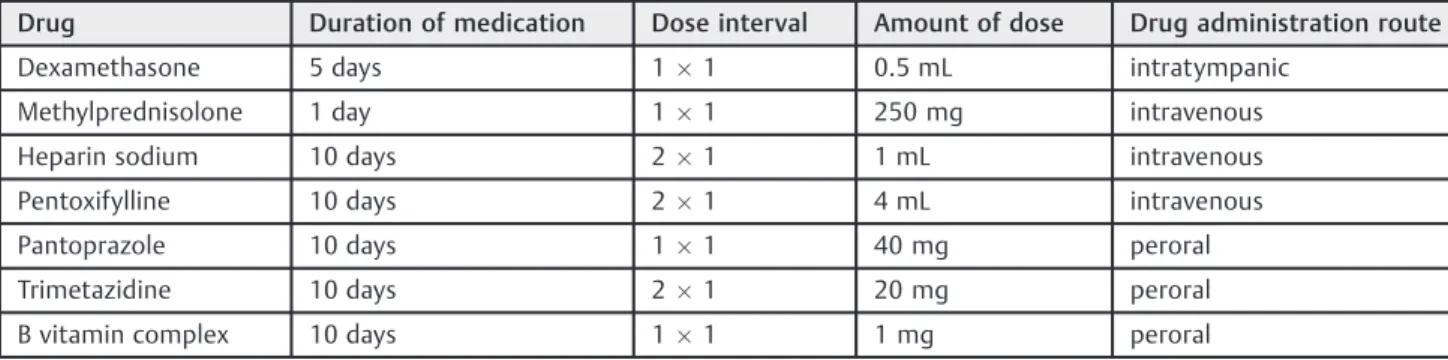
All patients with ISHL were treated according to our department’s standard protocol (►Table 1).
The degree of hearing loss was classified as mild (26–40 dB), moderate (41–55 dB), moderately severe (56–70 dB), severe (71–90 dB) and profound (>90 dB), as
proposed by Shaia and Sheehy.6 Three treatment success
categories were established according to the extent of the recovery. The groups were as follows: full recovery (that is, an improvement of at least a 25-dB in pure tone average, or a return to pre-loss values after treatment), partial recovery (that is, a pure tone average improvement between 10–24 dB) and no recovery (that is, an improvement of less than 10 dB). The patients belonged to one of the four treatment initiation time groups. In the early treatment group, the treatment was initiated within 0–3 days (group 1) and 4–7 days (group 2) after the hearing loss occurred, while the late treatment group consisted of patients whose treatment was initiated between 8–14 days (group 3) and 15–30 days (group 4) after the onset of the hearing loss.
Severe hearing loss was defined as having a loss greater than 70 dB. Four distinct audiogram type groups, namely sloping, ascending, flat, and total, according to Sheehy’s classification, were established.7
In the early treatment group, the effects on the success of the treatment of being female, having severe hearing loss, showing descending type audiogram patterns, and being older than 60 years old were evaluated.
Table 1 Treatment protocol for patients with idiopathic sudden hearing loss
Drug Duration of medication Dose interval Amount of dose Drug administration route
Dexamethasone 5 days 11 0.5 mL intratympanic
Methylprednisolone 1 day 11 250 mg intravenous
Heparin sodium 10 days 21 1 mL intravenous
Pentoxifylline 10 days 21 4 mL intravenous
Pantoprazole 10 days 11 40 mg peroral
Trimetazidine 10 days 21 20 mg peroral
Patients with bilateral sudden hearing loss, describing a loss that had begun more than 30 days prior to their consultations, and those younger than 15 years old were excluded from the study.
A dataset was built using the International Business Machines Statistical Package for the Social Sciences (IBM SPSS, IBM Corp., Armonk, NY, US). Numerical and categorical data were analyzed using the Student’s t- and the chi-square tests where appropriate. Values ofp<0.05 were considered
statistically significant.
Results
A total of 78 females (mean age: 452.7 years) and 76 males
(mean age: 463.4 years) diagnosed as having ISHL were
included in the study. The average time of admission was 6.21 days. Recovery rate, audiogram types and coexistent vertigo were presented according to the treatment initiation time in ►Table 2. Moderate (41–55 dB) and moderately
severe (56–70 dB) hearing losses are the most encountered audiogram types with ISHL (►Table 3).
In 66 patients, the causes of the sensorineural hearing loss were identified as: viral infections (21 patients), sys-temic disease (14 patients), trauma (13 patients), vascular pathologies (6 patients), ototoxicity (3 patients), vestibulo-cochlear nerve compression (2 patients), autoimmune con-ditions (2 patients), and Meniere’s disease (1 patient). Regarding the remaining 154 patients with ISHL, there was a statistically significant association between treat-ment initiation times and recovery degrees, when early and late treatment groups were compared (p¼0.043). The
degrees of recovery were similar between the patients treated at 0–3 days and 4–7 days (p>0.05), and between
the patients treated at 8–14 days and 15–30 days (p>0.05)
(►Table 2). The effects of gender, having a loss greater than
70 dB, being older than 60 years, having descending type audiogram patterns and presence of vertigo in early treated patients were summarized in►Table 4.
Discussion
No etiology can be detected in 70% of patients with
sudden hearing loss, and such cases are eventually identi-fied as ISHL.8 Some of these patients show spontaneous
recovery.9Various treatment protocols are available in the
literature, and steroids have been reported to be the most effective treatment method in general.10,11Chen et al found
that intratympanic steroids were more effective than sys-temic steroids in the treatment of sudden hearing loss.12
Ding et al reported that the first choice in the treatment of ISHL should be systemic steroids.13 However, Arastou
et al reported that the co-administration of systemic and intratympanic steroids was more effective in sudden hear-ing loss.14We prefer to administer systemic and
intratym-panic steroids together.
On the other hand, different protocols reveal different recovery rates. In concordance with ourfindings, the most important issue in the treatment is reported to be the early initiation.15 In the study by Lee et al, 289 sudden hearing
loss cases were evaluated, and the recovery rates were found to be of 73.8% when the treatment was initiated within 3 days, and of 87.2% when it was initiated within 7 days of the onset of the hearing loss.16Uysal et al studied
96 ISHL patients and reported better recovery rates when the treatment began within thefirst week.17Similarly, Cho
et al. found significantly higher recovery rates (88%) in patients who were treated within thefirst 3 days.18
Contra-dicting results are also present in the literature.19 In the Table 2 Recovery rate, audiogram types and coexistent vertigo presented according to the treatment initiation time
Treatment initiation time (days)/N
Mean age Gender (F/M)
Recovery rate Complete/Partial/No
Audiogram types S/A/F/T
Coexistent vertigo
0–3 (group 1) 43.71 31/30 13/18/30 50/2/5/4 39
4–7 (group 2) 48.46 30/30 16/18/26 34/5/11/10 28
8–15 (group 3) 46.37 13/11 2/7/15 6/1/8/9 9
15–30 (group 4) 49.1 4/5 0/2/7 2/0/2/5 2
Abbreviations: F, female; M, male.
Note: Audiogram types: Sloping (S), ascending (A),flat (F), and total (T).
Table 3 Relationship between recovery rates with treatment initiation time and degree of hearing loss
Treatment initiation time (days)/N
Mild C/P/N Moderate C/P/N Moderately severe C/P/N
Severe C/P/N Profound C/P/N
0–3 (group 1) 2/0/0 1/4/6 2/4/7 5/6/8 3/4/9
4–7 (group 2) 2/2/1 3/4/6 3/1/6 6/7/5 2/4/8
8–15 (group 3) 0/0/3 1/2/2 0/2/2 1/3/6 0/0/2
15–30 (group 4) 0/0/0 0/1/1 0/1/2 0/0/3 0/0/1
present work, which was conducted with 154 ISHL patients, treatment success rates were significantly higher when the treatment was initiated within thefirst week.
Some authors suggest that being of the female gender is a negative factor for the success of the treatment. However, several contradicting reports indicating no differences be-tween genders are also present.4,16,20,21We also did not
find
any significant association between gender and treatment success.
There is a strong negative correlation between age and prognosis. A great deal of studies report that prognosis is significantly better in patients younger than 60 years of age.2,20–22 Although 75% of the patients that achieved full
recovery were under the age of 60, no statistical significance could be obtained. On the other hand, several studies failed to show an association between age and prognosis.23,24
Severe hearing loss is indicative of serious cochlear da-mage, and leads to poorer treatment success rates. Milder cases are reported to attain better treatment results.16,21,22
However, in our study, 55% of the patients with full recovery and 58% of the patients with partial recovery had a loss greater than 70 dB. This may partially be due to the fact that patients with severe hearing loss were admitted to the hospital earlier.
The patients in our study presented four audiogram types, namely descending, ascending,flat and total loss. The des-cending type was present in 54% of our cases. Various prevalence data are available regarding the audiogram types in sudden hearing loss patients.15However, it is observed
that the cases showing descending type audiograms have the poorest treatment success rates. Chang et al stated that a significant association could be made between the
audiogram types and the treatment success rates.21,25But,
in our study, we did not detect any association between audiogram types and treatment success.
Inflammatory response in specific cochlear areas may extend beyond the barriers in the anterior labyrinthine region, and may reach the vestibule and semicircular chan-nels, consequently triggering vestibular symptoms, in addi-tion to sudden hearing loss. The co-presence of vertigo is shown to worsen the treatment outcomes in sudden hearing loss cases.26,27We also found lower success rates in patients
with accompanying vertigo without statistical significance.
Conclusion
In the present study, we decided that, in ISHL patients, when the treatment was initiated within thefirst 7 days of the onset of the hearing loss, the recovery rate was increased. We also found that the effect of other prognostic factors was less significant in the cases of early treatment. Further studies about early treatment in ISHL might con-tribute to our study.
Conflicts of Interest
The authors have no conflicts of interest to disclose.
Reference
1 Rauch SD. Intratympanic steroids for sensorineural hearing loss.
Otolaryngol Clin North Am 2004;37(05):1061–1074
2 Kuhn M, Heman-Ackah SE, Shaikh JA, Roehm PC. Sudden sensor-ineural hearing loss: a review of diagnosis, treatment, and prog-nosis. Trends Amplif 2011;15(03):91–105
Table 4 Effects of gender, having a hearing loss greater than 70 dB, being older than 60 years, having descending type audiogram patterns, and co-presence of vertigo in the early treated patients
Full Recovery Partial Recovery No Recovery
p p p
Gender 0.831 0.691 1.0
Female 14 19 28
Male 15 17 28
Hearing loss 0.837 0.949 0.295
>70 dB 16 21 30
70 dB 13 15 26
Age 0.746 0.001 0.001
>60 years old 7 0 25
60 years old 22 36 31
Audiogram type 0.184 0.001 0.004
Sloping 23 31 30
Others 6 5 26
Vertigo 0.192 0.708 0.143
Presence 13 19 35
3 Baloğlu O, Olgun G, Saraç S. İdiyopatik ani sensörinöral işitme
kaybıtedavisi. Hacettepe Tıp Dergisi 2007;38:26–32
4 Xenellis J, Karapatsas I, Papadimitriou N, et al. Idiopathic sudden
sensorineural hearing loss: prognostic factors. J Laryngol Otol 2006;120(09):718–724
5 Byl FM Jr. Sudden hearing loss: eight years’experience and sug-gested prognostic table. Laryngoscope 1984;94(5 Pt 1):647–661
6 Shaia FT, Sheehy JL. Sudden sensori-neural hearing impairment: a report of 1,220 cases. Laryngoscope 1976;86(03):389–398
7 Sheehy JL. Vasodilator therapy in sensory-neural hearing loss.
Laryngoscope 1960;70:885–914
8 Chau JK, Lin JR, Atashband S, Irvine RA, Westerberg BD.
Systematic review of the evidence for the etiology of adult sudden sensorineural hearing loss. Laryngoscope 2010;120(05): 1011–1021
9 Mattox DE, Simmons FB. Natural history of sudden sensorineural
hearing loss. Ann Otol Rhinol Laryngol 1977;86(4 Pt 1):463–480
10 Tsai HT, Hsueh N, Huang CM, Lin HC. Intratympanic steroid injection as afirst-line therapy in uremia patients with sudden sensorineural hearing loss. Acta Otolaryngol 2015;135(08): 786–790
11 Eftekharian A, Amizadeh M. Pulse steroid therapy in idiopathic
sudden sensorineural hearing loss: A randomized controlled clinical trial. Laryngoscope 2016;126(01):150–155
12 Chen P, Wang S, Zhang Y, Huang H, Zhang C, Xiao Z. [Intratympanic
versus systemic steroid initial treatment for idiopathic sudden hearing loss: a Meta-analysis]. Lin Chung Er Bi Yan Hou Tou Jing Wai Ke Za Zhi 2015;29(22):1970–1977
13 Ding XY, Cui TT, Feng GD, Gao ZQ. [Intratympanic versus systemic
steroid treatment for idiopathic sudden hearing loss: a meta-analysis]. Zhonghua Er Bi Yan Hou Tou Jing Wai Ke Za Zhi 2013; 48(05):412–416
14 Arastou S, Tajedini A, Borghei P. Combined intratympanic and systemic steroid therapy for poor-prognosis sudden sensori-neural hearing loss. Iran J Otorhinolaryngol 2013;25(70):23–28
15 Lloyd SK. Sudden sensorineural hearing loss: early diagnosis
improves outcome. Br J Gen Pract 2013;63(613):e592–e594
16 Lee HS, Lee YJ, Kang BS, Lee BD, Lee JS. A clinical analysis of sudden
sensorineural hearing loss cases. Korean J Audiol 2014;18(02): 69–75
17 UysalİÖ, Müderris T, Polat K, Yüce S, Gültürk S. Is the time from
the onset to the treatment a prognostic indicator for hearing recovery in idiopathic sudden sensorineural hearing loss? Kulak Burun Bogaz Ihtis Derg 2015;25(02):70–76
18 Cho CS, Choi YJ. Prognostic factors in sudden sensorineural hearing loss: a retrospective study using interaction effects. Rev Bras Otorrinolaringol (Engl Ed) 2013;79(04):466–470
19 Siegel LG. The treatment of idiopathic sudden sensorineural hearing loss. Otolaryngol Clin North Am 1975;8(02):467–473
20 Edizer DT, Çelebi Ö, Hamit B, Baki A, Yiğit Ö. Recovery of Idiopathic
Sudden Sensorineural Hearing Loss. J Int Adv Otol 2015;11(02): 122–126
21 Chang NC, Ho KY, Kuo WR. Audiometric patterns and prognosis in
sudden sensorineural hearing loss in southern Taiwan. Otolar-yngol Head Neck Surg 2005;133(06):916–922
22 Harada H, KatoT. Prognosis for sudden sensorineural hearing loss:
a retrospective study using logistical regression analysis. Int Tinnitus J 2005;11(02):115–118
23 Zadeh MH, Storper IS, Spitzer JB. Diagnosis and treatment of
sudden-onset sensorineural hearing loss: a study of 51 patients. Otolaryngol Head Neck Surg 2003;128(01):92–98
24 Mamak A, Yilmaz S, Cansiz H, Inci E, Güçlü E, Dereköylü L. A study
of prognostic factors in sudden hearing loss. Ear Nose Throat J 2005;84(10):641–644
25 CvorovićL, Deric D, Probst R, Hegemann S. Prognostic model for
predicting hearing recovery in idiopathic sudden sensorineural hearing loss. Otol Neurotol 2008;29(04):464–469
26 Bogaz EA, Maranhão AS, Inoue DP, Suzuki FA, Penido NdeO. Variables with prognostic value in the onset of idiopathic sudden sensorineural hearing loss. Rev Bras Otorrinolaringol (Engl Ed) 2015;81(05):520–526
27 Ceylan A, Celenk F, Kemaloğlu YK, Bayazit YA, Göksu N, Ozbilen S.