ANALYSIS OF THE PRENATAL CARE IN CUIABÁ-MATO GROSSO ACCORDING TO SISPRENATAL DATA ANÁLISE DA ATENÇÃO PRÉ-NATAL NO MUNICÍPIO DE CUIABÁ-MATO GROSSO SEGUNDO DADOS DO SISPRENATAL ANÁLISIS DE LA ATENCIÓN PRENATAL EN LA CIUDAD DE CUIABÁ-MATO GROSSO SEGÚN LOS DATOS SISPRENATAL
Áurea Christina de Paula Corrêa1, Rayssa Basilio Arantes2, Aline Pinto de Lima3, Janete Tamami T. Nakagawa4
ABSTRACT
Objective: This study analyzes, in terms of the Prenatal and Birth Humanization Program, the prenatal care offered in
Cuiabá-MT from SISPRENATAL data of the year 2010. Method: Quantitative. The sample consisted on data of 474 pregnant women. Data was collected through the management reports of the Health Regional Office of Baixada Cuiabana. A simple descriptive analysis was conducted on statistics from a database using Epi Info 3.5 software.
Results: There was an early uptake of 75.5% of pregnant women; puerperal visit occurred in 17.1% of pregnant
women.Reduction in the achievement of the core exams from 1st to 2nd routine, 64.6% of pregnant women received the immunizing dose or booster dose of tetanus vaccine. Conclusion: The developed prenatal care has strengths, however, it still presents issues that need to be reviewed aiming to provide a quality prenatal care. Descriptors: Women's Health, Prenatal Care, Information Systems.
RESUMO
Objetivo: Analisar, na perspectiva do Programa de Humanização do Pré-Natal e Nascimento, a assistência ao pré-natal
em Cuiabá-MT a partir dos dados do SISPRENATAL, em 2010. Método: Abordagem quantitativa. População composta por dados relativos a 474 gestantes. Dados coletados através dos relatórios gerenciais do Escritório Regional de Saúde da Baixada Cuiabana. Análise estatística descritiva simples com a utilização do software Epi Info 3.5. Resultados: Captação precoce de 75,5%, das gestantes; consulta puerperal ocorreu em 17,1% das gestantes. Redução na realização dos exames básicos da 1ª para 2ª rotina; 64,6% das gestantes receberam a dose imunizante. Conclusão: Assistência pré-natal desenvolvida tem pontos fortes; ainda apresenta pontos que precisam ser revistos com vistas à prestação de uma assistência pré-natal de qualidade. Descritores: Saúde da Mulher, Cuidado Pré-Natal, Sistemas de Informação.
RESUMEN
Objetivo: Analizar, desde la perspectiva del Programa de Humanización del Prenatal y el Parto, el cuidado prenatal en
Cuiabá-MT a partir de los datos del SISPRENATAL, en 2010. Método: Cuantitativo. La muestra está compuesta por los datos de 474 mujeres embarazadas. Datos fueran recogidos a través de los informes de gestión de la Oficina Regional de Salud de la Baixada Cuiabana. Análisis estadístico descriptivo simple utilizando el programa Epi Info 3.5. Resultados: Captación precoz de 75.5% de las mujeres embarazadas; la visita puerperal, se produjo en el 17,1% de las mujeres embarazadas. Reducción en la realización delos exámenes básicos de primero a segundo de rutina, el 64,6% de las mujeres embarazadas recibieron la dosis inmunizante . Conclusión: La atención prenatal presenta fortalezas, aún tiene problemas que necesitan ser revisados con el fin de proporcionar la calidad de la atención prenatal. Descriptores: Salud de la Mujer, Atención Prenatal, Sistemas de Información.
1Teacher at the Nursing School of the Federal University of Mato Grosso; coordinator of the Graduate Program in
Nursing; coordinator of the Argos Project Research Group. Email: [email protected]. 2Nurse; Master's candidate of
the Master's Program in Nursing, FAEN, Federal University of Mato Grosso; member of the Argos/GERAR Project Research Group. Phone: 55-65-92517020; Email: [email protected]. 3Nurse; Master's degree in Nursing from
the Master's Degree Program in Nursing, FAEN, Federal University of Mato Grosso; teacher at the Higher Education School of Amazônia Reunida; member of the Argos/GERAR Project Research Group. Email: [email protected].
3Nurse; PhD in Health Sciences from the Federal University of São Paulo; member of the Argos/GERAR Project Research
Group. Email: [email protected].
Prenatal care (PC) consists in carrying out care practices that aim to detect risk factors for pregnancy and the prevention of maternal death, as well as frequent aggravation during pregnancy and the birth of premature and low birth weight newborns.1 To that end, the main purpose of PC is
to ensure maternal and embryonic/fetal health throughout pregnancy and the birth process.2
In order to qualify and humanize such care, the Ministry of Health (MH) instituted the Program of Humanization of Prenatal and Birth (PHPB), through Ordinance GM/MS No. 569/2000 in 2000. The main objectives were the reduction of maternal and perinatal morbidity and mortality rates and the solution of issues regarding access, coverage and quality of care.3-5 This ordinance was
complemented with the issuance of Ordinance No. 1,067/GM in July 4th, 2005, which established the
National Policy of Obstetric and Neonatal Care (NPONC).6
To achieve the promotion of pregnant women's health and the prevention of diseases during the puerperal period, the PHPB defined the following minimum criteria necessary for qualification of PC, labor and birth: early identification of pregnant women (up to the fourth month of pregnancy); completion of at least six PC follow-up consultations and one in the puerperium (up to 42 days after birth); minimum laboratory tests: ABO/Rh (blood group determination) and hemoglobin/hematocrit (in the first consultation); VDRL (Venereal Disease Research Laboratory) for syphilis, urine I and fasting glucose screening, (being one test conducted in the first consultation and the other near the thirtieth week of pregnancy); testing for HIV (human immunodeficiency virus); deployment of tetanus vaccination; carrying out educational
activities; and classification of gestational risk ensuring attendance or access to the unit of reference for ambulatory and/or hospital care to high-risk pregnancy. In addition, the program established the payment of financial incentives after the registration of the pregnant woman for prenatal completion, as induction strategy and assistance to municipalities for the implementation of the actions proposed by the program.3,7
For the establishment of this program, it was necessary to create a computer system for the management of data collected. It was then created the PHPB Monitoring System, called SisPreNatal. This system generates information concerning aspects of PC management and the monitoring of fulfillment of essential minimum actions contemplated in the program at any level of complexity of the health system, influencing decision-making with regard to the definition of interventions in the process of pregnancy care.5
The feeding of this Health Information System (HIS) should be performed through two data sources: the Registration Certificate of the Pregnant Woman and the Daily Care Record, which are usually filled out by professionals (doctors or nurses) who perform the first and subsequent consultations.8 For care monitoring, the system
provides a set of reports and indicators of results and processes.5
After more than ten years since the creation and establishment of the PHPB and the SisPreNatal, the scientific literature presents some evaluative studies on PC developed in health services of the Brazilian Unified Health System (UHS). The results of these studies show that PC in the UHS achieved advances with the creation of the PHPB, but there are still many obstacles to its implementation in accordance with the advocated
INTRODUCTION
issues, which can be proven by the current high rates of maternal mortality in the country.5,9,8,10-1
According to the MH, the Maternal Mortality Ratio (MMR) in Brazil increased from 52.4 deaths per 100,000 live births (LB) in 2000 to 53.3 deaths per 100,000 live births in 2005, which represents an increase of 1.9% for that period. Data from the MH demonstrate that such increase occurred in several Brazilian regions, being mostly observed in the Midwest region (39.3%).12-3
In the State of Mato Grosso, according to data from the Information System of the State Department of Health, the MMR per 100,000 LB from 2000 to 2009 was 69.38; 38.13; 52.96; 51.95; 63.05; 82.78; 63.99; 67.80; 75.73; and 80.77, respectively.14 With respect to the city of Cuiabá,
specifically, MMr was 62,73/100.000 Lb from 1996 to 2005, noting that the framework does not differ from the Brazilian reality.15
The analysis of such data shows that maternal mortality, at federal and state levels and in the city of Cuiabá, is far beyond the average index of developed countries, which on average today represents 14 deaths per 100,000 LB.16
Prenatal care is essential for the control of maternal morbidity and mortality, which in many occasions change depending on the social, economic and political context of the health care system, and by the cultural and biological reality of women who seek care.17:535-36
This way, considering that the high rates of maternal morbidity and mortality remain a challenge to be overcome in Brazil and also in the city of Cuiabá, and qualified PC can contribute to reducing these rates through the promotion of safe motherhood18, and that other investigations
reviewing the PC from the data of SisPreNatal have not been conducted, we carry out this study in order to analyze, from the perspective of the PHPB, the care offered in the city of Cuiabá (MT), from SisPreNatal 2010 data.
This is a descriptive, documentary and cross-sectional study with a quantitative approach, conducted in the city of Cuiaba, capital of the State of Mato Grosso, using secondary data produced by the SisPreNatal of the city in 2010.
In 2010, 3,310 pregnant women were registered in the SisPreNatal from January 1st to
December 31st. The sample consisted of data
regarding 474 pregnant women registered in the period and with Date of Last Menstrual Period (DLMP) from January 1st to March 31st 2010. The
establishment of this criterion aimed to allow pregnant women of the study to have the opportunity to perform all activities related to prenatal monitoring advocated by the PHPB‒including puerperal consultation that must occur within 42 days after childbirth‒and also to allow time to enter the data into the computer system of SisPreNatal.
For data collection, we used three of the management reports of SisPreNatal, provided by the Regional Health Office (RHO) of Baixada Cuiabana: the Consolidated Statement of Pregnant Women (issued on 02/24/11); the Consolidated Statement of Pregnant Women with follow-up completed; and the Consolidated Statement of Pregnant Woman with follow-up not completed (both issued on 03/04/11). Data collection was carried out through the completion of the data collection instrument.
We performed a simple descriptive and statistical analysis in order to delineate the PC of the city from a database using the Epi Info 3.5 software, which allowed the description of variables determined for this study, according to the minimum criteria established by the PHPB.
For discussion of the results, we referenced to the literature that deals with the theme and the standardization concerning the PHPB. This program regulates the compliance with all requirements for monitoring of pregnant women and those who have recently given birth. This way, Family Health Units (FHU) receive financial incentives so that the care provided is qualified, reflecting the reduction of the maternal mortality rate in the city.
This study was submitted to the Committee of Ethics in Research of the Júlio Muller Hospital University, with final approval No. 880/CEP-HUJM/2011, according to Resolution No. 196/96 of the National Health Council that regulates the development of research involving humans.19
The analysis of data obtained from 474 pregnant women who fit the established criteria revealed that, 55.1% (261) of them were enrolled at the FHUs, 35.4% (168) at Health Centers (HC), and 9.5% (45) at polyclinics of the city.
In most cases, the registration of pregnant women was carried out in primary health care (FHU and HC); secondary care was responsible for the lowest part of the registrations of pregnant women in the study, showing that the organization of access is being done according to the norms established by the PHPN, because pregnant women registrations should be performed preferably during primary care and in case the pregnant woman is considered at high risk, she should be forwarded to ambulatory and hospital care.3 Next, we present Table 1 with data of the
fulfillment of minimum criteria recommended by the PHPN.
Table 1 - Compliance with the minimum criteria for
prenatal care established by the PHPN, according to data from SisPRreNatal. Cuiabá (MT), 2010.
Source: reports from SisPreNatal of Cuiabá (MT), 2010.
With regard to early identification of pregnant women, i.e., the first consultation for registration until the fourth months (120 days) of pregnancy, 75.5% (358) of pregnant women had this criterion met.
The achievement of at least six PC follow-up (pregnant women who had six or more consultations were included) was a requirement achieved by only 31.2% (148) of pregnant women in this study. It is noteworthy that the percentage of pregnant women who held one (14.8) or two (20.7) PC consultations reached 35.5% (168).
The early identification of pregnant women is the first criterion for adequate prenatal follow-up, because it aims at strengthening the adhesion of women to prenatal and diagnosing possible risk factors.9 In addition, for other authors,20 the
number of consultations is linked to the time when the prenatal follow-up started, i.e., the earlier the first contact between the health service and the pregnant woman, the greater number of consultations can be performed, as well as, the service will enhance the capacity to promote the
RESULTS AND DISCUSSION
adhesion of pregnant women to prenatal follow-up.
The information concerning the early identification of pregnant women in the city of Cuiabá shows that this criterion has been largely fulfilled in most registrations performed. This result corroborates the findings of other studies conducted in Brazil‒as in the case of research on quality and equity in care provided to pregnant women in the south of Brazil21and another
research that assessed PC in the city of Garanhuns (PE),20 in which the authors found that 73.5 and
76.5% of pregnant women, respectively, performed the first prenatal consultation up to 120 days of gestation.
However, the data from the city of Cuiabá showed that early identification did not assure the adhesion of pregnant women to prenatal follow-up recommended, because the percentage of one and two consultations was superior to the percentage required by the PHPB, i.e., six or more consultations. This fact represents a problem that may be related to quality of care provided to pregnant women, and that undermines the transfer of financial resources to health units.
The data relating to the minimum laboratory tests carried out show that 22.3% (106) of pregnant women underwent all the laboratory tests recommended by the PHPB. When the set of basic tests of first routine was assessed, the data showed that 49.7% (236) of pregnant women carried out all the tests; however, the data concerning the basic tests of second routine pointed out a reduction in their accomplishment, because only 25.1% (119) were submitted to them. In general, the percentages of the minimum tests were over 50%, and the test more frequently required was urine I in the first routine (64.3%) and the smallest was VDRL 2 in the second routine (27.8%).
Carrying out laboratory tests is considered as an indispensable measure for proper prenatal
follow-up, because complications during pregnancy can be identified and the necessary interventions implemented. In this study, the performance of tests recommended by the PHPB did not even achieve 25% percent of pregnant women. In addition, there was still a significant reduction between the percentage of tests requested in the first consultation, the first battery of tests, and the second battery of tests that should be performed at the 30th week of
pregnancy. This fact shows that the investigation of complications during the pregnancy was not occurring in the manner advocated, mainly with regard to the detection of syphilis.
Previous studies20,22-3 showed similarities
with this study, since low rates of laboratory tests performed have also been identified. As possible explanations for these results, authors point out that tests are not requested by professionals, the difficulty for carrying out the tests and the sub-enrollment of prenatal consultations, mainly in the first consultation, when most of the complementary tests are requested.
With regard to tetanus immunization, it was identified that, among pregnant women registered, 64.6% (306) received the immunizing dose (second dose scheme recommended) or the booster dose (for women previously immunized).
With regard to tetanus vaccination, authors24 highlight the importance of its
deployment during women's gestational period for their immunization and protection of the fetus against maternal and neonatal tetanus. In the city of Cuiabá, immunization falls short of what is required; however, more than 50% of women had records of immunizing doses. These results are more favorable than those found by other authors,8,20 in which the percentages did not
surpassed 33.5 and 46.4%, respectively.
With regard to gestational risk classification, 79.5% (377) of pregnant women were classified at low-risk and 5.3% (25) at
risk, totaling 84.8% (402) with risk classification as required by the PHPB. The other pregnant women (15.2% [72]), did not have this information recorded in the data sheets of SisPreNatal analyzed.
The classification of gestational risk proved satisfactory in the city, because more than 80% of the pregnant women had the risk classification recorded, showing the concern of professionals‒who carry out the PC follow-up of these women‒to identify perinatal risks for timely interventions. However, it is important to note that the data from the reports of the SisPreNatak make it possible to assess compliance (or non-compliance), with the classification of risks, even though they do not provide information as to guarantee that the high-risk pregnant women had access to the unit of reference for ambulatory and/or hospital care.
The puerperal consultation, held primarily up to 42 days after childbirth, is one of the measures of PC quality and a measure that aims to prevent unwanted complications to the binomial mother-child, in order to monitor problems detected during childbirth and facilitate the adhesion of the family and the inclusion of the baby to the health service.25 Given the importance
of this procedure, the results of this study showed that only 17.1% of the pregnant women held the puerperal consultation. This fact was also identified in a study conducted in Quixadá (CE), in which the authors10 reported that the low rates of
puerperal consultations found were related to important registration failures. It is possible that this also happens in Cuiaba, which is a fact that specific studies could prove.
Regarding the MH, the completion of care provided to pregnant women only occurs after the puerperal consultation has been held. This fact determines that the transfer of financial resources related to completion only ocurs after all the
5
Accordingly, the puerperal consultation is a vital criterion in order to complete the follow-up of pregnant women and facilitate the transfer of financial resources.
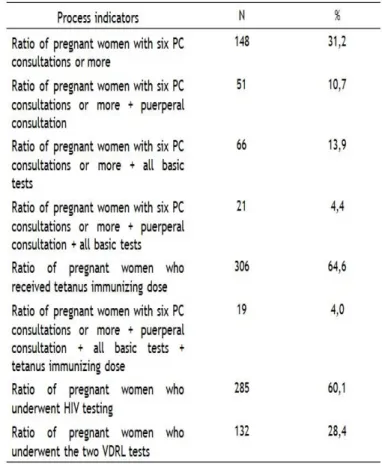
In addition to the minimum criteria, the PHPB also establishes process indicators for the following-up of the actions developed in the health units that provide care to pregnant women and those who have recently given birth. Process indicators of pregnant women that comprised the population of this study are described in Table 2.
Table 2 - Prenatal care process indicators established
by the PHPB. Cuiabá (MT), 2010.
Source: reports from the SisPreNatal of Cuiabá (MT),
2010.
The percentage of pregnant women with the recording of information relating to the achievement of at least six PC consultations was 31.2% (148). When puerperal consultation was included to that indicator, the percentage decreased to 10.7% (51).
The percentage of pregnant women who performed at least six PC consultations and all
association of performing at least six consultations with puerperal consultation.
When the three minimum criteria mentioned above were analyzed together, the percentage decreased significantly, because only 4.4% (21) of pregnant women of this study performed six or more PC consultations, all basic tests, and the puerperal consultation. Regarding tetanus immunization, when appended to the set of minimum criteria, it had an even smaller percentage (4.0%).
Process indicators related to the follow-up of pregnant women of this study showed that the fulfillment of the minimum criteria set did not occur to most of those women and that the low number of puerperal consultations or their records is a factor that contributed significantly to the decrease of these percentages.
A research that assessed PC in Brazil at the beginning of the PHPB7 implantation also found
important percentage reductions when all recommended criteria were analyzed together. This indicates that performing the set of activities is still a big challenge in PC.
Another indicator of the PHPB process consists in the anti-HIV test ratio, isolated from the other minimum recommended tests. Regarding this indicator, we observed a percentage of 60.1% (285), which is above the percentage found in other studies carried out in Brazil, as in the case of the study conducted in the city of Garanhuns (PE), in which the percentage was 26.9% and in Salvador (BA) with an index of 17,6%.20,8
Authors8 reinforce the importance of
conducting this test for women diagnosed as HIV-positive, so that they can receive proper treatment, and thus reduce the risk of mother-to-child transmission. The authors further highlight the responsibility of professionals as advisors for performing the test and the need to increase the provision of tests by health services.
With respect to conducting the two examinations of VDRL recommended (1st and 2nd
routine), a study conducted in the city of Rio Grande (RS) claims that 25.3% of the pregnant women underwent two tests,20 which is a result
that approximates to that found in this study (28.4%). In both studies, the fulfillment of this criterion had the worst rate of achievement in the prenatal period. These results point to the possibility of a serious problem in care provided to pregnant women, since the non-identification of infected pregnant women contributes to the non-implementation of treatment and the consequent impossibility to prevent diseases of the newborn.25
The analysis of compliance with the minimum requirements of the PHPB through the data from SisPreNatal allows evaluating PC in Brazilian municipalities, generating elements that can facilitate the management of care provided to pregnant and puerperal women.
Regarding the city of Cuiabá, the percentages found show that PC performed in health units have strengths, as the early identification of pregnant women and the classification of gestational risks. However, these percentages have also shown results that reveal weaknesses in PC that need to be reviewed, as is the case of the adhesion of pregnant women to consultations, the performance of puerperal consultations, the application of tetanus vaccination and the performance of all the tests recommended.
Taking into consideration that such data faithfully portray what happens in care provided in the city of Cuiaba, its quality is questioned in relation to recommendations by PHPB. Since it is possible that these results do not show the reality of the city, due to the possible existence of operational failures in the SisPreNatal, the need
to invest in the improvement of this information system is evident.
The analysis of the findings of this study leads us to question how information systems are used in the local health system, taking into consideration the good quality of the data and information obtained.
This way, it is evident that there is a need to carry out further research to examine the health care process from other sources, as well as examining the SisPreNatal regarding its quality and relevance to assess PC according to the PHPB.
1. Andrade RB de. A implementação do Programa de Humanização do Pré-natal no município de Duque de Caxias – RJ, na perspectiva dos gestores e profissionais de saúde. [Dissertação]. Rio de Janeiro (RJ): Escola Nacional de Saúde Pública Professor Sergio Arouca, Fundação Oswaldo Cruz; 2005.
2. Amorin MMR, Melo AS de. O. Avaliação dos exames de rotina no pré-natal (Parte 1). Rev Bras Ginecol Obstet. 2009; 31 (3): 148-55.
3. Ministério da Saúde (BR). Portaria 569, de 1º de junho de 2000, instituiu o Programa de Humanização do Pré-Natal e Nascimento (PHPN). Brasília (DF); 2000. [citado em 15 set 2010].
Disponível em:
http://sisprenatal.datasus.gov.br/SISPRENATAL/P ortaria_569_GM.PDF.
4. Ministério da Saúde (BR). Programa de Humanização no Pré-Natal e Nascimento. Rev Bras Saúde Matern. Infant. 2002 jan/abr; 2 (1): 69-71. 5. Serruya SJ. A experiência do Programa de Humanização no Pré-natal e Nascimento (PHPN) do Ministério da Saúde no Brasil [tese]. Campinas (SP): Doutorado em Tocoginecologia, Faculdade de Ciências Médicas, Universidade Estadual de Campinas; 2003.
6. Ministério da Saúde (BR). Portaria nº
Nacional de Atenção Obstétrica e Neonatal. Brasília (DF); 2005. [citado em 11 out 2010].
Disponível em:
http://dtr2001.saude.gov.br/sas/PORTARIAS/Port 2005/GM/GM-1067.htm.
7. Serruya JS, Cecatti JG, Lago TG. O Programa de Humanização no Pré-natal e Nascimento do Ministério da Saúde no Brasil: resultados iniciais. Cad de Saúde Pública 2004 set/out; 20 (5): 1281-289.
8. Nascimento ER do; Paiva MS, Rodrigues QP. Avaliação da cobertura e indicadores do Programa de Humanização do Pré-Natal e Nascimento no município de Salvador, Bahia, Brasil. Rev Bras Saude Matern. Infant. 2007 abr/jun; 7 (2): 191-97. 9. Serruya JS, Lago TG, Cecatti JG. Avaliação preliminar do Programa de Humanização do Pré-natal e Nascimento no Brasil. Rev Bras Ginecol Obstet. 2004; 26 (7); 517-25.
10. Grangeiro GR, Diógenes MAR, Moura ERF. Atenção Pré-Natal no Município de Quixadá-CE segundo indicadores de processo do SISPRENATAL. Rev esc enferm. USP 2008; 42 (1): 105-11.
11. Ministerio da Saúde (BR). Avaliação nacional do Programa de Humanização do Pré-natal e Nascimento. Rev Saúde Pública 2008; 42 (2): 383-87.
12. Ministério da Saúde (BR). Saúde Brasil 2007: uma analise da situação de saúde. Brasília (BR): 2008.
13. Calderon I de MP, Cecatti JG, Veja CEP. Intervenções benéficas no pré-natal para prevenção da mortalidade materna. Rev Bras Ginecol Obstet. 2006; 28 (5): 310-15.
14. Mato Grosso (MT). Secretária de Estado da Saúde. Portal de Serviços e Informações do Estado de Mato Grosso. Indicadores de Saúde. Mato Grosso; 2010. [citado em 11 out 2010] Disponível em:
http://www.saude.mt.gov.br/aplicativo/indicador es/.
15. Vilarinho ES. Mortalidade materna no município de Cuiabá no período de 1996 a 2005 [dissertação]. Cuiabá(MT): Instituto de Saúde Coletiva, Universidade Federal de Mato Grosso; 2008.
16. World Health Organization. Maternal mortality. Report. Fact sheet 2010; [citado 10 jan
2011]. Disponível em:
http://www.who.int/mediacentre/factsheets/fs3 48/en/index.html.
17. Xavier RB, Silva TJES, Ayres LFA, Penna LHG. Enfermeira na assistência a gestante que apresenta alto risco materno e/ou fetal: compreendendo a sua ação no ambulatório de pré-natal. Rev de Pesq: cuidado é fundamental Online 2010 jan/mar; [citado 04 jul 2011]; 2(1): [aprox.
19 telas]. Disponível em:
http://www.seer.unirio.br/index.php/cuidadofun damental/article/view/447.
18. Cunha M de A, Mamede MV, Dotto LMG, Mamede FV. Assistência Pré-Natal: competências essenciais desempenhadas por enfermeiros. Esc
Anna Nery Rev Enferm. 2009 jan/mar; 13 (1):
145-53.
19. Ministério da Saúde (BR). Conselho Nacional de Saúde. Diretrizes e normas regulamentadoras de pesquisas envolvendo seres humanos: Resolução n.° 196 de 10 de outubro de 1996. Brasilia (DF); 1996. [citado em 14 out 2010].
Disponível em:
http://conselho.saude.gov.br/resolucoes/reso_96 .htm.
20. Almeida SMO, Ramos MAC, Melo LP, Leite RMB, Abrão FM da SA. Assistência pré-natal: analisando indicadores segundo critérios do Programa de Humanização do Pré-natal e Nascimento. Rev Enferm UFPE on line [periódico on line]. 2010 out/dez; [citado 21 jan 2011]; 4(4):
[aprox. 8 telas]. Disponível em
http://www.ufpe.br/revistaenfermagem/index.ph p/revista/article/view/1008/pdf_210.
21. Gonçalves CV, Cesar JÁ, Mendoza-Sassi RA. Qualidade e equidade na assistência à gestante: um estudo de base populacional no Sul do Brasil. Cad de Saúde Pública. 2009; 25(11): 2507-516. 22. Trevisan MR, Lorenzi DR de, Araújo NM, Ésber K. Perfil da assistência pré-natal entre usuárias do Sistema Único de Saúde em Caxias do Sul. Rev Bras Ginecol Obstet. 2002; 24 (5): 293-99. 23. Carvalho VCP, Araújo TVB. Adequação da assistência pré-natal em gestantes atendidas em dois hospitais de referência para gravidez de alto risco do Sistema Único de Saúde, na cidade de Recife, Estado de Pernambuco. Rev Bras Saude Matern Infant. 2007 jul/set: 7(3): 309-17.
24. Pitombeira HCS, Teles LMR, Paiva JSP, Rolim MO , Freitas LVF, Damasceno AKC. Assistência pré-natal no contexto da Estratégia de Saúde da Família. Rev Enferm UFPE on line [periódico on line]. 2010 abr/jun; [citado 20 fev 2011]; 4 (1): [aprox. 6 telas]. Disponível em http://www.ufpe.br/revistaenfermagem/index.ph p/revista/article/view/804/pdf_9.
25. Succi RCM, Figueiredo EM, Zanatta LC, Peixe MB, Rossi MB, Vianna LAC. Avaliação da assistência pré-natal em unidades básicas do município de São Paulo. Rev Latinoam Enferm. 2008; 16 (6): 986-92.
Received on: 24/05/2012 Required for review: No Approved on: 17/10/2013 Published on: 01/04/2013