ISCTE Business School and School of Social Sciences and Humanities Department of Economics
Behavioural Water Resource Economics
Behavioural applications to the residential water sector
Ricardo Emanuel Sarmento Correia
Thesis specially presented for the fulfillment of the degree of Doctor in Economics
Supervisor
PhD, Catarina Roseta Palma, Associate Professor
ISCTE-IUL
Co-supervisor
PhD, Henrique Monteiro, Assistant Professor
ISCTE-IUL
ISCTE Business School and School of Social Sciences and Humanities Department of Economics
Behavioural Water Resource Economics
Behavioural applications to the residential water sector
Ricardo Emanuel Sarmento Correia
Thesis specially presented for the fulfillment of the degree of Doctor in Economics
Jury
Doctor Céline Nauges, Senior Research Fellow, French National Institute for Agricultural Research (INRA) and Toulouse School of Economics
Doctor Rui da Cunha Marques, Professor, Instituto Superior Técnico - Universidade de Lisboa
Doctor Rui Ferreira dos Santos, Associate Professor, Faculdade de Ciências e Tecnologia da Universidade Nova de Lisboa
Doctor Rita Martins, Assistant Professor, Faculdade de Economia da Universidade de Coimbra
Doctor Catarina Roseta Palma, Associate Professor, ISCTE-IUL
i
Ao meu Irmão, Miguel Correia, Ao meu marcante Pai À eterna Mulher da minha vida
Financial support of the research project of this thesis
The author acknowledges financial support from FCT Fundação para a Ciên-cia e a Tecnologia (Science and Technology Foundation), projects PTDC/EGE-ECO/114477/2009 and PEst-OE/EGE/UI0315/2011. He also acknowledges the individual scholarship, SFRH/BD/77809/2011 scholarship from FCT.
"Toda a teoria deve ser feita para poder ser posta em prática e toda a prática deve obedecer a uma teoria. Só os espíritos superficiais desligam a teoria da prática, não olhando a que a teoria não é senão uma teoria da prática, e a prática não é senão a prática de uma teoria. Na vida superior a teoria e a prática completam-se. Foram feitas uma para a outra."
Fernando Pessoa
"Não se vai de uma teoria para uma prática, começa-se sempre por uma prática e depois organiza-se uma teoria. Uma teoria que mais ou menos explica essa prática. Também ninguém começou por elaborar uma teologia para justificar um Deus, começou-se por afirmar a existência de Deus e depois elaborou-se a teologia que vai explicá-lo."
José Saramago
"In theory, theory and practice are the same. In practice, they are not."
Albert Einstein
Abstract
Water is a natural resource whose scarcity is very likely to rise in the future (Griffin, 2006), in spite of recent breakthroughs regarding the promotion of economic instruments (European Commission, 2007) and governance principles (OECD, 2015), as well as the declaration of water and sanitation as human rights since 2010 (Albuquerque and Roaf, 2012). Behavioural economics has been on the agenda of European Union policies (Van Bavel et al., 2013), however there is no bridge linking these two fields. This thesis focuses on this unexplored relationship, suggesting behavioural water resource economics.
Firstly, after the general introduction on chapter 1, a literature review is conducted on chapter 2 where four seminal ideas of behavioural economic applications to water management are identified: reference block pricing, asymmetric elasticities, reference transaction, and social comparison using reference consumption.
Chapter 3 contributes to a profile of Portuguese residential water consumers, especially focused on consumer perceptions. Consumers appear to exhibit some misperceptions and low awareness of average price and monthly water consumption, although they exhibit high awareness of their bill.
Chapter 4 continues to explore the effects of consumer perceptions, in this case, on the decision to adopt outdoor and indoor water-saving behaviours, as well as new extensions to modern billing standards, such as direct debit payment and electronic billing. The findings of chapter 3 lead to the study of factors influencing the consumer’s probability to have reference points (for the average water price, monthly water consumption and bill). Overall, the behavioural findings suggest that price (un)fairness plays a role on water choices. Moreover, results show a perceived price fairness (PPF) effect that affects the reference point about water price, a novelty in the literature. Additionally, the factors driving the decision to prefer to drink tap water are analysed. Consumer perception about price fairness seem to influence this choice.
These last evidences lead to the development of a conceptual framework to systematically measure PPF, as a global index, on chapter 5. This study proposes a conceptual model and variables to measure the determinants of PPF: price clarity, distributive fairness, consistent behaviour, price reliability, price honesty, respect and regard for the partner and fair dealing.
Chapter 6 presents a new discrete/continuous model for consumer choice with reference-dependent preferences. The main theoretical results are based on three scenarios of reference points. In the case where the first block is a reference point,
viii
consumers in the second block will suffer a loss effect which will decrease their consumption. When the second block is the reference, the first-block consumers will increase their consumptions influenced by a gain effect. In the last case, when the reference is the average price, "bunching" will occur around the point where block shifts happen.
Finally, chapter 7 discusses the main contributions. Overall, these contributions may be helpful to reshape water management and consequently water policies, through the use of behavioural findings. This work advocates a holistic approach of neoclassical and behavioural theories and further avenues to promote sustainable water consumption are proposed.
JEL Classification: D03, D12, D63, Q25.
Keywords: water management, consumer behaviour, tap water, water-saving
be-haviours, direct debit, electronic billing, perceived consumption, water bill perception, price perception, perceived price fairness, prospect theory, behaviour economics.
Resumo
A água é um recurso natural que se encontra sobre risco de escassez no futuro (Griffin, 2006), apesar dos avanços recentes quer na promoção do uso de instrumentos económicos (European Commission, 2007) e de princípios de governance (OECD, 2015), bem como na declaração da água e do saneamento como direitos humanos desde 2010 (Albuquerque and Roaf, 2012). A economia comportamental tem sido tema central na agenda política da União Europeia (Van Bavel et al., 2013), contudo não existe nenhuma ponte que unifique estas áreas. Esta tese centra-se nesta relação inexplorada sugerindo a economia comportamental aplicada aos recursos hídricos.
Em primeiro lugar, após a introdução geral do capítulo 1, é realizada uma revisão da literatura no capítulo 2 e são identificadas quatro ideias seminais de apli-cações económicas comportamentais na gestão dos recursos hídricos: bloco tarifário de referência, elasticidades assimétricas, transação de referência, e comparação social usando um consumo de referência.
O capítulo 3 contribui para definir um perfil dos consumidores domésticos portugueses de água, especialmente sobre as suas perceções. No geral, conclui-se que os consumidores apresentam algumas perceções que divergem da realidade, tendo reduzido nível de conhecimento sobre o preço médio e o consumo mensal de água percebidos. No entanto, apresentam um elevado nível de conhecimento da sua conta de água mensal (CAM).
O capítulo 4 continua a explorar os efeitos da perceção do consumidor, neste caso, na adoção de comportamentos de poupança de água em usos exteriores e interiores, bem como novas extensões aos hábitos modernos de pagamento, tais como a utilização de débito direto e de fatura eletrónica. Adicionalmente, os fatores que determinam a decisão de beber preferencialmente água da torneira são analisados, sendo que a perceção sobre o preço ser justo parece influenciar moderadamente a escolha de beber água da torneira. As evidências do capítulo 3 fomentaram a análise dos fatores que influenciam a probabilidade do consumidor ter ou não pontos de referência (i.e., preço médio de água, consumo de água mensal e CAM percebidos). As evidências comportamentais sugerem que a (in)justiça de preço percebida afeta os comportamentos analisados, bem como a existência de um efeito de justiça de preço percecionada (JPP) que afeta o ponto de referência relativo ao preço da água e constitui uma novidade na literatura.
Estas últimas evidências incentivaram o desenvolvimento de um quadro concep-tual para medir sistematicamente a JPP, sob a forma de um índice global, de acordo com o capítulo 5. Este estudo propõe um modelo conceptual de JPP e variáveis para
x
medir os seus determinantes, nomeadamente: clareza do preço, justiça distributiva, comportamento consistente, credibilidade do preço, honestidade do preço, respeito e consideração pela contraparte e tratamento justo.
O capítulo 6 apresenta um novo modelo de escolha discreta/contínua com preferências baseadas em referências. Os principais resultados teóricos são baseados em três cenários de pontos de referência. No caso do primeiro bloco como ponto de referência, os consumidores no segundo bloco sofrem um efeito de perda que os fará diminuir os seus consumos. Quando o segundo bloco é a referência, os consumidores do primeiro bloco irão aumentar o seu consumo devido a um efeito de ganho. No último caso, quando a referência é o preço médio baseada nos dois blocos anteriores irá ocorrer uma situação de "concentração" em torno do ponto onde as mudanças de bloco ocorrem.
Finalmente, o capítulo 7 resume as principais contribuições. Esta tese constitui um contributo que poderá ser útil para reformular a gestão dos recursos hídricos, e consequentemente, as políticas públicas de água, através da utilização de evidências comportamentais. Este trabalho advoga uma abordagem holística das teorias neo-clássica e comportamental e propõe novas direções de investigação para promover o consumo sustentável da água.
Classificação JEL: D03, D12, D63, Q25.
Palavras-chave: gestão de recursos hídricos, comportamento do consumidor,
água da torneira, comportamentos de poupança de água, débito direto, fatura eletrónica, consumo de água percebido, perceção da conta de água mensal, perceção de preço, justiça de preço percecionada, prospect theory, economia comportamental.
Acknowledgements
I am indebted (although not financially one, but from the heart) to all for this positive experience, good vibes, all the ups and downs, everything worth it. First, I would like to thank to my two supervisors Catarina Roseta Palma and Henrique Monteiro for all the high standards, and challenges made to accomplish this long journey to cross this Ocean, this PhD Thesis. Professor Henrique for all the patience, high accuracy and critical spirit on his invaluable comments and insights. Professor Catarina for all motivation, challenging me everyday, and support in this lifetime goal, and for being a professor of excellence in the academia, an academic idol. Thank you both for everything.
To all my PhD colleagues, especially to my friends Ricardo Barradas and Marta Silva. Farah Mussa, Patrícia Pinto, Patrícia Lourenço, Raquel Soeiro for helpful insights, discussions and revisions (although you might have found even more errors, besides the ones you found it, but thank you for all the patience). Margarida dos Reis Vale, Sandra Batalha, Sara Ruela, Ana Clemente, Catarina Neto Lopes, Sandra Nóbrega, Tiago Barros, Carlos Ferreira, Cristiano Canelas, André Martins, Daniel Sanches and João André for all the support and positive inspiration. As well as all my other friends and my family. Sharing Boa Energia with everyone.
,-I would like to acknowledge insightful comments and help from professors Ana Costa, João Leão, Emanuel Gasteiger, José Dias Curto, José Gonçalves Dias for helpful discussion and ideas, in the preliminary state of this research, among others. Additional thanks to Alistair Ulph and Dale Southerton as well as all the participants at "Sustainable Consumption: A Multifaceted Approach" (Sustainable Consumption Institute, University of Manchester, 8–9 March 2012). A special thanks to Geoff Beattie for his discussion of the literature review chapter of this thesis and to Partha Dasgupta for inspiring the work of so many economists. Lastly, to professor Rita Martins for her ideas and helpful comments.
I am also grateful to the conference participants at ISEE 2012 Conference (Rio de Janeiro, Brazil), V AERNA Conference (Faro) and 11º Congresso da Água (Porto), for helpful comments, as well as the useful discussion in the following conferences: 5th International Conference in Economics and Administration ICEA - FAA 2013, in Workshop on Applied Behavioral Economics and Decision Theory Workshop on Health Economics (Bucharest, Romania), European Water Resources Association 8th International Conference of Water Resources Management an Interdisciplinary and Changing Context (Porto), 7th Meeting of the Portuguese Economic Journal (Covilhã), Workshop New Directions in the Economic Analysis of Water (Lisboa)
xii
and discussions with participants of Young Water Professional Forum (Lisboa). I also would like to thank to BRU-IUL (Business Research Unit), ISCTE-IUL (ISCTE-Instituto Universitário de Lisboa) and FCT (Fundação para a Ciência e
a Tecnologia) for providing the resources and financial support, respectively, that
enabled the conclusion of this work.
To all the participants of forums from "Stata" (Stata statistical software) and LATEX(software for word processing) for the help in solving problems and making me understand the great advantages of these software.
Finally a word about the unfortunately unexplored path of this research, namely the design of a field experiment in the Portuguese water sector, with collaboration of some water utilities. First, thanks to Michael Price for his preliminary, but priceless insights on this issue. Secondly, to all water utilities that showed enthusiasm towards this project, although some factors turned out to be outside our control. I still believe one day will be the day. Any omissions and remaining errors, inevitably, present in this work are the responsibility of the author.
Abbreviations and Acronyms
Abbreviations and Acronyms
AD Aggregate Data
AIC Akaike Information Criterion
AIE Asymmetric Income Elasticity
AIF Average Index Function
APE Asymmetric Price Elasticity
ASF Average Structural Function
BIC Bayesian Information Criterion
EAD Experimental Aggregate Data
EHD Experimental Household Data
ERSAR Water and Waste Services Regulation Authority FCT Fundação para a Ciência e a Tecnologia
GMM Generalized Method of Moments
HD Household Data
HES Households and the Environment Survey
IBR Increasing Block Rate
INE National Statistical Institute of Portugal IPMA Portuguese Sea and Atmosphere Institute
IV Instrumental Variables
JEL Journal of Economic Literature
JOPA Núcleo de Jovens Profissionais de Águas
LPM Linear Probability Models
NGO Non-Governmental Organisations
OECD Organisation for Economic Co-operation and Development
PPF Perceived Price Fairness
PTA Portuguese Tax Authorities
RWD Residential Water Demand
SL Significance Level
VAT Value Added Tax
VIF Variance Inflation Factors
WFD Water Framework Directive
WS Water Supply
WU Water Utility
WW Waste Water
CONTENTS
1. General Introduction... 1
1.1 Behavioural water resources economics - a new subfield of behavioural economics ... 1
2. Behavioural Economics in Water Management ... 9
2.1 Introduction ... 9
2.2 Literature Review of Behavioural Economics in Water Management... 12
2.2.1 Behavioural Economics ... 12
2.2.2 State of the Art of Behavioural Economics in Water Resource Economics ... 13
2.2.3 Literature Review Based on a Behavioural Perspective ... 17
2.3 Discussion of Behavioural Applications and Their Effects in Water Management ... 22
2.3.1 Reference Block Pricing ... 22
2.3.2 Asymmetric Elasticities of Residential Water Demand ... 25
2.3.3 Reference Transaction and Tariff Acceptability ... 26
2.3.4 Social Comparison (and Water Reference Consumption) ... 27
2.4 Conclusion and Future Research ... 29
3. Do you know how much you pay for water? ... 33
3.1 Introduction ... 33
3.2 Framework of the residential water sector in Portugal ... 34
3.3 Literature review ... 36
3.4 Survey on the water consumption of Portuguese households... 38
3.4.1 Description of survey and dataset ... 38
3.4.2 Highlights from the survey responses ... 40
xvi Contents
4. Water consumer behaviours and perceptions... 47
4.1 Introduction ... 47
4.2 Literature review ... 50
4.2.1 Determinants of water-saving behaviours... 50
4.2.2 Determinants of the decision to drink tap water ... 53
4.3 Results... 56
4.3.1 Analysis of the probability of formation of reference points by residential water consumers... 56
4.3.2 Analysis of the probability to adopt outdoor water-saving behaviours... 60
4.3.3 Analysis of the probability to adopt indoor water-saving be-haviours ... 64
4.3.4 Analysis of the probability to adopt modern billing standards . 68 4.3.5 Analysis of the probability of drinking tap water ... 70
4.4 Conclusion and Future Research ... 72
5. Perceived Price Fairness - Determinants in the residential water sector in Portugal ... 75
5.1 Introduction ... 75
5.2 Cost recovery in the residential water sector in Portugal... 78
5.3 Conceptual model of price fairness ... 80
5.4 Determinants of PPF for water... 83
5.4.1 Price clarity ... 85
5.4.2 Distributive fairness ... 86
5.4.3 Consistent behaviour ... 87
5.4.4 Price reliability ... 89
5.4.5 Price honesty ... 89
5.4.6 Respect and regard for the partner ... 91
5.4.7 Fair dealing ... 92
5.5 Conclusion and Future Research ... 93
6. Nonlinear pricing with reference dependence ... 95
6.1 Introduction ... 95
6.2 Modelling different types of reference effects with block rates ... 97
Contents xvii
6.2.2 Modelling reference-expense effects ... 105
6.3 Conclusion and Future Research ... 108
7. Main Contributions... 113
Appendix 137 A. Appendix - Do you know how much you pay for water? ... 139
A.1 Tables... 141
B. Appendix - Water consumer behaviours and perceptions ... 145
B.1 Modelling Framework ... 147
B.1.1 Probit model with sample selection ... 147
B.1.2 Special regressor model ... 148
B.2 Brief literature review of the determinants of water-saving behaviours in outdoor and indoor uses ... 151
B.3 Brief literature review of the determinants of the preference for drinking tap water ... 152
B.4 List of variables with definitions, units and sources... 153
B.5 Estimation of income fitted variable incfitted for the special regressor method ... 157
B.6 Special regressor method estimated average index and coefficients ... 159
B.7 Kernel-weighted local polynomial regression of reference points on special regressor... 161
B.8 Tables... 163
C. Appendix - Nonlinear pricing with reference dependence ... 193
C.1 Sign of the difference term with decreasing and increasing block rates 195 C.2 Generalized Slutsky Equation ... 195
D. Appendix - Portuguese household water consumption survey (Por-tuguese version) ... 199
E. Appendix - Portuguese household water consumption survey (En-glish version)... 211
LIST OF TABLES
1.1 Synopsis of the studies developed in the thesis ... 5 2.1 Brief overview of residential water demand studies since 2000 to 2011 19 2.2 Brief overview of residential water demand studies since 2000 to 2011
(continued) ... 20 2.3 Potential behavioural applications to water management ... 24 3.1 Total dwellings and response rates by water utility ... 39 3.2 Summary statistics by water utility ... 41 4.1 Brief review of type of variables used in studies of water-saving
be-haviours ... 51 4.2 Brief review of the type of variables used in studies about the decision
between drinking tap water or alternative sources ... 54 4.3 Average marginal effects of the probability to have consumer perception
awareness based on reference points ... 59 4.4 Average marginal effects of the probability to adopt outdoor
water-saving behaviours ... 62 4.5 Average marginal effects of the probability to adopt indoor
water-saving behaviours ... 65 4.6 Average marginal effects of the probability to adopt indoor
water-saving behaviours (continued) ... 66 4.7 Average marginal effects of the probability to adopt modern billing
standards ... 69 4.8 Average marginal effects on the probability to drink tap water -
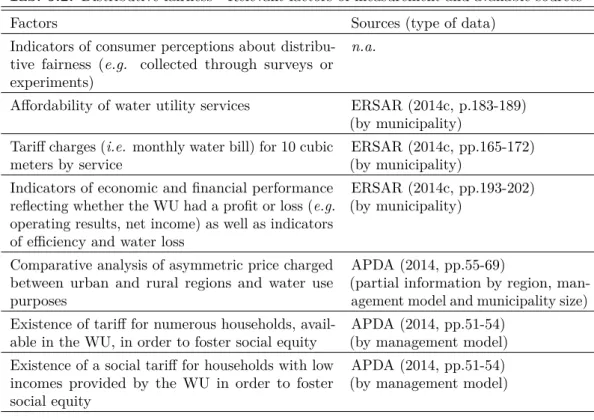
Com-parison without and with sampling weights ... 71 5.1 Price clarity - Relevant factors of measurement and available sources 86 5.2 Distributive fairness - Relevant factors of measurement and available
xx List of Tables
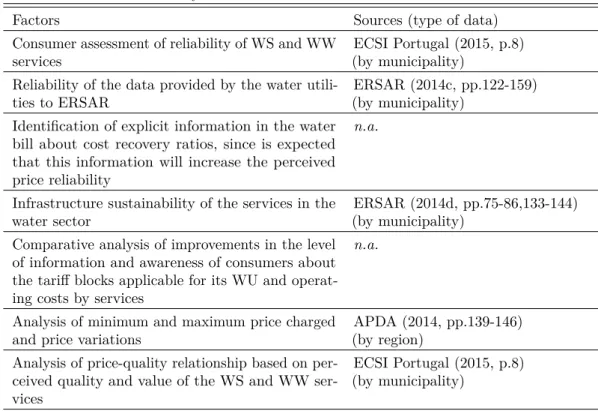
5.3 Consistent behaviour -Relevant factors of measurement and available sources ... 89 5.4 Price reliability - Relevant factors of measurement and available sources 90 5.5 Price honesty - Relevant factors of measurement and available sources 91 5.6 Respect and regard for the partner - Relevant factors of measurement
and available sources ... 92 5.7 Fair dealing - Relevant factors of measurement and available sources . 93 6.1 Main theoretical results with three different reference-price possibilities 109 7.1 Subareas of behavioural pricing explored in this thesis ... 115 7.2 Synopsis of the main results of the studies ... 116 A.1 Dwelling ownership and main residence by type of dwelling ... 141 A.2 Monthly net household income and household size by type of dwelling 141 A.3 Respondents’ characteristics by type of dwelling... 142 A.4 Consumer habits and decisions by type of dwelling... 143 B.1 Brief literature review of the type of variables used in studies about
the water-saving behaviours in outdoor and indoor uses ... 151 B.2 Brief review of the type of variables used in studies about the decision
between drinking tap water or alternative sources ... 152 B.3 List of variables of interest with definitions, units and sources ... 153 B.4 List of variables of interest with definitions, units and sources
(contin-ued) ... 154 B.5 List of variables of interest with definitions, units and sources
(contin-ued) ... 155 B.6 List of variables of interest with definitions, units and sources
(contin-ued) ... 156 B.7 OLS estimated coefficients of income (with sampling weights) to obtain
the linear prediction of fitted income ... 157 B.8 OLS estimated coefficients of income with sampling weights to obtain
the linear prediction of income fitted (continued) ... 158 B.9 Summary statistics of the variable income fitted (incfitted) used as
special regressor ... 158 B.10 Average index, marginal effects at means on the probability to have
List of Tables xxi
B.11 Special regressor estimated coefficients on the probability to have consumer perception awareness based on reference points ... 160 B.12 Summary statistics ... 163 B.13 Summary statistics (continued) ... 164 B.14 Final probit model estimated coefficients on the probability to have
consumer perception awareness based on reference points, with sam-pling weights ... 165 B.15 Final probit models estimated coefficients on the probability to adopt
outdoor water-saving behaviours with sampling weights ... 166 B.16 Heckman probit models estimated coefficients on the probability to
watering the garden in the coolest parts of the day with sampling weights ... 167 B.17 Heckman probit models estimated coefficients on the probability to
watering the garden in the coolest parts of the day with sampling weights (continued) ... 168 B.18 Average marginal effects on the probability to adopt outdoor
water-saving behaviours, including other variables in the literature ... 169 B.19 Probit models estimated coefficients on the probability to adopt
out-door water-saving behaviours, including other variables in the literature 170 B.20 Probit models estimated coefficients on the probability to adopt
out-door water-saving behaviours, including other variables in the literature (continued) ... 171 B.21 Average marginal effects on the probability to adopt outdoor
water-saving behaviours without sampling weights ... 172 B.22 Probit models estimated coefficients on the probability to adopt
out-door water-saving behaviours without sampling weights ... 173 B.23 Final probit model estimated coefficients on the probability to adopt
indoor water-saving behaviours with sampling weights ... 174 B.24 Final Probit model estimated coefficients on the probability to adopt
indoor water-saving behaviours with sampling weights (continued) ... 175 B.25 Average marginal effects on the probability to adopt indoor
water-saving behaviours, encompassing all variables with sampling weights ... 176 B.26 Probit model estimated coefficients on the probability to adopt indoor
water-saving behaviours, encompassing all variables with sampling weights ... 177
xxii List of Tables
B.27 Final probit model estimated coefficients on the probability to adopt indoor water-saving behaviours, encompassing all variables with sam-pling weights (continued) ... 178 B.28 Average marginal effects on the probability to adopt indoor
water-saving behaviours, encompassing all variables without sampling weights 179 B.29 Probit model estimated coefficients on the probability to adopt indoor
water-saving behaviours, encompassing all variables without sampling weights ... 180 B.30 Probit model estimated coefficients on the probability to adopt indoor
water-saving behaviours, encompassing all variables without sampling weights (continued) ... 181 B.31 Final probit model estimated coefficients on the probability to adopt
modern billing standards with sampling weights ... 182 B.32 Average marginal effects on the probability to adopt modern billing
standards, encompassing all variables without sampling weights ... 183 B.33 Probit model estimated coefficients on the probability to adopt modern
billing standards, encompassing all variables without sampling weights 184 B.34 Probit model estimated coefficients on the probability to adopt modern
billing standards, encompassing all variables without sampling weights (continued) ... 185 B.35 Average marginal effects on the probability to adopt modern billing
standards, encompassing all variables ... 185 B.36 Probit model estimated coefficients on the probability to adopt modern
billing standards, encompassing all variables ... 186 B.37 Probit model estimated coefficients on the probability to adopt modern
billing standards, encompassing all variables (continued) ... 187 B.38 Final probit model estimated coefficients on the probability to drink
tap water, comparison without and with sampling weights ... 188 B.39 Average marginal effects on the probability to drink tap water,
includ-ing other relevant variables in the literature... 189 B.40 Probit model estimated coefficients on the probability to drink tap
water, including other relevant variables in the literature ... 190 B.41 Probit model estimated coefficients on the probability to drink tap
water, including other relevant variables in the literature (continued) 191 C.1 Summary of the unit gain and unit loss for two-block IBR ... 196
List of Tables xxiii
E.1 Description of the questions in the survey and coding ... 213 E.2 Description of the questions in the survey and coding (continued) .... 214 E.3 Description of the questions in the survey and coding (continued) .... 215 E.4 Description of the questions in the survey and coding (continued) .... 216
LIST OF FIGURES
2.1 Type of data used in residential water demand studies... 18 3.1 Locations of the municipalities ... 40 5.1 The ECSI model ... 77 5.2 Conceptual model of price fairness ... 81 5.3 Components of PPF in WS and WW services ... 85 6.1 Budget set with two blocks for x1, with increasing block rates ... 98 6.2 Decrease in consumption due to the loss effect (with p1r= p11) ... 104 6.3 Increase in consumption due to the gain effect (with p1r = p12) ... 104 6.4 Increase (decrease) in consumption in the first (second) block (with
average price as the reference) ... 105 6.5 Increase (decrease) in consumption with expense lower (higher) than
reference expense ... 108 B.1 Kernel-weighted local polynomial regression of referenceprice on special
regressor incfittedd ... 161 B.2 Kernel-weighted local polynomial regression of referencebill on special
regressor mincfittedd ... 161 B.3 Kernel-weighted local polynomial regression of referencecons on special
1. GENERAL INTRODUCTION
1.1 Behavioural water resources economics - a new subfield of be-havioural economics
Since the first decade of the twentieth-first century, at least, behavioural economics has been in the European Commission agenda, with the promotion of conferences1and studies. The European Commission has been especially focused on enhancing public policy design (Van Bavel et al., 2013) and the libertarian-paternalism approach of nudges (Umpfenbach, 2014) to positively influence consumers towards better decisions. Overall, the European Commission recognizes and recommends the development of behavioural applications, highlighting potential benefits for consumers. Despite these great efforts at the policy level, in academia the situation is different.
At the European level, the European Commission revealed consistent efforts to incorporate behavioural economics in policy making. The aim seems to be to better serve citizens, with particular focus on consumer decision-making. Behavioural economics has attracted policy-makers’ attention due to its focus on how people make decisions in reality, using an interdisciplinary approach with insights from social sciences, like psychology and economics. Ciriolo (2011) attributes the seminal behavioural study by the European Commission to the report about consumer choices in the retail investment services (Chater et al., 2010), which used experimental and behavioural economics. One of the major findings of this study was that consumers seem to have difficulties to make optimal investment decisions.
In September of 2015, an executive order from president Barack Obama (2015)2 stated the importance of the field of behavioural economics and behavioural science insights (i.e. empirical research findings from that field) for a better design of public policies. This policy directive is a breakthrough towards the development of 1. So far three conferences were organized by the European Commission (European Commission, 2015) The first, in 2008, approached how behavioural science insights can improve public policies with impact on consumers. The 2010’s conference tackled why these insights are relevant to policy-makers. The last conference in 2013 was about application of behavioural economics to policy design. The information on European Commission’s website was accessed on 9th October 2015.
2. Executive Order - Using Behavioural Science Insights to Better Serve the American People (www.whitehouse.gov/the-press-office/2015/09/15/executive-order-using-behavioral-science-insights-better-serve-american), information was accessed on 9th October 2015.
2 1. General Introduction
behavioural science insights applied to policy, where higher relevance is given to how information is presented and frames the consumers and other economic agents.
Surprisingly, Barberis (2013, p.173) states that it is "curious, then, that so many
years after the publication of the 1979 paper, there are relatively few well-known and broad applications of prospect theory in economics. One might be tempted to conclude that, even if prospect theory is an excellent description of behavio[u]r in experimental settings, it is less relevant outside the laboratory. In my view, this lesson would be incorrect." One of the reasons for this fact is that prospect theory (Kahneman and
Tversky, 1979) that explains how people derive utility from "gains" and losses is not a "ready-made" framework. It appears that the formation of reference points and the accurate context-specific determination of what are gains and losses have been a topic with weak guidance in the work of Kahneman and Tversky (1979), as stated by Barberis (2013). Another reason pointed out is that although clarification about gains and losses has been attempted with success by (Kőszegi and Rabin, 2006), so far is unclear how to conciliate references and consumption levels and why the gain-loss framework matters, as we will discuss further on chapter 6. These challenges seem to explain the poor success of economic applications using prospect theory, although it contains important insights that can be incorporated into mainstream economics.
Prospect theory states that people’s willingness to take risks depends on the way a choice is framed as a gain or a loss, thus the choices are context-dependent. The Prospect theory’s seminal paper (Kahneman and Tversky, 1979) shows that people make decisions that are not optimal and it’s one of Econometrica’s most cited papers and a major reference to behavioural economists as an empirical and theoretical framework.
Economists (especially behavioural economists) struggled with two major issues: i) prospect theory is not a "ready-made" theory for applications in economics and ii) behavioural sciences insights needed to be incorporated into mainstream economics. This was the starting point of this thesis. Due to the broad potential applications of prospect theory we narrow our main goals to the study of potential applications of reference points and what factors affect the formation of these points in the residential water sector. This reference point framework is based on the idea that economic agents have reference terms used in their decision-making processes. In the work of Kahneman and Tversky (1979), reference points are used in prospect theory to divide the space of outcomes of the value function into gains and losses. In practice, these (neutral) points act as consumer anchors to make decisions, or they may be associated with an expected level the consumer wishes to achieve. Nevertheless, as we will discuss later on, reference terms can have other applications, from price
1.1. Behavioural water resources economics - a new subfield of behavioural economics 3
perceived price fairness that evolved from the standards of justice on price based on the reference-transaction framework (Kahneman et al., 1986b) to social comparison (Festinger, 1954).
The importance of reference points has been implicitly accounted for in early stages of development of behavioural science insights in the European Union policy design. For instance in consumer protection legislation, as early as 1997 there is a consumer right to cancel a contract during the cooling-off period, another example is the protection against framing effects on health and nutritional claims (e.g. low fat product) in 2006 (Ciriolo, 2011). The latter protects the consumers "(...) since
in the past consumers were often misled by changes in the reference point (a cheese containing 20% was often labelled as 80% fat-free)" as stated by Ciriolo (2011, p.2).
One of the underrated paths is the development of behavioural economics in water management, which is the main research topic of this thesis. We approach this issue acknowledging that behavioural insights can be useful to mainstream economics, but as an non-rival approach, in some cases. Instead of a dichotomy, we argue that reasonable research should account for the advantages of both fields. The researchers of conventional economics, but also from behavioural economics, are subject to the natural tendency to look and overvalue confirming evidence, also known as confirmation bias (Thaler, 1987), which could jeopardize the findings of these studies. In this thesis, we argue for a hybrid approach, since both behavioural and neoclassical economics can bring insights that would benefit water resource economics, and especially the residential water sector.
Overall, the Portuguese residential water sector can be characterized by ac-ceptable affordability conditions of the water utility services (Martins et al., 2013), whose charges representing 0.84% of the average household disposable income in 2013 (ERSAR, 2014c). This is a value within the range of affordability levels in the OECD (Organization for Economic Co-operation and Development) countries (OECD, 2010). The average bill for mainland Portugal was 21.9 € per 10 cubic meters in 2013. The average water prices for a thousand litres (or one cubic meter) of water supply (WS) and wastewater (WW) collected were 1.2 € and 0.7 €, respectively (ERSAR, 2014c). The cost recovery ratios in mainland Portugal in WS and WW changed, respectively, from 0.87 and 0.57 (INAG, 2005) to 0.87 and 0.67 between 2005 and 2013 (ERSAR, 2014c).
News that exhibit information about consumers often focus on typical "bad news", such as price increases for water utility services (Jornal de Notícias, 2015; Castanho, 2014; Tomás, 2014; Henriques and Filipe, 2011). The media has also reported social protests against water price rises (Henriques and Filipe, 2011; Mirante,
4 1. General Introduction
2011). Moreover, in the past Portuguese residential water consumers exhibited a low willingness to pay more to ensure a higher quality of water utility services, according to a national survey performed in 2007 based on around 1,000 face-to-face interviews (Pires, 2007). The results show that 70% of the sample was unwilling to pay more. The major reasons presented to explain this were that consumers already considered their charges to be too high, had concerns about paying more for nothing to change, and assumed that the WS and WW services were already too expensive. Notice that this survey was performed before the economic-financial crisis, so additional concerns could be raised today about about consumer acceptability of pricing strategies, such as water tariff increases.
Given the previous facts about residential water consumption, it is reasonable to look at non-pricing strategies or hybrid approaches. The recommendations of ERSAR (ERSAR, 2012a), the Water and Waste Services Regulation Authority, and recent legislation for the Portuguese water sector (Assembleia da República, 2014) reflect concerns about the need for more transparency and better data quality to enhance consumer perceptions. The Decree Law 114/2014 (Assembleia da República, 2014) provides the necessary procedures to implement a better billing system with clearer and more detailed information on average costs and revenue transfers from amounts paid by water consumers. This may potentially contribute to enhance consumer perceptions, but still there is a long path ahead.
Nowadays, water stress in river basins is an issue for 40% of the population in the world (OECD, 2015), urging the development of water governance principles to cope with challenges in the sector. Water pricing is linked with two foremost challenges: i) the increasing competition for water use and ii) ensuring sustainable access to WS and WW services (OECD, 2010). Economic market analysis (e.g. pricing, demand estimation, costs) has been on the main agenda of environmental economists studying water consumption. Promotion of economic instruments became a European Commission priority, but there is a lack of an integrated approach with behavioural science insights. The literature review on residential water demand in chapter 2 shows that there is scant evidence of the incorporation of psychological findings. In this vein, we identify behavioural economic applications that can have policy implications for water management and can be further extended to energy, gas or waste management. The empirical findings of this thesis are mainly obtained through the collection of data by a household-level survey using a telephone questionnaire during the summer of 2012.
The main research questions, motivations and behavioural theoretical frame-works used in each chapter are summarized in table 1.1.
1.1. Beha vioural w ater resources e conomics -a new subfield of b eh a vioural economics 5
Tab. 1.1: Synopsis of the studies developed in the thesis
Chapters Study name Main research questions Main motivations Research frameworks
Chapter 2 Behavioural Economics in Wa-ter Management - An Overview of Behavioural Economics Ap-plications to Residential Water Demand
- What is the state-of-art of behavioural economics in the field of water resource eco-nomics?
- Which behavioural applications can be sug-gested based on the literature?
- European Commission stresses the rele-vance of economic instruments in the water sector
- The 3Ts (taxes, transfers and tariffs) ap-proach was questioned with the financial crisis
- Unsustainability in water sector
- Prospect theory
- Asymmetric price elasticity - Reference transaction
- Social comparison (and refer-ence consumption)
Chapter 3 Do you know how much you
pay for water? - What is the profile of residential waterconsumers in terms of perceptions? - Studies show low awareness of water priceand consumption - Scant evidence of the overestimation or un-derestimation of key elements of the water bill, such price, number of blocks or con-sumption
- Water consumer habits and res-idential water demand literature - Behavioural pricing literature
Chapter 4 Water consumer behaviours
and perceptions - What factors influence the water con-sumer’s probability to have reference points (i.e. average water price, monthly water
consumption and bill)?
- Is perceived price fairness a factor affecting the formation of reference points?
- Do perception factors affect the household’s probability to adopt outdoor and indoor water conservation choices, modern billing standards and the choice to drink tap water?
- The determinants about the formation of reference points were never studied - Water-saving literature often neglects
wa-ter bill information, consumer perceptions and fairness concerns
- Direct debit payment of the water bill and the electronic billing, as well as perceived price fairness are underresearched subjects
- Consumer perceptions and ref-erence points literature
- Behavioural pricing literature - Indoor and outdoor water
con-servation literature
- Averting behaviour to drink tap water and water quality litera-tures
Chapter 5 Perceived Price Fairness (PPF) - Determinants in residential
water sector in Portugal
- What are the potential determinants of
PPF, for Portuguese households? Absence of a clear conceptual framework forprice fairness applied to water sector that incorporates price awareness
- Reference transaction literature - Price fairness and behavioural
pricing studies Chapter 6 Nonlinear pricing with
refer-ence dependrefer-ence - Can block price structures create specificreference effects? - Consumers often have to deal with nonlin-ear prices from water and energy services to cellphone and internet bills
- Nonlinear pricing has mostly been anal-ysed in the traditional utility-maximization framework
- Residential water demand liter-ature
- Prospect theory and reference-dependence models
6 1. General Introduction
Chapter 2 provides an overview of behavioural economics applications to the residential water sector, suggesting a new subfield of research, Behavioural Economics in Water Management. We try to address two issues: to describe the state-of-art of behavioural economics and applications of social sciences in the field of water resource economics and identify potential behavioural economic applications3.
One main motivation for this study was that within a context of unsustainability for water resources management the European Commission promoted the development of economic instruments in the water sector (European Commission, 2007), as a first stage in the implementation process of the Water Framework Directive (European Parliament and Council, 2000). The promotion of economic instruments is an essential part of efficient water management everywhere. Afterwards, the mainstream approach to the water sector was questioned with the economic-financial crisis since 2008, which could potentially lead to a paradigm shift.
We discuss the potential of economic instruments in a new light, looking into four behavioural economic applications that can have implications for water management. Namely, we suggest: reference block pricing, asymmetric elasticities of residential water demand, reference transaction implications for cost recovery and tariff acceptability and fairness, and social comparison based on reference water consumption. Some potential questions that emerge from this review for our study addressing these behavioural applications are: Can block price structures create specific reference effects? Are consumer reactions to price increases quantitatively different from those to decreases? Do consumer perceptions of price fairness hinder cost recovery efforts? How do social norms on consumption affect water use?
In order to improve the understanding of consumer perceptions a household survey was performed in the summer of 20124. In chapter 3, we review a group of studies which highlight the low awareness about water price (Frondel and Messner, 2008; Carter and Milon, 2005) and water consumption (Martins and Moura e Sá, 2011; Tralhão, 2011) in the residential water sector. We identify the profile of residential water consumers in terms of perceptions, especially whether they know how much they pay for water and what are their average price and monthly water consumption.
Chapter 4 is an empirical study that approaches the formation of reference points, water consumer behaviours and perceptions, given particular relevance to concerns about perceived price fairness. The perceived price fairness appears to be understudied in this context, especially regarding the formation of reference points. The reference points considered were the perceived values of residential water 3. The work developed for the thesis was published in 2014 (Correia and Roseta-Palma, 2014) 4. Survey developed under the project PTDC/EGE-ECO/114477/2009, with financial support from FCT - Fundação para a Ciência e a Tecnologia (Science and Technology Foundation). Additional information can be provided upon request.
1.1. Behavioural water resources economics - a new subfield of behavioural economics 7
consumers about their average water price, monthly water consumption and bill. In this context the accounting for endogeneity could be important, especially with discrete variables, for which special regressor methods (Dong and Lewbel, 2015; Lewbel, 2014, 2000) emerge as a potential general approach. Another rational motivating this chapter was the scant incorporation of information about the water bill and consumer perceptions in the literature on water-saving behaviours and the preference to drink tap water. Additionally, the relevance of modern billing standards such as the use of direct debit to pay the water bill and electronic billing are undervalued. The main research questions posed are focused on understanding how perception and fairness factors affect the probability of forming reference points, of adopting outdoor and indoor water conservation choices, modern billing standards, and the decision of drinking tap water.
Chapter 5 proposes a conceptual model of perceived price fairness (PPF) and identifies some factors that may explain PPF in the residential water sector in Portugal. In this sense, the main research goal of this chapter is to achieve a set of measures needed to identify each one of the determinants. At the European level, recent studies of consumer perceptions indicate that the majority of Europeans agree with the user-pays and polluter-pays principles (European Commission, 2012), and highlights that hunger, poverty and shortage of drinking water are the most serious issues worldwide (European Commission, 2014). Additionally, there is some reluctance to accept the increase of water price, which is perceived as unfair, although oddly there are relatively good affordability conditions with respect to water tariffs. Thus PPF may be a relevant factor in the analysis of water consumption decisions, despite the absence of this issue from water demand literature, as far as we know. This chapter could have different implications from reference transaction literature (Kahneman et al., 1986b) to price fairness (Diller, 2008) and behavioural pricing
studies (Krishna, 2009).
Chapter 6 was based on the previous empirical evidence of chapters 3 and 4 about residential water consumers and aims to develop a theoretical framework to study nonlinear pricing with loss aversion, in the case of increasing block rates (IBR),
i.e. when price increases as the consumption level increases beyond specific levels of
consumption.
Nonlinear pricing has been the subject of growing interest in several industries (Lambrecht et al., 2007). The use of nonlinear pricing schedules is common from communication and subscription services to many utilities, including water, electricity and gas, as a way to recover costs while taking into consideration consumer demand profiles. In this literature, the consumer is typically modelled as an individual who maximizes utility with a nonlinear budget constraint. However, in reality the
8 1. General Introduction
consumers may be influenced by a reference point. Based on the traditional approach that consumers are price-takers and empirical evidence that consumers have high awareness of their total expenses we analyse two potential references: reference price and reference expense. We take the discrete/continuous model of consumer choice that has been widely used for demand analysis (Hewitt and Hanemann, 1995) under block rates and modify it to include reference-price effects. Moreover, we develop a model to include reference-expense effects. In particular, we show how loss aversion with IBR changes consumption decisions when the consumer treats a higher-than-reference price (or expense) as a loss. Finally, we discuss implications for utility pricing policies and services with nonlinear pricing, as well as potential implications of reference-expense behaviour.
Overall, the development of behavioural economics appears to have been made with baby steps within the economic sciences, in general, and within environmental economics in particular. Only since the beginning of the twenty-first century has this field emerged in research areas, such as forest management (Knetsch, 2005), climate change (Brekke and Johansson-Stenman, 2008) and energy economics (Pollitt and Shaorshadze, 2011). Knetsch (2005) argues that economic analyses of natural resources can be significantly enhanced through behavioural science insights. The lack of behavioural economic applications in water management was one of the main drivers that lead to the development of this thesis, a modest contribution to the new subfield of behavioural water resource economics.
2. BEHAVIOURAL ECONOMICS IN WATER MANAGEMENT
2.1 Introduction
Water consumption is an essential component of human activities, yet it has only recently been acknowledged as an economic good that can be provided through markets, albeit imperfect or incomplete ones. Traditionally, water management was mostly held to mean supply management, such as the provision of reservoirs, distribution networks and other infrastructure, whereas demand management is now understood to be crucial. Moreover, the quantity and quality of water decisively affect all ecosystems on Earth, which means that the costs and benefits of water use are rarely captured fully in market mechanisms. Economists have therefore focused both on market analysis (pricing, demand estimation, costs) and on the study of external effects such as the negative impacts of human-induced scarcity and the losses brought about by water pollution. In the European Union, the Water Framework Directive (European Parliament and Council, 2000) Article 9 requires that water prices provide an appropriate incentive for the efficient use of the resource as well as recover costs, including environmental and scarcity costs. Nonetheless, recent evaluations (European Commission, 2007) show that economic instruments still play a very limited role in water management, while significant problems persist in ecological water status. The European Commission has thus identified the promotion of economic instruments as a priority action.
On the other hand, economists have also come to accept that traditional utility-maximization models often do not appropriately describe actual decisions of economic agents. Through the influence of many significant experiments and insights provided by psychologists, an interesting cross-fertilization process took place between the two fields, giving rise to what is now known as behavioural economics. To ascertain the potential of economic instruments in a new light, in this chapter we use the behavioural economics framework to identify possible implications for water management, using references from psychology and marketing that we believe have been overlooked. We suggest four behavioural economic applications (hereafter behavioural applications), namely: reference block pricing; asymmetric elasticities; reference transaction; and social comparison through reference consumption.
10 2. Behavioural Economics in Water Management
discuss water demand models, both generally, at a global level (Worthington and Hoffman, 2008) and at a European level (Schleich and Hillenbrand, 2009), and focus on price specifications and price elasticities (Arbués et al., 2003). Nevertheless, they all implicitly exhibit a common feature: the absence of behavioural economics in the residential water demand literature. In this work we corroborate this finding through a brief review of similar studies over the last decade, which differs from the previous surveys in that our analysis focuses on the behavioural perspective. We refer to the existing (slender) literature about behavioural economics in water management and sketch our proposals for the four behavioural applications mentioned already. Furthermore, we stress the importance of experimental data versus nonexperimental data, besides the usual division between aggregate data and household data.
First we discuss reference block pricing, which relates primarily to the issue of choosing the most appropriate price structure. There is a significant amount of literature on block-tariff structures in regulated water utilities, yet none of it explains the popularity of increasing block tariffs, since the nature of the water supply infrastructure recommends constant or decreasing tariff structures (Elnaboulsi, 2009, 2001). In Portugal, for example, most utilities charge prices with a fixed and a variable component, and the latter is usually an increasing block rate (IBR) of three or more blocks, especially for residential use, where the IBR structure is seen by water managers as a way to signal scarcity and promote resource conservation.
Recent work on residential water demand (Monteiro and Roseta-Palma, 2011) has shown that if water demand and costs respond to weather conditions, increasing marginal prices could indeed be explained by water scarcity and customer heterogene-ity in a setting where utilities maintain a balanced budget. However, the implications for tariff design of asymmetric value functions with loss aversion (Kahneman and Tversky, 1979) have never been considered, and we believe such a framework can shed new light on the issue. In particular, if water consumers react to a reference price, which may be that of the initial block or their actual block, the following block price can be interpreted as a loss or a discount, depending on whether the block tariff structure is increasing or decreasing, respectively.
A closely related topic is that of behavioural responses to price changes. We will investigate the implications of prospect theory (Kahneman and Tversky, 1979) on the optimal pricing policy and on the frequency of price updates, given that consumers seem to value losses more highly than gains, which should generate asymmetric price elasticities (i.e. higher price elasticities with price increases than with price reductions). This asymmetry was first corroborated by the pioneering study of Putler (1992). More recently this topic has been studied in the energy literature Adeyemi and Hunt (2007), but it is yet untested for water demand. The third topic deals with
2.1. Introduction 11
the implications of the reference-transaction framework (Kahneman et al., 1986b) for water management. The concept of reference transaction is based on the dual entitlement principle, under which firms are entitled to a (positive) reference profit and individuals are entitled to reference terms (i.e. price, salary, rent). This concept was recently applied in a comparison of allocation rules for scarce resources (Raux et al., 2009) as well as in the marketing literature, which has analysed the issue of perceived price fairness (for recent reviews see Diller (2008) and Krishna (2009). In the case of water, since a reference transaction could imply fairness constraints, the utilities could be inhibited from proposing reference terms (i.e. prices) that would be perceived as unfair. This may indeed be the case in Portugal, where 71 per cent of water utilities are held by municipalities or associations of municipalities (INAG, 2011). Recent social protests against the rise of water bills highlight consumers’ concerns and could lead to the maintenance of artificially low cost recovery levels by the municipalities due to fairness constraints. To illustrate, note that the revenues of Portuguese water utilities in 2009 covered only 80 per cent of the financial costs of providing the service5, for water supply, and an even lower 46 per cent for waste water drainage and treatment (INAG, 2011). Given the characteristics of water as an essential good, indeed now a human right, perceived fairness could be one explanation for the insufficient cost-recovery levels attained by water utilities in many countries.
Finally, we will review the few existing papers on the impact of the information included in water bills, such as that on price, social norms, and resource saving campaigns, in particular the inclusion of reference consumption values that are used to frame consumers into social comparison. The water demand literature has emphasized the importance of incorporating information about the water price in water bills and its relevance to the effectiveness of water pricing policies (Frondel and Messner, 2008; Gaudin, 2006). Nevertheless, only recently has social comparison been tested as a water management tool (Ferraro and Price, 2011), and reference consumption information was the more effective tool of all the conservation strategies tested.
The remainder of the chapter can be summarized as follows. Section 2.2 contains a literature review of behavioural economics in water management. Section 2.3 describes the behavioural applications and their potential contribution to water policy and water resource economics. Section 2.4 concludes and examines potential paths for future research in water management shedding light on the behavioural applications suggested.
5. The financial costs of water services include the operation and maintenance costs, capital costs, administrative costs, and other direct costs (European Commission, 2003, p.118).
12 2. Behavioural Economics in Water Management
2.2 Literature Review of Behavioural Economics in Water Manage-ment
2.2.1 Behavioural Economics
Behavioural economics arguably started as early as the eighteenth century with Adam Smith’s The Theory of Moral Sentiments, but economic theory gradually grew apart from psychology until the second half of the twentieth century with "researchers like George Katona, Harvey Leibenstein, Tibor Scitovsky, and Herbert Simon ... suggesting the importance of psychological measures and bounds on rationality" (Camerer, 2004a, p. 6).
In the mid-1970s Kahneman and Tversky (1974) identified some significant heuristics and biases of human behaviour, especially under uncertainty6, but their major contributions to economics were published a few years later. In one of Econo-metrica’s most cited papers the authors developed prospect theory as an alternative model to expected utility theory and the rational choice paradigm (Kahneman and Tversky, 1979). This article has had by far the most major influence in changing the conceptual framework of economics and establishing the growing field of behavioural economics7.
The field of behavioural economics is focused on empirical validation and identification of behavioural departures from the standard model (i.e. the neoclassical model) as well as on the interpretation of behavioural deviations using alternative economic frameworks. Furthermore, these deviations can be organized into three areas where human nature strays from standard assumptions: there are limits to the pursuit of self-interest, to cognitive abilities, and to self-control (Mullainathan and Thaler, 2000)8.
Despite the obvious rivalry between behavioural economic theory and stan-dard rational choice theory, we want the reader to bear in mind that these two competing theories are not a dichotomy, in spite of past (and current) conflicts among practitioners. Future economic theory could (and we dare say should) be based on a hybrid approach, with the co-existence of neoclassical and behavioural approaches (MacFadyen, 2006; Rabin, 2002). For instance, Matthew Rabin states that behavioural findings should be integrated into economics and that his research programme "does not abandon the correct insights of neoclassical economics, but 6. For further information about departures from the standard economic theory see Kahneman et al. (1982).
7. Behavioural economics could be defined as "a commitment to empirical testing of neoclassic assumptions of human behaviour and to modifying economic theory on the basis of what is found in the testing process" (Simon, 2008, p. 221).
2.2. Literature Review of Behavioural Economics in Water Management 13
supplements these insights with the insights to be had from realistic new assumptions" (Rabin, 2002, p. 659).
The rivalry mentioned here is one barrier to the development of this field, but there is another one, related to the dissemination of behavioural economic findings. The recent literature has made several efforts to encourage use of behavioural economic models, either through analysis of field phenomena (Camerer, 2004b) or by pointing out potential applications of different behavioural models (Ho et al., 2006). Nonetheless, some subfields of economics have shown little evidence of the incorporation of behavioural economics. Water resource economics is one of these cases, as discussed in section 2.2.2.
2.2.2 State of the Art of Behavioural Economics in Water Resource Economics Water resource economics deals with the efficient allocation of a scarce resource (water). It aims to develop water management policies and to study the
decision-making process of economic agents that use water resources (Griffin, 2006). In surveying this literature we found there is almost no incorporation of concepts from behavioural economics.
The subfield of behavioural water economics should focus on the development of water resource economics through the application of the findings of behavioural economics, as well as insights from other related general fields (e.g. psychology, sociology, ecology, marketing) or more specific fields (e.g. behavioural environmental economics, experimental economics, environmental psychology, behavioural finance).
So far, there seem to be very few published papers in this subfield. The first paper to incorporate behavioural assumptions into water resource economics was Win-kler and Winett (1982), which approaches resource conservation, namely residential energy and water, integrating the psychological (social-learning) and economic views. The authors discuss the importance of monetary rebates for conservation policies, emphasizing that those rebates9 (i.e. economic approach) could allow changes in conservation behaviour, but also that they could be complemented by information technology that would influence consumer behaviour (i.e. psychological approach). Therefore, they argue for a combined approach in conservation policies, without overlooking the psychological framework in the policy-makers’ agenda.
Additionally, the authors argue that changes in human behaviour are made through behavioural interventions which should be interpreted in the context of two systems of behaviours: an internal system (linked to the individual) and an external system (linking the individual and the society). Therefore, insofar we are 9. Nevertheless, the application of (monetary) rebates has since been criticized due to the low price elasticity of water demand (Foxall, 1995).
14 2. Behavioural Economics in Water Management
analysing behaviours of households (the typical individual level used in residential water demand literature) we should account for these two systems when designing water policies.
More recently, Jorgensen et al. (2009) contribute to the residential water demand literature with a new socio-economic model to understand household water consumption, emphasizing the importance of trust. Their work stresses the demand side and summarizes the main direct and indirect drivers which determine human behaviour towards water conservation. Their model also emphasizes other behavioural variables besides trust (e.g. past water use behaviour, outdoor-area interest and use, and pricing attitude), although the authors advise that there could be other variables to discover.
Finally, another issue within the framework of behavioural economics is the impact of social comparison as a water conservation strategy (Ferraro and Price, 2011). The authors analyse the influence on water consumption of three types of experimental treatments (i.e. technical recommendation, pro-social message, and social comparison). These authors conclude that non-pecuniary strategies (i.e. psychological strategies) do influence water conservation, with a higher effectiveness of social comparison in the group of high-use households, and a larger effect in the short-term rather than the long-term.
One of the major issues in water resource economics is the potential unsustain-ability of use (i.e. demand exceeding water supply in a consistent manner leading to the degradation of the resource). Strategies to improve water management can be centred on demand management or on supply enhancement (Griffin, 2006). Perhaps due to the prevalence of the latter throughout the twentieth century, the last few years have seen demand-side strategies became the dominant paradigm both in the water and energy sectors (Strengers, 2011; Barberán and Arbués, 2009)10. Naturally, demand analysis is also the purpose of the few published papers, described already, which incorporate behavioural insights into residential water consumption.
Further applications of behavioural economics in water management could also be developed for other sectors that contribute significantly to water demand, such as agriculture, industry, and tourism, although these are outside the scope of this chapter. Another possibility would be for supply-side analysis to take into account the biases of system managers within water utilities and understanding the behaviour of these utilities.11
10. This one-sided approach can be criticized, for instance Merrett states that "[w]ith outstream water we should always integrate in our thinking and our practice both demand-side and supply-side strategies" (Merrett, 2005, p. 92).
11. Recent literature discusses the importance of understanding the behaviour of firms. See the work of Bandiera et al. (2011) for a review of field experiments with firms.
2.2. Literature Review of Behavioural Economics in Water Management 15
At this point two questions could arise: (i) why is there so little work on behavioural economics in the water management literature? And (ii) why does behavioural economics matter in this context?
From our perspective, the underdevelopment of this subfield has some potential explanations:
Neoclassical hegemony
• Environmental economics models are underpinned by the hegemony of standard neoclassic economic theory (Shogren and Taylor, 2008; Venkatachalam, 2007), and water resource economics is not an exception, as will be described in section 2.2.3.
Dearth of household data
• Scarcity of social/psychological data about households (Jorgensen et al., 2009) and lack of "readily available data" in environmental data (Smith, 2008, p. 141).
• Difficulty in obtaining reliable (and real) variables (e.g. appropriate income per household) and in collecting information from several sources of household data.
Limited systematization and availability of detailed aggregate data
• There are significant limitations in the available aggregate statistics, even those related to fundamental aspects of water supply and waste water services at the country level (OECD, 2010).
Little application of experimental design to residential water de-mand
• Few water demand studies have used experimental data during the last decade (as discussed in section 2.2.3), possibly because many water utilities have not traditionally focused on demand management and so do not perceive the value of engaging in such activities.
Status quo bias
• Resistance to change of water resource economists to behavioural economic models12, which is in a broader sense connected to status quo bias in human behaviour. Or as stated by MacFadyen "we are often reluctant to abandon the security of conventional construct systems, but there may be cascade effects as highly regarded practitioners adopt new ideas" (MacFadyen, 2006, p. 195). 12. Note that water resource economists may not be aware of the existence of behavioural economics models and therefore in this case the idea of resistance to change is not applicable.