Affective Narratives for Engagement in
Digital Games
Matilde Freilão
Mestrado Integrado em Engenharia Informática e Computação Supervisor: Rui Rodrigues
Second Supervisor: Filipe Rodrigues
Matilde Freilão
Mestrado Integrado em Engenharia Informática e Computação
Approved in oral examination by the committee:
Chair: Prof. António CoelhoExternal Examiner: Prof. Nélson Zagalo Supervisor: Prof. Rui Rodrigues
Second Supervisor: Prof. Filipe Rodrigues
Stories can be told in many forms, but one that is especially powerful is video games. Nowadays, video game developers, when looking at ways to make a game more realistic and immersive, tend to turn to the interactive storytelling component of games. Most games have linear storylines, while some offer branching storylines, where the player can choose what to do next and be more involved in the story. However, these game stories, with or without branching paths, are often not enough to promote engagement and self-reflection (the activity of thinking about your own feelings and behavior, and the reasons that may lie behind them) in players throughout the game because the main traces of the story are still the same for every player, regardless of their different states of mind, emotions while playing and personality.
The objective of this thesis is to take an extra step in interactive storytelling and promote the development of tailor-made narratives, so that players can have a more engaging experience that enables self-reflection. A possible solution to achieve this is to collect the player’s emotional data and use that data to adapt a game narrative to the player’s emotions. It is expected that the resulting game story will be more engaging, promoting self-reflection, as opposed to other game stories.
This thesis presents the conceptualization, implementation and evaluation of a framework that can adapt game narratives to the player’s emotions, by using an annotated narrative structure cre-ated by the game designer and the affective profile (the emotions) provided by the player. The framework is then able to create adapted narratives by choosing the narrative elements that fit the current player. These narrative elements can be for example the setting in which the story takes place, the dialogue of the characters, the gameplay mechanics and the order of the story events.
To learn whether games built with this framework would be more engaging and better game experiences than a game with a non-adapted narrative, user tests were performed. These tests consisted of the users playing a version of the game with a default narrative and a version with an adapted narrative, in a random order. The results obtained from this experiment show that there was an improvement in engagement and game experience, from the default version to the adapted version. Additionally, the majority of the players stated that they preferred the adapted version and would like to play a game like this again.
Keywords: video games, interactive narratives, affective narratives, self-reflection, engagement
I would like to start by thanking my mom Fernanda, my dad Mário, my stepmom Cristina and the rest of my family for loving and supporting me unconditionally.
I also wish to thank my supervisors, Rui Rodrigues and Filipe Rodrigues, for the helpful advice, constructive criticism and guidance given to me during this process.
To Catarina and Tiago, and to every friend and colleague with whom I shared this experience in FEUP, thank you, for your friendship and for helping me overcome many hardships.
To my childhood friends, Cláudia, Catarina, Mariana, Iris, Gabriela and Francisca, thank you for always making me smile whenever I felt troubled.
And to Inês and Zé, thank you for all the movie nights and junk food dinners where I could forget my troubles.
Last, but not least, to my boyfriend, Francisco, whom, without his support, the completion of this thesis would not have been possible. Thank you for always staying by my side.
Matilde Freilão
in Undertale by Toby Fox
1 Introduction 1
1.1 Context, Motivation and Objective . . . 1
1.2 Research Questions . . . 2
1.3 Document Structure . . . 3
2 Game Adaptivity through Narratives: a review 5 2.1 Game Adaptivity . . . 5
2.2 Narratives and Video Games . . . 7
2.2.1 Distinction between stories, plots and narratives . . . 8
2.2.2 Narratives in Video Games . . . 8
2.2.3 Adaptive Narratives in Related Works . . . 10
2.2.4 Conclusions . . . 11
2.3 Player Modeling . . . 11
2.3.1 Player Modeling in Related Works . . . 12
2.3.2 Conclusions . . . 14
2.4 Self-reported Emotion Questionnaires . . . 16
2.5 Summary . . . 16
3 Proposed Solution for the Framework and its components 19 3.1 First Steps towards Game Narrative Adaptation . . . 20
3.1.1 Video game genre and narrative style . . . 20
3.1.2 Narrative elements to adapt . . . 20
3.1.3 Adaptation criteria and the Player’s Affective Profile . . . 21
3.2 Framework’s conceptual architecture . . . 22
3.3 Annotated Narrative’s Structure Specification . . . 23
3.4 Tools and Technologies . . . 26
3.5 Narrative Adapter Component . . . 28
3.5.1 Overall Narrative Document . . . 29
3.5.2 Narrative Adapter Component’s Implementation . . . 31
3.6 Game Component . . . 33
3.6.1 Game description assets . . . 34
3.7 Story Viewer as a Narrative Visualization and Debugging tool . . . 39
3.7.1 StoryViewer Overview . . . 39
3.7.2 Narrative Debug Tool . . . 41
3.7.3 StoryViewer implementation . . . 41
3.8 Summary . . . 42
4 Evaluation 43
4.1 Evaluation Protocol . . . 43
4.2 Experience Structure and Gathered Data . . . 44
4.3 The Game and its Default and Adapted Narratives . . . 49
4.4 Results and Analysis . . . 54
4.4.1 Part 1 - General Questions . . . 54
4.4.2 Part 2 - Game Sessions and GEQ . . . 54
4.4.3 Part 3 - Last questions . . . 59
4.5 Discussion . . . 62
5 Conclusions 63 5.1 Future Work . . . 64
A Narrative documents’ schemas 65
B Complete toy example 75
C Questionnaire 77
D Game Narratives 89
2.1 Overview of game adaptivity architectural principles . . . 6
3.1 System overview . . . 19
3.2 Conceptual Framework and System Architecture . . . 22
3.3 Toy example . . . 24
3.4 Toy example with branching locations . . . 25
3.5 Toy example with branching events . . . 27
3.6 Excerpt of figure3.2, containing only the Narrative Adapter Component . . . 28
3.7 Top-down approach to the specification of the game narrative . . . 30
3.8 A visual representation of the Overall Narrative graph (created by the visualization tool specified in section3.7) . . . 32
3.9 Excerpt of figure3.2, containing only the Game Component . . . 34
3.10 Excerpt of figure3.7with only the narrative documents parsed by the game . . . 35
3.11 Same location (salon), instantiated by different scenes . . . 35
3.12 A sprite and its tileset . . . 38
3.13 The main screen of the StoryViewer . . . 40
3.14 The default story branch highlighted in the StoryViewer . . . 40
3.15 Screenshot of the debug view . . . 41
4.1 The first page of the questionnaire . . . 48
4.2 Some screenshots of the game . . . 49
4.3 View of the default storyline . . . 52
4.4 View of an adapted narrative . . . 53
4.5 Favorite game genre and importance of narrative amongst regular players . . . . 55
4.6 Participant’s answers to the last questions . . . 60
4.7 Distribution of the different combinations of participants’ preferred version with the version that reflected them the most . . . 61
A.1 Player Affective Profile schema . . . 66
A.2 Overall Narrative schema . . . 67
A.3 Cutscene schema . . . 68
A.4 Gameplay schema . . . 69
A.5 Gameplay schema (cont.) . . . 70
A.6 Dialogue schema . . . 70
A.7 Actors schema . . . 71
A.8 Items schema . . . 71
A.9 Tilesets schema . . . 72
A.10 Enemies schema . . . 73
B.1 Complete toy example . . . 76
C.1 Introductory page . . . 78
C.2 Page 1 of step 1 - General questions . . . 79
C.3 Page 1 of step 1 - General questions (cont.) . . . 80
C.4 Page 2 of step 1 - DEQ . . . 81
C.5 Page 2 of step 1 - DEQ (cont.) . . . 82
C.6 Page 1 of step 2 - Game session . . . 83
C.7 Page 1 of step 2 - Game session (cont.) . . . 84
C.8 Page 2 of step 2 - Post game session questions (GEQ) . . . 85
C.9 Page 2 of step 2 - Post game session questions (GEQ) (cont.) . . . 86
C.10 Step 3 - General questions about the whole experience . . . 87
C.11 Step 3 - General questions about the whole experience (cont.) . . . 88
2.1 Related works in game narrative adaptivity . . . 11
2.2 Related works on player models for narrative adaptivity . . . 15
2.3 Self-reported emotion questionnaires . . . 17
4.1 DEQ scale . . . 44
4.2 The 32 words and their groups of the DEQ . . . 45
4.4 GEQ scale . . . 45
4.3 GEQ’s Core module questions . . . 46
4.5 Minimum and maximum scores for each component of the GEQ . . . 47
4.6 The changes to the default narrative for each emotion of the affective profile (ex-cluding fear and relaxation) . . . 51
4.7 Participants’ ages . . . 54
4.8 The average game time for the two game versions . . . 55
4.9 The difference between the score of the adapted version and the score of the default version for each category of the GEQ among all players . . . 56
4.10 The difference between the score of the adapted version and the score of the default
version for each category of the GEQ among the players of the default-first group 56
4.11 The difference between the score of the adapted version and the score of the default
version for each category of the GEQ among the players of the adapted-first group 56
NPC Non Playable Character
PC Playable Character
RPG Role Playing Game
PANAS Positive and Negative Affect Schedule
POMS Profile of Mood States
DEQ Discrete Emotions Questionnaire
JSON JavaScript Object Notation
DFS Depth-First Search
GEQ Game Experience Questionnaire
Introduction
Humans have been telling stories since the times they could speak, probably even before that. We tell stories to each other by talking but also by painting, by singing, by writing novels,
short-stories and plays, by filming, and by using social-networks [Khan Academy, 2017]. Fictional
stories allow us to escape reality and be able to experience different feelings and explore other
worlds [Rabin, 2013], but stories are also important because they are the way we make sense of
the world [Peng et al., 2018] and convey information to others [Kaptein and Broekens, 2015]. Additionally, stories are deeply connected with our emotions: our emotional systems are cru-cial for the creation and understanding of stories but stories also help us understand and develop our own emotional lives [Hogan, 2011]. By engaging in affective narratives (stories that express emotions) that mirror our own situation or current emotions, we often find ourselves meditating upon our own feelings and actions and the reasons that lie before them. This is called self-reflection [Cambridge Dictionary, 2020] and can be highly beneficial since it motivates us to change our be-haviours for our own well-being or of our social, biological environment [Peng et al., 2018].
1.1
Context, Motivation and Objective
The same story has many ways of being told, but one medium that is especially powerful is video games. Thanks to their interactive component, players are able to experience stories in a different perspective: stories about "someone else" become stories about "us". Game stories used to be predominantly linear, meaning that every player would experience the same story, independently from their playthrough. However, more and more games with branching storylines are being made, where players are able to choose which path they want to take in the story. This appeals to players because of the high degree of customization of their game experience but comes with some shortcomings. Branching stories are harder and more costly to make, since all options may lead to different scenarios, which usually means more script and more content must be created. Rabin even says that branching storylines are a waste of resources, since most players will not even get to
enjoy the game elements that fall outside of their path [Rabin, 2013]. Other ways of implementing branching exist, such as using parallel paths, which are branching plots that eventually join back to the main branch of the story. These implementations are less costly than pure branching, but players end up complaining about the lack of impact of their choices. This lack of branching in the game story also makes it so that game experiences, although fun, do not engage players in self-reflection, since the main traces of the story are the same for every player, not adapting to their different states of minds or emotions.
To respond to these problems it might be beneficial to search for other means of making a game story more personal. To this end, adapting a game’s story to the player’s state of mind and emotions might be a good solution to create experiences that are more personal and consequently induce self-reflection in players. Self-reflection not only has the ability of inducing positive behavior change [Peng et al., 2018] but, according to a study conducted by Oliver et al. [Oliver et al., 2016], experiencing introspection and self-reflection while playing video games helps in creating more enriching game experiences, making players recall those games as meaningful, which is something that gamers appreciate [Oliver et al., 2016]. Interestingly, the data gathered in this study also shows that these feelings of introspection and self-reflection were mostly strongly associated with the narrative of the game.
In conclusion, the objective of this thesis is to research and build a framework that is capable of helping the creation of an adapted story for a video game, based on the player’s emotions and feelings, so that players can engage in self-reflection and have a more meaningful and engaging experience.
1.2
Research Questions
To guide the process of researching for the creation of this proposed framework, the following research questions were identified:
1. How do affective narratives work in games? 2. How to adapt a game’s narrative to its player? 3. What criteria should be used to adapt the narrative?
4. Do personalized affective game narratives really induce self-reflection, thus impacting the player’s engagement in the game?
The first three questions are the "kick-starters" of the research needed for the creation of the proposed framework: what to adapt, how to adapt and how should it be adapted. The fourth question is what this thesis intends to answer after user-tests are done using a game that was built with the help of the framework.
1.3
Document Structure
This document is divided in four chapters. Chapter1, which this section belongs to, is the intro-ductory chapter, where the context, motivation and objective are explained. The research questions are also outlined in this chapter. Chapter2is a review of the state of the art in the fields of game
adaptivity, game narratives and player modeling. Chapter3details the conceptualization and the
implementation of the aforementioned framework. Chapter4shows the user tests and the results
and analysis that were done to test whether the framework could help in making games that are more engaging. Finally, chapter5contains the main conclusions of this work.
Game Adaptivity through Narratives: a
review
Typically, video games offer the same content, regardless of the player experiencing it. The game’s content, rules, narratives and environments are usually static, while the player dynamically inter-acts with them. This kind of design is used because it allows a greater control, robustness and testability of the video game for the developers [Lopes and Bidarra, 2011]. At the same time, the more choices the game designer plans to give to the player, the more complex it is to create the game, inherently boosting production and time costs [Alves Nogueira, 2016].
Such rigidity in the game content might lead to predictability of the game outcomes by the player [Lopes and Bidarra, 2011], since the game’s rules and gameplay do not adapt to the player’s actions. For example, players can repeatedly exploit the same strategy to overcome an obstacle, which can make the game less interesting to them. Other common issue is that the game’s "replaya-bility value" (the game’s content lifetime) is almost none: the player’s are not encouraged to keep playing the game after finishing it for the first time, since its content remains the same through the different playthroughs [Alves Nogueira, 2016]. This is especially critical to story-driven games, as the player might lose interest in the game as soon as the story is fully revealed.
To counter these problems, developers turned to means of generating or altering game content according to the player’s characteristics or actions. This is called game adaptivity.
2.1
Game Adaptivity
Game adaptivity’s main objective is to make a game experience more appealing by making it more unpredictable, unique, harder or easier, depending on the player.
Player
Modeling
Adaptation and
Generation
Engine
steers Personalized components: - narratives - objects - NPC/AI - etc...Desired
Player
Experience
steers predicts Player actions Game StateFigure 2.1: Overview of game adaptivity architectural principles as proposed by [Lopes and Bidarra, 2011]
Lopes and Bidarra [Lopes and Bidarra, 2011] describe the architectural principles of game
adaptivity (figure 2.1) as follows: player actions, recorded by game logs or other means, are
used to create a player model, which in turn, according to the current game state, is used to predict the desired experience of the player. Both the player model and the predicted desired player experience steer the adaptation and generation engine that is responsible for adapting and generating personalized video game elements.
Regarding the game components that can be adapted, these include but are not limited to: • Game worlds
• Mechanics • AI / NPC • Narratives • Scenarios / quests
Given the focus of this thesis on game narratives, this review of the state of the art will only target works done on the field of game adaptivity regarding narratives and scenarios / quests, which, in video games, are also part of how a story is told (see section2.2.2). For more works that
adapt other game components, please refer to the survey done by Lopes and Bidarra [Lopes and
Bidarra, 2011].
The architecture proposed in figure2.1uses player actions as the input for the player modeling, which leads to an adapted game based only on the player’s gameplay and decisions. Although some data about the player’s emotions and state of mind can be derived from their gameplay and decisions (e.g. through approaches such as the one used by [Hernandez et al., 2015]), other kinds of input can be used to model the player’s state of mind, for example, answering a questionnaire before being subjected to the experience (approach used by [Peng et al., 2018]). In section2.3, a deeper analysis will be done regarding player modeling.
The sequence of actions in figure 2.1 can happen once or be the main body of a loop: this
is called offline adaptivity and online adaptivity respectively. When using offline adaptivity, the adaptation and generation happens once, before initiating gameplay. One example is generating quests that compose the storyline of the game before being played, like the work of Li and Riedl [Li and Riedl, 2010]. Online adaptivity is when a game adapts its elements in real time, during
the entire gameplay session. Hernandez et al. [Hernandez et al., 2015] use this approach to
continuously adapt the plot to the players during the gameplay. The advantage of using online adaptivity is clearly the continuously adaptation of the game to the player, meaning that the game will always have the most recent model of the player, thus being able to better adapt to them in each circumstance. However, this continuous adaptivity can hurdle or even make impossible the creation and management of a continuously changing narrative that is still coherent. This results in the changes made to the narrative to be minimum, to minimize lack of coherency, which in turn leads to players not feeling the impact of their actions and choices, as reported by Hernandez et al. [Hernandez et al., 2015].
In conclusion, game adaptivity can be powerful enough to create unique and personal game experiences, by adapting game content to the players. The next step is figuring out how to adapt the content, more specifically, narratives, to each player. To that end, a greater knowledge about narratives is needed, in particular, about video game narratives.
2.2
Narratives and Video Games
Not all games tell stories (e.g. abstract games like Tetris) but nowadays it is more common to see games with intricate narratives than games without them. We now live in a world where games get scripts that could pass as blockbuster movie scripts and well-known Hollywood actors are
cast as the main characters of the game, like The Last of Us [Naughty Dog, 2013] and the 2018
entry of God of War [Santa Monica Studio, 2018]. Good stories in games have been present since
the beginning but the amount of good stories in video games is increasing and video games are rapidly turning into one of the favorite mediums of storytelling, next to books and movies. In fact,
we can see more and more people being drawn into games just for their story as opposed to their gameplay, as well as games focused mainly in storytelling instead of gameplay like Gone Home [Fullbright, 2013] and What Remains of Edith Finch [Giant Sparrow, 2017].
This section presents and examines the main characteristics of game narratives and their role in video games as described by different authors through time.
2.2.1 Distinction between stories, plots and narratives
It is important to have a clear understanding of what is a story, a plot and a narrative before discussing further. Barry Ip [Ip, 2011] gathers from various authors the difference between stories, plots and narratives.
When telling someone "what happened today", we are telling them a story. A story is a sequence of events involving entities [Porter Abbott, 2014], that may be fictional or real. It has a beginning, a middle and an end.
The plot is the set of events of the story [Heath, 1996]. Additionally, according to Cobley [Cobley, 2001], it is also how these events are linked to each other. So, the plot is the set of events of the story and the causality between events. The plot holds what happens in each event and why it happens.
The narrative is the representation of the story [Porter Abbott, 2014]. Even though the time and the sequence of events is tightly bound to a story and the causation and links between events are encapsulated in the plot, the narrative influences decisions such as what weight and length each
event should have and in which order should the events be presented [Ip, 2011]. Thus, a person
can say that each telling of a story can be defined as a narrative and is arguably unique.
In conclusion, the story is the sequence of events, the plot is what happens in each event and what causes and links events together and the narrative is how the story is told and presented to the audience.
The defining characteristics of a narrative vary between different mediums - films, books, games, and so on - even though the story and plot remain the same. In the next section, we will be focusing on video game narratives and their characteristics.
2.2.2 Narratives in Video Games
In the past, game developers described game narratives as something non-interactive and merely there for exposition of the game story. Adams and Rollings write that narrative is the part where "you as the designer and author tell the player things without letting him do anything" [Adams and Rollings, 2006]. This view on narratives results on the belief that the more story-heavy a game is, the less the player is interacting and playing, and that means the game fails at its main role of being playable. This opinion might have been born due to some game designers considering that video game stories are only presented in non-interactive forms such as cut-scenes, pre-recorded dialogues and monologues, text boxes, captions, and so on [Wei, 2011].
This opinion was not shared by all authors at the time. Jenkins takes into consideration both interactive and non-interactive elements of narrative and divides the narrative content in two types:
embedded narratives and emergent narratives [Jenkins, 2004]. Embedded narrative is the
pre-generated content by the developers or writers, while emergent narrative is the content pre-generated on the fly by the players. For example, the story of Skyrim [Bethesda, 2011] in a nutshell is about the main character, who is a Dragonborn, and their quest to defeat the dragon Alduin the World-Eater; this is the game’s embedded narrative. Being an open world role-playing game (RPG), the main character’s adventure is highly customizable, where the player controls the order of the adventures and quests, the time they spend on each city and even the main character looks and love interests, for example; this is the game’s emergent narrative, created by the player. Although at a first glance embedded narratives seem to be the only ones which the creator of the game can control, emergent narratives, although not as easy, are also controllable, to an extent. Another
Skyrim example, the cities and locations are all placed strategically in the map, meaning that
locations which have easier quests and monsters will be closer to the player’s starting point of the game. The first time the player steps out into the world, they are presented with a linear path that leads them to the first city. This path is a suggestion, but most players end up visiting that city first anyway, which contains important introductory lore to the game. This shows that game developers can still influence and guide to some extent the emergent narrative, even with a high degree of freedom of the player. Unfortunately, this has some setbacks, such as not being feasible for all game scenarios and that it can be very hard to write stories that take into account this amount of freedom. Since the game’s emergent narrative is so hard to control and depends heavily on the actions of the player, it will not be considered as a possible subject of adaptation in this thesis.
This classification proposed by Jenkins is still a bit simple towards embedded narratives. We are left to think that the only way the game designer has of conveying their embedded narrative is by letting the player sit through non-interactive sequences. That is clearly not true, and several games already exist where the whole story is told through interactive sequences. For example,
Untitled Goose Game[House House, 2019] never stops being interactive and the player is still
able to learn the main character motivations, by seeing the main character’s actions and the setting of the game.
Wei then proposes a new definition for embedded narrative in a game. By taking into con-sideration that games are visual interactive narratives, where the story is not only "told" but also "shown" and "interacted with", he writes that embedded narratives are not only sequences of shown events, but also game artifacts, that are able to tell mini-stories or back-stories [Wei, 2011]. Game artifacts can range from game objects and their disposition in order to tell a story, to game char-acters, that through dialogue, are able to narrate stories to the player. Note that the player can interact with these game artifacts, be it pick a game object or change the camera position to take a better look at it, or choose which NPC they want to talk to. With this new definition, we can (and should) take into consideration the possible actions of the player as part of the embedded narrative [Wei, 2011].
From this, it can be concluded that game narratives are composed of both interactive and non-interactive parts. In addition, the game designer is able to tell the story (embedded narrative) through exposition with game narrative elements such as cut-scenes, text boxes, pre-recorded
dialogues [Besmond, 2019] and make use of the game space and artifacts, letting the player see
and interact with the story [Wei, 2011].
2.2.3 Adaptive Narratives in Related Works
Although not as popular as difficulty adjustment adaptivity or game world generation [Lopes and
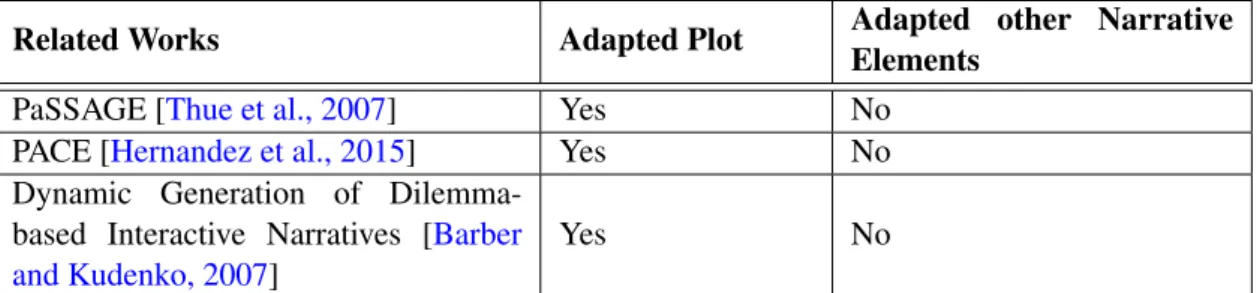
Bidarra, 2011], there has been a considerable amount of works in the field of game adaptivity related to narratives. This section will review and summarize some of the approaches taken by dif-ferent authors to adapt narratives, mainly what components of the narrative they decided to adapt and how they managed the narrative elements in the frameworks developed. A comparison table containing the focused characteristics of the frameworks or algorithms analysed in this section can be seen in table2.1.
In 2007, Thue et al. created PaSSAGE, a system that automatically creates the player model based on his preferred playstyle and uses it to adapt the content of the story to the player [Thue et al., 2007]. PaSSAGE chooses from a library of events the encounters to present to the player. The events contained in the library were previously annotated with which player types they should be presented to, by the author of the story. So the encounters that the player experiences have coherency with each other, all the possible encounters are grouped into the different phases of a
common used narrative structure for video games, the Monomyth from Joseph Campbell [
Camp-bell, 1949]. This way, PaSSAGE can offer the player different encounters to choose from, still forming a believable and coherent story.
Other works in the following years adapt the same narrative elements (the plot of the story) and in a manner inspired by Thue et al. For example, PACE, the framework developed by Hernandez et al. [Hernandez et al., 2015], also has a library of story events annotated with player preferences according to their player model.
Back in 2007, Barber and Kudenko took a different approach. They also create a system capa-ble of generating stories, but based on dilemmas to create dramatic tension [Barber and Kudenko,
2007]. The system is composed of a knowledge base and a narrative generator, that, according to
the knowledge base and a user model, chooses various substories for the player to experience. The narrative generator is responsible of creating an interactive drama, created through a series of sub-stories, each culminating in a dilemma. Each dilemma needs preconditions met; the satisfaction of those preconditions and the final dilemma become then a substory. So, instead of choosing dif-ferent pre-made events, this system creates the events based on a knowledge base, creating several substories that culminate in dilemmas and are linked to each other. The story designer only has to feed the knowledge base the characters, their relations, locations and actions. One of the draw-backs of this system is that it will only work well in generating stories of genres that emphasize
Related Works Adapted Plot Adapted other Narrative Elements
PaSSAGE [Thue et al., 2007] Yes No
PACE [Hernandez et al., 2015] Yes No
Dynamic Generation of
Dilemma-based Interactive Narratives [Barber
and Kudenko, 2007]
Yes No
Table 2.1: Related works in game narrative adaptivity
2.2.4 Conclusions
Narratives in video games are composed of several elements, both non-interactive and interactive. Stories can be told using this media through exposition and non-interactive means but also using the game space and artifacts, in a more interactive way. Most works done in adaptive narratives only adapt the narrative by choosing which events and in which order they should be presented to the player, so they only alter the plot element of the narrative. Some authors chose to generate substories linked to each other to create an entire story [Barber and Kudenko, 2007], while others preferred creating frameworks that choose which events or quests the player will experience [Thue et al., 2007, Hernandez et al., 2015]. From the works reviewed, none decided to adapt other narrative elements, like the spaces where the game takes place, or the setting, or the general mood of the game.
2.3
Player Modeling
Most work done in game adaptivity starts with defining a player model (figure 2.1). Houlette
defines a player model as "essentially, a collection of numeric attributes, or traits, that describe the playing style of an individual player" [Houlette, 2003]. These traits represent the player’s behavior in the game. For example, if we are adapting to each player the amount of weapon consumables that the game should drop throughout gameplay, the traits captured of the player could be "NumberOfGrenadesUsed", "NumberOfArrowsUsed" and so on. With these traits, the game adaptation engine could either try to favor the player by giving them more of their most used consumable or challenge them, by limiting the drops of that same consumable. So, a good player model should capture the main traits of the player that are most important to the type of "adaptation" that we need for the game.
Sharma et al. [Sharma et al., 2010] state that there are two type of player modeling approaches: • approaches that take direct measurements of physiological, psychological or behavioral
data, which they call Direct measurements
• approaches that infer information about the current player based on a previous collection of player features or player actions, which they call Indirect measurements. In this thesis, these kind of measurements will be referred to as Inferred measurements
Direct-measurement approaches for physiological data require that the player is connected to
bio-sensors. An example of direct-measurement approach is that of Caminha [Caminha, 2017],
where he uses biofeedback, such as measures of arousal and valence of the player, to control enemy spawns and guarantee that the player would not show signs of boredom. It is possible to recognize emotion using bio-sensors, such as the work done by Haag et al. [Haag et al., 2004], but it is out of the scope of this thesis.
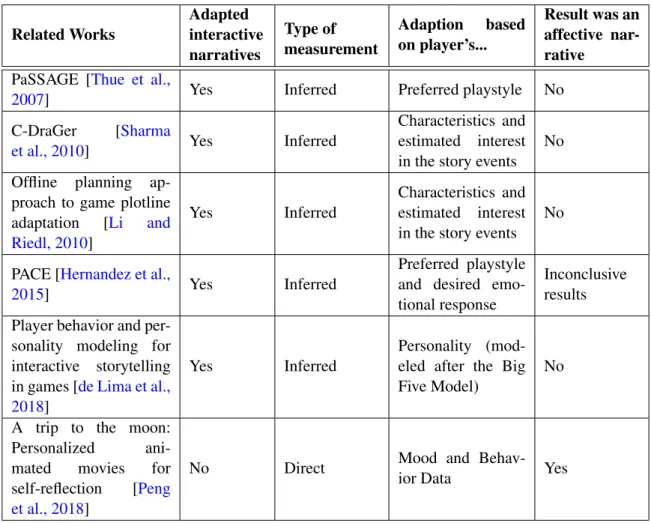
Since the player model used depends on what is being adapted in the game, there are no "off the shelf" models; most models used in game adaptivity are custom made. As a result, this section will mostly be gathering works done in game adaptivity related to game narratives, some already seen in section2.2.3, and analyzing what kind of player models were used. It is also important to remember that the objective of this work is to adapt the narrative to the emotions and feelings of the player, so the player model that will be built needs to focus on those emotive traits. Models that do so will be highlighted in the following section. A comparison table containing the summary of the focused characteristics of each model can be found in table2.2.
2.3.1 Player Modeling in Related Works
This section starts with PaSSAGE, the system created by Thue et al [Thue et al., 2007]. The
main objective of this system was to create game stories that had a greater entertainment value to players, hence the choice of preferred playstyle to model the players. As the basis for their model,
they used the player types from Robins Laws’ rules [Laws, 2002] which include Fighters, Power
Gamers, Tacticians, Storytellers and Method Actors. The model was implemented as weights for the five player types, in which the higher the weight the higher the belief of the model that the player belonged to that type. The model is updated throughout gameplay, based on the player actions and choices. The model used for this work seems to be simple to implement and produced good results, showing that players who played the adaptative version found the game more fun [Thue et al., 2007]. However, this model does not contain the affective makeup of the player, meaning that the player’s emotions were not considered in the narrative’s adaptation.
In 2010, Sharma et al. created a Case-based Drama manaGer (C-DraGer) [Sharma et al.,
2010], that similar to PaSSAGE, adapts the game story in order to improve the player’s experience, by picking story events that are likely to be more interesting to the player. To that end, they created a player modeling module (PMM) that constantly builds and maintains a player model for the current player. The player model contains the player’s characteristics, extracted by his actions during gameplay. The different actions that the player could take were categorized to facilitate comparisons between players. Then, the PMM calculates the "numeric interestingness" of the next possible story event to the player, given their player characteristics. This "interestingness" is calculated based on other player’s opinions, so the PMM works on the assumption that similar players will have similar interests. As with PaSSAGE, this manager showed good results, as the tests done indicated that it improved the player’s experience, especially for inexperienced players. The downside is that C-DraGer was used in a text-based interactive game, where the player actions were limited, and thus, easier to group and compare between players. This approach is harder to
do with other kinds of games. Also, this model does not contain any information regarding the player’s emotions.
Also in 2010, Li and Riedl presented an offline algorithm to plan the story of role-playing
games [Li and Riedl, 2010], by choosing which quests should the user see before they play the
game. The objective was the same as both works above, that is, to improve players’ experience. The approach used to model the player was the same as the one used by Sharma et al. but with two additions: similarity metrics between quests were used to calculate the "numeric interestingness" of quests that were not yet experienced by users and a novelty metric was used to calculate which quests would be appropriately novel to the player (so the player would not experience boredom or unpleasant surprises). Thus, a weighted sum of interestingness and novelty is used to choose which quests should show up in the player’s adventure. Again, this approach also showed good results but the authors do not describe in great detail how they built the player model, leaving doubts regarding how they captured the player’s characteristics before playing the game.
In 2015, Hernandez, Bulitko and Spetch implemented an "AI experience manager" called PACE [Hernandez et al., 2015] and tested it using the game "iGiselle". PACE predicts the emo-tional response of a player to certain events and uses these predictions to keep the player on a "target emotional curve" [Hernandez et al., 2015]. Contrary to the three works presented above, the main objective of PACE is not to improve the players’ experience, although the results show that it is one of the consequences of the adaptation. The user model used by PACE is similar to the one used by PaSSAGE, in that it has information of the inclinations of the player towards certain playstyles. For example, the playstyles used for the "iGiselle" were storytelling, showing off and being modest. Each possible player action in the story changes these values. How it affects them is chosen by the author of the story. The model is then used to predict which story end-goal would be more desirable to the player, based on probabilities provided by the author. These desirability values are used to predict the emotional response of the player for the next possible story events. Finally, PACE chooses the event in which the player will have a predicted emotional response in agreement with the emotional response that the author wants the player to have in that moment of the story. Although showing inconclusive results, this is a clever implementation using a user model that was initially thought out with the objective of increasing the player’s experience; its implementation does not rely on a lot of external data given by the player. Consequently, it relies heavily on author assumptions of the desired goals of each player and the probability of reaching that goal. These manual calibrations of the system are not properly validated and may be one of the reasons why, according to the authors, PACE showed inconclusive results. Yet, this imple-mentation shows promise as one that tries to adapt the story taking in consideration the player’s emotions.
In 2018, de Lima, Feijó and Furtado tried to implement a better player model for adaptation of video game narratives, since the ones implemented for previous works were based on simplified models of player archetypes and failed to represent "blended behaviours" [de Lima et al., 2018]. Their objective was to build a player model that could handle the complex and volatile nature of human behavior. To that end, the player model implemented was constantly updated using time
windowsduring gameplay and it was based on the Five Factor Model (also known as "Big Five") [Goldberg, 1990], which models human personality. To extract behaviours from the personality model, an Artificial Neural Network was used, trained with statistics extracted from gameplay. To determine the player’s personality traits, the authors developed a "Big Five Game Inventory", which comprises of 10 different questions related to the setting of the game, in which the decisions
made by the player are equivalent of answering BFI-10 questions [Rammstedt and John, 2007].
With this method, the player’s Big Five factors are determined through 10 questions that are fast to answer and are related to the game. According to the authors, the resultant player model, which models behaviours and not personality, helps game developers to prepare a game that dynamically adapts to the behavior of the player throughout the game. Although the player model implemented does not cover player’s emotions, the "Big Five Game Inventory" could be used as inspiration for the method of retrieving player’s emotions before gameplay in the context of this thesis’ work.
All the methods reviewed above were inferred-measurement approaches, where the player information was inferred from player actions. From this review, there is little to no work done on video game narrative’s adaptation using direct-measurement approaches to collect psycholog-ical or behavioral data, without the use of bio-sensors. There are, however, works where
direct-measurementis applied, albeit not being in the video game field. The work of Peng et al. [Peng
et al., 2018] adapts an animation to the viewer and is worth mentioning, since it uses
direct-measurementapproaches to adapt the narrative to the emotions and mood of the player, with the
intuit of creating personalized emotional narratives that induce self-reflection. Also, animation is one of the core components of video games and some of its rules and fundamentals are inter-changeable. The way the authors of the paper adapted the narrative of the animation was by col-lecting mood and behavior data for one week for each user. The collected data is directly mapped into character animations and perceived emotions, lighting, environment colors and overall mood. It also affects the order of the story events and the ending of the story. The results showed high engagement and self-reflection behaviours by most viewers, which are also the desired results of this thesis. The kind of data gathered from the users and the way it was shown in the animation can be of use to this thesis main objective. But, since this was done in the non-interactive narrative field, it might be harder to apply the same direct mapping technique between player’s mood and narrative elements in an interactive narrative, due to the unpredictability that naturally arises from user interaction. The users still have to feel that they have freedom to explore by themselves, or else it will feel more like a movie than a game.
2.3.2 Conclusions
From what was gathered, most works done in game narrative’s adaptation are done using
inferred-measurementapproaches. One of the reasons might be because these approaches are able to extract
player features more naturally, that is, the only thing the player has to do is play and their charac-teristics are extracted through their actions in the game. Direct-measurement approaches can be seen as more intrusive and feel less natural to the player. The player has to answer questionnaires or use sensors besides playing the game, which can break immersion. On the other hand, most
Related Works Adapted interactive narratives Type of measurement Adaption based on player’s... Result was an affective nar-rative
PaSSAGE [Thue et al.,
2007] Yes Inferred Preferred playstyle No
C-DraGer [Sharma
et al., 2010] Yes Inferred
Characteristics and
estimated interest
in the story events No
Offline planning
ap-proach to game plotline
adaptation [Li and
Riedl, 2010]
Yes Inferred
Characteristics and
estimated interest
in the story events No
PACE [Hernandez et al.,
2015] Yes Inferred
Preferred playstyle and desired emo-tional response
Inconclusive results Player behavior and
per-sonality modeling for
interactive storytelling
in games [de Lima et al., 2018]
Yes Inferred
Personality (mod-eled after the Big Five Model)
No
A trip to the moon:
Personalized
ani-mated movies for
self-reflection [Peng
et al., 2018]
No Direct Mood and
Behav-ior Data Yes
Table 2.2: Related works on player models for narrative adaptivity
inferred-measurement approaches are only used to adapt the narrative to the personality [Thue
et al., 2007,Sharma et al., 2010, Li and Riedl, 2010] or behavior [de Lima et al., 2018] of the player, with the main objective of increasing the player’s experience and fun. Little to no research was found in adapting a game’s narrative to the player’s emotions and moods with the objective of inducing self-reflection behaviours in the player, like the work of Peng et al. [Peng et al., 2018].
Two possible approaches to reach this thesis goal can be taken from this review:
• use an inferred-measurement approach and instead of modeling the player according to player types or according to the "Big Five" model, research into affective models [Hudlicka, 2008] and try to determine if, from player actions, a correct affective model can be obtained. This approach has the drawback of not knowing if player actions can accurately infer player emotions
• use a direct-measurement approach similar to the one of Peng et al. and, through the results of a questionnaire, directly map those results to narrative elements or to story events. For example, have a set of key story events, and each player would see the events that better reflect their emotional profile. This has the drawback of only being tested in non-interactive narratives, so these key events would have to take in account possible user interaction
2.4
Self-reported Emotion Questionnaires
To adapt the narrative to the players’ emotions, some means of acquiring their emotions had to be found. To this end, some research was done on self-reported emotion questionnaires.
Self-reported emotion questionnaires are usually given out by psychologists to their patients,
as a means of assessing the patient’s emotions [Riopel, 2020]. Three questionnaires were
con-sidered: the Positive and Negative Affect Schedule (PANAS)[Riopel, 2020], the Profile of Mood
States (POMS) [Searight and Montone, 2017] and the Discrete Emotions Questionnaire (DEQ)
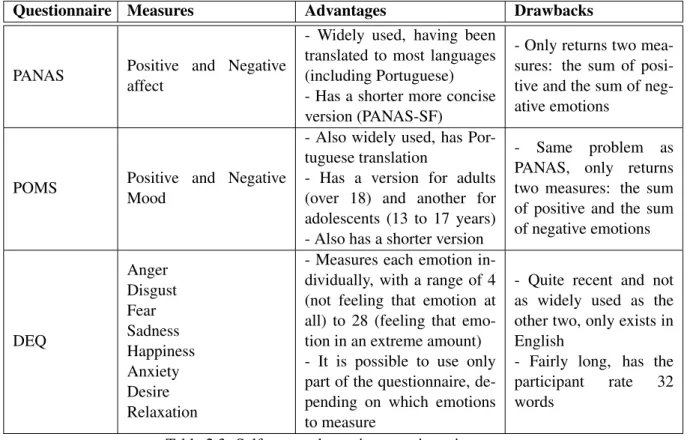
[Harmon-Jones et al., 2016]. The three questionnaires are similar in practice, differing only in what they measure. They consist of different words, each corresponding to an emotion. The pa-tient has to rate each word using a Likert scale, according to how they feel. Then, the score of each measure is calculated by the sum of the rates given to the words that correspond to that measure. This means that each questionnaire returns numerical measures, which is ideal as an input for the framework.
As it is a questionnaire based on words, the native language of the patient and the language in which the questionnaire is written can influence the results, as a person that is not so proficient in a certain language will probably misunderstand the meaning of certain words. Another weakness of these questionnaires is that it uses self-reported values, which are subjective and can be over or under estimated.
What each questionnaire measures, as well as their individual advantages and drawbacks can be seen in table2.3.
Out of the three questionnaires, the DEQ is the one that seems the most useful for the objective of this thesis, as it measures the value of 8 emotions and not only the value of positive and negative affect. With the granularity of 8 emotions, a better narrative can be crafted for each player, as opposed to only using the values of the player’s "good" emotions and "bad" emotions.
2.5
Summary
This research process showed that game adaptivity techniques could be used in order to adapt game narratives, which several works have already done. Game adaptivity often starts by modeling the player and then, according to that model, adapting the contents to the player. Most game elements can be adapted, one of them being the game’s narrative. In order to adapt the game narrative, one needs to know more about how it works and its unique properties. Game narratives share some core elements with narratives in other media, but are specially unique thanks to their balance of interactive and non-interactive components. In fact, developers can tell stories in games, not only through direct exposition, like films and animation, but through the game’s space and artifacts. However, the works reviewed only adapt the plot of the story, without taking into consideration the game’s spaces, setting or even its general mood, which are also part of a game’s narrative. In addition, the player models used for game narrative adaptation only take into consideration the player preferences according to their type or the player’s behavior, extracted through player
Questionnaire Measures Advantages Drawbacks
PANAS Positive and Negative
affect
- Widely used, having been translated to most languages (including Portuguese) - Has a shorter more concise version (PANAS-SF)
- Only returns two mea-sures: the sum of posi-tive and the sum of neg-ative emotions
POMS Positive and Negative
Mood
- Also widely used, has Por-tuguese translation
- Has a version for adults (over 18) and another for adolescents (13 to 17 years) - Also has a shorter version
- Same problem as
PANAS, only returns
two measures: the sum of positive and the sum of negative emotions DEQ Anger Disgust Fear Sadness Happiness Anxiety Desire Relaxation
- Measures each emotion in-dividually, with a range of 4 (not feeling that emotion at all) to 28 (feeling that emo-tion in an extreme amount) - It is possible to use only part of the questionnaire, de-pending on which emotions to measure
- Quite recent and not as widely used as the other two, only exists in English
- Fairly long, has the
participant rate 32
words Table 2.3: Self-reported emotion questionnaires
actions. Almost no works try to adapt the game’s narrative to the player’s emotion and state of mind, and even less have the objective of inducing self-reflection behaviors in the players. This is one of the reasons why this thesis’ results can pave the way for exploring new game design techniques based on reflective designs, with the addition of new forms of generating tailor-made experiences in interactive media.
Therefore, the main objective of this work is to build a framework capable of adapting game narratives to the emotional state and behaviors of the player, so that players can feel reflected by the game and have more engaging experiences. The next chapter presents the proposed architecture for such a framework and details its implementation.
Proposed Solution for the Framework
and its components
Adapting a video game’s narrative to the player’s emotions can lead the player to feel like the game reflects their emotional state, which can make playing that video game a more meaningful and engaging experience. In this chapter, we are going to propose a framework and supporting architecture, and describe its implementation. The framework’s objective is to generate narratives based on emotional profiles, to make gaming experiences more enjoyable and engaging.
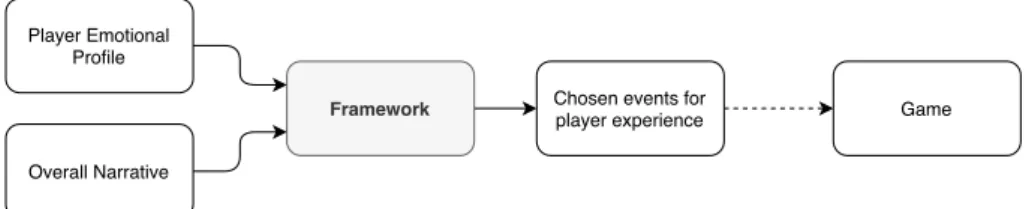
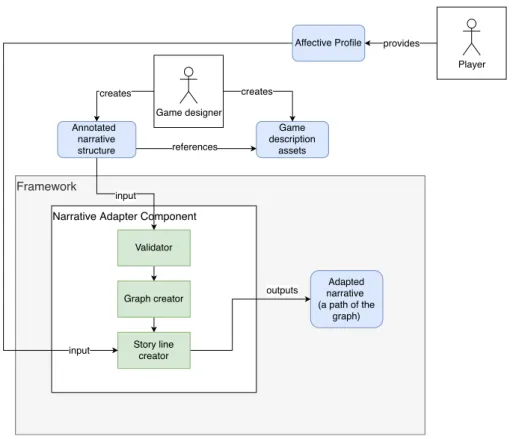
Figure3.1illustrates a simplified overview of a system where the framework would be used.
To be able to adapt the contents, the framework needs two inputs: the player’s characteristics and the narrative as a whole, annotated with adaptivity information. The output of the framework should be the components of the narrative that are chosen for that player to see. These chosen components are then input to the game that will present the adapted narrative.
This chapter starts by describing which decisions were made in the process of building this system (section3.1). Then, it presents the framework’s conceptual architecture and its components in section3.2. After, it specifies how the narrative is represented in the framework (section3.3). After a brief overview of tools and technologies chosen (section3.4), the implementation of each component of the framework is seen in sections3.5,3.6and3.7.
Player Emotional Profile
Overall Narrative
Framework Chosen events forplayer experience Game
Figure 3.1: System overview
3.1
First Steps towards Game Narrative Adaptation
Before building the framework, some decisions had to be made. This section presents such de-cisions in an ordered view, regarding genre and style (3.1.1), elements to adapt (3.1.2), and the adaptation criteria (3.1.3).
3.1.1 Video game genre and narrative style
As defined in section2.2.2, the concept of story is not the same as the concept of narrative: the same story can be told in different ways, thus having different possible narratives. This is no different in the world of video games, and, even in games inside the same genre, the ways of telling
their stories might vary significantly from each other. For example, Dark Souls [From Software,
2011] and Devil May Cry [Capcom, 2001], two game series that fall in the action genre, have
very different ways of communicating their stories. One gives very little information about the world and its characters directly to the player, choosing to tell its story gradually mostly through environmental storytelling. The other has a mission system, where every mission has a non-interactive section where it tells the story (cutscene) and the rest of the mission is mostly just focused on the gameplay.
Although it would be great to build a framework that could work with any video game genre and their specificities, it would be impossible to finish such a task in the given time for this thesis. So, this leads to the first question in developing the framework: which video game genre and narrative style should the framework be built for? The chosen genre was RPG with a narrative
style similar to the story-driven games made in the RPG Maker engine [Enterbrain, 2015]. Some
notable games made with this narrative style include Off [Mortis Ghost, 2008], Ib [Kouri, 2012]
and Pocket Mirror [AstralShift, 2016]. These games are characterized for being 2D games where
the main goal of the game is to unravel the story. The gameplay tends to only include interaction between items and characters, but can also include escape sequences, puzzles, mini-games and battles. Additionally, most of these games’ stories have multiple routes and endings. As I was most familiarized with this game genre and it seemed the most appropriate for the thesis’ objective, this was the first decision taken for building the framework.
Having the genre picked, the next step is to choose which narrative elements should the frame-work adapt to the player.
3.1.2 Narrative elements to adapt
As concluded in section 2.2.4, the narrative elements in a video game can be many, both
non-interactive and non-interactive. The elements to be adapted by the framework were chosen with two constraints in mind: they would have to be characteristic narrative elements from the chosen video
game genre (section3.1.1), and the number and complexity of these elements needed to take into
account the time given for implementation. The chosen narrative elements to adapt were: • Visual elements such as:
– Scenarios/maps
– NPCs, PCs (playable characters) and items disposition in the map, as well as their appearance
• Textual elements such as:
– Dialogues between characters – Items descriptions
– Text in cutscenes • The story and plot in general:
– Which events should the player see – The sequence of those events
– The type of the events - cutscene or gameplay
• In cutscenes, the behaviour (actions and positions) of the characters • The gameplay mechanics:
– Which NPCs and items the player could interact at the moment – Which enemies could be encountered by the player
– What the player should do in order to progress in the game
These were the narrative elements chosen to be adapted to the player. The next decision to be made is how to adapt those elements to the player, by choosing which player characteristics should be the adaptation’s criteria.
3.1.3 Adaptation criteria and the Player’s Affective Profile
To adapt a game to its player, there needs to be some knowledge of the player’s characteristics, defined in section2.3as player modeling. Also mentioned in that section, the player characteristics chosen for that player model must correspond to the type of adaptation being done. Since the objective of this thesis is to adapt the narrative to the player’s emotions, it follows that the chosen player’s characteristics were the player’s emotions. But the "player’s emotions" is a very broad notion, and defining it was one of the first challenges in building the framework; more specifically, which emotions, how to acquire the information about those emotions and how to quantify them in a way that could be used by the framework.
The end of section 2.3.2 contains the two possible approaches to modeling the player that
were considered: an inferred-measurement approach, where the emotions of the player would be inferred from the player’s actions in the game or a direct-measurement approach, where the emotions would be directly collected from the player, e.g. through a questionnaire before the game experience. The chosen approach was the direct-measurement approach, as it seemed to be
the most feasible one, and, as opposed to the inferred-measurement approach, was used at least once by Peng et al.[Peng et al., 2018] for the same effect (emotional adaptation), in all of the reviewed projects in section2.3.1.
To implement this direct-measurement approach, research was done on self reported emotion questionnaires, seen in section2.4. This research on how the player’s emotions could be acquired and measured led to a better understanding of which emotions could be used to model the player. So, the emotions chosen to model the player and to which the narrative is going to be adapted are the emotions measured by the Discreet Emotions Questionnaire (DEQ): anger, disgust, fear, sadness, happiness, anxiety, desire and relaxation. Throughout the rest of this thesis, this set of emotions and their values will be called the player’s affective profile.
3.2
Framework’s conceptual architecture
Framework
Game Component
Narrative Viewer and Debugging tool Narrative Adapter Component
outputs Validator Graph creator sends input Game description assets Game framework input Adapted narrative (a path of the graph) Story Manager engine input input input references Annotated narrative structure Game designer creates creates Player plays provides Story line creator input Affective Profile Validator Graph creator Graph Viewer views overall narrative
/ debugs game input Debug information current scene/event information player input Debug manager
With the video game genre, narrative elements to adapt, and the adaptation criteria chosen, it is possible to start designing and building all the needed components for the framework. Figure
3.2shows a block diagram of the different components of the framework and the system where it
would be inserted, as well as its users.
The framework is composed of three components: the Narrative Adapter component, the Game component and the Narrative Viewer and Debugging tool.
The Narrative Adapter component is responsible for creating an adapted narrative to the player’s affective profile. As an input, it receives a narrative structure created by the game de-signer, which contains all the possible narratives that players can see. This narrative structure is annotated with information about which parts of the narrative can be seen by which players. This component also receives as input the affective profile provided by the player. It outputs the narrative adapted to the player. This component’s workflow is composed of three steps. First, it validates the input given by the game designer (the annotated narrative structure). Then, it creates a graph from the narrative and from that graph chooses the path that is better adapted to the player. Its implementation can be seen in section3.5.
The Game component is responsible for instantiating the adapted narrative and showing it to the player. It receives as input the adapted narrative created by the Narrative Adapter compo-nent and the narrative structure and game description assets created by the game designer. This component is composed of two components, the Story Manager engine and the Game framework. The Story Manager engine reads the annotated narrative structure and the game description assets created by the game designer. Then, according to the adapted narrative created by the Narrative Adapter component, it sends the information of which assets should the game framework instanti-ate and show to the player, depending on which point of the story the player is. The specification of this component can be seen in section3.6.
The Narrative Viewer and Debugging tool is a support tool for the game designer. It allows the game designer to view the narrative that they are writing in its graph form and to debug the narrative while the game is running. This tool is detailed in section3.7.
3.3
Annotated Narrative’s Structure Specification
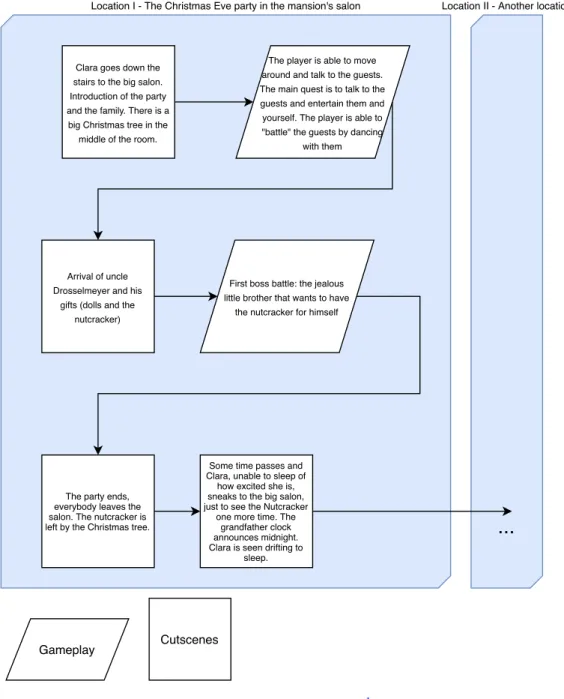
The game designer needs to create all the possible narratives that a player can experience. So that the framework can "understand" the narratives, a language protocol to write the narratives had to be defined. To help, a "toy example" was built, which can be partially seen in figure3.3(the complete "toy example" is available in appendixB).
The toy example as shown in fig3.3represents a game narrative that is composed of:
• Locations - the environment or the map where the events take place (e.g. a mansion, a kitchen, a forest)
• Events:
Location II - Another location Location I - The Christmas Eve party in the mansion's salon
Clara goes down the stairs to the big salon. Introduction of the party and the family. There is a big Christmas tree in the
middle of the room.
Cutscenes Gameplay
The player is able to move around and talk to the guests. The main quest is to talk to the guests and entertain them and yourself. The player is able to "battle" the guests by dancing
with them
Arrival of uncle Drosselmeyer and his
gifts (dolls and the nutcracker)
First boss battle: the jealous little brother that wants to have
the nutcracker for himself
The party ends, everybody leaves the salon. The nutcracker is left by the Christmas tree.
Some time passes and Clara, unable to sleep of
how excited she is, sneaks to the big salon, just to see the Nutcracker
one more time. The grandfather clock announces midnight. Clara is seen drifting to
sleep.
...
Figure 3.3: Toy example1
– Cutscenes - a non-interactive sequence of events which can show conversations be-tween characters and character actions (e.g. walking and talking)
– Gameplay - an interactive sequence of events where the player can interact with objects or other characters, engage in battle with enemies and explore the environment • Actors - all the characters present in the event that can act (NPCs, PCs and enemies) • Transitions - by the end of the last event, the player transitions to another location
This example shows a linear game narrative, which means the narrative would be the same for every player. To support adapting the narrative to the player, some kind of branching needs
to be introduced in the narrative (e.g. happy players will see a branch of the narrative which is different from the branch presented to sad players). The term "branching", when used in the context of video game narratives, means the game has moments where the course of the game can change, usually due to some explicit action of the player. In our context, what determines the different courses (branches) that are presented to the player is their affective profile. In other words, the game narratives created by this framework are linear in the player’s point of view, but have different branches in the game designer’s point of view.
Two different kinds of branching were considered: branching locations (figure3.4) and branch-ing events (figure3.5). Note that, due to keeping the figures readable, the two kinds of branching are shown in separate figures, but they can be used simultaneously in the game narrative.
Location I - The Christmas Eve party in the mansion's salon
Clara goes down the stairs to the big salon. Introduction of the party
and the family.
...
YES NO sadness > 10
Clara goes down the stairs to the big salon.
She doesn't feel like being at the party. Introduction of the party
and the family.
...
Scene I_1 - happy salon
The dance salon looks well lit and nicely decorated with
warm colors.
Scene I_2 - sad salon
The dance salon is decorated nicely but has cold
colors and looks quite sad.
Figure 3.4: Toy example with branching locations
Figure3.4introduces a new concept: scenes. Scenes are different possible implementations of a location. As seen in the example, the same location has two scenes: one for sad players (sadness > 10) and another for the rest of the players. Each of these scenes has its own collection of ordered events. In addition, the scenes are responsible for the imagery of each location, where scene I_1
implements a happier looking salon than scene I_2. This means each scene holds information on how the location looks.
An example of the set of events of a scene can be seen in figure3.5. While the scene is respon-sible for the visual representation of where the events take place, each event holds information of what happens in it, as well as characters and (interactable) items. All events have one or more pos-sible previous events and one or more pospos-sible next events (except the starting and ending events respectively), forming an ordered sequence of events. Two events cannot exist simultaneously, one must end before the other starts. A cutscene event ends when all its actions are finished (e.g. cutscene 1A and 1B end with Clara finishing her walk to the middle of the salon). A gameplay event ends when the player has met the conditions for it to end (e.g. gameplay event 2A ends when the player has finished talking to the Grandma NPC). Apart from their order, all events are designed to be independent from each other, meaning a player action taken in a gameplay event will not influence any event after it. For example, it is not possible to open a special chest at the end of the game with a key that was found in one of the first events. That key would have to be used in the same event that it was picked from. If the aforementioned example would be allowed, this framework would also have to deal with branching caused by player actions. This is one of the limitations of this design, but the events being self-contained and independent help in making branching game narratives more cohesive, still keeping a certain degree of freedom for "mix and matching" events. It also assures the designer that players with the same affective profile will always see the same branch.
Each scene and event has a condition that rules which players will see it. These conditions, as seen in figures3.4and3.5, are composed of the emotions belonging to the affective profile set. A condition can be as restrictive as the game designer wants, by combining any number of emotions from the set. Throughout the rest of this thesis, these conditions will be referred to as the "affective conditions" of an event or scene.
3.4
Tools and Technologies
Before implementing the framework, the tools and technologies were chosen. Since this thesis was made during the COVID-19 pandemic, user testing could not be done in person. So, web technologies were researched to develop the game, so that it could be available for everyone with a computer and an internet connection.
Phaser2 was chosen as the game framework. It is an HTML5 game framework for Canvas
and WebGL powered browser games. It is free and easy to learn. The current version is Phaser 3, which was the one used to develop the game. It has support for the Typescript language, the chosen language to write the game. Phaser was chosen for being a web framework but also for supporting the creation of 2D sprite-based games, with an equivalent feel of the ones made in RPG Maker.
Clara goes down the stairs to the big salon. Introduction of the party
and the family.
Scene I_1 - happy salon
The dance salon looks well lit and nicely decorated with warm colors.
YES
NO anxiety > 8
Clara goes down the stairs to the big salon. She notices people she hasn't
seen in a long time and gets nervous. She sees her grandma and decides
to ask her for advice
The player is able to move around and talk to the guests. The main quest is to talk to the guests and entertain them and yourself. The player is able to "battle" the guests by dancing
with them
Clara talks to her Grandma and feels better. She feels like she can greet the guests now.
happiness > 8
NO
The player is able to move around and talk to the guests. The main quest is to talk to the guests and entertain them and yourself. The player is able to "battle" the guests by dancing with them. Clara receives a gift
from one of the guests which makes her extremely happy.
YES
...
1A 1B
2A
3A 3B
![Figure 2.1: Overview of game adaptivity architectural principles as proposed by [Lopes and Bidarra, 2011]](https://thumb-eu.123doks.com/thumbv2/123dok_br/18911358.936344/24.892.167.687.135.653/figure-overview-adaptivity-architectural-principles-proposed-lopes-bidarra.webp)