MESTRADO EXECUTIVO EM GESTÃO EMPRESARIAL
DEVELOPING AND APPLYING A SMART CITY FOR DEVELOPMENT MODEL
-
THE CASE OF COR IN RIO DE JANEIRO
ALEXANDER KUHL
Rio de Janeiro – 2018DISSERTAÇÃO APRESENTADA À ESCOLA BRASILEIRA DE ADMINISTRAÇÃO
Kuhl, Alexander (2018): Developing and Applying a Smart City
for Development Model –The Case of COR in Rio de Janeiro
Abstract
Purpose: The present thesis addresses how smart city initiatives can positively impact
development, with a special emphasis on developing countries in Latin America. Existing definitions and maturity models have a very strong focus on the mere use of Information and Communication Technology (ICT) and ignore the special needs and factors to be considered in developing countries.
Methodology: By using the extant literature on Smart Cities and Information and
Communication Technology for Development (ICT4D) as a related area from which to learn, a comprehensive Smart City for Development (SC4D) model is introduced and then exemplified via its application to a Latin American smart city initiative.
Findings: The thesis argues that a favorable ecosystem for SC4D is one that is backed by both
national and local sustainability, infrastructure, human capital, services, apps, and data.
Practical implications: Successful SC4D initiatives include bottom-up approaches, citizen
participation, a fit with both the national and the local culture, as well as a fit with the United Nations’ Sustainable Development Goals and the Capability Approach developed by Amartya Sen.
Keywords: Information and Communication Technology, Information and Communication
Technology for Development, Smart City, Development, Capability Approach
Resumo
Objetivo: A presente dissertação analisa como as iniciativas de cidades inteligentes podem ter
impacto no desenvolvimento de países, com ênfase especial nos países em desenvolvimento da América Latina. As definições e os modelos de maturidade atualmente existentes para Cidade Inteligente têm um foco muito forte no uso de Tecnologias da Informação e da Comunicação (ICT), ignorando as necessidades especiais e os fatores a serem considerados nos países em desenvolvimento.
Metodologia: Fazendo uso da literatura existente e da revisão da literatura sobre Tecnologias
da Informação e da Comunicação para Desenvolvimento (ICT4D), como área relacionada, um modelo abrangente de Cidade Inteligente para Desenvolvimento (SC4D) é apresentado e então exemplificado por meio da sua aplicação em uma iniciativa de Cidade Inteligente na América Latina.
Resultados: O trabalho argumenta que um ecossistema favorável para o SC4D é aquele
apoiado pela sustentabilidade nacional e local, infraestrutura, capital humano, serviços, aplicativos e dados.
Aplicabilidade: As iniciativas de sucesso de SC4D incluem abordagens bottom-up,
participação dos cidadãos, adequação à cultura nacional e local, bem como adequação aos Objetivos de Desenvolvimento Sustentável das Nações Unidas e à Abordagem das Capacidades de Amartya Sen.
Palavras-chave: Tecnologias da Informação e da Comunicação, Tecnologias da Informação e
da Comunicação para Desenvolvimento, Cidade Inteligente, Desenvolvimento, Abordagem das Capacidades
Acknowledgements
I would like to thank everyone that supported me during my studies and my dissertation project.
At first, I would like to thank my thesis advisor, Luiz Antonio Joia, for your professional and constructive guidance and sharing the professional insights I needed to deliver a successful project.
Then, I would like to thank the teachers and staff of my universities, Católica Lisbon School of
Business and Economics and FGV EBAPE, for the top-quality education and assistance that
you have provided during my master program.
Finally, and most importantly, I would like to thank my friends and my family, in particular, my grandparents, Marita and Andre Sagante, for your psychological and financial support during my studies: You have made me what I am today.
Table of Contents
1 INTRODUCTION ... 1
1.1 BACKGROUND ... 1
1.2 STRUCTURE OF THE THESIS ... 1
2 RESEARCH PROBLEM ... 2
2.1 RESEARCH QUESTION ... 2
2.2 OBJECTIVES ... 2
2.3 RELEVANCE OF THE SUBJECT ... 2
3 METHODOLOGICAL PROCEDURES ... 3
4 LITERATURE REVIEW ... 4
4.1 ICT4D ... 4
4.1.1 ICTs and the digital divide ... 4
4.1.2 Digital inclusion ... 5
4.1.3 ICTs and development ... 6
4.1.4 Latin American ICT4D initiatives ... 9
4.2 SMART CITIES ... 10
4.2.1 Background and definitions ... 10
4.2.2 Characteristics and success factors ... 11
4.2.3 Maturity models ... 13
4.2.4 Latin America’s smartest cities ... 16
5 DEVELOPING AN SC4D MODEL ... 18
5.1 VISION FOR SC4D ... 18
5.2 RATIONALE FOR DEVELOPING AN SC4D MODEL ... 20
5.3 THE SC4D MODEL ... 21
5.4 COMPONENTS OF THE SC4D MODEL ... 22
5.4.1 Sustainability ... 22
5.4.2 Infrastructure ... 23
5.4.3 Data, apps and services ... 24
5.4.5 Contextual fitness ... 25
5.4.6 Development ... 26
5.4.7 Empowerment and participation cycle ... 26
6 APPLYING THE SC4D MODEL TO A SMART CITY INITIATIVE: IMPROVING PUBLIC SAFETY IN RIO DE JANEIRO ... 28
6.1 DESCRIPTION OF THE SMART CITY INITIATIVE ... 28
6.2 ANALYSIS OF THE SMART CITY INITIATIVE USING THE SC4D FRAMEWORK ... 29
7 CONCLUSIONS ... 32
7.1 MANAGERIAL IMPLICATIONS AND IMPLICATIONS FOR PUBLIC POLICY ... 32
7.2 ACADEMIC IMPLICATIONS ... 32
7.3 LIMITATIONS OF THE STUDY AND FURTHER STEPS ... 33
8 APPENDICES ... 34
List of Tables
Table 1: Characteristics of extant smart city maturity models and the SC4D model ... 20
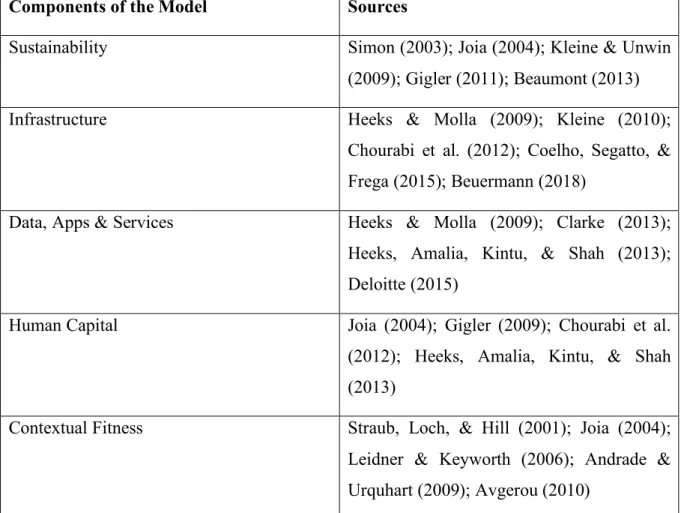
Table 2: Components of the SC4D model ... 27
List of Figures
Figure 1: The Dynamic Infoinclusion Model ... 6Figure 2: The Choice Framework ... 8
Figure 3: A unified definition of a smart city ... 11
Figure 4: Smart city initiatives framework ... 13
Figure 5: Smart City Capability Framework ... 14
Figure 6: Smart Cities Maturity Model ... 15
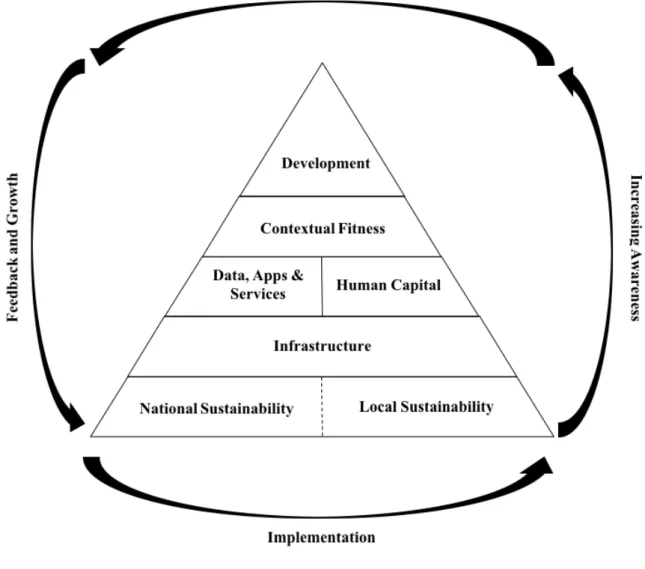
Figure 7: The Smart Cities for Development (SC4D) model ... 22
List of Abbreviations and Acronyms
BOP Bottom of the Pyramid
br-SCMM Brazilian Smart City Maturity Model BRL Brazilian Real
BRT Bus Rapid Transit COR Center of Operations Rio
ICT Information and Communication Technology
ICT4D Information and Communication Technology for Development IDB Inter-American Development Bank
IDC International Data Corporation IoT Internet of Things
IT Information Technology
OECD Organization for Economic Co-operation and Development PPP Public–private partnership
SC4D Smart Cities for Development SDGs Sustainable Development Goals UN United Nations
1 Introduction
1.1 Background
While the study field of ICT has been receiving increased attention and significance throughout the past few decades, the conventional wisdom has become that, if they are conducted efficiently, ICT projects in the public sector enable citizens to access services of higher efficiency (Bussell, 2011). In developed countries, this translates into increased productivity, whereas in developing countries the impact of ICT4D is far more meaningful and may, for instance, help eradicate poverty, handle problems related to climate change or enable people’s inclusion in economic, social and political life (Heeks, 2009).
Recently, a topic closely related to ICT and ICT4D has emerged: the idea of making cities smarter by leveraging the benefits of the digital age has been spreading both in academics and in practice. According to Lee, Hancock, & Hu (2014), as of 2012, there were around 143 self-declared smart city projects worldwide, most of which were located in Europe, North America and Asia, while South America had only eleven ongoing smart city projects at that time. These numbers show that the relevance and existence of smart city initiatives are higher in developed than in developing countries. Yet, at the same time, smart cities have a lot of potential to foster sustainable development in developing countries – a potential that is not being completely achieved so far. And worse, structural problems might even extend the gap between this potential and the reality (Estevez, Lopes, & Janowski, 2016).
In that context, the present paper sheds light on the situation in Latin America and provides a framework that may support policymakers in recognizing the opportunities and threats underlying extant or further smart city initiatives that aim to foster the development of the respective developing country.
1.2 Structure of the thesis
After those introductory remarks, in section 2, the research problem or underlying research questions are stated, the objectives of the study are outlined, and the relevance of the subject is justified. In section 3, the methodology of the study is described. In section 4, the theoretical background for the study is set, by the provision of a literature review for both ICT4D and smart cities, while already laying the focus on Latin American initiatives. Based on that theoretical background, section 5 sets a vision for Smart Cities for Development (SC4D) and thereby paves
the way towards an SC4D model, which is introduced and elucidated. In section 6, said SC4D model is applied to an example – a Latin American smart city initiative – in order to illustrate the model’s functionality and implications. The paper finishes by drawing conclusions in section 7 that include academic, managerial implications and implications for public policy, as well as the research limitations and further steps that ought to be taken following this study.
2 Research problem
2.1 Research question
The main focus of this thesis lies on the following research question:
How can smart city initiatives impact development in Latin American developing countries?
2.2 Objectives
The main objective of this study is to find out how smart city initiatives should be designed in order to have a positive impact on development in developing countries, with a special focus on Latin American ones. There are several auxiliary objectives that underlie and support the main one, namely:
• to provide an extended literature review on ICT4D and smart cities, with special focus on current Latin American initiatives, a definition for the term “smart city” and an overview of extant smart city maturity models
• considering the developed literature review, to define key success factors granting smart city initiatives’ positive impact on development in developing countries
• based on these key success factors and extant models – by illustrating and considering their strengths and weaknesses –, to develop an SC4D metamodel
• as an example, to apply the proposed SC4D model to a Latin American smart city initiative
2.3 Relevance of the subject
The subject of this thesis is relevant for several reasons. On the one hand, it is scientifically relevant. There are many definitions of what a smart city is and a number of smart city maturity models that try to explain the components necessary for smart city initiatives and process steps in reaching the goal of establishing a smart city. However, there is a lack of a model that offers a holistic approach targeted specially to address developing countries. Current smart city
research and models fail to take into account that the success factors for smart city initiatives in developing countries may differ from those in developed countries. Besides, little research with a special focus on Latin American initiatives has been conducted so far. Thus, this thesis is designed to partially fill these mentioned research gaps. On the other hand, the subject of this paper has a social and practical relevance for various stakeholders, namely:
• government officials and project managers of extant Latin American smart city initiatives, since they are given a tool to utilize in the evaluation of current projects, which might help them find inefficiencies underlying the ecosystem of those projects • government officials that consider implementing smart city initiatives, since this thesis
enables them to visualize the requirements, opportunities and possible pitfalls associated with the introduction of such initiatives within the local context wherein they are acting
• the private sector, since innovative businesses can form an important part of smart city initiatives and might use the model proposed in this thesis in order to find out space for improvement and, consequently, develop solutions to the problems revealed by an application of the model
• citizens of cities in developing countries, since it is ultimately them, particularly the most underprivileged ones, who are supposed to profit from SC4D initiatives and thus from the results of this study
3 Methodological procedures
The methodology supporting this thesis development involved four main undertakings or research stages. These are as followed:
1. Literature review: to identify and discuss the most significant research literature that treats the smart city field, including ICT4D as an essential background for the idea, the definition and concepts of a “smart city”, as well as smart city maturity models. Underlying research steps are the definition of data sources, the selection of keywords for the search of relevant publications, a qualitative analysis to detail the principal outcomes from the research literature and a sum-up of the findings.
2. Model development: built upon the knowledge taken from the literature review, a vision for SC4D and its conceptual framework are determined. Then, considering this vision, the structure of a conceptual framework for SC4D is created. This model aims to guide
how smart city initiatives in developing countries must be designed by governments and supported by ecosystems in order to lead to the desired positive impact on development. 3. Model application: having brought up an overview of smart city initiatives in Latin America, to determine which one of these initiatives serves as an appropriate example and to apply the conceptual framework defined in the previous stage to this example. This stage includes a qualitative analysis of the selected example considering each of the elements of the SC4D model, as well as a summary of the findings.
4. Synthesis: to sum up the findings of the study and make recommendations in terms of managerial, public policy and academic implications.
4 Literature Review
4.1 ICT4D
4.1.1 ICTs and the digital divide
The opportunities of easily and quickly accessing global information and communicating globally have become widespread since the beginning of the 1990s, mostly among developed countries (Atkinson & Castro, 2008). This trend has its roots in the implementation of ICT, which is defined as “all technical means used to handle information and aid communication. This includes both computer and network hardware, as well as their software.” (Eurostat, 2016) The rise of ICTs has led to the take-off of the so-called digital economy leading the world to enter into a fourth industrial revolution featured by exponentially rising processing and storage capacities and widely accessible knowledge (Baller, Dutta, & Lanvin, 2016). Hence, states and political institutions of the Western world have attributed a high importance to ICTs in their agendas. For instance, the European Commission (2018) acknowledges that ICTs can foster innovation and competitiveness within both the private and the public sector and thereby bring about a significant positive impact in terms of growth and creation of jobs.
Although this might be true for developed countries, people in the global south are running into danger of being left out from the digital revolution (Wilson, 2006). Intents to bridge this digital divide – the gap between those with regular, effective access and ability to use digital technologies and those without – have resulted in measures supporting the deployment of mobile networks all over the globe (Boyera, 2007). However, while the availability of mobile-telephone services has become ubiquitous as close to 100 percent of the world population is
covered by a mobile signal, not everyone has a mobile phone and worse, by the end of 2013, there were just about 2.7 billion worldwide internet users, which means that the vast majority – 4.4 billion people – was not online yet (International Telecommunications Union, 2013). This is why, nowadays, the digital divide is growing, while people in developing countries are at most partially participating in the information society and benefiting from ICTs (Avgerou & Madon, 2005).
4.1.2 Digital inclusion
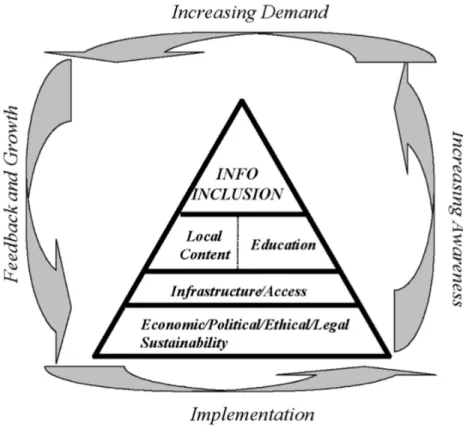
Digital inclusion is a necessity resulting from the growing digital divide and is “a framework for assessing and considering the readiness of communities to provide access to opportunities in a digital age”; to ensure digital inclusion means to provide access to ICTs by making them both available and affordable, to adopt ICTs by improving digital literacy, and to apply ICTs in different areas, such as the economy, education, healthcare and civic engagement (Digital Inclusion Survey, 2018). At the same time, merely making ICTs available is not enough and the political, social, cultural and institutional environment needs to be taken into account, too, since these are factors that influence the access to ICTs and the ability to make effective use of them (Warschauer, 2003). In this context, Joia (2004, 2006) provides a model that includes the key success factors and process that should underlie the promotion of digital inclusion in a country. According to that model, the primary requirement is economic, political, ethical and legal sustainability, meaning that the government’s actions need to support a favorable ecosystem. Secondly, infrastructure and access need to be made available. Thirdly, local content and education must be provided, while both of these need to be relevant and customized for the needs and interests of the local community or target group with the particular objective of empowering socially excluded groups. Lastly, the model emphasizes on digital inclusion as a process that is supposed to be a dynamic one. Said model therefore features a so-called virtuous participation and empowerment cycle, which includes four stages: at the first stage, an ICT initiative and corresponding tools are implemented; subsequently, at the second stage, people become increasingly aware of the possibilities and benefits connected to these tools; this ought to lead to the third stage, in which current participants increase their demand for the implementation of further tools, applications and IT infrastructure in general; consequently, at a fourth stage, those people that are already included in the process give feedback on it and, at the same time, have a feeling of involvement and empowerment, while the number of new users grows as well (Teles & Joia, 2011).
Figure 1: The Dynamic Infoinclusion Model (Joia, 2004)
4.1.3 ICTs and development
The idea of ICT4D covers but is not reduced to the aim of digital inclusion: apart from the relevance of ICTs for closing up on the digital divide, the United Nations Economic and Social Council (2006) emphasizes the potential impact on the social and economic development of a country related to ICTs that, if applied in a strategic matter, can lead to increased growth, create income sources for poor people and reduce poverty thanks to an improved global competitiveness of the country’s economy. In addition to such social and economic aspects, the European Parliament (2015) mentions the possibility of better outcomes in the areas of healthcare and education for developing countries that make use of ICTs. Thus, in a wider sense and as per Heeks (2009), ICT4D means using ICTs for international development or, more specifically, harnessing digital technologies in the service of the world’s most pressing problems and addressing the needs of the poor. In regard to the latter, it is argued that ICT4D initiatives should be inclusive – including the poor in improved services and opportunities –, enabling – supporting policies that improve the lives of the poor – and focused – aiming at the
poor’s rights, interests, and needs –, yet at the same time sustainable, scalable and effective (OECD, 2009).
While ICT initiatives have in the past mainly focused on tangible benefits of ICTs that are easily measurable and quantifiable, Gomez & Pather (2012) make the case for a shift in that focus towards intangible benefits, such as empowerment, self-esteem, and social cohesion, since these are more important from a developmental perspective. Thus, Gomez & Pather (2012) unveil the following three stages in the deployment of ICT4D initiatives:
• an early stage or euphoria stage, which is characterized by quantifiable and tangible outputs, such as the number of computers, number of users, rate of bandwidth consumption or e-literacy rate;
• an intermediate stage or instrumental stage, which is characterized by measurable, mostly tangible and economic outcomes, such as income generation or business opportunities;
• a mature stage or intangible stage, which is characterized by unquantifiable, intangible impacts or aspirational outcomes, such as empowerment, self-esteem and self-worth, social cohesion and social fabric, citizen empowerment in form of an improved relationship with governments, as well as individualized motivator factors like achievement and recognition.
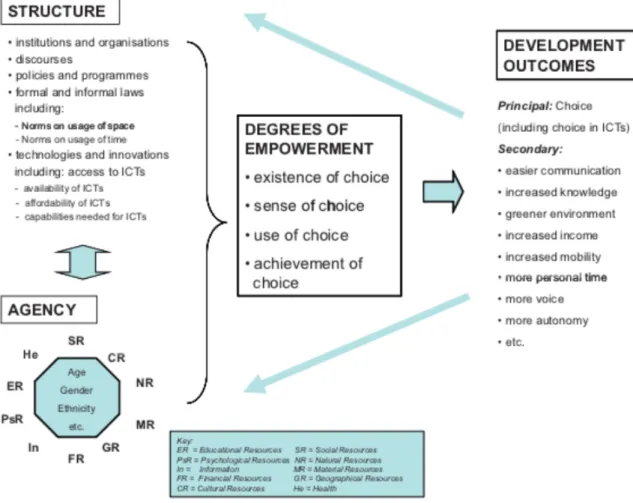
A similar approach to the evaluation of ICT4D initiatives is offered by Kleine (2010), who argues that instead of trying to make ICTs fit with a linear conceptualization of impacts and an often economistic view of development, an ICT4D endeavor is a development process that needs to be analyzed in a holistic way based on Amartya Sen’s capability approach. According to Sen (1979, 1989, 1999), development should be seen from the perspective of individual freedom rather than as mere economic growth. In this context, capabilities are factors that determine the freedom of choice regarding the question of how to live one’s life. They are therefore the central element to consider in the assessment of human development. Relating this capability approach to the topic of ICT4D, Kleine (2010) provides a so-called choice framework that puts choice – with different degrees of empowerment being the existence, sense, use, and achievement of choice – as a principal development outcome and benefits in communication, knowledge, environment, income, mobility, personal time, voice and autonomy as secondary ones. Inside this framework, ICTs are only regarded as one of several important inputs, which also include institutions and organizations, discourses, policies, as well
as formal and informal laws. This is in line with the idea that ICTs are unable to improve peoples’ lives and to contribute to human development unless their use occurs within broader strategies that are tailored to make the most use of these tools and techniques (Hamel, 2010). Figure 2: The Choice Framework (Kleine, 2010)
Eventually, the application of the capability approach to ICT4D has not only remained an academic idea but also been put into practice, for instance, with regard to the World Bank’s development strategy: instead of solely considering new technologies and the introduction of such, the focus of ICT4D projects increasingly lies on people and on how a meaningful use of ICTs enhances both the individual human capabilities and the collective social capabilities inside a community (Gigler, 2011). This focus on the people should also be considered in the initial design of ICT4D initiatives and the way in which they are directed: while top-down approaches may be necessary to create a favorable environment for the use and diffusion of ICTs, there is a need for more and innovative bottom-up approaches, since it is crucial to include and empower local stakeholders in order to create ICT4D projects that are actually sustainable (Pedrelli, 2001). Instead of a supply-driven focus that marginalizes the poor and regards them as passive consumers, ICT4D initiatives must be characterized by a demand-driven focus, by
putting the poor into the center and leveraging their potential to innovate and produce ICT services and content (Heeks, 2008).
4.1.4 Latin American ICT4D initiatives
Regarding the availability and distribution of ICTs, Chile, Costa Rica, Brazil, Panama, and Colombia are the five top-ranked countries in Latin America; yet, when compared internationally, the region still lacks behind more advanced ones (International Telecommunications Union, 2013). Consequently, in the past Latin American countries have been the target of a number of ICT4D initiatives, mostly conducted in rural areas. Some examples and their implications include:
• Internet supply and usage in rural Bolivia (Gigler, 2009): This study underlines that the influence of ICT initiatives on people’s well-being in rural areas is primarily determined by political, social and cultural factors and only secondarily by economic and technical ones. It turns out that a majority of the rural poor do not use the internet in their communities, but rather at public access points in close-by towns or cities. The results imply that the knowledge of how to use and benefit from ICTs is even more important than an easy access to them.
• Telecentres in rural Chile (Kleine, 2010): This study exemplifies the significance of an access to ICTs from a capability approach standpoint. It shows that, apart from the advantages in terms of business usage for micro-entrepreneurs, telecentres are also important regarding personal usage. By providing the opportunity to communicate with relatives or friends independently from their location, people’s level of choice inside these rural areas was dramatically increased.
• Information-seeking behavior in rural Peru (Andrade & Urquhart, 2009): This study emphasizes the importance of regarding information-seeking behavior as a social construct in a cultural context. It finds a critical role of certain individuals within communities when trying to popularize ICTs. These individuals were typically people who enjoyed sharing information or had larger networks than their peers.
• Mobile phone coverage in rural Peru (Beuermann, 2018): This study proves positive effects of mobile phone coverage on economic development. It suggests that mobile phone expansion significantly increased household real consumption and significantly decreased poverty incidence and extreme poverty in Peruvian villages.
• Developing an IT cluster in Brazil (Coelho, Segatto, & Frega, 2015): This study, conducted not in a rural area but in a city, claims that by expanding education offers related to ICTs and by actively promoting ICTs, the awareness for these technologies and their benefits can be raised. This can be useful for the whole population, especially for low-income people, since it empowers them and gives them the choice to take part in and benefit from ICTs.
4.2 Smart cities
4.2.1 Background and definitions
According to the United Nations (2008), nowadays the resource and energy consumption, economic importance and environmental footprint of cities are dramatically high. Moreover, while more than 50 percent of people worldwide were already living in urban areas by 2008, this figure is expected to further rise to 70 percent by 2050; in Europe, about 80 percent of people are already living in urban areas, and both the mentioned changes and their impacts are going to be much more significant in regions such as Asia, Latin America, and Africa, where the diffusion of megacities of more than 20 million people is already a reality (United Nations, 2008).
In light of this, cities worldwide are required to become “smart”, or in other words, to find intelligent and innovative ways to tackle these upcoming challenges effectively (Chourabi et al., 2012; Monzon, 2015). However, the definition and purpose of a so-called smart city have led to controversy in Academia, having a variety of proposals on this matter. Albino, Berardi, & Dangelico (2015) offer an extended overview of the literature regarding a smart city definition. In fact, there is no one-size-fits-all definition, neither for the smart city term nor for the successful conceptualization of a smart city (O’Grady & O’Hare, 2012). What is noteworthy is that while at the beginning, most of the definitions of smart city had a very strong focus on the diffusion of ICTs and tended to disregard the importance of other crucial factors besides technology, recent approaches have shifted towards the needs of people and communities (Albino, Berardi, & Dangelico, 2015), such as the quality of life (Batty, et al., 2012). Indeed, it is important to acknowledge that within the concept of successfully creating a smart city, ICTs are just one thread in the system as the deployment of such must follow an integrative and multi-dimensional approach (Repko & De Broux, 2012). In a truly smart city, adopting new technologies is not an end in itself as innovation in technology must be complemented by
innovation in management and policy (Nam & Pardo, 2011). Besides, progressive smart city initiatives must start with the focus on human capital – people, their interaction, knowledge, skills, and participation – rather than with the blind belief that ICTs can automatically transform and improve cities (Hollands, 2008). Considering both the traditional and more modern theories as well as more than 36 extant definitions of the smart city term, Ramaprasad, Sánchez-Ortiz, & Syn (2017) provide one of the most recent approaches – in form of a detailed modelization – for a unified definition of a smart city and come to the result that there are 25200 potential components of a smart city: the more components a city is composed of, the smarter it is.
Figure 3: A unified definition of a smart city (Ramaprasad, Sánchez-Ortiz, & Syn, 2017)
According to that model, there is a number of possibilities regarding the structure, functions, focus, semiotics, stakeholders, and outcomes of smart city initiatives. Their different combinations lead to the before mentioned high number of potential components, which – despite the comprehensiveness of the definition offered by Ramaprasad, Sánchez-Ortiz, & Syn (2017) – illustrates once more the general complexity and vagueness related to a universal definition and conceptualization of smart cities.
4.2.2 Characteristics and success factors
Giffinger & Gudrun (2010) provide the following six characteristics by which smart cities can be measured and compared.
• Smart economy: the level of competitiveness of a city, entrepreneurship, innovation, global connectedness, and productivity
• Smart people: the existing social and human capital in a city, including the level of education and creativity
• Smart governance: to which extent a city promotes e-government, e-democracy, transparency and the participation of citizens
• Smart mobility: how ICTs are used to improve and modernize the transport systems, logistics, and infrastructure in a city
• Smart living: the quality of life in the city considering cultural aspects, happiness, safety, and health
• Smart environment: the use of natural resources, level of sustainability and environmental friendliness
While this is a method of analyzing cities in general, an approach that focuses on individual smart city initiatives, in particular, is offered by Chourabi et al. (2012). Accordingly, there is a framework of eight dimensions that may be used as a basis to determine the success factors of a smart city initiative.
The three central dimensions are:
• Management and organization: includes skills, expertise, training, leadership, goal-setting and milestones, end-user involvement, stakeholder involvement, funding, planning, and communication; success stories of e-government and IT projects can be taken as a role model
• Policy context: institutional readiness is required and possible legal, regulatory, environmental and institutional – both formal and informal – challenges to the introduction of new ICTs have to be taken into account
• Technology: ICTs are the key drivers and components; their introduction needs to be combined with the spread of IT skills and organizational solutions such as cooperation, coordination, a clear vision, political support and cultural compatibility
The remaining five dimensions, surrounding the three central ones, are:
• Governance: stakeholder relations are in the center of this dimension; required is collaboration, leadership, participation, public-private partnerships, communication, data-exchange, service and application integration, accountability and transparency • People and communities: the needs of individuals, groups, and communities must be
met; participation, partnership, communication, education, accessibility, bridging the digital divide and focusing on the quality of life are factors to be considered
• Economy: the major driver of smart city initiatives; they aim to create jobs and businesses, develop the workforce and improve productivity
• Built infrastructure: the presence of a functioning ICT infrastructure is the basis for any smart city initiative; this includes the protection against security and privacy threats, an
adaption of the IT systems to make them compatible and integrated, as well as the control of operational costs to keep them from skyrocketing
• Natural environment: how natural resources are managed has a direct impact on sustainability and livability
Figure 4: Smart city initiatives framework (Chourabi, et al., 2012)
4.2.3 Maturity models
When a smart city initiative is planned and executed, it goes through various stages throughout the implementation process. This process can be described by maturity models addressed in this section.
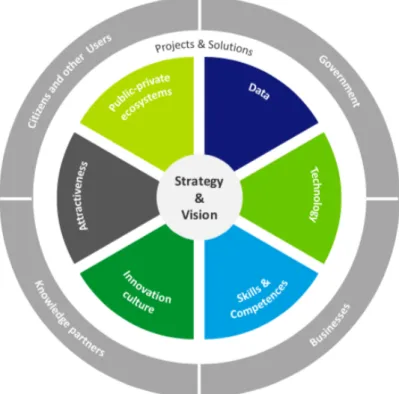
Firstly, this topic is addressed in a rather non-academic and practical way by consultancy firms. The most extended maturity model that can be openly accessed is proposed by Deloitte (2015). Having a strategy and vision is the central element of this maturity model in whose definition all stakeholders, such as citizens and other users, the government, businesses and partners in knowledge, must be involved. The surrounding capability dimensions are data, technology, skills and competencies, innovation culture, attractiveness and public-private ecosystems. Over the course of the four stages that a project goes through – “initial”, “intentional”, “integral” and, eventually, “transformed” – some of these dimensions and other factors change and develop. While the strategy is operational and the vision blurry at the beginning, throughout the process the strategy becomes more user-centric and stakeholder-centric and the vision clearer and, at a
final stage, continuously optimized. Projects become less experimental and bureaucratic and agiler over time. Data analytics gets more and more sophisticated, with a single data hub as the end goal to ensure quality and enable real-time use throughout the whole city and all of its institutions. In terms of technology, the city moves from fixed and mobile broadband networks to an Internet of Things (IoT) platform and eventually ensures a city-wide deployment of connectivity infrastructure and sensors networks. Furthermore, throughout the process existing skills and competencies are extended and complemented by external sources. A rather close-minded and risk-averse approach is increasingly replaced by openness and creativity. Last not least, regarding the ecosystem, the government organization transforms itself over time and becomes more open to partnerships and the inclusion of the private sector.
Figure 5: Smart City Capability Framework (Deloitte, 2015)
Secondly, a different yet also practical approach, targeted at cities for the conduction of a self-analysis, on maturity levels for smart cities is proposed by the International Data Corporation (IDC) (Clarke, 2013) and similarly adopted, for instance, by the Scottish Government that uses it as part of an active promotion of smart cities within the country (Urban Tide, 2014). Regarding the IDC’s proposal, five key dimensions – strategic intent, culture, process, technology, and data – are mentioned, as well as five stages that these dimensions pass through during the maturity process of a smart city – “ad hoc”, “opportunistic”, “repeatable”,
“managed” and “optimized”. As part of the maturity process, over time an initially non-existing strategy develops, including clear goal-setting and an increasingly holistic leadership approach. It moves from single departments towards an optimized cross-city tactic that involves continuous feedback. With regard to the dimension of culture, governments move from a risk-aversion towards an innovation culture and increase citizen engagement over time using more and more channels. The process dimension relates to the rise in a centralization of governance and to public-private partnerships (PPP) that become less of a government-dominated provider-supplier relationship and rather an actual cooperation between a number of actively participating stakeholders. Centralization takes place as well within the technology and data dimensions, where decentralized systems are integrated step by step and a consistent broadband infrastructure is adopted in order to provide real-time data and make information ubiquitous, open and personalized.
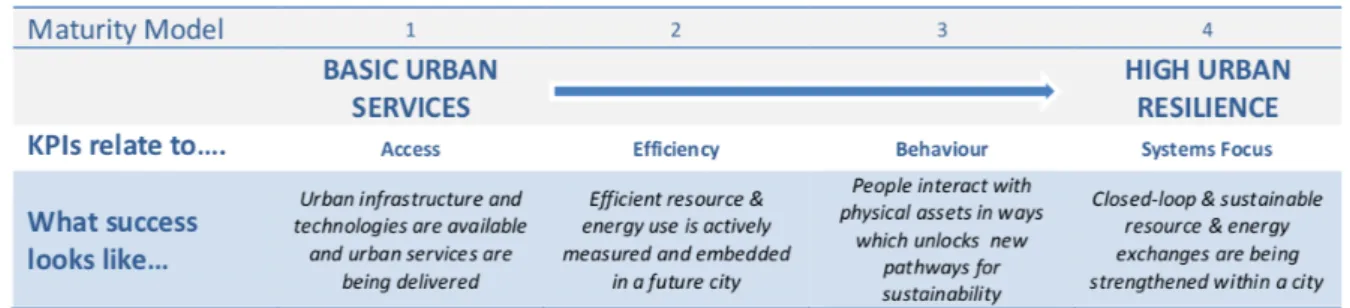
Thirdly, in criticism of the focus of most smart city maturity models on the access to services and infrastructure, Sustainability Outlook (2014) offers a different maturity model by which a city’s shift from basic urban access to high urban resilience is described in four levels. The first one is “access”: Infrastructure and technologies are available, and services delivered. Reaching the second level, “efficiency”, requires that the use of resources and energy is actively controlled and measured. On a next level – “behavior” – people in the city interact with the physical assets and hereby, new opportunities for sustainability are created. At a fourth, mature level – “system focus” – the city is able to strengthen sustainable resource and energy practices.
Figure 6: Smart Cities Maturity Model (Sustainability Outlook, 2014)
Lastly, an approach from Latin America – the Brazilian Smart City Maturity Model (br-SCMM) – is offered by Afonso, Brito, Nascimento, Garcia, & Álvaro (2015) who aim to measure and compare the inequality in Brazilian cities and do so by using a scale from zero to five to measure the status of a city in areas such as water, health, education, energy, governance, housing, environment, security, technology and transport. The overall score that a city achieves in a certain area depends on a set of questions, such as whether the city reaches threshold scores for
basic indicators, has goals and practices pointing at an optimized resource management, uses a maturity model to establish public policies, measures established strategic indicators and reaches desired results in the measurement of these strategic indicators.
4.2.4 Latin America’s smartest cities
Although smart cities have been more common and numerous in the Western and developed world, a few have been rising up in Latin American countries as well, despite only making up for one percent of smart cities worldwide (Cocchia, 2014). The ones in the region that are considered to be the smartest ones are Santiago de Chile, Mexico City, Bogota, Buenos Aires, Rio de Janeiro, Curitiba, Medellin and Montevideo (Cohen, 2013).
Santiago de Chile is constantly highly ranked in smart city rankings, mainly due to its leadership role in Latin America and worldwide with regard to e-government and the advanced usage of ICTs in public administration management (Smart City Business Institute, 2015). It is situated in a country with regionally compared low corruption, low inflation, and a stable economy and what’s more, the city has become an entrepreneurial hotspot thanks to a program called Startup Chile and is also smart in terms of mobility, with some of the features being an effective metro system, bike-sharing, a car-sharing pilot project and automated toll pricing on highways (Cohen, 2013).
Mexico City, with its open data initiatives, has become the region’s leading force in smart governance and is also advancing in the areas of smart environment – due to the promotion of smart and green buildings – and smart mobility – thanks to a sophisticated bike-sharing and the region’s first scalable car-sharing program (Cohen, 2013). There is a public policy on smart cities that involves an agenda towards a digital and knowledge-based city and a law underlining the use of ICTs in public administration, which has, for instance, led to the development of a system that integrates and centralizes health care information and the deployment of surveillance cameras. In the latter, citizens are engaged by being able to give their opinion on where those cameras should be placed, while open data systems further enable citizen engagement (Smart City Business Institute, 2015). Speaking of security, Mexico City is not only considered to be a pioneer in the region because of the surveillance cameras but also thanks to the implementation of an administration system for traffic incidents and an intelligent monitoring system for disasters, the environment and the electricity network (Escalona, 2017). Colombia has two cities that are considered to belong to the smartest of the region. Regarding Bogota, this city’s highlight is its integrated public transportation system that offers a high
travel speed at low costs and has thus significantly improved mobility (Bouskela, Casseb, Bassi, Luca, & Facchina, 2016). Besides, the city has established a center for security issues, in which thousands of surveillance cameras are integrated, a monitoring network for air quality and meteorological events, as well as an online application through which citizens can check ongoing leisure and cultural activities (Instituto de Estudios Urbanos, 2017). When it comes to Medellin, the outstanding feature of that city is its smart urban mobility system, which has significantly contributed to a decrease in traffic accidents by using ICTs to capture traffic information and detect violations, while also engaging citizens via online services, such as mobile applications and social media (Bouskela, Casseb, Bassi, Luca, & Facchina, 2016). Medellin’s metro system and supply of public bicycles further enhance mobility, and the city’s citizen engagement is not reduced to mobility, but generally encouraged, for example by the launch of a platform called “Mi Medellín”, on which ideas and opinions on projects in the city can be shared (Instituto de Estudios Urbanos, 2017). Besides, to ensure that everyone in the city is included and the benefits of ICTs and a smart city, Medellin provides training to people from its poorest areas (IEEE Smart Cities, 2018).
Likewise, Brazil also has two of the region’s smartest cities. One of them is the city of Rio de Janeiro, which increasingly uses applications to interact with its citizens, thus taking public administration online and making it more efficient (Bouskela, Casseb, Bassi, Luca, & Facchina, 2016). However, the city’s flagship project is the Center of Operations Rio (COR) which involves 30 government agencies and enables centralized and integrated monitoring in order to be able to quickly respond to crises, especially regarding meteorological events; furthermore, the city promotes digital inclusion by providing public centers throughout the city and encourages citizens to engage and create ideas and apps for the city through organized contests (Weiss, Bernardes, & Consoni, 2017). The other smartest Brazilian city is Curitiba, mostly because of intelligent solutions in environment – the city is considered to be the greenest one in Latin America – and in urban planning, as well as in mobility – the city launched new modes of transit and its Bus Rapid Transit (BRT) system has been adopted in other cities all over Latin America and the globe (Cohen, 2013). Other smart city projects of Curitiba include a program supporting innovation and technology startups, as well as a mobile application that allows citizens to make medical appointments online (Ohde, 2017).
Montevideo, the capital of Uruguay, has a favorable legal framework for smart city development and the use of ICTs in public administration and plays a predominant role in Latin America in a number of areas, including connectivity, ICT development, software exports,
e-government and open e-government (Smart City Business Institute, 2015). Moreover, it was the first city in the region to introduce a policy of open data (Scrolini, 2014).
The Argentinian city of Buenos Aires is especially smart in the area of governance combined with the active encouragement to a participation of its citizens. To be highlighted are the modernization of police through the use of ICTs as a response to the high crime rate and the integration of emergency systems (Bouskela, Casseb, Bassi, Luca, & Facchina, 2016). Another factor that makes Buenos Aires unique is the existence of a whole Ministry of Modernization, which is specifically dedicated to improving the smartness of the city (Cohen, 2013). In practice, some of the main features making Buenos Aires a smart city are its metro system and the implementation of a system of free and public Wi-Fi access points around the city – the most sophisticated one of its kind all over Latin America (CTecno, 2013). Open data and transparency are made a priority as well and furthermore, there is a legal framework allowing the use of ICTs in public administration and citizens are enabled to conduct formal administrative matters online instead of having to be physically present at a local town hall (Smart City Business Institute, 2015).
5 Developing an SC4D model
5.1 Vision for SC4D
The concept of ICT4D was introduced in order to customize the concept of ICT diffusion to lead to a positive impact on development in developing countries (Heeks, 2009). Likewise, the idea behind the concept of SC4D envisioned by the present thesis is to adapt the concept of smart cities in order to create customized smart city solutions with the objective of positively impacting development in developing countries. This customization is important because responses to challenges in cities inside developing countries will need to be tailored and framed differently from those in cities inside developed countries, due to the fact that urban growth will be a bigger phenomenon and therefore a more present problem in the developing world (United Nations, 2008). Because of this and against the background of the vague and broad conceptualization of smart cities highlighted in section 4.2.1, it is first necessary to redefine and narrow down the term to make it appropriate for developing countries. Due to its focus on development and its relatedness to Latin America, a feasible definition might be one that has been introduced by the Inter-American Development Bank (IDB) (Bouskela, Casseb, Bassi, Luca, & Facchina, 2016). According to that definition, a smart city is an innovative city that
uses a holistic approach – including both ICTs and other means – in order to improve the quality of life, efficiency of urban operations and services, as well as competitiveness, while ensuring that it fulfils both present and future generations’ needs related to economic, social, urban and environmental factors, thus placing people at the center and implementing collaborative planning activities and citizen participation methods.
Yet, if the question is how smart cities can foster development, the term of development itself needs to be defined as well. The inspiration for this can be found within the process that the ICT4D movement has gone through: after initially focusing too much on technology, an increased shift towards other factors took place over time, as explained in section 4.1.3. Within the context of smart city initiatives in developing countries, this means viewing development as freedom (Sen, 1999) in a city context, such as an increase in a city’s citizens’ well-being, as well as in their capabilities (Sen, 1989; Gigler, 2011) – capabilities meaning the different ways of living a life that are possible to be achieved and freely chosen (Kleine, 2010), in this case regarding each citizen of the respective smart city. A shift towards SC4D also means acknowledging the significance of intangible benefits of smart city initiatives, such as empowerment, social cohesion, and self-esteem, as done for ICT4D by Gomez & Pather (2012). The focus on bottom-up approaches (Pedrelli, 2001) and the society’s poorest (OECD, 2009) should be further points, in which the modern approach within ICT4D may serve as a role model for the conceptualization of SC4D. With regard to the latter suggestion – targeting the society’s poorest – the vision of SC4D suggested in the present thesis is that instead of improving the lives of those citizens that are already highly privileged, relevant SC4D initiatives should aim at targeting those people that are most in need – just like development cooperation does in general (ECOSOC, 2016) –, such as certain underprivileged groups or those at the Bottom of the Pyramid (BOP) – the world’s four billion poorest people with an income that is too low to sustain a decent life (Prahalad & Hart, 2002). Moreover, an additional guideline can be the Sustainable Development Goals (SDGs), which have been declared by the United Nations (UN) and include “no poverty”, “zero hunger”, “good health and well-being”, “quality education”, “gender equality”, “clean water and sanitation”, “affordable and clean energy”, “decent work and economic growth”, “industry, innovation and infrastructure”, “reduced inequalities”, “sustainable cities and communities”, “responsible consumption and production”, “climate action”, “life below water”, “life on land”, “peace, justice and strong institutions” and “partnership for the goals” as facets of development (United Nations, 2015).
In summary, any smart city initiative that targets the underprivileged citizens of any city inside any developing country, improves their quality of life, enhances their capabilities, and significantly and positively contributes to one or more of the 17 SDGs, is a smart city initiative that fosters development and may therefore be considered a successful SC4D initiative.
5.2 The rationale for developing an SC4D model
Considering the implications from the literature review and the defined vision for SC4D on the basis of ICT4D, a framework that effectively describes the nature and ecosystem of successful Latin American SC4D initiatives needs to comprehensively involve the success factors discussed in section 4.2.2, be a dynamic model (Joia, 2004), involve participation (Pedrelli, 2001), focus on development and capabilities (Kleine, 2010; Gigler, 2011; Gomez & Pather, 2012; OECD, 2009; UN, 2015) and also factor the contextual or cultural component in, because Latin American cultures, and therefore people’s behavioral habits and interests, differ from those cultures of other developing countries and regions elsewhere in the world. Besides, the model should be based on academic rather than anecdotal, practitioner-oriented reasoning. With regard to these requirements, Table 1 illustrates the strengths and weaknesses of the extant smart city maturity models that have been described in section 4.2.3.
Table 1: Characteristics of extant smart city maturity models and the SC4D model
Deloitte (2015) Clarke (2013) and Urban Tide (2014) Sustainability Outlook (2014) Afonso, Brito, Nascimento, Garcia, & Álvaro (2015) SC4D
Visualization High Low Medium Medium High
Comprehensiveness High High Medium Medium High
ICT-intensity High High High Low Medium
Development focus Low Low Medium Medium High
Academic viability Low Low Low High High
The smart city capability framework and maturity model developed by Deloitte (2015) offers a graphic illustration and is, in terms of the capabilities and stakeholders, relatively comprehensive. However, it is undynamic – just as the other three maturity models – and based on common sense. Besides, it is rather focused on developed than developing economies. Same goes for the maturity models of Clarke (2013) and Urban Tide (2014), yet in these cases, the theory is not even visualized as an actual framework. Contrary to that, the remaining two maturity models by Sustainability Outlook (2014) and Afonso, Brito, Nascimento, Garcia, & Álvaro (2015) are visualized frameworks, but not very sophisticated ones. While they propose measurables for the maturity of a city in different areas, they do not focus on the surroundings nor on the underlying ecosystem. Still, both of them have an emphasis on developing countries and the introduction of the br-SCMM is – in contrast to the other maturity models – based on academic reasoning.
In conclusion, none of the existing maturity models is able to fulfill all of the necessary characteristics that have been defined before. The rationale for developing the SC4D model is based on the need for a very dynamic model that balances ICTs with other crucial factors and has a high level of visualization, comprehensiveness, development focus and academic background.
5.3 The SC4D model
Based on the literature review and the vision for SC4D and taking the rationale for developing a new model into consideration, the SD4D model has been developed and is depicted below in Figure 7. Most of the model’s components, especially the empowerment and participation cycle surrounding the pyramid, have been inspired by the digital inclusion model introduced by Joia (2004), as discussed in section 4.1.2, and Joia & Paschoetto dos Santos (2018), due to its comprehensiveness and dynamic nature. However, some elements have been adapted or added with regard to the topic of smart cities. Besides, the research areas of ICT4D and digital inclusion, as closely related ones to the research area of smart cities, served as role models and sources of information and empirical evidence for the development of the SC4D model. All of the SC4D model’s constituent components are further explained in the upcoming section.
Figure 7: The Smart Cities for Development (SC4D) model
5.4 Components of the SC4D model
5.4.1 Sustainability
Apart from the prioritization of the poor’s needs and the empowerment of the disempowered, environmental, social, cultural and economic sustainability are further essential components within the definition of development initiatives (Simon, 2003). Besides, as explained by Joia (2004), an economic, political, ethical and legal sustainability is fundamental to a successful development project in the areas of ICT and digital inclusion. Nevertheless, there are different understandings of what sustainability actually means. In a development context, it is understood as meeting the needs of the present without compromising future generations’ ability to meet their needs, but put more basically, something is sustainable if it is capable of being sustained (Beaumont, 2013). Applying the latter definition to the before mentioned areas that need
sustainability, an SC4D initiative requires a stable economy and a predictable political setting, as well as a legal system and ethical values that are coherent with the well-functioning of the project. This also implies that the situation in terms of sustainability might differ from region to region and from city to city. Thus, in the assessment of a smart city project, both national and local sustainability play a role. Past failures of ICT4D initiatives have taught that a short-term focus on the initial investment can be fatal and instead, project managers must consider the sustainable viability of the respective initiative (Kleine & Unwin, 2009). Apart from the financial aspect, a sustainable effect of ICT implementation can only be achieved if the ICT initiative also encompasses the creation of economic, social, political and cultural capabilities (Gigler, 2011).
Accordingly, among the leading questions for the assessment of an SC4D initiative regarding this component must be:
• How economically, politically, ethically and legally sustainable is the country?
• How economically, politically, ethically and legally sustainable are the city and its region?
5.4.2 Infrastructure
With regard to infrastructure in the context of smart cities, what is meant is the built infrastructure or rather the ICT infrastructure, including available high-quality, high-security and privacy-ensuring wireless infrastructure and service-oriented information systems (Chourabi, et al., 2012). The importance of accessible ICT infrastructure forms part of some of the extant maturity models introduced in section 4.2.3 and also has been proven before in several ICT4D initiatives among Latin American countries (see section 4.1.4). The implementation of ICT infrastructure may lead to economic growth and development and thus significantly contribute to the eradication of poverty (Beuermann, 2018). Simultaneously, it gives low-income people the opportunity to partake in the digital society and to profit from it both economically and socially (Coelho, Segatto, & Frega, 2015). Thus, ICT infrastructure and access potentially offer the chance to increase citizens’ levels of choice and are therefore of crucial value from a capability approach point of view (Kleine, 2010). After all, infrastructure is a key input inside any ICT4D value chain and a necessary element to ensure the readiness for ICT4D projects (Heeks & Molla, 2009).
Accordingly, among the leading questions for the assessment of an SC4D initiative regarding this component must be:
• How developed is the city’s ICT infrastructure?
• Is the ICT infrastructure sufficiently developed for a smooth functioning of the smart city project?
5.4.3 Data, apps, and services
The significance of data for smart cities has been made clear in several of the presented maturity models: a smart city should aim at achieving an ever more sophisticated and comprehensive (Deloitte, 2015) as well as centralized data analytics system (Clarke, 2013). And though highly developed data systems are more common in highly developed countries and cities, an effective usage and processing of available data is also a precursor (Heeks & Molla, 2009) and likely to have a positive impact on SC4D initiatives, as a look at some of the smartest Latin American cities (see section 4.2.4) suggests – open data initiatives in Mexico City (Cohen, 2013), Montevideo (Scrolini, 2014) and Buenos Aires (Smart City Business Institute, 2015) are some examples of success stories. Indeed, advanced data systems should be complemented by apps and services for citizens – a practice widely common among Latin America’s smartest cities (see section 4.2.4). Modern and digital services that target the BOP underlie the idea of inclusive innovation (Heeks, Amalia, Kintu, & Shah, 2013), which translates into the use of digital services to empower the poor – the core of the vision for SC4D.
Accordingly, among the leading questions for the assessment of an SC4D initiative regarding this component must be:
• How developed is the city in terms of data collection, integration and centralization? • Are there services that facilitate citizen engagement with the initiative?
• Does the local government support the smart city initiative through apps?
5.4.4 Human capital
By definition, human capital comprises people’s education, skills, competencies, and knowledge (Keeley, 2007). Joia (2004) emphasizes the importance of education within the context of digital inclusion, underlining however that education involves more than simply training the citizens and should be considered as more important than ICTs themselves. Accordingly, the objective is that people become aware of the opportunities offered by ICTs or, in the present case, SC4D initiatives. A lack of skills and knowledge, however, might prevent any development initiative from achieving its purpose of inclusion (Heeks, Amalia, Kintu, & Shah, 2013). Chourabi, et al. (2012) rather emphasize other factors related to human
capital apart from education, such as participation, quality of life and accessibility of ICTs for everyone. Besides, what can be learned from ICT4D initiatives is that educating people about the initiative and its possible benefits for them is even more important than providing ICT infrastructure and access itself (Gigler, 2009). Relating this to the concept of SC4D, for a successful SC4D initiative, citizens need to be sufficiently educated and know about the opportunities the SC4D initiative brings about, while users should be skilled and competent enough.
Accordingly, among the leading questions for the assessment of an SC4D initiative regarding this component must be:
• How developed is the city in terms of human capital?
• Is the level of education in the city sufficient for a successful smart city initiative? • What kind of training is offered in order to enable people to engage with the smart city
initiative?
5.4.5 Contextual fitness
The importance of respect for the local context has been emphasized before with regard to digital inclusion (Joia, 2004). Same is valid for SC4D initiatives: those projects that are in line with the local culture are more likely to be widely accepted and spread among the community. An example for this can be taken from the area of ICT4D: Andrade & Urquhart (2009) found that in certain communities, certain individuals have influence and therefore play a decisive role during the process of popularizing innovative digital technologies. It is especially the cultural context that needs to be taken into account in the diffusion of ICTs (Avgerou, 2010). For instance, simply transferring ICTs that work well in Western societies to developing countries has proven to be an obstacle and met by resistance (Straub, Loch, & Hill, 2001). There are several ways how ICTs and culture are intertwined: culture has an impact on the way ICTs are developed, adopted, diffused, used and managed, as well as on their outcomes, which may lead to vision, system or contribution conflicts (Leidner & Kayworth, 2006). Thus, the conclusion with regard to SC4D projects is that what works well in some cultural areas might not necessarily be appropriate for Latin America and what is in line with one city’s local context is not necessarily applicable to all cities in the respective country.
Accordingly, among the leading questions for the assessment of an SC4D initiative regarding this component must be:
• Is the SC4D initiative compatible with the national context? • Is the SC4D initiative compatible with the local context?
5.4.6 Development
This component of the SC4D model is the most important one, on top of the pyramid. Development is the objective behind the concept of SC4D and all other components within the pyramid are supporting ones. The development component derives directly from the vision for SC4D. As set out in section 5.1, this vision is defined by three main ideas of development. Firstly, any SC4D initiative should work towards one or more of the SDGs (United Nations, 2015). In this context, the International Telecommunications Union (2018) gives concrete examples regarding each of the 17 goals for ICT4D projects that had a significant and positive impact on development. Secondly, development means increasing people’s capabilities and freedom (Sen, 1979, 1989, 1999). The choice framework introduced by Kleine (2010) involves a successful example taken from the area of ICT4D and serves as a role model for what an SC4D initiative needs to take into account to meet this second requirement. Thirdly, development means focusing especially on those people at the BOP (Prahalad & Hart, 2002). The social-economic and environmental impact connected with this specific focus is connected with positive examples from a number of sectors, such as education, health, agriculture and financial services (Carvalho, Klarsfeld, & Lepicard, 2012).
Accordingly, among the leading questions for the assessment of an SC4D initiative regarding this component must be:
• Does the SC4D initiative contribute to the fulfillment of the SDGs?
• Does the SC4D initiative improve people’s capabilities and levels of choice?
5.4.7 Empowerment and participation cycle
The dynamic way in which the SC4D model respects the integration of citizens in SC4D initiatives is one of its main differentiating factors compared to formerly developed maturity models for smart cities. This dynamic approach is adopted from Joia (2004) and – adapted here to the concept of SC4D – means that after the government implements an SC4D initiative, the targeted citizens should become aware of the initiative and the benefits for them related to it. They start giving feedback and feel involved and empowered by the SC4D initiative, consequently engaging more and demanding for an expansion of the SC4D initiative, while the total number of engaged citizens grows as well. It is expected that the government and project
managers react and interact appropriately. Indeed, three of the stages of the virtuous cycle of empowerment and participation – increased awareness, increased demand, and feedback and growth – can be seen as capabilities inside the whole SC4D system (Joia & Paschoetto dos Santos, 2018). When it comes to citizens’ freedom and their opportunities of choosing on how to live their lives (Sen, 1979, 1989, 1999; Kleine, 2010), said components of the pyramidal SC4D model have a direct and positive effect. At the same time, there is a direct link between the background of the empowerment and participation cycle and development as defined in section 5.1 and section 5.4.6.
Accordingly, among the leading questions for the assessment of an SC4D initiative regarding this component must be:
• Up to which extent does the SC4D initiative include bottom-up elements? • Does the government take measures in order to increase awareness and demand? • Is the initiative open to receiving and implementing citizens’ feedback?
Table 2: Components of the SC4D model
Components of the Model Sources
Sustainability Simon (2003); Joia (2004); Kleine & Unwin (2009); Gigler (2011); Beaumont (2013) Infrastructure Heeks & Molla (2009); Kleine (2010);
Chourabi et al. (2012); Coelho, Segatto, & Frega (2015); Beuermann (2018)
Data, Apps & Services Heeks & Molla (2009); Clarke (2013); Heeks, Amalia, Kintu, & Shah (2013); Deloitte (2015)
Human Capital Joia (2004); Gigler (2009); Chourabi et al. (2012); Heeks, Amalia, Kintu, & Shah (2013)
Contextual Fitness Straub, Loch, & Hill (2001); Joia (2004); Leidner & Keyworth (2006); Andrade & Urquhart (2009); Avgerou (2010)