New service development at the
multinational level
Trabalho Final na modalidade de Dissertação apresentado à Universidade Católica Portuguesa para obtenção do grau de mestre em Gestão de Serviços
por
Raquel Mouta Faria da Costa
sob orientação de Professora Dra. Sofia Salgado
Faculdade de Economia e Gestão Maio de 2015
iii
ACNOWLEDGMENTS
To my parents, José and Olinda, and my brother Nuno, for all the support during the development of this dissertation, for all the strength and courage.
To my boyfriend Rui, for the perseverance, patience and hope that kept me evolving.
To my dearest friends that motivated me all the way.
To my supervisor, Professor Dr. Sofia Salgado, for the support, enthusiasm and availability, that inspired me to continue the hard work.
To Catholic University, that gave me valuable resources through all the remarkable teachers during this Master’s experience.
v
ABSTRACT
Services have recently become the most important sector in terms of employment and have also been the most active in internationalizing their operations. It represented 62% of the world inward foreign direct investment (FDI) in 2006 (UNCTAD, 2008 in Pla-Barber and Ghauri, 2012). This strategic decision implied the contact with different cultures, different economic, political, social and legal contexts. Moreover, to remain competitive in the evolving market, companies have to innovate the existing services and to offer new ones, expanding their businesses to other countries.
The purpose of our study is to understand how a multinational company develops new services in several countries at the same time.
The literature review presented concerns the areas of New Service Development (NSD) and Internationalization. The concept of internationalization is defined and, in order to understand the process of international development, the internal and external factors that influence the development process are analyzed. Then, the outcomes of the international development process - the concepts of architecture, modularity and platforms that are part of the process structure – are presented.
After the literature review, data was collected from a real multinational company through an interview so that our research question could be answered.
We can now argue that companies do use a NSD process, composed by interactive and non-linear stages, where the components are standardized and the structure modular so that the services can be customized without losing its consistency. We proposed a framework, so that the NSD process of the studied company could be seen more clearly.
Costumers influence the development process through the participation during the service’s creation by the senior manager. Staff expatriation is not
vi
considered in a company with a multinational structure. Socio-cultural factors do not influence the core service, once it is so simple that can be adaptable to all companies and customers.
In the end, this study has contributed to deepen the understanding in what relates the complete NSD process and its development in several countries at the same time. It clarifies that the NSD process does not need to change when it is simultaneously developed in more than one country at the same time. It provides a guideline for other managers that aim to internationally develop their businesses overseas and determines future researches in the multinational NSD field.
viii
RESUMO
Os serviços tornaram-se, recentemente, no fator mais importante na internacionalização das operações de uma empresa. Representam 62% do investimento direto (FDI) em 2006 (UNCTAD, 2008 em Pla-Barber and Ghauri, 2012). Esta decisão estratégica implica o contato com diferentes culturas, diferentes economias, diferentes políticas e diferentes contextos socias e legais. Para se manterem competitivas no mercado envolvente, as empresas têm de inovar os serviços existentes e oferecer novos serviços para expandir os seus negócios para outros países.
O objetivo do nosso estudo é compreender como uma empresa multinacional desenvolve novos serviços, em vários países, ao mesmo tempo.
Os documentos analisados apresentam preocupações nas áreas de desenvolvimento de novos serviços e internacionalização. O conceito de internacionalização é definido e analisado através dos fatores internos e externos que influenciam o desenvolvimento internacional. Os resultados do processo de desenvolvimento internacional – os conceitos de arquitetura e plataformas fazem parte de um processo estruturado – são apresentados.
Depois de analisada a documentação, foram recolhidos dados através de uma entrevista com uma multinacional, para que as nossas questões durante a análise pudessem ser respondidas.
Podemos concluir que companhias que utilizam o processo de desenvolvimento de novos serviços, composto por fases interativas e não lineares, onde os componentes são estandardizados para que os serviços sejam automatizados sem perder consistência. Propomos uma tabela para que o processo de desenvolvimento de novos serviços, da companhia estudada, seja mais claro.
Os clientes influenciam o desenvolvimento do processo através da sua participação durante a criação de novos serviços pelo senior manager. A
ix
expatriação de staff não é considerada, numa empresa com uma estrutura multinacional. Os fatores socioculturais não influenciam o núcleo do serviço pretendido pois este é simples ao ponto de ser adaptável a todas as empresas e clientes.
No fim, este estudo contribuiu para a compreensão do desenvolvimento de novos serviços em vários países, ao mesmo tempo. Clarifica que o processo de desenvolvimento de novos serviços não precisa de ser alterado quando é desenvolvido em mais do que um país simultaneamente. Proporciona um guião para outros gerentes que apontam intencionalmente para o desenvolvimento dos seus negócios noutros países e determina futuras pesquisas no desenvolvimento multinacional no campo do desenvolvimento de novos serviços.
Palavras-chave: desenvolvimento de novos serviços, processo, internacionalização
xi
CONTENTS
ACKNOWLEDGEMENTS ...iii ABSTRACT ...v RESUMO ...viii CONTENTS ...xiLIST OF FIGURES ...xiii
LIST OF TABLES ...xv
1. INTRODUCTION ...17
2. NEW SERVICE DEVELOPMENT PROCESS AND INTERNATIONALIZATION ...19
2.1 Internationalization ...19
2.2 Internal factors of the international service development process ...23
2.2.1 New Services Development Process ...23
2.2.2 Service Nature ...26
2.2.3 Entry Modes ...28
2.2.4 Location ...30
2.2.5 Customer Participation ...31
2.2.6 Human Capital ...33
2.3 External factors of the international development process ...35
2.3.1 Socio-Cultural Factors ...36
2.3.2 Information and technological factors ...37
2.4 The outcome of the international development process ...40
3. THE ALPHA EXAMPLE ...44
3.1 Company studied and used methodology ...44
3.2 Data, Findings and Discussion ...45
4. CONCLUSION ...55
REFERENCE LIST ...58
xiii
LIST OF FIGURES
FIGURE I - Conceptual model for NSD ...34 FIGURE II - Service Design Architecture ...38
xv
LIST OF TABLES
TABLE I - Strengths and weaknesses of the process of internationalization in services’ companies ...43
17
CHAPTER 1
INTRODUCTION
In a more and more globalized era, the domestic markets are found to be saturated and companies’ managers tend to look outside their country. Allied with this situation is the fact that the services sector is significantly growing and its importance is being acknowledged (Bloomstermo, Anders, et. al., 2006).
This dissertation is built on a basis of an ongoing research project, which aims to investigate in detail the theme of the multinational development of services. The focus is on the understanding of the different phases of the development process and in particular on the following research question: “how a multinational company develops services simultaneously in the several countries where it operates”.
Although the themes of New Service Development (NSD) and Internationalization have already been explored by many authors such as Johnson
et al. (2000), Edvardsson et al. (2012), Pinto and Rei (2013), concerning the NSD,
and Pereira (2010), Pla-Barber and Ghauri (2012), concerning the internationalization, through different papers and studies, with diverse perspectives, aims and focus, the literature appears to be insufficient on studies detailing the development processes multinationally.
We have deepen the research in the field of service’s multinational development and to answer our research question “how a multinational company develops services in a simultaneous way in the several countries where it operates”, we assume the importance of understanding the concept and the process of internationalization.
Firstly, the existent bibliography on New Service Development (NSD) and internationalization is analyzed, in order to sustain the theoretical side of the theme.
18
This study begins, in chapter two, with the analysis of the factors that influence the New Service Development process. The internal factors, more connected to the process and therefore more controlled, and the external ones, not directly related to the service or the company that provides that service, are both described and its importance to the final service that is delivered to the customer is explained.
After considering the factors that influence the NSD process, we found it relevant to clarify the NSD process in itself and its results. This is also done in chapter two.
In chapter three, the company studied is characterized and the data, findings and discussion are presented. It is exemplified with empirical data some of the existing theories, enabling the understanding of the process of internationalizing a new service in several countries at the same time. In what concerns the empirical side, a questionnaire is created and presented to the company in study. Later, we scheduled an interview with the company’s CEO to obtain data, which is subsequently analyzed.
Finally, in the third chapter, we present the conclusions of our study, its limitations and considerations for further research.
19
CHAPTER 2
NEW SERVICE DEVELOPMENT PROCESS AND
INTERNATIONALIZATION
Being concerned in understanding how a company develops a new service in several countries at the same time, along with the NSD process, research was done concerning the theme of internationalization.
Companies seek to continuously improve the existing services and to develop new ones. And in order to evolve globally, accompanying the market trends, the development of new services internationally is essential.
The analyzed bibliography reflects our study, and the themes of NSD and internationalization will be explained in detail in this chapter.
2.1 Internationalization
The literature concerning internationalization has been divided into studies that focus on the decisions connected with the entry mode choice and strategy, and the ones centered on the process (Benito e Welch, 1997 in Pereira, 2010). This division can have appeared as a result of the pragmatism in research projects and differences in the disciplinary approaches and not for any specific reasons to the companies themselves. In reality, companies make decisions in consequence of development processes that, together, form individual patterns of internationalization (Jones, 1999 in Pereira, 2010).
Several definitions have been given to this concept. On the one side, authors like Welch eLoustarinen (1988) and Johanson and Vahlne (1992) have described internationalization has a process for which companies rose their involvement in international business activities; on the other side, Calof e Beamish (1995) refer to
20
internationalization as an adaptation process of the company’s operations (strategy, structure, resources) to international environments (Pereira, 2010).
International activities are also differentiated from the other business activities due to a larger physical and psychological distance that they imply.
According to Agndal (2006 in Pereira, 2010), international activities are different from domestic activities as the first ones imply an exchange relationship between companies located in different countries, with a certain spatial dimension associated to the business complexity.
To Hörnell et al. (1973 in Pereira, 2010) internationalization is characterized by the physical distance (between customer countries and suppliers) that has impact on the products, on the services and on the money exchange between countries, and also by the time and transportation costs, the schedule differences, the climate and by the infrastructures. The psychological distance that characterizes the international activities relates to the language, to the religion, and to the way society is structured, through its values and attitudes (culture).
According to Sanchez & Pla-Barber (2006 in Pla-Barber and Ghauri, 2012), in what concerns service firms, the internationalization process has been supported by an important outsourcing trend, by the liberalization of national and international regulations and by the creation and development of new service firms based on telecommunication and information technologies.
The heterogeneity of services leads to competitiveness and makes patterns of geographical distribution and internationalization more considerable. To add, services and manufacturing are becoming a part of each other, once many goods contain intangible parts and many services have tangible ones (Buckley & Ghauri, 2004; Lewin & Volberda, 2011 in Pla-Barber and Ghauri, 2012).
Many other authors who have discussed whether services are different from goods defend the same idea. These authors have also pointed out the specific characteristics that distinguish goods from services, which are intangibility, inseparability, heterogeneity, perishability and ownership. But the fact is, few services have all these characteristics. Many goods include intangible parts (services) and some services have tangible ones, so the distinction between them is
21
becoming tenuous. However it is claimed that the more intangible the good is, the greater is the difference from traditional goods, and therefore the hardest the efforts required in terms of internationalization process. Ghauri, Hadjikhani & Johanson (2005 in Pla-Barber and Ghauri, 2012) state that service firms are more international as often production and consumption are not separable and international presence is demanded.
All types of firms are presented with new challenges through globalization, and they need to look at their location and ownership strategies (Buckley and Ghaari, 2004 in Pla-Barber and Ghauri, 2012). These developments ask for more sophisticated decisions, and strategies become more complex due to contractual relationships. The internationalization success depends on the relationship network a company develops in its place of origin and abroad (Johanson and Vahlne, 2009 in Pla-Barber and Ghauri, 2012).
There are different perspectives in what concerns the internationalization of goods and services companies. Some authors such as Elg, Ghauri, & Tarnovskaya (2008, in Pla-Barber and Ghauri, 2012) make no distinction between them, but others believe that the service’s industry make companies follow a distinctive process of internationalization (Martinez-Noya & Garcia-Canal, 2011; Sanchez & Pla-Barber, 2006 in Pla-Barber and Ghauri, 2012). Other researchers have also stated that manufacturing firms are slower in their internationalization process, while services’ ones are faster (Gabrielsson & Gabrielsson, 2011; Vahlne, Ivarsoon & Johanson, 2011 in Pla-Barber and Ghauri, 2012).
The evolution in terms of international practices has been clear and starts to be influenced by the growing need of serving customers in a global environment, of taking products to the market in a faster way and introducing them into the market simultaneously. In the same way, the reduction of companies’ costs in each country centralizing their basic competences and the reduction of the promotion costs in the global marketing with one brand, influence internationalization
(Fletcher, 2001, in Pereira, 2010).
Additionally, Pla-Barber and Ghauri (2012) after analyzing other researchers’ studies state that, depending on the nature and the location of services’ firms there
22
are implications on globalization. The internationalization of higher education (universities) differs from the internationalization of engineering consulting firms, service franchise firms, the hotel industry or banking.
There are factors that influence the internationalization of service firms, such as “appropriability” that, especially in terms of formal mechanisms, influences positively the internationalization in the services’ sector. But there are other factors that influence the process of internationalization in service firms in a positive or in a negative way, as it can be seen in TABLE I. All of these factors have to be analyzed when a company considers developing a new service internationally.
Also, service companies engaged in international sourcing gain an improvement in the quality and technological learning, which results in the growth of employment and development. But at the same time, because of global policies that ensure consistency of service or global sourcing policies that reduce costs, global suppliers tend to be preferred by service multinationals (Pla-Barber and Ghauri, 2012).
Strengths Weaknesses
- Internationalization conditions are better for hard services
- It is possible to follow the customer - Is it possible to use a variety of entry modes
- Quality services are supplied on time to the international customers due to the control over the entry mode in the external market
- Internationalization is directly influenced by services’ characteristics - Internationalization is dependent on the type of service’s transacted
- It is harder to export soft services - It is hard to evaluate the provision of services
- The production of certain services is obliged to a specific location
TABLE I
Strengths and weaknesses of the process of internationalization in services’ companies Source: From the author
23
In summary, the evolution regarding the process of internationalization has been supported by an important outsourcing trend, by the creation and development of new service firms based on telecommunication and information technologies and by the need of serving customers in a global environment, taking products to the market in a faster way and introducing them into the market simultaneously.
In order to understand the process of international development we decided to analyze the internal and external factors that influence the development process.
2.2 Internal factors of the international service
development process
The internal factors of the process of developing new services are the ones directly related to the service that is being developed and the company that provides the services; are the factors internal to the process of international development and that can be more controlled. These factors, chosen for being the most representative in the analyzed literature, are the type of process used, the nature of the service, the type of entry modes in a foreign market, the service location, the customer participation and the human capital.
Each one of these is described in the following sections.
2.2.1 New Services Development Process
The adoption of development processes in the services’ sector is at the same level as in the manufacturing sector (Griffin, 1997 in Edvardsson et al., 2012), but
24
the failure rate for new services is as high as before (Stevens and Burley, 2003 in Edvardsson et al., 2012). One conclusion is that the actual understanding about strategies, methods, critical resources and activities used to develop new services is inadequate given its importance as a moving force to services compatibility.
According to Hauser et al. (2006 in Edvardsson et al., 2012) there is a need for research related to the strategic factors that influence the new services’ development performance.
The aim of this research project is to understand how firms develop new services at the multinational level, in several countries at the same time.
But first, it is important to understand what a “new service” is. According to Pinto and Rei (2013:2) a “new service” is considered a “service that differs from the previous one, as a result of a change either incremental or radical”. The “new service” can be multinationally developed using a regular process that could be later used in different NSD (New Service Development) projects, using separated processes depending on the new service or on the country where it is being developed, or not using any process at all.
The literature proposes several models of NSD, but it is not clear if any of them could be generalized or applicable in different industries or countries. They are either too product-based or too industry related (Johnson et al., 2000). Also, it has been found that many firms still develop new services without using a formal planning process (Alam, 2011 in Pinto and Rei, 2013).
Pinto and Rei (2013) chose, from the models analyzed, two that are among the most cited in the literature and that are the basis of other authors’ analysis. These are “The NSD process cycle” from Johnson et al. (2000), which proposes four stages of development (design, analysis, development and full launch) and “Two models of NSD” from Alam and Perry (2002) that suggest ten of these stages (from idea generation to commercialization). Both these models conclude that firms should have a systematic NSD process, with sequential interactive stages. And even though the stages names are different in each model, they are similar, agreeing in the need for customer interaction along the process, taking into consideration their needs and preferences.
25
Starting from the premise that the authors Pinto and Rei (2013), when analyzing the NSD at the multinational level, consider a firm that is presented in two or more countries at the same time and wishes to develop a new service in those countries simultaneously, more questions to be answered come to mind.
Is the NSD process used at home changed by firms and if so, how? The stages and processes are adapted to local characteristics or is the process standardized to one unique process? Are all the stages developed in each country or are they separated?
Limited data is provided in what concerns NSD in different countries and industries, as this data only seems to be accurate for one specific country or region.
Alam (2009, 2007, 2011 in Pinto and Rei, 2013) was one of the researchers that explored the cross country dimension investigating how new services are developed in two different countries. His researches show that strategies, processes, innovation and the managers’ attitudes depend on the country context, but they do not consider multinational development. The problem is that it is still not know to what extent a firm NSD process may change when it is simultaneously developed in more than one country at the same time, nor how the process is designed.
Pinto and Rei (2013) also analyzed service design literature in order to find data to help clarify the multinational NSD process.
In this literature a “service” is considered “a system delivering various services through a combination of distinct building blocks or modules” (Voss and Hsuan, 2009), in which each module is formed by a group of component systems and processes. Then the service may be created individually by the customer or the service provider, being a result of distinct service modules and/or services’ sequences (Voss and Hsuan, 2009).
With their research project, Pinto and Rei (2013) concluded that the NSD process and service design at a multinational level tend to be a non-linear process, where some of the development activities are interconnected with others. Also, the enablers used in the NSD are distinct along the different activities of the development process but are similar between different countries.
26
In conclusion, some authors present NSD models composed by a systematic process with a sequence of stages that interact between each other, and others defend that the service design at a multinational level tends to be a non-linear process where some activities interconnect with others. To actually be aware of the process that is being used in the development of new services, or even if any process is being used, is an important factor to control this multinational practice and the final service provided.
Along with the process of development, the nature of the service is one of the internal factors of the international development of new services that can have impact in the final service offered to the customer, as seen next.
2.2.2 Service Nature
The nature of the service, its specific characteristics, can limit the distribution and growth and create a risk in internationalizing.
“Intangibility” as a service’s characteristic has required the services’ companies to maintain a degree of physical presence in the markets served, as it affects the perception of the service’s quality. As services are based on the experience and are dependent on the individual perceptions in time and space, these are difficult to evaluate before and even after the consumption, which makes it difficult to develop quality control (Blomstermo et al., 2006 in Pereira, 2010).
“Separability” of production and consumption, as another services’ characteristic, also influences its internationalization process, once the level of interaction required between providers and users characterizes transactions (Erramili and Rao, 1993 in Bouquet et. al., 2002). News delivery, for example, is a separable service, as information has to be designed, manufactured and stocked for later consumption. Hotels and restaurants, on the other way, need the close physical proximity between buyers and sellers (Anand and Delios, 1997; Carmen and Langeard, 1980; Zeithaml et al, 1985 in Bouquet et. al., 2002).
27
Separable products or services can be transferred to international markets where they are sold to foreign customers; inseparable ones are “location-bound”, so if a foreign costumer wants to access a separable service he or she has to go to the place where the service is produced (Erramili and Rao, 1993 in Bouquet et. al., 2002). Hence, the risk of failing a market entrance is greater when related to the production and delivery of transactions that are dependent upon employee specialized know-how, and not easily separable.
Another key factor to consider when discussing the internationalization process is the ”singularity” of each service. Many services are people-centered and labor intensive, so the market differences between employees in terms of skills, knowledge, and education create variances in the performance at service production or delivery.
Services can also be characterized as hard or soft, as well as the companies that provide them (Bloomstermo, Anders, et. al., 2006).
Hard services, on the one hand, can be standardized, production and consumption can be decoupled and mass production can be achieved. As an example there are architectural and software services, that can be transferred into a document and sent to anywhere in the world (Bloomstermo, Anders, et. al., 2006). Hard services’ firms can be easily internationalized (Ball et al., 2008, in Pereira, 2010).
Soft services, on the other hand, are those where production and consumption occur simultaneously (as in hotels, management consultancies, and hospitals) and so decoupling is not possible, and require local proximity of service providers and service buyers (Bloomstermo, Anders, et. al., 2006). Also, soft services’ suppliers are involved in the acquisition of solutions based on information and knowledge and are an integral part of their product, requiring higher control over the production process (Palmer and Cole, 1995 in Bloomstermo, Anders, et. al., 2006).
According to Ball et al. (2008, in Pereira, 2010) there are two types of soft services, one based on the operations and the other based on the products: location-intensive and information-intensive. Although both are characterized by the production and consumption inseparability, location-intensive soft services
28
involve intangible actions and tangible products, as fast food or car rental, for example. The need of a physical contact to make a transaction clearly demands location-intensive soft services.
Information-intensive soft services involve intangible actions directly to the customers (information that are at the customer’s disposal). The aim is to define customers’ needs and require individual solutions as market evaluation or service’s consultancy (Ball et al., 2008, in Pereira, 2010).
In conclusion, services specific characteristics such as intangibility, separability and singularity, alongside with its typology – hard or soft - where production and consumption can occur separately or simultaneously, have direct influence in the NSD process and in the mode of entering foreign markets. With the same level of importance are the entry modes, which will guarantee the success of the developed service internationally, as seen in the next section.
2.2.3 Entry Modes
There are a variety of entry modes that can be used by service firms to enter foreign markets, such as licensing, export, joint ventures or even subsidiaries.
The entry modes choice is crucial and associated with control, as it guarantees the success of the companies’ purposes. According to Barkema et al. (1996 in Bloomstermo, Anders, et. al., 2006), control is one of the most relevant factors and defines the risks and returns, the relational friction between buyers and sellers, and finally, the investment’s performance abroad.
There is a division between two means of foreign presence in the market – high control mode (wholly owned subsidiary, majority owned subsidiary) and low control mode (licensing, different types of contractual relationships).
A high control mode requires more engagement abroad in what concerns the resources, and the company going abroad is more exposed to uncertainty. In addition, it offers the highest mode of control/integration (Anderson and
29
Gatignon, 1986; Erramili and Rao, 1993; Vandermerwe and Chadwick, 1989 in Bloomstermo, Anders, et. al., 2006) and it may be preferred to build personal relationships, manage local research, and adjust the foreign buyers’ needs and markets (Hastings and Perry, 2000 in Bloomstermo, Anders, et. al., 2006).
High control modes are more favorable to “fast technology learning”, according to Zahra et al. (2000 in Bloomstermo, Anders, et. al., 2006), as companies evaluate better the opportunities and risks, and achieve a high degree of confidence and experience; what also happens when the brand name has a high value (Klein and Leffler, 1981 in Bloomstermo, Anders, et. al., 2006).
Low control modes demand less resource engagement. Therefore, the company going abroad is less exposed to risks (Anderson and Gatignon, 1986; Erramili and Rao, 1993; Vandermerwe and Chadwick, 1989 in Bloomstermo, Anders, et. al., 2006). Companies choose low control entry modes when the risks are high or when the demand conditions are undetermined (Gatignon and Anderson, 1988; Kim and Hwang, 1992 1989 in Bloomstermo, Anders, et. al., 2006).
Bloomstermo, Anders, et. al (2006) state that it is more likely for soft service firms to choose high control entry modes when entering a foreign market than hard service firms. This happens because soft service firms need a higher interaction frequency between buyer and seller. These firms believe that the collection and interpretation of information is facilitated by formal organizational plans abroad (contracts, alliances) and, in consequence, unique competences that affect the perceived service quality are built. Foreign presence allows firms to become familiar with foreign buyers requirements, to manage interactions between buyers and sellers, and to adapt services to meet buyers’ requirements.
The need of making the customers loyal is making companies to increasingly choose high control entry modes (Carneiro, et al. 2008 in Pereira, 2010). But Erramilli (1991 in Pereira, 2010) defends that there is a relationship between the experience and the degree of control of the selected entry mode, that is to say, service companies with less experience prefer high control entry modes and as experience is gained the control modes becomes lower and when higher levels of experience are reached high control entry modes are preferred again.
30
Bloomstermo, Anders, et. al (2006) findings also show that it is not true that the greater the previous foreign market experience, the more likely firms will choose a high control entry mode than a low one to enter a foreign market.
Service firms accumulate more experiential knowledge abroad, develop skills, administrative processes, routines and processes to exercise control over their foreign operations without resorting to high control entry modes. Also, there are alternative means to gain control over foreign market operations, such as veto power and the development of relationships based on trust. For the same reasons it s also proved not to be true that to reduce relational friction, service firms are more likely to choose high control entry modes than low ones.
In conclusion, the entry mode’s choice in the external market is extremely important as it is related to the degree of control that the company will have over that market. This control guarantees the achievement of the companies’ final objectives, the risks and returns determination, the level of friction between buyers and sellers, and finally, the external investment performance. It also allows service companies to supply quality services internationally, protecting their reputation (Blomstermo et al., 2006).
At the same time, when choosing the mode of entry it is also important to consider the location of the services firm, as explained next.
2.2.4 Location
A service firm’s location is an important factor to consider when developing a new service internationally. The firm’s country of origin can have completely different legislation in terms of management, economics and trading, can have different social rules and values, can have different customers’ expectations and working personnel from the country where the company aims to expand.
Concerning this facts, it is more likely that service firms will choose a high control entry mode (more resource engagement abroad) over a low one when the
31
cultural distance between the investing firm and the country of entry is also high. These high control entry modes allow service firms to learn about cultural and other institutional factors abroad, and also allow more freedom of action (Bloomstermo, Anders, et. al., 2006).
Service firms, in addition, aim to gain knowledge that is not available in domestic and neighbor markets. So, in order to expand and enrich the firm’s knowledge base, investing in countries at a large cultural distance from the domestic market is an option. Establishing foreign operations based on high control entry modes are a better way of achieving these goals (Bloomstermo, Anders, et. al, 2006).
Concluding, the cultural distance between a service’s firm country of origin and the country of entry is of major importance when considering developing a service internationally. Also, the extent of customer involvement in the NSD process, which can be essential to the new service performance, will be explained next.
2.2.5 Customer Participation
As previously seen, the introduction of new development processes did not solve the problem of failure rates. So, which key strategic factors have the potential to influence the development of new services internationally? Former researches showed that the use of integrated development teams (Froehle et al., 2000 in Edvardsson et al., 2012) and the costumers’ co-creation (Witell et al., 2011 in Edvardsson et al., 2012) are extremely important.
Also, Melton and Hartline (2010 in Edvardsson et al., 2012) defend the perspective of collaborators and customers inclusion in the project development, as being important in the success of new services development. But these authors did not test the effects of this approach in the development of new services. Besides that, the knowledge about which key strategic factors managers believe can have influence in the development of new services is limited.
32
Studies show that the customer’s co-creation is important, but not as important as managers believe it to be. It is not enough to collect information about and through the customer, but also to know what information is relevant, how is it collected and, more important, how to integrate that information in the process of developing new services. The fact is that most of the companies mainly focus on the customers’ interviews, focus groups and questionnaires to collect information about the customers’ needs, but these methods do not allow the creation of new ideas in what concerns future offers (Edvardsson et al., 2012).
Other authors have a different opinion, and believe that costumer’s co-creation is seen as a relevant strategy in the development of new services that should be used by companies in order to fulfil the needs and preferences of the consumers, creating value. Their involvement is taken to a degree in which customers influence the creation, the production and the delivering of new services (Bendapudi and Leone, 2003; Chan et al., 2010 in Cheng et. al., 2012). For example, customers that are involved in the design stage can capture consumers’ needs (Von Hippel, 2007 in Cheng et. al., 2012), can share their services’ expectations during the stage of analyses (Lin and Germain, 2004 in Cheng et. al., 2012) and can even contribute to the reduction of the new service cycle time and imitation risk by being involved in the development and launch stages (Alam, 2006; Matthing et al., 2004 in Cheng et. al., 2012).
Another key-factor is the effect of integration between customer’s co-creation and the utilization of integrated development teams. Former researches showed its importance, but did not show that the effect in the development of new services is even greater when using both practices. Project managers should focus their attention in the development team individual capacities and in the way it interacts with the customers, so that energy, time and monetary resources can be saved.
New services development strategies should align the value proposal offered to the consumer by the supplier of the service with the service system design, in order to assure the value promised to the consumer. The result of a new service development process is the requirement for this same service.
33
The fact is that the comparison between the managers’ opinions and the research results had several implications. Managers devalue the efficiency of a new service development strategy and the project’s alignment with the internal resources and capacities focusing, at the same time, in the value creation. Instead of treating new services’ development as something that simply happens, managers should not only emphasize this strategy as part of the company’s global strategy, but also consider it in the creation of value to the consumer (Edvardsson
et al., 2012).
In completion, although the opinions differ, the customer is always an important part of the international service development, if not as a co-creator, certainly as the purchaser of the quality of the service.
Another important factor to consider when developing new services internationally is the human capital and the decision of expatriating or not staff, as it will be seen in the next section.
2.2.6 Human Capital
When expanding internationally a firm must determine the appropriate mode for entering foreign markets, and must decide whether to staff foreign subsidiaries with local managers or to expatriate their own managers. Both of these decisions have impacts on the firm’s competitive advantage in multinational markets (Edstrom and Galbraith, 1977; Hill et al., 1990 in Bouquet et. al., 2002). But in order to gain competitive advantage, service companies process a high amount of information and need an educated and skilled workforce (Laudon and Traver, 2002 in Javalgi et. al.).
Apart from the entry modes, systems and procedures as staffing or human resource-based mechanisms can be used as complementary in order to control foreign operations. Expatriate managers can reduce risks of opportunism and
34
ensure that the companies’ policies are being carried out efficiently (Baliga and Jaeger, 1984; Edstrom and Galbraith, 1977; Roth and Nigh, 1992 in Bouquet et. al., 2002).
According to Bouquet et. al. (2002), human capital intensity firms with a high degree of separability are less sensitive to the human capital’s influence, as it does not need to be where the consumption takes place. On the contrary, not separable transactions are more important in human capital intensity firms. But when human capital intensity is low, in a separable or nonseparable industry, the difficulty of independent international expansion is also low.
In what concerns the staff, low separability also drives many firms to export employees so that local workers can be trained. In order to preserve the quality standards, expatriates contribute to reinforce the trust-based relationships with the firms’ clients. The staff can be seen as a mean to avoid customers’ suspicions of unfairness, retaliation, and prevent serious damage to a firm’s reputation (Seiders and Berry, 1998 in Bouquet et. al., 2002).
The human capital is not easily transferred to different organizations or social contexts. Firms can reduce this risk by substituting physical resources by the human element (e.g. like the automated-teller machines) or through extensive training and employees education (Bouquet et. al., 2002).
It can be difficult to find qualified local candidates with the necessary skills to deliver professional services in a successful and consistent way. Expatriate staff is seen as an effective strategy, as it helps affiliates to engage the corporate approach and practices (Edstrom and Galbraith, 1977; Kobrin, 1988; Mayrhofer and Brewster, 1996 in Bouquet et. al., 2002). The expatriated staff needs to have the required experience, knowledge and social skills that can be transferred to local managers through socialization and training programs. Expatriates deployment is a key step in transferring and developing a firm’s unique capital in its new markets.
In conclusion, the human capital is always important in a company, especially when that company provides a service that is delivered and consumed at the same time. And when entering international markets, the staff expatriation is definitely
35
seen as a competitive advantage, to ensure that all the company’s mission, values and vision are maintained, and that the provided services stay always coherent.
It seems that, when considering hard services, for example software services, we can assume that this services can be standardized, the production and consumption are decoupled and the companies that develop them can be easily internationalized.
Once there is less resource engagement, low control entry modes are preferable, and staff expatriation is not considered an option as the human capital does not need to be where the consumption takes place.
On the other hand, when taking into account soft services, like hotels, as production and consumption occur simultaneously it is required local proximity of providers and buyers and consequently high control entry modes are chosen.
In both services, the customer participation is important during the development process, but in soft services it is also important during the delivery. In order to maintain the consistency of the service expatriation is considered a viable option.
2.3 External Factors of the international service
development process
The external factors of the international development are not directly related to the service process or the company that provides the service and are, consequently, more difficult to control. External factors such as country’s society and culture, advances in communication, difficulties in the service exportation and the customer participation influence the process of developing new services internationally.
36
2.3.1 Socio-Cultural Factors
Socio-cultural factors are one of the external factors that influence the adoption of new products and services and the development of new ones internationally. It has long been recognized that a country’s culture is a key environmental factor to explain differences in the acquisition of products and services. The lack of understanding of each country’s cultural difference has been the cause of many business failures (Steenkamp, 2001 in Javalgi et. al., 2004).
Using Hofstede’s five cultural dimensions (Hofstede, 1980 in Javalgi et. al., 2004):
1- individualism (which deals with the relationship between the individual and the group in a society);
2- power distance (which deals with expectations regarding equality among people in a society);
3- uncertainty avoidance (dealing with uncertainty);
4- masculinity (expectations regarding gender roles in a society/task orientation versus person orientation);
5- long term orientation (orientation toward time)
Researchers have attempted to examine Internet adoption between the U.S. and Japan. It was found that the adoption process of computers and Internet is slower in Japan because of the risks involved in the transactions. The country has high uncertainty avoidance, has a collectivistic culture (give more value to family and workgroup achievements than to individual needs and desires) and large power distance characteristics, believing that power and authority are facts of live.
In what concerns the behavioral models in the internationalization process, the cultural distance is an important factor to determine in which external market the company should enter (Bilkey e Tesar, 1977; Majkgärd e Sharma, 1998 in Pereira, 2010).
37
Also, cultural factors such as beliefs, language and value systems seem to present barriers to information sharing. The choice of offering services globally requires sensitivity and a prudent analysis to the different existing social norms (Javalgi et. al., 2004).
In conclusion, socio-cultural differences between the service’s country of entry and the country of origin have a major impact on the success of the transaction. So, the decision of internationalizing a service has to be taken considering these factors in detail, the social behaviors, laws, cultural implications and communication, as explained in the next section.
2.3.2 Information and Technological factors
Javalgi et. al. (2004) stated that the exportation of services was not new. What was new was the extent to which information and technology were facilitating the acceleration of services exportation, and the process was defying traditional visions that a worldwide presence required physical presence worldwide.
The fact is that advances in communication and information technologies have made a major impact on several businesses, including service-based businesses that became the fastest growing component of multinational enterprise activity.
All this evolvement made international delivery through electronic delivery feasible. First of all, materials that were primarily exported as goods can now be exported electronically, such as media materials, paintings and games. Also, services like consulting, entertainment, education, financial, travel, insurance, communication, computer and information, can be delivered to businesses and consumers electronically. In addition, the establishment of the World Trade Organization and its focus on eliminating trade restrictions in services in order to expand international trade has created opportunities for both developing and
38
developed countries. Furthermore, larger markets for the exportation of goods and services are being created through regional blocks like the European Union and NAFTA. And finally, improvements in electronic service networks, Internet speed and personal computers are creating new opportunities for service providers all over the world.
According to Edvardsson et al. (2012) the existing literature regarding new services consists in three research streams:
- the service;
- the product development; - the innovation.
The first one is based on the characteristics of the services and on the conceptualizations of the service production. The second uses structures and models of the product development, suggesting models based on stages. The third focuses on what the innovation of the service is and how it expands in an organization.
All of the three streams, although different, have its focus on the same phenomena: how the development of new services occurs or can occur in practice.
Several researches were made in order to find out which key strategic factors influence the development of new services. It was concluded that the influence of the development of new services in the innovation performance depends on the used service’s strategy.
The study defends that there is a certain number of control factors that influence the success of the development of new services, being the most important the quality of the available resources and the technology, as it can be seen in the Figure I (Froehle et al., 2000; Storey and Hull, 2012 in Edvardsson et al., 2012).
39
In summary, services internationalization has become more successful due to the evolvement in communication and technology, as well as the NSD performance. New opportunities have been developed and new means of delivering the products and services to the customers have been created.
The advances in communication and information technologies make it possible to provide a distinctive service making it adaptable and updatable to specific and changing customers’ needs. Successful services fit their designated markets and customers, and are compatible with the organization’s other products, marketing strategy, resources and capabilities.
The countries legislation has also followed the evolution, through the elimination of barriers that prevented international relationships. This made businesses grow fast, especially the services-based ones. But other difficulties still remain, as it can be seen in the next section.
In order to understand how a company develops new services internationally, the internal and the external factors related to the NSD process and the company
FIGURE I
Conceptual model for NSD
40
that provides the service, and that consequently influence the final service provided, were analyzed.
Now we will focus on the results of the international development process, explaining the concepts that are part of the process structure.
2.4 The outcome of the international development process
It was crucial to analyze the concepts of architecture, modularity and platforms in order to better understand the international development process results. This combination of concepts is the structure of the process results, which will be analyzed next.
Firms adopt the concepts of architecture, modularity and platforms in order to create an offering that could be unique, harmonious and replicable at the same time (Pinto and Rei, 2013).
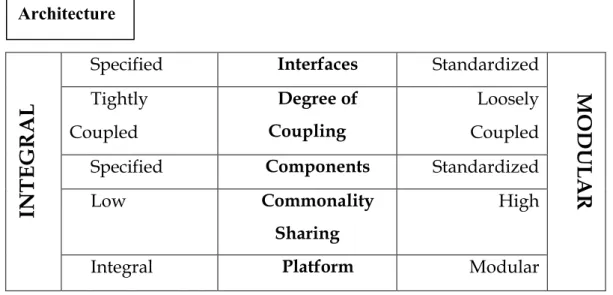
The architecture is considered the infrastructure designed for a product or service that can be integral or modular depending on the degree of coupling (connection) among its platforms, modules and components (Voss and Hsuan, 2009). It can be tightly coupled, when there is a certain degree of interdependence among the system’s components, or loosely coupled when the components are not so dependent on each other, which enables its separability, recombination and substitution. In the last case, architecture becomes more modular.
The modularity enables firms to separate its services in smaller parts (modules) and develop them independently. Then, combining the different modules, firms can offer a broad variety of services (Baldwin and Clark, 1997 in Pinto and Rei, 2013). But each module is created in an independent way and has particular characteristics that combined with other modules have final services with distinct functionalities as an outcome. It is expected that firms reduce costs and increase
41
flexibility in their offerings, when correctly designed (Pekkarinen and Ulkuniemi, 2008).
According to Rahikka et al. (2011 in Pinto and Rei, 2013) delivering a service module may help customers spend less in the additional services they buy to complement the core product/service, while the value perceived by the customer increases. But on the other hand, standardized modules will be produced and will respond (within a final product/service) to “customized” customers’ needs.
Pinto and Rei (2013) have identified five dimensions to determine the level of modularity present in architectures (Voss and Hsuan, 2009). These dimensions are the interfaces, the degree of coupling, the components, the commonality sharing and the platform, as it can be seen in FIGURE II.
In services, modularity can affect the entire firm and it can occur in the firm’s services, processes and organization (structure) (Pekkarinen and Ulkuniemi, 2008). These three dimensions can be divided into smaller parts enabling extensive service variations, work division, and activities outsourcing among a firm’s network. In fact, a firm can choose its suppliers according to its competence to produce a certain module and then, through coordination mechanisms, that firm will create the final value delivered to customers.
IN
TE
G
R
AL
Specified Interfaces Standardized
MO
D
UL
AR
Tightly Coupled Degree of Coupling Loosely Coupled Specified Components StandardizedLow Commonality
Sharing
High
Integral Platform Modular
FIGURE II
Service Design Architecture Source: Pinto and Rei (2013: 4).
42
At the multinational level, managing service modularity dimensions (in services, processes and organization) is even more important. As it was previously defined, a “service” is a result from the combination of two or more service modules and is visible to the customers; a “service production process” is the combination of one or more process modules that can be any physical operation process information; and finally, a “modular organization” results from the incorporation of organization modules and is also a mean of using the firm’s own resources and other firms’ resources.
Authors like Pekkarinen and Ulkuniemi (2008) defend that when implementing modularity in a multinational development strategy, companies should firstly analyze the current markets and its competitors, and then determine which are the most promising opportunities in terms of markets, customers’ needs and segments. Later, regarding services and processes’ related technology and customer knowledge, companies have to designate which service modules fulfill the customers’ needs of a new service. Then, companies are able to identify the country, in terms of resources availability and quality, which better meets the offering requirements, and next, independently of the delivering place, develop different modules in different countries.
Other authors regard that modularity can help firms improve their performances in the current markets and enter new ones. But what is not known yet is which modules to produce and where, and who should customize the final service and where (Pinto and Rei, 2013).
Modularity affects the whole supply chain and the firms’ affiliates, allowing them to enrich the capacity to customize products and services to different customers and market segments, while costs are reduced (Pekkarinen and Ulkuniemi, 2008). It is known that time and costs of developing a new service are reduced as some of the required resources are already part of the company, and so, there is no need for additional knowledge, tests or investments.
In terms of the service concept and platform, these might be coherent and strong if developed centrally by one project team composed by distinct elements. Moreover, the service platform and service product may be difficult to dissociate.
43
The consistency of the multinational deployment (distribution) of a service may be promoted by the use of one unique language in the full service development. In addition, English and visual languages tend to be universal facilitators of the development process and standardization, when several countries from different continents are involved in the multinational development of a service.
Also, the platform and modules standardization enables consistency in the multinational service offer, promoting the growth of reliability worldwide, and the combination of different standardized modules and/or components make it possible to customize the service. This customization can even be acquired through the translation to a different language of an architecture already defined and tested, and it can include the coupling of local examples.
In what concerns multinational service architecture, it appears to be similar to one country specific architecture and this specificity of the multinational architecture may be that final translations may bring into the product new components (a new case of training that may have no meaning in other countries). In summary, firms develop new services at the multinational level through different activities and stages more or less intertwined, for the definition of a platform associated with the service concept that together with standardized modules completes the service. The combination of different components within a module or of different modules in a platform provides the perceived customization.
44
CHAPTER 3
THE ALPHA EXAMPLE
After the literature review in what concerns Internationalization, NSD and the outcome of the international development process, it was eager to collect data from a real multinational company. Only this way we could answer our research question and bring new information into the international management field.
The company, which for confidentiality purposes in designated in this dissertation by Alpha, was chosen in order to illustrate the situations summarized in the literature review. This company had already been part of a previous study regarding the theme “Service development and deployment at the multinational level” that ended up being an article. This study was carried out by Pinto and Rei in 2013 with the aim of clarifying the stages of service deployment and design rollout at the multinational level and resulted in the analyses of each NSD activities executed by Alpha in the NSD process.
The first stage of the NSD process had been analyzed and we decided to continue the research work and gain more knowledge on the subject.
3.1 Company studied and used methodology
Alpha was founded in Switzerland in 1982, and provides training and consultancy services at the multinational level.
This company is specialized in attitudes and behaviors and started to develop training in the Management and Leadership areas, later expanding to new ones such as Customer Care and Commercial. Nowadays, operating in 15 countries, Alpha provides consulting, training and coaching through standard programs,
45
seminars and customized projects to all kinds of industries and companies’ sizes. Alpha has developed a new and innovative service at the international level, for the market already served.
With the purpose of answering our research question, a questionnaire was developed to structure data collection at Alpha. The questions were selected so to cover all the topics in discussion in this study. It was scheduled an interview with the company’s CEO, to obtain the data that were subsequently analyzed.
3.2 Data, Findings, Discussion
The new and innovative service developed by Alpha at the international level has already been launched, and the first stage of the development process observed, in previous research (Pinto and Rei, 2013). However, we wanted to reflect back about the process after some time has passed. Different perspectives of the process compared to the detailed in the work of Pinto and Rei (2013) were now conveyed in the interview.
According to Edvardsson et al. (2012) the formal service’s development process is based on a stages model. And although there are many firms that still develop new services without using a formal planning process (Alam, 2011 in Pinto and Rei, 2013), several models were created and have been the basis for numerous authors’ analysis.
The previous study presented a NSD process consistent with Johnson et al.’s (2000) model, “The NSD process cycle” which is one of the most cited among the literature and that proposes four stages, being these: design, analysis, development and full launch. The activities that had already been executed in the NSD process at Alpha were the following:
- Strategy and objective formulation for the new service (design); - Idea generation and screening (design);
46
- Business analysis (analysis);
- Service design and testing (development); - Personnel training (development);
- Service testing and pilot run (development).
In brackets are the stages identified by Johnson et al.’s (2000) model, “The NSD process cycle” (Pinto and Rei, 2013). The final stage - full launch - had not been analyzed at the time.
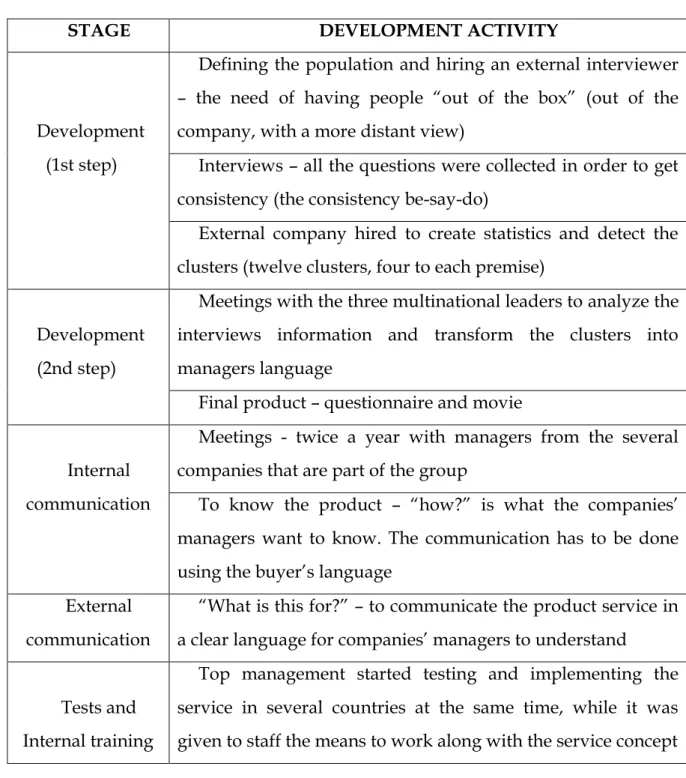
From the interview it could be concluded that, after the product’s launch and looking back in time to the development process, Alpha now considers the service development stages to have been:
1- Development;
2- Internal communication; 3- External communication;
4- Tests and internal training (both at the same time).
The development stage consisted in defining the population to interview, in the interviewing process and in the analysis of the collected data.
Firstly, the population was defined and hired an interviewer distant from the company, once there was a need of having people “out of the box” (out of the company, with a more distant view).
After the definition of the population, interviews were made and all the questions were collected in order to get consistency (the consistency be – say – do). According to a company that collaborates with Alpha in several projects:
“Be-Say-Do helps these different entities to examine their today’s profile and create new realities by adjusting it, for example, when a strategic plan is being implemented (Alpha’s collaborating company website).”
Later, as Alpha usually subcontracts services when it is not their core area of activity, it hired an external company Alpha with the aim of creating statistics and detect the clusters. Twelve clusters, four to each premise were identified.
47
Finally, the three most important company managers got together to analyze the interviews information and try to transform the clusters into manager’s language.
Hence, Alpha focused on developing a product with market information and creating it through a questionnaire and a movie.
This process resulted in something completely different from the expected. The company was trying to create a training product and ended up creating a consulting product, which is nowadays one of the most important products in the company.
The internal communication stage was and is accomplished thought meetings twice a year with managers of the several companies that are part of the group with the aim of communicating internally. These meetings already existed but then were used for this specific communication purpose.
Part of the communication was to get to know the product. In the case of this specific product, as it was declared by the company’s CEO, the company made a mistake.
“We focused more on “what?” than on “how?”, which is what companies’ managers really want to know.”
The internal communication resulted in the adoption of practical cases for a better understanding of the product. Alpha now knows that communication has to be made using the buyer’s language and has corrected it.
In terms of the external communication the aim was to communicate in a clear language for companies’ managers to understand the product, and it has been done.
The last development stages were tests and internal training (both at the same time). The internal training consisted in giving the staff the means to work along with the service concept, and at the same time, the service was being tested and implemented in several countries at the same time by top managers.