Engineering
ISSN: 1809-4430 (on-line)
_________________________
2 College of Agricultural Engineering, State University of Campinas/ Campinas - SP, Brazil.
3 College of Agrarian Sciences, Animal Science, Federal University of Grande Dourados/ Dourados - MS, Brazil.
EFFECT OF THERMAL STIMULATION IN EMBRYOS FROM COBB®GENETIC
STRAIN UNDER COMMERCIAL SCALE
Doi:http://dx.doi.org/10.1590/1809-4430-Eng.Agric.v37n2p236-245/2017
FERNANDA FLORES1*, IRENILZA DE A. NÄÄS2, RODRIGO G. GARCIA3
1*Corresponding author. College of Agricultural Engineering, State University of Campinas/ Campinas - SP, Brazil.
E-mail: [email protected]
ABSTRACT: Studies aimed at producing stronger birds and with better growth performance are
being developed involving artificial incubation. To that extent, thermal stimulation by the heat of 1.39 ºC and 1ºC above the standard, and by cold of 36 °C fixed, were applied in the last week of the embryonic development (day 14 to day 18) to Cobb® strain birds of 33 to 53 weeks age. With the
purpose of evaluating the behavior of the embryos facing these temperature stimuli to identify what is the best amplitude, frequency and the most appropriate period to perform temperature variation, obtaining more adapted birds to the field. It has been observed that heat or cold stimulation did not cause embryo mortality and did not affect the hatching and the quality of the chick for this strain negatively. The weight of the pullet, the residual weight of the yolk, and the peak of birth were not modified. The thermal stimulation during the last week of the birds’ incubation is an available tool to improve hatchery production, quality and performance. However, several variables must be tested.
KEYWORDS: hatchability, incubation, chick quality, thermal variation.
INTRODUCTION
Embryo temperature during incubation is considered the most important physical factor in the success of commercial poultry incubation (WILLEMSEN et al., 2011), as it alters the embryo development supported by the cell gene expression (FLORES et al., 2013, SARDARY & MOHAMMAD, 2016). It is known that small variations in the cell ambient might induce changes in the expression of genes with the potential of pre-conditioning of birds metabolism after hatching (AKŞIT et al., 2010; PIESTUN et al., 2011). It might occur in a long range (SHINDER et al., 2009; WALSTRA et al., 2010; PIESTUN et al., 2013), changing the development of the whole broiler embryos including the muscle, skeleton and the liver (PIESTUN et al., 2015; LOYAU et al., 2013, 2014a). These so-called epigenetic effects are the origin of the management of circadian incubation process, contrasting with the used incubation processes in which the fluctuation of environment data is avoided. However, there are still variations from the maternal influence on the quality of the pullet development since the incubated eggs reflect the stress and immunity level of the female breeder (HERNIKSEN et al., 2013).
During the thermal manipulation, the embryo receives cold and hot stimuli in determined periods during the embryo development. However, thermal manipulation is only favorable when applied in a clear and controlled way, at the right moment, and during the proper time (TZSCHENTKE, 2009; MOHAMMAD & SARDARY, 2016). The metabolic rate in broiler embryos 14-18 days old decreased after thermal manipulation (12h day-1 at 39.5°C day-1)
might induce oxidative stress (LOYAU et al., 2014b). However, there is a lack of information on the exposition of embryos to incubation temperature lower than the pattern. SHINDER et al. (2011) found that embryos exposed to low incubation temperature tend to present sensibility to cold and show ascites after exposition to cold in a tardy way. YALÇIN et al. (2012) revealed that is an interaction between the age of the female breeders and the period of incubation under cold temperature on the pullet weight at birth and particularly on the relative heart weight.
Most data in current literature were obtained in the experimental and controlled scheme. Therefore, the aim of this study was to evaluate the performance indexes of embryos from Cobb®
genetic strain to different thermal stimulation in the last phase of embryo development under commercial scale.
MATERIAL AND METHODS
Fertile eggs from four batches of Cobb® genetic strain from female breeders with age from 33
to 53 weeks were exposed to thermal stimulation combined with frequency, intensity, and duration. The study was randomly designed, observational and used a factorial scheme (2x3x2 – two ages of female breeders x three thermal manipulations and two controls) in a commercial incubator. Data were subjected to ANOVA using PROC GLM. The means were compared by the Tukey test adopting the confidence level of 95% using the software SAS® version 9.0 (2010).
The thermal simulations were done in the incubator SmartPro-77 of the single modular stage (PasReform Hatchery Technology, Zeddam, The Netherland) in a commercial hatchery. The machines had a total of 76,800 fertile eggs in all incubations. Control evaluation was done in a single stage machine (control SS – no thermal stimulation), and some batches were also observed in a multiple stage machine (CASP CM 125R, Amparo, Brasil) (control MS no thermal stimulation).
The thermal treatments were described using as the parameter the standard incubation program varying gradually according to the temperature established for that specific day of embryo development (E.D.). Two tests were done using hot stimuli called (T1 and T2), and one test with the cold stimulus was performed (T3). By definition, T1= increase of 1.39ºC above the set point temperature on the 14th day of the embryo development (E.D.) (36.55ºC), increasing 1.39ºC in each
set point until the 18th day of E.D. with three hours of duration; T2= increase of 1.00ºC above the
set point temperature at the 16th to the 18th day of E.D. with 2 hours of duration; and T3= cold
stimulus fixed at 36.00ºC varying from 1.00ºC to 0.30ºC below each set point from the 14th to 18th
day of E.D. with 3 hours of duration.
SmartPro 77 incubator schematics
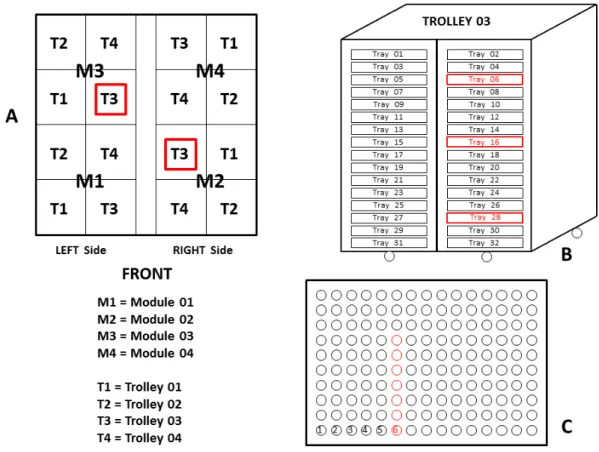
FIGURE 1. The positions of the modules, trolleys, trays, and eggs in the incubation trays, showing the locations where the temperatures were evaluated in the eggshells, trays were identified, and samples were collected; A: Upper overview of the SmartPro 77 incubator, showing the modules and incubation trolleys; B: View of the incubation trolley where the egg temperatures were measured, showing the identification of the trays; C: Incubation tray showing rows and eggs sampled (FLORES et al., 2016)
The behavior and quality of the chicks at birth were done in a sample of 25 birds in each batch (males and females) using the Pasgar® score methodology (VAN DE VEN, 2011). Five points were
verified: vitality (reflex), belly button health, leg health, beak, and abdomen. At the final of the incubation the fertile hatching egg (FHE) was calculated using [eq. (1)].
FHE= Total of chicks hatched / total of fertile eggs x 100 (%) (1)
Fifteen male chicks were randomly separated into previously identified boxes. They were numbered following the sequence of the position of the boxes in the incubation tray (low, mean, and high). The surface temperature of the cloaca was registered using an infrared thermometer (Braun Termoscan® - ITR 4520). After the measurements and evaluations, the birds were sacrificed
according to the welfare protocol approved by the UNICAMP ethics committee (protocol number 3503-1).
The total weight of the chick, yolk weight (yolk sac), heart weight, weight of the gastrointestinal tract (GIT), weight of the duodenal loop with the pancreas, weight pro-ventricular and ventricular (PVV, gizzard) were individually evaluated using a scale (WeighMax® W 3805
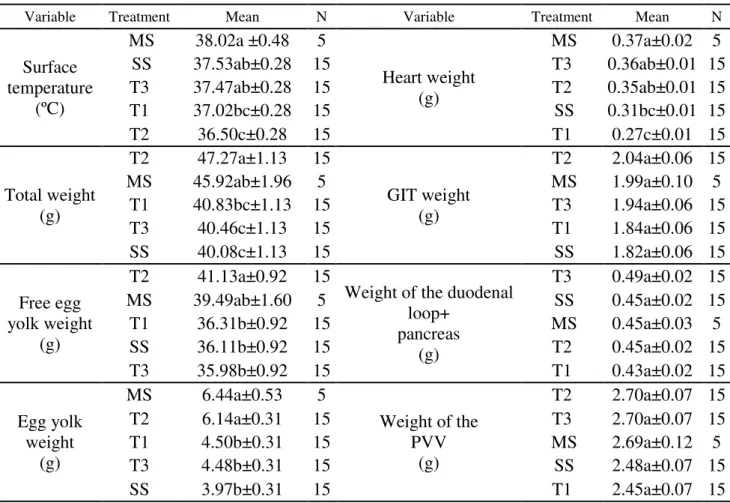
The surface temperature of the groups was smaller in those without the thermal stimulation in multiple stages (38.02ºC), and in the single stage (37.53ºC). However, results differed (p<0.05) at T2 ( an increase of 1.00ºC above the set point temperature at the 16th to the 18th day of E.D. with
two hours of duration; 36.50ºC; Table 1). The temperature of the birds after hatching is influenced by the environment and when measured at birth must be between 40-40.5ºC in the chicks (MACARI et al., 2013a), and must remain during the process, and in the expedition room. In the current study, body temperature was monitored by the cloaca surface temperature, and, because of these procedure results were smaller than that indicated in the literature (Table 1 and 2).
Heart weight was less (0.27g) in the T1 group (an increase of 1.39ºC in each set point until the 18th day of E.D. with three hours of duration) in the relation to the group without thermal
stimulation in multiple stages (0.37g). Embryos heated also show a reduction in the heart, as happened in the present study. The high eggshell temperature during incubation (38.9ºC) changed the development of the cardiac muscle (LEKSRISOMPONG et al., 2007) and might cause right ventricular hypertrophy and consequent increase in mortality caused by ascites (MOLENAAR et al., 2011).
The weight of the intestine tract (GIT), the duodenal loop with the pancreas, the pro- ventricle and ventricle (PVV) did not differ (p>0.05) between the treatments and the non-stimulated groups. In contrast research results indicate that high temperatures reduce the gastrointestinal tissue mass (LEKSRISOMPONG et al., 2007). The total weight of the chicks and the free weight of the egg yolk differed (p<0.05). The values were higher in the T2 group (increase of 1.00ºC above the set point temperature at the 16th to the 18th day of E.D. with two hours of duration; 36.50ºC) than T3
(cold stimulus fixed at 36.00ºC varying from 1.00ºC to 0.30ºC below each set point from the 14th to
18th day of E.D. with 3 hours of duration) and the group without stimulation in multiple stage
(Table 1). A study points out that the mean weight of the chicks was reduced in 5%, that corresponds to a loss of 2-3g, but the relative size about the pro-ventricle and ventricle weight and the intestine were reduced in 13% and 16%, respectively (LEKSRISOMPONG et al., 2007). Another research indicates that the thermal stimulation induced an increase in the relative chick weight in the first week after hatching (MOHAMMAD & SARDARY, 2016). However, in the current study, the weight of the GIT, pro-ventricle and ventricle and the duodenal loop with the pancreas did not differ (p>0.05) between the thermally stimulated or the non-stimulated group.
TABLE 1. Average values about the combined heat treatment and the variables analyzed.
Variable Treatment Mean N Variable Treatment Mean N
Surface temperature
(ºC)
MS 38.02a ±0.48 5
Heart weight (g)
MS 0.37a±0.02 5
SS 37.53ab±0.28 15 T3 0.36ab±0.01 15
T3 37.47ab±0.28 15 T2 0.35ab±0.01 15
T1 37.02bc±0.28 15 SS 0.31bc±0.01 15
T2 36.50c±0.28 15 T1 0.27c±0.01 15
Total weight (g)
T2 47.27a±1.13 15
GIT weight (g)
T2 2.04a±0.06 15
MS 45.92ab±1.96 5 MS 1.99a±0.10 5
T1 40.83bc±1.13 15 T3 1.94a±0.06 15
T3 40.46c±1.13 15 T1 1.84a±0.06 15
SS 40.08c±1.13 15 SS 1.82a±0.06 15
Free egg yolk weight
(g)
T2 41.13a±0.92 15
Weight of the duodenal loop+
pancreas (g)
T3 0.49a±0.02 15
MS 39.49ab±1.60 5 SS 0.45a±0.02 15
T1 36.31b±0.92 15 MS 0.45a±0.03 5
SS 36.11b±0.92 15 T2 0.45a±0.02 15
T3 35.98b±0.92 15 T1 0.43a±0.02 15
Egg yolk weight
(g)
MS 6.44a±0.53 5
Weight of the PVV
(g)
T2 2.70a±0.07 15
T2 6.14a±0.31 15 T3 2.70a±0.07 15
T1 4.50b±0.31 15 MS 2.69a±0.12 5
T3 4.48b±0.31 15 SS 2.48a±0.07 15
SS 3.97b±0.31 15 T1 2.45a±0.07 15
T1 = heat stimuli 1.39ºC)(14th to 18th E.D./3h); T2 = reduced heat stimuli 1ºC)(16th to 18th E.D./2 h); T3= cold fixed stimuli 36ºC
(14th to 18th E.D./3h); control MS: no stimuli - multiple stages); control SS: no stimuli - single stage). Treatments with different
letters are significant (p<0.05) by the Tukey test.
In the present study, group MS (no stimuli - multiple stages) showed higher weight egg yolk than the other groups, representing 14.01% of the chick weight, followed by treatment T2 with residual egg yolk of 12.9%. Since the multiple stage incubator has fertile eggs in different stages of embryo development, and eggs from females breeders of different ages, therefore the eggs have different pattern contributing to the presence of several microenvironments leading to hyper-heating in some areas. For the treatments T1, T3, and in the control group without stimulation in multiple stages machines the values were 11.02%; 11.07%, and 9.90%, respectively.
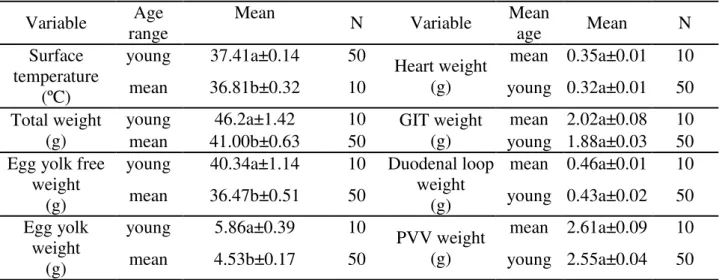
Young female breeders presented higher temperature than others (p<0.05). The heart weight, the GIT weight, the duodenal loop weight, and the PVV weight did not differ (p>0.05) within the range of average production (age of 48 and 53 weeks) versus the young females production (33, 34,
35, and 36 weeks). Related to the total weight, the egg yolk weight, and the free weight of egg yolk, the highest value was found in the female age in the average production (p<0.05) (Table 2), agreeing with current literature (HAMIDU et al., 2007). There was a difference between heat production, metabolism, and oxygen consumption between young female breeders (<35 weeks) and the old compared to those eggs from female breeders in the average period of production (35-50 weeks) (HAMIDU et al., 2007). As the female breeder age increase, the size of the eggs also increases leading to egg’s lack of uniformity.
About the chick quality (Table 3), the mean Pasgar® score should be 9 (PAS REFORM,
study, it was verified that fertile eggs from female breeders 48 and 53 weeks old had a hatching percentage of 88.52 and 84.18% respectively.
TABLE 2. Average values over the age range of hens and the variables analyzed.
Variable range Age Mean N Variable Mean age Mean N
Surface temperature
(ºC)
young 37.41a±0.14 50 Heart weight (g)
mean 0.35a±0.01 10
mean 36.81b±0.32 10 young 0.32a±0.01 50
Total weight (g)
young 46.2a±1.42 10 GIT weight
(g)
mean 2.02a±0.08 10
mean 41.00b±0.63 50 young 1.88a±0.03 50
Egg yolk free weight
(g)
young 40.34a±1.14 10 Duodenal loop weight
(g)
mean 0.46a±0.01 10
mean 36.47b±0.51 50 young 0.43a±0.02 50
Egg yolk weight
(g)
young 5.86a±0.39 10
PVV weight (g)
mean 2.61a±0.09 10
mean 4.53b±0.17 50 young 2.55a±0.04 50
The range of mean age: 48 to 53 weeks; Young range: 33, 34, 35, and 36 weeks; Treatments with different letters are significant (p<0.05) by the Tukey test.
TABLE 3. Average overall hatching, hatchability, fertility and Pasgar©score batches of Cobb®
genetic strain submitted to thermal stimulation.
Batch Treat.
Age of female breeders (weeks) Incub. Stage Hatching (%) Waste (%)
Hatch-bility (%) Fertility (%)
Pasgar©score
(%)
200 T2 53 SS 81.15 2.25 84.18 96.39 8.8
201 T1 33 SS 84.45 2.59 89.71 98.59 9.2
201 Control 34 SS 87.98 2.59 89.69 98.09 8.4
201 Control 34 MS 87 2.54 - - -
201 T3 35 SS 88.35 1.98 89.18 99.25 9.2
201 T2 48 SS 85.95 2.32 88.52 97.09 8.2
203 T2 36 SS 89.57 1.25 90.57 98.89 8.9
T1 = heat stimuli 1.39ºC (14th to 18th E.D./3h); T2 = reduced heat stimuli 1ºC)(16th to 18th E.D./2 h); T3= cold fixed stimuli 36ºC
(14th to 18th .D.E/3h); control MS: no stimuli - multiple stages; control SS: no stimuli - single stage.
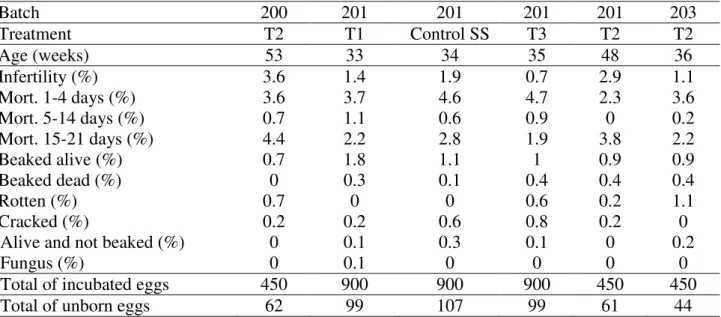
Results from the non-hatched eggs which were evaluated using the embryo-diagnosis (Table 4) reveals that treatment T3 did not present high percentage of non-beaked eggs. This occurred probably due to the low temperature inside the incubator. There is a standard embryo mortality rate within each stage of embryo development as a result of inadequate management of the fertile egg production (egg management, genetic strain, and the age of female breeders) (MACARI et al., 2013b). In the present study high values of embryo mortality were found in the group without thermal stimulation in a single stage and T3 (4.6 and 4.7%, respectively), and in T2 for tardy mortality (4.4%).
hatching. The standard temperature used varies within the threshold of 37.5 to 37.8ºC (WILLEMSEN et al., 2011; YALÇIN et al., 2012). The technical recommendation for single stage incubators is to reach an average eggshell temperature of 38.33ºC in the last three days before transferring to hatching, with the maximum limit of 38.61ºC (PAS REFORM, 2010ab). Under commercial incubation conditions, the challenge remains in maintaining equal eggshell temperature equally distributed in all trays, especially in the beginning and the final of the process due to the eggs heterogeneity characteristic.
TABLE 4. Average values of embryo diagnosis of lots of Cobb® lineage in 150 eggs trays.
Batch 200 201 201 201 201 203
Treatment T2 T1 Control SS T3 T2 T2
Age (weeks) 53 33 34 35 48 36
Infertility (%) 3.6 1.4 1.9 0.7 2.9 1.1
Mort. 1-4 days (%) 3.6 3.7 4.6 4.7 2.3 3.6
Mort. 5-14 days (%) 0.7 1.1 0.6 0.9 0 0.2
Mort. 15-21 days (%) 4.4 2.2 2.8 1.9 3.8 2.2
Beaked alive (%) 0.7 1.8 1.1 1 0.9 0.9
Beaked dead (%) 0 0.3 0.1 0.4 0.4 0.4
Rotten (%) 0.7 0 0 0.6 0.2 1.1
Cracked (%) 0.2 0.2 0.6 0.8 0.2 0
Alive and not beaked (%) 0 0.1 0.3 0.1 0 0.2
Fungus (%) 0 0.1 0 0 0 0
Total of incubated eggs 450 900 900 900 450 450
Total of unborn eggs 62 99 107 99 61 44
T1 = heat stimuli 1.39ºC (14th to 18th E.D./3h); T2 = reduced heat stimuli 1ºC)(16th to 18th E.D./2 h); T3= cold fixed stimuli 36ºC
(14th to 18th E.D./3h); control MS: no stimuli - multiple stages; control SS: no stimuli - single stage.
Different genetic strains of fowls (broiler, layer, tom turkey) need different incubation temperature to reach the same embryo temperature. Studies indicate different embryo heat production in broilers and layers (NANGSUAY et al., 2011), and amongst distinct broiler genetic strains (TONA et al., 2010). According to LOURENS et al. (2007), the variation in the embryo temperature is a result of the modification in the metabolism during the growth.
Birds under heat thermal stimulation tend to hatch earlier than those not stimulated while birds stimulated by cold tend to reduce the embryo development (WILLEMSEN, 2010, MOHAMMAD & SARDARY, 2016). However, the effect of both the increase and reduction of the incubation temperature during hatching depends on the duration and the temperature amplitude manipulation, and the period the manipulation took place (TZSCHENTKE, 2009; MOHAMMAD & SARDARY, 2016). The hatch windows are the period between the first and last chick hatched. In the present study birds thermally stimulated in T3 and T2 had a hatch window of 10.5 h. The birds in T1 and the control SS with no stimuli - single stage were 16.6 h and 17 h, respectively. All treatments using single stage incubation had similar results, and it was not identified shortened of the hatch windows in the heat thermal manipulation. The response of chicks to the adverse expositions after hatching is highly dependent on the exact moment of the hatching of each bird; that is still not fully understood commercially (ROMANINI et al., 2013).
In Table 5, it is shown the results of three houses were a flock of thermally manipulated broilers were reared. Heat thermal stimulation T1 presented higher efficiency index (EI), mean weight, mean daily weight, and feasibility than the others, as well as less percentage of condemnations, and less feed conversion. The group thermally stimulated by cold (T3) presented inferior results when compared to T1 and the group without stimulation in a single stage.
negatively, depending on the management of the variables involved in the rearing process (LEKSRISOMPONG et al., 2009).
TABLE 5. Batch performance of thermally stimulated from breeders with 33, 34 and 35 weeks of age.
House Sex Amount of birds Treat. dermatitis (%) Podo- Condem- nation
FIS (%) Feasibility (%) FC (kg) MDG (g) EI (Unit) MW (kg)
X Mixed 21.300 T1 45 1.36 98.4 1.758 59.09 330.8 2.64
Y Mixed 21.200 SS 53 1.45 97.36 1.776 56.95 3.121 2.43
Z Mixed 17.000 T3 100 2.48 96.12 1.946 0.5337 2.636 2.34
T1 = heat stimuli 1.39ºC (14th to 18th E.D./3h); T3= cold fixed stimuli 36ºC (14th to 18th E.D./3h); control SS: no stimuli - single
stage; FC=feed conversion; MDG = mean daily gain; EI =efficiency index; MW= mean weight;
CONCLUSIONS
Thermal stimulation by heat or cold did not cause embryo mortality and did not alter the chick quality and the hatchability indexes for the Cobb® genetic strain. Heat stimuli with 1.39ºC above
the set pointsfrom the 14th to the 18th day of embryo development presented EI, mean weight, mean
daily weight, and the feasibility higher the others. The percentage of condemnations was smaller than the others as well as the feed conversion. These data suggest that the imprinting of temperatures is a tool available to the incubators to improve production, quality, and performance. It was not clear which is the proper frequency, the intensity and the duration of the thermal manipulation.
REFERENCES
AKSIT, M.; YALÇIN, S.; YENISEY, Ç. ÖZDEMIR, D. Brooding temperatures for chicks
acclimated to heat during incubation: effects on post-hatch intestinal development and body weight under heat stress. British Poultry Science, Cambridge, v.51, n. 3, p. 444-452, 2010.
DECUUYPERE, E.; BANWELL, R.; HEMERYCK, P.; MORO, D. Desafios no processo de
incubação. In: MACARI, M.; GONZALES, E.; PATRÍCIO-SALES, I.; NÄÄS, I. A.; MARTINS,
P. C. Manejo da incubação. 3. ed. Campinas: FACTA, 2013a. cap. 2.13, p. 302 -303.
FLORES, F.; NÄÄS, I. A.; GARCIA, R. G. Variação térmica durante a incubação de ovos e seus efeitos sobre os componentes imunológicos do embrião. Enciclopédia Biosfera,Goiânia, v.9, p. 2594-2612, 2013.
FLORES, F.; NÄÄS, I. A.; GARCIA, R. G.; SOUZA L. I. Thermal stimulation of Ross®-lineage embryos on a commercial scale. Ciência Rural, Santa Maria, v.46, n.9, p.1668-1674, 2016 HAMIDU, J. A.; FASENKO, G. M.; FEDDES, J. J. R.; O’DEA, E. E.; OUELLETTE, M. J.; WINELAND, M. J.; CHRISTENSEN, V. L. The effect of broiler breeder genetic strain and parent flock age on eggshell conductance and embryonic metabolism. Poultry Science, Oxford, v. 86, p.2420-2432, 2007.
HENRIKSEN, R.; RETTENBACHER, S.; GROOTHUIS T.G.G. Maternal corticosterone elevation during egg formation in chickens (Gallus gallus domesticus) influences offspring traits, partly via prenatal undernutrition. General and Comparative Endocrinology,New York,v. 191, p.83–91, 2013.
HULET, R.; GLADYS, G.; HILL, D.; MEIJERHOF, R.; EL-SHIEKH, T. Influence of Egg Shell Embryonic Incubation Temperature and Broiler Breeder Flock Age on Posthatch Growth
LEKSRISOMPONG, N.; ROMERO-SANCHEZ, H.; PLUMSTEAD, P. W.; BRANNAN, K. E.; BRAKE. Broiler incubation-1. Effect of elevated temperature during late incubation on body weight and organs of chicks. Poultry Science, Oxford, v.86, n. 12 p.2685-2691, 2007.
LEKSRISOMPONG, N.; ROMERO-SANCHEZ, H.; PLUMSTEAD, P. W.; BRANNAN, K. E.; YAHAV, S.; BRAKE. Broiler incubation-2. Interaction of incubation and brooding temperatures on broiler chick feed consumption and growth. Poultry Science, Oxford, v. 88, n. 6, p.1321-1329, 2009.
LOURENS, A.; VAN DEN BRAND, H.; HEETKEAMP, M. J. W.; MEIJERHOF, R.; KEMP, B. Effects os eggshell temperature and oxygen concentration on Embryo growth and metabolism during incubation. Poultry Science, Oxford, v. 86, p.2194-2199, 2007.
LOYAU, T.; BERRI, C,; BEDRANI, L.; MÉTAYER-COUSTARD, S; PRAUD, C.; DUCLOS, M. J.; TESSERAUD, S.; RIDEAU, N.; EVERAERT, N.; YAHAV, S. MIGNON-GRASTEAU, S. COLLIN, A. Thermal manipulation of the embryo modifies the physiology and body composition of broiler chickens reared in floor pens without affecting breast meat processing quality. Journal
Animal Science, Champaign, v. 91, p. 3674-3685, 2013.
LOYAU, T.; COLLIN, A.; YENISEY, Ç.; CROCHET, S.; SIEGEL, P. B.; AKŞIT, M.; YALÇIN, S. Exposure of embryos to cyclically cold incubation temperatures durably affects energy
metabolism and antioxidant pathways in broiler chickens. Poultry Science, Oxford, v. 93, p. 2078–
2086, 2014b.
LOYAU, T.; MÉTAYER-COUSTARD, S.; BERRI, C.; CROCHET, S.; CAILLEAU-AUDOUIN, E.; SANNIER, M, ; CHARTRIN, P.; PRAUD, CHRISTOPHE.; HENNEQUET-ANTIER, C., RIDEAU, N.; COUROUSSÉ, N.; MIGNON-GRASTEAU, S. Thermal manipulation during
embryogenesis has long-term effects on muscle and liver metabolism in fast-growing chickens. Plos One, San Francisco, v. 9, e-105339, 2014a. doi:10.1371/journal.pone.0105339.
MACARI, M.; GONZALES, E.; PATRÍCIO-SALES, I.; NÄÄS, I. A.; MARTINS, P. C. Manejo da incubação. 3. ed. Jaboticabal: Facta, 2013. In: PLANO,Carlos Mario; DI MATTE, Ana Maria.
Embriodiagnóstico e patologia Perinatal,Capítulo 2.10, p. 251-252.
MOHAMMAD, S.H.; AL SARDARY S. Effect of thermal manipulation during embryogenesis on thermotolerance and hatched broiler performance. Food and Nutrition Science - An International
Journal, Talence, v. 1, 2016. Disponível em: <http://iaras.org/iaras/journals/fnsij>. Acesso em: 3
apr. 2016.
MOLENAAR, R.; HULET, M.; MEIJERHOF, R.; MAATJENS, C. M.; KEMP, B.; VAN DEN BRAND, H. High eggshell temperatures during incubation decrease growth performance and increase the incidence of ascites in broiler chickens. Poultry Science, Oxford, v.90, p.624–632,
2011.
NANGSUAY, A.; RUANGPANIT, Y.; MEIJERHOF, R.; ATTAMANGKUNE, S. Yolk absorption and embryo development of small and large eggs originating from young and old breeder hens.
Poultry Science, Oxford, v. 90, p.2648 – 2655, 2011.
PAS REFORM HATCHERY TECHNOLOGIES. Departamento de Pesquisa e Desenvolvimento.
Publicações técnicas. Academia de incubação: Zeddan, 2010.
PIESTUN, Y.; DRUYAN, S.; BRAKE, J.; YAHAV S. Thermal manipulations during broiler incubation alter performance of broilers to 70 days of age. Poultry Science, Oxford, v. 92, p.1155–
1163, 2013.
PIESTUN, Y.; YAHAV, S.; HALEVY, O. Thermal manipulation during embryogenesis affects myoblast proliferation and skeletal muscle growth in meat-type chickens. Poultry Science, Oxford, v. 94, p. 2528–2536, 2015.
SAS Institute. Version 9.2. Cary, 2010.
SHINDER, D.; RUSAL, M.; GILOH, M.; YAHAV, S. Effect of repetitive acute cold exposures during the last phase of broiler embryogenesis on cold resistance through the life span. Poultry
Science, Oxford, v. 88, p. 636-646, 2009.
SHINDER, D.; RUZAL, M.; GILOH, M.; DRUYAN, S.; PIESTUN Y.;YAHAV. S. Improvement of cold resistance and performance of broilers by acute cold exposure during late embryogenesis.
Poultry Science, Oxford, v. 90, p. 633 – 641, 2011.
TONA, K.; ONAGBESAN, O. M.; KAMERS, B.; EVERAERT, BRUGGEMAN, V.; DECUYPERE, E. Comparison Cobb e Ross strains in embryo physiology and chick juvenile growth. Poultry Science, Oxford, v. 89, p.1677 – 1683, 2010.
TZSCHENTKE, B.; HALLE, I. Influence of temperature stimulation during the last 4 days of incubation on secondary sex ratio and later performance in male and female broiler chicks. British
Poultry Science, Cambridge, v. 50, n. 5, p. 634-640, 2009
VAN DE VEN, L. J.; VANWAGENBERG, A. V.; DEBONNE, M.; DECUYPERE, E.; KEMP, B.; VAN DEN BRAND, H. Hatching system and time effects on Broiler physiology and post-hatch growth. Poultry Science, Oxford, v.90, p.1267-1275, 2011.
WALSTRA, I.; TEN NAPEL, J.; KEMP, B.; VAN DEN BRAND, H. Temperature manipulation during layer chick embryogenesis. Poultry Science, Oxford, v. 89, n.7, p.1502-8, 2010.
WILLEMSEN, H.; KAMERS, B.; DAHLKE, F.; HAN, H.; SONG, Z.; PIRSARAEI, A.; TONA, K.; DECUYPERE, E.; EVERAERT, N. High- and low- temperature manipulation during late incubation:Effects on embryonic development, the hatching process, and metabolism in broilers.
Poultry Science, Oxford, v.89, p. 2678-2690, 2010.
WILLEMSEN, H.; LI, Y.; WILLEMS, E.; FRANSSENS, L.; WANG, Y.; DECUYPERE, E.; EVERAERT.N.; Intermittent thermal manipulations of broiler embryos during late incubation and their immediate effect on the embryonic development and hatching process. Poultry Science, Oxford, v. 90, p. 1302–1312, 2011.