Pesq. agropec. bras., Brasília, v.49, n.4, p.296-305, abr. 2014 DOI: 10.1590/S0100-204X2014000400008
Diversity and nitrogen fixation efficiency of rhizobia isolated
from nodules of
Centrolobium paraense
Alexandre Cardoso Baraúna(1), Krisle da Silva(2), Gilmara Maria Duarte Pereira(3), Paulo Emílio Kaminski(2), Liamara Perin(4) and Jerri Edson Zilli(5)
(1)Universidade Federal de Roraima (UFRR), Campus Cauamé, BR‑174, Km 12, Monte Cristo, CEP 69304‑000 Boa Vista, RR, Brazil.
E‑mail: [email protected] (2)Embrapa Roraima, BR‑174, Km 8, Distrito Industrial, CEP 69301‑970 Boa Vista, RR, Brazil.
E‑mail: [email protected], [email protected] (3)UFRR, Centro de Estudo da Biodiversidade, Campus do Paricarana, Avenida
Ene Garcez, no 2.413, CEP 69304‑000 Boa Vista, RR, Brazil. E‑mail: [email protected] (4)Instituto Federal de Sergipe, Campus
São Cristóvão, Rodovia BR‑101, Km 96, Povoado Quissamã, CEP 49100‑000 São Cristóvão, SE, Brazil. E‑mail: [email protected]
(5)Embrapa Agrobiologia, BR‑465, Km 7, CEP 23891‑460 Seropédica, RJ, Brazil. E‑mail: [email protected]
Abstract – The objective of this work was to isolate and characterize rhizobia from nodules of Centrolobium paraense and to evaluate their symbiotic efficiency. Soil samples collected from four sites of the Roraima Cerrado, Brazil, were used to cultivate C. paraense in order to obtain nodules. Isolates (178) were obtained
from 334 nodules after cultivation on medium 79. Twenty‑five isolates belonging to six morphological groups were authenticated using Vigna unguiculata and they were characterized by 16S rRNA. Isolates identified as Bradyrhizobium were further characterized using rpoB gene sequencing. A greenhouse experiment was carried out with C. paraense to test the 18 authenticated isolates. Approximately 90% of the isolates grew
slowly in medium 79. The 16S rRNA analysis showed that 14 authenticated isolates belong to the genus
Bradyrhizobium, and rpoB indicated they constitute different groups compared to previously described species.
Only four of the 11 fast‑growing isolates nodulated V. unguiculata, two of which belong to Rhizobium, and two to Pleomorphomonas, which was not previously reported as a nodulating genus. The Bradyrhizobium
isolates ERR 326, ERR 399, and ERR 435 had the highest symbiotic efficiency on C. paraense and showed a contribution similar to the nitrogen treatment. Centrolobium paraense is able to nodulate with different rhizobium species, some of which have not yet been described.
Index terms: Bradyrhizobium, Rhizobium, bacteria diversity, biological nitrogen fixation.
Diversidade e eficiência na fixação do nitrogênio de rizóbios isolados
de nódulos de
Centrolobium paraense
Resumo – O objetivo deste trabalho foi isolar e caracterizar rizóbios de nódulos de Centrolobium paraense e avaliar sua eficiência simbiótica. Amostras de solo, coletadas de quatro locais do Cerrado de Roraima, foram utilizadas para o cultivo de C. paraense, para obtenção dos nódulos. Os isolados (178) foram obtidos dos 334
nódulos coletados após o cultivo em meio 79. Vinte e cinco isolados, pertencentes a seis grupos morfológicos, foram autenticados com uso de Vigna unguiculata e caracterizados pelo 16S rRNA. Os isolados identificados como Bradyrhizobium foram caracterizados depois pelo sequenciamento do gene rpoB. Um experimento em
casa de vegetação foi realizado com C. paraense, para testar os 18 isolados autenticados. Aproximadamente
90% dos isolados mostraram crescimento lento em meio 79. A análise do 16S rRNA mostrou que 14 dos isolados autenticados pertencem ao gênero Bradyrhizobium, e o rpoB indicou que eles constituem grupos
diferentes em comparação às espécies já descritas. Somente quatro dos 11 isolados com crescimento rápido nodularam V. unguiculata, dois dos quais pertencentes a Rhizobium e dois a Pleomorphomonas, que não foi
relatado anteriormente como gênero nodulífero. Os isolados de Bradyrhizobium ERR 326, ERR 399 e ERR 435
apresentaram a maior eficiência em C. paraense e mostraram contribuição similar ao tratamento nitrogenado. Centrolobium paraense é capaz de nodular com diferentes espécies de rizóbios, algumas das quais ainda não
foram descritas.
Termos para indexação: Bradyrhizobium, Rhizobium, diversidade bacteriana, fixação biológica de nitrogênio.
Introduction
Centrolobium paraense Tul. (Fabaceae), commonly
known as “pau‑rainha”, is a nodulating Neotropical
ecological roles, which are essential to environmental sustainability, as increasing nutrient availability through biological nitrogen fixation (BNF), protecting against soil erosion, and acting as pioneer or early secondary species, which have also been reported for
other Centrolobium species (Marques et al., 2001;
Dahmer et al., 2009). In addition to its ecological importance, C. paraense has an economic and social
importance because its wood is used by indigenous communities and industry (Dahmer et al., 2009; Pedreira, 2011). However, extractive exploration has been causing a gradual decrease in this plant resource, with an estimated decline of approximately 30% of the natural populations over the next years, demanding studies to increase the knowledge about this species and its conservation (Pirie et al., 2009).
Previous studies have indicated that C. paraense
is capable of forming nodules with rhizobia native to the Amazon soil (Souza et al., 1994), but there are no published studies on the isolation and characterization of these rhizobia. Bacteria belonging to both genera
Bradyrhizobium and Rhizobium have been reported
to be able to establish symbioses with other species
of Centrolobium, although studies have not been
performed at the species level (Moreira et al., 1993; Pagano, 2008).
Cultural characteristics have been used for the initial
characterization and screening of rhizobia; however, molecular techniques are necessary for a reliable characterization and identification. The 16S rRNA gene is the universal genetic marker most widely used for identification, classification and reconstruction of bacteria phylogeny. However, for identification of different rhizobia, the 16S rRNA gene sequencing is not suitable. For instance, in the genus Bradyrhizobium, the
gene 16S rRNA presents a high degree of conservation among species, and sequence similarity is relatively high (Willems et al., 2001), limiting the species separation. However, housekeeping genes, which are
involved in fundamental cell functions, came to be
recommended to differentiate closely related species, including those within Bradyrhizobium genus, since
they give a better resolution (Rivas et al., 2009). Considering the ecological and economic importance
of C. paraense, the isolation, characterization, and the
symbiotic efficiency assessment of rhizobia is essential to develop inoculants for this legume.
The objective of this work was to isolate and characterize rhizobia from nodules of C. paraense and
to evaluate their symbiotic efficiency.
Materials and Methods
Soil samples and seeds of Centrolobium paraense
were collected in February 2010, which is the regional
dry season, as well as C. paraense seed maturation
season (Kaminski, 2004), at four different sites located on a private property, in four municipalities of the state of Roraima (Table 1). Five simple soil samples were collected at 0‑20 cm depth, under the canopy of
a Centrolobium paraense adult tree, at each site. The
samples were combined into a composite sample of approximately 1 kg and were chemically characterized. Seed of the same plant were also collected for sowing as trap plant in the greenhouse. The soil samples were mixed with autoclaved sand (1:1) and placed in pots (approximately 3 L) in triplicate. Centrolobium paraense seed were scarified with sulphuric acid
(5 min), desinfected in 5% hydrogen peroxide for 5 min, washed five times with sterilized water, and sown (5 seeds per pot), in soil samples of the same origin. Plant thinning was performed leaving two plants per pot. The experiment was carried out for 60 days using a completely randomized experimental design, and plants were watered with distilled water.
All the obtained nodules were disinfected with
sodium hypochlorite (5%), individually macerated, inoculated in Petri dishes containing culture medium 79 (Fred & Waksman, 1928), and incubated for 10 days, at 28ºC. The resulting colonies were successively cultured in medium 79 until purification. Isolates were initially characterized in the same culture medium containing 0.05% bromothymol blue. Growth time, pH change of the culture medium, colony colour, shape, size, and mucus production were measured following Vincent (1970). These characteristics were used for clustering the isolates using Bionumerics (Applied Mathematics, Kortrijk, Belgium, v.6.1), with the Jaccard coefficient and UPGMA method.
Twenty‑five isolates were selected, based on their distribution within the morphological groups; and considering the representativeness in each collecting sites. The isolates were inoculated in Vigna unguiculata
Pesq. agropec. bras., Brasília, v.49, n.4, p.296‑305, abr. 2014 DOI: 10.1590/S0100‑204X2014000400008
nodulation capacity with rhizobia from Amazon soils (Guimarães et al., 2012; Silva et al., 2012).
The experiment was performed in 500 mL recyclable amber glass bottles wrapped in aluminum foil with Hoagland nutrient solution (Hoagland & Arnon, 1950) modified by Guimarães et al. (2012) at ¼ of ionic strength, with low nitrogen concentration (5.25 mg L‑1). Inoculants were prepared in liquid
culture medium 79 (5 days; 28°C), and 1 mL inoculum, at approximately 109 cell mL‑1 concentration, was
applied to each plant. A treatment without inoculation was included as a negative control, and a treatment inoculated with BR 3262 Bradyrhizobium commercial strain for V. unguiculata was included as a positive
one. A completely randomized experimental design was used with three replicates.
All isolates inoculated on V. unguiculata were grown
in culture medium 79, and genomic DNA was extracted using the RBC kit (catalogue number: YGB 300). Amplification of 16S rRNA gene was performed using the Y1 (Young et al., 1991) and B3 primers (Haukka, 1997), and partial sequencing was performed using the primer Y1. The sequencing was performed using a 3730xl DNA sequencer (Applied Biosystems, Foster City, CA, EUA).
For the 14 isolates that were similar to the genus
Bradyrhizobium according to the 16S rRNA analysis,
the gene rpoB was also analyzed. DNA was amplified
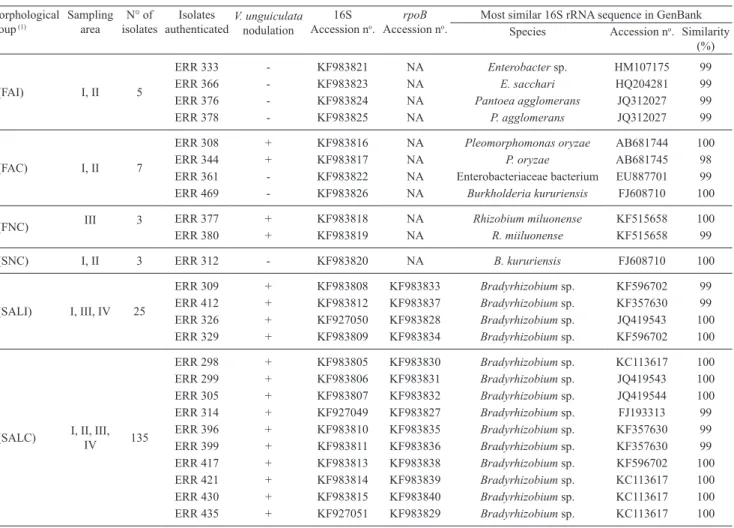
using the rpoB83F and rpoB1061R primers (Martens et al., 2008), followed by sequencing using the primer rpoB83F. Alignment, editing, and phylogenetic analysis were performed in Mega 5.05 (Tamura et al., 2011), using the neighbour‑joining method (Saitou & Nei, 1987). The sequences were deposited in the GenBank (2014), and the accession numbers are given in Table 2.
After authentication, 18 isolates were tested for biological nitrogen fixation efficiency in C. paraense.
This experiment was performed in a greenhouse (28ºC, 50% reflective shade cloth) using a completely randomized experimental design with four replicates. Plants were grown in pots (7 L) containing autoclaved sand and vermiculite (2:1) as substrate. Centrolobium paraense seed collected from site III were scarified,
desinfected (as described above), and pre‑germinated in Petri dishes containing autoclaved moistened cotton and filter paper. Five days following germination, two seeds with approximately 1 cm long radicles were transplanted into each pot and inoculated with 1 mL bacterial suspension (as described above). In addition, two treatments inoculated with
Bradyrhizobium japonicum and B. elkanii USDA 6T
and USDA 76T strains, respectively, were included:
one of the treatments had the addition of nitrogen (N) as ammonium nitrate (10 mg N per week from 0 to 28 days; 15 mg N per week from 29 to 70 days; 20 mg N per week from 71 to 77 days; and 30 mg N per week from 78 to 91 days); and the other treatment was a negative control, without inoculation, and with a low nitrogen concentration. Each pot received 800 mL per week of nutrient solution adapted from Hoagland & Arnon (1950), as above described, at ¼ of ionic strength for 42 days, ½ of ionic strength for the following 35 days, and full ionic strength until the end of the experiment.
The measured variables were: shoot dry matter; root dry matter; number of nodules; nodule dry matter; total N content in the shoots, measured using the Kjeldahl method (Liao, 1981); leaf area, measured as the area of all leaflets using a LI – 3100 area meter (LI‑COR, Lincoln, NE, EUA); plant height, measured from the base of the stem to the plant apex; and number of leaflets. Dry matter (of shoots, roots, and nodules) was
Table 1. Chemical analysis of collected soil samples from different phytophysiognomies at the Cerrado of the state of
Roraima, Brazil.
Site Coordinates Phytophysiognomies pH OM(1) Ca Mg K Al P
(g dm‑3) ‑‑‑‑‑‑‑‑‑‑‑‑‑‑‑‑‑‑‑‑‑ (cmol
c dm‑3) ‑‑‑‑‑‑‑‑‑‑‑‑‑‑‑‑‑‑‑‑ (mg dm‑3)
I 3º25'11" N; 59°56'18" W Forest island 5.8 19.5 1.57 0.67 0.21 0.01 1.68 II 3º44'25" N; 59º40'9" W Gallery forest 5.1 20.8 1.69 0.68 0.28 0.15 1.78 III 2º43'40" N; 60º51'36" W Forest island 4.9 20.8 1.35 1.06 0.15 0.66 1.68 IV 2º27'13" N; 60º54'12" W Transition forest 6.0 29.2 4.92 0.91 0.21 0.06 26.10
determined by drying the material at 65°C for 72 hours.
The data were subjected to analysis of variance, and
averages were compared using the Scott‑Knott test, at 5% probability.
Results and Discussion
Nodules (334) were obtained using C. paraense
as a trap plant. Nodule totals of the three replicates for each site – I through IV (Table 1) ‑ were 94, 87, 20, and 133, respectively. The soil characteristics and, more specifically, the higher soil organic matter, Ca, and P concentrations, at site IV, and the higher Al concentration, at site III, may have
determined the differences in nodulation among sites, since these elements were reported as limiting for nodulation (Hungria & Vargas, 2000). However, because the soil collection was performed during the dry season, and because there is usually higher rainfalls in forest/cerrado transition areas, the water availability may have also influenced soil‑rhizobia population and, consequently, plant nodulation (Sadowsky, 2005).
Out of the 334 collected nodules, 178 isolates were obtained, 41 originating from the site I, 63 from site II, 10 from site III, and 64 from site IV. Therefore, isolates were obtained from 44 to 70% of the nodules from each soil sample. This variation
Table 2. Morphological groups, sampling areas, nodulation in Vigna unguiculata, and identification using 16S rRNA of
rhizobia isolates obtained from Centrolobium paraense nodules from the Roraima Cerrado, Brazil.
Morphological
group (1) Sampling area isolatesN° of authenticatedIsolates V. unguiculatanodulation Accession n16S o.
rpoB
Accession no.
Most similar 16S rRNA sequence in GenBank Species Accession no. Similarity
(%)
1 (FAI) I, II 5
ERR 333 ‑ KF983821 NA Enterobacter sp. HM107175 99
ERR 366 ‑ KF983823 NA E. sacchari HQ204281 99
ERR 376 ‑ KF983824 NA Pantoea agglomerans JQ312027 99
ERR 378 ‑ KF983825 NA P. agglomerans JQ312027 99
2 (FAC) I, II 7
ERR 308 + KF983816 NA Pleomorphomonas oryzae AB681744 100
ERR 344 + KF983817 NA P. oryzae AB681745 98
ERR 361 ‑ KF983822 NA Enterobacteriaceae bacterium EU887701 99
ERR 469 ‑ KF983826 NA Burkholderia kururiensis FJ608710 100
3 (FNC) III 3 ERR 377 + KF983818 NA Rhizobium miluonense KF515658 100 ERR 380 + KF983819 NA R. miiluonense KF515658 99
4 (SNC) I, II 3 ERR 312 ‑ KF983820 NA B. kururiensis FJ608710 100
5 (SALI) I, III, IV 25
ERR 309 + KF983808 KF983833 Bradyrhizobium sp. KF596702 99
ERR 412 + KF983812 KF983837 Bradyrhizobium sp. KF357630 99
ERR 326 + KF927050 KF983828 Bradyrhizobium sp. JQ419543 100
ERR 329 + KF983809 KF983834 Bradyrhizobium sp. KF596702 100
6 (SALC) I, II, III, IV 135
ERR 298 + KF983805 KF983830 Bradyrhizobium sp. KC113617 100
ERR 299 + KF983806 KF983831 Bradyrhizobium sp. JQ419543 100
ERR 305 + KF983807 KF983832 Bradyrhizobium sp. JQ419544 100
ERR 314 + KF927049 KF983827 Bradyrhizobium sp. FJ193313 99
ERR 396 + KF983810 KF983835 Bradyrhizobium sp. KF357630 99
ERR 399 + KF983811 KF983836 Bradyrhizobium sp. KF357630 99
ERR 417 + KF983813 KF983838 Bradyrhizobium sp. KF596702 100
ERR 421 + KF983814 KF983839 Bradyrhizobium sp. KC113617 100
ERR 430 + KF983815 KF983840 Bradyrhizobium sp. KC113617 100
ERR 435 + KF927051 KF983829 Bradyrhizobium sp. KC113617 100
Pesq. agropec. bras., Brasília, v.49, n.4, p.296‑305, abr. 2014 DOI: 10.1590/S0100‑204X2014000400008
can be explained by the presence of many small nodules, apparently still in formation. Cultivation times longer than the tested 60 days may result in
more fully formed nodules and in the recovery of
a higher number of isolates. Characterization of the isolates, based on the morphology of colonies formed in culture medium 79, showed that 90% of the isolates have characteristics which are typical of the genus Bradyrhizobium, such as slow growth
(longer than five days), alkalinization and white colour of the colony and mucus (Jordan, 1982). Six morphological groups were obtained with 55% similarity, and groups V and VI comprised 160 isolates, all with slow growth (Table 2).
Twenty‑five of the 178 rhizobia isolates (15% of the total) were authenticated in V. unguiculata. Isolate
selection was based on the morphological grouping and on the representativeness of the different sites in each group. Ten, eight, two, and five isolates were tested from sites I, II, III, and IV, respectively. From the 25 tested isolates, seven belonging to the morphological groups with only fast‑growing isolates were not capable to promote V. unguiculata nodulation. In contrast,
representatives of all groups containing slow‑growing bacteria (14 isolates) and four fast‑growing isolates
formed nodules in V. unguiculata, indicating that more
than 90% of the isolates were rhizobia.
Comparison of the partial 16S rDNA sequences, obtained for this study with the NCBI database (GenBank, 2014), showed that isolates with slow growing in the medium 79 and capable to form nodules
on V. unguiculata belong to the genus Bradyrhizobium
(Table 2). The isolates ERR 377 and ERR 380, highly
similar to Rhizobium, and the ERR 308 and ERR 344, similar to Pleomorphomonas, were also capable to
nodulate. From the remaining fast‑growing isolates, three were grouped with Enterobacteriaceae, two
with Burkholderia, and two with Pantoea, and none formed nodules on V. unguiculata. Isolates belonging to Enterobacteriaceae, Pantoea and Burkholderia
have been reported as capable of colonizing nodules of different leguminous plants without, however, induce nodule formation (Saidi et al., 2011), although
there are several Burkholderia nodulating species
(De Meyer et al., 2013). This indicates that the non nodulating, cultured bacteria in the present study most likely grew in the culture medium before the rhizobia and were thus isolated. Strains ERR 378 and ERR
380 were not included in the phylogenetic analysis using 16S rDNA sequence (509 bp) because fewer than 500 bp of the 16S rDNA were obtained. The ERR 308 and ERR 344 fast‑growing isolates were grouped with the type strains of Pleomorphomonas oryzae and P. diazotrophica, with high similarity,
and strains ERR 377 and ERR 380 were grouped
with R. tropici and R. miluonense, confirming that
these strains belong to the genera Pleomorphomonas and Rhizobium, respectively (Figure 1). There
are no previous reports on bacteria from the genus
Pleomorphomonas forming nodules, although the
three species described for this genus were indicated as capable to fix N in vitro (Xie & Yokota, 2005; Im et al., 2006; Madhaiyan et al., 2013).
Fast‑growing bacteria with similarity to
Rhizobium have been previously found in nodules of Centrolobium plants (Moreira et al., 1993; Pagano,
2008), but symbionts of tropical leguminous plants predominantly belong to the genus Bradyrhizobium
(Moreira et al., 1998). Bacteria of the genus
Bradyrhizobium are reported as tolerant to low pH and
fertility of tropical soils (Menna & Hungria, 2011). The 14 slow‑growing isolates were grouped into four different phylogenetic branches (Figure 1). Two isolates were grouped together with Bradyrhizobium
group I type strains, which includes the traditional species B. japonicum (Delamuta et al., 2013), four strains with Bradyrhizobium group II, which includes B. elkanii, and two formed a group intermediate to Bradyrhizobium groups I and II.
The gene rpoB analysis showed high genotypic
diversity and polyphyletic distribution of the
Bradyrhizobium isolates (Figure 2). Ten of the
isolates were grouped with the B. iriomotense type
strain EK05T, but with four subgroups, three of them
with at least two isolates. The remaining four bacteria were grouped with B. elkanii and B. pachyrhizi,
in agreement with which was observed for the 16S rDNA gene. Other works using V. unguiculata
as a trap plant have shown the existence of
Bradyrhizobium isolate groups from different sites in
the Amazon region that are phylogenetically distant from species already described (Guimarães et al., 2012; Silva et al., 2012). Centrolobium paraense
probably establishes symbioses preferentially with
Centrolobium is exclusively a Neotropical genus
(Dahmer et al., 2009; Pirie et al., 2009). The analysis of 16S rDNA and rpoB genes have confirmed that
the slow‑growing isolates, obtained in the present study, belonged to the genus Bradyrhizobium, but
that they constitute phylogenetic branches different from those of previously described species. Further taxonomic studies are needed for the confirmation of this hypothesis.
The strains USDA 6T and 76T formed only
few nodules and did not promote plant growth
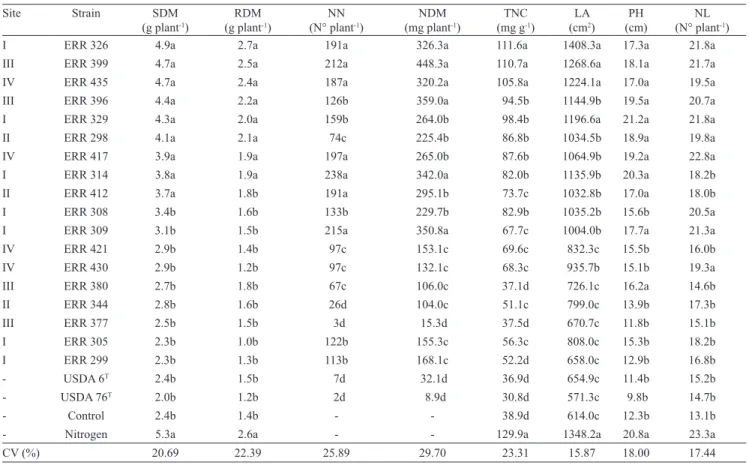
compared with the negative control (Table 3). Similarly, inoculation with isolates ERR 308, ERR 309, ERR 421, ERR 430, ERR 377, ERR 305, ERR 299, ERR 344, and ERR 380 did not increase root or shoot dry matter compared with the control, although some nodulation and significant effects on some of the measured variables were observed. In contrast, isolates ERR 326, ERR 399, ERR 435, ERR 396, ERR 329, ERR 298, ERR 417, ERR 314, and ERR 412 significantly promoted accumulation of plant biomass which was similar to the treatment
Figure 1. Neighbour‑joining phylogeny, based on 16S rRNA gene sequences showing the
Pesq. agropec. bras., Brasília, v.49, n.4, p.296‑305, abr. 2014 DOI: 10.1590/S0100‑204X2014000400008
receiving mineral nitrogen. By nodulation and plant development results, it can be inferred a wide functional variability among rhizobia isolates for growth promotion in C. paraense plants, with the
occurrence of high and low efficiency, irrespectively of the sample site (Table 2). There is an established population of rhizobia in the soils of the Roraima Cerrado, with efficient isolates that can contribute significantly to the development of C. paraense.
Similarly, studies conducted with C. tomentosum have
also shown variability in the symbiotic efficiency of native strains, and selected strains improved seedling development and plant establishment (Marques et al., 2001; Pagano, 2008).
Among the efficient isolates, ERR 326, ERR 399, and ERR 435 had more pronounced growth promotion
effects on C. paraense because in addition to higher
nodulation (number of nodules higher than 180, and nodule dry matter higher than 320 mg per plant) and increasing biomass production (more than 7 g total dry matter, in 100 days), they also increase total N content in the shoots, leaf area, plant height and number of leaflets (Table 3). Therefore, as these three isolates belong to the genus Bradyrhizobium (indicated by 16S rDNA and rpoB gene), there is an indication that Bradyrhizobium
strains are more efficient in BNF than fast‑growing
strains for C. paraense. These three isolates show high
potential for use as inoculants for this host.
Figure 2. Neighbour‑joining phylogeny, based on rpoB gene sequences
showing the relationships among Bradyrhizobium sp. isolates obtained from Centrolobium paraense nodules (shown in bold) and other Bradyrhizobium
Conclusions
1. Centrolobium paraense is able to nodulate with
different rhizobia species, including some not yet described.
2. Rhizobia belonging to the genus Bradyrhizobium
are the most common root‑nodulating‑bacteria for
C. paraense.
3. Some rhizobia isolated from C. paraense exhibit
high biological nitrogen fixation efficiency for this host.
References
DAHMER, N.; WITTMAN, M.T.S.; KAMINSKI, P.E. Chromosome number and karyotype of the endangered
Amazonian woody Centrolobium paraense Tul. species. Crop
Breeding and Applied Biotechnology, v.9, p.382‑385, 2009.
DOI: 10.12702/1984‑7033.v09n04a13.
DE MEYER, S.E.; CNOCKAERT, M.; ARDLEY, J.K.; MAKER, G.; YATES, R.; HOWIESON, J.G.; VANDAMME,
P. Burkholderia sprentiae sp. nov., isolated from Lebeckia
ambigua root nodules. International Journal of Systematic
and Evolutionary Microbiology, v.63, p.3950‑3957, 2013.
DOI: 10.1099/ijs.0.048777‑0.
DELAMUTA, J.R.M.; RIBEIRO, R.A.; ORMEÑO‑ORRILLO, E.; MELO, I.S.; MARTÍNEZ‑ROMERO, E.; HUNGRIA, M. Polyphasic evidence supporting the reclassification of
Bradyrhizobium japonicum group la strains as Bradyrhizobium
diazoefficiens sp. nov. International Journal of Systematic and Evolutionary Microbiology, v.63, p.3342‑3351, 2013.
DOI: 10.1099/ijs.0.049130‑0.
FRED, E.B; WAKSMAN, S.A. Yeast extract‑mannitol agar for laboratory manual of general microbiology. New York:
McGraw Hill, 1928. 145p.
Table 3. Shoot dry matter (SDM), root dry matter (RDM), number of nodules (NN), nodule dry matter (NDM), total N content
in shoots (TNC), leaf area (LA), plant height (PH), and number of leaflets (NL) of pau‑rainha (Centrolobium paraense Tul.)
inoculated with soil‑rhizobium isolates from the Roraima Cerrado, Brazil(1).
Site Strain SDM
(g plant‑1) (g plantRDM‑1) (N° plantNN ‑1) (mg plantNDM‑1) (mg gTNC‑1) (cmLA2)
PH
(cm) (N° plantNL ‑1)
I ERR 326 4.9a 2.7a 191a 326.3a 111.6a 1408.3a 17.3a 21.8a III ERR 399 4.7a 2.5a 212a 448.3a 110.7a 1268.6a 18.1a 21.7a IV ERR 435 4.7a 2.4a 187a 320.2a 105.8a 1224.1a 17.0a 19.5a III ERR 396 4.4a 2.2a 126b 359.0a 94.5b 1144.9b 19.5a 20.7a I ERR 329 4.3a 2.0a 159b 264.0b 98.4b 1196.6a 21.2a 21.8a II ERR 298 4.1a 2.1a 74c 225.4b 86.8b 1034.5b 18.9a 19.8a IV ERR 417 3.9a 1.9a 197a 265.0b 87.6b 1064.9b 19.2a 22.8a I ERR 314 3.8a 1.9a 238a 342.0a 82.0b 1135.9b 20.3a 18.2b II ERR 412 3.7a 1.8b 191a 295.1b 73.7c 1032.8b 17.0a 18.0b I ERR 308 3.4b 1.6b 133b 229.7b 82.9b 1035.2b 15.6b 20.5a I ERR 309 3.1b 1.5b 215a 350.8a 67.7c 1004.0b 17.7a 21.3a IV ERR 421 2.9b 1.4b 97c 153.1c 69.6c 832.3c 15.5b 16.0b IV ERR 430 2.9b 1.2b 97c 132.1c 68.3c 935.7b 15.1b 19.3a III ERR 380 2.7b 1.8b 67c 106.0c 37.1d 726.1c 16.2a 14.6b II ERR 344 2.8b 1.6b 26d 104.0c 51.1c 799.0c 13.9b 17.3b
III ERR 377 2.5b 1.5b 3d 15.3d 37.5d 670.7c 11.8b 15.1b
I ERR 305 2.3b 1.0b 122b 155.3c 56.3c 808.0c 15.3b 18.2b I ERR 299 2.3b 1.3b 113b 168.1c 52.2d 658.0c 12.9b 16.8b ‑ USDA 6T 2.4b 1.5b 7d 32.1d 36.9d 654.9c 11.4b 15.2b
‑ USDA 76T 2.0b 1.2b 2d 8.9d 30.8d 571.3c 9.8b 14.7b
‑ Control 2.4b 1.4b ‑ ‑ 38.9d 614.0c 12.3b 13.1b
‑ Nitrogen 5.3a 2.6a ‑ ‑ 129.9a 1348.2a 20.8a 23.3a CV (%) 20.69 22.39 25.89 29.70 23.31 15.87 18.00 17.44
Pesq. agropec. bras., Brasília, v.49, n.4, p.296‑305, abr. 2014 DOI: 10.1590/S0100‑204X2014000400008
GENBANK. Available at: <http://www.ncbi.nlm.nih.gov/ Genbank>. Accessed on: 12 Feb. 2014.
GUIMARÃES, A.A.; JARAMILLO, P.M.D.; NÓBREGA, R.S.A.; FLORENTINO, L.A.; SILVA, K.B.; MOREIRA, F.M.S. Genetic and symbiotic diversity of nitrogen‑fixing bacteria isolated from agricultural soils in the western Amazon by using cowpea as the trap plant. Applied and Environmental Microbiology, v.78, p.6726‑6733, 2012. DOI: 10.1128/
AEM.01303‑12.
HAUKKA, K. Genetic diversity and phylogeny of rhizobial isolated from tropical tree legumes. 1997. 94p. Thesis (Ph.D.)
– University of Helsinki, Helsinki, Finlandia.
HOAGLAND, D.R.; ARNON, D.I. The water‑culture method for growing plants without soil. Berkeley: University of
California, 1950. 32p. (California Agricultural Experiment Station. Circular, 347).
HUNGRIA, M.; VARGAS, M.A.T. Environmental factors affecting N2 fixation in grain legumes in the tropics, with an
emphasis on Brazil. Field Crops Research, v.65, p.151‑164,
2000. DOI: 10.1016/S0378‑4290(99)00084‑2.
IM, W.‑T.; KIM, S.‑H.; KIM, M.K.; TEN, L.N.; LEE, S.T.
Pleomorphomonas koreensis sp. nov., a nitrogen‑fixing species
in the order Rhizobiales.International Journal of Systematic and Evolutionary Microbiology, v.56, p.1663‑1666, 2006. DOI:
10.1099/ijs.0.63499‑0.
JORDAN, D.C. Transfer of Rhizobium japonicum Buchanan
1980 to Bradyrhizobium gen. nov., a genus of slow‑growing, root
nodule bacteria from leguminous plants. International Journal of Systematic Bacteriology, v.32, p.136‑139, 1982. DOI:
10.1099/00207713‑32‑1‑136.
KAMINSKI, P.E. O pau‑rainha (Centrolobium paraense):
características, potencialidades e usos. Boa Vista: Embrapa Roraima, 2004. 31p. (Embrapa Roraima. Documentos, 10). LIAO, C.F.H. Devarda’s alloy method for total nitrogen determination. Soil Science Society of America Journal, v.45,
p.852‑855, 1981. DOI: 10.2136/sssaj1981.03615995004500050 005x.
MADHAIYAN, M.; JIN, T.Y.; ROY, J.J.; KIM, S.J.; WEON, H.Y.; KWON, S.W.; JI, L. Pleomorphomonas diazotrophica sp.
nov., an endophytic N‑fixing bacterium isolated from root tissue
of Jatropha curcas L. International Journal of Systematic and
Evolutionary Microbiology, v.63, p.2477‑2483, 2013. DOI:
10.1099/ijs.0.044461‑0.
MARQUES, M.S.; PAGANO, M.; SCOTTI, M.R.M.M.L. Dual inoculation of a woody legume (Centrolobium tomentosum)
with rhizobia and mycorrhizal fungi in South‑Eastern Brazil. Agroforestry Systems, v.52, p.107‑117, 2001. DOI:
10.1023/A:1010637401475.
MARTENS, M.; DAWYNDT, P.; COOPMAN, R.; GILLIS, M.; DE VOS, P.; WILLEMS, A. Advantages of multilocus sequence analysis for taxonomic studies: a case study using 10 housekeeping genes in the genus Ensifer (including former
Sinorhizobium). International Journal of Systematic and
Evolutionary Microbiology, v.58, p.200‑214, 2008. DOI:
10.1099/ijs.0.65392‑0.
MENNA, P.; HUNGRIA, M. Phylogeny of nodulation and nitrogen‑fixation genes in Bradyrhizobium: supporting evidence
for the theory of monophyletic origin, and spread and maintenance by both horizontal and vertical transfer. International Journal of Systematic and Evolutionary Microbiology, v.61, p.3052‑3067,
2011. DOI: 10.1099/ijs.0.028803‑0.
MOREIRA, F.M.S.; GILLIS, M.; POT, B.; KERSTERS, K.; FRANCO, A.A. Characterization of rhizobia isolated from different divergence groups of tropical Leguminosae by comparative polyacrylamide gel electrophoresis of their total proteins. Systematic and Applied Microbiology, v.16,
p.135‑146, 1993. DOI: 10.1016/S0723‑2020(11)80258‑4. MOREIRA, F.M.S.; HAUKKA, K.; YOUNG, J.P.W. Biodiversity of rhizobia isolated from a wide range of forest legumes in Brazil.
Molecular Ecology, v.7, p.889‑895, 1998. DOI: 10.1046/j.1365‑
294x.1998.00411.x.
PAGANO, M.C. Rhizobia associated with Neotropical tree
Centrolobium tomentosum used in riparian restoration. Plant Soil
and Environment, v.54, p.498‑508, 2008.
PEDREIRA, J.L. Uso e manejo de pau‑rainha (Centrolobium paraense Tul. – Fabaceae) na terra indígena Araçá, RR. 2011.
91p. Dissertação (Mestrado) – Instituto Nacional de Pesquisa da Amazônia, Manaus.
PIRIE, M.D.; KLITGAARD, B.B.; PENNINGTON, R.T. Revision and biogeography of Centrolobium (Leguminosae ‑
Papilionoideae). Systematic Botany, v.34, p.345‑359, 2009.
DOI: 10.1600/036364409788606262.
RIVAS, R.; MARTENS, M.; DE LAJUDIE, P.; WILLEMS, A. Multilocus sequence analysis of the genus Bradyrhizobium.
Systematic and Applied Microbiology, v.32, p.101‑110, 2009.
DOI: 10.1016/j.syapm.2008.12.005.
SADOWSKY, M. Soil stress factors influencing symbiotic nitrogen fixation. In: WERNER, D.; NEWTON, W. (Ed.).
Nitrogen fixation in agriculture, forestry, ecology, and the environment. Dordrecht: Springer, 2005. p.89‑112. DOI:
10.1007/1‑4020‑3544‑6_6.
SAIDI, S.; MNASRI, B.; MHAMDI, R. Diversity of nodule‑endophytic agrobacteria‑like strains associated with different grain legumes in Tunisia. Systematic and Applied Microbiology, v.34, p.524‑530, 2011. DOI: 10.1016/j.
syapm.2011.01.009.
SAITOU, N.; NEI, M. The neighbor‑joining method: a new method for reconstructing phylogenetic trees. Molecular Biology and Evolution,v.4, p.406‑425, 1987.
SILVA, F.V.; SIMÕES‑ARAÚJO, J.L.; SILVA JÚNIOR, J.P.; XAVIER, G.R.; RUMJANEK, N.G. Genetic diversity of rhizobia isolates from Amazon soils using cowpea (Vigna unguiculata) as
trap plant. Brazilian Journal of Microbiology, v.43, p.682‑691,
2012. DOI: 10.1590/S1517‑83822012000200033.
SOUZA, L.A.G. de; SILVA, M.F. da; MOREIRA, F.W. Capacidade de nodulação de cem leguminosas da Amazônia.
TAMURA, K.; PETERSON, D.; PETERSON, N.; STECHER, G.; NEI, M.; KUMAR, S. MEGA5: molecular evolutionary genetics analysis using maximum likelihood, evolutionary distance, and maximum parsimony methods. Molecular Biology and Evolution,
v.28, p.2731‑2739, 2011. DOI: 10.1093/molbev/msr121.
VINCENT, J.M. A manual for the practical study of root‑nodule bacteria. Oxford: Blackwell Scientific, 1970.
164p.
WILLEMS, A.; COOPMAN, R.; GILLIS, M. Phylogenetic and DNA‑DNA hybridization analyses of Bradyrhizobium species.
International Journal of Systematic and Evolutionary Microbiology, v.51, p.111‑117, 2001.
XIE, C.H.; YOKOTA, A. Pleomorphomonas oryzae gen.
nov., sp. nov., a nitrogen‑fixing bacterium isolated from paddy
soil of Oryza sativa. International Journal of Systematic and Evolutionary Microbiology, v.55, p.1233‑1237, 2005. DOI:
10.1099/ijs.0.63503‑0.
YOUNG, J.P.W.; DOWNER, H.L.; EARDLY, B.D. Phylogeny of the phototropic Rhizobium strain BTAil by polymerase chain
reaction‑based sequencing of a 16S rDNA gene segment. Journal of Bacteriology, v.173, p.2271‑2277, 1991.