M. M. Lordelo, A. M. Gaspar, L. Le Bellego and J. P. B. Freire
meal-based diet for piglets: Growth performance and nitrogen balance
Isoleucine and valine supplementation of a low-protein corn-wheat-soybean
doi: 10.2527/jas.2007-0222 originally published online Jun 20, 2008;
2008.86:2936-2941.
J Anim Sci
http://jas.fass.org/cgi/content/full/86/11/2936
the World Wide Web at:
The online version of this article, along with updated information and services, is located on
ABSTRACT: The effects of Ile and Val
supplementa-tion of a low-CP, corn-wheat-soybean meal-based pig-let diet on growth performance, incidence of diarrhea, and N balance were studied using 60 Landrace × Duroc male piglets in a 4-wk experiment. The 60 individually caged piglets were divided into 5 dietary treatments, each consisting of 12 piglets. Diet 1 was a positive con-trol diet (20% CP); diet 2 was a low-CP negative concon-trol diet (17% CP); diets 3, 4, and 5 were low-CP diets to which Ile, Val, or the combination of Ile and Val were added, respectively. All diets were supplemented with Lys, Met, Thr, and Trp to provide the required concen-trations of these AA according to the 1998 NRC. Aver-age daily gain and ADFI were similar among pigs fed the positive control, Val-added, and the Val plus
Ile-added diets. On wk-2 and wk-4, fecal score was greater (softer feces) in piglets fed the 20% CP level compared with the remaining treatments (P < 0.01). Nitrogen in-take was decreased (P < 0.0001) in pigs fed diets con-taining low levels of CP compared with pigs fed the 20% CP diet. Fecal N excretion (g/d) was decreased (P < 0.05) in piglets fed low-CP diets at wk 1 and wk 4 of feeding, and in urine at wk 4 of feeding. Crude pro-tein levels or AA supplementation had no effect on N retention efficiencies. These results indicate that the supplementation of Val alone, or in combination with Ile, to a low-CP piglet diet with adequate levels of Lys, Met, Thr, and Trp is necessary to achieve maximum performance in pigs consuming corn-wheat-soybean meal-based diets.
Key words: crude protein, growth, isoleucine, piglet, valine
©2008 American Society of Animal Science. All rights reserved. J. Anim. Sci. 2008. 86:2936–2941 doi:10.2527/jas.2007-0222
INTRODUCTION
Reducing the dietary CP level of the diet and sup-plementing it with limiting crystalline AA can reduce N excretion, which may prevent surface and ground water contamination (Bridges et al., 1995; Carter et al., 1996). In addition, reducing dietary CP level has been reported to limit the frequency and the severity of digestive problems in piglets (Prohaszka and Baron, 1980; Ball and Aherne, 1982, 1987). The increasing availability of crystalline AA allows reduction of the CP level in piglet diets in association with adequate AA supplementation, which maintains sufficient essential
AA supply with little or no decrease in growth perfor-mance (Brudevold and Southern, 1994; Jin et al., 1998; Figueroa et al., 2002).
As long as crystalline Lys, Trp, Thr, and Met are added, performance is not affected when reducing CP levels in a traditional corn-soybean meal-based diet (Russell et al., 1986; Kerr et al., 1995; Knowles et al., 1998). When using alternative feed ingredients, addi-tional AA appear to become limiting in low-CP diets. Such is the case with the utilization of spray-dried blood cells, which without supplemental Ile, has growth-depressing effects (Kerr et al., 2004). In addition, in a barley-wheat-soy protein concentrate-based diet, Val was shown to be the first limiting AA for growth rate in young pigs after Lys, Met, and Thr (Theil et al., 2004). Therefore, when alternative ingredients are used in a corn-soybean meal diet, the order of AA limitation in a low-CP piglet diet is uncertain.
The objective of the present experiment was to study the effects on growth performance and N balance of weaned piglets due to the supplementation of
crystal-Isoleucine and valine supplementation of a low-protein
corn-wheat-soybean meal-based diet for piglets:
Growth performance and nitrogen balance
1M. M. Lordelo,* A. M. Gaspar,† L. Le Bellego,‡ and J. P. B. Freire*2
*Universidade Técnica de Lisboa, Instituto Superior de Agronomia, Departamento de Produção Agrícola e Animal, Tapada da Ajuda, 1340-017 Lisboa, Portugal; †Vetiquima, Produtos Químicos, Lda., 2695-066 Bobadela
Loures, Portugal; and ‡Ajinomoto Eurolysine SAS, rue de Courcelles, 75817 Paris, France
1 The authors thank Ajinomoto Eurolysine and
Vetiquima-Produ-tos Químicos, Lda., for providing financial support and for donating the amino acids used in this study.
2 Corresponding author: [email protected]
Received April 19, 2007. Accepted June 5, 2008.
line Ile, Val, or both, to a low-CP corn-wheat-soybean meal-based diet.
MATERIALS AND METHODS
All animal procedures followed the Portuguese Guidelines for the Protection of Animals Used in Ex-perimental Research and Other Scientific Purposes.
Animals and Diets
Sixty individually caged 4-wk-old Landrace × Duroc male piglets, with a mean initial BW of 6.92 ± 0.61 kg, were allotted into 5 dietary treatments (Table 1), each consisting of 12 piglets. Each piglet represented an ex-perimental unit. The piglets were randomly assigned to the experimental diets based on average BW at weaning in a complete block design. The piglets were individually housed in cages (1.0 × 0.8 m) with a single-hole feeder and 1 nipple drinker and were allowed free access to water and feed. Cages were equipped with
perforated stainless steel trays underneath for feces and urine collection. The feed was provided as pellets, 3 mm in diameter. Temperature at the animal level was 28°C initially and was reduced by 1°C each week thereafter.
Starter diets were corn, wheat, and soybean meal-based and formulated to differ in CP and AA quanti-ties (Table 1). All diets were fortified with Lys, Met, Thr, and Trp to provide recommended levels accord-ing to the 1998 NRC (Table 1). Diet 1 was the positive control and contained 20% CP. In diets 2 to 5 the CP level was reduced to 17%. Diet 2 was not supplemented with crystalline Ile or Val (negative control); diet 3 was supplemented with 0.13% Ile, diet 4 was supplement-ed with 0.15% Val; and diet 5 was supplementsupplement-ed with both 0.13% Ile and 0.15% Val (Table 1). Isoleucine and Val were supplemented to meet the NRC (1998) recom-mendations of these AA of pigs between 5 and 20 kg as presented in Table 1.
Piglets were allowed to adapt to the cages for a pe-riod of 4 d after which the experimental diets were fed
Table 1. Composition of the experimental diets, as-fed basis
Item Diet 1 2 3 4 5 Ingredient, % Corn 39.70 49.60 49.47 49.45 49.32 Wheat 25.00 25.00 25.00 25.00 25.00 Soybean meal, 48% CP 28.10 18.20 18.20 18.20 18.20 Corn oil 3.00 2.50 2.50 2.50 2.50 l-Lys, HCl 0.30 0.64 0.64 0.64 0.64 dl-Met 0.20 0.23 0.23 0.23 0.23 l-Thr 0.10 0.26 0.26 0.26 0.26 l-Trp 0.04 0.09 0.09 0.09 0.09 l-Ile — — 0.13 — 0.13 l-Val — — — 0.15 0.15 Calcium carbonate 1.20 1.29 1.29 1.29 1.29 Dicalcium phosphate 1.40 1.44 1.44 1.44 1.44 Sodium chloride 0.20 0.25 0.25 0.25 0.25 Premix1 0.50 0.50 0.50 0.50 0.50
Calculated and analyzed composition2
ME, MJ/kg 10.20 10.35 10.33 10.33 10.31 GE, MJ/kg 13.62 13.50 13.49 13.49 13.46 DM, % 90.08 89.83 90.38 91.30 90.58 CP, % 20.37 16.38 17.03 17.08 16.990 Cys, % 0.310 0.255 0.260 0.260 0.260 Ile, % 0.825 0.595 0.745 0.630 0.740 Lys, % 1.245 1.190 1.200 1.220 1.210 Met, % 0.533 0.455 0.440 0.445 0.440 Thr, % 0.830 0.790 0.795 0.800 0.795 Trp, % 0.285 0.270 0.271 0.275 0.269 Val, % 0.905 0.690 0.715 0.855 0.845 Ile:Lys 0.66 0.50 0.62 0.52 0.61 Met + Cys:Lys 0.68 0.60 0.58 0.58 0.58 Thr:Lys 0.67 0.66 0.66 0.66 0.66 Trp:Lys 0.23 0.23 0.23 0.23 0.22 Val:Lys 0.73 0.58 0.60 0.70 0.70
1Provided per kilogram of diet: vitamin A, 15,000 IU; vitamin D
3, 2,000 IU; vitamin E, 20 IU; vitamin C, 200 mg; thiamin, 1.5 mg; riboflavin,
5 mg; niacin, 30 mg; pantothenic acid, 15 mg; pyridoxine, 2.5 mg; biotin, 0.08 mg; folic acid, 0.5 mg; cyanocobalamin, 0.03 mg; vitamin K3, 1
mg; choline chloride, 300 mg; I, 1 mg as potassium iodate; Mn, 50 mg as manganese oxide; Fe, 120 mg as ferrous carbonate; Zn, 140 mg as zinc oxide; Cu, 160 mg as copper sulfate; Se, 0.3 mg as sodium selenite; Co, 0.5 mg as cobalt carbonate; antioxidant (butylated hydroxytoluene), 30 mg.
2Both GE and ME were calculated according to INRA (2002). All other values represent analyzed values.
for 4 consecutive wk. During the experimental period, BW was monitored at the beginning and at the end of each week. Individual feed intake and mortality were monitored daily. Feed refusals were collected daily, fro-zen, and pooled by wk for determination of the DM. Although pigs were fed twice daily, the amount of feed offered was enough to ensure there was approximately 10% of feed refusals each day. Feces and urine were in-dividually collected from each pig on the first and last week of the experimental period for determination of N balance. Feces were collected twice daily, and urine was continuously collected directly to a container which contained 50 mL of sulphuric acid (5% vol) solution to prevent N loss and then frozen daily at −20°C.
The consistency of feces of each individual pig was recorded daily during the entire experimental period and was characterized by using the fecal consistency score described by Marquardt et al. (1999). The feces were scored as normal = 0, soft = 1, mild diarrhea = 2, and severe diarrhea = 3.
Chemical Analyses
At the end of each collection period, representative sample of feces and urine were individually prepared. Samples of feces were freeze-dried and ground by a hammermill through a 1-mm mesh screen. Similarly, samples of each diet were ground through a 1-mm screen. Fecal samples and feed refusals were analyzed for DM and N, whereas urine samples were analyzed for N only. All diets were analyzed for DM, N, energy, and AA.
Dry matter was calculated after oven-drying at 105°C for 24 h and GE was measured with a isoperibol calo-rimeter (Parr 1261, Moline, IL). Nitrogen analysis was performed using the Kjeldahl method. All AA analy-ses were performed by Ajinomoto Eurolysine (Amiens, France), using AFNOR method (standard NF EN ISO 13903), except for Trp, which was analyzed using AF-NOR method (standard NF EN ISO 13904).
Statistical Analyses
Animal performance, digestibility, and nitrogen bal-ance data were analyzed by ANOVA, according to a randomized complete block design (block and dietary treatment were considered class variables). When the
F-value in the ANOVA was significant, the means were
compared by a Duncan’s multiple range test. All statis-tical procedures were conducted using the GLM proce-dures (SAS Inst. Inc., Cary, NC), and differences were considered significant when P-values were less than 0.05.
RESULTS
The supplementation of diets 3 and 5 with 0.13% crystalline Ile increased the Ile:Lys to a value greater than 0.6 and close to the positive control, whereas
sup-plementation of diets 4 and 5 with 0.15% Val allowed the Val:Lys to be similar to the positive control diet (Table 1).
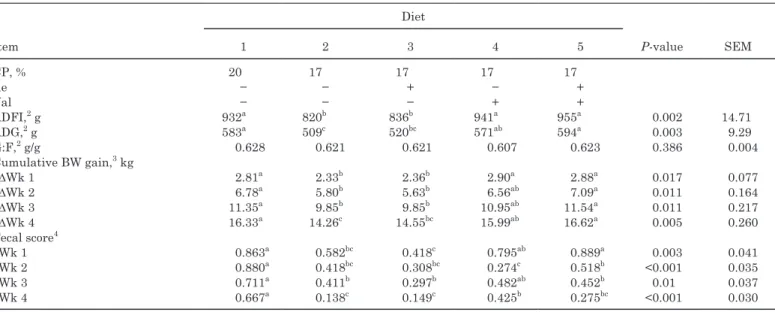
The addition of either Val alone, or Ile and Val, to the low-CP diet increased (P < 0.01) feed intake in com-parison to pigs fed the negative control or the addition of Ile alone (Table 2). In addition, ADG was similar to the positive control when piglets were fed diets supple-mented with either Val or Ile and Val (Table 2). Av-erage daily gain of piglets fed Ile-supplemented diets was similar to piglets fed the negative control (Table 2). Gain:feed was not different among treatments (Ta-ble 2).
For all experimental weeks, cumulative BW gain was similar among piglets fed the positive control diet and piglets fed a diet containing crystalline Val, or Ile and Val (Table 2). Pigs consuming the negative control diet, and the diet supplemented with Ile alone, had de-creased (P < 0.05) cumulative BW gains than pigs fed the positive control diet (Table 2).
For each week, the fecal score was greater (P < 0.01) in piglets fed the 20% CP level than the other dietary treatments, with the exception of piglets fed Val alone, or in combination with Ile in wk 1 and of piglets fed Val alone in wk 3 (Table 2), indicating that the type of diet that the piglets were fed affected fecal consistency.
In the N balance portion of the experiment, there was a decrease in N intake when piglets were fed the low-CP diets during wk 1 and 4 (Table 3). This decrease was more noticeable when piglets were fed the nega-tive control or the diet supplemented with Ile alone. Nitrogen excretion in the feces decreased (P < 0.05) in piglets fed diets with low-CP levels in wk 1 and 4, with the exception of piglets fed a Val-supplemented diet in wk 4. Urine N excretion was not affected by diet in wk 1 but was decreased in pigs fed all the low CP di-ets, regardless of AA supplementation, in wk 4 (Table 3). The N retained by the piglets as a percentage of N absorbed, or as a percentage of N consumed, was not different among treatments at either measured time period (Table 3).
DISCUSSION
All diets in the present experiment were supple-mented with Lys, Met, Thr, and Trp to meet or exceed the required levels of these AA (NRC, 1998) and pro-vide similar total concentrations as those in the 20% CP diet.
When Val was supplemented to the low-CP, corn-wheat-soybean meal diet, feed intake and growth rate improved in comparison to an unsupplemented control diet, but feed efficiency was unaffected. As a result pig performance was not different compared with pigs con-suming the 20% CP diet. These results are similar to a previous experiment in which nursery pigs fed a low-CP corn-soybean meal-whey diet showed positive re-sponses to Val supplementation (Mavromichalis et al., 1998). Our results for Val supplementation of a
corn-wheat-soybean meal starter pig diet are also consistent with previous experiments with growing pigs (Russell et al., 1987, Figueroa et al., 2003). In those studies, the addition of Val to a low-CP, corn-soybean meal-based diet with supplemental Lys, Trp, Thr, and in some cas-es Met, increased feed intake and daily gain but did not improve feed efficiency in growing pigs.
In contrast, Brudevold and Southern (1994) reported that the addition of Val by itself to a low-CP, sorghum-soybean meal-based diet supplemented with Lys, Thr, and Glu did not result in improved pig performance, and the addition of Ile, His, and Trp were necessary for growth to be similar to piglets fed the positive control diet. Nevertheless, it is important to note that
Brude-Table 2. Effect of dietary CP level and the supplementation of Ile, Val, or Ile and Val on feed intake and growth
performance of piglets (as-fed basis) and on fecal score1
Item Diet P-value SEM 1 2 3 4 5 CP, % 20 17 17 17 17 Ile − − + − + Val − − − + + ADFI,2 g 932a 820b 836b 941a 955a 0.002 14.71 ADG,2 g 583a 509c 520bc 571ab 594a 0.003 9.29 G:F,2 g/g 0.628 0.621 0.621 0.607 0.623 0.386 0.004 Cumulative BW gain,3 kg ∆Wk 1 2.81a 2.33b 2.36b 2.90a 2.88a 0.017 0.077 ∆Wk 2 6.78a 5.80b 5.63b 6.56ab 7.09a 0.011 0.164 ∆Wk 3 11.35a 9.85b 9.85b 10.95ab 11.54a 0.011 0.217 ∆Wk 4 16.33a 14.26c 14.55bc 15.99ab 16.62a 0.005 0.260 Fecal score4 Wk 1 0.863a 0.582bc 0.418c 0.795ab 0.889a 0.003 0.041 Wk 2 0.880a 0.418bc 0.308bc 0.274c 0.518b <0.001 0.035 Wk 3 0.711a 0.411b 0.297b 0.482ab 0.452b 0.01 0.037 Wk 4 0.667a 0.138c 0.149c 0.425b 0.275bc <0.001 0.030
a–cWithin a row, means without a common superscript letter differ (P < 0.05). 1The average initial BW was 6.92 ± 0.068.
2Cumulative performance over the 4-wk experiment.
3∆Wk 1 = Wk 1 − Wk 0; ∆Wk 2 = Wk 2 − Wk 0; ∆Wk 3 = Wk 3 − Wk 0; ∆Wk 4 = Wk 4 − Wk 0. 4Fecal score: 0 = normal, 1 = soft feces, 2 = mild diarrhea, and 3 = severe diarrhea.
Table 3. Effect of dietary CP level and the supplementation of Ile, Val, or Ile and Val on nitrogen balance of piglets
during the first and last experimental week
Item Diet P-value SEM 1 2 3 4 5 CP, % 20 17 17 17 17 Ile − − + − + Val − − − + + N intake, g/d Wk 1 18.17a 13.72c 14.02c 15.92b 16.14b <0.001 0.336 Wk 4 39.59a 27.20c 29.76c 33.24b 32.39b <0.001 0.789 N excretion, g/d Wk 1 Feces 3.03a 2.34b 2.33b 2.45b 2.34b 0.032 0.084 Urine 2.56 1.58 2.20 1.77 1.78 0.076 0.122 Wk 4 Feces 5.91a 3.91c 4.19bc 5.04ab 4.45bc <0.001 0.171 Urine 8.98a 5.27b 4.33b 4.59b 6.07b 0.028 0.515 N retention Wk 1 g/d 12.58a 9.77b 9.48b 11.70a 12.01a <0.001 0.286 % of N absorbed 82.88 85.65 80.93 87.06 87.08 0.119 0.91 % of N intake 68.96 71.11 67.61 73.87 74.39 0.107 0.97 Wk 4 g/d 24.73a 18.02b 21.25ab 23.61a 21.88a 0.013 0.667 % of N absorbed 73.84 77.51 83.43 83.88 77.40 0.238 1.63 % of N intake 62.88 66.40 71.61 71.35 66.81 0.266 1.43
a–cWithin a row, means without a common superscript letter differ (P < 0.05).
vold and Southern (1994) utilized experimental diets with CP levels as low as 12%, almost 10 percentage units less than the positive control diet, which may have contributed to the lack of response observed for Val supplementation alone.
For Ile supplementation, our results suggest that the addition of this AA alone to a corn-wheat-soybean meal low-CP piglet diet will not improve feed intake or growth rate. Isoleucine has also been shown to be less limiting than Val in a reduced CP corn-soybean meal-whey diet for young pigs (Mavromichalis et al., 1998). In growing pigs it was also demonstrated that the supplementation of Ile alone in a low-CP, corn-soybean meal diet did not contribute to improved pig performance (Russell et al., 1987). However, the com-bination of Ile and Val to the low-CP diet in the present experiment resulted in increased growth rate but simi-lar feed efficiency in comparison to that of pigs consum-ing the negative control. This differed from earlier ex-periments that reported an increase in growth rate and feed efficiency when Ile and Val were supplemented in combination to growing pig diets (Russell et al. 1987).
In the current work, fecal score was greater in ani-mals fed the high-CP diet compared with the remain-ing treatments. This was not surprisremain-ing because diets for early weaned pigs usually contain increased quan-tities of protein, which may promote proliferation of pathogenic bacteria in the gastrointestinal tract, lead-ing to postweanlead-ing diarrhea (Prohaszka and Baron, 1980; Ball and Aherne, 1987; Le Bellego and Noblet, 2002). This is a potential problem under commercial conditions due to poorer sanitary and housing condi-tions compared with most swine research facilities.
Reducing the CP content in the AA-supplemented diets reduced total N intake and thus, decreased N ex-cretion on a grams per day basis. The total N exex-cretion after feeding the low-CP diet supplemented with Ile and Val for wk 1 was reduced by 26% compared with the high-CP diet, and after wk 4 this difference was 29% reduced. When only Val was added to the diet, the wk 4 total N excretion was 35% less than the positive control. These data show that with the aid of crystal-line AA, a 10% reduction in total N excretion is possible for every 1% reduction in CP content of the diet. Very similar decrease has been shown by other investiga-tors who have measured reductions in total N excretion of low-CP diets with crystalline AA (Kerr and Easter, 1995; Le Bellego and Noblet, 2002; Shriver et al., 2003). It is important to note that N intake and N excretion were significantly reduced in piglets fed the low-CP diets supplemented with Val alone, or in combination with Ile. However, N retention as a percentage of N intake was not affected, indicating that the capability of retaining N by the animals was not altered with the diet used.
The results demonstrate that the inclusion of Val alone, or in combination with Ile, in a low-CP corn-wheat-soybean meal-based starter diet leads to growth performance responses similar to those obtained when
feeding a high-CP diet. However, animals fed the diet to which only Val was included excreted less total N and had less soft feces compared with pigs fed diets supplemented with both Val and Ile. Therefore, this re-search indicates that piglets can optimally perform on low-CP corn-wheat-soybean meal diet, supplemented with Lys, Trp, Thr, Met, and Val, but not Ile.
LITERATURE CITED
Ball, R. O., and F. X. Aherne. 1982. Effect of diet complexity and feed restriction on the incidence and severity of diarrhea in early-weaned pigs. Can. J. Anim. Sci. 62:907–913.
Ball, R. O., and F. X. Aherne. 1987. Influence of dietary nutrient density, level of feed intake and weaning age on young pigs. 2. Apparent nutrient digestibility and incidence and severity of diarrhea. Can. J. Anim. Sci. 67:1105–1115.
Bridges, T. C., L. W. Turner, G. L. Cromwell, and J. L. Pierce. 1995. Modelling the effects of diet formulation on nitrogen and phos-phorus excretion in swine waste. Appl. Eng. Agric. 11:731– 739.
Brudevold, A. B., and L. L. Southern. 1994. Low-protein, crystalline amino acid-supplemented, sorghum-soybean meal diets for the 10- to 20- kilogram pig. J. Anim. Sci. 72:638–647.
Carter, S. D., G. L. Cromwell, M. D. Lindemann, L. W. Turner, and T. C. Bridges. 1996. Reducing N and P excretion by dietary ma-nipulation in growing and finishing pigs. J. Anim. Sci. 74(Sup-pl. 1):59 (Abstr.)
Figueroa, J. L., A. J. Lewis, P. S. Miller, R. L. Fischer, R. S. Gómez, and R. M. Diedrichsen. 2002. Nitrogen metabolism and growth performance of gilts fed standard corn-soybean meal diets or low-crude protein, amino acid-supplemented diets. J. Anim. Sci. 80:2911–2919.
Figueroa, J. L., A. J. Lewis, P. S. Miller, R. L. Fischer, R. S. Gómez, and R. M. Diedrichsen. 2003. Growth, carcass traits, and plas-ma amino acid concentrations of gilts fed low-protein diets sup-plemented with amino acids including histidine, isoleucine, and valine. J. Anim. Sci. 81:1529–1537.
INRA. 2002. Tables de composition et de valeur nutritive des mat-ières premmat-ières destinées aux animaux d’élevage. INRA Edi-tions et AFZ, Paris, France.
Jin, C. F., I. H. Kim, K. Han, and S. H. Bae. 1998. Effects of supple-mental synthetic amino acids to the low protein diets on the performance of growing pigs. Asian-australas. J. Anim. Sci. 11:1–7.
Kerr, B. J., and R. A. Easter. 1995. Effect of feeding reduced protein, amino acid-supplemented diets on nitrogen and energy balance in grower pigs. J. Anim. Sci. 73:3000–3008.
Kerr, B. J., M. T. Kidd, J. A. Cuaron, K. L. Bryant, T. M. Parr, C. V. Maxwell, and E. Weaver. 2004. Utilization of spray-dried blood cells and crystalline isoleucine in nursery pig diets. J. Anim. Sci. 82:2397–2404.
Kerr, B. J., F. K. McKeith, and R. A. Easter. 1995. Effect on perfor-mance and carcass characteristics of nursery to finisher pigs fed reduced crude protein, amino acid-supplemented diets. J. Anim. Sci. 73:433–440.
Knowles, T. A., L. L. Southern, T. D. Bidner, B. J. Kerr, and K. G. Friesen. 1998. Effect of dietary fiber or fat in low-crude protein, crystalline amino acid-supplemented diets for finishing pigs. J. Anim. Sci. 76:2818–2832.
Le Bellego, L., and J. Noblet. 2002. Performance and utilization of dietary energy and amino acids in piglets fed low protein diets. J. Anim. Sci. 76:45–58.
Marquardt, R. R., L. Z. Jin, J. W. Kim, L. Fang, A. A. Frohlich, and S. K. Baidoo. 1999. Passive protective effect of egg-yolk anti-bodies against enterotoxigenic Escherichia coli K88+ infection in neonatal and early-weaned piglets. FEMS Immunol. Med. Microbiol. 23:283–288.
Mavromichalis, I., D. M. Webel, J. L. Emmert, R. L. Moser, and D. H. Baker. 1998. Limiting order of amino acids in a low-protein corn-soybean meal-based diet for nursery pigs. J. Anim. Sci. 76:2833–2837.
NRC. 1998. Nutrient Requirements of Swine. 10th ed. Natl. Acad. Press, Washington, DC.
Prohaszka, L., and F. Baron. 1980. The predisposing role of high di-etary protein supplies in enteropathogenic E. coli infections of weaned pigs. Zentralbl. Veterinarmed. [C] 27:222–232. Russell, L. E., R. A. Easter, V. Gomez-Rojas, G. L. Cromwell, and T.
S. Stahly. 1986. A note on the supplementation of low-protein, maize-soybean meal diets with lysine, tryptophan, threonine and methionine for growing pigs. Anim. Prod. 42:291–295.
Russell, L. E., B. J. Kerr, and R. A. Easter. 1987. Limiting amino ac-ids in an 11% crude protein corn-soybean meal diet for growing pigs. J. Anim. Sci. 65:1266–1272.
Shriver, J. A., S. D. Carter, A. L. Sutton, B. T. Richert, B. W. Senne, and L. A. Pettey. 2003. Effects of adding fiber sources to re-duced-crude protein, amino acid-supplemented diets on nitro-gen excretion, growth performance, and carcass traits of finish-ing pigs. J. Anim. Sci. 81:492–502.
Theil, K. P., J. A. Fernández, and V. Danielsen. 2004. Valine require-ments for maximal growth rate in weaned pigs. Livest. Prod. Sci. 88:99–106.