Editor
Carla Nunes, FCT, Universidade do Algarve, Faro, Portugal
Editorial Board
Brion Duffy, Agroscope FAW Wadenswil Bacteriology, Switzerland Carla Nunes, FCT, Universidade do Algarve, Portugal
Christian Larrigaudiere, IRTA-Institut de Recerca i Tecnologia Agroalimentàries, Spain Josef Streif, Inst. Sonderkulturen & Produktsphysiologie, Hohenheim, Germany Maribela Pestana, FCT, Universidade do Algarve, Portugal
Maria Graça Barreiro, Instituto Nacional de Investigação Agrária, Portugal Maria Dulce Antunes, FCT, Universidade do Algarve, Portugal
Miguel Salazar, CICAE, Instituto Universitário Dom Afonso III, Portugal Mustafa Erkan, Akdeniz University, Turkey
Paolo Bertolini, Universita de Bologna, Italy Pol Tijskens, Wageningen University, Netherlands Shimshon Ben-Yehoshua, A.R.O. Volcani Centre, Israel Susan Lurie, A.R.O. Volcani Centre, Israel
The papers contained in this book report some of the peer reviewed Proceedings of the International Conference “Environmentally friendly and safe technologies for quality of fruit and vegetables”, but also other papers related with the subject were included. The manuscripts were reviewed by the Editor and Editorial Board, and only those papers judged suitable for publication were accepted. The Editor wish to thank to all the reviewers and authors for their contribution.
Proceedings of the International Conference “Environmentally friendly and safe
technologies for quality of fruit and vegetables”, held in Universidade do Algarve, Faro,
Portugal, on January 14-16, 2009. This Conference was a join activity with COST Action 924.Convener
Carla Nunes, Universidade do Algarve, Portugal
Scientific Committee
Carla Nunes, Universidade do Algarve, Portugal Amílcar Duarte, Universidade do Algarve, Portugal
Angelos Kanellis, Aristotle University of Thessaloniki, Greece Bart Nicolaï, Katholieke Universiteit Leuven, Belgium
Brion Duffy, Agroscope FAW Wadenswil Bacteriology, Switzerland
Christian Larrigaudiere, IRTA-Institut de Recerca i Tecnologia Agroalimentàries, Spain Domingos de Almeida, Universidade do Porto, Portugal
Josef Streif, Inst. Sonderkulturen & Produktsphysiologie Hohenheim, Germany Krzysztof Rutkowski, Research Inst. of Pomology and Floriculture, Poland Maria Dulce Antunes, Universidade do Algarve, Portugal
Maria da Graça Barreiro, Instituto Nacional de Investigações Agrárias, Portugal Mustafa Erkan, Akdeniz University, Turkey
Paolo Bertolini, Universita de Bologna, Italy Pol Tijskens, Wageningen University, Netherland Shimshon Ben-Yehoshua, A.R.O. Volcani Centre, Israel
Organizing Committee
Carla Nunes, Universidade do Algarve, Portugal Amílcar Duarte, Universidade do Algarve, Portugal Bart Nicolaï, Katholieke Universiteit Leuven, Belgium Maria Dulce Antunes, Universidade do Algarve, Portugal Maria Emília Costa, Universidade do Algarve, Portugal Maribela Pestana, Universidade do Algarve, Portugal
Miguel Salazar, Instituto Universitário Dom Afonso III, Portugal
Sponsors
COST, European Cooperation in the field of Scientific and Technical Research
Fundação para a Ciência e a Tecnologia
International Association of Students in Agriculture and Related Sciences, Faro
Serviço Técnico Pós-colheita do IRTA em Portugal Algarve.resorts.net
Câmara Municipal de Faro Câmara Municipal de Albufeira
Câmara Municipal de Aljezur Câmara Municipal de Lagos
Câmara Municipal de S. Brás de Alportel Crédito Agrícola, Caixa do Algarve A Farrobinha 80 g C.N. Kopke & Cª PrimeDrinks, S.A. Uniprofrutal Frutas Mourinho
Se c ti o n 4 . e n v ir o n m en ta ll y f ri en d ly a n d Sa fe m et h o d S t o c o n tr o l p o Sth a rv eS t l o SS eS
SECTION 5. NEW APPROACHES TO ENHANCE SAFETy
AND QuALITy OF mINImALLy PROCESSED FRuITS AND
VEgETABLES
Se c ti o n 5 . n ew a pp ro a c h eS t o e n h a n c e Sa fe ty a n d q u a li ty o f m in im a ll y p ro c eSS ed f ru it S a n d v eg et a bl eS
36. CRACkED gREEN TABLE OLIVE FROm THE SOuTH
OF PORTugAL: THE INFLuENCE OF DIFERENT BRININg
CONDITIONS
Neusa Rodrigues1, Teresa Cavaco1, Célia Quintas1,2*
1Universidade do Algarve, Instituto Superior de Engenharia, Campus da Penha 8005-139 Faro Portugal 2CIQA. Universidade do Algarve, Campus de Gambelas, 8005-139 Faro, Portugal
*E-mail: [email protected]
abstract
In the south of Portugal, cracked green olives represent a traditional way of processing table olives. After harvesting and sorting, the olives are washed, broken and immediately brined (Process A) or submitted to various washing steps with water prior to brining (Process B). The objective of this work was to study the effect of different processing treatments on the evolution of microbiological and physicochemical parameters during the fermentation of cracked green olives at a homemade scale and at different temperatures (25 ºC, room temperature and 18 ºC). Yeasts were found to be the dominant group in fermented cracked green table olives. Process A originated brines without countable Enterobacteria, with higher free acidity and higher phenolic content, when compared to brines resulting from Process B, suggesting that cracking and brining them straight away, represent a preferable way of processing olives which may guarantee the safety of the final product.
Keywords: brines, cracked table olives, Enterobacteriaceae, fermentation, yeasts
Introduction
Table olives and olive oil are relevant components of the Mediterranean diet. However, they are also consumed worldwide. The International Olive Oil Council (IOOC 2008) estimates that table olives´ world production reached around 1,823,000 ton in 2006/07 crop year. In the EU, Spain was the leading producer with 499,700 ton, followed by Greece (108,000 ton), Italy (80,000) ton, Portugal (19,200 ton) and France (1,500 ton).
The table olives of greatest importance are the Spanish-type green olives, Greek-type natural black olives and ripe olives produced by alkaline oxidation called Californian style (Garrido-Fernández et al. 1997). There are many other traditional or industrial ways of processing table olives according to fermentation conditions (temperature, aeration and salt content) and maturation of fruits (green, turning color or black). Additionally, homemade production of table olives is a widespread practice in Mediterranean rural areas. In some cases, untreated olives are directly brined after harvesting, without NaOH debittering. Once in brine, olives undergo fermentation depending on their variety, temperature, concentration of salt, presence of anti-microbial compounds in fruits and in brines, among others. Fruits are fermented in these solutions until they lose their natural bitterness, at least partially (Garrido-Fernández et al. 1997; Panagou et al. 2003; Panagou 2006; Arroyo-López et al. 2007, 2008a; Hurtado et al. 2008). The organoleptic properties of these untreated olives called “naturally green olives” (Garrido-Fernández et al. 1997) are different from the lye treated ones, mainly due, to their residual bitterness. Garlic and aromatic herbs are often added, either during fermentation or at the end of the fermentation period.
In the southern part of Portugal (Algarve), one of the most popular table olives are cracked, brined and left to ferment, without NaOH treatment. The production methodology relies on empirical knowledge and the levels of salt and sensorial characteristics are the unique parameters controlled.
The aim of this work was to study the effect of two different traditional ways of processing table olives, produced at a homemade scale, in the microbiological parameters (total viable counts, lactic acid bacteria, yeasts and Enterobacteriaceae) and physicochemical parameters (pH, titratable acidity, phenolic content and organic acids) during the fermentation of cracked green table olives. Two different processing methods
En v ir o n m En ta ll y F ri En d ly a n d S a FE tE ch n o lo g iES F o r Q u a li ty o F F ru it S a n d vE g Eta bl ES
were compared: i) Process A where olives were cracked and immediately brined and, ii) Process B where olives were cracked and submitted to washing steps with water before brining. Both cases were studied at room temperature, 25 and 18 ºC.
material & methods
fermentation Conditions
Olives (‘Manzanilla’ cv.) were hand-picked in the Algarve in October 2008, while their surface colour was green and were transported in the same day to the laboratory in polyethylene bags and kept away from direct sunlight to avoid qualitative losses. On arrival, were selected to remove fruits showing blemishes, cuts and insect damage. After washing with tap water to eliminate dirt, were cracked with a stone machete, washed and placed in screw–capped glass flasks and treated following two different traditional processes: i) Process A: olives were immediately covered with freshly prepared brine (NaCl, 8%, w/v) and ii) Process B: olives were washed every 2 days (d) with water, during one week and brined (NaCl, 8%, w/v) on the day 7. Using this last method, producers can achieve a quicker debitterization of the final product.
Fermentation experiments were carried out, at room temperature, at 25 and 18 ºC, during 25 to 50 d, depending on the temperature. Fermentations were stopped based on the development of the adequate sensorial characteristics and on the overall eating quality. Each treatment was repeated twice.
microbiological analysis
Samples of brine were taken under sterile conditions, analyzed immediately after brining (day 1) and at regular time intervals throughout fermentation. One mL of fermenting brine was treated, following the decimal dilution protocol, in sterile ¼ Ringer solution and aliquots were plated, by surface spreading or mixing, in duplicate, on the agar media for the detection and enumeration of microorganisms: a) Plate count agar (PCA) (pH 5) for total viable count, incubated 5 d at 25 ºC; b) Man, Rogosa & Sharpe agar (MRS) (pH 5) with cycloheximide (0.05%) overlaid with the same medium without cycloheximide, for lactic acid bacteria, incubated 5 d at 25 ºC; c) Malt Extract Agar (MEA) (pH 5) for yeasts, incubated 5 d at 25 ºC and d) Violet Red Bile Glucose Agar (VRBGA) (pH 6) and Chromocult Agar for Enterobacteriaceae incubated 2 d at 32 ºC. Microbial colonies grown on MRS, MEA and VRBGA were checked regularly for morphological characteristics, Gram staining and catalase activity.
ph and titratable acidity
pH brine samples were studied using a pHmetter (Crison, Micro pH2000) and titratable acidity was determined following AOAC’s methods (AOAC 942.15 2005).
determination of total Phenol Contents
Each brine sample (0.2 mL) was mixed with 1 mL Folin-Ciocalteau’s reagent and with 0.8 mL of saturated sodium carbonate solution (7.5%). After incubation at room temperature, the absorbance was read at 765 nm in a spectrophotometer (Genesys 10 UV Scanning, Thermo Electron Corporation, USA). Phenol contents were calculated based on calibration curves of gallic acid and expressed as mg of gallic acid per 100 mL of brine (Huang et al. 2006).
quantification of Organic acids
Brines were filtered through 0.45 μm filters and the organic acids present (lactic, acetic, malic, citric and succinic) were monitored by HPLC performed with liquid chromatograph equipped with PU-2080 Plus solvent pump (Jasco, Japan), photodiode array detector (PDA) (Jasco, Japan) and Borwin software. A Lachrospher 100 RP-18 with a reversed-phase column (25 cm×4 mm×5 μm) was used throughout this study. Organic
Se c ti o n 5 . n ew a pp ro a c h eS t o e n h a n c e Sa fe ty a n d q u a li ty o f m in im a ll y p ro c eSS ed f ru it S a n d v eg et a bl eS
to 2.4 with phosphoric acid, at a flow rate of 0.8 mL min-1. Injection volume was 20 μL, using an injector
with a 20 μL loop (Rheodyne, model 7725 (i), Manual Sample injector). Acids were identified by comparison of their retention times with those of pure standards and quantified individually based on standard curves of each standard compounds. The results were expressed as g of organic acid per 100 mL of brine. Each sample was analyzed in triplicate.
results & discussion
microbiological analysis
The production of cracked green table olives in the south of Portugal is a traditional process that has not been previously studied. The microbial populations involved in the process are represented in Fig 1. It should be noticed that the lactic acid bacteria group was not found in the monitored processes (lactic acid bacteria
< 10 cfu mL-1 of brine). Figure 1 shows the changes in total microbiota, yeasts and Enterobacteriaceae in
brines of cracked green table olives submitted to two different treatments: Process A: olives were brined immediately after cracking (Fig 1A) and Process B: olives were cracked, washed with water 3 times during 7 d and finally brined (Fig 1B).
During the first 8 d, the total microbiota showed an exponential growth reaching then a stationary
phase with counts between 5-7 log cfu mL-1 of brine in olives treated by both processes at 25 ºC
(Fig 1A1,B1) and at room temperature (Fig 1A3,B3). A similar behavior was observed with yeasts which were present throughout all the experiments. At 18 ºC the total microbiota and the yeast population started an
exponential growth after 15 d of the adaptation phase, reaching approximately 5 log cfu mL-1 of brine, in
Process A (Fig 1A2).
In olives directly brined, at 25 ºC (Fig 1A1) and at room temperature (Fig 1A3) Enterobacteriaceae were
detected in the beginning of the fermentation and reached levels of 2.5 and 5.8 log cfu mL-1 of brine,
respectively, after 8 and 10 d. Thereafter, a decline of these bacteria can be observed and no viable counts were found after day 19 at 25 ºC (Fig 1A1) and after day 15 at room temperature (Fig 1A3). A clear decrease of the Enterobacteriaceae population was observed in brines prepared according to Process A. Hurtado et al. (2008) and Arroyo-López et al. (2007) reported an increasing population of Enterobacteriaceae in ‘Arbequina’ table olives and in seasoned ‘Manzanilla-Aloreña’ table olives, followed by its disappearance, in both cases.
In the case of olives submitted to preliminary washing treatments with water before brining Enterobacteriaceae grew since the beginning of the process (0.7-2.8 log cfu mL-1 of solution) and survived
throughout the fermentation processes, at 25 ºC (Fig 1B1) and at room temperature (Fig 1B3) showing
counts between 5.5 and 7.0 log cfu mL-1 of brine, at the stationary phase.
When fermentations were performed at 18 ºC, the Enterobacteriaceae population was not detected in the case of Process A (Fig 1A2), while in Process B (Fig 1B2) those bacteria increased during the first 10 d followed by a decrease and no viable counts were detected after day 21.
In Process B, counts of Enterobacteriaceae were higher except when the fermentation occurred at 18 ºC. Those high numbers of Enterobacteriaceae may increase the risk of deterioration due to the production of gas pocket spoilage in the olives’ surface and can also originate off flavors (Garrido-Fernández et al. 1997). Yeasts were present throughout all the experiments (Fig 1A1, A2, A3 and B1, B2, B3). At the start of the
processes, counts of the yeast population increased from 1.0-2.5 log cfu mL-1 of brine (day 1) to maximum
values of 5.5-7.0 log cfu mL-1 of solution (days 7-9) in both Process A and B (Fig 1) at 25 ºC and at room
temperature. Similar yeast profiles have been reported for green and black olives’ fermentation by Spanish and Greek researchers (Spyropoulou et al. 2001; Tassou et al. 2002; Leal-Sánchez et al. 2003; Panagou et al. 2003; Chorianopoulos et al. 2005; Panagou & Katsaboxakis 2006; Arroyo-López,et al. 2008a; Panagou et al. 2008; Hurtado et al. 2008).
En v ir o n m En ta ll y F ri En d ly a n d S a FE tE ch n o lo g iES F o r Q u a li ty o F F ru it S a n d vE g Eta bl ES
fig 1. Evolution of microbiota during fermentation of cracked green olives treated according to Process A (immediately brined) (A1, A2, A3) and Process B (washed with water before brining) (B1, B2, B3), submitted to different temperatures, 25 ºC (A1, B1), 18 ºC (A2, B2) and room temperature (A3, B3). Total microbiota ( ), yeasts ( ) and Enterobacteriaceae ( ). Lactic acid bacteria were not detected in both processes of olive fermentation previously described. The high levels of phenolic contents found in the brines studied in the present work, (especially in Process A), and the NaCl concentration (8%) used, may have interfered with the growth of lactic acid bacteria as described by Medina et al. (2008a,b). These authors reported that in the Manzanilla variety of green olives, the presence of substances such as the dialdehydic form of decarboxymethyl elenolic acid, may explain a delay or even lack of lactic acid fermentation during their processings. Additionally, Landete et al. (2008) reported that the phenolic compounds sinapic and syringic acids inhibit the growth of Lactobacillus plantarum.
Physicochemical analysis
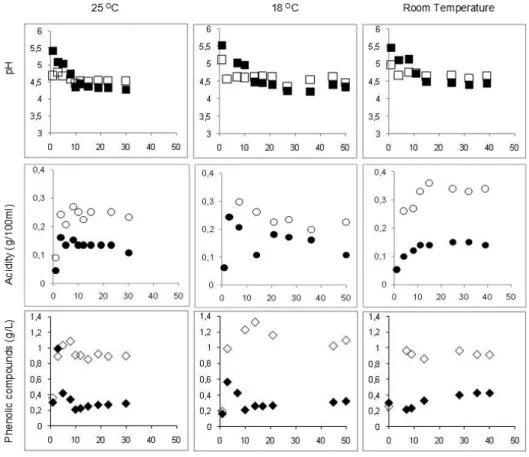
Fermentations were also monitored through pH and titratable acidity changes represented in Fig 2. The pH values showed an initial drop in the first 8-10 d in all fermentations, at 25, 18 ºC and at room temperature. After this initial decrease, pH continued to drop slowly until it reached a plateau with values of 4.2-4.5 in Process B and of 4.5-4.6 in Process A. The final pH obtained may be slightly high for a fermented product (Garrido-Fernández et al. 1997).
Se c ti o n 5 . n ew a pp ro a c h eS t o e n h a n c e Sa fe ty a n d q u a li ty o f m in im a ll y p ro c eSS ed f ru it S a n d v eg et a bl eS
The titratable acidity increased during the first 8-12 d in the fermentation where olives were immediately brined (Fig 3). From this point onwards, acidity reached 0.25, 0.20 and 0.35% (w/v), expressed as lactic acid in olives fermented at 25, 18 ºC and at room temperature, respectively. When olives were submitted to a pretreatment with water during the first week before brining, the titratable acidity increased slightly and, after that, remained almost constant during the entire fermentation period, at all temperatures, reaching values from 0.13 to 0.15%, expressed as lactic acid. The washing steps may have caused the removal and loss of nutrients and other substances diffusing from the olives into the brines and the loss of the end products, resulting from the microbes’ activity (such as acids).
The diffusion of phenolic compounds from the drupes into the fermentation liquids is represented in Fig 4. After submerging the fruits into the liquids, the concentration of phenolic compounds increased from
0.18-0.30 g L-1 to 1.00-1.40 g L-1, after 5-7 d and stayed almost constant in olives directly brined. In the case
of olives submitted to a pretreatment with water the level of phenolic compounds increased slowly in the
first 5-7 d, due to removals induced by the washings, and slightly increased thereafter reaching 0.30 g L-1 in
fermentations occurring at 25 and 18 ºC and of 0.40 g L-1 at room temperature. The washing treatments in
Process B caused a loss of phenolic compounds that diffused from the olives into the washing water, while in Process A brines were richer in phenolics.
The acids studied during this work were lactic, acetic and succinic acids. The organic acids profile found in the brines (room temperature) are represented in Table 1. In Process A, the level of lactic acid increased in the first days and remained almost constant thereafter. In olives treated according to Process B, there was an increase in the concentration of lactic acid. However, the overall concentrations found were lower than those observed in Process A. Acetic acid was produced in Process A, but when Process B was used it was not detected. The differences between Process A and B are explained by the fact that in the second one, the successive water washings may have caused the loss of metabolites, including acids. Low levels of succinic acid were detected, regardless of the processing treatment (Table 1). The presence of the referred acids is also reported in the literature for both green olive and black olive fermentations (Spyropoulou et al. 2001; Tassou et al. 2002; Montaño et al. 2003; Panagou et al. 2003,2008; Panagou & Katsaboxakis 2006).
table 1. Evolution of organic acids during the fermentation of cracked green olives treated according to Process A and Process B, at room temperature. (Organic acids (g 100 mL-1 of brine). Values are means ± SD of triplicate assays.
ND- Not detected.
Day
Organic acids (g 100 mL-1)
Acetic acid Lactic acid Succinic acid
Process A Process B Process A Process B Process A Process B
1 0.15±0.090 ND 1.15±0.456 1.12±0.567 0.01±0.004 0.02±0.007
8 0.47±0.004 ND 2.05±0.909 1.31±0.156 0.81±0.005 0.09±0.005
15 1.37±0.001 ND 1.99±0.378 1.02±0.189 0.17±0.099 0.15±0.045
En v ir o n m En ta ll y F ri En d ly a n d S a FE tE ch n o lo g iES F o r Q u a li ty o F F ru it S a n d vE g Eta bl ES
fig 2. Evolution of brines’ pH ( , ), total acidity (% lactic acid) ( , ) and phenolic compounds ( , ) during fermentation of cracked green olives treated according to Process A ( , , ) and Process B ( , , ), at 25 ºC (A), 18 ºC (B) and room temperature (C).
Conclusion
The results presented in the present study are a contribution to understand the fermentation process underlying the production of cracked green table olives. To guarantee the high quality of cracked green table olives, special attention should be paid to the initial brining conditions and the evolution of the fermentation phase. The initial brining conditions affect the pH values, total acidity, phenolic contents, concentration of organic acids and evolution of microorganisms’ growth, in particular, of the Enterobacteriaceae group and consequently, the safety of the product. Olives immediately brined after cracking originated final products with higher total acidity, higher phenolic contents, higher concentration of lactic and acetic acids, without Enterobacteriaceae, suggesting that this process represents a preferable way of processing olives. On the other hand, Process B allowed for a fast debittered final product. However, the loss of acids and phenolic compounds due to the washing steps enable fermentation processes where Enterobacteriaceae found conditions to survive and grow, at 25 ºC and at room temperature, representing a risk of spoilage and affecting the safety of the final product. The conditions of the fermentation processes can result in spoilage or survival of pathogens, thereby creating unexpected health risks in this fermented food product.
Se c ti o n 5 . n ew a pp ro a c h eS t o e n h a n c e Sa fe ty a n d q u a li ty o f m in im a ll y p ro c eSS ed f ru it S a n d v eg et a bl eS
references
AOAC. 2005. Official Methods of Analysis of AOAC International, 18th ed. Hortwitz W (ed). The cientific
Association Dedicated to Analytical Excellence, Caithersburg, Maryland
Arroyo-Lopez FN, Duran-Quintana MC, Romero C, Rodriguez-Gomez F, Garrido-Fernandez A. 2007. Effect of storage process on the sugars, polyphenols, color and microbiological changes in cracked Manzanilla-Alorena table olives. J Agr Food Chem 55:7434-44
Arroyo-Lopez FN, Bautista-Gallego J, Duran-Quintana MC, Rodriguez-Gomez F, Romero-Barranco C, Garrido-Fernandez A. 2008a. Improvement of the storage process for cracked table olives. J Food Eng 89:479-87
Arroyo-Lopez FN, Querol A, Bautista-Gallego J, Garrido-Fernandez A. 2008b. Role of yeasts in table olive production. Int J Food Microbiol 128:189-96
Chorianopoulos NG, Boziaris IS, Stamatiou A, Nychas GJE. 2005. Microbial association and acidity development of unheated and pasteurized green-table olives fermented using glucose or sucrose supplements at various levels. Food Microbiol 22:117-24
Garrido-Fernández A, Fernández-Díez MJ, Adams RM. 1997. Table olives. Production and processing. Chapman & Hall. London
Hernández A, Martín A, Aranda E, Pérez-Nevado F, Córdoba MG. 2007. Identification and characterization of yeast isolated from the elaboration of seasoned green table olives. Food Microbiol 24:346-51 Huang YC, Chang YH, Shao YY. 2006. Effects of genotype and treatment on the antioxidant activity of
sweet potato in Taiwan. Food Chem 98:529-38
Hurtado A, Reguant C, Esteve-Zarzoso B, Bordons A, Rozès N. 2008. Microbial population dynamics during the processing of Arbequina table olives. Food Res Int 41:738-44
IOOC (International Olive Oil Council). 2008. Statistics of table olive’s world production. http://www.internationaloliveoil.org/downloads/production3_ang.PDF. Last visit April .2009
Leal-Sánchez MV, Ruiz-Barba JL, Sánchez AH, Rejano L, Jiménez-Díaz R, Garrido A. 2003. Fermentation profile and optimization of green olive fermentation using Lactobacillus plantarum LPCO10 as a starter culture. Food Microbiol 20:421-30
Landete MJL, Curiel A, Rodríguez H, Rivas BDL, Muñoz R. 2008. Study of the inhibitory activity of phenolic compounds found in olive products and their degradation by Lactobacillus plantarum strains. Food Chem 107:320-6
Medina E, Romero C, Brenes M, García P, de Castro A, García A. 2008a. Profile of anti-lactic acid bacteria compounds during the storage of olives which are not treated with alkali. Eur Food Res Technol 228:133-8
Medina E, Romero C, de Castro A, Brenes M, García A. 2008b. Inhibitors of lactic acid fermentation in Spanish-style green olive brines of the Manzanilla variety. Food Chem 110:932-7
Montaño A, Sánchez AH, Casado FJ, de Castro A, Rejano L. 2003. Chemical profile of industrially fermented green olives of different varieties. Food Chem 82:297-302
Panagou EZ. 2006. Greek dry-salted olives: Monitoring the dry-salting process and subsequent physico-chemical and microbiological profile during storage under different packing conditions at 4 and 20 degrees C. LWT-Food Sci Technol 39:323-30
Panagou EZ, Katsaboxakis CZ. 2006. Effect of different brining treatments on the fermentation of cv. Conservolea green olives processed by the Spanish-method. Food Microbiol 23:199-204
Panagou EZ, Schillinger U, Franz C, Nychas GJE. 2008. Microbiological and biochemical profile of cv. Conservolea naturally black olives during controlled fermentation with selected strains of lactic acid bacteria. Food Microbiol 25:348-58
Panagou EZ, Tassou CC, Katsaboxakis CZ. 2003. Induced lactic acid fermentation of untreated green olives of the Conservolea cultivar by Lactobacillus pentosus. J Sci Food Agr 83:667-74
Sánchez AH, de Castro A, Rejano L, Montaño A. 2000. Comparative study on chemical changes in olive juice and brine during green olive fermentation. J Agr Food Chem 48:5975-80
Spyropoulou KE, Chorianopoulos NG, Skandamis PN, Nychas GJE. 2001. Survival of Escherichia coli O157:H7 during the fermentation of Spanish-style green table olives (Conservolea variety) supplemented with different carbon sources. Int J Food Microbiol 66:3-11
Tassou CC, Panagou EZ, Katsaboxakis KZ. 2002. Microbiological and physicochemical changes of naturally black olives fermented at different temperatures and NaCl levels in the brines. Food Microbiol 19:605-15