1. Rheumatology, Başkent University, School of Medicine, Ankara 2. Internal Medicine, Numune Training and Research Hospital, Ankara
3. Endocrinology, Başkent University, School of Medicine, Ankara
The effect of infliximab on
depressive symptoms in patients
with ankylosing spondylitis
ACTA REUMATOL PORT. 2015;40:262-267
abstract
Objectives: Ankylosing spondylitis is a chronic
in-flammatory disease which physically, psychologically, and socially affects the patient’s life. Previous studies have reported a correlation between ankylosing spon-dylitis and depression. In this study we investigated the effect of infliximab on depression in ankylosing spon-dylitis patients.
Methods: A total of 29 patients with ankylosing
spon-dylitis were enrolled in this prospective study. Inflixi-mab was administered intravenously at a dose of 5 mg/ /kg at baseline, weeks 2 and 6. The measurements of morning stiffness, modified Schober’s test, chest ex-pansion, erythrocyte sedimentation rate, C-reactive protein, Bath ankylosing spondylitis disease activity in-dex, Bath ankylosing spondylitis functional index and Beck depression inventory scores were compared between baseline and 12th week.
Results: The modified Schobers’ quotes test and chest
expansion increased, the morning stiffness duration, erythrocyte sedimentation rate and C-reactive protein levels decreased after infliximab treatment (p < 0.001, respectively). There was statistically significant decrea-se in Bath ankylosing spondylitis didecrea-seadecrea-se activity index, Bath ankylosing spondylitis functional index and Beck depression invantory scores of patients after 12 weeks (p < 0.001, respectively).
Conclusion: Infliximab can improve depression and
its symptoms in patients with ankylosing spondylitis.
Keywords: Depression; Ankylosing Spondylitis;
Infli-ximab.
Ersözlü-Bozkırlı ED1, Ke şkek SO2, Bozkırlı E3, Yücel AE1
IntroductIon
Ankylosing spondylitis (AS) is a chronic inflammatory disorder of joints and spine. It is manifested clinically by pain and progressive stiffening of the spine. The di-sease is more common in males and the onset is gene-rally in late adolescence or early adulthood. A back pain associated with morning stiffness that lasts hours, li-mited chest expansion, acute arthritis of the peripheral joints, enthesopathy, anterior uveitis may be the symp-toms signs of ankylosing spondylitis1. The course is ei
-ther continuously progressive or alternates with exa-cerbations and remissions2. In addition to the physical
outcomes, AS also leads to psychological consequences such as depression3.
Depression is one of the most common mental di-sorders. Depressed mood and anhedonia are major symptoms of this mental disorder. Increased prevalen-ce of depression has found to be associated with chro-nic medical diseases4-6. In ankylosing spondylitis,
proinflammatory cytokines like tumor necrosis factor (TNF) seem to play a central role in the pathogenesis of depression.
Anti-TNF agents represent an outstanding advan ce in the symptomatic control of patients with ankylosing spondylitis presenting an inadequate response to non--steroidal anti-inflammatory drugs. As a TNF antago-nist, infliximab has established efficacy for AS patients1,8.
In this study we aimed to investigate the effect of infli-ximab on depressive symptoms, in patients with AS.
MaterIal and Methods
This observational-prospective study was carried out in the Rheumatology outpatient clinics of Ba kent Uni-versity School of Medicine in Adana, from January 2011 to February 2012. The institutional review board
of the hospital approved this study and informed con-sent was obtained from all subjects. All procedures were followed in accordance with the Good Clinical Practice standards and ethical standards of the Res-ponsible Committee on Human Experimentation, and with the Helsinki Declaration of 1975, as revised in 2008.
A total of 29 patients with ankylosing spondylitis, who met the modified New York criteria for AS, were enrolled9. All patients received a full history and
com-plete physical examination. High disease activity was defined as a score of 4 or higher on the Bath ankylo-sing spondylitis disease activity index (BASDAI)10.
Patients with other concomitant disorders like malignan -cies, infections, systemic disorders (endocrine, gas-trointestinal, cardiac, neurological, renal, hepatic, respira tory or other rheumatological disorders) were excluded. Patients with a history or a diagnosis of men-tal disorder were also excluded. Patients with positive tuberculin skin test or abnormal chest x-ray findings were not included.
Infliximab was administered intravenously at a dose of 5 mg/kg at baseline, weeks 2 and 6. All patients were followed for 12 weeks.
We prospectively collected the following data at ba-seline and week 12: the duration of morning stiffness (min), modified Schober’s test (cm), chest expansion (cm), erythrocyte sedimentation rate (ESR) (mm/h), C-reactive protein (CRP) (mg/L). ESR and CRP levels were determined using the Westergreen method and immunoturbidimetry, respectively. Disease activity was assessed by using BASDAI, while functional capacity was evaluated with Bath ankylosing spondylitis func-tional index (BASFI)11. The ankylosing sondylitis
di-sease activity scores (ASDAS-CRP and ASDAS-ESR) were calculated. ASDAS-CRP was calculated according to the ‘‘0.12 x Back Pain + 0.06 x Duration of Morning Stiffness + 0.11 x Patient Global + 0.07 x Peripheral Pain/Swelling + 0.58 x Ln(CRP+1)’’ formule. ASDAS--ESR was calculated according to the ‘‘0.08 x Back Pain + 0.07 x Duration of Morning Stiffness + 0.11 x Pa-tient Global + 0.09 x Peripheral Pain/Swelling + 0.29 x √ (ESR)’’ formule12.
All patients had a Beck Depression Inventory (BDI) evaluation at baseline and week 12. The BDI is a 21-question multiple-choice, self-report inventory. Re-liability and validity of BDI in Turkey were studied by Tegin13and Hisli14previously. It is one of the most
wi-dely used instruments for measuring depression seve-rity. A value of 0 to 3 is assigned for each answer, and
then the depression severity is determined by the total score. Higher total scores indicate more severe depres-sive symptoms. Correspondingly, BDI scores of 0–9, 10–18, 19–29 and 30–63 are considered as minimal, mild, moderate and severe depression, respectively15.
Statistical analyses were performed using the MedCalc software version 13.0. The variables were in-vestigated using Kolmogorov-Smirnov test to determi-ne whether or not they are normally distributed. Des-criptive analyses were presented using means and stan-dard deviations. Paired Student’s t-test was used to compare the normally distributed measurements at two time points (baseline and 12 weeks). As a non-para-metric test, Wilcoxon test was conducted to compare non-normally distributed parameters, between baseli-ne and 12 weeks. The correlation coefficient was used to analyse the degree of association between BDI and BASDAI, BASFI, CRP, ESR, CRP and ASDAS--ESR (Pearson correlation coefficient (r) with p-value and 95% CI for r). A log transformation was used for variables that were not normally distributed. Multiple regression test (backward method) was used to analy-se the relationship between a dependent variable (BDI) and one or more independent variables (predictor va-riables or explanatory vava-riables). The probability of ma-king a type I error (alpha, significance) is 0.05 in all tests.
results
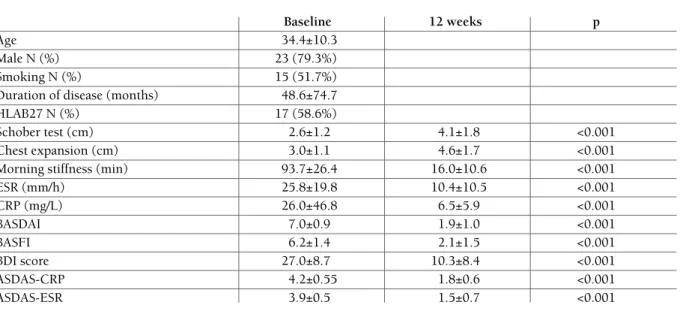
Twenty-nine patients with AS were enrolled in this prospective observational study. The mean age was 34.4±10.3 years old. Males to females ratio was 23:6 (79.3% vs. 20.7%). The mean disease duration was 48.6±74.7 months. HLAB27 was found in 17 (58.6%) of patients. Table I shows the demographical and cli-nical characteristics of the patients. There was statisti-cally significant differences in the modified Schober’s test, chest expansion, morning stiffness duration, ESR, CRP, ASDAS-CRP and ASDAS-ESR levels after inflixi-mab treatment. While the modified Schober’s test and chest expansion increased after 12 weeks; the morning stiffness duration, ESR, CRP, CRP and ASDAS-ESR levels decreased (p < 0.001, respectively, Table I). Additionally, there was a statistically significant de-crease in BASDAI and BASFI scores of patients after 12 weeks (p < 0.001, respectively, Table I).
BDI scores of the patients were significantly higher at baseline in comparison with end of the study.
(ave-rage BDI scores were 27.0 ± 8.7 vs. 10.3 ± 8.4, at ba-seline vs. 12th week, respectively, p < 0.001, Table I). While patients with minimal depression scores were not detected (0%) at the baseline, the majority of the-se patients had minimal depression scores (55.1%) at 12th week. Addi tio nally, 37.9% of the patients had a severe depression score at baseline; however, this ra-tio was reduced to and this 3.4% at 12th week. The dif-ference was statistically significant (p < 0.001, Table II). BDI score was positively correlated with BASDAI (r = 0.532, p = 0.0029, Table III), BASFI (r = 0.563, p = 0.0014), ASDAS-CRP (r = 0.392, p = 0.035), and with ASDAS-ESR (r = 0.430, p = 0.019, Table III) at baseline while it was not correlated with CRP, and
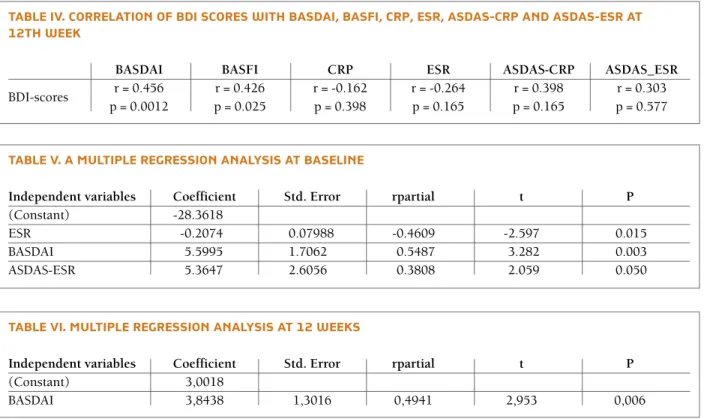
with ESR (p = 0.898, p = 0.729, respectively). Similarly, BDI score was positively correlated with BASDAI (r = 0.456, p = 0.0012, table IV), and with BASFI (r = 0.426, p = 0.025, table IV) at 12th week while it was not correlated with CRP, ESR, ASDAS-CRP, and with ASDAS-ESR (r = 0.398, p = 0.165, r = 0.303, p = 0.577, respectively).
Multiple regression analyses (backward method) was performed with BDI as a dependent variable and with ESR, CRP, BASFI, BASDAI, ASDCRP and AS-DAS-ESR as independent variables. A significant cor-relation persisted between BDI and ESR (p = 0.015), and between BDI and BASDAI (p = 0.003), and bet-ween BDI and ASDAS-ESR (p=0.050) at baseline
(Ta-table I. deMograPhIcal and clInIcal ProPertIes of the PatIents
Baseline 12 weeks p
Age 34.4±10.3
Male N (%) 23 (79.3%)
Smoking N (%) 15 (51.7%)
Duration of disease (months) 48.6±74.7
HLAB27 N (%) 17 (58.6%)
Schober test (cm) 2.6±1.2 4.1±1.8 <0.001
Chest expansion (cm) 3.0±1.1 4.6±1.7 <0.001
Morning stiffness (min) 93.7±26.4 16.0±10.6 <0.001
ESR (mm/h) 25.8±19.8 10.4±10.5 <0.001 CRP (mg/L) 26.0±46.8 6.5±5.9 <0.001 BASDAI 7.0±0.9 1.9±1.0 <0.001 BASFI 6.2±1.4 2.1±1.5 <0.001 BDI score 27.0±8.7 10.3±8.4 <0.001 ASDAS-CRP 4.2±0.55 1.8±0.6 <0.001 ASDAS-ESR 3.9±0.5 1.5±0.7 <0.001
table II. frequency of PatIents accordIng to the bdI scores at baselIne and 12th week
0-9 10-18 19-29 30-63 p
Baseline 0 (0%) 4 (13.7%) 14 (48.2%) 11 (37.9%)
<0.001
12th week 16 (55.1%) 7 (24.1%) 5 (17.2%) 1 (3.4%)
table III. correlatIon of bdI scores wIth basdaI, basfI, crP, esr, asdas-crP and asdas-esr at baselIne
BASDAI BASFI CRP ESR ASDAS-CRP ASDAS-ESR
BDI-scores r = 0.532 r = 0.563 r = 0.024 r = -0.066 r = 0.392 r = 0.430 p = 0.0029 p = 0.0014 p = 0.898 p = 0.729 p = 0.035 p = 0.019
ble V). A significant correlation persisted between BDI and BASDAI (p = 0.006), at 12th week (Table VI).
dIscussIon
Depression may be the final expression of genetic fac-tors, personality problems or psychosocial stress16.
How ever, the prevalence of depression is going up with the increased prevalence of the chronic medical con-ditions4. AS is a chronic inflammatory disorder which
negatively affects the patients’ life in terms of physical, social and psychological aspects17.
In this study, we have shown that the infliximab treatment improves and decreases the depressive symptoms in patients with AS. In our study popula-tion, the majority of patients with AS had depressive symptoms at baseline. Moreover, a substantial part of them had severe depression. After infliximab treatment both depressive symptoms and frequency of depres-sion decreased. In contrast to the baseline a substan-tial part of the patients had minimal depression scores at the end of the study. Additionally, BASDAI and BAS-FI scores of patients were positively correlated with BDI scores both at baseline and 12th week.
World Health Organization offers to evaluate psy-chological and social well being, as well as physical well being, to determine the health status of a patient. AS was studied in many studies and depression was found to be associated with this chronic inflammato-ry disorder in some of the previous studies, as well as in the current study17-20. However, the effect of
inflixi-mab on depressive symptoms in patients with AS was investigated in a very few studies. Ertenli et al. con-ducted a longitudinal study on 16 AS patients18. They
reported lower BDI scores after first, second and third infusions of infliximab. The study design of their stu-dy is different from ours. Our stustu-dy is an observatio-nal-prospective study. We tested the patients with BDI at baseline (before treatment) and 12th week (after 6 weeks from the third infusion of infliximab). Additio-nally, the sample size of our study is larger than that study. In the study of Arısoy et al. they studied 9 AS pa-tients and reported that TNF blockers had potential antidepressant effect besides their anti-inflammatory effect in patients with AS21. In that study the sample
size was also small and, they tested depressive symp-toms with Hamilton Depression scale. They also con-trolled the patients at 6th week. However, the result of our study is supported by these two previous studies.
table IV. correlatIon of bdI scores wIth basdaI, basfI, crP, esr, asdas-crP and asdas-esr at 12th week
BASDAI BASFI CRP ESR ASDAS-CRP ASDAS_ESR
BDI-scores r = 0.456 r = 0.426 r = -0.162 r = -0.264 r = 0.398 r = 0.303 p = 0.0012 p = 0.025 p = 0.398 p = 0.165 p = 0.165 p = 0.577
table V. a MultIPle regressIon analysIs at baselIne
Independent variables Coefficient Std. Error rpartial t P
(Constant) -28.3618
ESR -0.2074 0.07988 -0.4609 -2.597 0.015
BASDAI 5.5995 1.7062 0.5487 3.282 0.003
ASDAS-ESR 5.3647 2.6056 0.3808 2.059 0.050
table VI. MultIPle regressIon analysIs at 12 weeks
Independent variables Coefficient Std. Error rpartial t P
(Constant) 3,0018
In our study, we controlled the patients at 12th week, evaluating the effect of infliximab in a longer period.
Patients with AS treated with infliximab, a chimeric IgG1 antibody against TNF, have shown rapid, pro-found, and sustained reductions in all clinic and labo-ratory measures of disease activity22. In accordance with
this link, in this study, we show ed that modified Scho-ber’s test and chest expansion increased, serum levels of ESR, CRP, ASDAS-CRP, and ASDAS-ESR, scores of BASDAI, BASFI and BDI decreased after infliximab treatment.
Previous studies have shown that, as a common mental disorder, depression is associated with an enhanced production of cytokines, such as IL-1, IL-6 and TNF. These cytokines are potent modulators of cor-ticotropin-releasing hormone which produces heigh-tened hypothalamic-pituitary-adrenal axis activity cha-racterized by increases in adrenocorticotropic hormo-ne (ACTH) and cortisol, both of which are reported elevated in major depression. A successfully pharma-cological treatment of depression decreases the eleva-ted cytokine levels23-25. In the study by Tuglu et al., was
reported that patients with major depression had higher serum TNF levels compared to controls24.
Accor ding to the other studies in the literature, Uguz et el. have reported that anti-TNF therapy is associated with less depressive symptom and anxiety disorders in rheumatoid arthritis patients26. Additionally, in the
stu-dy by Iglesias et al., they concluded that infliximab the-rapy in Crohn’s disease patients is associated with fewer depressive symptoms27.
In the current study, we have found a correlation between BDI scores and BASDAI, and BASFI at baseli-ne. Martindale et al., analysed 89 AS patients and re-ported that BASDAI and BASFI scores correlated with depression scores19. Similarly, Ortancil et al. reported
that BASDAI and BASFI correlated with depression in their study20. Our results are reinforced with both of
these previous studies. Additionally, we have also found a correlation between BDI scores and ASDAS-CRP, and ASDAS-ESR at baseline. On the other hand, we have found also a correlation between BDI scores and BAS-DAI, and BASFI at 12th week. This result may be at-tributed the duration of the follow-up of the patients. As a difference from other studies we follow-up the pa-tients for 12 weeks. Decrease in depression scores in our study might be due to the decrease in disease se-verity with TNF treatment.
This study had some limitations. First, it would have been beneficial if the sample size had been larger.
Se-cond, patients with lower BASDAI and BASFI scores have less pain and this could be the major determinant for BDI improvement and not only infliximab treat-ment. Third, BDI is a self-rated instrutreat-ment. So, the sco-res of BDI can be exaggerated or minimized by the pa-tients completing them.
conclusIon
Proinflammatory cytokines like TNF play a central role in the pathogenesis of depression which is a common mental disorder and detected in the majority of AS pa-tients. Infliximab is an effective medicine in the treat-ment of AS. It can improve depression and its symp-toms by blocking TNF.
corresPondence to
Şakir Özgür Keşkek
Numune Training and Research Hospital Ankara, Turkey
E-mail: [email protected]
references
1. Hellmann DB, Imboden JB. Blood Disorders. In: Papadakis MA, McPhee SJ, ed Current Medical Diagnosis and Treatment. New York: Mc Graw Hill; 2014: 822-823.
2. Braun J, Sieper J. Ankylosing spondylitis. Lancet 2007; 369: 1379-1390.
3. Lim HJ, Lim HS, Lee MS. Relationship between self-efficacy and exercise duration in patients with ankylosing spondylitis.Clin Rheumatol 2005; 24(4):442-443.
4. Moussavi S, Chatterji S, Verdes E, Tandon A, Patel V, Ustun B. Depression, chronic diseases, and decrements in health: results from the World Health Surveys. Lancet 2007; 370(9590): 851–858.
5. Kırım S, Ke kek Ö, Köksal F, Haydardedeo lu FE, Bozkırlı E, To-ledano Y. Depression in patients with euthyroid chronic au-toimmune thyroiditis. Endocr J 2012; 59: 705-708.
6. Ke kek O, Haydardedeo lu FE, Kırım S, et al. Which increases depressive symptoms in obese patients, hypertension or diabe-tes? Qscience Connect 2013. http://dx.doi.org/10.5339/con-nect.2013.9.
7. Schiepers OJ, Wichers MC, Maes M. Cytokines and major de-pression. Prog Neuropsychopharmacol Biol Psychiatry 2005; 29: 201–217.
8. ndreu JL, Otón T, Sanz J. [Anti-TNF therapy in ankylosing spondylitis: symptom control and structural damage modifica-tion]. Reumatol Clin 2011; 7(1): 51-55. doi: 10.1016/j.reu-ma.2009.03.007.
9. Van der Linden S, Valkenburg HA, Cats A . Evaluation of diag-nostic criteria for anklosing spondylitis: a proposal for modifi-cation of the New York criteria. Arthritis Rheum 1984; 27(4) : 361 – 368 .
10. Garret S, Jenkinson T , Kennedy LG, Whitelock H , Gaisford P, Calin A. A new approach to defining disease status in ankylo-sing spondylitis: The Bath Ankloankylo-sing Spondylitis Disease Acti-vity Index. J Rheumatol 1994; 21(12) : 2286 –2291.
11. Calin A, Garret S, Whitelock H, et al. A new approach to defi-ning functional ability in anklosing spondylitis: the develop-ment of the Bath Ankylosing Spondylitis Functional Index. J Rheumatol 1994; 21(12): 2281– 2285.
12. Lukas C, Landewé R, Sieper J, Dougados M, Davis J, Braun J, van der Linden S, van der Heijde D. Development of an ASAS--endorsed disease activity score (ASDAS) in patients with an-kylosing spondylitis. Ann Rheum Dis 2009; 68: 18-24. 13. Tegin B. Cognitive impairments in depression: an investigation
based on Beck’s Model. Ankara, Turkey: Hacettepe University; 1980.
14. Hisli N. Validity and reliability of Beck Depression Inventory among university students. Turk J Psychol 1989; 7: 3-13. 15. Beck AT, Ward CH. "An inventory for measuring depression".
Arch Gen Psychiatry 1961; 4(6): 561-571.
16. Eisendrath SJ, Lichtmacher JE. Mood Disorders. In: Papadakis MA, McPhee SJ, ed Current Medical Diagnosis and Treatment. New York: Mc Graw Hill; 2014: 1023-1024.
17. Li Y, Zhang S, Zhu J, Du X, Huang F. Sleep disturbances are as-sociated with increased pain, disease activity, depression, and anxiety in ankylosing spondylitis: a case-control study. Arthri-tis Res Ther 2012; 14(5): R215. [Epub ahead of print] 18. Ertenli I, Ozer S, Kiraz S, et al. Infliximab, a TNF- antagonist
treatment in patients with ankylosing spondylitis: the impact on depression, anxiety and quality of life level. Rheumatol Int 2012; 32(2): 323-330. doi: 10.1007/s00296-010-1616-x. 19. Martindale J, Smith J, Sutton CJ, Grennan D, Goodacre L,
Goo-dacre JA. Disease and psychological status in ankylosing spon-dylitis. Rheumatology (Oxford) 2006; 45(10): 1288-1293.
20. Ortancil O, Konuk N, May H, Sanli A, Ozturk D, Ankarali H. Psychological status and patient-assessed health instruments in ankylosing spondylitis. J Clin Rheumatol 2010; 16(7): 313--316. doi: 10.1097/RHU.0b013e3181f3bfba.
21. Arısoy O, Bes C, Cifci C, Sercan M, Soy M. The effect of TNF-alpha blockers on psychometric measures in ankylosing spon-dylitis patients: a preliminary observation. Rheumatol Int 2013; 33(7): 1855-1864. doi: 10.1007/s00296-013-2671-x. 22. Taurog JD. The Spondyloarthritides. In: Longo DL, ed
Harri-son’s principles of internal medicine. New York: Mc Graw Hill; 2012: 2777.
23. Lanquillon S, Krieg JC, Bening-Abu-Shach U, Vedder H. Cyto-kine production and treatment response in major depressive di-sorder. Neuropsychopharmacology 2000; 22: 370–379. 24. Tuglu C, Kara SH, Caliyurt O, Vardar E, Abay E. Increased
se-rum tumor necrosis factor-alpha levels and treatment respon-se in major depressive disorder. Psychopharmacology (Berl) 2003; 170: 429–433.
25. O'Brien SM, Scott LV, Dinan TG. Cytokines: abnormalities in major depression and implications for pharmacological treat-ment. Hum Psychopharmacol 2004; 19(6): 397-403. 26. Uguz F, Akman C, Kucuksarac S, Tufekci O. Anti-tumor
ne-crosis factor-alpha therapy is associated with less frequent mood and anxiety disorders in patients with rheumatoid arth-ritis. Psychiatry Clin Neurosci 2009; 63(1): 50-55. doi: 10.1111/j.1440-1819.2008.01905.x.
27. Iglesias M, Barreiro de Acosta M, Vázquez I, et al. Psychologi-cal impact of Crohn's disease on patients in remission: anxiety and depression risks. Rev Esp Enferm Dig 2009; 101(4): 249--257.