*Correspondence: K. S. Aplevicz. Instituto Federal de Santa Catarina. Av. 15 de julho, 150, 88075-0101 - Florianópolis, SC, Brasil. E-mail: [email protected]
A
vol. 50, n. 2, apr./jun., 2014 http://dx.doi.org/10.1590/S1984-82502014000200011
Isolation and characterization of lactic acid bacteria and yeasts
from the Brazilian grape sourdough
Krischina Singer Aplevicz
1,*, Jaciara Zarpellon Mazo
1, Eunice Cassanego Ilha
2,
Andréia Zilio Dinon
3, Ernani Sebastião Sant´Anna
21Department Teaching, Research and Extension, Federal Institute of Santa Catarina, Florianopolis, SC, Brazil,2Department of Food Science and Technology, Federal University of Santa Catarina, Florianopolis, SC, Brazil, 3Department of Engineering of
Food, Staty University of Santa Catarina, Florianopolis, SC, Brazil
Sourdough is a mixture of lour and water fermented by lactic acid bacteria and yeast, with a large use in bakery products. This study was developed with Brazilian grape (Niagara rosada) sourdough obtained from spontaneous fermentation. The aim of this work was to characterize genotypic and phenotypically lactic acid bacteria and yeasts isolated from sourdough. The phenotypic identiication for bacteria and yeasts was performed by using the kit API50CHL and 20CAUX and the genotypic characterization was performed by sequencing method. A total of four isolated strains were analyzed in this study. Two of these strains were phenotypically and genotypic identiied as Lactobacillus paracasei and one as Saccharomyces cerevisiae. Another sample phenotypically identiied as Candida pelliculosa did not show the same identity by sequencing. It shows the need to use phenotypic and genotypic characterization associated for the correct microorganism identiication.
Uniterms: Spontaneous fermentation. Sourdough. Brazilian grape/sourdough .Niagara rosada/sourdough. Lactic acid bacteria/phenotypic characterization. Lactic acid bacteria/genotypic characterization. Yeast/ phenotypic characterization. Yeast/ genotypic characterization.
Fermento natural é mistura de farinha e água fermentada por bactérias láticas e leveduras, amplamente utilizada em produtos de paniicação. Neste estudo desenvolveu-se um fermento natural de uva brasileira (Niagara rosada), obtido a partir de fermentação espontânea. O objetivo deste trabalho foi caracterizar fenotipicamente e genotipicamente bactérias láticas e leveduras isoladas do fermento natural de uva. A identiicação fenotípica para bactéria lática e leveduras foi realizada usando os kits API50CHL e 20CAUX e a caracterização genotípica foi realizada pelo método de sequenciamento. Neste estudo, isolaram-se quatro cepas. Duas cepas foram identiicadas fenotipicamente e genotipicamente como Lactobacillus paracasei e outra cepa como Saccharomyces cerevisiae. A outra amostra de levedura, identiicada fenotipicamente como Candida pelliculosa, não obteve a mesma identidade com a técnica de sequenciamento. Isso mostra a necessidade do uso da caracterização fenotípica e genotípica em associação para a correta identiicação do micro-organismo.
Unitermos: Fermentação espontânea. Fermento natural. Uva brasileira/fermento natural. Niagara rosada/ fermento natural. Bactéria lática/caracterização fenotípica. Bactéria lática/caracterização genotípica. Levedura/caracterização fenotípica.Levedura/caracterização genotípica.
INTRODUCTION
Sourdough has a large application for bakery products, for examples the production of sourdough bread, classical bread, snacks, pizza and sweet baked products
(De Vuyst, Vancanneyt, 2007). Production of sourdough can be as simple as mixing lour and water and placing in a warm place. After several replenishments, the sourdough will be formed. The incorporation of sourdough in baking
technological traits, enhances sensorial characteristics, increases shelf life and improves nutritional properties
(Arendt, Ryan, Dal Bello, 2007; Corsetti et al., 2000).
to the microbiota that forms this unique ecosystem and consists of yeasts and lactic acid bacteria (Paramithiotis, Tsiasiotou, Drosinos, 2010).
Mostly yeasted pre-ferments are being used for the production of white bread. The use of lactic acid bacteria (LAB) as starter culture may help to improve the quality and shelf life of the products. The LAB from the sourdoughs naturally fermented may be used in the
production of novel fermented foods such as sourdough
bread, which is likely to have superior quality and long shelf life (Saeed et al., 2009). LAB belongs to a group of
Gram positive bacteria, catalase-negative, non-motile,
non-spore forming rods or coccid and produce lactic acid as the major end product during the fermentation.
They are strictly fermentative, microaeroile, acidophilic, salt-tolerant with complex nutritional requirements for carbohydrates, amino acids, peptides, fatty acids, salts, nucleic acids derivatives and vitamins. The natural habitat
of these microorganisms includes humans, animals and
plants (Holzapfel et al., 2001). The LAB microbiota is
predominant (8 log CFU/g) and is represented, principally, by members of the genus Lactobacillus. Yeasts are
generally counted in lower levels (7 log CFU/g) and can even be absent. The major part of the yeasts belong to the
genera Saccharomyces and Candida (Vera et al., 2012).
Throughout Europe, Italy (Realeet al., 2011),
Germany (Vogel et al., 1994) or Belgium (Scheirlincket al., 2007) sourdoughs have been studied intensively.
Characterizations of Turkish (Gület al., 2005), Thai
(Luangsakulet al., 2009), Chinese (Zhang et al., 2011)
and French (Vera et al., 2012) sourdoughs have also been
reported. However, research published in Brazil about sourdoughs is still scarce, even though the bread is widely consumed. The objective of this study was to develop a Brazilian grape sourdough and to identify genotypic and phenotypically four LAB and yeasts for further applications in breads.
MATERIAL AND METHODS
Sourdough preparation
Sourdough has been developed using Brazilian
grape juice from “Niagara rosada” as substrate. The
substrate was mixed with water and spontaneously fermented for 3 days at 25 °C for the initial fermentation
(IF). Thereafter, it was realized the first mixing with addition of 100% IF,100% wheat lour, 10% of rye lour and 90% water, standing 24 hours at room temperature to origin the preferment. Following intervals of 24 hours, it was performed a second, a third and a fourth mixture using
100% of preferment, 50% wheat lour, 10% of rye lour and 40% water. The sourdough remained for 8 hours at 25 °C, and 16 hours at 5 °C after each daily alimentation.
The sourdough was refreshed regularly during one year.
Isolation of lactic acid bacteria and yeast
The counting of LAB and yeast was performed using the pour plate method. Aseptically,25 g of sourdough was mixed with 225 mL of 0.1 g 100 g-1 of peptone water in BagMixer (model P, Interscience, St.Nom, France). From this dilution were realized subsequent necessary dilutions. The isolation of LAB was realized in MRS agar (Difco, Sparks,USA) with incubation at 3 °C under
aerobiosis for 48 h and yeasts were grown in PDA Agar (Himedia, Mumbai, India) and tartaric acid 10% under aerobic conditions at 25 °C for 72 h. After incubation, isolated LAB colonies were randomly selected and were transferred to tubes containing MRS broth (Difco,Sparks, USA). Morphology was observed by Gram coloration and catalase test. Colonies isolated for yeasts growed in malt extract broth (Himedia, Mumbai, India) (Apha, 2001). The colonies were subjected to microscopic test to detect the presence of hyphae or pseudohyphae.
Phenotypic characterization of LAB and yeast in sourdough
The identiication of lactic acid bacteria was done by phenotypic analysis using the kit API50CHL (BioMérieux, Marcy-l’Etoile, France) according Saeed et al.(2009) and
Lu et al. (2008).The API 50CHL system allows the species
identiication of LAB according to the biochemical proile of carbohydrate fermentation. Readings were taken after 24 and 48 hours of incubation at 30°C. The identiication
of yeasts was performed using the kit API 20CAux (BioMérieux, Marcy-l’Etoile, France) according Saeed
et al.(2009) and the readings were made after 48 and72
hours of incubation at 30 °C.
Genotypic characterization of LAB and yeast in sourdough
a n d 1 6 S F C G G T G T G T A C A A G A C C C ) set for bacteria and with ITS primer (ITS 4 T C C T C C G C T T A T T G A T A T a n d I T S 5 GGAAGTAAAAGTCTAACAAGG) set for fungi. PCR products were treated with ExoSAP-IT (USB, Ohio, USA) according to the manufacturer’s instructions and directly sequenced with Applied Biosystems® 3500 Genetic Analyzer (Foster City, CA). The nucleotide sequence of the sequencing products was determined by using the Sanger’s chain termination method (Sanger, Nicklen, Coulson, 1977). The identity of the isolates was analyzed by using the Blast tool (Basic Local Alignment Search Tools Nucleotide) from the National Center for Biotechnology Information (NCBI).
Statistical analysis
All tests were performed in triplicate and the data expressed as mean ± standard deviation. The genus and species of LAB and yeast isolated were interpreted by the statistical program APIWEB 50CHLv5.1 and APIWEB 20CAuxv 4.0, respectively.
RESULTS AND DISCUSSION
Isolation of lactic acid bacteria and yeast
The counting of aerobics LAB at 30 °C was7.52±0.07
log CFU/g and yeasts was 7.62 ± 0.29 log CFU/g. After
incubation, 10 isolated LAB colonies were transferred to tubes containing MRS broth. A total of twenty-five colonies were isolated for yeasts and growed in malt extract broth.
Phenotypic characteristics
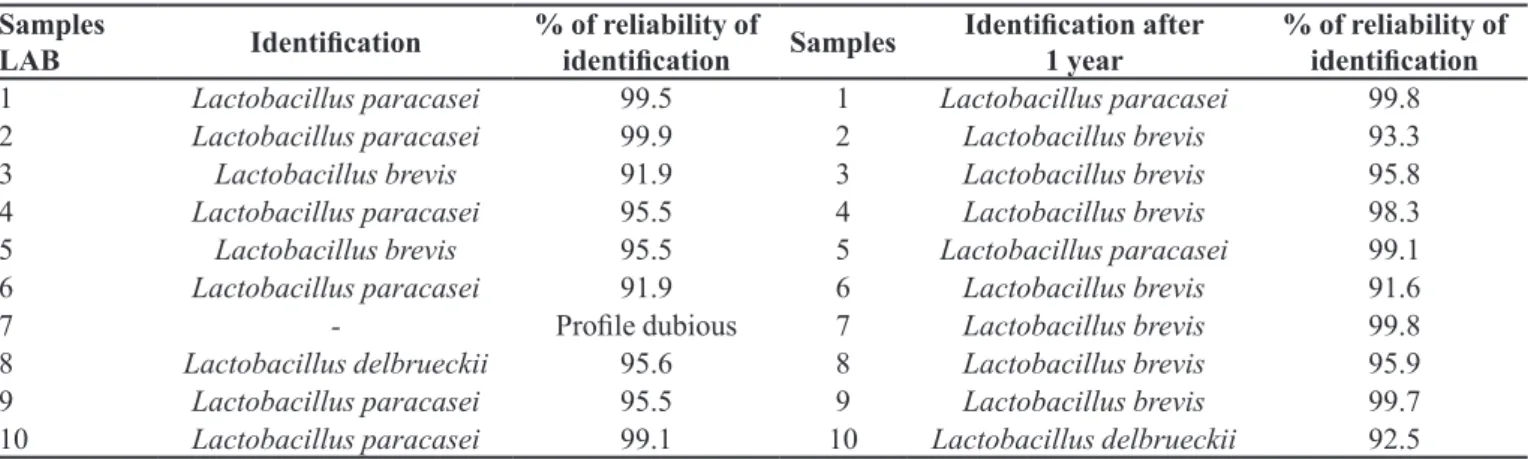
The results obtained by the isolates tested with
API 50CHL were shown in Table I. LAB samples 1 and 2 (Table I) of Lactobacillus paracasei (LAB samples 1
LAB obtained6.36 ± 0.18 and LAB sample 2 obtained
8.34 ± 0.15 log CFU/g) were selected to proceed this
study due the high reliability of identiication that was 99,5% and 99,9%, respectively. Lactobacillus paracasei
was the dominant species with 60% of identification among the LAB of Brazilian grape sourdough. The
species Lactobacillus paracasei (LAB sample 1) achieved
99.5% reliability of identiication, while the Lactobacillus paracasei (LAB sample 2) showed 99.9%. It proves that
sourdough is more dominated by heterofermentative LAB in agreement with a previous study (De Vuyst, Neysens, 2005). Endo, Futagawa-Endo, Dicks (2011) reported that the carbohydrates have a big impact on the isolation of a variety of LAB in fermented food. It is observed in this study that after one year of sourdough cultivation,
Lactobacillus brevis was the dominant species, with
70% of identiication among 10 LAB samples analyzed. Scheirlinck et al. (2009) indicated that speciic strains
of LAB persist in artisanal dough after many years and they circulate in the bakery environment. Furthermore, the air is a potential carrier of LAB in artisanal bakery
environments.
Mugula, Narvhus, Sørhaug (2003) identified that starter cultures of LAB (Lactobacillus brevis,
Lactobacillus cellobiosus, Lactobacillus fermentum,
Lactobacillus plantarum and Pediococcus pentosaceus)
and yeasts (Candida pelliculosa, Candida tropicalis,
Issatchenkia orientalis and Saccharomyes cerevisiae)
were isolated from native togwa.
The result of the fermentation of carbohydrates to yeasts is illustrated in Table II. The yeast samples selected for this study were samples 1 and2, both with 99.9% reliability of identification. Saccharomyces cerevisiae (yeast sample 1) and Candida pelliculosa
TABLE I - Phenotypic identiication of lactic acid bacteria from Brazilian grape sourdough using API 50 CHL gallery kit
Samples
LAB Identiication
% of reliability of
identiication Samples Identiication after 1 year
% of reliability of
identiication
1 Lactobacillus paracasei 99.5 1 Lactobacillus paracasei 99.8
2 Lactobacillus paracasei 99.9 2 Lactobacillus brevis 93.3
3 Lactobacillus brevis 91.9 3 Lactobacillus brevis 95.8
4 Lactobacillus paracasei 95.5 4 Lactobacillus brevis 98.3
5 Lactobacillus brevis 95.5 5 Lactobacillus paracasei 99.1
6 Lactobacillus paracasei 91.9 6 Lactobacillus brevis 91.6
7 - Proile dubious 7 Lactobacillus brevis 99.8
8 Lactobacillus delbrueckii 95.6 8 Lactobacillus brevis 95.9
9 Lactobacillus paracasei 95.5 9 Lactobacillus brevis 99.7
(yeast sample 2) obtained 7.54 ± 0.18 and 7.34 ± 0.06
log CFU/g, respectively. Candida pelliculosa was the
dominant species with 48% of identification among yeasts isolated in Brazilian grape sourdough, followed by 28% of identiication for Saccharomyces cerevisiae. Yeasts Candida famata and sphaerica showed 4%
of identiication. After one year of cultivation, it was observed that Saccharomyces cerevisiae was the
dominant specie. Saccharomyces cerevisiae is the
most common yeast used in bread making. Yeast cells metabolize fermentable sugars (glucose, fructose, sucrose and maltose) under anaerobic conditions producing carbon dioxide (CO2) as a residual product,
which acts as a leavening agent and enhances dough volume (Chavan, Jana, 2008; Giannou, Kessoglou, Tzia, 2003). Rosenquist and Hansen (2000) reported that
Saccharomyces cerevisiae was the yeast specie isolated
only from sourdoughs.
Lu et al. (2008) isolated and characterized
phenotypically 170 LAB and 96 yeasts in sour Mifen, a traditional fermented rice noodle from China. Lactobacillus plantarum and Saccharomyces cerevisiae were identiied
as predominant. The microflora of twenty five wheat sourdoughs from the Apulia region, southern Italy, was
characterized for Corsetti et al. (2001). Edema and Sanni
(2008) reported that for sour maize bread, 30% of the isolates were identiied as Lactobacillus sanfranciscensis,
20% as Lactobacillus alimentarius, 14% as Lactobacillus brevis, 12% as Leuconostoc citreum, 7% as Lactobacillus plantarum, 6% as Lactococcus lactis subsp. lactis, 4% as Lactobacillus fermentum and Lactobacillus acidophilus,
2% as Weissella confuse and 1% as Lactobacillus delbrueckii subsp. delbrueckii.
Qureshi, Masud, Sammi (2007) isolated and
characterized yeast strains on the basis of the capacity to use maltose during bread fermentation. From these
TABLE II - Yeasts isolated from brazilian grape sourdough identiied by API 20CAux gallery kit
Samples
yeast Identiication
% of reliability of
identiication Samples Identiication after 1 year
% of reliability of
identiication
1 Saccharomyces cerevisiae 99.9 1 Candida pelliculosa 93.9
2 Candida pelliculosa 99.9 2 Saccharomyces cerevisiae 99.9
3 Saccharomyces cerevisiae 99.9 3 Saccharomyces cerevisiae 96.2
4 Saccharomyces cerevisiae 96.2 4 Candida guilliermondii 89.9
5 Candida famata 96.2 5 - Proile dubious
6 Candidas phaerica 98.5 6 Saccharomyces cerevisiae 99.9
7 - Proile dubious 7 Candidasphaerica 99.8
8 Candida pelliculosa 88.8 8 Candidasphaerica 98.5
9 Saccharomyces cerevisiae 96.2 9 - Proile dubious
10 - Proile dubious 10 - Proile dubious
11 Candida pelliculosa 93.1 11 Saccharomyces cerevisiae 99.2
12 - Proile dubious 12 Saccharomyces cerevisiae 99.9
13 Candida pelliculosa 99.3 13 Saccharomyces cerevisiae 99.7
14 Saccharomyces cerevisiae 99.9 14 Saccharomyces cerevisiae 99.7
15 - Proile dubious 15 Candida guilliermondii 84.3
16 Candida pelliculosa 93.1 16 Candida pelliculosa 99.8
17 Candida pelliculosa 88.8 17 Cryptococcus albidus 99.8
18 Candida pelliculosa 99.3 18 Saccharomyces cerevisiae 99.9
19 Candida pelliculosa 99.9 19 Saccharomyces cerevisiae 99.9
20 Candida pelliculosa 93.1 20 - Proile dubious
21 Saccharomyces cerevisiae 99.9 21 Saccharomyces cerevisiae 99.9
22 Candida pelliculosa 88.8 22 Saccharomyces cerevisiae 99.7
23 Candida pelliculosa 88.8 23 Saccharomyces cerevisiae 99.2
24 Saccharomyces cerevisiae 99.9 24 Saccharomyces cerevisiae 99.9
TABLE III - Genotypic identiication of lactic acid bacteria and yeasts isolated from Brazilian grape sourdough
Samples Sequence
coverage
Percent of
identity Genotypic identity
Lactobacillus paracasei (LAB 1) 93% 99% Lactobacillus casei, L. rhamnosus and L. paracasei Lactobacillus paracasei (LAB 2) 97% 98% Lactobacillus casei, L. rhamnosus and L. paracasei
Saccharomyces cerevisiae (yeast 1) 93% 88% Saccharomyces cerevisiae Candida pelliculosa (yeast 2) 89% 99% Saccharomyces cerevisiae
40 strains, 14 were identified as S. cerevisiae, 12 as S.kluyveri, 4 as S. exigus and S. dairnensis, 2 as S. ludwigii, S. octosporusand S. unisporus, respectively. Later on, 14
isolates of S. cerevisiae were assessed for their maltose
utilization capacity for bread production.
Genotypic identification
Four representative LAB cultures and yeasts phenotypically characterized in this study were genotypically analyzed by sequencing of 16S rRNA region for LAB and ITS for fungi detection. The sequencing product resulted in a main amplicon of 600 bp for LAB samples and 800 bp for yeasts samples. The result of the genotypic identiication is illustrated in Table III.
The sample phenotypically characterized as
Lactobacillus paracasei (LAB sample 1) showed 93% of
sequence coverage with 99% of identity for Lactobacillus casei, L. rhamnosus and L. paracasei. The isolated culture
phenotypically identiied as Lactobacillus paracasei (LAB
sample 2) showed 97% of sequence coverage with 98% of identity for Lactobacillus casei, L. rhamnosus and L. paracasei.
The partial sequence results for one of the isolated culture phenotypically characterized as Saccharomyces cerevisiae (yeast sample 1) obtained 88% percent of
identity for Saccharomyces cerevisiae with 93% of
sequence coverage. The isolated culture phenotypically identiied as Candida pelliculosa (yeast sample 2) showed
99% percent of identity for Saccharomyces cerevisiae with
89% of sequence coverage.
These sequence results suggested that all LAB samples showed major identity with Lactobacillus casei, L. rhamnosus and L. paracasei. Moreover, the phenotypic
characterization suggested that LAB samples were L. paracasei.
According to the phenotypic and genotypic results for yeast samples, it was possible to conirm the identiication
of Saccharomyces cerevisiae for yeast sample 1. Therefore,
yeast sample 2 showed phenotypic identification as
Candida pelliculosa and genotypic identification as
Saccharomyces cerevisiae. Compared with PCR, the
phenotypic characterization by carbohydrates fermentation
is less sensitive due to natural variations in this process
(Barros et al., 2009). According to Nigatu (2000), main
differences between genotypic and phenotypic analysis suggested that results from API kit should be complemented with genetic results to give an accurate result.
CONCLUSION
This study allowed to isolate and to identify four microorganisms in Brazilian grape sourdough with technological potential for sourdough applications. The phenotypic and genotypic characterization suggested that two samples were Lactobacillus paracasei and one sample is Saccharomyce cerevisiae. One sample phenotypically
identiied as Candida pelliculosa was genotypic identiied
as Saccharomyces cerevisiae. It suggests that phenotypic
results should be conirmed by genotypic analysis.
ACKNOWLEDGEMENTS
This work was inancially supported by National Council for Scientiic and Technological Development, CNPq, Brazil.
REFERENCES
AMERICAN Public Health Association. Compendium of methods of the microbiological examination of foods.4.ed. APHA: Washington, 2001.
ARENDT, E.K.; RYAN, L.A.M.; DAL BELLO, F. Impact of sourdough on the texture of bread. Food Microbiol., v.24, p.165-174, 2007.
BARROS, M.R.; ANDREATTI FILHO, R.L.; OLIVEIRA, D.E.; LIMA, E.T.; CROCCI A.J.Comparação entre método bioquímico e reação em cadeia de polimerase para
identiicação de Lactobacillus spp. isolados de aves. Arq.
CHAVAN, R.S.; JANA, A. Frozen dough for bread making – a review.Int. J. Food Sci. Technol. Nutr., v.2, p.9-27, 2008.
CORSETTI, A.; GOBBETTI, M.; DE MARCO, B.; BALESTRIERI, F.; PAOLETTI, F.; RUSSI, L.; ROSSI, J. Combined effect of sourdough lactic acid bacteria and additives on bread firmness and staling. J. Agric. Food Chem.,v.48,p.3044-3051, 2000.
CORSETTI, A., LAVERMICOCCA, P.; MOREA, M.; BARUZZI, F.; TOSTI, N.; GOBBETTI, M. Phenotypic and molecular identiication and clustering of lactic acid bacteria and yeasts from wheat (species Triticum durum
and Triticumaestivum) sourdough of southern Italy. Int. J.
Food Microbiol., v.64, p.95-104, 2001.
DE VUYST, L.; NEYSENS, P.The sourdough microflora: biodiversity and metabolic interactions. Trends Food Sci. Technol., v.16, p.43-56, 2005.
DE VUYST, L.; VANCANNEYT, M. Biodiversity and identification of sourdough lactic acid bacteria. Food Microbiol., v.24, p.120-127, 2007.
EDEMA, M.O.; SANNI, A.I. Functional properties of selected starter cultures for sour maize bread. Food Microbiol., v.25, p.616-625, 2008.
ENDO, A.; FUTAGAWA-ENDO, Y.; DICKS, L.M.T. Inluence of carbohydrates on the isolation of lactic acid bacteria. J. Appl. Microbiol., v.110, p.1085-1092, 2011.
GIANNOU, V.; KESSOGLOU, V.; TZIA, C. Quality and safety characteristics of bread made from frozen dough. Trends Food Sci. Technol., v.14, p.99-108, 2003.
GÜL, H.; ÖZÇELIK, S.; SAGDIÇ, O.; CERTEL, M. Sourdough
bread production with lactobacilli and S. cerevisiae isolated
from sourdoughs. Process Biochem., v.40, p.691-697, 2005.
HOLZAPFEL, W.H.; HABERER, P.; GEISEN, R.; BJORKROTH, J.; SCHILLINGER, U. Taxonomy and important features of probiotic microorganisms in food and
nutrition. Am. J. Clin. Nutr.,v.73, p.365-373, 2001.
LU, Z.H.; PENG, H.H.; CAO, W.; TATSUMI, E.; LI, L.T. Isolation, characterization and identiication of lactic acid
bacteria and yeasts from sour Mifen, a traditional fermented
rice noodle from China. J. Appl. Microbiol., v.105,
p.893-903, 2008.
LUANGSAKUL, N.; KEERATIPIBUL, S.; JINDAMORAKOT, S.; TANASUPAWAT, S. Lactic acid bacteria and yeasts isolated from the starter doughs for Chinese steamed buns in Thailand. Food Sci. Technol., v.42, p.1404-1412, 2009.
MUGULA, J.K.; NARVHUS, J.A.; SØRHAUG, T. Use of starter cultures of lactic acid bacteria and yeasts in the preparation of togwa, a Tanzanian fermented food. Int. J. Food Microbiol., v.83, p.307-318, 2003.
NIGATU, A. Evaluation of numerical analyses of RAPD and API 50 CH patterns to differentiate Lactobacillus plantarum, Lact. fermentum, Lact. rhamnosus, Lact. sake,
Lact. Parabuchneri ,Lact. gallinarum, Lact. casei, Weissella minor and related taxa isolated from kocho and tef. J. Appl. Microbiol., v.89, p.969-978, 2000.
PARAMITHIOTIS, S.; TSIASIOTOU, S.; DROSINOS, E.H. Comparative study of spontaneously fermented sourdoughs originating from two regions of Greece: Peloponnesus and
Thessaly. Eur. Food Res. Technol., v.231, p.883-890, 2010.
QURESHI, S.K.; MASUD, T.; SAMMI, S. Isolation and taxonomic characterization of yeast strains on the basis of maltose utilization capacity for bread making. Int. J. Agric. Biol., v.9, p.110-113, 2007.
REALE, A.; DI RENZO, T.; SUCCI, M.; TREMONTE, P.; COPPOLA, R.; SORRENTINO, E. Identification of lactobacilli isolated in traditional ripe wheat sourdoughs by
using molecular methods. World J. Microbiol.Biotechnol.,
v.27, p.237-244, 2011.
ROSENQUIST, H.; HANSEN, A. The microbial stability of two bakery sourdoughs made from conventionally and organically grown rye. Food Microbiol., v.17, p.241-250, 2000.
SAEED, M.; ANJUM, F.M; ZAHOOR, T.; NAWAZ, H.; REHMAN, S.U. Isolation and characterization of starter
culture from spontaneous fermentation of sourdough. Int. J. Agric. Biol., v.11, p.329-332, 2009.
SCHEIRLINCK, I.; VAN DER MEULEN, R.; DE VUYST, L.; VANDAMME, P.; HUYS, G. Molecular source tracking of predominant lactic acid bacteria in traditional Belgian
sourdoughs and their production environments. J. Appl. Microbiol., v.106, p.1081-1092, 2009.
SCHEIRLINCK I.; VAN DER MEULEN, R.; VAN SCHOOR, A.; VANCANNEYT, M.; DE VUYST, L.; VANDAMME, P.; HUYS, G. Inluence of geographical origin and lour type on diversity of lactic acid bacteria in traditional Belgian
sourdoughs. Appl. Environ. Microbiol.,v.73, p.6262-6269,
2007.
VERA, A.; LY-CHATAIN, M.H.; RIGOBELLO, V.; DEMARIGNY, Y. Description of a French natural wheat sourdough over 10 consecutive days focussing on the lactobacilli present in the microbiota. Antonie van Leeuwenhoek, v.101, p.369-377, 2012.
VOGEL, R.F.; BÖCKER, G.; STOLZ, P.; EHRMANN, M.; FANTA, D.; LUDWIG, W.; POT, B.; KERSTERS, K.; SCHLEIFER, K.H.; HAMMES, W.P. Identification of lactobacilli from sourdough and description of Lactobacillus
pontis sp. nov. Int. J. Syst. Bacteriol., v.44, p.223-229, 1994.
ZHANG, J.; LIU, W.; SUN, Z.; BAO, Q.; WANG, F.; YU, J.; CHEN, W.; ZHANG, H. Diversity of lactic acid bacteria and yeasts in traditional sourdoughs collected from western
region in Inner Mongolia of China. Food Control., v.22,
p.767-774, 2011.
Received for publication on 13th May 2013