*Correspondence: Razibul Habib. Department of Pharmacy, East West Uni-versity. Dhaka - Bangladesh. E-mail: [email protected]
A
vol. 48, n. 2, apr./jun., 2012
In vitro
study on the interaction of ketotifen fumarate with
anhydrous theophylline
Mohammed Aktar Sayeed
1, Razibul Habib
2,*, Mominur Rahman
1, Hasan Al Banna
1, Sohel Rana
31Department of Pharmacy, International Islamic University Chittagong, Bangladesh, 2Department of Pharmacy, East West
University, Dhaka, Bangladesh, 3Department of Pharmacy, Jahangirnagar University, Savar, Dhaka, Bangladesh
The purpose of the present study was to investigate the interaction between ketotifen fumarate and anhydrous theophylline in aqueous media of various pH (1.2 and 6.8). Using Job’s continuous-variation analysis and Ardon’s spectrophotomeric measurement methods, the values of the stability constants of
theophylline with ketotifen were determined at a ixed temperature (37 oC) at various pH. The stability
constants, ranging between 5.66 and 9.92, were derived from Ardon’s plot, indicating that comparatively
stable complexes had formed as a result of an interaction between the drugs. However, following the
interaction of theophylline with ketotifen, stability constants were <1 at gastric pH (1.2) and intestinal pH (6.8). Concurrent administration of ketotifen and theophylline could result in the formation of a stable
complex and this is likely to reduce the therapeutic activities of both drugs.
Uniterms: Stability constant. Job’s method. Ardon’s method. Ketotifen. Theophylline.
O objetivo do presente estudo foi investigar a interação entre o fumarato de cetotifeno e a teoilina
anidra em meios aquosos com vários pH (1,2 e 6,8). Utilizando a análise da variação contínua de Job e os métodos de medida espectrofotométrica de Ardon, os valores das constantes de estabilidade da
teoilina com o cetotifeno foram determinados em temperatura ixa (37 oC) em vários pH. As constantes
de estabilidade, variando entre 5,66 e 9,92 derivaram-se a partir do delineamento de Ardon, indicando,
comparativamente, que complexos estáveis se formaram como resultado da interação entre os fármacos. Entretanto, seguindo a interação da teoilina com o cetotifeno, as constantes de estabilidade foram <1, em pH gástrico (1,2) e intestinal (8,8). A administração concomitante de cetotifeno e teoilina poderia resultar na formação de complexo estável, o que reduz a atividade terapêutica de ambos os fármacos.
Uniterms: Constante de estabilidade. Método de Job. Método de Ardon. Cetotifeno. Teoilina.
INTRODUCTION
Ketotifen is a benzocycloheptathiophene derivative that has been shown to possess histaminic and anti-anaphylactic properties (Martin, Romer, 1978). It has been
demonstrated that it can block the in vitro release of
media-tors from rat peritoneal mast cells (Martin, Romer, 1978).
The drug inhibits the release of histamine and leukotrienes from basophils and lung tissue, antagonises histamine at
H1 receptors, inhibits calcium uptake, blocks the passive
cutaneous anaphylactic reaction, reverses
isoprenaline-induced beta-adrenoceptor tachyphylaxis, and inhibits
both allergen-induced and drug-induced asthma (Craps,
Greenwood, Radielovic, 1978). A number of clinical tri
-als of ketotifen have shown to have a beneicial effect in
the treatment of asthma (Hoshino et al., 1998; Tinkelman
et al., 1985) equivalent to that of disodium cromoglycate, which has an established place in the treatment of asthma
(B.H./M.R.C.C.T., 1972; Clarke, May, 1980). Ketotifen,
which is useful in the treatment of hay fever and asthma, has been found to inhibit anaphylactic histamine release
from animal tissues (Martin et al., 1980). Theophylline, also
known as dimethylxanthine, is a xanthine with bronchodi -lator properties and is used in the treatment of asthma and chronic obstructive pulmonary disease (COPD). Moreover,
theophylline has been shown to have some anti-inlamma -tory activities, inhibiting the activity of CD4 lymphocytes
in vitro and mediator release from mast cells (Salamzadeh
by exercise and challenge testing, and has been shown to have beneicial effects on the contraction of the diaphragm,
an effect which may be particularly useful in patients with
COPD (Kidney et al., 1990; Mak, 1997). Drug-drug inter
-actions occur when one therapeutic agent either alters the concentration (pharmacokinetic interactions) or the bio-logical effect (pharmacodynamic interactions) of another
agent (Leucuta, Vlase, 2006). The clinical signiicance of a speciic drug-drug interaction depends on the degree of
accumulation of the substrate and the therapeutic window
of the substrate (Bachmann, Lewis, 2005). The combination
of theophylline and ketotifen is often used in respiratory tract infections and some have suggested that the
combi-nation is effective (Benjamin et al., 1994), while others
have postulated that the combination may be embryotoxic,
leading to growth retardation and morphological abnormali-ties (Bechter, Schön, 1988). The major goal of the present study was to elucidate the possible importance of drug-drug
interactions (DDIs) as a contributing factor towards drug safety and inally to observe and determine the stability of the complexes which could be formed by the interaction of
ketotifen fumarate with anhydrous theophylline in aqueous media at variable pH. The values of the stability constants of theophylline with ketotifen were determined using Job’s continuous-variation analysis and Ardon’s spectropho-tomeric measurement methods. However, following the interaction of theophylline with ketotifen, stability constants
ranged between 0.4-2.0 at pH 1.2 and 4.12 at pH. 6. The sta -bility constant values indicate that co-administration of both drugs may reduce the pharmacological effect of the drugs.
MATERIAL AND METHODS
Drugs and chemicals
Ketotifen fumarate and anhydrous theophylline were obtained from Square Pharmaceuticals Ltd., Dhaka,
Bangladesh as a gift and were used without further purii -cation. Sodium dihydrogen orthophosphate and disodium hydrogen orthophosphate, used for the preparation of buffer solutions, were purchased from Merck, Germany.
Potassium chloride, sodium hydroxide and potassium hydroxide were all of reagent grade.
Equipment
For these tests, we used a UV-Visible spectrometer
(model no. UV-1600, Shimadzu, Japan), a pH meter (Met -tler Toledo, Switzerland), an analytical balance (model
number: AL 204-S/01) (Mettler Toledo, Switzerland), and
a thermostatted water bath (Shimadzu, Japan). A Dunbuff
metabolic shaking incubator (Nickel, Electrical Company,
England) was used to shake the drug mixtures to attain
equilibrium.
Preparation of standard solutions
Stock solutions of ketotifen fumarate (1x10⁻³ M) and
anhydrous theophylline(1x10⁻³ M) prepared by dissolving them in distilled water. These stock solutions were diluted
to the desired concentration (1x10⁻⁵ M) in the buffer
solu-tions to obtain the working standard solusolu-tions.
Absorption spectrum analysis
In the observation of the spectra, the absorption
characteristics of ketotifen fumarate and theophylline
and their 1:1, 1:2, and 2:1 mixtures in the buffer solutions (Perrin, Dempsey, 1974; Mohiuddin et al., 2009) at pH 1.2
and 6.8 were compared with those of each interacting spe-cies. The concentrations of the sample were kept at very dilute levels in each case and the measurements made
using the UV-VIS spectrophotometer were taken at a con -stant temperature of the cell compartment and automatic recording unit. The stock solutions of the samples were
diluted to the appropriate levels with the buffers (1x10⁻⁵ M)
at the desired pH and the spectra were recorded between
400-190 nm. The spectra were compared with those of the
pure samples in each case.
Job’s spectrophotometric method
According to Job’s method (Job, 1971) a series of
solutions were prepared in which the analytical concentra-tion of one reactant (usually the caconcentra-tion) was held constant while that of the other was varied. The absorbance of a series of ketotifen fumarate with theophylline in different
molar ratios (1:9, 2:8, 3:7, 4:6, 5:5, 6:4, 7:3, 8:2, 9:1) was
measured by keeping the total molar concentration constant.
The observed absorbance of the mixtures at various molar
fractions was subtracted from the sum of the values for the free drugs (ketotifen fumarate and anhydrous theophylline). The absorbance difference (D) was then plotted against the
molar fractions of the drug in the mixtures. If the forma -tion constant is reasonably favourable, two straight lines with different slopes that intersect at a molar ratio that
cor-responds to the ratio of drugs in the complex are obtained.
Ardon’s spectrometric method
The anhydrous theophylline concentration was kept
varied. The absorbance of free drug solutions and those of
mixtures were measured at 300 nm at different pH. From Ardon’s equation (Ardon, 1971) the values of 1/(D-CɛA) versus 1/drug were plotted and the values of the stability constants were calculated from the intercept/slope of the
straight lines. In the above equation D is the absorbance of the mixture, C is the molar concentration of ketotifen, and ɛA is the molar extinction coeficient of the complex.
RESULTS AND DISCUSSION
By spectral observation analysis, both of the
stud-ied drugs showed absorption in the UV-VIS range. The
molecular species of ketotifen fumarate and theophylline, when observed separately, showed some changes in the absorption characteristics of the drug molecules, including
shifts in the absorption maxima. The initial detection of the complexation of ketotifen fumarate with theophylline
was obtained from the spectra of the pure compounds as
well as their 1:1, 1:2, and 2:1 mixtures in buffer solutions at pH 1.2 and 6.8 at a ixed concentration (1x10⁻⁵ M). It is
clear that each compound has a unique molecular structure
or electronic coniguration which is responsible for the
absorption of light in the ultraviolet or visible range. For this reason, the UV-spectrum of any pure compound will be unique and totally different from another compound
or a complex of that compound with another compound.
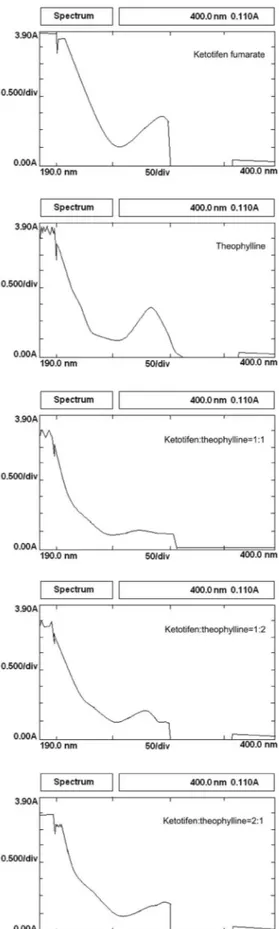
The spectrum of ketotifen fumarate alone at different pH
showed a sharp absorption maximum at 300 nm. When theophylline was mixed with ketotifen in a 2:1 ratio, the
intensity of the peak of ketotifen changed remarkably (decreased absorbance), i.e. the absorption characteristics were altered due to the interaction, but the position of the compound did not shift. The UV spectra of ketotifen at pH
1.2 and 6.8 and the 1:1, 1:2, and 2:1 mixtures of ketotifen
fumarate with theophylline at the same pH are shown in Figure 4 and Figure 5. The curves obtained by Job’s method show breaks at different molar concentrations for
both drugs. It was found that the curves obtained at pH 6.8 were somewhat lat compared to those at pH 1.2. On the
other hand, the kinetics of the interaction between keto-tifen fumarate and theophylline anhydrous were slow at pH 1.2 (Figure 1). The continuous variation plot provides
information on the relative affinities of the complexes
and depends on the intrinsic spectral characteristics of
each complex.
Ardon’s plots have been used to evaluate
stabil-ity constants. It has been observed that when values of
1/(D-CɛA) are plotted against 1/drug (Figure 2), straight
lines are obtained following Ardon’s equation. The values of the stability constants at different pH levels are shown in
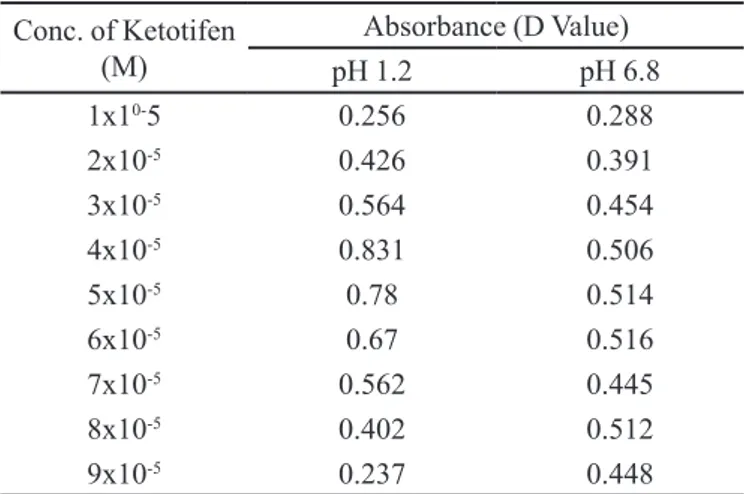
TABLE I - Absorbance of ketotifen at different pH (using Job’s method)
Conc. of Ketotifen (M)
Absorbance (D Value)
pH 1.2 pH 6.8
1x10⁻⁵ 0.256 0.288
2x10⁻⁵ 0.426 0.391
3x10⁻⁵ 0.564 0.454
4x10⁻⁵ 0.831 0.506
5x10⁻⁵ 0.78 0.514
6x10⁻⁵ 0.67 0.516
7x10⁻⁵ 0.562 0.445
8x10⁻⁵ 0.402 0.512
9x10⁻⁵ 0.237 0.448
FIGURE 1 - Job’s plot for the complexation of ketotifen with theophylline at 300 nm.
Table III and Table V. Very low stability constant numeri -cal values (between negative values and 1) mean that the
formation of the complex due to an interaction between
the drugs is readily dissociated (Table V), yielding essen-tially all drugs in ionic form at low pH as in the stomach
(about pH 2 to 3) to as high as physiological (pH 7.4, the pH of extracellular body luids such as serum and lymph)
(Landy et al., 1999).
The numerical values of the resulting stability constants were 9.92 at pH 1.2 and 5.66 at pH 6.8 when
complexation occurred with ketotifen and theophylline (Table III). These values indicate a good interaction be
-tween ketotifen and theophylline. It can be assumed that
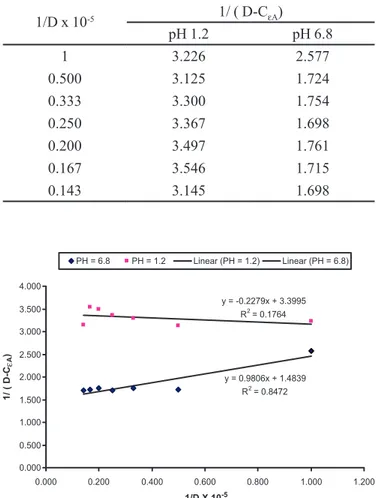
FIGURE 3 - Ardon’s plot for the complexation of theophylline with ketotifen at 300 nm.
TABLE II - Absorbance of ketotifen at different pH (using Ardon’s method, when the concentration of theophylline is constant)
1/D x 10-5 1/ ( D-CεA)
pH 1.2 pH 6.8
1.000 38.5 33.3
0.500 32.3 4.0
0.330 8.4 4.7
0.250 4.5 2.3
0.200 2.9 1.8
0.167 2.0 1.7
0.143 1.5 1.4
TABLE III - Stability constant of ketotifen with theophylline at different pH
System pH Stability
constant Interaction of ketotifen with
theophylline
1.2 9.92
6.8 5.66
TABLE IV - Absorbance of ketotifen at different pH (using Ardon’s method, when the concentration of ketotifen is constant)
1/D x 10-5 1/ ( D-CεA)
pH 1.2 pH 6.8
1 3.226 2.577
0.500 3.125 1.724
0.333 3.300 1.754
0.250 3.367 1.698
0.200 3.497 1.761
0.167 3.546 1.715
0.143 3.145 1.698
TABLE V - Stability constant of theophylline with ketotifen at different pH
System pH
Stability constant (1x10⁻²)
Interaction of theophylline with ketotifen
1.2 6.70
6.8 66
FIGURE 2 - Ardon’s plot for the complexation of ketotifen with
theophylline at 300 nm.
ketotifen, a lower stability constant was found, indicating the ready solubility of both drugs and a minimal drug-drug
interaction (Figure 3).
CONCLUSION
The interaction of ketotifen with theophylline
de-creases the free drug concentration of both drugs, which can result in decreased availability of the drugs at their receptors. Ultimately, one or both drugs may show dimin-ished pharmacological activity. Therefore, caution should
be exercised during the administration of both drugs,
pending in vivo experiments to determine the implications
FIGURE 4 - Spectral studies of ketotifen fumarate and theophylline at pH 1.2. X axis: UV range; Y axis: absorbance.
REFERENCES
ARDON, M. Oxidation of ethanol by ceric perchlorate. J.
Chem. Soc., [Online]. p.1811-1815, 1957. Available at:
<http: // pubs.rsc.org/en/content/articlelanding/ 1957/jr/jr 9570001811>. Accessed on: 02 aug. 2011.
BACHMANN, K.; LEWIS, J.D. Predicting inhibitory drug-drug interactions and evaluating drug interaction reports using inhibition constants. Ann. Pharmacother., v.39,
p.1064-1072, 2005.
BECHTER, R.; SCHÖN, H. Use of the whole-embryo culture system in drug safety assessment. Toxicol. in vitro, v.2, p.195-203, 1988.
BENJAMIN, V.; JACOB, A.; HAGIT, M.; MAYA, L.; ITZHAK, V. Administration of half-dose theophylline together with ketotifen to asthmatic children-a double-blind, placebo-controlled study. J. Asthma, v.31, p.27-34, 1994.
BROMPTON HOSPITAL. Medical Research Council Collaborative Trial. Long-term study of disodium cromoglycate in treatment of severe extrinsic or intrinsic bronchial asthma in adults. Br. Med. J., v.4, p.383-388,
1972.
CHURCH, K.M.; GRADIDGE, C.F. Inhibition of histamine release from human lung in vitro by antihistamines and related drugs. Br. J. Pharm., v.69, p.663-667, 1980.
CLARKE, C.W.; MAY, C.S. A comparison of the eficacy of ketotifen (HC 20-511) with sodium cromoglycate (SCG) in skin test positive asthma. Br. J. Clin. Pharmacol., v.10,
p.473-476, 1980.
CRAPS, L.; GREENWOOD, C.; RADIELOVIC, P. Clinical investigation of agents with prophylactic anti-allergic effects in bronchial asthma. Clin. Allergy, v.8, p.373-382,
1978.
HOSHINO, M.; NAKAMURA, Y.; SIM, J.J.; TOMIOKA, H. A comparative study of the effects of ketotifen, disodium cromoglycate, and beclomethasone dipropionate on bronchial mucosa and asthma symptoms in patients with atopic asthma. Respir. Med., v.92, p.942-950, 1998.
JOB, P. Job’s method of continuous variation. Ann. Chim., v.9, p.113-203, 1928.
KIDNEY, J.; DOMINGUEZ, M.; TAYLOR, P.M.; ROSE, M.; CHUNG, K.F.; BARNES, P.J. Immunomodulation by theophylline in asthma. Demonstration by withdrawal of therapy. Am. J. Respir. Crit. Care Med., v.151,
p.1907-1914, 1995.
LEUCUTA, S.E.; VLASE, L. Pharmacokinetics and metabolic drug interactions. Curr. Clin. Pharmacol., v.1, p.5-20, 2006.
MAK, V. Chest medicine on-line, chronic obstructive pulmonary disease (COPD): the UK perspective. Available at: <http:// www.prioiry.com/cmol/ copd.htm>. Accessed on: 19 May 2007.
MARTIN, U.; ROMER, E. Ketotifen: a histamine release inhibitor. Monogr. Allergy, v.12, p.145-149, 1977.
MOHIUDDIN, M.; AZAM, Z.; AMRAN S.; HOSSAIN, M.A. In vitro study on the interaction of caffeine with gliclazide
and metformin in the aqueous media. J. Pharmacol.
Toxicol., v.4, p.194-204, 2009.
PERRIN, D.D.; DEMPSEY, B., Buffer for pH and metal ion
control. London: Chapman and Hall, 1974. p.211-216.
SALAMZADEH, J.; DADASHZADEH, S.; HABIBI, M.; ESTIFAIE, S. Serum and saliva theophylline levels in adult outpatients with asthma and chronic obstructive pulmonary disease (COPD): a cross-sectional study. IJPR, v.7,
p.83-87, 2008.
TINKELMAN, D.G.; MOSS, B.A.; BUKANTZ, S.C.; SHEFFER, A.L.; DOBKEN, J.H.; CHODOSH, S.; COHEN, B.M.; ROSENTHAL, R.R.; RAPPAPORT, I.; BUCKLEY, C.E.; CHUSID, E.I.; DEUTSCH, A.J.; SETTIPANE, G.A.; BURNS, R.B.P. A multicenter trial of the prophylactic effect of ketotifen, theophylline, and placebo in atopic asthma. J. Allergy Clin. Immunol., v.76, p.487-497, 1985.
Received for publication on 2nd February 2011