*Correspondence: G. Martins. Faculdade de Ciências da Saúde, Departa-mento de Enfermagem, Universidade de Brasília, Campus Universitário Darcy Ribeiro, 70910-900 - Brasília - DF, Brazil. E-mails: [email protected]; [email protected]
A
vol. 48, n. 2, apr./jun., 2012
Oxybutynin and tolterodine for treatment of neurogenic detrusor
overactivity: a pharmacoeconomic evaluation in the Brazilian context
Rodrigo Silva Suguino
2, Gisele Martins
1,*, Brunna Carvalho Viana Campos
3, Raylayne Ferreira
Bessa
4, Démerson André Polli
5, Mani Indiana Funez
3, Cris Renata Grou Volpe
31Department of Nursing, Faculty of Health Sciences, University of Brasília, 2Department of Pharmaceutical Sciences,
Faculty of Ceilândia, University of Brasília, 3Department of Nursing, Faculty of Ceilândia, University of Brasília, 4Department of Public Health, Faculty of Ceilândia, University of Brasília, 5Department of Statistics,
Institute of Exact Sciences, University of Brasília
Antimuscarinic agents are the irst-line choice for the treatment of neurogenic detrusor overactivity
(NDO). The currently available antimuscarinic drugs have been widely studied in patients presenting idiopathic detrusor overactivity; however, investigations evaluating the effects of these drugs on NDO are scant, particularly with regard to cost-effectiveness analyses. A pharmacoeconomic evaluation was performed to compare the costs and effectiveness of oxybutynin and tolterodine in two different formulations, extended (ER) and immediate-release (IR), for the treatment of NDO (based on Brazilian maximal consumer price index). A systematic review of literature was conducted in order to obtain
signiicant clinical and urodynamic data (based on expert opinion), concerning the effects of these
drugs in the neurogenic population. Furthermore, a pharmacoeconomic evaluation was performed and costs involved were calculated based on percentage effectiveness obtained for the timeframes of one month and of one year. The best cost-effectiveness ratio (CER) was observed with oxybutynin IR for the urodynamic parameters. In terms of clinical parameters, oxybutynin IR and ER showed the best CER. Based on the key urological parameters analyzed, oxybutynin IR was considered the most cost-effective antimuscarinic agent.
Uniterms: Urinary Bladder Neurogenic. Muscarinic Antagonists. Pharmaceutical economy.
A terapia antimuscarínica é vista como primeira escolha para o tratamento da hiperatividade detrusora de origem neurológica (HDON). No entanto, a maioria dos antimuscarínicos existentes é amplamente estudada em pacientes portadores de hiperatividade detrusora idiopática. Assim, existe escassez de pesquisas que avaliam esses fármacos na problemática da HDON, principalmente em termos de estudos de custo-efetividade. Diante isso, um estudo farmacoeconômico foi realizado (baseado no índice de preço máximo ao consumidor) para comparar os custos e a efetividade da oxibutinina e da tolterodina, em duas diferentes formulações, cápsulas de liberação imediata (LI) e controlada (LC), para o tratamento da HDON. Uma revisão sistemática da literatura foi conduzida para obtenção de dados urodinâmicos e clínicos relevantes (baseado em opinião de especialistas), quanto aos efeitos desses fármacos em pacientes com distúrbios urológicos de origem neurológica. Após essa etapa, um estudo farmacoeconômico foi conduzido e os custos envolvidos foram calculados sobre cada percentual de efetividade obtido, num horizonte temporal de 1 mês e 1 ano. A melhor razão de custo-efetividade (RCE) quanto aos parâmetros urodinâmicos foi obtida com uso de oxibutinina LI. Quantos aos parâmetros clínicos, oxibutinina LI e LC tiveram as melhores RCE. Baseando-se nos principais parâmetros urológicos analisados, oxibutinina LI foi considerada o antimuscarínico mais custo-efetivo.
INTRODUCTION
Neurogenic detrusor overactivity (NDO) is related to neurogenic bladder (NB) and generally associated to traumatic medullary damage or neurological disease. NB can stem from damage above the medulla level such as in strokes, tumors and dementia or may be secondary to spinal cord medulla lesions such as in cases of traumatic spinal cord injury, multiple sclerosis, intervertebral disc herniation and inflammatory lesions affecting sites of micturition control (Tanagho, Bella, Lue, 2010).
The term NDO refers to neurological damage caused by trauma or disease which interferes directly with mictu-rition. Affected patients present with urinary incontinence, urgency incontinence, frequency, residual urine or urinary retention. If not treated effectively, patients with NB can develop upper urinary tract infections which can be recur-rent and lead to renal failure. Another aggravating problem of NB is its negative impact on patients’ quality of life, leading to low self-esteem, and loss of independence, particularly among the elderly population (Chancellor, Anderson, Boone, 2006).
Neurophysiology of micturition is associated with a complex of autonomic and somatic nervous system in-nervations, which can be divided into afferent and efferent pathways. Afferent paths are composed of receptors origi-nating in the muscle wall and the mucosa of the detrusor muscle, where the signal originates. These signals travel to the dorsal ganglions and the sacral medulla. The pontine center for micturition is the inal site where the afferent signals are perceived sensorially. The efferent system for micturition emerges from the pontine center causing exci-tation via the sacral parasympathetic pathways to contract the detrusor and the sacral somatic pathways to relax the sphincter. Other organs are also involved in micturition control including the cerebellum, cerebral cortex, thalamus and hypothalamus, which exert control over the pontine micturition center (Kennelly, DeVoe, 2008).
Conservative therapy with antimuscarinic drugs is the first choice for treatment of patients with NDO. Two of the leading antimuscarinic drugs available in the market are Oxybutynin and Tolterodine which, as anti-muscarinic agents, have a direct antispasmodic effect on smooth muscle receptors. Thus, these drugs inhibit the muscarinic action of acetylcholine (released from the parasympathetic terminals) on the smooth muscle of the detrusor (Woodward, 2004).
Oxybutynin was the irst antimuscarinic drug to be approved for the management of detrusor overactivity secondary to neurogenic bladder. It was developed by Ma-jewski and patented in 1965. Ten years later (1975), it was
approved by the Food and Drug Administration (FDA) of the United States for treatment of uncontrolled neurogenic bladder relexes as well as for treatment of nocturnal en -uresis in patients over ive years of age. This advance was possible due to the fact that the irst trials of the main active ingredient were conducted using cystometrography in a patient with NB, a urodynamic technique which allowed the measurement of internal urinary bladder pressure.
In 1980, oxybutynin was shown to be effective not only for individuals with NB but also for patients who had idiopathic detrusor overactivity or of unknown etiology. Mosley et al (1980) carried out a randomized double blind study with oxybutynin in 30 patients who had bladder instability, whose results showed a subjective improve-ment in symptoms. This led to the approval in 1992 of Oxybutynin by the FDA for detrusor instability (Dionne, Ingber, 2006).
A major drawback of oxybutynin use is the high level of side effects. The low selectivity in specific muscarinic receptors of urinary function, affects other physiological systems causing dry mouth, constipation and heat intolerance in around one third of patients. These side effects are the main reason for noncompliance with therapy. Another reason for non-adherence to therapy is the need for a three times daily dose. A sustained or extended release oxybutynin preparation was developed in order to overcome these issues (Aslan, Kogan, 2002). Although oxybutynin has collateral effects (particularly immediate release form), it remains the most commonly used drug in Brazil due to its eficacy and low cost (Palma, 2007).
Another antimuscarinic drug developed in the mid-1990s was tolterodine, acclaimed as a muscarinic antago-nist which was more selective for bladder receptors. Over-all, this medication was better accepted and tolerated by patients in comparison to oxybutynin (Woodward, 2004).
Nevertheless, in the Brazilian context, the costs involved in treatment with tolterodine for NDO are much higher than those with the use of oxybutynin, especially considering the price made available by the National Agency of Health Safety (ANVISA). The literature rein-forces the fact that, while the monthly cost of tolterodine is higher, it is better tolerated in terms of undesirable side effects. This economic aspect should be considered as a selection criteria and taken into account for each patient (Palma, 2007).
The cost calculations in this study were based on the 2009 maximum consumer price index compiled by the ANVISA for the year 2009, and patients’ perspective.
METHODOLOGY
A systematic literature review was done using the following databases: Pub Med, Cochrane Library, CI-NAHL, Embase, MEDLINE, Web of Science, Current Controlled Trials, Evidence-NHS, Centre for Reviews and Dissemination (CRD York), INAHTA, LILACS, SciELO and IBECS. The review also included content from jour-nals and those studies in the references of relevant articles which met the inclusion criteria. These searches were performed in each database by four independent reviewers.
No time limit was deined for publication date and only articles written in English and Spanish were included as no articles were found written in Portuguese. Retrieval was based on a total of 578 descriptive combinations including Bladder, Neurogenic; Cholinergic antagonists; Muscarinic Antagonists; Oxybutynin; Tolterodine and Urinary Bladder, Overactive.
The selected studies met the following inclusion criteria:
• Studies which included only NDO patients; • Use of oxybutynin and tolterodine by oral route; • Details given in the study on dose regimen/duration
of treatment;
• Studies which used the two antimuscarinic agents, both prospective or retrospective;
• Inclusion of clinical and urodynamic information, showing effectiveness of the antimuscarinic therapy used.
The exclusion criteria applied were as follows: • Integrated or narrative review articles, and
• Other antimuscarinic formulations used (intrablad-der, transdermal).
A total of 29 studies were found meeting the inclu-sion criteria, only 22 of which were included in the inal sample for data extraction after evaluation. Among the principal reasons for exclusion of the initial 7 articles were the following problems:
• Clinical and urodynamic parameters were not in-dividually separated for each antimuscarinic drug studied, and
• Absence of effectiveness parameters both pre and post treatment.
It is important to highlight that for a pharmacoeco-nomic study, the average price paid by the consumer in the Brazilian market, was calculated (based on mean national price set by ANVISA in 2009) for the oral formulations
(pills and capsules) of the two antimuscarinic drugs oxy-butynin and tolterodine.
The following urodynamic parameters were used: • Increase in cystometric capacity ≥ 10%;
• Decrease in detrusor pressure ≤ 40 cmH2O; • Increase in bladder compliance.
The following clinical parameters were used: • Increase in urinary volume eliminated in each
uri-nary effort or catheterization
• Mean number of episodes of urgency with inconti-nence and/or urge-incontiinconti-nence.
Studies used to determine the eficacy of the medica -tions in the pediatric population were: 1.Mahanta, K. et al. 2.Franco, I et al. 3.Cartwright, P. C. et al. 4.Goessl, C.
et al. 5.Christoph, F. et al. 6.Reddy, P. P. et al. 7.Youdim, K. et al. 8.Madesbacher, H. et al. 9.Ferrara, P. et al. 10. Pannek, J. et al. 11.Ellsworth, P. I. et al. 11.Goessl, C. et al.
The selected studies which investigated the ef-ficacy of these drugs in the adult population included: A.1.Bennett, N. et al. A.2.Kawabe, K. et al. A.3.Ethans, K. D. et al. A.4.Fader, M. et al. A.5.Horstmann, M. et al. A.6.Brooks, M. E. et al. A.7.Gajewski, J. B. et al.
A.8.Stohrer, M. et al. A.9.Madersbacher, H. et al. A.10. Van Kerrebroeck, P. E. V. A. et al.
In order to calculate the daily, monthly and annual cost of each medication used, we calculated the average price according to the data available on pricing from the ANVISA site for 2009. In addition, it was necessary to calculate the weighted mean price of each pack of these antimuscarinic drugs, sold by all the pharmaceutical com-panies which commercialize these products, according to the Tax on the Circulation of Goods and Services (ICMS) of each Brazilian State. The cost of each medication was then deined in terms of Reais per milligram (R$/mg).
The eficacy/effectiveness of the selected antimusca -rinic drugs was stratiied in terms of clinical and urodynamic parameters. Using values suggested by the literature search and a consensus opinion on this subject by specialists, the following urodynamic parameters of effectiveness after intervention were the following: a ≥10% increase in cys -tometric capacity measured, detrusor pressure reduced to ≤ 40 cmH2O, and augmented bladder compliance. In terms of the clinical parameters of effectiveness, the following were considered: increase in urinary volume excreted by natural means or by catheter, in a period of 24 hours, and a decrease in the average number of incontinence episodes (urgency or urge-incontinence) over a 24-hour period.
decrease and one natural unit increase or decrease, for each investigated parameter. It is worth emphasizing that the average eficacy was calculated (along with the respective standard deviation) for all analyzed parameters, based on the average dose of each antimuscarinic drug, according to the doses adopted in the studies selected in the systematic literature search.
Precision of all calculations was to four decimal places. These were then reduced to two decimal places for ease of presentation of results.
RESULTS
The mean number of milligrams in each dose of the antimuscarinic studies and the corresponding average price is shown in Table I. The national average price of oxybutynin CR in 2009 was R$0.2295/mg and R$2.5472 for tolterodine CR. The average price for IR oxybutynin was R$0.1269/mg versus R$ 2.0458 for IR Tolterodine.
Tables II and III give details regarding eficacy of each antimuscarinic drug, separately for pediatric and adult patients, according to the clinical data and urody-namic parameters analyzed.
It can be seen that tolterodine CR yielded better results than oxybutynin CR across all the urodynamic parameters evaluated, based on percentage values for both the pediatric and adult populations. For the IR formulation, tolterodine IR showed better performance in percentage terms than oxybutynin IR only for the increase in cysto-metric capacity parameter in the pediatric population. For the rest of the parameters measured, in both pediatric and adult populations, oxybutynin gave better results com-pared to tolterodine IR, suggesting it was more effective. On clinical parameter analysis, the greatest volume increase in urinary volume eliminated with urination or by catheter use, was found with tolterodine CR, given the better percentage results obtained in comparison to oxy-butynin CR. Comparing immediate release formulations
(IR), tolterodine produced better results than oxybutynin in the pediatric group; but the reverse was true for the adult group in which oxybutynin had a superior result for the same parameter.
With regard to reduction in average number of incontinence episodes, tolterodine had better percentage results than oxybutynin only in the pediatric population and only for the IR formulation. No studies described this parameter for oxybutynin IR. Concerning the other popu-lations and formupopu-lations, oxybutynin had the best results.
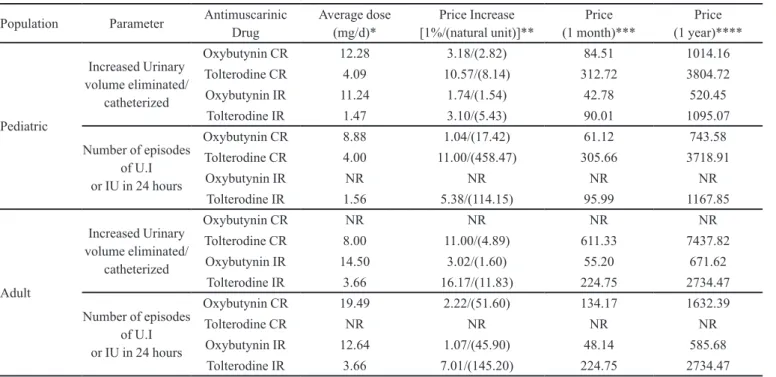
Tables IV and V show daily dose in milligrams cal-culated for each antimuscarinic drug, according to each selected study; the cost beneit ratio of each antimuscarinic drug is separated into urodynamic and clinical parameters respectively, considering the daily maintenance of the treatment over the time period considered.
The results suggest that Oxybutynin IR is the low-est cost antimuscarinic medication offering the most favorable overall effectiveness in both pediatric and adult populations given its greater eficacy at a lower price for each urodynamic parameter studied. On the other hand, it should be noted that no reports investigating effective-ness parameters for the outcome of reduction in detrusor pressure or increased bladder compliance, associated to the use of tolterodine CR were available.
In relation to the cost-effectiveness ratios for clinical parameters, the data suggest that oxybutynin IR is the low-est cost antimuscarinic drug and has the lowlow-est price asso-ciated with a 1% increase in volume of urine eliminated by urination or catheter use. Considering the CR formulation in the adult population, information was available only for tolterodine whose cost was R$11.00.
In summary, regarding the parameter related to reduction in average number of urgency incontinence or urge-incontinence episodes, in the pediatric popula-tion, the lowest cost and most effective muscarinic drug was oxybutynin in both CR and IR formulation. Studies were available only for tolterodine IR, whose cost was
TABLE I - Average milligrams in antimuscarinic drug packs studied, according to average consumer price and price per milligram.
Brazil, 2009
Antimuscarinic Drugs Amount per pack (mg) Average (SD)
(mg)
APC*
(R$) Average Price (R$/mg)
Oxybutynin CR 300 300.00 (0.00) 68.86 R$ 0.2295
Oxybutynin IR 100 150 300 183.33 (84.98) 27.12 R$ 0.1269
Tolterodine CR 56 112 84.00 (28.00) 237.74 R$ 2.5472
Tolterodine IR 28 56 120 68.00 (38.51) 161.59 R$ 2.0458
TABLE II - Urodynamic parameters of each antimuscarinic drug used in pediatric and adult populations, according to pre and post treatment data, and difference in each medication used. Brazil, 2009
Population Parameter Antimuscarinic
Drug Study N
Mean Pre (SD)
Mean Post (SD)
Difference in unit values
Difference
in %
Pediatric
Cystometric capacity increased by
≥10%
Oxy CR 2; 3 70 195.66 (2.90) 264.66 (9.71) +69.00 +35.27% Tolt CR 1; 6; 11 64 159.16 (53.32) 225.32 (77.17) +66.16 +41.57% Oxy IR 2; 3; 8; 9; 10; 12 248 186.86 (40.70) 267.82 (47.86) +80.96 +43.33% Tolt IR 1; 4; 5; 6; 11 171 124.53 (6.93) 184.39 (88.14) +59.86 +48.07% Detrusor
pressure decreased
≤40 cmH2O
Oxy CR 2;3 70 43.23 (0.77) 33.59 (0.26) -9.64 -22.30% Tolt CR 1 25 50.00 (***) 36.80 (***) -13.20 -26.40% Oxy IR 2; 3; 9; 12 135 46.22 (2.50) 30.18 (2.13) -16.04 -34.70% Tolt IR 1; 4; 5 67 50.17 (12.76) 34.83 (1.97) -15.34 -30.58% Bladder
compliance improved
Oxy CR NR NR NR NR NR NR
Tolt CR 1 25 2.28 (***) 4.43 (***) +2.15 +94.30% Oxy IR 9; 12 108 7.38 (0.80) 15.70 (1.00) +8.32 +112.74% Tolt IR 1; 4; 5 90 10.86 (6.59) 12.37 (5.90) +1.51 +13.90%
Adult
Cystometric capacity increased by
≥10%
Oxy CR NR NR NR NR NR NR
Tolt CR A.5 11 308.00 (***) 480.00 (***) +172.00 +55.84% Oxy IR A.4; A.6; A.7; A.8; A.9 164 184.46 (32.26) 300.16 (28.20) +115.70 +62.72% Tolt IR A.3; A.10 91 156.36 (39.26) 353.79 (205.81) +197.43 +126.27% Bladder
compliance increased
Oxy CR NR NR NR NR NR NR
Tolt CR NR NR NR NR NR NR
Oxy IR A.8; A.9 81 17.08 (4.93) 55.77 (20.22) +38.69 +226.52% Tolt IR A.10 55 31.13 (13.70) 67.78 (6.90) +36.65 +117.73% NR: data not reported in article.
*** Not possible to estimate standard deviation since only one article retrieved, and information was absent. Standard deviations were estimated as variation between means in articles, considering that each patient had a value equal to the corresponding weighted average.
TABLE III - Clinical parameters for each antimuscarinic drug used in pediatric and adult populations, according to pre and post
treatment data, and difference in each medication used. Brazil, 2009
Population Parameter Antimuscarinic
Drug Study N
Mean Pre (SD)
Mean Post (SD)
Difference in unit values
Difference
in %
Pediatric
Increase in urinary volume eliminated by urination or catheterization
Oxy CR 2; 3 70 112.65 (57.23) 142.57 (72.95) +29.92 +26.56% Tolt CR 6; 11 39 129.88 (4.79) 169.73 (7.70) +39.85 +30.68% Oxy IR 2; 3 27 112.52 (0.43) 140.26 (7.42) +27. 4 +24.65% Tolt IR 6; 11 123 57.20 (26.23) 73.78 (24.65) +16.58 +28.99% Decreased number
of episodes of U.I/ I in 24 hours
Oxy CR 7 12 8.50 (***) 1.80 (***) -6.70 -78.82% Tolt CR 11 33 2.40 (000) 1.73 (0.29) -0.67 -27.92%
Oxy IR NR NR NR NR NR NR
Tolt L.IR 11 83 4.71 (0.45) 3.87 (0.52) -0.84 -17.83%
Adult
Increase in urinary volume eliminated by urination / catheterization
Oxy CR NR NR NR NR NR NR
Tolt CR A.5 11 225.00 (***) 350.00 (***) +125. 0 +55.56% Oxy IR A.2; A.8 54 179.80 (43.26) 215.42 (46.02) +35. 2 +19.81% Tolt IR A.10 71 136.70 (5.85) 155.70 (11.87) +19.00 +13.90%
Decreased number of episodes of U.I/I in 24 hours
Oxy CR A.1 39 4.30 (***) 1.70 (***) -2.60 -60.47%
Tolt CR NR NR NR NR NR NR
Oxy IR A.4; A.7; A.8 121 2.33 (0.76) 1.28 (0,.6) -1.05 -45.06% Tolt IR A.10 71 4.83 (1.19) 3.28 (0.90) -1.55 -32.09% NR: data not reported in article.
R$114.15 per episode avoided. For the adult population, the lowest cost per reduced episode was found to oxybu-tynin in both IR and CR formulations, since no studies investigating the comparative costs for tolterodine CR were available.
DISCUSSION
The elevated costs of health management, especially those related to pharmaceutical costs to the patient have become a growing concern in public health. In the case of urology, and more speciically, among NDO patients, the costs involved in the diagnosis and treatment of this dysfunction can have a significant financial impact on patients and the health care system. One of the main reasons for this is the need for chronic use of medication and frequent medical consultations as well as exams such as urinary bacterial cultures, urodynamic examinations,
ultrasonography as well as expenses with urinary catheters etc. In addition to these costs, indirect and intangible costs must also be considered such as impaired quality of life, caregiver burden (in cases of patients who cannot care for themselves) and loss of professional productivity in the work place.
Another aspect warranting emphasis regarding costs involved in NDO treatment is the lack of information on the average costs of treating NDO with pharmacologic agents. Nevertheless, in the case of bladder overactivity or idiopathic detrusor overactivity, medication costs represent a signiicant part of the direct treatment costs. In the United States, the cost of a year´s treatment with oxybutynin is $506 dollars while in the UK similar treatment costs £226 a year. For tolterodine, the US costs are $1044 whereas in the UK the cost is £508 (McGhan, 2001).
The costs in Canada are estimated to be even higher. Direct and indirect costs of urinary incontinence in the
TABLE IV - Cost-effectiveness ratios for urodynamic parameters according to % value and natural unit price, cost of therapy for
one month and for one year, among pediatric and adult populations. Brazil, 2009
Population Parameter Antimuscarinic Drug Average dose (mg/d)*
Increased Price
[1%/(natural unit )]**
Price (1 month)***
Price (1 year)****
Pediatric
Cystometric capacity increased
by ≥10%
Oxybutynin C.L 12.28 2.40/(1.22) 84.51 1014.16 Tolterodine C.L 3.28 6.02/(3.78) 250.26 3044.86 Oxybutynin I.R 8.99 0.77/(0.42) 34.14 415.33
Tolterodine I.R 2.02 2.58/(2.07) 123.80 1506.28
Detrusor pressure reduced
≤40 cmH2O
Oxybutynin C.L 12.28 3.79/(8.77) 84.51 1014.16 Tolterodine C.L 2.00 5.79/(11.58) 152.83 1859.46 Oxybutynin I.R 4.72 0.51/(1.09) 17.97 218.64
Tolterodine I.R 2.88 5.28/(10.55) 176.57 2148.2
Bladder compliance
increased
Oxybutynin C.L NR NR NR NR
Tolterodine C.L 2.00 1.62/(71.08) 152.83 1859.46 Oxybutynin I.R 3.09 0.11/(1.46) 11.77 143.15
Tolterodine I.R 2.71 11.98/(145.86) 166.09 2020.75
Adult
Cystometric Capacity increased
by ≥10%
Oxybutynin C.L NR NR NR NR
Tolterodine C.L 8.00 10.95/(3.55) 611.33 7437.82 Oxybutynin I.R 13.26 0.81/(0.44) 50.49 614.30
Tolterodine I.R 3.66 4.80/(2.79) 224.75 2734.47
Bladder compliance
increased
Oxybutynin C.L NR NR NR NR
Tolterodine C.L NR NR NR NR
Oxybutynin I.R 15.00 0.25/(1.44) 57.11 694.78 Tolterodine I.R 4.15 2.16/(6.94) 254.43 3095.53 NR: data not reported in article.
Price = in Reais (Brazil).
(*) Average daily dose in studies analyzed. (**) Additional R$ for every 1% increase or decrease in parameter, considering difference between
TABLE V - Cost-effectiveness ratios for clinical parameters by % value and natural unit price, cost of therapy for one month and for one year, in both pediatric and adult populations. Brazil, 2009
Population Parameter Antimuscarinic Drug
Average dose (mg/d)*
Price Increase
[1%/(natural unit)]**
Price (1 month)***
Price (1 year)****
Pediatric
Increased Urinary volume eliminated/
catheterized
Oxybutynin CR 12.28 3.18/(2.82) 84.51 1014.16 Tolterodine CR 4.09 10.57/(8.14) 312.72 3804.72 Oxybutynin IR 11.24 1.74/(1.54) 42.78 520.45
Tolterodine IR 1.47 3.10/(5.43) 90.01 1095.07
Number of episodes of U.I or IU in 24 hours
Oxybutynin CR 8.88 1.04/(17.42) 61.12 743.58 Tolterodine CR 4.00 11.00/(458.47) 305.66 3718.91
Oxybutynin IR NR NR NR NR
Tolterodine IR 1.56 5.38/(114.15) 95.99 1167.85
Adult
Increased Urinary volume eliminated/
catheterized
Oxybutynin CR NR NR NR NR
Tolterodine CR 8.00 11.00/(4.89) 611.33 7437.82 Oxybutynin IR 14.50 3.02/(1.60) 55.20 671.62
Tolterodine IR 3.66 16.17/(11.83) 224.75 2734.47
Number of episodes of U.I or IU in 24 hours
Oxybutynin CR 19.49 2.22/(51.60) 134.17 1632.39
Tolterodine CR NR NR NR NR
Oxybutynin IR 12.64 1.07/(45.90) 48.14 585.68 Tolterodine IR 3.66 7.01/(145.20) 224.75 2734.47 NR: data not reported in article.
Price = in Reais ( Brazilian).
(*) Average daily dose in studies analyzed. (**) Additional R$ for every 1% increase or decrease in parameter, considering difference between
post and pre intervention levels. (***)Considering one month as 30 days – price based on mean 2009 price. (****)Considering one year as 365 days – price based on mean 2009 price.
Canadian population have been estimated at 2.6 billion dollars per year, which is higher than American costs. Considering each drug separately, a year of bladder over-activity treatment with oxybutynin CR costs $656 (CAD), $534 of which is related directly to drug costs whereas $688 (CAD) represents the cost for a year’s treatment with tolterodine, of which $550 represents direct drug costs (Getsios, et al. 2004).
In the present study, the antimuscarinic drug with the best effectiveness proile and lowest price was oxybutynin. When stratifying by age group or pediatric/adult patients and both clinical and urodynamic parameters, oxybutynin remained the lowest cost with the best performance char-acteristics.
In Brazil, weighted values for the antimuscarinic drug tolterodine are unfavorable, due to the economic conditions of the Brazilian population, in spite of the fact that tolterodine seems to be associated with better adher-ence to therapy and to have a tolerability index three times higher than that of oxybutynin (McGhan, 2001).
Based on this assertion, tolterodine has become the second therapeutic option in clinical practice, indicated in oxybutynin-refractory cases. Another important aspect
to be considered is that in Brazil, tolterodine is not yet included in the list of Medications Prescribable under Ex-ceptional Circumstances (Componentes de Medicamentos de Dispensação Excepcional: CMDE), also called “high cost” drugs. This is important in that its use as a chronic ongoing therapy would be unaffordable for most of the Brazilian population.
Moreover, 132 (69%) patients complained of at least one side effect in the tolterodine group, in contrast to 153 un-desirable similar side effects reported by the group of 188 individuals on oxybutynin (81%). Dry mouth was once again the most commonly reported side effect found in 71 out of 190 patients (37%) in the tolterodine group, and in 114 out of 188 patients (61%) in the oxybutynin group (Malone-Lee et al. 2001).
Our results suggest that the two antimuscarinic drugs, oxybutynin and tolterodine, show distinct outcomes as to their effectiveness. In the case of oxybutynin CR, this seems to be clinically relevant. This was especially notable in terms of the number of reduced episodes of incontinence (a highly signiicant clinical outcome measure for patient satisfaction). This resulted in an effectiveness of around 60% for both population groups assessed. The pediatric population showed reduced incontinence episodes by an average of 6.7 episodes per day, while the adult group reported an average reduction in incontinence episode of 2.6 per day. .
Analysis of the pertinent literature revealed an increasingly significant number of publications on the subject of bladder overactivity. However, studies ad-dressing antimuscarinic treatment in the NDO patient population were scant and generally classiied as based on a low quality of evidence. The major challenge in this area is to conduct studies with better methodological design, with a view to performing a meta-analysis on the resulting information. Thus, given the need for further studies on patients with NB, this preliminary exploratory study was of fundamental importance. Discovery of new technologies, especially low cost solutions, constitutes one of the most important factors for successful treatment of NDO, particularly with regard to the use of antimuscarinic medications.
CONCLUSION
This study found that in 2009, oxybutynin IR was the cheapest and most effective medication for the treatment of NDO, based on clinical and urodynamic parameters, in both the pediatric and adult populations in Brazil.
STUDY LIMITATIONS
This study was a pharmacoeconomic study using data from a systematic literature review, and thus cannot be considered a complete analysis of cost-effectiveness but instead a study of cost-consequence. The study aims were to present the incremental cost-effectiveness ratios for each clinical and urodynamic parameter considered,
leaving the reader to decide which outcome is most im-portant in their particular situation.
It is also important to emphasize that it was impos-sible to obtain details regarding quality of life from the literature. This precluded the comparative study of other effectiveness parameters, such as years of life adjusted by quality, for the two alternative treatments from the perspective of one common denominator.
Another noteworthy point is that this study did not employ rates of discount of future beneits and costs. The scope of this study was restricted to the costs related to the acquisition of the two medications studied, and for this reason the average ANVISA published prices to consum-ers for 2009 was used.
In summary, this preliminary investigation paves the way for further research in this area. Broader studies should incorporate the results reported and could examine the incorporation of technologies, given the clear need for use of these drugs as part of the therapeutic arsenal for treatment of patients with chronic diseases such as NDO. The results of the present study should be interpreted with care for making health care decisions.
FUNDING SOURCES
National Council for Scientific and Technologic Development (Conselho Nacional de Desenvolvimento Cientíico e Tecnológico (CNPq)/DECIT/REBRATS).
REFERENCES
ASLAN, A.R.; KOGAN, B.A. Conservative management in neurogenic bladder dysfunction. Curr. Opin. Urol., v.12, n.6, p.473-477, 2002.
BENNETT, N.; O’LEARY, M.; PATEL, A.S.; XAVIER, M.; ERICKSON, J.R.; CHANCELLOR, M.B. Can higher doses
of oxybutynin improve eficacy in neurogenic bladder? J.
Urol., v.171, n.2, p.749-751, 2004.
BROOKS, M.E.; BRAF, Z.F. Oxybutynin Chloride (Ditrophan) – clinical uses and limitations. Paraplegia, v.18, n.1, p.64-68, 1980.
CARTWRIGHT, P.C.; COPLEN, D.E.; KOGAN, B.A.;
VOLINN, W.; FINAN, E.; HOEL, G. Eficacy and safety
of transdermal and oral oxybutynin in children with neurogenic detrusor overactivity. J. Urol., v.182, n.4, p.1548-1554, 2009.
CHANCELLOR, M.B.; ANDERSON, R.U.; BOONE, T.B. Pharmacotherapy for neurogenic detrusor overactivity. Am. J. Phys. Med. Rehabil., v.85, n.6, p.536-545, 2006.
C H R I S T O P H , F . ; M O S C H K O W I T S C H , A . ; KEMPKENSTEFFEN, C.; SCHOSTAK, M.; MILLER,
K.; SCHRADER, M. Long-term eficacy of tolterodine and
patient compliance in pediatric patients with neurogenic detrusor overactivity. Urol. Int., v.79, n.1, p.55-59, 2007.
DIOKNO, A.; INGBER, M. Oxybutynin in detrusor overactivity.
Urol. Clin. North Am., v.33, n.4, p.439-445, 2006.
ELLSWORTH, P.I.; BORGSTEIN, N.G.; NIJMAN, R.J.M.; REDDY, P.P. Use of tolterodine in children with neurogenic detrusor overactivity: relationship between dose and urodynamic response. J. Urol., v.174, n.4, p.1647-1651, 2005.
ETHANS, K.D.; NANCE, P.W.; BARD, R.J.; CASEY, A.R.;
SCHRYVERS, O.I. Eficacy and safety of tolterodine in
people with neurogenic detrusor overactivity. J. Spinal. Cord Med., v.27, n.3, p.214-218, 2004.
FADER, M.; GLICKMAN, S.; HAGGAR, V.; BARTON, R.; BROOKS, R.; MALONE-LEE, J. Intravesical atropine compared to oral oxybutynin for neurogenic detrusor overactivity: a double-blind, randomized crossover trial. J. Urol., v.177, n.1, p.208-213, 2007.
FERRARA, P.; D’ALEO, C.M.; TARQUINI, E.; SALVATORE, S.; SALVAGGIO, E. Side-effects of oral or intravesical
oxybutynin chloride in children with spina biida. BJU Int.,
v.87, n.7, p.674-678, 2001.
FIGUEIREDO, T.A. Componente de medicamentos de dispensação excepcional. Available at: <http://www.
ensp.iocruz.br/portal-ensp/judicializacao/pdfs/338.pdf>.
Accessed on: 22 Feb. 2011.
FRANCO, I.; HOROWITZ, M.; GRADY, R.; ADAMS, R.C.; DE JONG, T.P.; LINDERT, K.; ALBRECHT, D.
Eficacy and safety of oxybutynin in children with detrusor hyperrelexia secondary to neurogenic bladder dysfunction.
J. Urol., v.173, n.1, p.221-225, 2005.
G A J E W S K I , J . B . ; AWA D , S . A . O x y b u t y n i n v e r s u s propantheline in patients with multiple sclerosis and
detrusor hyperrelexia. J. Urol., v.135, n.5, p.966-968, 1986.
GETSIOS, D.; CARO, J.J; ISHAK, K.J.; EL-HADI, W.; PAYNE, K. Canadian economic comparison of extended-release oxybutynin and immediate-extended-release tolterodine in the treatment of overactive bladder. Clin. Ther., v.26, n.3, p.431-438, 2004.
GOESSL, C.; KNISPEL, H.H.; FIEDLER, U.; HÄRLE, B.; STEFFEN-WILKE, K.; MILLER, K. Urodynamic effects of oral oxybutynin chloride in children with
myelomeningocele detrusor hyperrelexia. Urology, v.51,
n.1, p.94-98, 1998.
GOESSL, C.; SAUTER, T.; MICHAEL, T.; BERGÉ, B.;
STAEHLER, M.; MILLER, K. Eficacy and tolerability of
tolterodine in children with detrusor hyperrelexia. Urology,
v.55, n.3, p.414-418, 2000.
HORSTMANN, M.; SCHAEFER, T.; AGUILAR, Y.; STENZL, A.; SIEVERT, K.D. Neurogenic bladder treatment by doubling the recommended antimuscarinic dosage.
Neurourol. Urodyn., v.25, n.5, p.441-445, 2006.
KAWABE, K.; ABE, S.; KANDA, T.; TEI, K. Clinical reevaluation of the effect of oxybutynin chloride on
uninhibited neurogenic and relex neurogenic bladder. Urol.
Int., v.41, n.1, p16-20, 1986.
KENELLY, M.J.; DEVOE, W.B. Overactive bladder: pharmacologic treatment in the neurogenic population. Rev. Urol., v.10, n.3, p.182-191, 2008.
LEE, J.G.; HONG, J.Y.; CHOO, M.-S.; KWON, H.Y.; CHUNG, D.Y.; LEE, K.S.; LEE, J.Y.; LEE, T. Tolterodine: As effective but better tolerated than oxybutynin in Asian patients with symptoms of overactive bladder. Int. J. Urol., v.9, n.5, p.247-252, 2002.
MADERSBACHER, H.; STÖHRER, M.; RICHTER, R.; BURGDÖRFER, H.; HACHEN, H.J.; MÜRTZ, G. Trospium chloride versus oxybutynin: a randomized, double-blind, multicentre trial in the treatment of detrusor
hyper-relexia. Br. J. Urol., v.75, n.4, p.452-456, 1995.
MAHANTA, K.; MEDHI, B.; KAUR, B.; NARASIMHAN,
K.L. Comparative eficacy and safety of extended release
and instant release tolterodine in children with neural tube defects having cystometric abnormalities. J. Pediatr. Urol., v.4, n.2, p.118-123, 2008.
MALONE-LEE, J.; SHAFFU, B.; ANAND, C.; POWELL, C. Tolterodine: superior tolerability than and comparable
eficacy to oxybutynin in individuals 50 years old or older
with overactive bladder: a randomized controlled trial. J Urol., v.165, n.5, p.1452-1456, 2001.
MCGHAN, W.F. Cost effectiveness and quality of life considerations in the treatment of patients with overactive bladder. Am. J. Manag. Care, v.7, suppl.2, p.62-75, 2001.
PALMA, T. Aspectos práticos do tratamento farmacológico da bexiga hiperativa. Rev. Prática Hospitalar, v.9, n.54, p.58-61, 2007.
PANNEK, J.; DIEDERICHS, W.; BÖTEL, U. Urodynamically controlled management of spinal cord injury in children.
Neurourol. Uradyn., v.16, n.4, p.285-292, 1997.
REDDY, P.P.; BORGSTEIN, N.G.; NIJMAN, R.J.M.; ELLSWORTH, P.I. Long-term efficacy and safety of tolterodine in children with neurogenic detrusor overactivity. J. Pediatr. Urol., v.4, n.6, p.428-433, 2008.
SECOLI, S.R.; PADILHA, K.G.; LITVOC, J.; MAEDA, S.T. Pharmacoeconomics: resultant perspective of decisions process. Ciênc. Saúde Coletiva, v.10, supl.0, p.287-296, 2005.
SOUZA, M.V.; KRUG, B.C.; PICON, P.D; SCHWARTZ, I.V.D. Medicamentos de alto custo para doenças raras no Brasil: o exemplo das doenças lisossômicas. Ciênc. Saúde Coletiva, v.15, suppl.3, p.3443-3454.
STÖHRER, M.; MÜRTZ, G.; KRAMER, G.; SCHNABEL, F.; ARNOLD, E.P.; WYNDAELE, J.J. Propiverine compared to oxybutynin in neurogenic detrusor overactivity – results of a randomized, double-blind, multicenter clinical study.
Eur. Urol., v.51, n.1, p.235-242, 2007.
TANAGHO, E.A.; BELLA, A.J.; LUE, T.F. Urologia Geral de Smith. In: TANAGHO, E.A; MCANINCH, J.D. (Eds.).
Distúrbios neuropáticos da bexiga. 17.ed. Porto Alegre: AMGH, 2010. cap.27, p.438-454.
VAN KERREBROECK, P.E.V.A.; AMARENCO, G.; THRÜROFF, J.W.; MADERSBACHER, H.G.; LOCK, M.T.W.T.; MESSELINK, E.J.; SOLER, J.M. Dose-ranging
study of tolterodine in patients with detrusor hiperrelexia.
Neurourol. Urodyn., v.17, n.5, p.499-512, 1998.
WOODWARD, S. Current management of neurogenic bladder in patients with MS. Br. J. Nurs., v.13, n.7, p.362-370, 2004.
YOUDIM, K.; KOGAN, B.A. Preliminary study of the safety
and eficacy of extended-release oxybutynin in children.
Urology, v.59, n.3, p.428-432, 2002.
Received for publication on 24th April 2011