*Correspondence: J. E. Rodríguez Chanfrau. Facultad de Química. Uni-versidad de la Habana, Ciudad de la Habana. CP 10600. Cuba. E-mail: [email protected]
A
vol. 51, n. 1, jan./mar., 2015 http://dx.doi.org/10.1590/S1984-82502015000100019
Stability of Tilo
®tablets formulation obtained from dry extract of
Justice
pectoralis
Jacq.
Jorge E. Rodríguez-Chanfrau
1,*, Yanier Núñez-Figueredo
2, Viviana Fuste-Moreno
21Facultad de Química. Universidad de la Habana, Cuba, 2Centro de Investigaciones y Desarrollo de Medicamentos, Cuba
Justicia pectoralis Jacq., Acanthaceae, is a herb known popularly in Cuba as Tilo and used traditionally as sedative. The development in a solid pharmaceutical (Tablets 100 mg) using dry extract of Justicia pectolaris aqueous extract is of interest for the development of phytomedicines, which uses this active raw material. The aim of the present study was to carry out chemical and biological stability studies to the formulation. A method of coumarin determination by High Performance Liquid Chromatography (HPLC) was used and validated. The stability studies during different periods of time (24 months) showed a stability of the product stored at 32 ± 2 °C, and protected of the light.
Uniterms: Justicia pectoralis/pharmacognosy. Medicinal plants. Phytomedicines. Coumarins/ determination. High Performance Liquid Chromatography/phytomedicines analysis. Phytomedicines/ stability studies. Tilo®/tablets/stability studies.
Justicia pectoralis Jacq., Acanthaceae é uma erva conhecida popularmente em Cuba como Tilo e utilizada tradicionalmente como sedativo. O desenvolvimento de formas farmacêuticas sólidas (comprimido 100 mg) usando extrato aquoso seco de J. pectoralis é de interesse no desenvolvimento de itoterápicos que empreguem esse princípio ativo. O objetivo do presente estudo foi realizar estudos de estabilidade
químicos e biológicos da formulação. Um método de determinação de cumarinas por Cromatograia Líquida de Alta Eiciência (CLAE) foi usado e devidamente validado. Os estudos de estabilidade durante
diferentes períodos de tempo (24 meses) mostraram a estabilidade do produto preservado a 32 ± 2 °C e protegido da luz.
Unitermos: Justicia pectoralis/farmacognosia. Plantas medicinais. Fitoterápicos. Cumarinas/
determinação. Cromatograia Líquida de Alta Eiciência/análise de itoterápicos. Fitoterápicos/estudos
de estabilidade. Tilo®/estudos de estabilidade.
INTRODUCTION
The development of natural products pharmaceuticals is one of the main lines of research and development of the Cuban pharmaceutical industry. Justicia pectoralis Jacq is a medicinal plant studied for its sedative property. This plant is a herbaceous of the Acanthaceae family species, known in Cuba as Tilo, and used as a traditional sedative by the Cuban population. (Rivero, Rodríguez, 2000; La Serna et al., 1989).
Justicia pectoralis Jacq dry extract was obtained from hydroalcoholic and aqueous extractsby spray dried technology. Coumarin is one of the main active
phytochemicals of the dry extract, and could be used as analytic marker (Rodríguez et al., 2008a; Rodríguez et al., 2013; Rodríguez, Rodríguez, 2014). Justicia pectoralis
Jacq dry extract has been used as active principle in a liquid formulation stable chemical, physical, and technologically for 36 months (Paz et al., 2011).
Tablets containing 100 mg of Justicia pectoralis
Jacq dry extract were prepared. A method of coumarin determination by HPLC was developed and validated. The aim of the present study was to carry out chemical and biological stability studies to the formulation.
MATERIAL AND METHODS
total mass to pilot scale (about 15 600 tablets) each one were prepared according to the technological process developed in the Drug Investigation and Developed Center (CIDEM, acronym for Centro de Desarrollo e Investigación de Medicamentos). The active principle was Tilo® dry extract, obtained according to technological
process developed by Rodriguez et al, 2013a.Tablets were prepared by wet granulation method, containing 100 mg of Tilo® dry extract; and common exicipients as maize
starch (Roquette, Italy, polyvinylpyrrolidone (Kollidon K25®) (Basf, Alemania), lactose (Xinan, China), sodium
starch glicolate (Blanver, Brasil), talc (Olimpic, Mexico), and magnesium estearate (Xinan, China) in appropriate proportions were used in the preparation.
A wet massing (Planetary granulation equipment model HOBART, Germany) process followed by a drying of Tilo® granules (Fluidized-bed dryer equipment model
VIANI, Italy) process was used to prepare the tablets. Each tablet of 320 ± 10 mg containing 100 mg Tilo® dry extract
was compressed on a rotary tablet machine (MANESTY F3, Italy) using flat-faced, beveled punches of 8 mm diameter, at a speed of 110 tablet/min. The hardness of the
tablets was ixed at 9 ± 1 kgf/Monsanto, and the height at
4.5 mm ± 5%. Each batch was packaged in high-density polyethylene plastic container.
Analysis assay
A coumarin determination method by Liquid Chromatography of High Resolution (HPLC) with UV detection technique was developed. Separation was achieved (HPLC KNAUER, Germany) on reverse phase
L1 (C18) (5 μm, 250 mm × 4 mm, Merck, Germany)
column (Lichrospher® 100, Merck, Germany). All chromatographic runs were performed using methanol - water in the ratio of 40:60 v/v as the mobile phase. The
parameters employed were: low rate was 1 mL/min, UV
detection at 274 nm, and at injection volume 20 µL.
Sample preparation
About 60 mg of active pharmaceutical ingredient was weighed, and later on dissolved and diluted in 100 mL of mobile phase.
Standards preparation
To prepare a standard solution containing coumarin (Aldrich Chemical Co.) and 7 hydroxycoumarin (Aldrich Chemical Co.) 25 mg, accurately weighed amounts of each compound were dissolved in 100 mL of mobile phase.
Two mililiters of this solution were dissolved in 50 mL
of mobile phase to give amounts of 10 μg, respectively.
Validation of analytical method
Specificity and selectivity of the method was evaluated. Samples of raw material, placebo (tablets without active principle) and Tilo® tablets were placed
under the following relevant stress conditions: heat (70 °C during 72 hours), acid/base hydrolysis (HCl 1 mol/L, 70 °C during 72 hours or NaOH 1 mol/L, 70 °C during 72 hours), and oxidation (30% H2O2 solution during 24 hours). Once the experimint ended, the chromatograms of each assay were carried out (ICH, 2005).
The precision (repeatability and intermediate precision) was established by assaying 10 different samples of the same lot, by two different analysts in different days, with the proposed chromatographic
method. Mean, standard deviation (DS) and coeficient
of variation (CV) for each analyst were determined. The statistic differences were tested by means of the Student test and Fisher test (ICH, 2005).
To evaluate the accuracy, the analyses of samples with known amounts of coumarin standard (equivalent to concentrations between the 60 and 130% of the concentration of present coumarin in the lot in study),
were carried out. In each point, the variation coeficient
and recovery percentages were determined. The statistic differences between recovery mean and 100% of recovery was tested by the Student test. The G of Cochran was determined to know if the concentrations variances were equivalent (ICH, 2005).
Linearity was evaluated by means of a calibration curve of the signals as a function of analyte concentration. A curve with 0,65, 0,98, 1,09, 1,20, and 1,42 mg of coumarin concentration (equivalent to concentrations between the 60 and 130% of the concentration of present coumarin in the lot in study) was prepared. Each sample was analysed, and the peak areas were recorded. The
intercepts signiicance was determined by the Student test,
and the linearity test was applied (ICH, 2005).
The range was evaluated between 90 and 110% of the coumarin concentration contained in the test lot. The prepared samples for the determination of the accuracy were used, and a suitable level of precision, accuracy, and linearity of the analytical procedure was demonstrated (ICH, 2005).
In vitro dissolution
according to Rodríguez and Gil, 2013. A PHARMA TEST, model PTW S3C (Germany) dissolutor was used. The in vitro dissolution test was carried out using type II (paddle) dissolution apparatus with 500mL of distilled water at 37 ± 0,5 °C and 100 rpm. Coumarin content was determined in aliquots by the analytical procedure previously described.
Stability study
The studied lots were placed at 40 ± 2 °C/75 ± 5% relative humidity (RH) for 6 months (accelerated study), and 30±2 °C/70 ± 5% RH for 24 months (long-term study). In the accelerated study the samples were evaluated to 0, 1, 2, 3 and 6 months, while in the long-term study the samples were evaluated to 0, 6. 12, 18 and 24 months. In both studies the coumarin content and in vitro dissolution were determined (ICH, 2003).
In the photostability test, the 90 days´samples were exposed to light source (ICH, 1996). In the humidity study, the 180 days´ samples in plastic container (open and closed) at 84, 92 and 98 % of relative humidity ere exposed (ICH, 2003). Once both conclulded, both experiments the coumarin content and in vitro dissolution were determined.
Pharmacological studies
To know if the sedative activity was affected in the time, the pharmacological evaluation was carried out to 0, 12, and 24 months.
Animals
Male albino mice (Swiss, 18-22g) in thiopental-induced sleep, open field activity and aggressive behaviours test.
All animals were housed in groups of five under standard laboratory conditions of temperature, humidity and lighting (12:12-h light/dark). Animals had free access to food and water, except during experiment. They were deprived of food, but not of water, 6h before the drug administration, and each group consisted of ten animals. All experiments were carried out between 8:00 am to 11:00 am in accordance with the Institutional Animal Ethical Committee approved the study, and animal care was in conformity with Canadian Council for Animal Care guidelines.
Pharmacological evaluation
In tablets samples, animals were divided into ive
groups: distilled water- treated group (NC), Diazepam
(1 mg/kg) - treated group (PC) and Tilo® tablets (5, 20 and
80 mg/kg) - treated groups.
Open field activity
The Open ield activity was carried out according to a previously reported method with some modiications
(Archer, 1977; Walsh, Cummins, 1976; Pinna et al., 2008). Thirty minutes after the administration of vehicle or test compound, a mouse was placed in the centre of a round
open ield of 30 cm diameter and 25 cm high, and the open ield activity were measured during 6 minutes recording
how many times the animal stays in the centre of the cage and the number of risings.
Aggressive behaviours
This study was realized according to the method described by Pinna et al. (2008). A group of animals was isolated in individual cage and other group remained grouped during six week. Thirty minutes after the administration of vehicle or test compound, the aggressive behaviours were evaluated through an intruder mouse into the isolated mice’s home cage, and were recorded the aggressive activity (biting attacks and wrestling) in
isolated mice was measure as total ighting time during a
20 min period.
Thiopental-induced sleep
The Thiopental-induced sleep study was realized according to the method described by Fernandez et al., 2005. Thiopental Sodium (50 mg/kg) was injected intraperitoneally 30 min after administration of distilled water or test compound. An animal was placed on its back on a warmed (35 °C) pad. The number of sleeping animals
and the duration of loss of righting relex were recorded. The duration from loss of righting relex until a mouse regained its righting relex was measured.
Statistical analysis
Experimental results are expressed as Means ± SD, and were assessed by an analysis of variance (ANOVA) and later were carried out a test of Duncan. Results were
considered signiicant when p <0.05.
RESULTS AND DISCUSSION
Flat-faced, beveled and grooved tablets, of marbled brown colour, with characteristic odour to the plant, were obtained. The coumarin content of all the tablets batches were between 1,05 and 1,15 mg/tab (Acceptable limits not less than 0.70 mg/tab). The results of the in vitro dissolution assays were between 92,0 and 101,0%
(Not less than 80% of the coumarin content quantiied in
the sample in 60 minutes is an acceptable limit for this assay). These results showed that all the lots respond to
the established speciications of quality. The viability of
the developed process was demonstrated.
Validation of analytical method
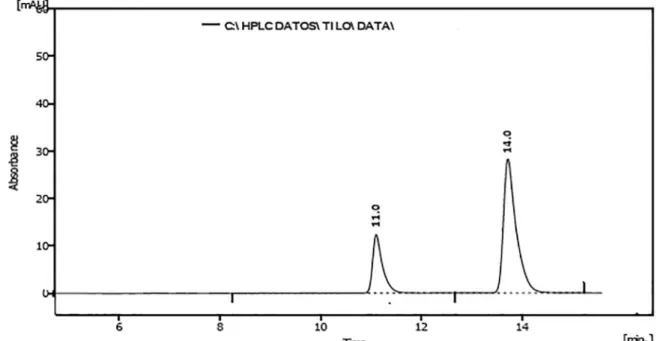
The chromatogram of standard mixture is shown in Figure 1. The retention time of coumarin and 7-hydroxycoumarin were 14,0 and 11,0 min, respectively. This result demonstrates that both components can be effectively separated by HPLC methods developed.
Specificity is the ability to assess unequivocally the analyte in the presence of components, which may be expected to be present. These might include impurities, degradants, and matrix, among others (ICH, 2005). The chromatograms of raw material, Tilo® tablets and placebo
are shown in Figure 2. Coumarin can be determined in raw material and Tilo® tablets, by means of the developed
method. One inspection of chromatograms of these samples (Figure 2a and 2b) showed the retention time
of coumarin at 14,0 min, similar to standard reference. There was not peak found at their retention time in the
placebo sample (Figure 2c). This result conirms that the
other components of the formulation do not interfere in the coumarin determination.
In NaOH 1 mol/L and 70 °C during 72 hours, a decrease was observed in the intensity of the peak corresponding to coumarin (retention time=14 min) in the chromatograms of the tablets. Peaks degradation was not observed (Figure 2d). Meanwhile, in 30% H2O2 solution
during 24 hours, a signiicant decrease of coumarin peak
and the appearance of a degradation peak corresponding to 7-hydroxycoumarin (retention time = 11 min) in the chromatograms of tablets were observed. Similar results were observed in the raw material samples.
The vast majority of the coumarins are oxygenated at C-7, 7-hydroxycoumarin is frequently considered to be the parent compound for the more structurally complex members of the family (Keating, O’Kennedy, 1997). Similar results were reported by Rodriguez et al. (2008b). In the rest of the treatments studied, changes in the chromatograms were not observed. The results of this study demonstrated that the method described is capable of simultaneously quantitating both components in Tilo® tablets.
The results of the precision study (analyst 1: 1,13 ± 0,023 (mean ± DS) and 1,92% (CV); analyst 2: 1,12 ± 0,014 (mean ± DS) and 1,27% (CV)) showed values
of coeficients of variation smaller than the established limits for chromatographic methods (< 2%) (ICH,
2005). The experimental value of Fisher test (Fexperimental = 2,319) was smaller than the theoretical Fisher test value (Ftheoretical = 3.18 from F9/9), and the experimental Student test value (texperimental = 0,432) was smaller than the
theoretical Student test value (ttheoretical = 2.10 from df = 18). The most important part of any analytical method validation is precision analysis. This is usually expressed
as the variance, standard deviation, or variation coeficient,
of a series of measurements (ICH, 2005). In this study, the
results showed that the values of the variations coeficient
agreed with the established limits for chromatographic methods, as well as the established criteria for the Fisher tests and Student test.
In the accuracy study, an equation of Y = 1.00X – 0.005 with a correlation coefficient of 0.998 for n = 15, was obtained in the recovery curve. The variations of the
coeficient values (0,78; 1,18; 1,39; 1,27 and 0,35% for
theoretical concentration of coumarin of 0,65; 0,98; 1,09; 1,20 and 1,42 mg, respectively) were smaller than the
established limits for chromatographic methods (< 2%).
The recovery percentages (99,2; 99,7; 100,6; 100,6 and 99,6% for theoretical concentration of coumarin of 0,65;
0,98; 1,09; 1,20 and 1,42 mg, respectively) were higher than 99%, and were among the 98 and 102%, acceptable limits in this analysis type (ICH, 2005). Comparative analyses with the mean recovery, and the 100% of the recovery by Student test, show that the experimental value (texperimental = 1,28) was smaller than the theoretical
value (ttheoretical = 2.13 from df = 15). Meanwhile, the test of the G of Cochran showed an experimental value (Gexperimental = 0.308) smaller than the theoretical G (Gtheoretical = 0.684 for p = 0.05, K = 5 and n = 3). These
results indicated an acceptable accuracy of the analytical method.
A regression equation of the calibrating curve: y=184547x - 93458, r=0,997 and r2= 0,994 (criteria of
acceptance r=0,99 and r2=0,98) was obtained. When
applying the test of Student, the experimental value (texperimental =1,94, p=0,263) for the intercept was obtained, while the proportionality test showed that the intercept
was not signiicant (texperimental=26,1, p=0,007) according
to the accepted criteria texperimental < ttheoretical (2,16 for n=15
and p=0,05 for intercept and t=high, p << 0,005 for
the proportionality). On the other hand, the variation
FIGURE 2 - Results of speciicity study (a: chromatogram of raw material sample; b: chromatogram of Tilo® tablets sample;
c: chromatogram of placebo sample; d: chromatogram of Tilo® tablets sample in NaOH 1 mol/L, 70 °C during 72 hours and e:
chromatogram of Tilo® tablets sample at 30% H
coeficient of the response factors (CVf) was of 2,94%,
which is smaller than the established limit of 5% (ICH, 2005).
In the range study, an equation of Y=1.05X - 0.05
with a correlation coeficient of 0.992 for n=9, was obtained in the recovery curve. The variations of coeficient values
(1,18; 1,39; and 1,27% for theoretical concentration of coumarin of 0,98; 1,09 and 1,20 mg, respectively) were smaller than the established limits for chromatographic
methods (<2%), and the recovery percentages (99,7; 100,6
and 100,6% for theoretical concentration of coumarin of 0,98; 1,09 and 1,20 mg, respectively) were higher to 99% and were among the 98 and 102%, acceptable limits in this analysis type (Rodríguez et al., 2008b). When being compared, the mean recovery and the 100% of the recovery by Student test, the experimental value (texperimental=2,08) was smaller than the theoretical value
(ttheoretical=2.26 from df=9). Meanwhile, the test of the G of Cochran showed an experimental value (Gexperimental=0.333)
smaller than the theoretical G (Gtheoretical=0.879 for p=0.05, K=3 and n=3). These results indicated an acceptable range of the analytical method.
Similar results were obtained in the studies of accuracy and range. The average percentage recovery was between the limit established for these assays. In both
cases, the value of the variations coeficient agreed with
the established limits for chromatographic methods. The linearity of an analytical procedure is the ability to obtain test results directly proportional to the concentration of analyte in the sample within a given range. The most common method used for demonstrating linearity is least squares regression. In this study, a regression equation of the calibrating curve that responds to the established acceptance criteria was obtained.
Summaryzing, the method described is rapid, lineal, accurate, reproducible, and capable of simultaneously quantitating coumarin and 7-hydroxycoumarin in Tilo® tablets. It can thus be used for the routine analysis of sample stability and the quality control of Tilo® tablets.
Stability study
Knowledge about the chemical and physical stability of a product is extremely important in drug development, because it will dictate the shelf life of the marketed product (ICH, 1996; ICH, 2003; Zhou et al., 2009; Waterman, Adami, 2005). The most common reactions observed in pharmaceuticals are hydrolysis, dehydration,
isomerization, oxidation, photodegradation, and speciic
interactions with formulation components (excipients and their impurities) (Narang et al., 2009).
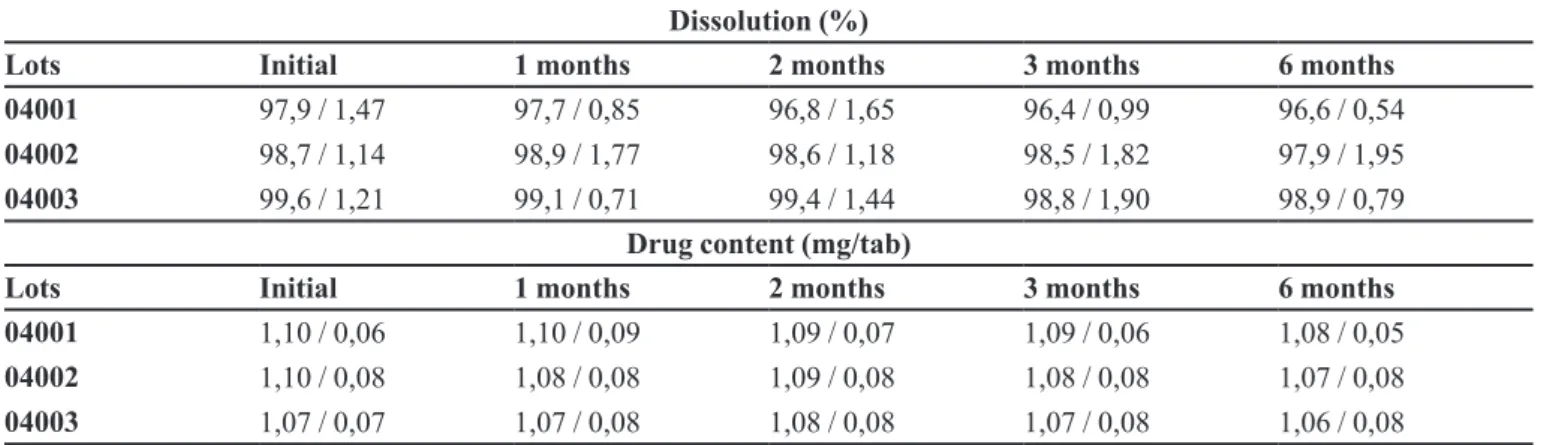
The results of accelerated stability study showed
after 6 months that the formulations satisied the quality
specifications in the container studied (Table I). A percentage of released drug higher than 90% (Not less
than 80% of the coumarin content quantiied in the sample.
in 60 minutes is an acceptable limit for this assay) and coumarin content superiors to 1,0 mg/tab (Not less than 0.70 mg/tab is an acceptable limit for this assay) during 6 months were obtained. These results demonstrate that the temperature does not affect the quality of the product under the conditions of this investigation.
Coumarin concentration suffers a slight increase after 90 days in photostability study (Table II). It is known that the ultraviolet light excites the coumarins, transforming the cis-form in the trans-isomer. Apparently, in the trans-isomer the hydrogen atom of the phenol group forms a chelate with the unsaturated carbon atom, giving
TABLE I - Analytic results of the lots under accelerated stability conditions
Dissolution (%)
Lots Initial 1 months 2 months 3 months 6 months
04001 97,9 / 1,47 97,7 / 0,85 96,8 / 1,65 96,4 / 0,99 96,6 / 0,54
04002 98,7 / 1,14 98,9 / 1,77 98,6 / 1,18 98,5 / 1,82 97,9 / 1,95
04003 99,6 / 1,21 99,1 / 0,71 99,4 / 1,44 98,8 / 1,90 98,9 / 0,79
Drug content (mg/tab)
Lots Initial 1 months 2 months 3 months 6 months
04001 1,10 / 0,06 1,10 / 0,09 1,09 / 0,07 1,09 / 0,06 1,08 / 0,05
04002 1,10 / 0,08 1,08 / 0,08 1,09 / 0,08 1,08 / 0,08 1,07 / 0,08
04003 1,07 / 0,07 1,07 / 0,08 1,08 / 0,08 1,07 / 0,08 1,06 / 0,08
TABLE II - Results of the study of photostability
Lots Dissolution (%) Drug content (mg/tab)
Initial 90 days Initial 90 days
04001 97,9 / 1,47 98,5 / 1,17 1,10 / 0,06 1,12 / 0,05
04002 98,7 / 1,14 98,9 / 1,02 1,10 / 0,08 1,13 / 0,02
04003 99,6 / 1,21 99,7 / 1,08 1,07 / 0,07 1,10 / 0,09
The results correspond to mean / DS the average of three determinations (n=3)
rise to a six-membered ring, which is the fluorophore.
These with UV light, increase the luorescence intensity
(Tan et al, 1976). In our opinion, this phenomenon can explain the results obtained in the photostability studies, where the isomeric is not separated by the analysis method with an increment of the peak intensity in the chromatogram to the wavelength used (Tan et al., 1976; Keating, O’Kennedy, 1997).
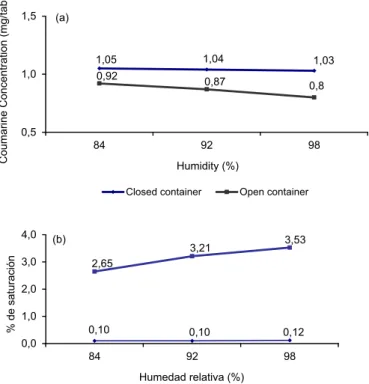
In the humidity study in open plastic container, a decrease of the coumarin content of 15,6, 19,9 and 26,6% for the 84, 92 and 98% of relative humidity observed from the initial value (Figure 3). A maximum of saturation of water absorption was reached to the 120 days under our conditions (2,65; 3,21 and 3,53% for the 84, 92 and 98% of relative humidity, respectively), being proportional
to the humidity conditions. In vitro dissolution studies, a coumarin concentration decrease with the increment of the concentration of relative humidity and a total disintegration of the tablets in the means, was observed (Figure 3). Significant changes in the organoleptic characteristic (doughy consistency and darker colour) and a retention time peak at 11 minutes, in the chromatogram, characteristic of the 7-hydroxycoumarin were detected (Rodríguez, Rodríguez, 2014).
In the humidity study in closed plastic container, an extreme behaviour as the previously described was not observed. Although, it also exists a decrease of the coumarin content of 3,4, 4,3 and 5,2% for the 84, 92 and 98% of relative humidity respectively, from the initial value (Figure 3). A maximum of saturation of water absorption was reached at the 180 days under our conditions (0,10; 0,10 and 0,12% for the 84, 92 and 98% of relative humidity, respectively). Contrary to the study
with open plastic container, signiicant changes in the
coumarin concentration and in vitro dissolution were not observed.
The coumarins are oxidized in presence of water, forming different oxygenated compounds. The most common is the umbelliferona (7-hydroxycoumarin), considered the compound structurally more complex of this family, and the biggest metabolite in the coumarin. The chemical is considered the main product of degradation of the simple coumarin (Keating, O’Kennedy, 1997).
The results of the study of humidity conirmed that the
active principle is affected with the formation of the 7-hydroxycoumarin.
Our studies demonstrated that the main factors that affect the tablets stability were the light and the relative humidity of the environment. Similar results were observed in studies with the raw material (Rodríguez et al, 2008a; Rodríguez et al, 2013). These aspects must be controlled during the elaboration and storage of the tablet formulations.
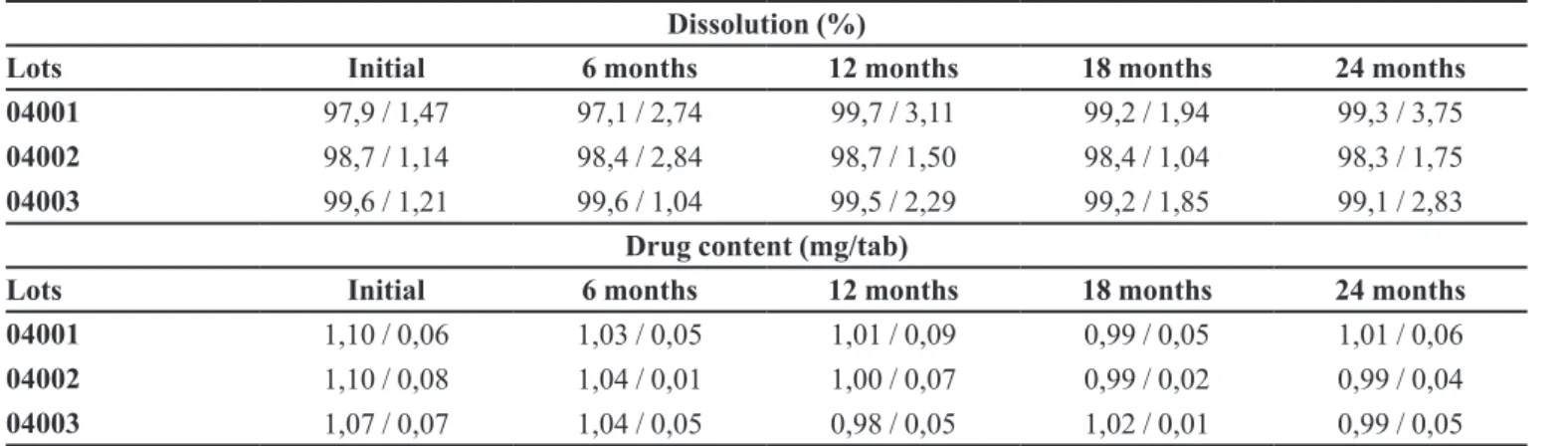
According to the long-term study, it was veriied that
the formulation showed high chemical stability during 24 months in the container studied (Table III).
1,05 1,04 1,03
0,92
0,87 0,8
0,5 1,0 1,5
84 92 98
Coumarine Concentration (mg/tab)
Humidity (%)
Closed container Open container
0,10 0,10 0,12
2,65
3,21 3,53
0,0 1,0 2,0 3,0 4,0
84 92 98
% de saturación
Humedad relativa (%)
Closed container Open container
(a)
(b)
Pharmacological studies
Reduced spontaneous locomotors activity in mice and rearing in a dose-dependent manner were observed in
the open ield activity study (Figures 4a and 4b). Usually,
the rodents show an exploratory behaviour when they are collocated in a novel place. However, if the animals are pre-treated with depressant drugs, the locomotors activity
decreases. Doses of 80 mg/kg of test compound showed similarity behaviour to diazepam 1 mg/kg (standard anxiolytic drugs). This result is typical of sedative drugs. Figure 4 (c and d) shows the effects of test compound on aggressive behaviour in isolated mice, test compound reduces an aggressive behaviour in a dose-dependent manner. A similar result to open field test between 80 mg/kg of dried powder and diazepam 1 mg/kg doses
a
b
c
d
b
0 5 10 15 20 25 30
CN CP 5 20 80
Number of rising (means)
Teatred groups (a)
(c)
(b)
(d)
0 month 12 months 24 months
a
b
c
d
b
0 10 20 30 40 50 60 70 80
NC PC 5 20 80
Biting attacks and wrestling
(mean)
Treated groups
0 month 12 months 24 months
a
b
b
b b
0 1 2 3 4 5 6 7 8
CN CP 5 20 80
Teatred groups Teatred groups
0 month 12 months 24 months
a
b
c
d
b
0 10 20 30 40 50 60 70 80 90 100
CN CP 5 20 80
T
ime of duration of dream (min)
T
ime of appearence (min)
0 month 12 months 24 months
FIGURE 4 - Pharmacological evaluation in the time. (a) Results of open ield activity in mice treated with Tilo® tablets; (b) Results
of aggressive study in mice treated with Tilo® tablets; (c) Effect of Tilo® tablets on Thiopental induced sleep in mice. Time of
appearance of dream induced and (d) Effect of Tilo® tablets on Thiopental induced sleep in mice. Time of duration of dream).
Similar letter no signiicant for p < 0.05.
TABLE III - Analytic results of the lots under long-term stability conditions
Dissolution (%)
Lots Initial 6 months 12 months 18 months 24 months
04001 97,9 / 1,47 97,1 / 2,74 99,7 / 3,11 99,2 / 1,94 99,3 / 3,75
04002 98,7 / 1,14 98,4 / 2,84 98,7 / 1,50 98,4 / 1,04 98,3 / 1,75
04003 99,6 / 1,21 99,6 / 1,04 99,5 / 2,29 99,2 / 1,85 99,1 / 2,83
Drug content (mg/tab)
Lots Initial 6 months 12 months 18 months 24 months
04001 1,10 / 0,06 1,03 / 0,05 1,01 / 0,09 0,99 / 0,05 1,01 / 0,06
04002 1,10 / 0,08 1,04 / 0,01 1,00 / 0,07 0,99 / 0,02 0,99 / 0,04
04003 1,07 / 0,07 1,04 / 0,05 0,98 / 0,05 1,02 / 0,01 0,99 / 0,05
was obtained. This behaviour was reported by Valzelli (1973) as a sign classic of central nervous system depressor.
The time of appearance of dream induced in animals treated with the different doses of Tilo ® tablets was
signiicantly smaller (p <0,05) than the obtained with the
animals of the group negative control. All test compound doses increased the number of sleeping animals compared with the control, doses of 20 and 80 mg/kg caused sleep in all animals. The behaviour to doses of 80 mg/kg and diazepam 1 mg/kg was similar in all animals.
Similar results were obtained in the studies to the 12 and 24 months in each assay.
Our results show an anti-aggressive behaviour in tablets-treated mice this result can be mediated by inhibitory effects on brain biogenic amines action, or excitatory neurotransmitter release and suggest the inhibitory effect on the central nervous system; this suggestion was strengthened by the increase in sleeping time in the test-compound treated groups in the control group in the model of thiopental-induced sleep. Similar results were observed during raw material studies and confirm the sedative effect of the Tilo® tablets
(Rodríguez et al., 2013). The pharmacological stability study demonstrated that the product maintains its pharmacological activity for 24 months.
CONCLUSIONS
The results evidenced the linearity, precision, specificity, accuracy, and range of the developed
method for the coumarin quantiication in Tilo® tablets.
The selected formulation showed good chemical and pharmacological stability, with optimum in vitro drug release during 24 months in the studied container, stored at 32 ± 2 °C, and protected from the humidity and light.
REFERENCES
ARCHER, J. Sex differences in the emotional behaviour of laboratory mice. Br. J. Psychol., v.68, n.1, p.125-131,1977.
FERNÁNDEZ, S.; WASOWSKI, C.; PALADINI, A.; MARDER, M. Synergistic interaction between hesperidin, a
natural lavonoid, and diazepam. Eur. J. Pharmacol., v.512, n.2-3, p.189-198, 2005.
INTERNATIONAL CONFERENCE ON HARMONISATION. ICH. Harmonised Tripartite Guideline. ICH Expert Working Group. Stability Testing of new drug substances and products Q1A(R2). London, 2003. p.24.
INTERNATIONAL CONFERENCE ON HARMONISATION. ICH. Harmonised Tripartite Guideline. ICH Expert Working Group. Stability Testing: Photostability Testing of New Drug Substances and Products. Q1B. London. 1996. p.12.
INTERNATIONAL CONFERENCE ON HARMONISATION. ICH. Harmonised Tripartite Guideline. ICH Expert Working Group. Validation of Analytical Procedures: Text and Methodology. Q 2 (R1). London. 2005. p.17.
KEATING, G.; O’KENNEDY, R. The chemistry and occurrence of coumarins. In: O’KENNEDY, R.; DOUGLAS, R.(Eds.).
Coumarins. Biology, applications and mode of action. London: John Wiley and Sons Ltd, 1997. chap.2, p.22-66.
LA SERNA, B.; AMOR, A.; MARTINEZ, M. Preliminary chemical characterization of Justicia pectoralis. Rev. Cubana Farm., v.23, n.3, p.256-264, 1989.
NARANG, A.; RAO, V.; RAGHAVAN, K. Excipient compatibility. In: OIU; Y. CHEN; Y. ZHANG; G. (Eds.
Developing solid oral dosage forms. Pharmaceutical theory and practice. New York: Elservier, 2009. cap.6, p.125-145.
PAZ, N.; RODRÍGUEZ, J. E.; LÓPEZ, O. D.; GONZÁLEZ, M.; GIL, J. M.; FUSTE, V.; NOGUEIRA, A. Technological development of a sedative medicine of natural origin from
Justicia pectoralis Jacq. Rev. Cubana Planta Med, v.16, n.3, p.227-235, 2011.
PINNA, G.; AGIS-BALBOA, R.C.; PIBIRI, F.; NELSON, M.; GUIDOTTI, A.; COSTA, E. Neurosteroid biosynthesis regulates sexually dimorphic fear and aggressive behavior in mice. Neurochem. Res., v.33, n.10, p.1990-2007, 2008.
RIVERO, R.; RODRÍGUEZ, J. E. Justicia pectoralis Jacq. Some aspects about the chemical composition, pharmacology and toxicology. Rev. Mex. Cien. Farm.,v.30, n.2, p.15-19, 2000.
RODRÍGUEZ, J. E.; LÓPEZ, O. D.; NÚÑEZ, Y.; RODRÍGUEZ, C. Obtention of pharmaceutical quality raw material from aqueous extractsof Justicia pectoralis Jacq. by spray dried.
Rev. Cubana Planta Med., v.18, n.4, p.543-554, 2013.
RODRÍGUEZ, J. E.; GIL, J. M. Dissolution Assay for Tilo®
tablets prepared with dry extract of Justicia pectoralis Jacq.
RODRÍGUEZ, J. E.; RODRÍGUEZ, C. Harvest time inluences
on coumarin and umbelliferone contents in extracts of Justicia pectoralis Jacq (Tilo). Rev. Cubana Farm., v.48, n.2, p.477-485, 2014.
RODRÍGUEZ, J. E.; LÓPEZ, O. D.; NÚÑEZ, Y.; RODRÍGUEZ, C.; CARRILLO, C.; GIL, J. M.; ECHEVARRIA, I. Obtention of Pharmaceutical Quality Raw Material from
Justicia pectoralis Jacq by Spray dried. Technology Development from a 30% Hydroalcoholic Extract. Lat. Am. J. Pharm., v.27, n.3, p.333-338, 2008a.
RODRÍGUEZ, J.E.; LÓPEZ, O.D.; GIL, J.M. Method for coumarin quantification in dry extracts from Justicia pectoralis Jacq. Rev. Cubana Planta Med., v.13, n.3, 2008b.
TAN, H.; RITSCHEL, W.; SANDERS, P. Determination of coumarin and umbelliferone mixture in whole blood by
spectrophotoluorometry. J. Pharm. Sci., v.65, n.1, p.30-33, 1976.
VA L Z E L L I , L . T h e i s o l a t i o n s í n d r o m e i n m i c e .
Psychopharmacology,v.31, p.305-320, 1973.
WALSH, R.N.; CUMMINS, R.A. The open-ield test: a critical
review. Psychol. Bull.,v.83, n.3, p.482-504, 1976.
WATERMAN, K.C.; ADAMI, R.C. Accelerated ageing: prediction of chemical stability of pharmaceuticals. Int. J. Pharm.,v.293, p.101-125, 2005.
ZHOU, D.; PORTER, W.; ZHANG, G. Drug Stability and Degradation Studies. In: OIU, Y.; CHEN, Y.; ZHANG, G. (Eds.). Developing solid oral dosage forms. Pharmaceutical theory and practice. New York: Elservier, 2009. chap.5, p.87-124.
Received for publication on 11th October 2013