Superluminal Hidden Communication as the Underlying Mechanism
for Quantum Correlations: Constraining Models
Valerio Scarani and Nicolas Gisin
Group of Applied Physics, University of Geneva; 20, rue de l’Ecole-de-M´edecine, CH-1211 Gen`eve 4 Received November 20, 2004
Since Bell’s theorem, it is known that quantum correlations cannot be described by local variables (LV) alone: if one does not want to abandon classical mechanisms for correlations, a superluminal form of communication among the particles must be postulated. A natural question is whether such a postulate would imply the possi-bility of superluminal signaling. Here we show that the assumption offinite-speedsuperluminal communication indeed leads to signaling when no LV are present, and more generally when only LV derivable from quantum statistics are allowed. When the most general LV are allowed, we prove in a specific case that the model can be made again consistent with relativity, but the question remains open in general.
I. INTRODUCTION
The quest for models underlying quantum mechanics (QM), i.e. structures out of which QM could ”emerge”, is an actual topic of research in the foundations of physics [1]. One of the features that these models are required to recover is the non-localityof the correlations of entangled particles. Since the work of Einstein, Podolski and Rosen in 1935 [2], in fact, it is known that QM predicts correlations between the outcomes of the measurements of entangled particles, at any distance. In a classical world, correlations can be due ei-ther to common information available in the preparation, or from the exchange of a signal. In 1964, John Bell proved [3] that common information at the preparation (the so-called lo-cal variables, LV) cannot reproduce the quantum-mechanical predictions: if one still wants to think classically, some ad-ditional communication is needed. Such a communication should propagate faster than light, because the choices of the measurement settings can be space-like separated events. A natural question arises then: can one not find a result ana-log to Bell’s theorem, that would rule out the possibility of superluminal communication(SC), thus fully vindicating the non-classical origin of quantum correlations? In particular, one may hope to show that a SC among the particles can-not be ”hidden”, that is, that any SC-model would break the no-signaling condition. But this is not true: if the speed of the SC is allowed to be infinite in a suitable preferred frame (or preferred foliation), and the amount of transferrable in-formation is not restricted, one has the most general exam-ple of non-local variables — actually this is Bohm’s view of his own model [4]. Such a model can be made to match any experimental prediction with no inconsistency: in partic-ular, it can reproduce QM, in which the no-signaling condi-tion holds. For other SC-models, however, consistency with the no-signaling condition becomes an important issue. For instance, the model proposed by Eberhard, that uses both SC and LV, allows signaling as demonstrated by the author him-self [5]; and so does the Bohm-Bub model [6]. A SC-model without LV in which the preferred frame is replaced by sev-eral meaningful frames associated with the experimental de-vices [7] was also shown to lead to signaling, even in the case of infinite speed [8]. In this paper, we consider a large class of SC-models, namely all those in which the SC is assumed
to propagate in the preferred frame withfinite speed[9]. Gen-eralizing a previous result [8], we prove that the no-signaling condition can be broken if LV are absent or are restricted to come from a quantum state, and present a study of the con-straints induced by the no-signaling condition in the presence of the most general LV [10].
II. THE SC-MODEL AND THE NO-SIGNALING CONSTRAINT
As mentioned in the introduction, let’s suppose that the ”re-ality” underlying quantum correlations consists of local vari-ables (LV) and superluminal communication (SC) with finite speed in a preferred frame (PF). In such a model, when parti-cle A is measured before partiparti-cle B in the PF, so that SC can go from A to B (that we write AÃB), one recovers the
pre-dictions of QM (quantum scenario); and the same is assumed for the reverse time-ordering, BÃA. We suppose moreover
that all quantum scenarios are equivalent: as soon as the SC can propagate from one particle to the other, a given source produces always the same statistics, compatible with a quan-tum stateρ. However, when two particles are measured al-most simultaneously in the PF, the SC cannot arrive from one particle to the other (A6!B). In particular, if in the quantum scenario the probabilities are those computed from the singlet state √1
2(|01i − |10i) and can thus violate Bell’s inequality, then, when A6!B, these probabilities must be modified in order to become compatible with LV (no Bell inequality vi-olation). Such a loss of non-locality may be testable in an experiment, provided the PF is identified and the sufficient si-multaneity is achieved [9]; however, as long as only two parti-cles are concerned, the no-signaling condition does not imply any constraint on the possible models [8]. Things are different if we considerthreeparticles A, B and C. LetP(a,b,c|A,B,C) be the statistics of a measurement, where smallxare the pos-sible outcomes of the measurementX. Whenever the SC can arrive on each link, e.g. AÃB, AÃC and BÃC, the particles
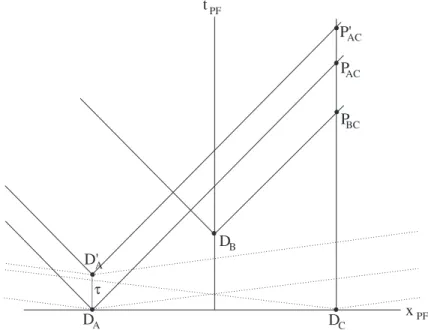
give statistics that can be derived from a quantum stateρABC (quantum scenario). Whenever a link is broken, e.g. when A6!C, departures from QM can be expected. In particular, a non-quantum scenario can be constructed in which:
xPF DA
PBC PAC P'AC
DC D'A
DB t
PF
τ
FIG. 1: Space-time diagram in the coordinates of the preferred frame (PF) illustrating the non-quantum scenario that leads to conditions (1) and (2). The dotsD’s are the detection events, the full diagonal lines are standard light cones (cones of classical information), the dotted lines are the ”superluminal communication cones”. See text for the explanation.
preferred frame, hence A6!C, hence their correlation can be due only to LV:
P(a,c|A,C)must come from LV. (1) Note that this probability cannot depend on the choice of the measurement on B, since this choice may be done later in time.
• Particle B is measured later, with a time delay sufficient to ensure AÃB and CÃB, but not sufficient to ensure
communication at the speed of light to arrive from A or C. It can be shown, see below, that the no-signaling condition requires
P(a,b|A,B,C) = PQM(a,b|A,B) P(b,c|A,B,C) = PQM(b,c|B,C)
¾
(2)
wherePQM are computed usingρABC, the state of the source in any quantum scenario.
It is not obvious that conditions (1) and (2) are consistent for any choice of the quantum state, and indeed this will be the main theme of the rest of the paper. Before that, for com-pleteness let us repeat the construction of the scenario, al-ready presented in Ref. [8]. The scenario is depicted in Fig. 1. The particles are at locations xA=−ℓ,xB=0 and xC= +ℓ. The dotsD’s in the space-time diagram are the de-tection events. The unprimed events define the non-quantum scenario: as we said,DAandDCare simultaneous and there-fore lie outside the SC-cones (dotted lines) of each other, whence condition (1). If A chooses to delay the measure-ment by a time τ, so that the detection of particle A is now D′A, the quantum scenario is recovered since CÃA, CÃB
and AÃB (follow the SC-cones). Now, classical information
aboutDBcan arrive at the location of C at the point labelled byPBC: then, P(b,c|A,B,C) can be estimated. But at that moment, classical information about A has not yet arrived, because it will arrive only inPAC or PAC′ . In particular, the no-signaling condition imposes thatP(b,c|A,B,C)cannot de-pend either on the measurement done on A or on whether that measurement was delayed or not. But if the measurement of A was delayed, we have the quantum scenario, so in partic-ularP(b,c|A,B,C) =PQM(b,c|B,C)as required in (1). The other part of (1),P(a,b|A,B,C) =PQM(a,b|A,B)can be de-rived by the symmetric argument, supposing that it is C that can delay the measurement (situation not shown in the figure, for clarity).
III. THE NEED FOR LOCAL VARIABLES
A first instructive step is taken by supposing that there are no LV at all, that is, all the correlations are due to SC. In this case, condition (1) is replaced by the stronger condition of independence:
P(a,c|A,B,C) = PQM(a|A)PQM(c|C) (3) where the marginals must be those of QM to avoid signaling. Now, it is very easy to see that this condition and condition (2) are incompatible. Consider a source that produces, in the quantum scenarios, the Greenberger-Horne-Zeilinger state of three qubits |GHZi=√1
2
¡
|000i+|111i¢
predictsP(a=c) =P(a6=c) =1
2. We have thus proved The-orem 1. In any model of superluminal communication with finite speed, the assumption that there are no local variables leads to signaling.In some sense, the result of this paragraph is the counterpart of Bell’s theorem for the SC-models that we consider: SC with finite speed cannot bealonethe cause of quantum correlations, some LV must be present as well. This was proved in [8]. In the next paragraph, we extend this re-sult by showing that a well-defined class of LV model is not enough to restore the no-signaling condition.
IV. THE NEED FOR NON-QUANTUM STATISTICS
We can go a step further and require thatP(a,b,c|A,B,C) can always be obtained from a quantum state. This would mean that, when we arrange a situation in which particles A and C do not communicate, the statistics are still described by a density matrix ˜ρABC such that the partial state ˜ρAC can be described by LV in order to satisfy (1). This extension is enough to remove signaling from the example of the GHZ state described just above: the LV statistics may be those of the quantum state ˜ρABC=12P000+12P111. However, moving to other quantum states we can demonstrate the following: The-orem 2. In any model of superluminal communication with finite speed, the requirement that P(a,b,c|A,B,C)can always be obtained from a quantum state leads to signaling. This follows from a result by Linden and Wootters [11] applied to our situation. At least two qubitsand one qutritare needed to work out this argument. Consider the state in C2⊗C3⊗C2
|Ψi = cosα|021i√+|120i
2 +sinα
|000i+|111i √
2 (4)
with 0<α<π2. The statistics of the sub-systems A-B and B-C are computed from the density matrices
ρAB=ρCB = 1
2|ψ1ihψ1|+ 1
2|ψ2ihψ2| (5) where |ψ1i=sinα|00i+cosα|12i and |ψ2i=sinα|11i+ cosα|02i. The statistics of the two qubits A-C is computed from
ρAC = cos2α|Ψ+ihΨ+|+ sin2α
2 (P00+P11) (6) with|Ψ+i=√1
2(|01i+|10i)and violates the Clauser-Horne-Shimony-Holt (CHSH) inequality for cos2α>√1
2 [12]. We want to show that|Ψiis the only quantum state of A-B-C, pure or mixed, compatible with the partial traces (5). Here is the proof. One starts fromρABgiven by (5): since|ψ1iand
|ψ2iare orthogonal, any purification ofρABcan be written
|Φi = √1
2
¡
|ψ1iAB|E1iCX+|ψ2iAB|E2iCX
¢
(7) withX an auxiliary mode andhE1|E2i=0. Then, using the Schmidt decomposition:
|E1iCX = c0|0iC|x10iX+c1|1iC|x11iX (8)
|E2iCX = d0|0iC|x20iX+d1|1iC|x21iX (9)
withhxk0|xk1i=0. The rest of the proof goes as follows: one inserts these expressions into|Φi, and then requires thatρBC is also given by (5). Specifically,ρBCshould span a space that is orthogonal to|01iBCand|10iBC. By direct inspection, for 0<α<π2, this forcesc1=d0=0, that in turn impliesc0= d1=1. Using this condition, one can further verify thatρBC can be obtained only ifhx10|x21i=1. All in all, this implies means that
|ΦiABCX = |ΨiABC|xiX : (10)
|ΨiABC is the only quantum state, pure or mixed, compati-ble with the quantum marginals (5). In particular then, fixing ρABandρBCas required by the no-signaling condition (2) im-plies thatP(a,c|A,B,C)is the statistics derived fromρAB. For cos2α>√1
2, this is non-local, in contradiction with the spirit of the model (1). In conclusion: if, in addition to conditions (1) and (2), we impose that the possible probabilities must still be describable within quantum physics, then we reach a contradiction. Thus, if one wants to invoke finite-speed su-perluminal communication to describe quantum correlations and, at the same time, avoid superluminal signaling between observers, the only hope left lies with local variables distrib-uted according tonon-quantumstatistics.
V. MOST GENERAL MODEL
The additional constraints that we imposed in the previous sections (no LV, then LV coming from a density matrix) are good working hypotheses, but rather artificial. If one is ready to allow a departure from quantum physics by assuming the finiteness of the ”speed of quantum information”, then one is also ready to accept the most general local variable mod-els to describe the situations where the information is not ar-rived. Can one still find a contradiction in this extended frame-work? That is, are conditions (1) and (2) definitely contradic-tory, without any further hypothesis? The answer is, we don’t know. What we do know, is that non-quantum local variables are enough to remove the contradiction pinpointed in the pre-vious section, based on the specific state (4). To prove this statement, the starting point is to have a convenient form for the probabilities. Since A and C give binary outcomes, we can label these outcomesa,c=±1. It is easy to be convinced that any probability distribution of two bits and another variable (here, the tritb) can be written as
P(a,b,c|M) = 1 4
h
FM(b) +a AM(b)
+cCM(b) +ac HM(b)
i
(11) whereM={A,B,C}labels the measurements and where the functions introduced here are submitted to the constraint that all probabilities must be positive and sum up to one. Note in particular that∑bFM(b) =1. In this notation, the correlation coefficient A-C is given by
E(ac|M) =
∑
bCondition (2) implies directly that FM,AM andCM must be those that can be computed in QM, and that the only freedom for an alternative model is left onHM. We have to estimate the constraints that are imposed onE(ac|M). For this, we fix once for all the measurements on the qubits. At first, we fix also the measurementBand its resultb. Any value ofHM is acceptable that satisfies the condition that all the probabilities are non-negative:
P(+,b,+) = FM+AM+CM+HM≥0 P(−,b,−) = FM−AM−CM+HM≥0
¾
(13) P(+,b,−) = FM+AM−CM−HM≥0
P(−,b,+) = FM−AM+CM−HM≥0
¾
(14)
From (13) we obtain the lower bound HM ≥ −FM(b) +
|AM(b) +CM(b)| ≡LM(b), from (14) the upper boundHM ≤ FM(b)− |AM(b)−CM(b)| ≡UM(b). In conclusion, forBand its outcome fixed, all the values ofHare possible that satisfy
LM(b)≤ HM(b) ≤UM(b). (15)
From this last equation, using (12), we can immediately derive the consequent constraint on the A-C correlations:
∑
b
LM(b)≡LM ≤E(ac|M)≤ UM≡
∑
bUM(b). (16)
Remember that the source is such thatE(ac|M)violates the CHSH inequality for suitable settings in the quantum sce-nario; our goal is to see whether the bounds we have just de-rived are tight enough to preserve the violation. Let Mi j=
{Ai,B,Cj}fori,j=1,2: the CHSH inequality reads|
B
| ≤2 whereB
= E(ac|M11) +E(ac|M12)+E(ac|M21)−E(ac|M22). (17)
The bounds (16) impose the following constraints:
B
≥L
≡L11+L12+L21−U22 (18)B
≤U
≡U11+U12+U21−L22 (19)whereLi j≡LMi j andUi j≡UMi j. Thus, the constraints
un-der study force the violation of CHSH if and only if there exist a family of four measurements {Mi j} such that either
L
>2 orU
<−2 holds. To check this for the state (4), we re-call that the functionsFM(b),AM(b)andCM(b)must be those predicted by QM. Specifically, let|bi=b0|0i+b1|1i+b2|2i the eigenstate of measurement B for the eigenvalueb; and the parametrization of the measurements on the two qubits be given in terms of the vectors in the Bloch sphere ˆnX = (θX,ϕX)forX =A,C. Then we computePQM(a,b,c|M) =¯
¯hanˆA,b,cnˆC|Ψi
¯ ¯
2
, write it down in the form (11) and thus find
FM(b) = cos2α|b2|2+ 1 2sin
2α(1
− |b2|2),
AM(b) = 1 2sin
2α
cosθA(|b0|2− |b1|2) +1
2sin 2αsinθARe
£
eiϕA(b
0b∗2+b2b∗1)
¤
,
CM(b) = 1 2sin
2α
cosθC(|b0|2− |b1|2) +1
2sin 2αsinθCRe
£
eiϕC(b
0b∗2+b2b∗1)
¤
The last step is to maximize
L
(respectively minimizeU
) over all possible families of four measurements{Mi j}. This is an optimization over fourteen real parameters: four for qubit A (θAi andϕAi for i=1,2), as much for qubit C (the analogones), and six for the qutrit B, the number of real parameters needed to define a basis, i.e. an element ofSU(3). We pro-grammed the optimization in Matlab. The result is that
L
is always clearly smaller than 2 for any value ofα. Specifically,¯
L
=max{M}L
starts at−4 forα=0, then increases to∼0.4 at the point cos2α=√12 where the quantum stateρABceases to violate the CHSH inequality, and finally reaches exactly 2 forα=π2, that is|Ψi=|GHZi. As intuitively expected,
U
behaves exactly in the symmetric way: ¯U
=min{M}U
starts at 4 forα=0 and decreases down to−2 forα=π2[13]. Let’s summarize: we have studied a state that is entirely determined by its ”quantum marginals”ρABandρBC if we want to stay within quantum mechanics. However, if we relax this require-ment, several non-quantum functions HM(b)become possi-ble — that quantum probabilities have much built-in struc-ture is evident e.g. from the fact thatHM(b)must be bilin-ear in the vectors ˆnAand ˆnCin the quantum case, while in the non-quantum caseHM(b)need not even be a continuous func-tion of these vectors. All this freedom is enough to break the uniqueness result that holds in the quantum case, so strongly, that also the non-locality of the marginal distribution A-C is destroyed. Thus, for the state (4) that we have considered and for the CHSH inequality, superluminal communication with finite speed does not lead to signaling when non-quantum lo-cal variables are allowed. It remains an open problem to deter-mine whether this conclusion holds in general, whatever the state and for any possible Bell-type inequality.VI. DISCUSSION
constraints discussed in this paper should contribute to inspire deeper models for ”emergent quantum mechanics”.
Acknowledgments
We acknowledge fruitful discussion on this topic with An-tonio Ac´ın, Lajos Di´osi, Sandu Popescu, Ben Toner and
Ste-fan Wolf.
[1] For some examples, see: S.L. Adler,Quantum Theory as an Emergent Phenomenon (Cambridge University Press, Cam-bridge, 2004); G. ’t Hooft, quant-ph/0212095; F. Markopoulou, L. Smolin, Phys. Rev. D70, 124029 (2004).
[2] A. Einstein, B. Podolski, and N. Rosen, Phys. Rev. 47, 777 (1935)
[3] J.S. Bell, Speakable and Unspeakable in Quantum Mechanics: Collected papers on quantum philosophy (Cambridge Univer-sity Press, Cambridge, 1987)
[4] D. Bohm, B.J. Hiley, The undivided universe (Routledge, New York, 1993)
[5] Ph. Eberhard, A Realistic Model for Quantum Theory with a Locality Property, in: W. Schommers (ed.), Quantum Theory and Pictures of Reality (Springer, Berlin, 1989)
[6] T. Durt, Helv. Phys. Acta72, 356 (1999)
[7] A. Suarez, V. Scarani, Phys. Lett. A232, 9 (1997). This model was also ruled out by experiment: H. Zbinden, J. Brendel, N. Gisin, and W. Tittel, Phys. Rev. A63, 022111 (2001); A. Ste-fanov, H. Zbinden, N. Gisin, and A. Suarez, Phys. Rev. Lett.88, 120404 (2002)
[8] V. Scarani, N. Gisin, Phys. Lett. A295, 167 (2002)
[9] Experimental lower bounds for this speed have been presented in: V. Scarani, W. Tittel, H. Zbinden, N. Gisin, Phys. Lett. A 276, 1 (2000)
[10] One might ask why the no-signaling condition should be en-forced if we assume a preferred frame for quantum phenomena. Indeed, there is no longer a fundamental reason for that require-ment. Still, classical events seem to be conveniently described using special relativity; and the record of a detection is a classi-cal events that can be precisely located in space-time.
[11] N. Linden, W.K. Wootters, Phys. Rev. Lett.89, 277906 (2002) [12] J.F. Clauser, M.A. Horne, A. Shimony, and R.A. Holt, Phys.
Rev. Lett. 23, 880 (1969). To compute the maximal viola-tion and the corresponding settings, see: R. Horodecki, P. Horodecki, M. Horodecki, Phys. Lett. A200, 340 (1995) [13] Obviously, although for some values of α it happens that