Article
Printed in Brazil - ©2016 Sociedade Brasileira de Química0103 - 5053 $6.00+0.00*e-mail: [email protected]
Nanocomposite of Poly(Lactic Acid)/Cellulose Nanocrystals: Effect of CNC Content
on the Polymer Crystallization Kinetics
Mauro Vestena,*,a,b Idejan P. Gross,a Carmen M. O. Müllerc and Alfredo T. N. Piresa
aGrupo de Estudo em Materias Poliméricos (POLIMAT), Departamento de Química, Universidade
Federal de Santa Catarina (UFSC), 88040-900 Florianópolis-SC, Brazil
bDepartamento Acadêmico de Química, Universidade Tecnológica Federal do Paraná (UTFPR),
Campus Pato Branco, 85503-390 Pato Branco-PR, Brazil
cDepartamento de Ciência e Tecnologia de Alimentos, Universidade Federal de Santa Catarina
(UFSC), 88034-001 Florianópolis-SC, Brazil
The barrier and mechanical properties of polymer matrices are affected by the polymer crystallization kinetics and the incorporation of nanoparticles can modify the nucleation density as well as the rate and mechanism of crystallization. In this study, a nanocomposite of poly(lactic acid) (PLA) containing cellulose nanocrystals (CNC) was prepared in order to evaluate the effect of the CNC content on the crystallization kinetics of the polymer matrix. Dimethylformamide, a solvent of PLA, was used to replace the aqueous medium for the dispersion of the CNC, to facilitate the preparation of PLA films with dispersed CNC. Higher levels of CNC in the films induced an increase in the crystallization rate and reduced the degree of crystallinity without affecting the dimensions of the crystal lattice. In conclusion, the incorporation of CNC into PLA influences the crystallization kinetics, which significantly affects the PLA processing conditions.
Keywords: cellulose nanocrystals, poly(lactic acid), crystallization kinetics, nanocomposites
Introduction
Particles with nanometric dimensions, such as carbon nanotubes, nanoclays and cellulose nanocrystals (CNC), have been used as reinforcing materials in polymer matrices. The addition of such particles alters the physicochemical characteristics of the matrix, which are related to specific properties associated with these materials.1 The polymer
crystallization kinetics, for example, can be enhanced by adding nanoparticles, which also influences the crystalline morphology and rheological behavior.2
CNC are crystalline domains isolated from lignocellulosic fibers that are composed of cellulosic microfibrils surrounded by lignin and hemicellulose. A bleaching process is therefore required to remove the non-cellulosic components of the lignocellulosic fibers, followed by acid hydrolysis to isolate the CNC. These nanomaterials are of particular importance, considering that cellulose is one of the most abundant renewable resources and a biodegradable polymer.1,3,4
In this context, environmental concerns have led to an increase in studies using biopolymer matrices, such as poly(lactic acid) (PLA), a linear aliphatic biodegradable polymer, derived from renewable resources. It can be produced by polycondensation from lactic acid or the ring-opening polymerization of lactides (cyclic dimer of lactic acid), resulting in low or high molar weight, respectively. The presence of a stereocenter in the PLA repeating unit results in the optically active enantiomers poly(L-lactic acid) (PLLA) and poly(D-lactic acid)
(PDLA), or optically inactive poly(D,L-lactic acid)
(PDLLA), as well as a racemic mixture.1,5
PLLA can be crystallized in an α (orthorhombic),
β (orthorhombic) or γ (pseudo-orthorhombic) system, and the α-structure is more stable.6 Commercial-grade PLA is
made up of L-lactide and D,L-lactide copolymers.5,7,8
non-biodegradable polymers.8,9 The barrier and mechanical
properties can be affected by polymer crystallization kinetics, through the incorporation of nanoparticles that modify the nucleation density, and the rate and mechanism associated with the crystallization.10,11
Mathew and Dufresne12 studied the crystallinity of
plasticized starch films with sorbitol and reported an increase in the crystallinity of the films when they incorporated CNC. They attributed this behavior to an anchoring effect of the CNC, which act as nucleating agents for starch and favor the crystallization process. Anglés and Dufresne13
reported that composite films of starch/CNC presented the phenomenon of transcrystallization, which consists of the preferential crystallization of amorphous polymeric chains during cooling at the surface of the CNC. Samir et al.14
studied the crystallization of poly(oxyethylene) films with the incorporation of CNC and observed that increasing the CNC content resulted in a decrease in the average diameter of the spherulites, due to a change in the nucleation rate. In a previous study, Samir et al.15 observed that the presence
of CNC within the polymeric matrix does not affect the spherulitic growth rate of poly(oxyethylene) during its crystallization. In agreement with other studies, Yu et al.16
evaluated poly(3-hydroxybutyrate-co-3-hydroxyvalerate
(PHBV)/CNC nanocomposites and observed a decrease in the degree of crystallinity with an increase in the CNC content, due to strong intermolecular hydrogen bonding interactions associated with the dispersion of the CNC in the PHBV matrix. Similar studies on the PLA matrix have demonstrated the influence of CNC on the PLA crystallization, leading to an improvement in the nanocomposite mechanical properties,17 with a reduction
in the water and oxygen permeability.18-20 The mechanical
reinforcement of the nanocomposite is a consequence of different effects, such as the CNC distribution in the matrix, intrinsic CNC characteristics (shape, aspect ratio) and the crystallization process. The reduction in the gas and vapor water permeability may be associated with decreased diffusion due to the presence of the CNC which increases of the tortuous path of the diffusing components.4
One approach to evaluating the crystallization process is to consider the isothermal crystallization kinetics, which can be described by the Avrami model. The Avrami model describes the uncrystallized polymer mass fraction as a function of time and determines the crystallization rate and the Avrami parameter, which correlates with the growth dimensions and the crystallization mechanism. Kamal and Khoshkava21 studied PLA/CNC nanocomposites, applying
a previous process, such as spray drying, freeze drying or spray freeze drying, to obtain the CNC suspensions. These processes modify the size and porosity of CNC
agglomerates, and consequently affect the dispersion in the polymer matrix. Higher values for the crystallization rate, nucleation density and lower spherulite dimension were observed with porous and smaller agglomerates of CNC. In this context, the evaluation of the nanocomposite crystallization process is a field of study of considerable interest, since it is dependent on the polymer matrix and the nanoparticles incorporated.
Considering that the CNC were isolated in an aqueous medium, their incorporation into a hydrophobic polymer, such as PLA, is not favorable. Several strategies have been used to try and achieve the dispersion of CNC in hydrophobic matrices, e.g., adding surfactants, CNC surface modification, polymer grafting and solvent exchange dispersion. The best dispersion of CNC in a polyhydroxybutyrate (PHB) matrix has been observed for solvent exchange dispersion (water to acetone and acetone to chloroform) using centrifugation processes.9,16,17,22-26
In this context, the aim of this study was to evaluate the effect of the presence of CNC isolated from sugarcane bagasse after solvent exchange (water to dimethylformamide) on the isothermal crystallization kinetics of PLA.
Experimental
Materials
Sugarcane bagasse, provided by regional ethanol producers (São Paulo, Brazil), was washed, dried and milled to yield particles that passed through a 30 mesh sieve. Poly(lactic acid) was purchased from NatureWorks LLC, Cargill under the brand name Ingeo 3251D. Sulfuric acid and sodium hydroxide were purchased from Lafan Química Fina and dimethylformamide (DMF) was supplied by Nuclear. All chemical reagents were used without further purification.
Cellulose nanocrystals (CNC)
Initially, the particulates of sugarcane bagasse (smaller than 30 mesh) were maintained in a 5% aqueous solution of NaOH (1:20 m/v fiber/solution) at 85 oC for 90 min, under
mechanical stirring. In the next step, the dispersion was filtered and the fibers washed until neutral pH and dried. The fibers were then ground and maintained in an aqueous solution of 5% NaOH and 11% H2O2 (1:20 m/v), at 55 oC
for 90 min, and the dispersion was filtered and the fibers washed until neutral pH and dried. Acid hydrolysis was carried out at 55 oC for 30 min with 60 wt.% H
2SO4 under
(five times the volume of the reaction mixture) at room temperature to stop the reaction, and after centrifugation the supernatant was removed. Distilled water was then added to the sediment, which was suspended under mechanical stirring, and the suspension was centrifuged until the appearance of the cloud point. This suspension of CNC was collected and treated using dialysis bags at neutral pH. The CNC dispersion medium was changed from water to DMF, in order to solubilize the PLA. DMF was added to the aqueous suspension of CNC and the water eliminated through vacuum distillation, since the boiling point of DMF is greater than the boiling point of water.
Transmission electron microscopy (TEM)
Transmission electron microscopy analysis of the CNC was carried out using a JEOL-1011 TEM electron microscope operating at 80 kV. One drop (0.002 g mL-1)
of the suspension of CNC was diluted in 2 mL of isopropyl alcohol and deposited on a grid coated with FORMVAR®
film and after being almost dried it was stained by adding one drop (ca. 4 µL) of 3% uranyl acetate (m/v). The excess liquid was removed and this was followed by drying at room temperature. To evaluate the length and width, five images and one hundred nanoparticles were considered and the ImageJ software was used (values reported are average).
Films of PLA/CNC
PLA was dissolved in the DMF suspension of CNC, at compositions of 99/1, 97/3 and 95/5 (m/m). In this procedure the PLA was added to the suspension of CNC in DMF and the heating system maintained the temperature above 70 oC, for the polymer solubilization. The dispersion
of PLA and CNC in DMF was transferred to Petri dishes and maintained at 120 oC for solvent evaporation to obtain
thin films.
Isothermal crystallization kinetics and X-ray diffraction
The use of differential scanning calorimetry (DSC) has been found to be suitable for investigating the crystallization kinetics and in this study a Shimadzu DSC-50 instrument was used. All experiments were performed under nitrogen gas flow (50 mL min-1). The samples were heated from
room temperature up to 200 oC, at a rate of 20 oC min-1, and
maintained at this temperature for 5 min to allow complete melting of the crystalline domains. The temperature was then decreased and the samples were kept at 130 oC to
evaluate the exothermic heat involved in the crystallization process. Based on the crystallization enthalpy, the degree
of crystallization was obtained (equation 1) from the DSC curve, where Xc∞ is the degree of crystallization of the
samples, ∆Hc is the crystallization enthalpy of the PLA in
the sample, which is equal to the melting enthalpy of PLA (∆Hm), ∆Hm0 is the melting enthalpy of 100% crystalline
PLA and is equal to 93 J g-1,7 and f
PLA is the weight fraction
of PLA in the nanocomposite.
0 m c
m PLA H X
H f
∞ ∆
= ∆
(1)
From the crystallization enthalpy as a function of time determined from the DSC isotherm curve, based on the heat evolved in the crystallization process at different time intervals, the degree of crystallization, denoted by
Xct, can be evaluated and the isothermal crystallization
kinetics data were fitted according to the Avrami equation (equation 2), where Xt denotes the crystallized fraction of
PLA as a function of time t, and K and n are the Avrami
kinetic parameters:
–( )
1– n t
Kt c
t c X
X e
X∞
= = (2)
Polarized optical microscopy was used to investigate the size, morphology and characteristics of spherulite crystals during the crystallization process. The nanocomposites were cast between two glass slides and the physical characteristics of each sample were observed under crossed polarization using a Motic SMZ-168-BL microscope, with a data acquisition system (TCS pro500) and the software VMS 3.6.
X-Ray patterns of the specimens were obtained on a Philips X’Pert diffractometer, with Cu Kα radiation
(λ = 1.5418 Å), operating at room temperature, 30 mA and 40 kV. The scanned region of 2 to 60o (2θ) and a
pitch of 0.05o s-1 were applied to evaluate the influence of
the CNC in the PLA unit cell. Samples of neat PLA and PLA/CNC with different percentages of the components in the composition were melted at 200 oC and maintained
at 130 oC for 60 min.
Results and Discussion
Suspensions of CNC in water and in DMF
Solvent exchange is an interesting process since it avoids the drying step and consequent agglomeration of the CNC. Other processes have been described in the literature to maintain the stability of the suspension, such as CNC surface modification or the addition of surfactants, which increases the complexity and cost of the process.22-27
The process used to change solvent through vacuum distillation, evaluated in this study, was found to be an efficient approach to changing the CNC suspension medium and preventing the agglomeration of CNC in the non-aqueous suspension. It was possible to obtain stable suspensions of CNC in DMF with 0.013 g mL-1 and in
aqueous medium with 0.018 g mL-1, as determined by the
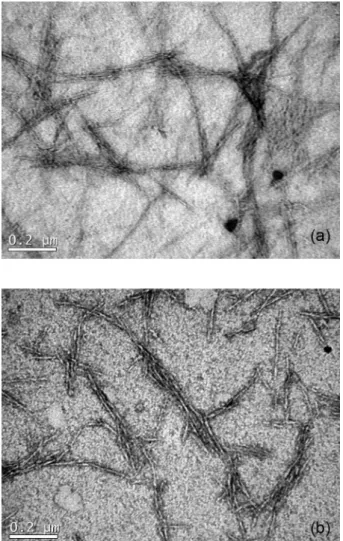
gravimetric method. The morphology and dimensions of the CNC were evaluated through transmission electron microscopy. Figure 1 shows the TEM micrographs of the CNC dispersed in water and in DMF, where similar dispersions without CNC agglomeration can be observed, suggesting that nanocomposites with a hydrophobic polymer matrix could be obtained. The CNC, with a rod-like aspect, had an average length of 230 ± 53 nm (L),
average diameter of 10 ± 4 nm, and aspect ratio (L / D) of 23. These values are in agreement with others reported in the literature. For CNC isolated from bagasse sugarcane, Teixeira et al.28 obtained average values for the length
and diameter of 255 ± 55 and 8 ± 3 nm, respectively, while Mandal and Chakrabarty29 reported a shorter length
(170 nm) and larger diameter (35 nm) compared with the values obtained in this study.
Neat PLA and PLA/CNC nanocomposites
The DSC curves (Figure 2a) obtained at constant temperature (130 oC) show the PLA crystallization peaks
for neat PLA and PLA/CNC nanocomposites. In Figure 2a it can also be observed that the time required to reach the maximum crystallization rate decreases as the CNC content increases, which suggests that the CNC can act in the crystallization kinetics. From the experimental data supplied by the DSC curves we can obtain the Xtvs. time
curves, which were fitted using the Avrami equation (Figure 2b), in order to obtain the kinetic parameters (K and n), which are shown in Table 1.
Figure 1. TEM micrographs of CNC dispersed in (a) water and (b) DMF.
0 100 200 300 400 500 600 700 0.0
0.5 1.0 1.5
e
x
o
PLA/CNC 5%
PLA/CNC 3%
Neat PLA
Heat
flow /(mW mg
)
-1
time / s
time / s PLA/CNC 1% (a)
0 200 400 600 800
0.0 0.2 0.4 0.6 0.8 1.0
PLA/CNC 5% PLA/CNC 3%
PLA/CNC 1% Neat PLA
Experimental data Avrami curve
Xt
(b)
The K parameter has a physical meaning and expresses
the rate of the crystallization process as a function of the nucleation and growth rate. A significant increase in the K parameter was observed when the CNC content
increased and the data indicate that only an increase in the CNC accelerates the crystallization process. Based on this result it is not possible to affirm whether the CNC are more effective as a nucleating agent or if they have an effect on the growth rate. The Avrami exponent n is dependent on
the nucleation mechanism or growth dimensions,30 and
according to Wunderlich31 and Wenig et al.,32 a decrease
in the exponent n by a value of one may be associated with
a change from thermal to athermal nucleation. A decrease
in the n parameter may reflect a change in the nucleation
mechanism to athermal heterogeneous nucleation.33
Intermediate n values may be associated with a combination
of mechanisms, since heterogeneous nucleation becomes more or less frequent with an increase in the heterogeneous nuclei, i.e., as the CNC content increases, up to saturation (above 3% m/m CNC), after which changes in the exponent n were not observed. To verify whether the
presence of CNC accelerates the crystallization process only through a nucleation effect, optical microscopy with polarized light (Figure 3) was performed under the same isothermal crystallization kinetics conditions, in order to evaluate the growth of spherulite crystals in the different components of the composition.
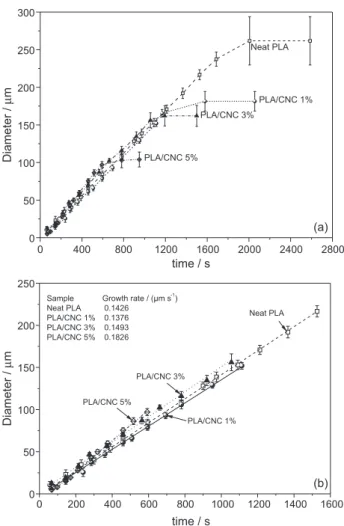
The diameters of the spherulites were measured and plotted vs. time (Figure 4a). Based on the linear
section of the curve, before impingement (Figure 4b) it is possible to determine the growth rate. No significant change was observed in the growth rate of the spherulites and the difference between the slopes for the PLA and PLA/CNC nanocomposites is within the standard deviation of the spherulite size, in agreement with results for poly(oxyethylene) (POE)/CNC reported by Samir et al.15
The Avrami K parameter is dependent on the growth and
nucleation rate. As observed through experimental data, the presence of CNC has no significant effect on the growth rate
Table 1. Avrami parameters and degree of crystallinity percentage for isothermal crystallization kinetics of PLA and PLA/CNC nanocomposites
Sample K × 103 / s-1 n X
c
∞ / %
Neat PLA 1.95 2.70 74
PLA/CNC 1% 2.84 2.51 71
PLA/CNC 3% 3.75 2.34 60
PLA/CNC 5% 4.31 2.34 57
K: Avrami parameter; n: Avrami exponent; Xc∞: degree of crystallization;
PLA: poly(lactic acid); CNC: cellulose nanocrystals.
and this observation is associated with an increase in the number of crystallization nuclei, as can be seen in Figure 3, suggesting that the increase in the rate of crystallization is only associated with the effect of the CNC on the nucleation of PLA crystals.
The degrees of cyrstallinity obtained using equation 1 (reported in Table 1) show that there is a decrease in crystallinity with increasing CNC content. An increase in the content of CNC in the PLA matrix has a direct influence on the number of crystallization nuclei (Figure 3), which causes the impingement of spherulites to occur earlier and this affects the final size of the spherulite crystals. The number of spherulites per volume of polymer increases
as the CNC content increases, which results in an increase in the volume of the spherulite border and, therefore, in a higher relative amount of the amorphous fraction, as shown in Table 1, where a reduction in the degree of crystallinity with increasing CNC content can be observed.
Figure 5 shows the XRD patterns for the PLA and films of PLA/CNC with 1, 3 and 5% of CNC, prepared
isothermally at 130 oC. It can be observed that the same set
of 2θ angles of 12.5, 14.8, 16.8, 19.1 and 22.3o appears for
all samples, which are related to the families of crystalline planes: (103), (100), (110)/(200), (203) and (015), in agreement with results reported by other authors.34-36 This
provides evidence of the presence of a single α phase
with the same lattice parameters characteristic of the orthorhombic unit cell, for all CNC contents investigated in this study.
Conclusions
The CNC isolated in this study had the dimensions and morphological characteristics of nanometric structures. The CNC can act as PLA nucleating agents, affecting the density of nucleation, thus decreasing the final size of the spherulites as well as the rate of crystallization and degree of crystallinity of the PLA. However, no significant effect of the presence of CNC on the growth rate of the PLA spherulites was observed. In addition, the presence of CNC did not affect the lattice parameters of the PLA crystals at the CNC contents investigated in this study.
Acknowledgments
The authors are grateful for the financial support provided by CAPES and CNPq and also for the characterization by transmission electron microscopy performed by LCME-UFSC.
References
1. Reddy, M. M.; Vivekanandhan, S.; Misra, M.; Bhatia, S. K.; Mohanty, A. K.; Prog. Polym. Sci.2013, 38, 1653.
0 4 8 12 16 20 24 28 32
(150) (203) (100) (103)
(110)/(200)
2 / degreeθ
Neat PLA PLA/CNC 1% PLA/CNC 3% PLA/CNC 5%
Intensity / a.u.
Figure 5. X-Ray diffraction patterns for samples of neat PLA and
PLA/CNC nanocomposites with 1, 3 and 5% (m/m) CNC, after isothermal crystallization at 130 oC.
0 400 800 1200 1600 2000 2400 2800 0
50 100 150 200 250 300
(a) PLA/CNC 3%
PLA/CNC 5%
PLA/CNC 1%
Diameter /
m
µ
Diameter /
m
µ
time / s
time / s
Neat PLA
0 200 400 600 800 1000 1200 1400 1600 0
50 100 150 200 250
Sample Growth rate / (µm s-1
) Neat PLA 0.1426 PLA/CNC 1% 0.1376 PLA/CNC 3% 0.1493 PLA/CNC 5% 0.1826
(b) Neat PLA
PLA/CNC 1% PLA/CNC 3%
PLA/CNC 5%
Figure 4. (a) Diameter of spherulites in neat PLA and PLA/CNC
2. Refaa, Z.; Boutaous, M.; Rousset, F.; Fulchiron, R.; Zinet, M.; Xin, S.; Bourgin, P.; AIP Conf. Proc. 2014, 1593, 342. 3. Habibi, Y.; Lucia, L. A.; Rojas, O. J.; Chem. Rev.2010, 110,
3479.
4. Moon, R. J.; Martini, A.; Nairn, J.; Simonsen, J.; Younblood, J.; Chem. Soc. Rev. 2011, 40, 3941.
5. Auras, R.; Harte, B.; Selke, S.; Macromol. Biosci.2004, 4, 835. 6. Hoogsteen, W.; Postema, A. R.; Pennings, A. J.; Brinke, G.;
Macromolecules 1990, 23, 634.
7. Garlotta, D. A.; J. Polym. Environ.2001, 9, 63. 8. Gupta, A. P.; Kumar, V.; Eur. Polym. J.2007, 43, 4053. 9. Petersson, L.; Kvien, I.; Oksman, K.; Compos. Sci. Technol.
2007, 67, 2535.
10. Suryanegara, L.; Nakagaito, A. N.; Yano, H.; Compos. Sci. Technol. 2009, 69, 1187.
11. Sanchez-Garcia, M. D.; Lagaron, J. M.; Cellulose2010, 17, 987.
12. Mathew, A. P.; Dufresne, A.; Biomacromolecules2002, 3, 609. 13. Anglés, N. M.; Dufresne, A.; Macromolecules2000, 33, 8433. 14. Samir, M. A. S. A.; Chazeau, L.; Alloin, F.; Cavaillé, J. Y.;
Dufresne, A.; Sanchez, J. Y.; Electrochim. Acta2005, 50, 3897. 15. Samir, M. A. S. A.; Chazeau, L.; Alloin, F.; Sanchez, J. Y.;
Dufresne, A.; Polymer2004, 45, 4149.
16. Yu, H. Y.; Qin, Z. Y.; Liu, Y. N.; Carbohydr. Polym.2012, 89, 971.
17. Camarero-Espinosa, S.; Boday, D. J.; Weder, C.; Foster, E. J.; J. Appl. Polym. Sci.2015, 132, 41607.
18. Sanchez-Garcia, M. D.; Lagaron, J. M.; Cellulose2010, 17, 987.
19. Petersson, L.; Oksman, K.; Compos. Sci. Technol. 2006, 66, 2187.
20. Fukuzumi, H.; Saito, T.; Wata, T.; Kumamoto Y.; Isogai, A.; Biomacromolecules2009, 10, 162.
21. Kamal, M. R.; Khoshkava, V.; Carbohydr. Polym. 2015, 123, 105.
22. Bondeson, D.; Oksman, K.; Compos. Interfaces2007, 4, 617. 23. Kim, D. Y.; Nishiyama, Y.; Kuga, S.; Cellulose2002, 9, 361. 24. Araki, J.; Wada, M.; Kuga, S.; Langmuir2001, 17, 21. 25. Pracella, M.; Haque, M. U.; Puglia, D.; Polymer2014, 55, 3720. 26. Oksman, K.; Mathew, A. P.; Bondeson, D.; Kvien, I.; Compos.
Sci. Technol. 2006, 66, 2776.
27. Samir, M. A. S. A.; Alloin, F.; Sanchez, J. Y.; El Kissi, N.; Dufresne, A.; Macromolecules2004, 37, 1386.
28. Teixeira, E. M.; Bondancia, T. J.; Teodoro, K. B. R.; Corrêa, A. C.; Marconcini, J. M.; Mattoso, L. H. C.; Ind. Crops Prod.
2011, 33, 63.
29. Mandal, A.; Chakrabarty, D.; Carbohydr. Polym. 2011, 86, 1291. 30. Ozawa, T.; Polymer1971, 12, 150.
31. Wunderlich, B.; Macromolecular Physics, vol. 2; Academic Press: New York, 1976.
32. Wenig, W. H.; Fiedel, W.; Scholl, A.; Colloid Polym. Sci.1990,
268, 528.
33. Cebe, P.; Hsiao, B. H. In Polymeric Materials Encyclopedia, vol. 8; Salamone, J. C., ed.; CRC Press: Boca Raton, 1996, pp. 6185.
34. Pan, P.; Liang, Z.; Zhu, B.; Dong, T.; Inoue, Y.; Macromolecules
2009, 42, 3374.
35. Lai, W. C.; J. Phys. Chem. B2011, 115, 11029.
36. Xu, T.; Zhang, A.; Zhao, Y.; Han, Z.; Xue, L.; Polym. Test. 2015,
45, 101.
Submitted: August 6, 2015