From the Division of Surgery of the Digestive Tract, Department of Gastroenterology, Hospital das Clínicas, Faculty of Medicine, University of São Paulo – São Paulo/SP, Brazil.
Received for publication on December 02, 2002.
ORIGINAL ARTICLE
LAPAROSCOPIC
VERSUS OPEN SPLENECTOMY IN
THE MANAGEMENT OF HEMATOLOGIC DISEASES
Manuela V. Sapucahy, Joel Faintuch, Cláudio J.C. Bresciani, Pedro L. Bertevello, Angelita Habr-Gama and Joaquim José Gama-Rodrigues
SAPUCAHY MV et al. - Laparoscopic versus open splenectomy in the management of hematologic diseases. Rev. Hosp. Clín. Fac. Med. S. Paulo 58 (5):243-249, 2003.
Splenectomy is the best available treatment for severe forms of hereditary spherocytosis, idiopathic thrombocytopenic purpura, and other hematologic conditions when these prove refractory to conservative management. It has been employed for many decades with low mortality and favorable remission rates.
The use of laparoscopic splenectomy in recent years has been rapidly and even enthusiastically adopted in this field. However, the exact role of laparoscopic versus open surgery for hematologic diseases is still debated. In this study of 58 adult patients, laparoscopic procedures were compared with conventional splenectomies for similar indications.
METHODS: All patients were operated on within an 8-year period. Subjects underwent similar procedures under the supervision of the same surgical school and were compared regarding age, gender, body mass index, and diagnosis. Laparoscopically managed cases (Group I, n = 30) were prospectively followed according to a written protocol, whereas the same investigation was retrospectively done with regard to traditional laparotomy (Group II, n = 28).
Methods included general and demographic findings, duration and technical steps of operation, blood loss, weight of spleen, need for conversion (in minimally invasive subjects), intraoperative and postoperative complications, time until realimentation, postoperative hospitalization, mortality, and late follow-up including recurrence rate.
RESULTS: Idiopathic thrombocytopenic purpura was the surgical indication in over 50% of the patients in both groups, but familial spherocytosis, thalassemia, myelodysplasia, and lymphomas were also represented in this series. Laparoscopic procedures took more time to perform (P = 0.004), and postoperative hospitalization was 2 days shorter, but this difference was not statistically significant. Postoperative hematocrit and volume of blood transfusions was equivalent, although the laparoscopic cases had a somewhat lower preoperative hematocrit (NS) and displayed better recovery for this measurement (P = 0.03). More patients in Group I were able to accept oral food on the first day than subjects undergoing conventional operations (P < 0.05). Relatively few conversions were necessary during the minimally invasive surgeries (13.3%), and postoperative early and late complications as well as recurrences occurred in similar proportions. Also, the mean weight of the spleen was not statistically different between the groups, although there was a marked numerical tendency toward larger masses in conventional procedures. No spleen in Group I exceeded 2.0 kg, whereas in Group II values up to 4.0 kg occurred, and the mean weight was 50% higher in the latter group.
CONCLUSIONS: 1) Minimally invasive splenectomy was essentially comparable to open surgery with regard to safety, efficacy, and late results; 2) Advantages concerning shorter postoperative hospitalization could not be shown, despite earlier food intake and a non-significant tendency toward earlier discharge; 3) This new modality should be considered an option in cases of hematologic conditions whenever the spleen is not hugely enlarged.
DESCRIPTORS: Splenectomy. Laparoscopic operation. Hereditary spherocytosis. Idiopathic thrombocytopenic purpura. Hematologic disease.
Modern laparoscopic surgery was introduced by Mouret who, in 1987, removed a diseased gallbladder in Lyon, France employing the instru-ments of a fellow gynecologist1. A few
months later Dubois2,3 in Paris not
whole new specialty would be an-nounced, with video-laparoscopy, spe-cial instruments, insufflators and light sources, and successful followers in virtually all continents4.
The advantages of reduced trauma, less postoperative pain, earlier hospi-tal discharge, and superior esthetic re-sults were not overlooked by other sur-gical branches, and soon the laparos-copic method found supporters in urol-ogy, pediatric surgery, thoracic and cardiovascular surgery, plastic surgery, endocrinologic surgery, bariatric sur-gery, orthopedics, and other areas.
Within the abdomen, not only hol-low viscera but also solid organs were approached by this minimally invasive method, and the spleen was not to be an exception. As early as in 1993, au-thors such as Flowers5 and Lefor et al.6,7
were applying the new technique for benign and malignant splenic condi-tions.
Since the spleen is the major site for blood cell destruction both in physiologic and pathologic circum-stances, splenectomy has been proved useful for severe aplastic, autoimmune, and cryptogenic anemia; thrombocy-topenia or neutropenia; hypersplen-ism; bone marrow dysfunction; and miscellaneous hematologic diseases that do not adequately respond to
phar-macological management8. These
in-clude congenital spherocytosis, idi-opathic thrombocytopenic purpura, autoimmune hemolytic anemia, major thalassemia, idiopathic neutropenia, myelodysplasia, hypersplenism, Hodgkin´s lymphoma, Gaucher´s dis-ease, and splenic sarcoidosis5-9.
In spite of multiple potential indi-cations, the initial experience with laparoscopic splenectomy was usually focused on idiopathic thrombocyto-penic purpura because the spleen is not considerably enlarged in this circum-stance9.
Indeed, voluminous spleens may pose a challenge to minimally invasive
procedures because of increased chances of hemorrhage and need for conversion to the open approach. These challenges stem from technical difficul-ties in dissecting enlarged splenic ves-sels, intrinsic bleeding tendencies linked to low thrombocyte counts, or possible coagulation factor deficits, and occsional focal infarctions that produce adhesions and anatomical distortions. Nevertheless, well-trained teams have demonstrated the feasibility of remov-ing even massive organs when the tech-nique is carefully employed10.
Of course, laparoscopic splenec-tomy may be used for trauma, cysts, aneurisms of the splenic artery, benign or malignant tumors, and other nonhematologic situations. Experi-ence with small children is also grow-ing, but these are out of the scope of this study11.
The current series aims to retro-spectively compare indications, re-sults, and complications of laparoscopic splenectomy exclusively in adolescents and adults suffering from hematologic diseases, employing as controls a similar population under-going open surgery within an 8-year period (November 1993 to June 2001).
PATIENTS AND METHODS
Clinical charts from 3 hospitals (n= 120) were reviewed for criteria of in-clusion and exin-clusion, of which 58 were adequate. All patients had been operated on in accordance with the principles and routines and under the supervision of our Division, and most of the laparoscopic procedures were performed by the first author (67%).
Criteria for inclusion:
Age >13 years, males or females Confirmed hematologic diagnosis Unresponsive to pharmacological therapy
Elective procedure
Criteria for exclusion:
Splenectomy for portal hypertension Splenectomy during gastric cancer surgery
Splenectomy due to trauma or other nonhematologic diseases
Re-operations because of accessory spleen
Procedures carried out by external teams
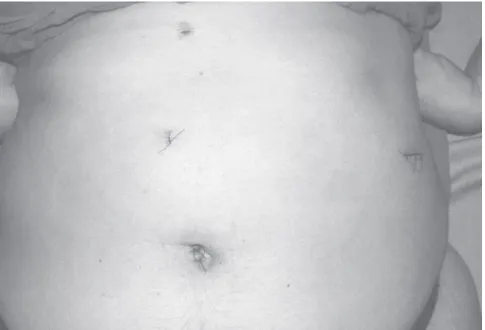
Surgical technique: Laparoscopic operations employed 4 (70% of the pa-tients) or 5 trocars (30.0% of the group) via the transperitoneal route (Fig. 1), and as soon as the gastrocolic ligament was opened, preliminary ligature of the splenic artery was carried out. A plastic bag was employed to protect the ab-dominal cavity from implants, to per-mit cutting or slicing of larger organs and to enable the surgeon to easily and safely retrieve the splenic mass.
Open splenectomy was equally performed via the peritoneal cavity adopting the initial ligature of the splenic artery. Vascular ligatures and dissections were done from the lower pole upwards, after the omental cavity was exposed. In both modalities, ac-cessory spleens were carefully located and removed, and external drainage was an option, depending on the lo-cal conditions.
Methods: Variables included clini-cal and demographic information, sur-gical findings (operative time and need for blood transfusions, weight of the spleen, drainage and other technical maneuvers), time to postoperative food intake, preoperative and postop-erative hematologic profile, immediate and late complications, and recurrence of the disease.
Randomization: No randomization could be applied, since this was a ba-sically retrospective study and all op-erations had been performed already.
Statistical analysis: Discrete meas-urements were compared by means of a chi-square analysis and Fisher’s ex-act test, whereas quantitative variables were first submitted to variance and normality assessment using Levene as well as Kolmogorov-Smirnov tests. Actual differences were estimated by Student’s t test or Mann-Whitney test as appropriate. A significance limit of 5% (P <0.05) was adopted.
Preliminary findings: The age in both groups was similar (40.6 ± 18.5 vs. 38.6 ± 17.5, NS), females were the ma-jority in both contexts (19/30 vs. 20/28, NS), and body mass index was compa-rable (24.8 ± 3.2 vs. 25.7 ± 5.2 kg/m2,
NS). Idiopathic thrombocytopenic pur-pura was the most common entity in both groups (17/30 vs. 17/28, NS), followed by familial spherocytosis, hemolytic anemia, myelodysplasia, lymphoma, and miscellaneous conditions.
In addition to splenectomy, hepatic biopsy (3/30 vs. 6/28, NS) and chole-cystectomy (5/30 vs. 6/28, NS) were simultaneously performed in this se-ries. All patients received antipneu-mococcus vaccine in the preoperative period.
RESULTS
Laparoscopic procedures took longer than standard splenectomy (261
± 83 vs. 184 ± 71 minutes, P =
0.0004). Hospital stay was numerically shorter in Group I (5.1 ± 2.4 vs. 7.1 ± 8.1 days), but statistical confirmation was not obtained. In a few cases, pre-liminary ligature of the splenic artery was not performed by the surgeon (8/ 30 vs. 3/28, NS), whereas drains were more often utilized in the minimally invasive procedure than in open sur-gery (15/30 vs. 4/28, P = 0.009).
The mean weight of the spleen was 40% smaller in Group I than II (478 ± 489 vs. 789 ± 1072 g), and maximum weight was also quite different (2000 vs. 3980 g), but statistical difference
could not be demonstrated. On the other hand, the laparoscopic route was as efficient as the conventional ap-proach for identifying and eliminating accessory spleens (5/30 vs. 2/28, NS).
In 4 patients, conversion to open surgery was required (13.3%). Two of these were secondary to persistent hemorrhage; a third case had firm ad-hesions between the spleen and the diaphragm due to previous infarction and displayed heart arrhythmia when-ever maneuvers to free the organ were attempted; and 1 subject exhibited strongly adherent and confluent lymph nodes and areas of fibrosis surround-ing the hilar vessels of the spleen, thus preventing dissection of this area by the laparoscopic method.
The most frequent intraoperative complication in both groups was bleeding, and comparable numbers of patients in both populations required blood transfusions (12/30 vs. 7/28, NS). Minor laceration of the stomach was seen in an open case, and was im-mediately repaired, and a minor skin burn due to leak of current from the laparoscopic cautery was identified in Group I, without differences in total intraoperative complications between the populations (8/30 vs. 2/28, NS). Again, early postoperative (up to hos-pital discharge) and late complications occurred in equivalent proportions (re-spectively 7/30 vs. 12/28, NS and 3/ 30 vs. 7/28, NS).
Serious early complications in Group I were represented by 1 episode of bleeding through the drain that re-quired re-operation and 1 death on the 2nd postoperative day in a 63 year-old-male due to necroscopically con-firmed myocardial infarction. In Group II subjects, 3 re-operations were nec-essary, 1 due to bleeding with hemorrhagic shock, another connected to a subphrenic abscess, and the last one because of abdominal dehiscence and evisceration.
Significant late complications in a
laparoscopically managed patient in-cluded 1 wound abscess that was drained on the outpatient visit, and 3 incisional hernias occurred in cases managed by conventional surgery.
The laparoscopic procedure permit-ted earlier food intake by the patients (77% accepted food on the first post-operative day, versus 43% in the con-trol group, P =0.05). Also recovery of hematocrit values was more effective in the laparoscopic group (P = 0.033), whereas no differences were observed in platelet counts. Within the average fol-low-up period of 2 years, hematologic recurrences were uncommon in both groups (4/30 vs. 3/28, NS).
DISCUSSION
Not many new concepts in medi-cine are truly paradigmatic, and few have been recognized as more practi-cal in recent years than the laparos-copic method of performing surgery. Laparoscopic surgery clearly passes the test of great innovations, which is the criterion of before and after. In-deed, few people would question that modern surgical treatment can be clas-sified as before and after the advent of laparoscopic procedures.
This change was surely record-set-ting regarding elapsed time between first attempts and definitive interna-tional acceptance. No more than a cou-ple of years separated the pioneering reports of the French precursors1,2 and
the widespread adoption of the tech-nique by multiple specialties and countless services and countries. With regard to laparoscopic splenectomy, a similar phenomenon occurred: the first 2 reports appeared between 1991 and 199212,13, and in 199814 the new
mo-dality was already praised as the “gold standard” for surgical management of the spleen in benign hematologic dis-eases whenever the organ is not much enlarged.
In spite of the enthusiasm of the authors mentioned above14, this is a
complex subject, and it is likely that for some years to come the optimal al-ternative for performing splenectomy in certain circumstances will still be debated.
Baccarani et al.15 reviewed 104
pa-pers published between 1989 and 1998, many of which compared open versus laparoscopic splenectomy. In-terestingly, none of the studies was prospective, with most of them using nonrandomized controls as in the present experience. Among these in-vestigations, 41 fulfilled the criteria of inclusion, representing over 600 lapa-roscopic splenectomies. The principal advantages of the new option were ear-lier restoration of gastrointestinal func-tion and shorter hospital stay.
Klingler et al.16 attempted a
simi-lar collective review of 21 reports, of which 6 were comparative. Neverthe-less, definitive conclusions were hard to come by, since the size of the spleen was not homogeneous among laparos-copic and conventional groups. Simi-larly to the current investigation, most surgeons preferred the open approach for very large spleens and laparoscopic route for smaller ones.
In the present protocol, great care was directed toward homogenization of the 2 series, and they were certainly comparable with regard to biodemo-graphic features, hematologic diagno-sis, and general surgical management. A limit in size of a laparoscopically re-movable spleen was not adopted, as suggested by Poulin & Thibault17,
namely of up to 20 cm length or 1 kg. These precautions notwithstanding, a tendency toward clustering of the big-ger spleens in Group II occurred, with greater amounts of preoperative throm-bocytopenia in this population.
Surgical maneuvers and allied care were as similar as possible for the 2 modalities, including general tech-nique, vaccine use, preliminary
liga-ture of the splenic artery, and blood transfusions. However, a discrepancy was noted with regard to drainage, which was more frequent in the lapa-roscopic group.
Operative time was expected to be longer for the laparoscopic approach, and that was really the case. A few words are required to explain the ac-tual duration numbers, which ex-ceeded those published in other se-ries15,16 for both open and minimally
invasive routes. The longer duration times were surely due to the participa-tion in all operaparticipa-tions of junior resi-dents, as well as to the fact that sev-eral of the laparoscopic procedures were done at a time when this tech-nique was still new in the service, thus coinciding with the learning curve of the hospital team.
No clear pattern was noted concern-ing the amount of blood loss or volume of transfusions required, and interpreta-tion of these values are clouded any-way by circumstances such as size of the spleen, technical difficulties during operation, and the baseline coagulation status of the patient. In accordance with a number of authors18-20, no differences
were detected between the groups. It is worthwhile to emphasize that hema-tocrit values recovered more effectively after laparoscopy, thus suggesting less operative hemorrhage than in the open modality.
General morbidity and mortality are usually reported as worse when laparotomy instead of laparoscopy is utilized19-21, but statistical confirmation
is not always achieved. In the current series, no statistical difference could be demonstrated when these variables were examined. One highly relevant pitfall is the need for conversion to open surgery, and in this experience, conversion was required in 13.3% of the operations. That is a larger propor-tion than has been reported by some authors16 but is perfectly compatible
Several of these investigations in-dicate both earlier refeeding and ear-lier hospital discharge when laparos-copic resection is provided16,18,19, but
in the current study, only the former advantage was evident. It is expected that minimally invasive surgery should elicit a more modest neuroendocrine response and also less postoperative ileus, thus explaining rapid restoration of gastrointestinal function, and this was clearly the case in this series. On the other hand, postoperative hospi-talization is usually linked to general morbidity. Since morbidity was equiv-alent in both situations, the same out-come should be anticipated for time until discharge.
Accessory spleens and recurrences failed to display any differences be-tween the groups. These are poten-tially important findings, since video-laparoscopy has been suspected as less effective in the search and identifica-tion of accessory spleens16.
Unrecog-nized splenic tissue is a cause for con-cern and may explain early recurrence of the hematologic disease, but
fortu-nately, all analyzed procedures were equally successful in this regard.
Since the first laparoscopic sple-nectomy performed in Brazil in 199323,
few reports have been published in this country24-27. However, a
question-naire was submitted to practicing laparoscopists by the Brazilian Soci-ety of Laparoscopic Surgery28 polling
the results of 408 procedures. Yet it is difficult to compare our results with these findings, since they were not sys-tematic investigations, and the ques-tionnaire was responded to by a non-representative sample of Brazilian pro-fessionals.
In any case, they bear witness to the growing interest in this modality and to the rapid increase in the number of laparoscopic splenectomies performed in this country. It is not unreasonable to foresee that technical obstacles that were listed here will progressively di-minish in the future, thus rendering video-laparoscopy an even more ap-pealing option in the treatment of chronic hematologic diseases.
CONCLUSIONS
1) Laparoscopic procedures were indicated for smaller spleens with less affected platelet counts;
2) Hematocrit recovery suggested less blood loss during video-laparos-copy, although these operations took longer to perform;
3) Laparoscopically managed pa-tients accepted food earlier, but mor-bidity, mortality, and duration of hos-pitalization were similar in both groups;
4) Laparoscopic procedures were as effective as open procedures in the re-moval of accessory spleens and pre-vention of postoperative recurrence;
5) Conversion to laparotomy was required in 13% of the laparoscopic procedures; however, the final outcome of the patients was not adversely af-fected by this change;
6) It can be affirmed that the lapa-roscopic splenectomy is a valid and safe option for the treatment of chronic hematologic conditions whenever the spleen is not massively enlarged.
RESUMO
SAPUCAHY MV e col. - Esplenec-tomia laparoscópica versus aberta no tratamento de doenças
hema-tológicas. Rev. Hosp. Clín. Fac.
Med. S. Paulo 58 (5):243-249, 2003.
A esplenectomia é o melhor trata-mento disponível para formas graves de esferocitose hereditária, púrpura trombocitopênica idiopática e outras entidades hematológicas refratárias à abordagem conservadora. Ela tem sido empregada há muitas décadas com baixa mortalidade e taxas de remissão favoráveis.
A alternativa de esplenectomia laparoscópica em anos recentes foi adotada rapidamente e até
entusiasti-camente, todavia o papel exato das in-tervenções abertas em contraposição às laparoscópicas para doenças hemato-lógicas ainda é objeto de debate. Num estudo de 58 pacientes adultos, os pro-cedimentos laparoscópicos foram com-parados com as esplenectomias con-vencionais em indicações semelhantes.
MÉTODOS: Todos os pacientes foram operados num período de 8 anos. Eles foram submetidos a opera-ções análogas sob a supervisão da mes-ma escola cirúrgica e eram compará-veis no tocante a idade, sexo, índice de massa corporal e diagnóstico. Os casos abordados laparoscopicamente (Grupo I, n= 30) foram seguidos prospectivamente de acordo com pro-tocolo escrito, ao passo que a mesma
investigação foi aplicada retrospecti-vamente no que concerne aos doentes de esplenectomia aberta (Grupo II, n= 28).
Os métodos incluíram achados ge-rais e demográficos, duração e passos técnicos da cirurgia, perda sangüínea, peso do baço, necessidade de conver-são (nos casos minimamente invasi-vos), complicações intra e pós-opera-tórias, tempo para realimentação, hospitalização pós-operatória, mortali-dade e seguimento tardio, incluindo recidivas.
mielodisplasia e linfomas também es-tavam representados nesta série. As in-tervenções laparoscópicas demoraram mais (p=0,004) e sua hospitalização pós-operatória foi dois dias mais bre-ve, porém esta diferença não foi esta-tisticamente significativa. O hema-tócrito pós-operatório e o volume de transfusões foram equivalentes, no en-tanto os casos laparoscópicos exibiam um hematócrito pré-operatório ligeira-mente inferior (NS) e a recuperação desta variável foi melhor (p=0,03).
Mais pacientes do Grupo I tolera-ram dieta oral no primeiro dia que ca-sos abordados convencionalmente (p<0,05). Relativamente poucas
con-versões foram necessárias no decurso das laparoscopias (13,3%), e as com-plicações pós-operatórias precoces e tardias assim como as recidivas distri-buíram-se de forma eqüitativa. Tam-bém não foi possível demonstrar-se di-ferenças no peso do baço, ainda que no Grupo I nenhum órgão excedesse a 2,0 kg, sendo que no Grupo II este va-lor chegou até 4,0 kg, notando-se ain-da que o peso médio foi 50% mais ele-vado nesta última população.
CONCLUSÕES: 1) A esplenec-tomia minimamente invasiva foi essen-cialmente comparável à variante aber-ta no tocante à segurança, eficácia e resultados tardios; 2) Não foi possível
comprovar-se vantagens relativas à menor hospitalização pós-operatória, embora a realimentação fosse mais pre-coce e houvesse uma tendência não-significativa para alta hospitalar ante-cipada; 3) Esta nova modalidade deve ser considerada uma excelente opção para casos de moléstias hematológicas sempre que o baço não estiver forte-mente aumentado.
DESCRITORES: Esplenectomia.
Operação laparoscópica. Esferoci-tose hereditária. Púrpura trombo-citopênica idiopática. Doença hema-tológica.
REFERENCES
1 . MOURET P – From the first laparoscopic cholecystectomy to the frontiers of laparoscopic surgery: the future perspectives. Dig Surg 1991; 8:124.
2 . DUBOIS F, BERTHELOT G, LEVARD H – Cholécystectomie par coelioscopie. Presse Med 1989; 18:980-982.
3 . DUBOIS F, ICARD P, BERTHELOT G et al. – Coelioscopic cholecystectomy. Preliminary report of 36 cases. Ann Surg 1990; 211:60-62.
4 . FILIPI CJ, FITZGIBBONS JR, SALERNO GM – Historical review: diagnostic laparoscopic cholecystectomy and beyond. In: ZUCKER KA – Surgical Laparoscopy. St. Louis, Missouri, Quality Medical Publishing, 1991. p. 3-21.
5 . FLOWERS JL – Laparoscopic splenectomy. In: ZUCKER KA – Surgical Laparoscopy Update. 2nd ed. St. Louis, Missouri,
Quality Medical Publishing, 1993. p. 357-371.
6 . LEFOR AT, FLOWERS JL, HEYMAN MR – Laparoscopic staging of Hodgkin’s disease. Surg Oncol 1993; 2(3):217-220. 7 . LEFOR AT, MELVIN WS, BAILEY RW et al. – Laparoscopic
splenectomy in the management of immune thrombocytopenia purpura. Surgery 1993; 114(3):613-618.
8 . KATKHOUDA N, MAVOR E – Laparoscopic splenectomy. Surg Clin North Am 2000; 80(4):1285-1297.
9 . FRIEDMAN RL, FALLAS MJ, CARROLL BJ et al. – Laparoscopic splenectomy for ITP. The gold standard. Surg Endosc 1996; 10(10):991-995.
10. TARGARONA EM, ESPERT JJ, BALAGUE C et al. – Splenomegaly should not be considered a contraindication for laparoscopic splenectomy. Ann Surg 1998; 228(1):35-41
11. GIGOT JF, DE VILLE DE GOYET J, VAN BEERS BE et al. -Laparoscopic splenectomy in adults and children: experience with 31 patients. Surgery 1996; 119(4):384-389.
12. DELAITRE B, MAIGNIEN B – Splenectomy by the coelioscopic approach. Report of a case [Letter]. Presse Med 1991; 20:2263. 13. CARROLL BJ, PHILLIPS EH, SEMEL CJ et al. – Laparoscopic
splenectomy. Surg Endosc 1992; 6(4):183-185.
14. GIGOT JF, LENGELE B, GIANELLO P et al. – Present status of laparoscopic splenectomy for hematologic diseases: certitudes and unresolved issues. Semin Laparosc Surg 1998; 5 (3):147-167.
15. BACCARANI U, DONINI A, TERROSU G et al. - Laparoscopic splenectomy for haematological diseases: review of current concepts and opinions. Eur J Surg 1999; 165(10):917-923. 16. KLINGLER PJ, TSIOTOS GG, GLASER KS et al. - Laparoscopic splenectomy: evolution and current status. Surg Laparosc Endosc 1999; 9(1):1-8.
17. POULIN EC, THIBAULT C - Laparoscopic splenectomy for massive splenomegaly: operative technique and case report. Can J Surg 1995; 38(1):69-72.
18. REGE RV, MERRIAM LT, JOEHL RJ - Laparoscopic splenectomy. Surg Clin North Am 1996; 76(3):459-468.
19. GLASGOW RE, YEE LF, MULVIHILL SJ - Laparoscopic splenectomy: the emerging standard. Surg Endosc 1997; 11:108-112.
21. TARGARONA EM, ESPERT JJ, BOMBUY E et al. – Complications of laparoscopic splenectomy. Arch Surg 2000; 135 (10):1137-1140.
22. DELAITRE B, CHAMPAULT G, BARRAT C et al. - Laparoscopic splenectomy for hematologic diseases. Study of 275 cases. French Society of Laparoscopic Surgery. Ann Chir 2000; 125(6):522-529.
23. GAMA-RODRIGUES JJ, BRESCIANI CJC - Esplenectomia associada à colecistectomia e exploração das vias biliares pelo método vídeo-laparoscópico. [Vídeo-livre apresentado no I Seminário Nacional de Cirurgia Laparoscópica da Sociedade Brasileira de Cirurgia Laparoscópica –SOBRACIL]. Porto Alegre / RS, de 22 à 24 de abril de 1993.
24. NOGUEIRA MVF, HIDD BE, SABOYA SOBRINHO CJ et al. -Esplenectomia laparoscópica. Rev Col Bras Cir 1994; 21(5):278-281.
25. NOGUEIRA MVF, AZEVEDO JCS, TEIXEIRA CAB et al. -Terceira esplenectomia para recidiva de púrpura trombocito-pênica imunológica por vídeolaparoscopia. Rev Cirurg Vídeoendoscópica 1995; 2(1):32-35.
26. MARTINS FP, RESENDE AP, GUERRA FILHO V et al. -Esplenectomia laparoscópica. Rev Cient SOBRACIL 1998; 2:19-23.
27. BRANDALISE NA, ARANHA NC - A esplenectomia e a colecistectomia por vídeo-laparoscopia no tratamento da esferocitose congênita. Rev Cient SOBRACIL 1998; 3:1-5. 28. NOGUEIRA MVF et al. - Inquérito Nacional sobre Esplenectomia