250
REV. HOSP. CLÍN. FAC. MED. S. PAULO 58(5):250-253, 2003
From the Human Reproduction Unit, Albert Einstein Jewich Hospital - São Paulo/SP, Brazil.
Received for publication on February 04, 2003.
SPERM TAIL FLEXIBILITY TEST: A SIMPLE TEST FOR
SELECTING VIABLE SPERMATOZOA FOR
INTRACYTOPLASMIC SPERM INJECTION FROM
SEMEN SAMPLES WITHOUT MOTILE
SPERMATOZOA
Jonathas Borges Soares, Sidney Glina, Nelson Antunes Jr, Roberta Wonchockier, Andrea Giannotti Galuppo and Françoise Elia Mizrahi
SOARES JB et al. – Sperm tail flexibility test: a simple test for selecting viable spermatozoa for intracytoplasmic sperm injection from semen samples without motile spermatozoa. Rev. Hosp. Clín. Fac. Med. S. Paulo 58(5):250-253, 2003.
PURPOSE: The objective was to describe the results of the injection of immotile spermatozoa with flexible tails when only immotile spermatozoa are present in the semen sample.
METHODS: A retrospective study was conducted to analyze the procedure results for 10 couples who participated in our intracytoplasmic sperm injection program. The sperm tail was considered flexible when it moved up and down independently of the head movement, and it was considered inflexible when the movement occurred together (tail plus head). The fertilization and pregnancy rate were analyzed.
RESULTS: The normal fertilization rate (presence of 2 pronuclei) was 30.3% (40/132), and the abnormal fertilization rate (presence of less than or more than 2 pronuclei) was 6.81% (9/132). A total of 52 embryos were obtained with 9 transfer procedures performed (pregnancy rate: 11.12%).
CONCLUSIONS: The sperm tail flexibility test (STFT) is an easy and cost-effective way for selecting viable immotile spermatozoa and can be used as an alternative method for determining the viability of spermatozoa. This test seems to be a simple and risk-free method when compared to the swelling test.
DESCRIPTORS: Intracytoplasmic sperm injection. Sperm. Flexible tail. Immotile sperm. Swelling test.
Even involving oligozoospermic or azoospermic men, intracytoplasmic sperm injection (ICSI) has produced acceptable fertilization and pregnancy rates. Palermo et al. (1995) obtained a fertilization rate of 63.9% and a preg-nancy rate of 37% when the ICSI pro-cedure was used as with couples in which the men presented severe male factor including a small number of motile sperm retrieved from the testis or epididymis1,2. It has been observed
that the conventional seminal param-eters have no influence in the results of ICSI procedures, except when only immotile spermatozoa are available3.
However, the use of live immotile sper-matozoa leads to the possibility of fer-tilization, which does not happen when dead spermatozoa are injected.
Thus, it is crucial to differentiate live immotile spermatozoa from dead spermatozoa when only immotile sper-matozoa are available. The most com-monly used test with this purpose is the swelling test4. However the
swell-ing test, used as a test to determine cell viability, is still controversial. There is evidence that this test is not totally re-liable for predicting sperm viability and that the standardized solutions used can be harmful to the spermato-zoa5,6.
251
REV. HOSP. CLÍN. FAC. MED. S. PAULO 58(5):250-253, 2003 Sperm tail flexibility test
Soares JB et al.
The aim of this work is to describe the results of 10 ICSI cycles for which the injection of exclusively immotile spermatozoa with flexible tails was performed.
METHODS
Among 1283 cycles in which ICSI done from January 1997 to October 2001, in 10 cycles the men presented samples containing only immotile spermatozoa, as follows: 4 were azoospermic men due to vasectomy, 5 had nonobstructive azoospermia, and 1 did not get the sample. All patients underwent percutaneous epididymal sperm aspiration (PESA), testicular sperm aspirations (TESA) and/or tes-ticular sperm extraction (TESE)7,8. The
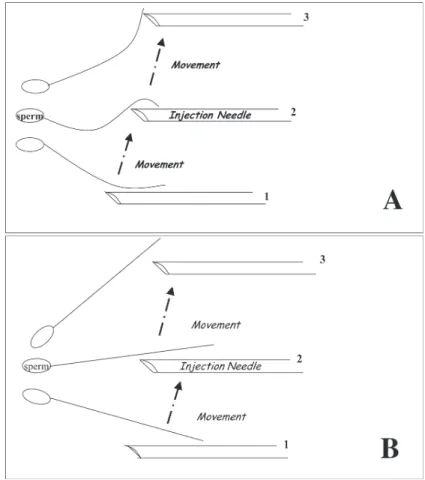
average age of the women was 34 years (range, 31 to 40 years), and the aver-age aver-age of their partners was 44 years (range, 38 to 51 years). In the women after hypophysis blockage with the GnRh agonist (GnRh-a), human meno-pausal gonadotrophin (hMG), follicle stimulating hormone (FSH) or recom-binant FSH was used to stimulate folliculogenesis. Follicular develop-ment was followed by echography. When the follicles reached a maximum diameter of 20 to 22 mm, human cho-rionic gonadotrophin (hCG) was ad-ministrated. Follicular aspiration was performed under the guidance of trans-vaginal ultrasound 36 hours after the hCG injection. The follicular fluid was collected in closed system in 15 mL tubes filled with 2 mL of Dulbeco’s phosphate buffer solution plus 10 IU/ mL heparin at 37 ºC. The presence of spermatozoa was verified by optical microscopy. The material was kept at 37 ºC until the moment of the ICSI procedure. Sperm tail flexibility was verified just before the injection. The spermatozoa was considered flexible when the tail moved up and down in-dependently of the head movement,
and it was considered inflexible when the movement occurred together (tail plus head) (Figure 1). The ICSI proce-dure was performed in a Petri dish (Fal-con 3002) in a 5 µL drop of modified human tubal fluid (HTF) (Irvine Scien-tific 9962) supplemented with 5% bo-vine serum albumin under mineral oil (Sigma M8410). The ICSI procedure was performed according to the Hu-man Reproduction Unit protocol9.
RESULTS
In this study, the results of 10 ICSI cycles using immotile spermatozoa with flexible tails were evaluated. A total of 177 oocytes were retrieved, of which 132 were mature and were in-jected. All the oocytes were injected with immotile spermatozoa with flex-ible tails. The normal fertilization rate (presence of 2 pronuclei) was 30.3%
(40/132), and the abnormal fertiliza-tion rate (presence of less than or more than 2 pronuclei) was 6.81% (9/132). After the injection, 52 embryos were obtained; 36 were grade I or II, and 16 were grade III or IV, according to the Veeck morphological classification10.
Third-four embryos were transferred, with an average of 3.4 embryos per pa-tient. In 9 transfer procedures, 1 preg-nancy was obtained (pregpreg-nancy rate: 11.12%). One patient had all her em-bryos cryopreserved because she had ovarian hyperstimulation syndrome. The embryos were divided into groups and thawed twice, with transfer in 2 different cycles without pregnancy.
DISCUSSION
The immobility of the spermatozoa can indicate cell death or just a struc-tural alteration that does not
252
REV. HOSP. CLÍN. FAC. MED. S. PAULO 58(5):250-253, 2003 Sperm tail flexibility test
Soares JB et al.
mise the possibility of fertilization. However, the methods used today to select immotile but viable spermato-zoa do not have absolute efficacy5,11.
The swelling test can be used to se-lect viable sperm; however, the results are still controversial. According to Liu et al. (1995), the absence of mo-tile spermatozoa is one of the most im-portant factors related to the reduction of the pregnancy rate after ICSI12.
Sev-eral authors have performed studies re-garding the advantages and disadvan-tages of the swelling test5,6. Tsai et al.
(1970) suggested that the swelling test should be used to select viable sper-matozoa for ICSI when the samples present only immotile spermatozoa11.
Liu et al. (1997) also presented this test as an efficient method for selecting
vi-able spermatozoa6. However, Lin et al.
(1998) showed that the hyposmotic test was not able to predict the viabil-ity of spermatozoa after a freezing/ thawing procedure13. Tsai et al. (1997)
demonstrated that the hyposmotic swelling test standardized by the World Health Organization could be harmful to the spermatozoa11.
Further-more, the swelling test is a time-con-suming process that adds extra steps to the assisted fertilization procedure.
In our work, the fertilization rate was 30.3% when the selection of the spermatozoa was made by tail flexibil-ity, and the pregnancy rate resulting after fresh embryo transfer was 11.12%. Our results are similar to those re-ported in the literature. Nagy et al. (1998) reported a fertilization rate of
21% when immotile spermatozoa se-lected by swelling test were used14.
Sallam et al. reported 30.1% of fertili-zation rate when immotile spermato-zoa collected by TESA were used5.
Vandervorst et al. found a similar re-sult; they reported a fertilization rate of 34.4% using immotile spermatozoa collected by masturbation15. Ron-El et
al.16 reported only a 3% fertilization
rate when immotile spermatozoa were used.
The sperm tail flexibility test (STFT) is an easy and cost-effective way to select viable immotile sperma-tozoa and can be used as an alterna-tive method for determining the viabil-ity of spermatozoa. The STFT seems to us a simpler and more risk-free method than the swelling test.
RESUMO
SOARES JB e col. - Teste de flexibili-dade da cauda do espermatozóide: um teste simples para seleção de espermatozóides viáveis para inje-ção intracitoplasmática de esper-matozóide a partir de amostras de sêmen sem espermatozóides mó-veis. Rev. Hosp. Clín. Fac. Med. S. Paulo 58(5):250-253, 2003.
OBJETIVO: Descrever os resulta-dos da injeção de espermatozóides imóveis com cauda flexível quando somente estavam presentes nas amos-tras espermatozóides imóveis.
MÉTODOS: Estudo retrospectivo analisando os resultados dos
procedi-mentos de injeção intracitoplasmática de espermatozóide, de 10 casais, rea-lizados no nosso centro. A cauda do espermatozóide era considerada flexí-vel quando esta se movia para cima e para baixo independente do movimen-to da sua cabeça, e era considerada rí-gida quando o movimento acontecia em bloco (cabeça e cauda). Os parâ-metros de avaliação foram taxas de fer-tilização e gestação.
RESULTADOS: A taxa normal de fertilização (presença de 2 pró-núcleos) encontrada foi 30,3% (40/132) e a taxa de fertilização anormal (presença de menos ou mais de 2 pró-núcleos) foi 6,81% (9/132). No total foram obtidos
52 embriões e foram realizados 9 pro-cedimentos de transferência, a taxa de gestação encontrada foi de 11,12%.
CONCLUSÕES: O teste de flexi-bilidade da cauda do espermatozóide é um método fácil e de baixo custo para avaliação da viabilidade de espermatozóides imóveis e pode ser usado como um método alternativo de determinação da viabilidade de esper-matozóides. Esse teste nos parece ser mais simples e com menor risco quan-do comparaquan-do ao Swelling Test.
DESCRITORES: ICSI. Esperma-tozóides. Cauda flexível. Espermato-zóides imóveis. Swelling test.
REFERENCES
1 . PALERMO GD, COHEN J, ALIKANI M et al. - Intracytoplasmic sperm injection: a novel treatment for all forms of male factor infertility. Fertil Steril, 1995, 63(6): 1231-40.
253
REV. HOSP. CLÍN. FAC. MED. S. PAULO 58(5):250-253, 2003 Sperm tail flexibility test
Soares JB et al.
3 . JEYENDRAN RS, VAN DER VEM HH, PEREZ-PELAEZ BG et al. - Development of an assay to assess the functional integrity of the human sperm membrane and its relationship to other semen characteristics. J Reprod Fertil 1984; 70:219-28. 4 . WORLD HEALTH ORGANIZATION laboratory manual for
the examination of human semen and sperm-cervical mucus interaction. 4th ed. Cambridge, Cambridge University Press,
1999.
5 . SALLAM HN, FARRAG A, AGAMEYA AF et al. - The use of a modified hypo-osmotic swelling test for the selection of viable ejaculated and testicular immotile spermatozoa in ICSI. Human Reprod 2001;16(2):272-6.
6 . LIU J, TSAI YL, KATZ E et al. - High fertilization rate obtained after intracytoplasmic sperm injection with 100% no motile spermatozoa selected by using a simple modified hypo-osmotic swelling test. Fertil Steril 1997; 68(2):373-5.
7 . TEMPLE-SMITH PD, SOUTHWICK GJ, TROUNSON AO et al. - Human pregnancy by in vitro fertilization (IVF) using sperm aspirated from the epididymis. J In Vitro Fert Embryo Transf 1985; 2:119-22.
8 . CRAFT I, TSIRIGOTIS M, BENNETT V, et al. - Percutaneous epididymal sperm aspiration and intracytoplasmic sperm injection in the management of infertility due to obstructive azoospermia. Fertil Steril 1995; 63:1038-42.
9 . MIZRAHI FE, SOARES JB, WONCHOCKIER R, et al. -Determinação da qualidade embrionária e correlação com sua taxa de implantação em um programa de Reprodução Assistida. J Bras Reprod Assist 1999; 3:14-9.
10. VEECK LL AND JONES JR HW - Atlas of the Human Oocyte and Early Conceptus. Cambridge, Cambridge University Press, 1991. v.2.
11. TSAI YL, LIU J, GARCIA JE et al. - Establishment of an optimal hypo-osmotic swelling test by examining single spermatozoa in four different hypo-osmotic solutions. Human Reprod 1997; 12(5):1111-1113.
12. LIU J, NAGY Z, JORIS H et al. - Analysis of 76 total-fertilization-failure cycles out of 2732 intracytoplasmic sperm injection cycles. Human Reprod 1995; 10:2630-6.
13. LIN MH, MORSHEDI M, SRISUMBUT C et al. - Plasma membrane integrity of cryopreserved human sperm: an investigation of the results of the hypo-osmotic swelling test, the water test and eosin-y staining. Fertil Steril 1998; 70 :1148-55.
14. NAGY ZP, VERHEYEN G, TOURNAYAL H et al. - Special applications of intracytoplasmic sperm injection: the influence of sperm count, motility, morphology, source and sperm antibody on the outcome of ICSI. Human Reprod 1998; 13(suppl 1):143-54.
15.VANDERVORST M, TOURNAYE H, CAMUS M et al. - Patients with absolutely immotile spermatozoa and intracytoplasmic sperm injection. Human Reprod 1997; 12(11):2429-33. 16.RON-EL R, STRASSBURGER D, FRIEDLER S et al. - Repetitive