From the Center for Advanced Research in Human Reproduction and Infertility, Urological Institute - Cleveland, USA.
Received for publication on February 21, 2003.
RESULTS OF MICROSURGICAL ANASTOMOSIS IN
MEN WITH SEMINAL TRACT OBSTRUCTION DUE TO
INGUINAL HERNIORRHAPHY
Fabio Firmbach Pasqualotto, Eleonora Bedin Pasqualotto, Ashok Agarwal and Anthony Joseph Thomas Jr.
PASQUALOTTO FF et al. - Results of microsurgical anastomosis in men with seminal tract obstruction due to inguinal herniorrhaphy. Rev. Hosp. Clín. Fac. Med. S. Paulo 58(6):305-309, 2003.
The incidence of vasal injury during inguinal herniorrhaphy is estimated at 0.5%. We sought to assess the patency rates and long-term fertility outcome after microsurgical repair of vasal obstruction related to prior inguinal herniorrhaphy.
METHODS: Twenty procedures were performed on 13 men diagnosed with infertility and vasal injury secondary to previous inguinal herniorrhaphy. Eight of these men had undergone bilateral and 5 unilateral inguinal herniorrhaphy. Twelve procedures were vasovasostomies, 3 were crossover vasovasostomies, 2 were vasoepididymostomies, and 3 were crossover vasoepididymostomies. Eight patients were azoospermic, 2 were severely oligospermic (<1 M/mL), 1 was oligospermic, and 2 were asthenospermic. Patency data was obtained on all 13 patients, and pregnancy data was available for 10 couples (77%), with a mean follow-up of 69.5 months.
RESULTS: The overall patency rate was 65%. In the vasovasostomy group, the patency rate was 60% (9/15), and in the vasoepididymostomy group it was 80% (4/5). Among the azoospermic patients, 13 procedures were performed. The patency rate was 42.9% for the vasovasostomy (3/7), and 100% for the vasoepididymostomy procedure (4/4). The overall pregnancy rate was 40%. Of the men who underwent vasoepididymostomy, 80% (4/5) established a pregnancy.
CONCLUSIONS: Microsurgical vasovasostomy after inguinal vas injury results in a reasonable patency rate but a lower pregnancy rate than that after vasectomy reversal. When microsurgical vasoepididymostomy was possible, it resulted in high patency and pregnancy rate. Crossover vasoepididymostomy, when appropriate, can be a useful alternative to inguinal vasovasostomy.
DESCRIPTORS: Azoospermia. Herniorrhaphy. Infertility. Male. Vasoepididymostomy.
Prior hernia repair is the most com-mon cause of inadvertent vasal ob-struction1. The estimated incidence of
injury of the vas deferens is 0.3% for adults and 0.8 to 2.0% in the pediatric age group2-4. Vasal injury is not
usu-ally recognized at the time of hernia surgery. If the patient sustains only a unilateral vas deferens obstruction with a normal contralateral testicle and patent excurrent duct, the injury may forever go unnoticed. However, if there is bilateral injury, a congenital absence of the contralateral vas or an intrinsic abnormality associated with the
con-tralateral testis, the patient will be ren-dered infertile5,6.
Correction of these vasal injuries can be challenging. The obstruction is commonly associated with substantial scarring in the inguinal region, particu-larly if mesh had been used1,5-9.
Suc-cessful reanastomosis after
herniorrha-phy is dependent upon adequate mo-bilization of the ends of the vas, rec-ognition and subsequent correction of a secondary epididymal obstruction, and adequate spermatogenesis. With the availability of gamete microman-ipulation, one must question whether microsurgical reanastomosis of the vas deferens should be considered the pri-mary treatment of choice10,11. To help
From 1983 to 1998, the medical records of 13 patients who underwent a microsurgical reanastomosis of the seminal tract due to hernia repair were reviewed. Eight men had undergone bilateral and 5 unilateral inguinal herniorrhaphies. Ten patients under-went this surgery during childhood, 1 at age 15 years, and 2 during adult-hood. None of the 13 men had ever fa-thered a child. A single urologist per-formed all of the microsurgical proce-dures. The indication for the reanas-tomosis was infertility in 12 and tes-ticular pain in 1 man. The patient with testicular pain was asthenospermic.
Patients with less than 20 M/mL sperm in the ejaculate were considered oligospermic, those with less than 1 M/mL were considered to have severe oligospermia, and patients without sperm were considered azoospermic. Asthenospermia was defined as motil-ity lower than 20%. Eight patients presented with azoospermia, 2 with se-vere oligospermia (<1 M/mL), 1 with oligospermia (5 M/mL), and 2 with asthenospermia. Four patients had a unilateral atrophic testis, 3 had unilat-eral congenital absence of the vas def-erens, 1 had an orchiectomy due to an undescended testis, and 1 had an un-descended testis. The mean patient age was 32 years (range: 26 to 41 years),
and the mean obstructive interval was 25.4 years (range: 3 to 40 years) (Ta-ble 1). Patency was defined by the presence of long-tailed sperm in a postoperative semen analysis. Informa-tion regarding pregnancy rate was ob-tained via chart review or telephone interview of the couple or referring physician. Patency data was obtained for all patients. Pregnancy data was available for only 10 couples (77%), with a mean follow up of 69.5 months (range: 13 to 181 months).
A testis biopsy was performed on all azoospermic patients to evaluate the degree of spermatogenesis. All pa-tients underwent vasography to con-firm the site of obstruction. All surgi-cal anastomoses were performed using the operating microscope.
Surgical technique: If an inguinal vasovasostomy was to be performed, the incision was made in the inguinal region high enough to open the inter-nal ring superiorly in order to identify the distal vas, which usually was to end in the retroperitoneum. Most of the patients had obstruction near the internal ring. These obstructions can often be palpated along the lateral wall of the retroperitoneum. After freeing the vas from the surrounding scar tis-sue, a 23-gauge angiocatheter was placed into the lumen, and contrast
was injected to assure distal patency. Fluid from the proximal end of the vas (testicular) was examined by a light microscopy, noting gross appearance and whether sperm were present. Be-cause of the marked disparity in lumi-nal diameters between the 2 ends of the vas deferens, a modified single-layer microsurgical anastomosis with 9-0 nylon suture was performed.
When crossover or secondary vaso-epididymostomy was performed, a 2-layer microsurgical end-to-side single tubule anastomosis was used at the level where sperm were identified12. If
motile sperm were found, aspiration for cryopreservation was performed using a tuberculin syringe and 23-gauge angiocatheter. The lumen-to-lumen anastomosis between the vas deferens and the epididymis was performed us-ing 4 to 6 interrupted 10-zero nylon sutures. The muscularis and adventitia were approximated to the epididymal tunic with 8 to 12 9-zero nylon sutures. The technique of crossover vaso-vasostomy or crossover vasoepididy-mostomy involved isolating a suffi-cient length of normal vas on the con-tralateral side to tunnel through an opening in the scrotal septum, bring-ing it to the vas deferens (COVV) or epididymis (COVE).
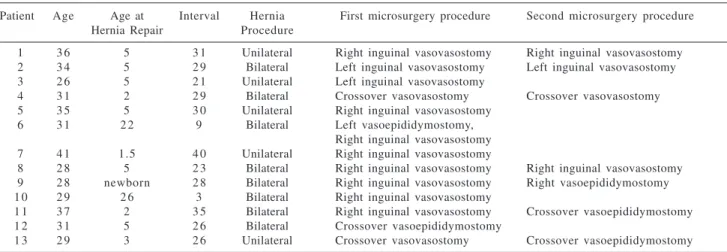
Table 1 - Age, interval between herniorrhaphy and microsurgery, hernia procedure, and type of microsurgery procedure in 13 patients.
Patient Age Age at Interval Hernia First microsurgery procedure Second microsurgery procedure
Hernia Repair Procedure
1 3 6 5 3 1 Unilateral Right inguinal vasovasostomy Right inguinal vasovasostomy
2 3 4 5 2 9 Bilateral Left inguinal vasovasostomy Left inguinal vasovasostomy
3 2 6 5 2 1 Unilateral Left inguinal vasovasostomy
4 3 1 2 2 9 Bilateral Crossover vasovasostomy Crossover vasovasostomy
5 3 5 5 3 0 Unilateral Right inguinal vasovasostomy
6 3 1 2 2 9 Bilateral Left vasoepididymostomy,
Right inguinal vasovasostomy
7 4 1 1.5 4 0 Unilateral Right inguinal vasovasostomy
8 2 8 5 2 3 Bilateral Right inguinal vasovasostomy Right inguinal vasovasostomy 9 2 8 newborn 2 8 Bilateral Right inguinal vasovasostomy Right vasoepididymostomy
1 0 2 9 2 6 3 Bilateral Right inguinal vasovasostomy
1 1 3 7 2 3 5 Bilateral Right inguinal vasovasostomy Crossover vasoepididymostomy
1 2 3 1 5 2 6 Bilateral Crossover vasoepididymostomy
RESULTS
A total of 20 procedures were per-formed in 13 patients. Six patients un-derwent a second procedure due to pri-mary inguinal vasovasostomy (VV) failure, and 1 patient underwent 2 pro-cedures simultaneously. The semen analysis of these 6 men who under-went a second procedure revealed azoospermia in 3 and severe oli-gospermia in 3. Of the 20 procedures, 12 were VV, 3 crossover vasovasos-tomy (COVV), 2 vasoepididymosvasovasos-tomy (VE), and 3 crossover vasoepididy-mostomy (COVE) (Table 2). All testis biopsies in the obstructed side re-vealed active spermatogenesis.
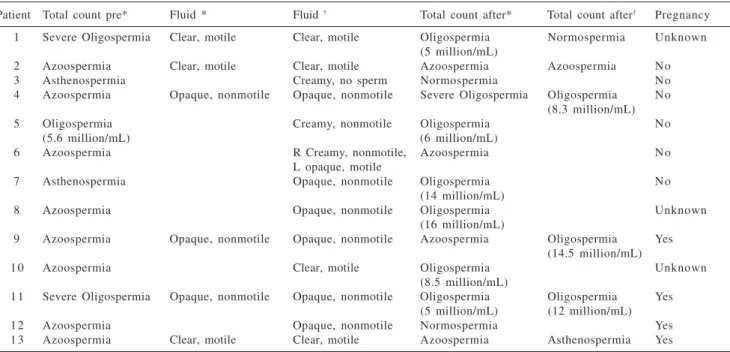
At the time of surgery, 35% (7/20) of the vasa or epididymides had clear fluid with motile sperm from the proxi-mal end, 20% (4/20) had clear fluid with nonmotile sperm, 5% (1/20) had opaque fluid with motile sperm, 25% (5/20) had an opaque fluid with non-motile sperm, 10% (2/20) had creamy fluid with nonmotile sperm, and 5% (1/ 20) had creamy fluid with no sperm in the vasal or epididymal fluid. We did
not find a relationship between vasal or epididymal fluid and patency or pregnancy rates. After the 20 proce-dures, the overall patency rate was 65% (13/20). Of the men who under-went vasovasostomy alone, 60% (9/ 15) were patent, and 80% (4/5) of those who underwent a vasoepididymostomy demonstrated sperm in the ejaculate. The patient with testis pain (patient number 7) (Ta-ble 2) got better after the surgery.
Thirteen procedures (7 VV, 4 VE, and 1 simultaneous VE and 1 contral-ateral VV) were performed on the 8 azoospermic patients. The patency rate for this subset of patients was 42.9% (3/7) when VV was performed and 100% (4/4) when VE was indicated. The single azoospermic patient who underwent simultaneous VV and VE had a patent anastomosis on initial fol-low-up, but subsequently became azoospermic (Table 2).
Of the men who were followed more than 12 months, 40% (4/10) es-tablished a pregnancy. None of the 6 men who underwent vasovasostomy established a pregnancy. By contrast,
of the 5 patients who underwent VE, 80% (4/5) established pregnancies (Table 2). The man who had LVE and RVV did not establish a pregnancy.
DISCUSSION
Herniorrhaphy is the most common cause of iatrogenic vasal obstruction1.
The true incidence of vasal disruption related to herniorrhaphy is unknown due to the fact that a unilateral ob-struction does not always affect fertil-ity if the contralateral testicular func-tion is normal. Patrick et al. evaluated 1,494 hernia sacs from 1,077 children (89% male) and found vas deferens in the pathology specimen in 0.2% (2/ 963) of the boys2. Tiryaki et al.
re-ported a similar incidence (0.2%) in a review of 1,131 hernia repairs at their institution3. Matsuda reported that the
incidence of unilateral vas deferens obstruction caused by inguinal her-niorrhaphy was 26.7% among infertile patients with a history of hernior-rhaphy during childhood1.
Detection of a unilateral
obstruc-Table 2 - Semen analysis, quality of vasal or epididymal fluid, and pregnancy rates.
Patient Total count pre* Fluid * Fluid † Total count after* Total count after† Pregnancy
1 Severe Oligospermia Clear, motile Clear, motile Oligospermia Normospermia Unknown (5 million/mL)
2 Azoospermia Clear, motile Clear, motile Azoospermia Azoospermia No
3 Asthenospermia Creamy, no sperm Normospermia No
4 Azoospermia Opaque, nonmotile Opaque, nonmotile Severe Oligospermia Oligospermia No (8.3 million/mL)
5 Oligospermia Creamy, nonmotile Oligospermia No
(5.6 million/mL) (6 million/mL)
6 Azoospermia R Creamy, nonmotile, Azoospermia No
L opaque, motile
7 Asthenospermia Opaque, nonmotile Oligospermia No
(14 million/mL)
8 Azoospermia Opaque, nonmotile Oligospermia Unknown
(16 million/mL)
9 Azoospermia Opaque, nonmotile Opaque, nonmotile Azoospermia Oligospermia Yes (14.5 million/mL)
1 0 Azoospermia Clear, motile Oligospermia Unknown
(8.5 million/mL)
1 1 Severe Oligospermia Opaque, nonmotile Opaque, nonmotile Oligospermia Oligospermia Yes (5 million/mL) (12 million/mL)
1 2 Azoospermia Opaque, nonmotile Normospermia Yes
1 3 Azoospermia Clear, motile Clear, motile Azoospermia Asthenospermia Yes
tion of the seminal tract can be diffi-cult because all patients do not present with azoospermia. Any man who presents with infertility and previous herniorrhaphy should be carefully evaluated to rule out an obstructed vas. When the vas is obstructed due to pre-vious hernia repair, the epididymis may be thickened or indurated, and the vas is generally fuller and more convoluted when palpated. A testis bi-opsy can confirm spermatogenesis on the obstructed side.
The overall patency rate in our se-ries was 65%, which is lower than those in reports of microsurgical vasectomy reversal12,13. It is well recognized that
patency and pregnancy rates are in-versely related to the time interval be-tween vasectomy and reversal13-15. The
mean obstructive interval in our pa-tients was 25.4 years (range 3 to 40). Therefore, it is better to compare the patency rate in our study with those of patients who underwent a vasectomy reversal at least 15 years after vasec-tomy. In this case, our patency rate was slightly lower than the vasectomy re-versal group (71%)13. Vasovasostomy in
the inguinal region after herniorrhaphy is technically more difficult compared to routine vasectomy reversal1,6,8,9. In
addition to the extensive scar tissue that may be present after the herniorrhaphy, some patients have had part of their vas deferens resected6. This can lead to a
very challenging surgical procedure. Silber reported that the prognosis for vasovasostomy performed 10 years or more after vasectomy was poor mainly because of the absence of sperm in the proximal fluid16. Patients
who develop sperm granuloma after vasectomy are considered to have an
improved prognosis at the time of va-sectomy reversal17. The sperm
granu-loma is thought to form from sperm leakage after vasectomy. This leakage decreases intravasal pressure and sub-sequently reduces the likelihood of secondary epididymal obstruction. In patients with vasal obstruction due to childhood inguinal herniorrhaphy, no sperm granuloma is present because sperm is not produced until much later in life. This may result in a much higher likelihood of secondary epidi-dymal obstruction and may also be re-sponsible for the great differences in vasal diameter between the proximal and distal ends of the vas deferens.
Our results are comparable to a re-cent report when we evaluated the overall patency and pregnancy rates6.
However, we observed a better patency and pregnancy rate in the group who underwent a crossover vasoepididy-mostomy. Of the 20 procedures, 15 were VV and 5 were VE. We observed that both patency and pregnancy rates were higher in the VE group than in the VV group. All 3 of the patients who underwent a COVE fathered children. In these 3 cases, we bypassed the ob-structed region and performed the anastomosis on the contralateral side. These 3 patients had a normal vas def-erens associated with an atrophic tes-tis on the contralateral side to the herniorrhaphy. The high pregnancy rate in the group who underwent a crossover vasoepididymostomy is comparable to a previous report from Japan5. None of the 6 patients who had
undergone only VV achieved a preg-nancy, despite the 60% patency rate. These disappointing results may in part be due to a partial obstruction,
in-sufficient mobilization of the abdomi-nal vas with its blood supply, or inad-equate vasal motility due to the time of obstruction.
Advances in assisted reproductive techniques (ART), particularly intracy-toplasmic sperm injection (ICSI), have made another treatment modality available for men with obstructive azoospermia10,11,18,19. Assisted
reproduc-tive techniques subject a healthy woman to invasive and expensive pro-cedures and may also result in a higher rate of multiple births. Our pregnancy rate is similar to the results obtained with ICSI. However, it is important to note that in these patients, the micro-surgical procedure is covered by insur-ance and ICSI is never covered by in-surance. In our opinion, microsurgical reanastomosis with, if possible, sperm cryopreservation is an appropriate ap-proach for men with inguinal vasal ob-struction, particularly if the contralat-eral normal vas may be available for a crossover procedure.
In conclusion, patients who have inguinal vasal obstruction were ob-structed for a longer period of time, and the procedure is more demanding than vasectomy reversal. Therefore, these patients do not experience the same success rate for vasovasostomy as those men who have had a previous vasectomy for purposeful sterilization. Crossover vasovasostomy or crossover vasoepididymostomy may be the pro-cedure of choice if spermatogenesis is compromised on the contralateral side and the ductal system is intact. The re-sults in this setting are reasonable, and it is appropriate to offer microsurgical reconstruction to these couples inter-ested in establishing a pregnancy.
RESUMO
PASQUALOTTO FF e col. - Resultados de anastomose microcirúrgica em homens com obstrução do trato
se-minal devido à herniorrafia ingui-nal. Rev. Hosp. Clín. Fac. Med. S. Paulo 58(6):305-309, 2003.
ava-liamos as taxas de permeabilidade e o prognóstico da fertilidade a longo-pra-zo após o reparo microcirúrgico da obstrução dos vasos deferentes relaci-onados com herniorrafia inguinal pré-via
MÉTODOS: Vinte procedimentos foram realizados em 13 homens diag-nosticados com infertilidade e trauma nos vasos deferentes secundário à herniorrafia inguinal prévia. Oito des-tes homens foram submetidos à her-niorrafia inguinal bilateral e 5 à herniorrafia inguinal unilateral. Doze procedimentos foram vasovasosto-mias, 3 vasovasostomias cruzadas, 2 vasoepididimostomias e 3 vasoepi-didimostomias cruzadas. Oito pacien-tes estavam azoospérmicos, 2 com
oligozosspermia grave (< 1 milhão/ mL) 1 oligozoospérmico e 2 astenozo-ospérmicos. Dados de permeabilidade foram obtidos em 13 pacientes e da-dos de gravidez estavam disponíveis em 10 casais (77%) com um seguimen-to médio de 69,5 meses.
RESULTADOS: A taxa de permea-bilidade foi de 65%. No grupo de vasovasostomia, a taxa de permea-bilidade foi de 60% (9/15) e no grupo de vasoepididimostomia foi de 80% (4/5). Entre os pacientes azoospér-micos, 13 procedimentos foram reali-zados. As taxas de permeabilidade fo-ram de 42,9% para a vasovasostomia (3/7), e 100% para o procedimento de vasoepididimostomia (4/4). As taxas globais foram de 40%. Quatro de 5
(80%) homens que foram submetidos à vasoepididimostomia estabeleceram gravidez.
CONCLUSÕES: Vasovasostomia microcirúrgica após trauma inguinal nos vasos deferentes resultam em ta-xas de permeabilidade razoáveis, mas uma taxa de gravidez baixa compara-da à reversão de vasectomia. Quando a vasoepididimostomia microcirúrgica foi possível, ela resultou em altas ta-xas de permeabilidade e gravidez. A vasoepididimostomia cruzada, quando apropriada, pode ser uma alternativa útil à vasovasostomia inguinal.
DESCRITORES: Azoospermia. Herniorrafia. Infertilidade. Homem. Vasoepididimostomia.
REFERENCES
1. Matsuda T, Horii Y, Yoshida O. Unilateral obstruction of the vas deferens caused by childhood inguinal herniorrhaphy in male infertility patients. Fertil Steril 1992; 58: 609-13.
2. Patrick DA, Bensard DD, Karrer FM, et al. Is routine pathologic evaluation of pediatric hernia sacs justified? Pediatr Surg 1998; 33: 1090-92.
3. Tiryaki T, Baskin D, Bulut M. Operative complications of hernia repair in childhood. Pediatr Surg 1998; 13: 160-1.
4. Uzzo RG, Lemack GE, Morrisey KP et al. The effects on mesh bioprosthesis on the spermatic cord structures: a preliminary report in a canine model. J Urol 1999; 161: 1344-49. 5. Matsuda T, Muguruma K, Hiura Y et al. Seminal tract obstruction
caused by childhood inguinal herniorrhaphy: results of microsurgical reanastomosis. J Urol 1998; 159: 837-40. 6. Sheynkin YR, Hendin BH, Schlegel PN et al. Microsurgical repair
of iatrogenic injury to the vas deferens. J Urol 1998; 159: 139-41.
7. Matsuda T, Horii Y, Mugurama K et al. Microsurgical epididymovasostomy for obstructive azoospermia: factors affecting postoperative fertility. Eur Urol 1994; 26: 322-26. 8. Weber CH. Successful restoration of fertility twenty-nine years after bilateral vasal injury in infancy. Urology 1986; 28: 299-300.
9. Yavetz H, Harash B, Yogev L et al. Fertility of men following inguinal hernia repair. Andrology 1991; 23: 443-6. 10. Pasqualotto FF, Rossi-Ferragut LM, Rocha C et al. Outcome of in
vitro fertilization and intracytoplasmic injection of epididymal and testicular sperm obtained from patients with obstructive and nonobstructive azoospermia. J Urol 2002; 167: 1753-56.
11. Palermo G, Joris H, Devroey P et al. Pregnancies after injection of single spermatozoa into an oocyte. Lancet 1992; 340: 17-18. 12. Sabanegh E Jr, Thomas AJ JR. Effectiveness of crossover transseptal vasoepididymostomy in treating complex obstructive azoospermia. Fertil Steril 1995; 63: 392-5.
13. Belker AM, Thomas AJ JR, Fuchs EF et al. Results of 1,469 microsurgical vasectomy reversals by the Vasovasostomy Study Group. J Urol 1991; 145: 505-11.
14. Schlegel PN, Goldstein M. Microsurgical vasoepididymostomy: refinements and results. J Urol 1993; 150: 1165-8.
15. Pasqualotto FF, Agarwal A, Srivastava M et al. Fertility outcome after repeat-vasoepididymostomy. J Urol 1999; 162: 1626-1628.
16. Silber SJ. Pregnancy after vasovasostomy for vasectomy reversal: a study of factors affecting long-term return of fertility in 282 patients followed for 10 years. Hum Reprod 1989; 4: 318-322.
17. Silber SJ. Sperm granuloma and reversibility of vasectomy. Lancet 1977; 2: 588-9.
18. Marmar JL. The emergence of specialized procedures for the acquisition, processing, and cryopreservation of epididymal and testicular sperm in connection with intracytoplasmic sperm injection. J Androl 1998; 19:, 517-526.