Abstract
The identification of Amazonian plants is still difficult for many reasons, one being the lack of collections
over large areas of the region. As a consequence of the poor knowledge on the Amazonian flora, many
taxonomic publications (revisions and floristic treatments) become out of date within a few years. In this
context, the on-line publication of taxonomic treatises has been suggested, since it allows constant data
updates; and this type of publication should therefore be more valued by the scientific community. An
excellent field guide for the Ducke Reserve (Manaus, central Amazonian Brazil) was published, based
exclusively on vegetative characters. However, the presence of reproductive structures in the collected
material does not facilitate identification with this type of field guide. Furthermore, as in any printed key,
the text cannot be updated, except through a new edition. As an example of a way to facilitate the
identi-fication of Amazonian plants, an interactive, multiple-entry key to the seed plant genera that occur in the
Ducke Reserve was created using the program
Lucid
3.5. The key includes vegetative and reproductive
characters and many illustrations, and is available on-line. We discuss here the peculiarities and advantages
of this type of electronic publication.
Key words: interactive multi-access key, electronic publication, flora of central Amazon, plant taxonomy.
Resumo
A identificação de plantas da Amazônia é ainda muito difícil devido a muitos fatores, como por exemplo
grandes lacunas de coleta. Em consequência do conhecimento ainda preliminar da flora dessa grande
região, muitas publicações taxonômicas (revisões ou tratamentos florísticos) tornam-se ultrapassadas
em poucos anos. A publicação on-line de trabalhos taxonômicos foi sugerida como desejável nesse
contexto, por permitir a constante atualização dos dados, embora esse tipo de publicação deva ser mais
valorizada pela comunidade científica. Para a área da Reserva Ducke (Manaus, AM), foi publicado um
excelente guia de campo ilustrado, baseado exclusivamente em caracteres vegetativos. Entretanto, a
presença de estruturas reprodutivas no material coletado não facilita sua identificação com esse tipo
de guia de campo. Além disso, como em qualquer chave impressa, o texto não pode ser atualizado, a
não ser em uma nova edição. Para exemplificar uma maneira de facilitar a identificação das plantas da
Amazônia, foi elaborada uma chave interativa de entradas múltiplas para os gêneros de fanerógamas
que ocorrem na Reserva Ducke, com o auxílio do programa
Lucid
3.5. Essa chave inclui caracteres
vegetativos, reprodutivos e muitas ilustrações e está disponível
on-line
. São discutidas as vantagens e
peculiaridades desse tipo de publicação eletrônica.
Palavras-chave: chave de identificação interativa de acesso múltiplo, publicação eletrônica, flora da Amazônia
Central, taxonomia vegetal.
An interactive key (
Lucid
) for the identifying of the genera
of seed plants from the Ducke Reserve, Manaus, AM, Brazil
Chave interativa (Lucid) para identificação dos gêneros de fanerógamas da Reserva Ducke
(Manaus, AM, Brasil)
Volker Bittrich
1,
Clara Sampaio D. Souza
2,
Rubens L.G. Coelho
2,
Milena V. Martins
2,
Michael J.G. Hopkins
3&
Maria C.E. Amaral
2,4Rodriguésia 63(1): 055-064. 2012
http://rodriguesia.jbrj.gov.br
1 R. Mário de Nucci 500, Bairro Cidade Universitária, 13083-001 Campinas, SP, Brazil.
2 Universidade Estadual de Campinas – UNICAMP, Instituto de Biologia, Depto. Biologia Vegetal, C.P. 6109, 13083-970, Campinas, SP, Brazil. 3 Instituto Nacional de Pesquisas da Amazônia – INPA, Coordenação de Pesquisas em Biodiversidade (CBIO), Av. André Araújo 2936, 69060-001, Manaus, AM, Brazil.
56
Introduction
The identification process faces great difficulties for Amazonian plants, and this situation is unlikely to a change in the short term. The taxonomic base is weak, principally because the sampling of the flora is far from comprehensive (Mori 1992; May 2004; Hopkins 2007; Schulman
et al. 2007). Hebert et al. (2003) and Janzen (2004) recently suggested using DNA barcodes, which are short specific gene sequences of each species of plant or animal, to solve problems in the identification of tropical biodiversity, but this suggestion is at best naive. Spooner (2009) showed that DNA barcodes do not work well in taxonomically complex groups.
Hence, due to the continued poor knowledge on the flora of the huge and megadiverse region of Brazil, most taxonomic publications (revisions, floras, florulas) frequently become out of date within a few years. Recently, many biologists have suggested that taxonomic studies should be published at least in part online (e.g., Bisby 2000; Pennisi 2000; Godfray 2002; Moretzsohn 2002; Wheeler et al. 2004; Knapp et al. 2007). This approach has many advantages, mainly for the users of taxonomic data. However, online publication has also some limitations, including the poor valuation by the scientific community, which affect mainly the providers of taxonomic information, who show reservations (Lawrence & Hawthorne 2006; Bittrich 2008a).
Floras available online (e.g., <http://www. efloras.org>) usually exhibit only dichotomous identification keys without illustrations, and are directly adapted from their respective printed floras. A more interesting possibility is the online publication of computerized identification keys, produced with specialized software. Recently, these keys have become more popular, as specialized programs for their creation become more complete and user friendly. Moreover, it is currently easier to produce low-cost illustrations, obtained with digital cameras and scanners. One example is the program Lucid-Phoenix (<http://lucidcentral.cbit. uq.edu.au/phoenix/>), which allows making extant keys published in floras available on the internet. In these dichotomous keys, illustrations of characters and taxa can be included, aggregating value to them (Bittrich 2008b).
However, interactive multiple-entry keys are more popular (Dallwitz et al. 2005). These keys are based on a matrix of characters and taxa. The first interactive multiple-entry key for a tropical flora was published for trees and shrubs of Borneo
(Jarvie & Ermayanti 1995–96). Currently, many programs for the production of interactive multiple-entry keys are available, either as freeware or commercially. The most frequently used are Actkey
(Brach & Song 2005), Delta (Description Language for Taxonomy, <http://delta-intkey.com/>), and
Lucid (<http://www.lucidcentral.com/>). The first keys of this kind used in Brazil were published by Araújo et al. (2005) for the identification of monocotyledon families of the state of São Paulo.
The first attempt to produce an illustrated interactive multiple-entry key for the Amazon was carried out in the on-going floristic project of the Uatumã Biological reserve, to the north of Manaus (Ribeiro 2008). The best known terra firme area (i.e. non-flooded rainforest) in the Amazon is most probably the Adolfo Ducke Forest Reserve, near Manaus. Long-term collections by the researchers of the Amazon National Research Institute (INPA) and the efforts during the nineteen nineties during the ‘Flora of the Ducke Reserve’ project which
resulted into an important field guide (Ribeiro et al. 1999) praised by the world’s scientific community. This book is composed mainly of illustrated identification keys based on vegetative characters (plant size, presence of exudates, bark and leaf characters). The Flora of the Ducke Reserve, as any other floristic book of taxonomically poorly-known regions, becomes progressively outdated over the years. Producing a second edition is possible and desirable, as the first edition has sold out, but this is a complicated and expensive task, and it is not a long-term solution.
A promising approach to enable the identification of plants of the Ducke Reserve and of Central Amazon in general would be an illustrated interactive multiple-entry key, based largely on the data of the Flora of the Ducke Reserve, especially concerning vegetative characters. This project was started during a field taxonomy course in Ducke Reserve in July 2008. On that occasion, an interactive key was created for the angiosperm genera that occur in the Ducke Reserve. The results were limited, due to the use of only ten characters
and insufficiently standardized information of the
Flora of the Ducke Reserve.
Interactive key to genera of the Ducke Reserve 57
Material and Methods
The interactive multiple-entry key was created for the identification of 649 angiosperm genera as well as the gymnosperm genera Gnetum
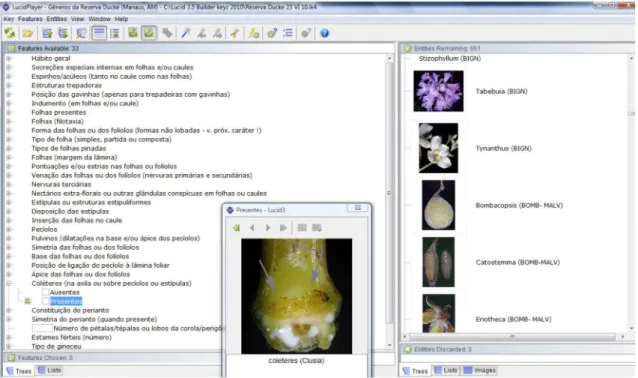
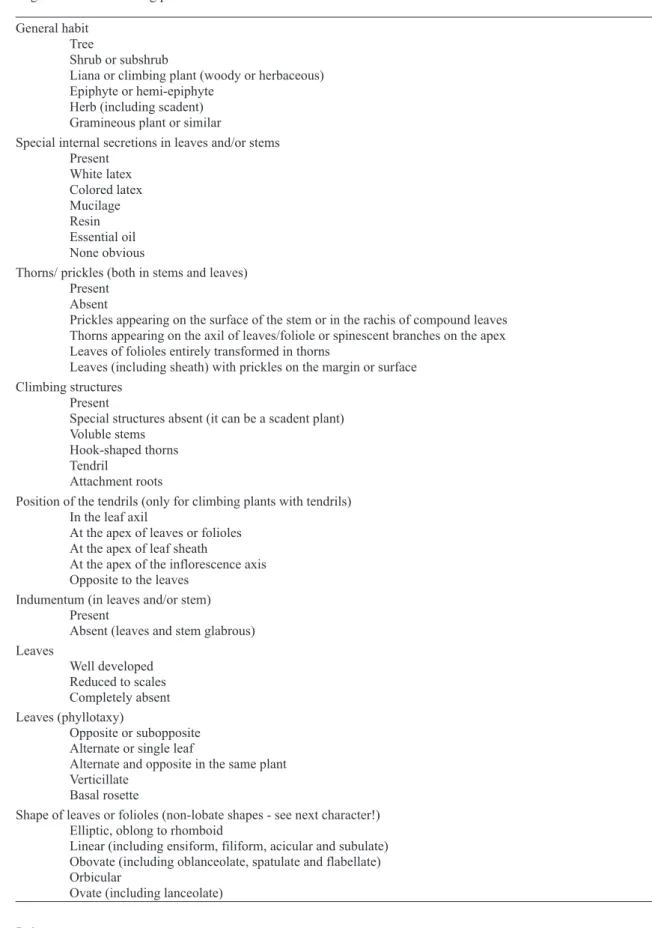
L. and Zamia L. Generic names were extracted from the Flora of the Ducke Reserve (Ribeiro et al. 1999). In the key, names of genera are followed by abbreviations of their respective family names, according to the current classification system (Souza & Lorenzi 2008); when necessary, we followed the system of Cronquist (1988), which was used in the guide of the Ducke Reserve (Fig. 1). Twenty-six vegetative and seven floral characters were selected, with a total of 147 states (Tab. 1). By observing the images produced during the project Flora of the Ducke Reserve it was possible to include characters of leaf shape and venation patterns.
The key was made in the program Lucid 3.5
Builder (<www.lucidcentral.org>). To attribute states of characters to the respective taxa (scoring), the program allows either marking the presence of a character or, in case of doubt or lack of data, marking the field with “?”. This avoids incorrectly eliminating the respective taxa during the identification process. It is also possible to mark the state of a character as “present due to error”, when it seems that users
interpreted wrongly a structure, for example, taking the cyathium of Euphorbia L. for a flower. In the present key to the genera of the Ducke Reserve, Gnetum was an interesting case for the use of this kind of marking.
Gnetum belongs to gymnosperms, but it looks so similar to an angiosperm that only a specialist would recognize this genus as a gymnosperm; in this case, the specialist obviously does not need a key to identify the genus. In addition, floral traits (e.g., gynaeceum type and ovary position in the anthesis) obviously do not apply, since there are no carpels in a gymnosperm. Therefore, to enable the correct classification of these lianas, the following characters were marked as “present due to error”: both gynaeceum as “monomer”’ or “apocarpic”, and ovary position as “superior”. Illustrations were based on digitalized images made during the project Flora of the Ducke Reserve, further photos were taken with a digital camera in the Ducke Reserve, and lithographies of the Flora brasiliensis
were used (Martius et al. 1840–1906). In all cases, the digitalized photos were treated and recorded considering the balance between small size of the digital file and good resolution for visualizing on a computer screen. The key was produced based on
LucidBuilder for web publishing (available at <www. ib.unicamp.br/plantkeys/>).
Figure 1
– Key to the genera of seed-bearing plants of the Ducke Reserve created in the software
Lucid 3.5
. The right
Table 1
–
List of the characters and their respective states used in the interactive multi-access key for the identification
of genera of seed-bearing plants of the Ducke Reserve.
General habit Tree
Shrub or subshrub
Liana or climbing plant (woody or herbaceous) Epiphyte or hemi-epiphyte
Herb (including scadent) Gramineous plant or similar
Special internal secretions in leaves and/or stems Present
White latex Colored latex Mucilage Resin
Essential oil None obvious
Thorns/ prickles (both in stems and leaves) Present
Absent
Prickles appearing on the surface of the stem or in the rachis of compound leaves Thorns appearing on the axil of leaves/foliole or spinescent branches on the apex Leaves of folioles entirely transformed in thorns
Leaves (including sheath) with prickles on the margin or surface Climbing structures
Present
Special structures absent (it can be a scadent plant) Voluble stems
Hook-shaped thorns Tendril
Attachment roots
Position of the tendrils (only for climbing plants with tendrils) In the leaf axil
At the apex of leaves or folioles At the apex of leaf sheath
At the apex of the inflorescence axis Opposite to the leaves
Indumentum (in leaves and/or stem) Present
Absent (leaves and stem glabrous) Leaves
Well developed Reduced to scales Completely absent Leaves (phyllotaxy)
Opposite or subopposite Alternate or single leaf
Alternate and opposite in the same plant Verticillate
Basal rosette
Shape of leaves or folioles (non-lobate shapes - see next character!) Elliptic, oblong to rhomboid
Linear (including ensiform, filiform, acicular and subulate) Obovate (including oblanceolate, spatulate and flabellate) Orbicular
Interactive key to genera of the Ducke Reserve 59
Reniform (kidney-shaped)
Cordate to sagittate (including deltoid) Leaf type (simple, divided or compound)
Simple or unifoliolate, entire Bifid or bilobate
Trifid or trilobate Palmatifid or palmatisect Pinnatifid or pinnatisect Bifoliate
Trifoliate (ternate), bi- or triternate Palmate or digitate
Pinnate Bipinnate
Irregularly pinnate and dissected Types of pinnate leaves
Imparipinnate (with an odd number of folioles along the axis) Paripinnate (with a pair number of folioles along the axis) Leaves (blade margin)
Entire, without glands on the margin Entire, with glands on the margin Sinuate
Lobate Scalloped Serrate Dentate Spinescent
Spots and/or streaks on leaves or folioles Non-spotted/streaked
Spotted/streaked (translucent or dark spots/streaks) Venation of leaves or folioles (primary and secondary veins)
Penninerved (with straight or curved secondary veins) Palmate-veined or 3-veined on the base of the blade Parallel-veined (including acrodromous)
Without obvious veins Uninerved
Tertiary nerves
Not parallel to each other Parallel to each other Non-visible (on fresh leaves)
Extra-floral nectaries or other conspicuous glands on leaves or stems Absent
Present on branches
Present on the petiole and/or rachis of compound leaves Present at the base of leaves
Present at the apex of leaves Present on the margin of leaves Present on the surface of the leaf
Present on the inflorescence and hollows, cupular or saccate Stipules or stipuliform structures
Present Absent Disposition of the stipules
Free among themselves and from the petiole and inserted on the sides of the petiole Disposed between opposite or verticillate leaves (interpetiolar)
Invaginating the stem above the petiole (ocreate) At the apex of the stem or bud, forming a cap Insertion of leaves on the stem
Normal
With sheath invaginating the stem Leaves fused around the stem (perfoliate) Petiole
Absent (sessile leaves) Present (peciolate leaves)
Present, but very small or obscure (subsessile leaves) Pulvini (thickening at the base and/or apex of the petioles) Absent
Present only at the base Present only at the apex Present at the base and apex Symmetry of leaves or folioles Symmetric
Clearly asymmetric Leaf or foliole base
Auriculate Cordate
Sagittate to hastate
Other types (acute to obtuse)
Connecting position of the petiole to the leaf blade On the leaf margin (normal)
On the lower surface (peltate leaf) Leaf or foliole apex
Obtuse to rounded Retuse to emarginate Acute
Acuminate
Apiculate, mucreonate to cuspidate Colleters (in the axil or on the petioles or stipule) Absent
Present Perianth constitution
Distinct calyx and corolla, or two perianth verticils clearly distinguishable
Perianth elements not clearly distinguishable into calyx and corolla = perigone formed by tepals (only one verticil or all parts more or less similar among one another)
Perianth vestigial or absent Perianth symmetry (when present)
More or less radially symmetric (actinomorphic, regular) Symmetry distinctly bilateral (zygomorphic)
Asymmetric
Number of petals/tepals or lobes of the corolla/ perigone Fertile stamens (number)
1 2 3 4 5 6 7 8 9 10
Interactive key to genera of the Ducke Reserve 61
Gynaeceum type
monocarpous (formed by a single carpel) apocarpous (2 or more carpels completely free) syncarpous (carpels fused, styles free or united)
syncarpous, but with carpels more or less free, united by the style or stigma Ovary position in the anthesis
Superior, directly above the receptacle Superior and stipitate (gynophore present)
Superior and stipitate together with the stamens (androgynophore present) Half-inferior
Inferior
Number of locules (only for the syncarpous gynaeceum)
Results and Discussion
The interactive multiple-entry key was created for the identification of genera and not species of seed-bearing plants of the Ducke Reserve. The genus level has several advantages: the identification is usually correct, even when the names of the species are unknown or have been wrongly used; there is a good chance of making a correct identification even if the species considered is not included in the guide of Ducke Reserve.
In the list of 33 characters divided into 147 states, vegetative traits were listed first (habit, leaf characters, etc.) and the floral traits second. When the character list is extensive, a person who is not familiar with the relative importance of different taxonomic characters could be unsure about the best characters to start the identification. In order to facilitate this process, some taxonomically important and easy to observe characters can be duplicated and included in the beginning of the list, in a file named “suggested characters to start with”. Experience suggests that these characters eliminate a large number of genera, what greatly facilitates the identification process. However, in the key for seed-bearing plant genera of the Ducke Reserve this was not necessary, since the number of characters is relatively small compared with the number of taxa.
A general problem observed when using the guide of Flora of the Ducke Reserve is the lack of comparative data. The concept of this field guide was to provide only strictly necessary written information to reach a correct identification of a plant collected in the Ducke Reserve, together with thousands of photos. This means that for the identification of some species, some characters, such as the type of indumentum, are used, whereas for the identification of other species, it is necessary
to compare other characters, as for example leaf shape or venation. When the guide does not mention the indumentum of a plant, it does not mean that the plant is glabrous, but only that the indumentum does not help in the identification at that point of the process. Hence, it is not enough to extract data from the Flora of the Ducke Reserve; these data must be complemented with other sources, including herbarium material. It was interesting to observe that data on indumentum, colleters, bud scales, and even leaf venation are not only difficult to be extracted from the Flora of the Ducke Reserve, but also from several conventional floras, such as the Flora of the Venezualan Guayana (Steyermark
62
As mentioned before, plant identification keys in the guide of Flora of the Ducke Reserve are basically dichotomous or polychotomous and use exclusively vegetative characters, together with many photos. In the printed guide, flowers and fruits of some of the species that occur in
the Ducke Reserve are shown on the first page of
each family. Although there is no doubt that in the Amazon keys must be based on vegetative characters in the first place, it is frustrating for a user of the Flora of the Ducke Reserve that even with flowers in hand, floral traits cannot be used to facilitate identification. A multi-access key works differently from a dichotomous or polychotomous key; it allows a free choice of characters to be used, without a rigid sequence; floral characters can be included, even if the fertile material is rarely found in the field.
Interactive multi-access keys have also other advantages. Any user of the Flora of the Ducke Reserve or of other printed keys knows that, frequently, the user comes to the name of some taxon, but has doubts about the result. On principle, it is not possible, using only this kind of key, to check the identification with other characters. However, this is different with computerized multi-access keys. In Lucid 3, for example, there are two basic options on how to use the key: “filtered” or “ranked”. These options can be chosen by the user before starting or even during the identification process. The option “filtered” means that, during the identification process, the program eliminates the taxa whose characters do not coincide with the state of the characters chosen. In the option “ranked” the taxa are not eliminated, but ordered in accordance with their agreement with the states of the characters chosen. Hence, at the top of the list are located the taxa that agree 100% with these states and, in the end, those that have few of the states indicated by the user. The option “ranked” has the great advantage
of reducing the impact of errors, both of the key and those occasionally made by user. Even when reaching a single taxon, with 100% agreement on characters, frequently it is still worth including
extra characters to confirm the identification and to
take into account also those taxa that have a high agreement rate, though lower than 100%.
Considering the high number of genera (650), the interactive key includes relatively few characters (33 characters and 147 states, Tab. 1). The key’s efficiency can be evaluated through the “score analyzer”, a tool that is part of the program
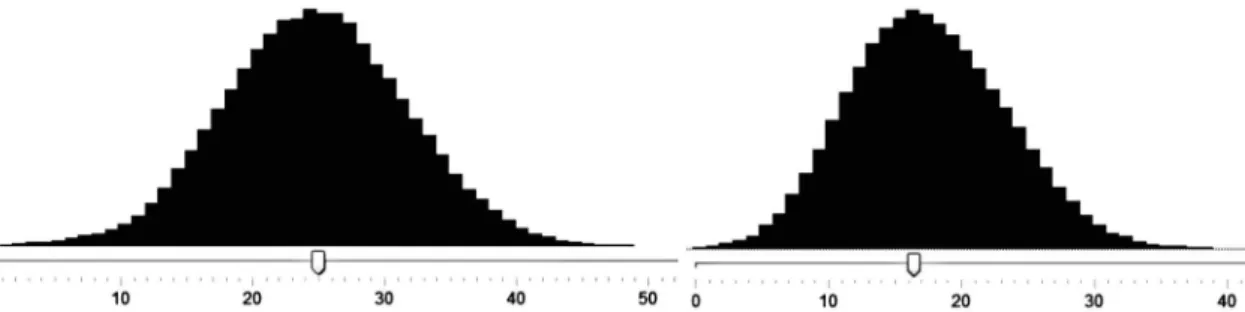
Lucid. This tool analyzes how well different states of characters separate pairs of taxa, and shows the result graphically. With the score analyzer it is also possible to analyze which pairs of taxa in the respective key show fewest differences. In the case of our key, this analysis revealed that, despite the relatively reduced number of characters, most taxa are separated by more than two states, with an average of 25 (Fig. 2a). Besides, even using only vegetative characters, few genera are not separable using the key. Analyzing the key’s efficiency with the score analyzer using only vegetative characters, the genera are separated on average by 16 states of characters (Fig. 2b). It is possible to improve this result by adding more characters, though with diminishing returns, i.e, to achieve a better result it is necessary to analyze several characters. In some cases, it is also necessary to carefully analyze the description of these characters and their states, which many times exhibit subtle differences. For the creation of this kind of key in the Amazon, it seems more promising to accept a certain level of imperfection. In the cases that the key does not reach one, but two or a few taxa, the identification can be carried out through the observation of the images inserted in the key itself, or through the more detailed analysis of herbarium material.
Figure 2
– a-b. Analysis (using the tool score analyzer of
Lucid
) of the number of states of characters that differentiate
Interactive key to genera of the Ducke Reserve 63
Experimenting with this kind of key and additional tests of its efficiency are very desirable. In the case of the key to angiosperm genera of the Uatumã Biological Reserve (in progress), 172 characters with 671 states were used. However, this key is far from being concluded; even with this high number of characters, it remains difficult to identify all genera using only vegetative characters, especially in the cases of families whose generic identification depends on the analysis of very particular characters, such as in Cyperaceae, Orchidaceae, and Poaceae. Since in the long term the objective should be the production of interactive multiple-entry keys for angiosperm genera for much larger areas of the Amazon, we must aim at a balance between effort and result.
Acknowledgements
The present study was made possible thanks to the support of CAPES (Programa PROCAD Amazônia 1544/2006). Our interactive multiple-entry key projects had the initial support of FAPESP (Processes 2002/01424-4 and 2005/01780-3). We thank also the scholarships granted to us (C.S.D.S., M.V.M. and R.L.G.C. by CAPES, M.C.E.A. by CNPq).
References
Araújo, J.S.; Bittrich, V. & Amaral, M.C.E. 2005.
Chave interativa para identificação de famílias de
monocotiledôneas do estado de São Paulo. Available in <http://www.ib.unicamp.br/plantkeys>. Access on 20 Jun 2011.
Bisby, F.A. 2000. The quite revolution: Biodiversity informatics and the internet. Science 289: 2312. Bittrich, V. 2008a. Chaves on-line: modelos, dificuldade
e potencialidades. In: Loiola, M.I.B.; Baseia, G.I.; Lichston, J.A. (orgs.). Atualidades, desafios e perspectivas da botânica no Brasil. Anais do 59º Congresso Nacional de Botânica. Natal, Rio Grande do Norte. Pp. 367-368.
Bittrich, V. 2008b. Gêneros de Guttiferae do Brasil 2008 (website com chave dicotômica). Available in <http://www2.ib.unicamp.br/profs/volker/chaves/ Phoenix/Phoenix%20Guttiferae/Generos%20 de%20Guttiferae%20do%20Brasil.html>. Access on 20 Jun 2011.
Brach, A.R. & Song, H. 2005. ActKey: a web-based
interactive identification key program. Taxon 54:
1041-1046.
Cronquist, A. 1988. The evolution and classification of flowering plants. The New York Botanical Garden, New York. 555p.
Dallwitz, M.J.; Paine, T.A. & Zurcher, E.J. 2005. Principles of interactive keys. Undated and expanded version of a paper presented at a conference on “Computer-based Species Information”, held at the University of Kent at Canterbury, UK, December 1996. Available in <http://delta-intkey.com/www/ interactivekeys.htm>. Access on 20 Jun 2011. Godfray, H.C.J. 2002. Challenges for taxonomy. Nature
417: 17-19.
Hebert, P.D.N.; Cywinska, A.; Ball, S.L. & deWaard, J.R. 2003.Biological identifications through DNA barcodes. Proceedings of the Royal Society of LondonB 270: 313-321.
Hopkins, M.J.G. 2007. Modelling the known and unknown plant biodiversity of the Amazon basin. Journal of Biogeography 34: 1400-1411.
Janzen, D. 2004. Now is the time. Philosophical Transactions of the Royal Society of London B 359: 731-732.
Jarvie, J.K. & Ermayanti. 1995–1996. The tree and shrub genera of Borneo. Available in <http://www. phylodiversity.net/borneo/delta/>. Access on 20 Jun 2011.
Knapp, S.; Polaszek, A. & Watson, M. 2007. Spreading the word. Nature 446: 261-262.
LaPasha, C.A. 1986. General unknown entry and search system reference manual. A program package for microcomputer assisted identification. GUESS version 1.1. Dept. of Wood and Paper Science, School of Forest Resources. North Carolina State University, Raleigh. 116p.
LaPasha, C.A. & Wheeler, E.A. 1987. A microcomputer
based system for computer-aided wood identification.
IAWA Bulletin 8: 347-354.
Lawrence, A. & Hawthorne, W. 2006. Plant identification. Creating user-friendly field guides for biodiversity
management. Earthscan, London. 256p.
Martius, C.F.P; Eichler, A.W. & Urban, I. 1840-1906.
Flora brasiliensis. Munchen, Wien, Leipzig. Vols. 1-15, 40 partes.
May, R.M. 2004. Tomorrow’s taxonomy: collecting new
species in the field will remain the rate-limiting step.
Philosophical Transactions of the Royal Society of London 359: 733-734.
Moretzsohn, F. 2002. TaxonBank, proposal for a new online database for taxonomic research on type specimens. Research Report from the National Institute for Environmental Studies, Japan No. 171. NIES, Tsukuba. Pp. 142-147.
Mori, S.A. 1992. Neotropical floristics and inventory:
who will do the work? Brittonia 44: 372-375. Mori, S.A.; Cremers, G.; Gracie, C.A.; Granville, J.-J.;
64
Memoirs of the New York Botanical Garden 76:
1-422p.
Mori, S.A.; Cremers, G.; Gracie, C.A.; Granville, J-J.; Heald, S.V.; Hoff, M. & Mitchell, J.D. (eds.). 2002. Guide to the vascular plants of Central French Guiana: Part 2. Dicotyledons. Memoirs of the New
York Botanical Garden 76: 1-776.
Pennisi, E. 2000. Taxonomic revival. Science 289: 2306-2308.
Ribeiro, J.E.L.S. 2008. Chaves on-line de acesso múltiplo como recursos para acessar biodiversidade na Amazônia: exemplo do projeto Flora do Uatumã. In: Loiola, M.I.B.; Baseia, G.I.; Lichston, J.A. (orgs.).
Atualidades, desafios e perspectivas da botânica
no Brasil. Anais do 59º Congresso Nacional de Botânica, Natal. Pp. 365-366.
Ribeiro, J.E.L.S.; Hopkins, M.J.G.; Vicentini, A.; Sothers, C.A.; Costa, M.A.S.; Brito, J.M.; Souza,
M.A.; Martins, L.H.; Lohmann, L.G.; Assunção,
P.A.; Pereira, E.C.; Silva, C.F.; Mesquita, M. & Procópio, L.C. 1999. Flora da Reserva Ducke:
guia de identificação das plantas vasculares de uma floresta de terra-firme na Amazônia Central. INPA,
Manaus. 800p.
Schulman, L.; Toivonen, T. & Ruokolainen, K. 2007. Analysing botanical collecting effort in Amazonia and correcting for it in species range estimation. Journal of Biogeography 34: 1388-1399. Souza, V.C. & Lorenzi, H. 2008. Botânica sistemática:
guia ilustrado para identificação das famílias de angiospermas da flora brasileira, baseado em APG
II. Instituto Plantarum, Nova Odessa. 640p. Spooner, D.M. 2009. DNA barcoding will frequently
fail in complicated groups: an example in wild potatoes. American Journal of Botany 96: 1177-1189.
Steyermark, J.A.; Berry, P.E. & Host, B.K. (eds.). 1995-2005. Flora of the Venezuelan Guayana. 9 vols. Missouri Botanical Garden, St. Louis.
Wheeler, Q.D.; Raven, P.H. & Wilson, E.O. 2004. Taxonomy: impediment or expedient? Science 303: 285.