Consequences of Seed Origin and Biological
Invasion for Early Establishment in
Restoration of a North American Grass
Species
Mollie E. Herget1*, Kristina M. Hufford1, Daniel L. Mummey2, Lauren N. Shreading2
1Department of Ecosystem Science and Management, University of Wyoming, Laramie, Wyoming, United States of America,2MPG Ranch, Florence, Montana, United States of America
Abstract
Local, wild-collected seeds of native plants are recommended for use in ecological restora-tion to maintain patterns of adaptive variarestora-tion. However, some environments are so drasti-cally altered by exotic, invasive weeds that original environmental conditions may no longer exist. Under these circumstances, cultivated varieties selected for improved germination and vigor may have a competitive advantage at highly disturbed sites. This study investigat-ed differences in early establishment and seinvestigat-edling performance between wild and cultivatinvestigat-ed seed sources of the native grass,Poa secunda, both with and without competition from the invasive exotic grass,Bromus tectorum. We measured seedling survival and above-ground biomass at two experimental sites in western Montana, and found that the source of seeds selected for restoration can influence establishment at the restoration site. Cultivars had an overall advantage when compared with local genotypes, supporting evidence of greater vigor among cultivated varieties of native species. This advantage, however, declined rapid-ly in the presence ofB.tectorumand most accessions were not significantly different for growth and survival in competition plots. Only one cultivar had a consistent advantage de-spite a strong decline in its performance when competing with invasive plants. As a result, cultivated varieties did not meet expectations for greater establishment and persistence rel-ative to local genotypes in the presence of invasive, exotic species. We recommend the use of representative local or regional wild seed sources in restoration to minimize commercial selection, and a mix of individual accessions (wild, or cultivated when necessary) in highly invaded settings to capture vigorous genotypes and increase the odds native plants will es-tablish at restoration sites.
OPEN ACCESS
Citation:Herget ME, Hufford KM, Mummey DL, Shreading LN (2015) Consequences of Seed Origin and Biological Invasion for Early Establishment in Restoration of a North American Grass Species. PLoS ONE 10(3): e0119889. doi:10.1371/journal. pone.0119889
Academic Editor:Eric Gordon Lamb, University of Saskatchewan, CANADA
Received:October 15, 2014
Accepted:February 1, 2015
Published:March 5, 2015
Copyright:© 2015 Herget et al. This is an open access article distributed under the terms of the Creative Commons Attribution License, which permits unrestricted use, distribution, and reproduction in any medium, provided the original author and source are credited.
Data Availability Statement:The data for this study has been deposited in Dryad. The DOI number for this data is10.5061/dryad.h8n6m.
Introduction
Ecological restoration of native plants depends on successful germination and establishment of seeded species, and the source of seeds for restoration may have consequences for both short-and long-term population viability [1,2]. Intraspecific variation is common within plant spe-cies that occupy a wide geographic range and span different environments [3], [4], and these diverse adaptive traits among populations may be critical for resilience to disturbance [5]. Spe-cies-level diversity may also drive community-level variation leading to broader ecological con-sequences [6–8]. As a result, guidelines for ecological restoration recommend the use of local seed sources to increase the likelihood that plants are adapted to site conditions, maintain ge-netic diversity and improve the long-term sustainability of restored plant populations [2,9].
While local, wild-collected seed is recommended for ecological restoration, its availability is scarce and restoration practitioners frequently purchase commercially produced seed sources to meet native vegetation goals and reduce costs [10,11]. Commercial seeds are often derived from cultivated plant varieties—or cultivars—and generally represent a limited number of pop-ulations of native species that are suitable for agricultural production. Cultivars are selected for improved germination, vigor and competitive ability, and are likely to represent low levels of genetic diversity and novel genotypes relative to remnant populations at restoration sites [12, 13]. Few data are available for the consequences of the use of cultivars in restoration, but recent evidence suggests that cultivated varieties differ from local genotypes in morphological and physiological traits, and may alter patterns of dominance within plant communities [8,14,15]. Large-scale introductions of novel genotypes may therefore have unintended consequences, such as the swamping of local genotypes, and altered community structure and function [1,8].
Recommendations to use locally adapted seed sources are based on the assumption that the environmental conditions to which plants are adapted remain relatively unchanged. However, some areas are so drastically altered by exotic, invasive weeds that original environmental con-ditions may no longer exist [16,17]. Because of their increased vigor, cultivars may have a com-petitive advantage at highly invaded restoration sites and the assumption that local genotypes are better adapted to site conditions than cultivars may no longer hold [18–20]. In light of widespread biological invasion, the geographic origin and genetic composition of seed stock may have significant consequences for restoration outcomes [1,21]. Both the advantages and drawbacks of using cultivars and local genotypes for restoration require further investigation in the field.
The spread ofBromus tectorumL. (cheatgrass or downy brome) in North America is a well-documented example of land conversion as a result of biological invasion [22].Bromus tec-torumcurrently dominates millions of acres of grassland in the Intermountain West and repre-sents a significant challenge for the restoration of native plant species [23].Bromus tectorumis a winter annual and has a competitive advantage over native plants that germinate later during the growing season [24]. Stands ofB.tectorumare also responsible for increased fire frequency, which can significantly alter both abiotic and biotic conditions at restoration sites [16]. Thus, the choice of appropriate seed sources for restoration may benefit from investigations of intra-specific variation and the performance of native plants in environments altered by biological invasion [25].
This study investigated the early seedling establishment and performance of wild and culti-vated seed sources ofPoa secundaJ. Presl (Sandberg bluegrass) at sites impacted byB. tec-torum.Poa secundais a native, cool-season perennial grass commonly targeted for restoration because of its vast distribution [26] and potential ability to establish and compete for resources at sites invaded by exotic species [27]. We asked two questions relevant for grassland restora-tion: 1) Does the performance of wild seed sources differ significantly from cultivated seed analysis, decision to publish, or preparation of the
manuscript. The specific roles of these authors are articulated in the‘author contributions’section.
sources? 2) Are cultivars more likely than their wild relatives to establish and persist in the presence of invasive, exotic weeds? If seed origin affects plant performance, the choice of seeds for reintroduction may represent an important consideration in restoration planning. At the same time, if evidence suggests cultivars are more likely to persist in the presence ofB. tec-torum, the selection of suitable seed sources may change with the level of invasion at the restoration site.
Materials and Methods
Study Area
We conducted this study at MPG Ranch, a conservation property consisting of 9,500 acres in western Montana (Fig. 1). The ranch is located on the west-facing slope of the Bitterroot Valley in the Northern Rocky Mountains. Prior to 2009, MPG Ranch had been used for agricultural production and livestock grazing for more than a century. Since that time, livestock have been removed and the majority of crop fields are out of production. Dominant native species present in MPG grasslands arePseudoroegneria spicata(Pursh) Á. Löve,Festuca idahoensisElmer,
Fig 1. Origin of eachPoa secundaaccession.On the left is the distribution ofPoa secundain the contiguous western United States (shaded area; adapted from Stubbendieck, Hatch & Bryan 2011). The location of the MPG Ranch field site is indicated by the triangle. Circles indicate the origin locations of the cultivated accessions. To the right is an aerial image of MPG Ranch property lines. Circles mark the locations of the three wild seed source origins (MPG accessions 5, 10 and 15). The two experimental sites are indicated by squares.
Koeleria macrantha(Ledeb.) Schultes, andPoa secunda. Invasive species are widespread and includeCentaurea stoebeL.,Poa bulbosaL. andB.tectorum.
Our experiment was conducted at two sites at MPG Ranch to evaluate the interactions of local environmental conditions and competition by exotic invasive plants with wild and culti-vated accessions ofP.secunda. The first (Lower) site was located at an elevation of 998 m and consisted of sandy loam soil having an average pH of 6.3. Prior to establishment of the experi-mental plots, the area had been used for soybean production. The second (Upper) site was lo-cated 1,023 m further up-slope, at an elevation of 1,076 m and consisted of loam soil with an average pH of 6.6. The Upper Site had previously been dominated byAgropyron cristatum(L.) Gaertn, (crested wheatgrass) with aP.bulbosaunderstory and used as pasture for cattle. His-torical climate data for the area available from the PRISM Climate Group (2012) recorded an average annual precipitation of approximately 35 cm and a mean annual temperature of 7°C (range of -9–30°C). For the duration of this study, annual precipitation logged at the nearest MPG Ranch weather station was approximately 20 cm and the mean temperature was 9°C (-17–37°C).
Study Species
Poa secundais an important component of sagebrush steppe and temperate grassland vegeta-tion in the western United States [28]. A native perennial bunchgrass,P.secundaserves as a primary source of forage for both wildlife and livestock at the beginning of the growing season [29].Poa secundaoccurs from Alaska through the Intermountain West and Great Plains states. Individuals of Sandberg bluegrass germinate early in the spring, and reproduce by tillering and seed maturation in early summer. Seed production is commonly the result of apomixis, but outcrossed pollination and subsequent self-fertilization contribute to distinct genetic lines [30].
Three U.S. Department of Agriculture selected varieties (hereafter,“cultivars”) were includ-ed in the study because of their recommendinclud-ed use in the study region and similar, early-maturing attributes within theP.secundacomplex [26]. These cultivars included“High Plains Germplasm”(HP) with origins in Wyoming,“Mountain Home Germplasm”(MH) with ori-gins in Idaho, and“Reliable”(RE) from Washington State (Table 1;Fig. 1). Cultivars were com-pared with three wild accessions (MPG-5, MPG-10, MPG-15) derived from sites that differed in elevation, aspect, and surrounding plant community. Both wild Sandberg bluegrass and Table 1. Site characteristics at the location of origin for eachPoa secundawild and cultivated accession.
Accession Approximate Location Latitude, Longitude
Elevation (m)
Plant Community Annual
Temp. (°C)
Annual Precip. (cm)
MPG-5 Florence, MT 46° 41035" N, 114° 105" W
1,144 Bromus tectorum,Hesperostipa comata,
Aristida purpurea
7.0 35.0
MPG-10 Florence, MT 46° 40018@N, 114° 1043@W
1,026 Pseudoroegneria spicata,Bromus tectorum,
Poa bulbosa
“ “
MPG-15 Florence, MT 46° 42050@N, 113° 59049@W
1,333 Thinopyrum intermedium,Bromus tectorum,
Pseudoroegneria spicata
“ “
High Plains Casper, WY, Granger, WY, Gillette, WY
42° 47037@N, 107° 35054@W
1,647 Hesperostipa comata,Pascopyrum smithii,
Bouteloua gracilis
8.3 26.7
Mountain Home
Mountain Home, ID 42° 5204@N, 115° 34057@W
900 Elymus elymoides,Bromus tectorum,
Sisymbrium altissimum
9.5 20.0
Reliable Yakima, WY 46° 45040@N, 120° 11029@W
639 Pseudoroegneria spicata,Artemisia tridentate wyomingensis,Achillea millefolium
occidentalis
11.6 21.0
cheatgrass seeds were collected at MPG Ranch during the summer of 2012 and subsequently stored at room temperature (15–25°C) until planting.
Experimental Design
We established and seeded our study sites in early fall 2012. The two sites were initially disked, chain harrowed, and raked to remove existing vegetation and litter to ensure a smooth and even seedbed. Fencing was installed around the perimeter of each experimental site to prevent herbivory by large ungulates.
The experiment was organized as a randomized complete block design with five paired-plot replicates at both study sites, resulting in ten plots per site (S1 Fig.). One plot of each pair was either weed-free or planted withB.tectorum(hereafter,Bromusor brome). Brome seeds were broadcast into experimental plots at a rate of 7,600 pure live seed m-2[31,32] and incorporated
into the soil by raking before planting Sandberg bluegrass. Subsequently, all sixPoa secunda (hereafter,Poa) accessions were replicated 50 times within each plot, and planted in random order at intervals of 30 cm to avoid intraspecific competition. To account for viability differ-ences among seed sources, four seeds of the same accession were planted per replication to en-sure high germination rates in the spring [33]. A color-coded toothpick was then placed in the center of the four planted seeds to aid in locating the plants and to identify which accession had been planted. When plants emerged in early spring, the four seedlings were thinned to one plant per replication. Due to drought conditions, plots were watered during the first week of May with a one-time application of approximately 30 ml applied to each plant via a
sprinkler system.
Each plot had dimensions of 1.8 x 15 m and each pair of weed-free and competition plots was separated by 1 m. All plots contained a 45 cm wide buffer around the edge; buffer zones were cleared for weed-free plots, and planted withBromusfor competition plots to avoid edge effects. This experimental design resulted in a total of 300Poaplants possible (50 replications for the 6 accessions) per plot.
Sampling Method
Experimental plots were surveyed for germination during spring 2013 after seeds had overwin-tered. A survey of survival was subsequently conducted once every 3 weeks during the spring/ summer growing season, resulting in four surveys for all experimental plots. A plot-wide survey ofBromuscanopy cover was taken at its maximum production period in July to determine if levels of competition were even between study sites.Bromuscover was measured using Dau-benmire’s six cover classes [34]. Sites were cleared of all non-experimental vegetation between surveys to ensure that relatively little competition occurred in the weed-free plots, and that competition was due to the presence of brome in the weed plots. At the same time, we noted the presence or absence of herbivory for each plant surveyed. At the end of the growing season, aboveground biomass for allPoaplants was clipped and dried in an oven at 60°C for three days. Dry weights for aboveground biomass were measured to 0.0001 g using an analytical bal-ance (Mettler Toledo, Columbus, OH, U.S.A.).
Statistical Analyses
(n50). Prior to analyses, survival data were arcsine square-root transformed and biomass data were log transformed to satisfy assumptions of statistical tests [35].
The repeated-measures data for survival were analyzed using a split-plot analysis of variance (ANOVA) where block was nested within site. Block was considered a random factor and ac-cession, site, and competition treatment were analyzed as fixed factors. The repeated measures model incorporated compound symmetry covariance structure which resulted in the smallest Akaike’s Information Criterion [36].
A split-plot, mixed-model ANOVA (block nested within site) was used to calculate the sig-nificance of main and interaction effects for above-ground biomass of each cultivated and wild seed source between weed-free and competition plots. Block was treated as a random factor and accession, site, and competition treatment were analyzed as fixed factors. All calculations for survival and biomass data were made using the MIXED procedure in SAS version 9.3.1, using an alpha of 0.05 (SAS Institute Inc., Cary, NC, U.S.A.). The presence or absence of small mammal herbivory was added to the models as a covariate. Degrees of freedom were estimated using Satterwaite’s method [36] and paired comparisons were made using least-squares means. We tested assumptions of higher vigor among cultivars relative to wild populations with con-trasts of the pooled seed sources (i.e. wild versus cultivar) and also examined the performance of individual cultivar and wild accessions.
As a last step, we assessedBromuscover to ensure that the level of competition was consis-tent among all treatment plots in the study. The midpoint of the Daubenmire cover class range was averaged across each treatment plot. AverageBromuscover values were compared to de-termine if cover class was significantly different among competition plots.
Results
A total of 2,627 seeds germinated and established, and 1,773 were monitored after thinning to one plant per replication. One of the wild seed sources (MPG-5) had near-zero rates of germi-nation and as a result, this seed source was removed from analyses. Despite efforts to account for differences in seed viability, cultivated seeds had higher rates of seedling emergence when compared with the two wild seed sources (0.48 vs. 0.15,P<0.001). This outcome may reflect
differences in the viability or germination and establishment of seeds among accessions. Her-bivory was noted during the final two surveys, and was likely caused by small rodents. Approx-imately 21% of experimentalPoaplants were impacted by herbivory at the time of the third survey, and this number increased to 28% by the fourth and final survey. AverageBromus can-opy cover for competition plots ranged from 46–69%. Plot cover differences were not signifi-cant and we included competition effects in analyses measured as the presence or absence of brome.
Survival
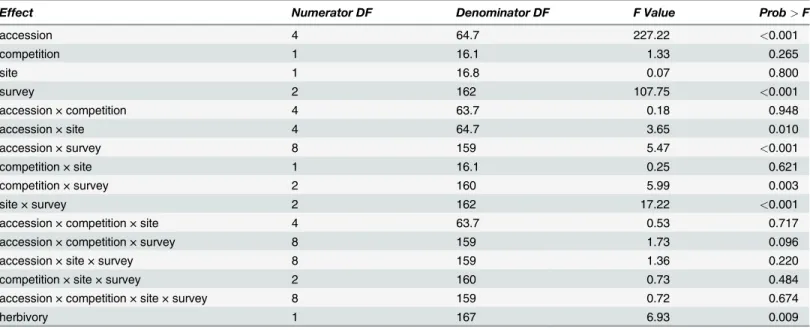
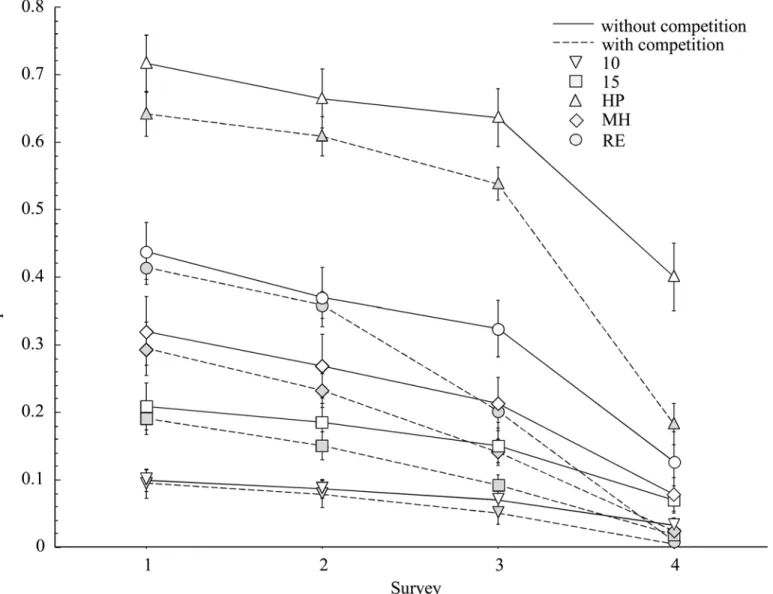
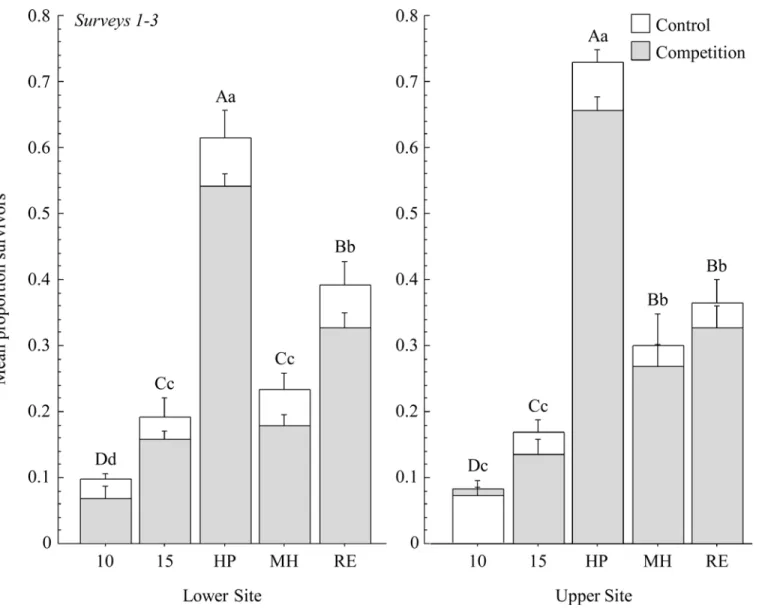
Results of the repeated measures analysis for surveys 1–3 revealed significant differences in seedling survival for the interactive effects of accession, site, survey, and competition treatment (Table 2). Survival differed among eachPoaaccession (P<0.001), and in all cases, survival
de-clined over time (Fig. 2). We did not detect a significant effect of competition with brome for Poasurvival early in the growing season (Fig. 3). Overall, cultivars were more likely to survive than wild accessions (P<0.001) and survival of HP seedlings was greater than all other
culti-vated and wild accessions combined (P<0.001).
At the end of the growing season, survival was significantly impacted by the interaction of Poaaccession, competition treatment and differences between experimental sites (Table 3). Of note was the significant competition effect in weed plots (Fig. 4). Survival rates were lower for Poaseedlings grown withBromuslater in the season when plants were larger and competition for resources was greater. Survival rates were higher for all seed sources in weed-free plots at the Lower Site relative to competition plots. However, no differences were detected for any of the five seed sources at the Upper Site when survival in weed-free plots was compared with competition plots. Herbivory was greater at the Upper Site over the growing season, although this effect was not significant for survival at the final survey.
Cultivars were more likely to survive than wild plants by the time of the last survey
(P<0.001), although that effect was solely the result of greater survival of the HP cultivar
(cul-tivar vs. wild when HP removed,P= 0.207). Among accessions, the HP cultivar had the great-est number of survivors regardless of site or competition treatment (P<0.001). We also noted
that survival of MPG-15 seedlings did not differ significantly from MH and RE seedlings, sug-gesting that some wild populations may perform as well as some cultivated accessions. Only MPG-10 and MH had a similar proportion of survivors in competition and weed-free plots. However, the number of survivors was low for these two accessions and we were unable to de-termine if this effect was due to the ability of these accessions to tolerateBromus, or the result of a lack of statistical power.
Table 2. Repeated measures analysis of seed source, competition treatment, and planting location effects onPoa secundaproportion survival for surveys 1–3.
Effect Numerator DF Denominator DF F Value Prob>F
accession 4 64.7 227.22 <0.001
competition 1 16.1 1.33 0.265
site 1 16.8 0.07 0.800
survey 2 162 107.75 <0.001
accession × competition 4 63.7 0.18 0.948
accession × site 4 64.7 3.65 0.010
accession × survey 8 159 5.47 <0.001
competition × site 1 16.1 0.25 0.621
competition × survey 2 160 5.99 0.003
site × survey 2 162 17.22 <0.001
accession × competition × site 4 63.7 0.53 0.717
accession × competition × survey 8 159 1.73 0.096
accession × site × survey 8 159 1.36 0.220
competition × site × survey 2 160 0.73 0.484
accession × competition × site × survey 8 159 0.72 0.674
herbivory 1 167 6.93 0.009
To sum, we noted significant differences in survival among the five accessions for both ex-perimental sites, and survival differences between weed-free and competition plots for the Lower Site, at the fourth survey. The significant 3-way interaction at the final survey between site, accession and competition effects was explained by greater rates of herbivory at the Upper Site later in the growing season. The Upper Site was in a more remote location than the Lower Site, and it is likely thatPoaseedlings were exposed to greater rates of herbivory in weeded plots, resulting in similar numbers of surviving seedlings between weed-free and competition plots over time.
Biomass
Poabiomass was significantly influenced by accession and statistical interactions between ac-cession, experimental site, and competition treatment (Table 4). Cultivars had greater biomass relative to wild plants (P= 0.025), although that effect was no longer significant when the HP cultivar was removed from the contrast (P= 0.482). HP produced the greatest average biomass Fig 2. Average proportion survival perPoa secundaaccession between non-competing and competing plants over time (±1 SE).
Fig 3. Average proportion survival per accession for surveys 1–3 between non-competing and competing plants (+ 1 SE).Different uppercase
letters denote significant differences among non-competing accessions and lowercase letters denote differences among competing accessions. At the Upper Site, MPG-10 had a smaller mean proportion of survivors when grown alone, compared to when grown in competition.
doi:10.1371/journal.pone.0119889.g003
Table 3. ANOVA ofPoa secundaproportion survival for survey 4.
Effect Numerator DF Denominator DF F Value Prob>F
accession 4 37.8 33 <0.001
competition 1 14.7 8.08 0.013
site 1 13.4 2.71 0.123
accession × competition 4 34.2 2.87 0.037
accession × site 4 35.4 1.16 0.343
competition × site 1 8.14 8.14 0.021
accession × competition × site 4 33.1 4.12 0.008
herbivory 1 66.7 1.6 0.210
Fig 4. Average proportion survival per accession at survey 4 between non-competing and competing plants (+ 1 SE).Asterisks denote significances within accessions between competition treatments. Different uppercase letters denote significant differences among non-competing accessions and lowercase letters denote differences among competing accessions. At the Upper Site, Mountain Home had a smaller mean proportion of survivors when grown alone, compared to when grown in competition
doi:10.1371/journal.pone.0119889.g004
Table 4. ANOVA ofPoa secundaaverage biomass.
Effect Numerator DF Denominator DF F Value Prob>F
accession 4 16.8 6.61 0.002
competition 1 7.47 2.78 0.137
site 1 7.21 4.62 0.068
accession × competition 4 48 2.72 0.041
accession × site 4 49 4.72 0.003
competition × site 1 3.76 16.59 0.017
accession × competition × site 4 49 0.75 0.564
herbivory 1 50.4 36.05 <0.001
compared to all other accessions (P= 0.0004). On average, the five accessions produced more biomass at the Lower Site than the Upper Site, but this difference was only significant for MPG-15. At the Lower Site, wild accessions performed as well as a subset of cultivars (MPG-15 performed as well as HP and MH, and MPG-10 was similar to MH and RE), while MPG-15 was similar to cultivars MH and RE at the Upper Site. Regardless of accession, competition withBromusnegatively affectedPoabiomass at the Lower Site (P= 0.003). However, there was no effect of competition at the Upper Site (P= 0.237), and this was likely the result of high lev-els of herbivory that reduced biomass ofPoain weed-free plots by the final survey. Biomass did not differ between sites in competition plots.
Regardless of site, HP yielded the greatest biomass compared to all other accessions when in competition withBromus(P<0.001;Fig. 5). Cultivars, overall, produced significantly more
biomass compared to wild plants when in competition (P= 0.007), but this effect was due to the performance of HP (cultivar vs. wild when HP removed,P= 0.232). Wild accessions did
Fig 5. Average aboveground biomass of surviving plants at survey 4 per accession between non-competing and competing plants (+ 1 SE).
Asterisks denote significance within accessions between competition treatments. Different uppercase letters denote significant differences among non-competing accessions, and lowercase letters denote differences among non-competing accessions.
not differ from cultivars in weed-free plots (P= 0.372). Both wild accessions performed as well as at least two cultivars in weed-free plots (MPG-15 was similar to all three cultivars, while MPG-10 was similar to MH and RE), and they performed as well as one or more cultivars in competition plots (MPG-15 was similar to MH and RE, while MPG-10 matched RE). Three ac-cessions (HP, MH and MPG-15) produced similar amounts of biomass between weed-free and competition plots, while two accessions (MPG-10 and RE) produced significantly lower bio-mass in competition plots relative to weed-free plots.
Discussion
In the present study, we investigated seedling establishment and growth among local and culti-vated genotypes ofPoa secundaat sites impacted by cheatgrass invasion. We noted differences in performance among seed sources for measured variables in nearly all cases, suggesting that the source of seeds can have a significant impact on plant performance and, as a result, restora-tion outcomes [37]. Mean biomass and survival of cultivars was greater than wild plants on av-erage, and these results reflect the increased vigor documented for cultivars relative to wild populations (e.g. [14,38]). Differences in vigor were also apparent between local accessions, and MPG-15 had higher fitness and increased seed viability relative to MPG-10. Among the five accessions, performance of the High Plains cultivar was distinctive. High Plains seedlings maintained their overall performance advantage in both weed-free and competition plots. The High Plains cultivar was originally derived from high elevation sites with a semi-arid climate, which may have been an advantage when the plants were grown at exposed sites in this study [39]. Experimental plots imitated seedbeds for ecological restoration and likely represented rel-atively low soil moisture and extremes in temperature range, which negrel-atively impact seedling establishment [40].
Competition effects inBromusplots were only apparent late in the growing season and were significant at the final survey. This indicated a window of opportunity to minimize competition with weeds when restoration sites are cleared prior to seeding, and thereby improve establish-ment of desired species with continued manageestablish-ment of exotics [41,42]. Despite the overall ad-vantage of cultivars, in each test, one or more wild accessions performed as well when
compared to one or more cultivated accessions, particularly in competition plots. In addition, seedling performance also varied among cultivars and between the two wild seed sources. While High Plains seedlings had the greatest vigor among accessions in competition plots, the performance of Mountain Home seedlings exhibited the smallest decline in the presence of Bromusfor all measured variables, indicating its potential for tolerance of invasive species. One of Mountain Home’s reported uses is in post-fire restoration ofBromusdominated landscapes [43], and the competitive ability of this cultivar warrants further investigation in the field.
Environmental conditions such as soil, slope, precipitation, and elevation may have influ-enced differences in seedling performance between experimental sites. Low emergence rates across accessions could be explained by the drier than normal conditions that year. Early in the field season, survival of experimental plants was greater at the Upper Site where loam soils had more potential for moisture retention relative to sandy loam soil at the Lower Site [47]. During the second half of the growing season, plant performance at the Upper Site declined rapidly when compared to the Lower Site, and this was likely a result of differences in slope and rates of herbivory. Herbivory obscured variation among seed sources at the Upper Site, suggesting that grazing may reduce the advantage of dominant genotypes in the short term [48].
In summary, we found that these three cultivars had an overall advantage over local geno-types, supporting evidence of greater vigor among cultivated varieties of native species. This advantage, however, declined rapidly in the presence ofBromusand most accessions were not significantly different for growth and survival in competition treatments. Only the HP cultivar had an advantage, and the rapid decline in its performance in the presence ofBromusindicated this advantage may decline over time and requires further investigation. As a result, cultivated varieties as a group did not meet our expectations for greater establishment and persistence rel-ative to local plants in the presence of invasive, exotic species. Other control measures would be needed to reduce competition with invasive plants, and promote the early establishment of desirable, native vegetation (e.g. herbicide; [49]). Additionally, numerous studies suggest that the differences in vigor between cultivated and non-cultivated varieties can impact communi-ty-level interactions and population dynamics [7,8,50] (but see [51]). Non-cultivated, wild populations therefore remain the best choice to maintain population genetic diversity and avoid risks of large-scale introductions of non-local genotypes [1]. Measures should be taken to ensure high viability of seed stock before planting to improve establishment.
In cases where sites are heavily impacted by invasive species and other control measures are not feasible or are ineffective, our results suggest cultivated varieties may provide some advan-tage for establishment of natives. However, the ability to discern among cultivars is difficult un-less data are available for competitive dominance and overall vigor (such as in the case of High Plains). If no data are available, the use of multiple cultivar accessions might increase the odds of including highly competitive genotypes in the restoration seed mix. This strategy, however, is not without risks and would be most useful in highly invaded settings. In contrast, if restora-tion sites are contiguous with undisturbed plant communities and/or exotic species are not pre-dominant, we recommend the use of a composite seed mix representing appropriate local or regional variation either via wild collections or limited field production of region-specific varie-ties to avoid directional selection and altered patterns of genetic variation. This approach would maintain intraspecific patterns of genetic diversity, increase the odds of including vigor-ous wild genotypes, and may improve plant community diversity as well as resistance to biolog-ical invasion [6–8,52].
Supporting Information
S1 Fig. Experimental design of each study site.Each site contained five blocks (Block 1–5), split (Plot A or B) between one weed-free plot (white border) and one paired cheatgrass plot (shaded border). Every plot contained 50 replicates of all sixPoa secundaaccessions, placed randomly within each plot (each small square cell within a plot corresponded to onePoa repli-cation).
S1 Table. Repeated measures analysis of seed source, competition treatment, and planting location effects onPoa secundaproportion survival for surveys 1–4.
(DOCX)
Acknowledgments
We thank the staff and scientists at MPG Ranch for their invaluable support with field site in-stallation and surveys, and the University of Wyoming Restoration Genetics lab students who aided in data collection. P. Stahl and B. Mealor provided logistical support and guidance with the experimental design, while D. Legg generously provided statistical support.
Author Contributions
Conceived and designed the experiments: MH KH DM LS. Performed the experiments: MH KH DM LS. Analyzed the data: MH KH DM LS. Contributed reagents/materials/analysis tools: MH KH DM LS. Wrote the paper: MH KH DM LS.
References
1. Hufford KM, Mazer SJ. Plant ecotypes: genetic differentiation in the age of ecological restoration. Trends Ecol Evol. 2003; 18: 147–155.
2. McKay J, Christian CE, Harrison S, Rice KJ.“How local is local?”—A review of practical and conceptual issues in the genetics of restoration. Restor Ecol. 2005; 13: 432–440.
3. Linhart YB, Grant MC. Evolutionary significance of local genetic differentiation in plants. Annu Rev Ecol Syst. 1996; 27: 237–277.
4. Leimu R, Fischer M. A meta-analysis of local adaptation in plants. PLoS One. 2008; 3: e4010. doi:10. 1371/journal.pone.0004010PMID:19104660
5. Reusch TBH, Ehlers A, Hämmerli A, Worm B. Ecosystem recovery after climatic extremes enhanced by genotypic diversity. Proc Natl Acad Sci U S A. 2005; 102: 2826–2831. PMID:15710890
6. Hughes AR, Stachowicz JJ. Genetic diversity enhances the resistance of a seagrass ecosystem to dis-turbance. Proc Natl Acad Sci U S A. 2004; 101: 8998–9002. PMID:15184681
7. Gibson DJ, Allstadt AJ, Baer SG, Geisler M. Effects of foundation species genotypic diversity on subor-dinate species richness in an assembling community. Oikos. 2012; 121: 496–507.
8. Gustafson DJ, Major C, Jones D, Synovec J, Baer SG, Gibson DJ. Genetic sorting of subordinate spe-cies in grassland modulated by intraspecific variation in dominant spespe-cies. PLoS One. 2014; 9: e91511. doi:10.1371/journal.pone.0091511PMID:24637462
9. Bischoff A, Steinger T, Müller-Schärer H. The importance of plant provenance and genotypic diversity of seed material used for ecological restoration. Restor Ecol. 2008; 18: 338–348.
10. Burton PJ, Burton CM. Adaptive genotype strategy promoted and tested in nursery field plots studies and plantings in British Columbia. Ecol Rest. 2002; 20: 117–123.
11. Smith SL, Sher AA, Grant TA III. Genetic diversity in restoration materials and the impacts of seed col-lection in Colorado’s restoration plant production industry. Restor Ecol. 2007; 15: 369–374.
12. Allard RW. Genetic changes associated with the evolution of adaptedness in cultivated plants and their wild progenitors. J Hered. 1988; 79: 225–238. PMID:3166481
13. Johnson RC, Erickson VJ, Mandel NL, St Clair JB, Vance-Borland KW. Mapping genetic variation and seed zones forBromus carinatusin the Blue Mountains of eastern Oregon, USA. Botany. 2010; 88: 725–736.
14. Klopf RP, Baer SG. Root dynamics of cultivar and non-cultivar population sources of two dominant grasses during initial establishment of tallgrass prairie. Restor Ecol. 2011; 19: 112–117.
15. Schröder R, Prasse R. Do cultivated varieties of native plants have the ability to outperform their wild relatives? PLoS One. 2013; 8: e71066. doi:10.1371/journal.pone.0071066PMID:23951081 16. D’Antonio CM, Vitousek PM. Biological invasions by exotic grasses, the grass/fire cycle, and global
change. Annu Rev Ecol Syst. 1992; 23: 63–87.
18. Lesica P, Allendorf FW. Ecological genetics and the restoration of plant communities: mix or match? Restor Ecol. 1999; 7: 42–50. PMID:10030623
19. Wilkinson DM. Is local provenance important in habitat creation? J Appl Ecol. 2001; 38: 1371–1373.
20. Jones TA. When local isn’t best. Evol Appl. 2013; 6: 1109–1118. doi:10.1111/eva.12090PMID:
24187591
21. Gustafson DJ, Gibson DJ, Nickrent DL. Using local seeds in prairie restoration—data support the para-digm. Native Plants J. 2005; 6: 25–28.
22. Mack RN. Invasion ofBromus tectorumL. into Western North America: an ecological chronicle. Agro-Ecosystems. 1981; 7: 145–165.
23. Brown CS, Anderson VJ, Claassen VP, Stannard ME, Wilson LM, Atkinson SY, et al. Restoration ecolo-gy and invasive plants in the semiarid West. Invasive Plant Sci Manag. 2008; 1: 399–413.
24. Aguirre L, Johnson DA. Influence of temperature and cheatgrass competition on seedling development of two bunchgrasses. Journal of Range Management. 1991; 44: 347–354.
25. Leger EA. The adaptive value of remnant native plants in invaded communities: an example from the Great Basin. Ecol Appl. 2008; 18: 1226–1235. PMID:18686583
26. Majerus M, Holzworth L, Tilley D, Ogle D, Stannard M Plant Guide for Sandberg bluegrass (Poa secunda J. Presl). US Natural Resources Conservation Service. Aberdeen, ID: Idaho Plant Materials Center. 2009. Available:http://plants.usda.gov/plantguide/pdf/pg_pose.pdf.
27. Monsen SB, Stevens R, Shaw N. Grasses. In: Restoring Western Ranges and Wildlands, vol 2. USDA Forest Service. Fort Collins, CO: Rocky Mountain Research Station. 2004. pp. 295–424.
28. Peterson JS. Plant Fact Sheet: Sandberg bluegrass (Poa secundaJ. Presl). US Natural Resource Con-servation Service. Washington, DC: Plant Materials Program. 2002. Available:http://plants.usda.gov/ factsheet/pdf/fs_pose.pdf.
29. Stubbendieck J, Hatch SL, Bryan NM. North American Wildland Plants: A Field Guide. 2nd ed. Lincoln: University of Nebraska Press; 2011.
30. Kellogg EA. A biosystematics study of thePoa secundacomplex. J Arnold Arbor. 1985; 66: 201–242.
31. Griffith AB. Positive effects of native shrubs onBromus tectorumdemography. Ecology. 2010; 91: 141–154. PMID:20380204
32. Humphrey LD, Schupp EW. Competition as a barrier to establishment of a native perennial grass ( Ely-mus elymoides) in alien annual grass (Bromus tectorum) communities. J Arid Environ. 2011; 58: 405–
422.
33. Hironaka M, Tisdale EW. Growth and development ofSitanion hystrixandPoa sandbergii. U.S. Interna-tional Biological Program, Desert Biome, Research Memorandum 72–24. Logan, UT: Utah State Uni-versity; 1972.
34. Daubenmire R. A canopy-coverage method of vegetational analysis. Northwest Sci. 1959; 33: 43–64.
35. Zar JH Biostatistical Analysis. 4th ed. New Jersey: Prentice-Hall; 1999.
36. Littell RC, Milliken GA, Stroup WW, Wolfinger R, Schabenberger O. SAS for Mixed Models. 2nd ed. Cary, NC: SAS Institute, Inc.; 2006.
37. Mijnsbrugge KV, Bischoff A, Smith B. A question of origin: where and how to collect seed for ecological restoration. Basic Appl Ecol. 2010; 11: 300–311.
38. Gustafson DJ, Gibson DJ, Nickrent DL. Competitive relationships ofAndropogon gerardii(Big Blue-stem) from remnant and restored native populations and select cultivated varieties. Funct Ecol. 2004; 18: 451–457.
39. Weißhuhn K, Auge H, Prati D. Geographic variation in the response to drought in nine grassland spe-cies. Basic Appl Ecol. 2011; 12: 21–28.
40. Banerjee MJ, Gerhart VJ, Glenn EP. Native plant regeneration on abandoned desert farmland: effects of irrigation, soil preparation, and amendments on seedling establishment. Restor Ecol. 2006; 14: 339–
348.
41. Bakker JD, Wilson SD, Christian JM, Li X, Ambrose LG, Waddington J. Contingency of grassland resto-ration on year, site, and competition from introduced grasses. Ecol Appl. 2003; 13: 137–153.
42. Sher AA, Gieck S, Brown CS, Nissen SJ. First-year responses of cheatgrass followingTamarixspp. control and restoration-related disturbances. Restor Ecol. 2008; 16: 129–135.
44. Bischoff A, Cremieux L, Smilauerova M, Lawson CS, Mortimer SR, Dolezal J, et al. Detecting local ad-aptation in widespread grassland species—the importance of scale and local plant community. J Ecol. 2006; 94: 1130–1142.
45. Rice KJ, Knapp EE. Effects of competition and life history stage on the expression of local adaptation in two native bunchgrasses. Restor Ecol. 2008; 16: 12–23.
46. Stevens JM, Fehmi JS. Early establishment of a native grass reduces the competitive effect of a non-native grass. Restor Ecol. 2011; 19: 399–406.
47. Gupta SC, Larson WE. Estimating soil water retention characteristics from particle size distribution, or-ganic matter percent, and bulk density. Water Resour Res. 1979; 15: 1633–1635.
48. Hufford KM, Mazer SJ. Camara MD. Local adaptation and effects of grazing among seedlings of two native California bunchgrass species: implications for restoration. Restor Ecol. 2008; 16: 59–69.
49. Rafferty DL, Young JA. Cheatgrass competition and establishment of desert needlegrass seedlings. J Range Manage. 2002; 55: 70–72.
50. Booth RE, Grime JP. Effects of genetic impoverishment on plant community diversity. J Ecol. 2003; 91: 721–730.
51. Baer SG, Gibson DJ, Gustafson DJ, Benscoter AM, Reed LK, Campbell RE, et al. No effect of seed source on multiple aspects of ecosystem functioning during ecological restoration: cultivars compared to local ecotypes of dominant grasses. Evol Appl. 2014; 7: 323–335. doi:10.1111/eva.12124PMID:
24567751