Adoption of the International Accounting Standard by Small and
Medium-Sized Entities and its Effects on Credit Granting
Enrico Dalla Riva
Universidade de São Paulo, Faculdade de Economia, Administração e Contabilidade, Departamento de Contabilidade e Atuária, São Paulo, SP, Brazil
Bruno Meirelles Salotti
Universidade de São Paulo, Faculdade de Economia, Administração e Contabilidade, Departamento de Contabilidade e Atuária, São Paulo, SP, Brazil
Received on 12.12.2013 – Desk acceptance on 02.16.2014 – 4th version approved on 06.11.2015
ABSTRACT
This research examines the relationship between the adoption of the international accounting standard by small and medium-sized entities in Brazil and the cost of credit granted by financial institutions. The literature about this subject discusses accounting regulation as a response to the existence of environments having information asymmetry and the Disclosure Theory studies the phenomenon of accounting disclosure, from the viewpoint of its causes and effects. The International Accounting Standards Board (IASB) suggests that an accounting standard with higher information quality tends to reduce the funding cost for small enterprises and, thus, this paper has as its main aim investigating whether the adoption of the international accounting standard has caused some effect on the cost of banking credit. The investigation was conducted through a theoretical and empirical approach, where the statistical analyses involved a sample of 179 enterprises subject to the Brazilian Technical Pronouncement – Accounting for Small and Medium-Sized Entities (CPC-SMEs), which underwent descriptive analysis, sample means testing, panel data analysis, and quantile regressions, with data from financial statements for three years (2009 to 2011). Evidence suggests a weak association between measures of the accounting information quality (disclosure and exposure of the adoption of the accoun-ting standard based on the CPC) and the cost of banking credit for these enterprises. However, such evidence did not prove to be consistent over time and, furthermore, through regression analysis, the variables were not significant. So, it is possible to observe only a slight influence of accounting information in the sector under analysis, at least at this very first moment of changes in the accounting standards, on the cost of banking credit. Thus, this study contributes to examine the relationship between accounting information quality and the cost of banking credit among small and medium-sized entities.
1 INTRODUCTION
2010; Neag et al., 2009; Pacter, 2009); and (iv) identifica-tion of users of accounting informaidentifica-tion, as well as issues concerning the size of small businesses, especially mi-cro-enterprises, and the influence of tax legislation (Le-normand et al., 2012), explored in the literature review.
Subsequently, SMEs were contextualized, and credit was approached with a focus on small-sized entities and we sought to identify the various relationships between accounting (among the various information sources of borrowers), small and medium-sized entities, and credit granting by inancial institutions, through previous inves-tigations. Credit restriction has been pointed out as one of the diiculties faced by SMEs (Carvalho & Abramovay, 2004; Ortiz-Molina & Penas, 2008; Binks & Ennew, 1996; Van Caneghem & Van Campenhout, 2012) and, thus, ac-counting, hitherto used solely for tax purposes, begins to shit the focus of its purpose not only to assist in busi-ness management, but mainly to bring transparency. So, it was found that a more reliable set of inancial statements, more transparent, and closer to companies’ reality can in-terfere with the bank credit granting decisions.
This paper is justified, first, due to lack, in the Bra-zilian academy, of studies addressing SMEs, relevant to the national economy, and papers addressing aspects of the international accounting standards (which also have been poorly studied in terms of SMEs). On the other hand, this study may trigger discussions on the need to adopt a set of international standards specific to SMEs. The standard-setting bodies in Brazil have anticipated to several other countries of advanced economy, by adop-ting the International Financial Reporadop-ting Standards (IFRS) for SMEs, approved by the Brazilian Technical Pronouncement – Accounting for Small and Medium--Sized Entities (CPC-SMEs), turned into standard by the end of 2009. However, many countries are still exami-ning the feasibility of a full or partial implementation of the international standard for SMEs.
Indeed, the economic foundation does not have a di-rect relation between the requirement of international accounting standards and a reduced cost of capital, let alone when it comes to the universe of SMEs. It is no-ticed, through the literature review, that the IFRS mi-ght have an indirect effect on reducing borrowing costs, as they contribute to an increased transparency, thus resulting in a reduced informational asymmetry at va-rious global proportions, which needs to be identified by resource providers, especially the banking sector. However, despite CPC-SMEs accounting standard adop-tion in Brazil has as one of its purposes the possibility of achieving greater transparency and higher financial information quality among small companies, tangible benefits are not provided to these entities, as for impro-ved bank funding costs. So, this research seeks to answer the following question: What is the relationship between the adoption of an international accounting standard for Issues involving the field of international accounting
have been object of intensive study in recent years, es-pecially considering the advances triggered by globali-zation, but, nevertheless, there are still many gaps to be bridged by the academy and one of them is the research universe aimed at the Micro, Small, and Medium-Sized Entities (MSMEs). The theme of this paper refers to one of the many effects of changes in the accounting crite-ria proposed by the International Accounting Standards Board (IASB), more specifically on the accounting con-vergence for small and medium-sized entities (SMEs).
The effect of changes in the accounting standards on the costs of funds for banking credit to SMEs in Bra-zil was analyzed in these entities and banking institu-tions with which companies maintain relainstitu-tionships. In this way, at first some concepts concerning the origins of accounting regulations reported by the literature are discussed to ground discussions on asymmetric infor-mation, such as the differences between regulatory envi-ronments (“Common Law” and “Code Law”).
Also from the theoretical perspective, in order to shape the constructs analyzed in this paper, exami-ning the aspects related to the phenomenon of accoun-ting information disclosure played a major role, as for the incentives and effects, as well as their relationship with information quality. According to the Internatio-nal Accounting Standards Board (IASB, 2009), there are advantageous consequences that justify adopting an in-ternational accounting standard, such as: (i) increased comparability of financial information, elucidating the comparisons made by investors, lenders, and others; (ii) possibility of reducing uncertainties related to effective capital allocation and pricing, benefiting not only those who provide third-party capital or capital of their own, but also companies that seek capital, by reducing uncer-tainties about the costs; (iii) ease of education and trai-ning for employees; and (iv) improved audit quality.
small and medium-sized entities (CPC-SMEs) in Brazil and the cost of credit granted by financial institutions?
To answer the study question, we sought support from the Disclosure Theory and the objectives proposed
by regulators, through which empirically testable hypo-theses could be designed, where good-quality accoun-ting information might justify a reduction in costs. The hypotheses of this study are presented in Table 1:
his article is structured into ive parts, in addition to the references. Ater the introduction, there is the theoretical framework, then the methodological approach is
introdu-ced. Next, the ieldwork results are listed with a quantitative analysis of the inancial statements by SMEs. Finally, the paper refers the collected information to the theoretical framework.
2 THEORETICAL FRAMEWORK
his section irstly addresses concepts from the eco-nomic theory and research that addresses issues involving the regulation and the disclosure of accounting informa-tion. Subsequently, accounting standards are contextuali-zed for SMEs and, inally, the relationship between credit, SMEs, and accounting information is addressed.
2.1 The Accounting Standards
Regulation as a determining factor of the level of ac-counting information disclosure has several arguments for and against it. Cardoso, Saravia, Tenório and Adria-no Silva (2009) highlight some ecoAdria-nomic theories of re-gulation that can help understanding accounting regula-tion: (i) the public interest theory, which – as suggested by the name itself – claims that regulation is something good, which has the purpose of protecting collective in-terest, an interest that the market might not be able to produce by itself; (ii) the capturing theory, prepared as a counterpart of the first one, since, in practice, regulation favors companies regulated at the expense of society; and (iii) the theory of competition between stakeholder groups, whose regulation is not imbued with the public spirit, but with competition for power, a consequence of pressure from stronger groups (lobbying). The first the-ory mentioned fits the purpose of this paper, as the Bra-zilian regulatory agency has required the adoption of an accounting standard for SMEs, in an attempt to reduce information asymmetry in this market.
According to Lopes and Martins (2005), an argument favorable to information as a public good is the fact that government agencies have advantages when compared to the market in terms of the requirement to provide in-formation to favor minority investors, for instance. Ho-wever, the authors also argued that there is no clear em-pirical evidence on this regard, highlighting the case of the British market and accounting practice as an opposite example. La Porta, Lopez-de-Silanes, Shleifer and Vishny
(1997, 2000) investigated issues concerning corporate go-vernance, related to the origins of legal systems in various countries in the world, mainly due to opposition from regulatory environments in “Common Law” countries, whose decisions were based on principles, and “Code Law” countries, based on the letter of the law, an environ-ment which characterizes the legal systems of Latin coun-tries. heir studies revealed the existence of diferences between countries with regard to protecting the rights of minority shareholders, enforcement quality, and develop-ment of capital markets at higher levels in “Common Law” countries, hence there is less information asymmetry (La Porta et al., 1997, 2000). Jaggi and Low (2000) speciically tested the impact of legal systems on inancial disclosure and the results indicate that companies from “Common Law” countries are associated with higher quality inan-cial disclosure when compared to companies from “Code Law” countries. Biddle and Hilary (2006) examined how accounting information quality is related to capital invest-ment efectiveness by reducing asymmetries between ma-nagers and capital providers. heir results were consistent with their hypotheses, and they corroborate that this rela-tionship is stronger in economies having rather developed capital markets than in countries with funding based on the banking sector.
2.2 The Disclosure Theory
In addition to aspects related to the regulation theory, some elements concerning the Disclosure heory are hi-ghlighted, whose main objective is explaining phenomena with regard to inancial information disclosure (Salotti & Yamamoto, 2005), as it seeks to investigate the efects on borrowing costs. Verrecchia (2001) introduced a classiica-tion of research models for understanding the phenome-non of accounting information disclosure. In this way, the author’s taxonomy suggests three research categories on the subject: (i) association-based disclosure, which consists
Hypothesis I (HI) Companies with good quality of accounting information obtain banking credits at better cost conditions than
companies with poor quality of accounting information.
Hypothesis II (HII) Companies that demonstrate their accounting standards based on the standards issued by the CPC obtain banking
in studying exogenous efects of accounting disclosure in investors’ attitudes, especially on prices and trading volu-me of stocks; (ii) disclosure based on discretion or opinion, concerning studies where disclosure is regarded as endo-genous, having incentives due to which managers decide to disclose or conceal information; and, inally, (iii) disclo-sure based on efectiveness, about unconditional disclodisclo-sure choices, through which players choose between maximi-zing social welfare and reducing asymmetries.
Salotti and Yamamoto (2008), in turn, investigated ac-counting information disclosure from the viewpoint of the second research line proposed by Verrecchia (2001), i.e. the motives or incentives that inluenced certain compa-nies to disclose their respective cash low statements (CFS) were addressed. hat is, the validity of justiications pro-posed by the theory to explain the reasons leading compa-nies in the Brazilian capital markets to voluntarily disclose the CFS was examined. According to Lima (2009), such a categorization is associated with the theory of accounting choices, because managers inluence them due to market imperfections (agency costs, information asymmetry, and external factors). Lima (2009) inferred about disclosure ba-sed on efectiveness by referring the disclosure behavior to the cost of third-party capital in the Brazilian listed com-panies. According to Verrecchia (2001), among the studies associating efectiveness with disclosure, both in the con-text of welfare and eiciency for the irm, the one showing the greatest potential associates disclosure with reduced information asymmetry. Initially, the studies by Leuz and Verrecchia (2000) analyzed the relationship between dis-closure and reduced information asymmetry and the cost of capital for companies, and they still have not conirmed a signiicant relationship, at least in the U.S. On the other hand, tests performed in Germany already brought a sig-niicant efect on reduced capital cost. So, in later study, Lambert, Leuz and Verrecchia (2007) found strong eviden-ce of an unmistakable decline in the cost of capital due to accounting information quality.
he purpose of this research is studying the pheno-menon of disclosure according to the line investigated by Lima (2009), but it also considers aspects of the Disclo-sure heory through discretion, addressed by Salotti and Yamamoto (2008), with regard to players’ behavior when they lack information (adverse selection), difering from the scope of SMEs. Several inancial institutions classify their credit areas by the borrowers’ size, because the so--called Middle Market, name assigned to a credit bureau focusing on SMEs, has risks peculiarities of its own.
2.3 IFRS for Small and Medium-Sized Entities
Ater several years of discussion, the IASB prepared, in 2009, an independent set of accounting principles based on the full version of the IFRS, but simpliied for small and medium-sized entities. he IFRS for SMEs comparable be-tween countries are needed for these reasons: (i) inancial institutions provide credit abroad and in most jurisdic-tions, even though over half of SMEs have banking credits, and banks, in turn, are based on inancial statements when
making decisions with regard to credit granting; (ii) sup-pliers intend to assess the inancial health of buyers in other countries before selling products or services with payment term; (iii) credit rating agencies try to devise ratings uni-formly at the international level and inancial information are key to the rating process; (iv) many SMEs have pliers overseas and use inancial statements from one sup-plier to assess the prospects of a feasible long-term business relationship; (v) venture capital irms invest in SMEs from other countries; and (vi) occasional SMEs with external in-vestors do not participate in the daily management of the entity (IASB, 2009).
Still according to the international standard, the main external user groups might be: (i) banks that provide banking credit to SMEs; (ii) providers that sell to SMEs and use inancial statements of SMEs to make decisions on cre-dit and prices; (iii) crecre-dit rating agencies and other users of inancial statements of SMEs to rate SMEs; (iv) customers of SMEs that use inancial statements of SMEs to decide whether doing business; (v) shareholders of SMEs that are not managers of their SMEs at the same time. Brazil an-ticipated to several other countries of advanced economy in adopting the IFRS for SMEs, with approval of the CPC for SMEs, making it a standard, and by the end of 2009, the Brazilian Federal Accounting Council (CFC) approved, through Resolution CFC 1,255/2009, the standard “Ac-counting for SMEs,” derived from the Technical Pronoun-cement CPC-SMEs, prepared by the Brazilian Accounting Pronouncements Committee (CPC), based on the IFRS for SMEs by the IASB, and its validity starts from the exercises started on January 1, 2010 (CFC, 2010).
hus, the set consists of closed societies without public obligation to disclosure accounts adopted, necessarily, an ac-counting standard convergent with the current international standards. he term SME used in the standard did not inclu-de (i) listed companies, regulated by the Brazilian Securities and Exchange Commission (CVM); (ii) large companies, as deined by Law 11,638/2007; and (iii) companies regulated by the Central Bank of Brazil, the Brazilian Superintendency of Private Insurance, and other companies whose accounting policy is dictated by the corresponding regulatory agency with legal power to do so (CFC, 2010).
Ater nearly two years of receiving the IASB standard through the CPC, the CFC issued Resolution 1,418/2012, ap-proving a new optional accounting model for micro and small businesses, considered by the Brazilian Complementary Law 123/2006, referring to the Pronouncement CPC-SME. his is a document consisting of 13 pages with standards, whose con-tent is very brief and user friendly. In this document, there are recommendations for even more simpliied accounting stan-dards, such as, e.g. providing a linear depreciation calculation of ixed assets, assessment of stocks through the in, irst--out method (FIFO), among others. hus, we notice the irst reactive responses produced by the standard.
of the reasons to adopt IFRS for SMEs. Other authors, such as Jermakovicz and Epstein (2010), Seifert and Lindberg (2010), and Fitzpatrick and Frank (2009) also highlighted potential beneits in the standard, particularly with regard to simpliications when compared to the full IFRS. On the other hand, there are much criticism in the world concer-ning its arrangement and several authors point out the di-iculty of inding the comparability intended by the new standard (Herman, 2010; Neag et al., 2009; Pacter, 2009). Other authors criticize the adverse cost-beneit ratio of this standard (Neag et al., 2009; Wright et al., 2012; Litjens et al., 2012) and also the negative impact of the need for accounting education compatible with the new standard, something which requires qualiication for accounting as-sessment at fair value (Herman, 2010; Bertoni & De Rosa, 2010; Wright et al., 2012; Lenormand, Poulard, & Touchais, 2012). Besides, there is criticism related to the strong cultu-re of using statements with a view to mecultu-re iscal cultu-record by SMEs (Lenormand et al., 2012).
In Brazil, on the business media, Meirelles (2012) re-ported that the adoption of changes is a slow process, be-cause the CFC is a body without supervision power and inefective in order to apply ines for non-compliance with the new accounting standards and, as a consequence, com-panies have not adopted the needed changes.
2.4 Credit, Small and Medium-Sized Entities,
and Accounting Information
According to the Brazilian Institute of Geography and Statistics (IBGE, 2012), in 2010, out of the total number of Brazilian companies, 99.7% were micro, small, and medium-sized. As for the capital structure of these enter-prises, Barros, Nakamura and Forte (2013) examined the determinants in Brazil and the authors found that their debt ratios are negatively related to their proitability ra-tios, but positively associated with the growth of their as-sets. According to the authors, these results suggest that Brazilian SMEs tend to inance their expansion through banking debt only ater exhausting their internal resour-ces. Also according to these authors, to a lesser extent, companies’ size is directly related to leverage, something which was interpreted as the prevalence of a less restric-ted access to the credit market by larger companies.
In a similar study, Degryse, de Goeij and Kappert (2012) addressed the characteristics of Dutch SMEs and found out that earned proits are oten used to reduce the indebted-ness igures, and they only seek leverage as they grow, de-monstrating, again, the existence of a stronger connection between company size and debt. According to Carvalho and Abramovay (2004), restricted access to credit by smal-ler borrowers in Brazil may be analyzed from the perspecti-ve of adperspecti-verse selection and information asymmetry, as well as from the perspective of the oligopolistic structure of the inancial sector. Banks can organize competition in order to avoid “price wars” and increased supply towards the sec-tors traditionally excluded from their activities.
As reported by the Brazilian newspaper Valor Eco-nômico (“PMEs pagam”, 2012), which highlights a study
jointly conducted by the Organization for Economic Co-operation and Development (OECD) and the United Na-tions Economic Commission for Latin America and the Caribbean (ECLAC), Brazilian SMEs receive only 12% of the credit available in the country, while in developed countries this igure reaches 25%; besides, long-term fun-ding is more expensive when compared to that provided to large companies. Ortiz-Molina and Penas (2008) and Binks and Ennew (1996) studied credit restrictions for the SME sector in the U.S. and the U.K., respectively, both addressing the amounts and funding conditions (terms, prices), and both of them were associated with higher risks and also information asymmetry problems found in the studies by Van Caneghem and Van Campenhout (2012), too, when they examined Belgian companies. Mo-reover, these authors found evidence that both the quan-tity and quality of accounting information are associated with the capital structure of SMEs. In contrast, another study conducted in the U.S. small business market (Le-vensoon & Willard, 2000) pointed out a limitation in the belief that there are credit restriction in this sector, since most of the small U.S. companies that gained access to the credit market in the late 1980s managed their requests. he few that were unable to do so, however, were charac-terized by being smaller in size, newer, and owned by their founding partners. Berger, Klapper and Udell (2001) tes-ted Argentine banks and identiied that these institutions faced diiculties to extend the lending conditions based on relationship from their customers to the companies named by them as “opaque small companies in informa-tional terms.” According to these authors, the reaction of borrowers might be seeking funding from various banks, causing an increase in funding costs, destroying the bene-its of relationship.
Another interesting evidence of credit relationship was found in the study by Degryse and Cayseele (2000), where over 18,000 bank loans to SMEs in continental Europe were investigated (a region with funding system based on banking credit). Two opposite effects were ob-served: on the one hand, the time of relationship betwe-en the company and the bank was reflected in an increa-se in lending rates, as this relationship extended to other banking products, the rates decreased, i.e. the dimen-sion of relationship had greater influence than its length of time. Although the authors have not studied SMEs on a specific basis, Bharath, Sunder and Sunder (2008) in-vestigated the impact of accounting information quali-ty concerning borrowers on the U.S. loan contracts and they found evidence that poor quality books hinders the estimation of the cash flows of a company that seeks cre-dit. Consequently, this risk is priced in the cost of ca-pital, in addition to produce a search by the creditor in other sources of credit risk information. In a way, this study goes again towards information asymmetry.
speci-ically investigated the disclosure policy in SMEs in Europe and their indings suggest that these companies highlight i-nancial information to the extent they identify further bene-its of disclosure, especially when they issue stocks, i.e. to the extent that these companies grow, they are keen to reduce information asymmetry. Zuelch and Burghardt (2010) also corroborate these indings by asking the analysts of German inancial institutions whose customers are SMEs: (i) during the credit analysis process, to what extent the inancial sta-tements were adjusted to the IFRS and which adjustments were badly needed?; (ii) does transition from statements to the IFRS bring advantages or disadvantages in terms of
rating?; and, especially, (iii) do German banks better assess businesses that have migrated to the IFRS than businesses whose statements are in accordance with commercial law? According to the authors, for German SMEs, the internal credit assessment by banks may be the motivation for an ac-counting system change, indeed, coming from the national standard to the international standard, and, moreover, such a change can have a positive efect on the decision to borrow from the bank, by informing that the company has a well--organized accounting department. Surprisingly, these com-panies, in some cases, may even expect a bonus in the credit price rating, if they provide statements under the IFRS.
3 METHODOLOGY
his research was conducted through a theoretical and empirical approach, by using mainly quantitative techni-ques. We sought to identify the evidence of relationship between the new standard with economic theory, espe-cially with regard to information asymmetry, the Disclo-sure heory, and the reality of credit granting analysis process of Brazilian inancial institutions towards Brazi-lian SMEs, thus setting the theoretical research platform. In a later research stage, primary data from SMEs were collected, identifying practical evidence about the use of new accounting standards by SMEs and its efects on the costs of banking credit provided by inancial institutions.
Field research was characterized by manual survey of i-nancial statements for the years 2009 to 2011 from compa-nies at the database of the Foundation Institute for Accoun-ting, Actuarial, and Financial Research (FIPECAFI), which covers the collection of companies from the yearbook
Me-lhores & Maiores [Best & Biggest] developed by the magazi-ne Exame. From this universe, companies framed into the concept of “Small and Medium-Sized Entities” used by the CPC-SMEs and not eligible for the categorization of large companies, as provided for by Law 11,638/2007, i.e. large companies with total assets over R$ 240 million or annual gross revenues over R$ 300 million. In order to further res-trict the sample, we also removed the companies regarded as micro and small businesses, according to the Brazilian Statute of Micro and Small Entities, i.e. companies with annual revenues lower than R$ 3.6 million. hus, this was a content analysis of balance sheets, intending to demons-trate the efects on the methodology for descriptive and in-ferential statistical analysis. he list of companies with the size pattern requested to the FIPECAFI has resulted in a total of 195 companies, which were adjusted to allow statis-tical processing, as described in Table 2.
For addressing the cost of banking credit for compa-nies, we used three diferent proxies with accounting ba-ses: (a) the ratio of inancial expenses (DF) registered in the statement of net results of taxes (a 34% rate was used) within the period and the average balance of the inancial liability (PF) from the previous year and the current year
(I1), similar to that used by Lima (2009) to analyze the im-pact of accounting disclosure on the cost of credit for lis-ted companies; (b) the ratio of DF and the average balance of third-party capital (CT) from the previous year and the current year (I2), to capture the cases where inancial lia-bility is not apparent; and (c) the ratio of DF and average
Table 2 Sample adjustments
Number of observations Adjustments Motivation
195 Initial sample
-(15) Cooperatives Not subject to the CPC-SMEs
(1) Pension company Not subject to the CPC-SMEs
(43) Companies without bank loans No inancial expenses
(11) Companies that did not submit statements No disclosure note
(3) Companies that did not report their inancial expenses
in the Income Statement for the Fiscal Year (DRE) Impossibility to analyze inancial expenses
(7) Companies with uncovered liability
Data with negative Equity (PL) make the sample subject to
misleading information when used in the variables of some
indexes adopted (Return over Equity - ROE, inancial expenses)
-equity from the previous year and the current year (I3), to capture situations where companies in this sector can maintain high volume of inancial expenses (mainly due to the use of working capital), without necessarily main-taining balance in loans at the period end.
To investigate the impact of the adoption of an in-ternational accounting standard on the cost of banking credit taken by SMEs, these variables were chosen as hypothesis testing objects: (i) accounting disclosure le-vel (disclosure) and (ii) adoption of an international ac-counting standard. To measure the disclosure level, we
used the same technique employed by Lopes and Rodri-gues (2007) in their analysis on adherence to disclosure for financial instruments in Portugal and also used by Lima (2009), by designing indexes based on disclosure categories with check items, typically dichotomous, whi-ch assume a value one (1), if the item is observed, and zero (0), if not, with the accounting standard changes making effects on the disclosure required for SMEs. As for the analytical description referred to above, we have observed in the companies’ balance sheets references linked to the items displayed in Table 3.
The items were categorized into three possible con-figurations: (i) meet the disclosure required by the CPC standard; (ii) does not meet the disclosure required by the CPC standard; or (iii) does not apply (N/A), becau-se there is no need for registration and/or disclosure in certain accounts of certain companies (i.e. stocks in service-providing companies).
For representing the adoption of the international ac-counting standard, we used a binary variable, named as Dcpc, which has a value one (1), if the company has eviden-ced using the pattern in accordance with the standards is-sued by the CPC, either based on the full IFRS or the IFRS for SMEs, and zero (0), otherwise. Having the full IFRS as a basis was considered, since the research analyzes the inter-national accounting standard in association with disclosu-re quality, and failing to observe such a pattern may bring
unwanted distortions. First, we analyzed the existence of diferences in the median values of banking credit funding costs among companies with above-average quality in the sample (group 1) and companies below the average (group 2), as well as the same diferences between companies that adopted an accounting standard based on the CPC (group 1) or not (group 2). For such an analysis, non-parametric Mann-Whitney tests were used, whose null hypotheses have equality between the sample median values as a pattern. hen, we evaluated the signiicance and the sign of parame-ters related to variables also subject to the prior tests and the variable associated with quality, i.e. it was considered the va-lue of the disclosure index (discl) and the variable associated with the accounting standard, dichotomous with regard to disclosure in the standard CPC (Dcpc). hese variables are independent on a regression with panel data against the
va-Table 3 Composition of the Disclosure Index
Accounting standard
Standard disclosure based on the CPC Submission of the administration report Disclosure of the company’s main activity Submission of the notes
Detailed disclosure of the notes
Disclosure of DFC and Statement of Changes in Equity (DMPL)
Fixed assets
Disclosure of accounting practice Disclosure of asset composition
Deemed cost, disclosure at the irst adoption
Disclosure of practice and provision of impairment Disclosure of market life considering economic depreciation
Intangible assets
Use of the accounting signature Disclosure of accounting practice Disclosure of asset composition
Disclosure of market life amortization within 10 years
Stocks
Disclosure of accounting practice Disclosure of stocks composition Disclosure of accounting at fair value
Loans and funding
Disclosure of accounting practice for inancial instruments
Disclosure of costs Disclosure of creditors
Disclosure of inancial products
Disclosure of deadlines
Auditing Disclosure of external audits
riables dependent on the cost of credit in the year following the publication of balance sheets.
In order to control other relevant factors that could inluence the cost for SMEs we included in the econome-tric model several variables associated with characteristics drawn from the companies’ inancial statements (company size [net income]; proitability [ROE]; indebtedness [third--party capital/total assets]; independent audit [reviews pro-vided by the “Big 4” audit irms]), as well as aspects related to economic factors, such as interest rate and credit level in
the economy (binary variable of year) and the lagged cost of borrowing within a period itself, in order to capture the inluence of relationship between inancial institutions and the companies. Loan prices tend to vary from pre-existing levels of funding conditions. he assessment of parameters allows investigating the same hypothesis analyzed in non--parametric tests, from a diferent viewpoint. he models consider the variables of interest mentioned above, separa-tely and together (additive form and multiplicative form), in addition to the control variables, as described in Table 4.
In order to provide the regression results using panel data with greater robustness, quantile regressions were performed using the original sample data to analyze the
impact of the variables of interest along the distribution of the dependent variable.
4 RESULTS
Before the actual results, to check the reliability of the disclosure measure designed in the research, we calculated the Cronbach’s alpha. Depending on the 25 items analyzed, the average score correlations between each item and the scores of the other items has resulted in a 97.31% rate, vali-dating the measurement instrument.
hrough the descriptive statistics analysis, it was found that for the irst year, 2009, when the CPC-SMEs standard was not yet in force, 35% of the companies studied, although it was not mandatory, yet, already submitted their inancial state-ments having the CPC standard as a basis, i.e. much of the in-ternational standards already existed before their legal validity
in Brazil. As for the CPC-SME itself, we can see that the adop-tion of the speciic standard was observed in the years 2010 and 2011, ater the entry into force of the standard, but there was a still incipient implementation degree, representing only 11% of references to the accounting standard in the notes in-cluded in the sample. However, the companies that since 2009 have increased their levels of compliance with the internatio-nal standards, at least in the label, as the accounting standard disclosure having the CPC standard as a basis (including both the CPC-SMEs and the full CPC) has increased every year, oten voluntarily, because this universe of companies does not require disclosure based on the full IFRS.
Table 4 Regression models
Note: i corresponds to the company, t to the period, and j to the proxy cost of credit (I1, I2, or I3).
Null hypotheses Variables p value (2010) p value (2011)
HI: (In, t discl1, t-1=In, t discl2, t-1)
I1(DFt/ ((PFt-1+PFt) /2)) 0.001 *** 0.130 I2(DFt/ ((CTt-1+CTt) /2)) 0.008 *** 0.099 *
I3(DFt/ ((PLt-1+PLt) /2)) 0.066 * 0.284
HII: (In, t cpc1, t-1=In, t cpc2, t-1)
I1(DFt/ ((PFt-1+PFt) /2)) 0.143 0.105
I2(DFt/ ((CTt-1+CTt)/2)) 0.133 0.126
I3(DFt/ ((PLt-1+ PLt) /2)) 0.093 * 0.266
Note: *: p value is significant at a 10% significance level; **: p value is significant at a 5% significance level; ***: p value is significant at a 1% significance level.
Regarding the results of the total sample of non-pa-rametric tests of average values, for the disclosure level, the null hypothesis was rejected in the three indexes of financial expenses in 2010, i.e. it may be inferred that the cost of banking credit is lower for financial statements disclosed with values above average in the previous year. The same happened to the index I3, when analyzing dis-closure of the accounting standard based on the CPC in the previous year. The results were repeated the next year for the variable I2 with regard to disclosure, but not to the other five variables. Because of the predominance of inconsistency between the years, it was not possible to generalize the behavior of variables for the sample according to the hypotheses. However, it seems there is a small influence on the credit level with regard to the level of last disclosure. So, the tests have not allowed a complete rejection of the null hypotheses I and II. It is worth highlighting that, although it was not adopted be-fore 2009, some companies have already submitted their statements having the CPC as a basis (Full IFRS).
Following the results of panel data analysis, where at first data from 115 cross-sectional units used in non-pa-rametric tests were modeled by using the method pooled ordinary least squares with data for two years, with the control variables added and their assumptions have been tested, according to the model in Table 4.
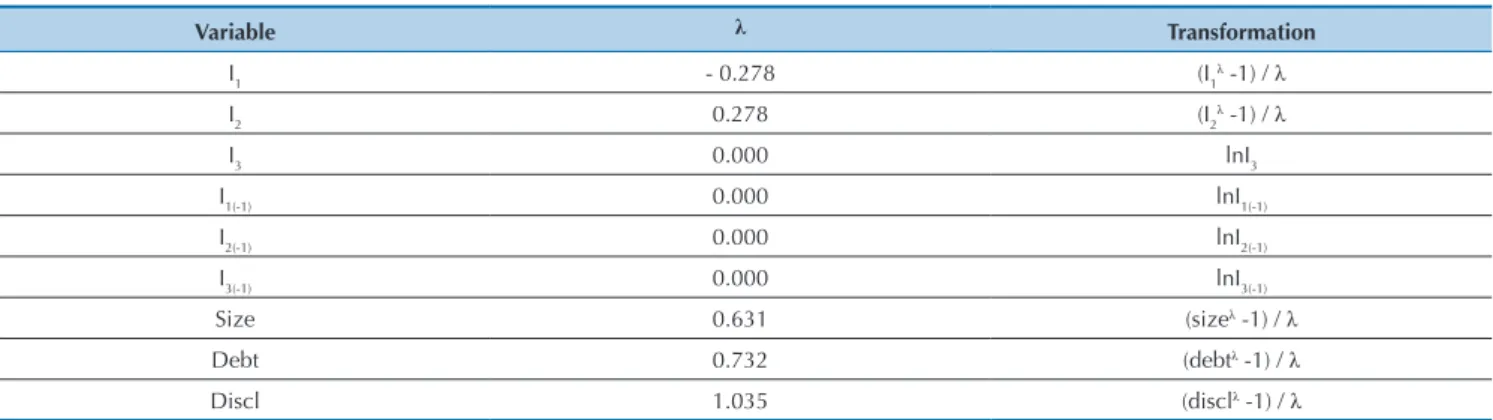
For panel data analysis, the models showed signiicant re-gression parameters, however, they violated the assumptions joint linearity, normality, and heteroskedasticity. In an attempt to ix problems that prevented estimating the parameters, we chose to perform Box-Cox transformations in the dependent and independent variables. hrough the transformation pro-posed by Box and Cox, we replaced the dependent variable Y and the independent variables Xn by (Yλ -1) / λ e (Xnθ -1) / θ, respectively, where λ and θ are the transformation parameters. hese expressions might seem indeterminate when λ and θ were zero, however, by providing their expansions in a Taylor series, for λ = 0, there is (Yλ -1) / λ = ln Y (Fávero, Beliore, Silva, & Chan, 2009). Table 6 displays the results of Box-Cox transformations detailing the parameters calculated.
In addition to this procedure, concomitantly, the ou-tliers were eliminated and the Winsorization technique was used to do this, which consists in replacing records with values above or below certain limits, lower or higher, by the highest and lowest remaining value from the limit set. he limit used for technical employment of the te-chnique was that from the Box-Plot curve, according to which the need to change the outliers of I1, I2, I1(-1), I2(-1), and ROE was found. The next step was providing diag-noses to define the best fit of panels. Thus, the best fit for
the dependent variable I1 was the panel of fixed effects for the four models tested and, for the variables I2 and I3, the most appropriate regressions could be made by using the method of the ordinary least squares (OLS) of pooled panel data. Regressions with the variables I1 and I2 produced results whose validation tests did not allow observing the assumptions for proper analysis of para-meters, both for fixed effects and OLS. However, models having the variable I3 formed the basis for conclusions about the parameters (table 7).
Table 6 Parameters of the Box-Cox transformation of variables
Variable λ Transformation
I1 - 0.278 (I1λ -1) / λ
I2 0.278 (I2λ -1) / λ
I3 0.000 lnI3
I1(-1) 0.000 lnI1(-1)
I2(-1) 0.000 lnI2(-1)
I3(-1) 0.000 lnI3(-1)
Size 0.631 (sizeλ -1) / λ
Debt 0.732 (debtλ -1) / λ
Tests for the variable I3 pointed out that the parame-ters estimated for the variables “discl” and “Dcpc” are not significant, having p values much above 10% for the four models tested, with the variables included se-parately and together (in an additive and multiplicative way), something which means there are no relationship between these variables and the variable dependent on funding costs, at least in the early years after the stan-dard entered into force. As for the other variables, in-debtedness, profitability, year, and the lagged dependent variable showed up as significant. The signals may be
interpreted as a higher indebtedness level, generating hi-gher financial expenses to companies, and profitability is inversely proportional to the costs of borrowing, eco-nomic factors that influence credit prices for those two years analyzed and a direct relation to the funding con-ditions of the previous year. On the other hand, the va-riables related to size and auditing were not significant.
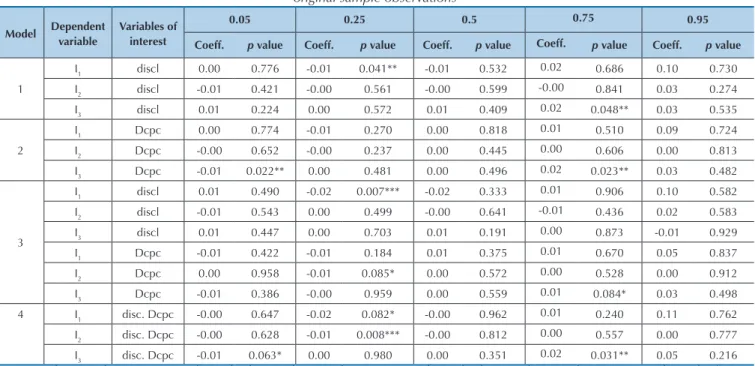
Table 8 summarizes the results of quantile regres-sions in the original sample observations, displaying re-sults only for the variables of interest for the research. Altogether, 60 regressions were performed.
Note: *: p value is significant at a 10% significance level; **: p value is significant at a 5% significance level; ***: p value is significant at a 1% significance level.
Table 7 OLS using 230 observations, including 115 cross-sectional units and length of the 2-year time series for the 4 models with the dependent variable I3
Dependent variable = I3 1 2 3 4
Variables Coeff. p value Coeff. p value Coeff. p value Coeff. p value
Const 0.06 0.746 0.00 0.988 0.04 0.844 -0.02 0.932
Discl 0.09 0.561 0.06 0.743
Dcpc 0.04 0.597 0.02 0.825
discl. Dcpc -0.17 0.499
Size 0.00 0.142 0.00 0.157 0.00 0.151 0.00 0.191
Roe -0.78 0.000*** -0.77 0.000*** -0.78 0.000*** -0.77 0.000***
Debt 1.37 0.000*** 1.38 0.000*** 1.37 0.000*** 1.39 0.000***
I3(-1) 0.70 0.000*** 0.70 0.000*** 0.70 0.000*** 0.69 0.000***
Dbig4 -0.18 0.108 -0.17 0.115 -0.18 0.109 -0.15 0.147
Dt 0.30 0.000*** 0.29 0.000*** 0.30 0.000*** 0.29 0.000***
Validation tests
R-squared 0.82 0.82 0.82 0.82
Adjusted R-squared 0.81 0.81 0.81 0.81
F (a) 143.98 0.00 143.94 0.00 125.45 0.00 144.08 0.00
RESET test (b) 0.54 0.58 0.53 0.59 0.53 0.59 0.58 0.56
White test (LM) (c) 50.31 0.03 44.33 0.07 54.11 0.08 49.86 0.03
Normality residual test (d) 8.24 0.02 8.25 0.02 8.22 0.02 8.30 0.02
Non-linearity test (e) 0.44 0.99 0.36 0.99 0.48 0.99 0.74 0.98
Model Dependent variable
Variables of interest
0.05 0.25 0.5 0.75 0.95
Coeff. p value Coeff. p value Coeff. p value Coeff. p value Coeff. p value
1
I1 discl 0.00 0.776 -0.01 0.041** -0.01 0.532 0.02 0.686 0.10 0.730 I2 discl -0.01 0.421 -0.00 0.561 -0.00 0.599 -0.00 0.841 0.03 0.274
I3 discl 0.01 0.224 0.00 0.572 0.01 0.409 0.02 0.048** 0.03 0.535
2
I1 Dcpc 0.00 0.774 -0.01 0.270 0.00 0.818 0.01 0.510 0.09 0.724
I2 Dcpc -0.00 0.652 -0.00 0.237 0.00 0.445 0.00 0.606 0.00 0.813 I3 Dcpc -0.01 0.022** 0.00 0.481 0.00 0.496 0.02 0.023** 0.03 0.482
3
I1 discl 0.01 0.490 -0.02 0.007*** -0.02 0.333 0.01 0.906 0.10 0.582
I2 discl -0.01 0.543 0.00 0.499 -0.00 0.641 -0.01 0.436 0.02 0.583
I3 discl 0.01 0.447 0.00 0.703 0.01 0.191 0.00 0.873 -0.01 0.929
I1 Dcpc -0.01 0.422 -0.01 0.184 0.01 0.375 0.01 0.670 0.05 0.837
I2 Dcpc 0.00 0.958 -0.01 0.085* 0.00 0.572 0.00 0.528 0.00 0.912
I3 Dcpc -0.01 0.386 -0.00 0.959 0.00 0.559 0.01 0.084* 0.03 0.498
4 I1 disc. Dcpc -0.00 0.647 -0.02 0.082* -0.00 0.962 0.01 0.240 0.11 0.762
I2 disc. Dcpc -0.00 0.628 -0.01 0.008*** -0.00 0.812 0.00 0.557 0.00 0.777 I3 disc. Dcpc -0.01 0.063* 0.00 0.980 0.00 0.351 0.02 0.031** 0.05 0.216
Note: *: p value is significant at a 10% significance level; **: p value is significant at a 5% significance level; ***: p value is significant at a 1% significance level.
Table 8 Summary of quantile regression (quantiles 0.05, 0.25, 0.5, 0.75, and 0.95) for the variables of interest with the 230
In all models, for quantile 0.75, some of the varia-bles of interest were significant in the proxy for cost of borrowing I3, however, they showed an unexpected sig-nal for an influence inversely proportiosig-nal to the cost of borrowing.
In just 7 regressions signiicant interest variables were found: for quantile 0.05, variable Dcpc with dependent variable I3 in model 2 and discl.Dcpc with I3 in model 4; and for quantile 0.25, discl with I1 in models 1 and 3, Dcpc with I2 in model 3, and discl.Dcpc with variables I1
and I2 in model 4. It is inferred that for inancial costs at lower levels (quantiles 0.05 and 0.25), disclosure and the CPC standard may have a signiicant relationship. Just as in non-parametric tests, there was no strong consistency of results over the distribution of the dependent variable, something which corroborates the results of panel data.
So, the hypotheses I and II, based on panel data analysis, along with quantile regressions, were rejected, since it was not possible to consistently infer on the pa-rameters in both regression techniques.
5 CONCLUSIONS
This research examined the relationship of adopting an international accounting standard for SMEs, associa-ting it with an improved accounassocia-ting information quality and a better cost of credit granted by financial institu-tions. The main aim of this paper was investigating whe-ther the adoption of the international accounting stan-dard by SMEs caused an impact on the cost of banking credit. Regarding the accounting standard CPC-SMEs itself, it might be noticed, by a descriptive analysis of the sample of companies that the adoption of this ac-counting standard is still very incipient. Although it is mandatory from 2010, only 11% on average of the total sample specifically mentioned in the notes they adop-ted the CPC-SMEs standard within the first two years of its entry into force. On the other hand, positively, the use of principiological accounting standards based on the CPC was noticed, indicating that international accounting standards are already part of the procedures for medium-sized companies since 2009.
Statistical results showed a still very incipient inverse relationship between cost of credit and accounting disclo-sure quality. Average tests showed diferences between ac-counting disclosure groups as for the costs of borrowing that could not be regarded as statistically negligible, par-ticularly with regard to disclosure level, but they still need consistency over time. Panel data analysis and quantile regressions, in turn, dismissed the statistical signiican-ce of relationships related to accounting disclosure with the cost of credit, contrary to the IASB and other resear-chers, such as Lardon and Deloof (2014) and Zuelch and Burghardt (2010). However, the relationships of the other variables were statistically signiicant and, especially with regard to the relationship with the variables ‘indebted-ness,’ ‘time dummy,’ and the dependent variable lagged by a year. he indebtedness factor emerged in line with the studies by Barros et al. (2013) and Degryse et al. (2012), where SMEs tend to use inner resources rather than rai-sing funds from banks. he sample itself suggested such a result, since 24% of companies in the sample did not have any debt with inancial institutions in any of the three years analyzed. he time dummy variable indicated that macroeconomic factors (interest rates, credit level in the economy, etc.) had signiicant inluence on credit rates for
these two years. he lagged dependent variable showed up as in line with the fact that inancial institutions seek other information sources about credit risk, such as, e.g. relationship history, as observed by Bharath et al. (2008), and efect of the relationship studied by Degryse and Cay-seele (2000). Furthermore, a signiicant relationship was also found for the variable proitability, having a reverse signal to the costs of borrowing, suggesting that banks as-sess the inancial conditions in the pricing of loans. On the other hand, the variables size and auditing were not signiicant in statistical analysis; the irst variable was op-posite to Barros et al. (2013) and the second is indirectly opposite to several studies that associate accounting in-formation quality with costs of funding, such as Ortiz--Molina and Penas (2008) and Binks and Ennew (1996).
It is worth emphasizing this study has limitations inherent to data unpublished by official institutions. That is, a number of simplifications were provided so that data under analysis could be approached, such as: application of the hypothesis of no inbreeding problems on data collected from companies to allow processing through the panel data technique; and the assumption of an uniform standard among companies for accounting values with financial expenses, even if these premises do not invalidate the results. In addition, although the sta-tistical validation method has been used, disclosure me-asurements and adoption of the international standard (CPC) are subject to criticism, and once again we chose a simplification. Add to this the fact that the control va-riables included in the model may fail to capture all the effects that occur over time with the surveyed compa-nies, in addition to adopting the CPC-SMEs.
need observed in his daily life, and not as another obli-gation imposed by standard setters anymore.
he results of quantitative analyses, related to efects on the cost of banking credit, may bring useful implications to the various stakeholders, such as: (i) credit analysts – a group of users with greater importance in the sector of com-panies addressed by this research. If information is useful insofar as it serves to make decisions, in this case it emerges in the form of determination of rating classiications, which, in turn, inluence the bank funding costs. Hardly the credit granting processes undergo changes before the adoption of a new accounting standard by companies, at least in the short term. he short time of maturity for the international stan-dards, especially concerning SMEs, does not allow a decisi-ve contribution by accounting in decision-making, as in the case of large companies; (ii) standard setters – the results indicate a weak relationship between accounting informa-tion disclosure degree and bank funding costs, something opposite to one of the arguments on which the IASB lea-ned to design the IFRS for SMEs What is put into question in the Brazilian case is the mandatory nature of the CPC--SMEs standard for a certain group of companies based on this cost of borrowing. What if the company does not use third-party resources, speciically inancial institutions? he standard should be reconsidered, just as it happened to the micro and small businesses with the advent of Resolution CFC 1,418/2012, which allows a more simpliied accounting method, consistent with the size of these entities. he same reasoning may be applied to the cost-beneit ratio, even if there are no studies supporting the beneits that arise from the adoption of the international accounting standards in re-lation to disclosure costs (qualiied personnel, systems, pro-cedures, etc.). One way to adapt the accounting standards to
the companies’ needs might be the agreement to voluntarily adopt accounting standards by the companies themselves. For instance, a company discloses its accounting statements having the full CPC as a basis, requiring no explicit legal provision, something which reveals that, at some time, it have assessed the beneits to employ this kind of disclosure. Finally, it is also important to emphasize that, although the companies analyzed in the research are required to prepare their accounting statements having the CPC as a basis since 2010, a considerable part of the sample under investigation has not been complying with the regulatory determinations of the CFC (47% in 2010, 40% in 2011); (iii) entrepreneurs – this group of users may identify, when providing good--quality accounting information disclosure, a diversiication ratio of investment funding and not simply recognizing it as another tax obligation and an obstacle to their business. he international accounting standard can not only be reques-ted, but also preferred to others, to the extent that banking credit providers, or even new entrepreneurs, signal towards the usefulness of good-quality information, based on a i-nancial situation that represents the companies’ economic reality, both for credit granting under better conditions and for opening new business opportunities for companies, both nationally and also internationally. On the other hand, if a company has not reached a development planning level, yet, with a long-term view, investment in information is not a priority, and such a behavior is perfectly understandable, but the formality degree becomes compromised.
Barros, L. A., Nakamura, W. T., & Forte, D. (2013). Determinants of the capital structure of small and medium sized Brazilian enterprises.
BAR-Brazilian Administration Review, 10(3), 347-369.
Berger, A. N., Klapper, L. F., & Udell, G. F. (2001). he ability of banks to lend to informationally opaque small businesses. Journal of Banking &
Finance, 25(12), 2127-2167.
Bertoni, M., & De Rosa, B. (2010). he evolution of inancial reporting for private entities in the European Union. Social Science Research
Network. Retrieved on 3 agosto, 2011, from http://papers.ssrn.com/
sol3/papers.cfm?abstract_id=1536065.
Bharath, S. T., Sunder, J., & Sunder, S. V. (2008). Accounting quality and debt contracting. he Accounting Review, 83(1), 1-28.
Biddle, G. C., & Hilary, G. (2006). Accounting quality and irm-level capital investment. he Accounting Review, 81(5), 963-982. Binks, M. R., & Ennew, C. T. (1996). Growing irms and the credit
constraint. Small Business Economics, 8(1), 17-25.
Cardoso, R. L., Saravia, E., Tenório, F. G., & Adriano Silva, M. (2009). Regulação da contabilidade: teorias e análise da convergência dos padrões contábeis brasileiros aos IFRS. RAP - Rio de Janeiro, 43(4), 773-99.
Carvalho, C., & Abramovay, R. (2004). O difícil e custoso acesso ao sistema inanceiro. In C. A. Santos (Org.). SEBRAE, Sistema inanceiro
e as micro e pequenas empresas: diagnósticos e perspectivas (2a ed.,
pp.17-45). Brasília: SEBRAE.
Chen, F., Hope, O. K., Li, Q., & Wang, X. (2011). Financial reporting quality and investment eiciency of private irms in emerging markets. he Accounting Review, 86(4), 1255-1288.
Conselho Federal de Contabilidade. CFC. (2009, 10 dezembro). Resolução
CFC 1.255/09. Aprova a NBC T 19.41 – Contabilidade para Pequenas
e Médias Empresas. Brasília, DF: CFC.
Conselho Federal de Contabilidade. CFC. (2010). Contabilidade para pequenas e médias empresas: Normas Brasileiras de Contabilidade NBC
T 19.41. Brasília, DF: CFC.
Conselho Federal de Contabilidade. CFC. (2012, 5 dezembro).
Resolução CFC 1.418/12. Aprova a ITG 1000 – Modelo contábil para
microempresa e empresas de pequeno porte. Brasília, DF: CFC. Degryse, H., de Goeij, P., & Kappert, P. (2012). he impact of irm and
industry characteristics on small irms’ capital structure. Small
Business Economics, 38(4), 431-447.
Degryse, H., & Van Cayseele, P. (2000). Relationship lending within a bank-based system: Evidence from European small business data.
Journal of Financial Intermediation, 9(1), 90-109.
Fávero, L. P., Beliore, P., Silva, F. L., & Chan, B. L. (2009). Análise de dados:
modelagem multivariada para tomada de decisões. Rio de Janeiro:
Elsevier.
Fazzari, S. M., & Athey, M. J. (1987). Asymmetric information, inancing constraints, and investment. he Review of Economics and Statistics,
69(3), 481-487.
Fitzpatrick, M., & Frank, F. (2009). IFRS for SMEs: the next standard for U.S. private companies. Journal of Accountancy, 208(6), 50-54. Herman, N. (2010). IFRS for SMEs: not for private American companies.
he CPA Journal, 8(12), 11-12.
Hope, O. K., homas, W. B., & Vyas, D. (2009). Transparency, ownership,
and inancing constraints in private irms. [Working Paper]. University
of Toronto and University of Oklahoma.
Instituto Brasileiro de Geograia e Estatística. IBGE. (2012). Estatísticas do
cadastro central de empresas 2010. Rio de Janeiro: IBGE.
International Accounting Standards Board (IASB). (2009). Basis for
conclusions on IFRS for small and medium-sized Entities. London.
Jaggi, B., & Low, P. Y. (2000). Impact of culture, market forces, and legal system on inancial disclosures. he International Journal of
Accounting, 35(4), 495-519.
Jermakowicz, E., & Epstein, B. (2010). IFRS for SMEs - an option for U.S. private entities? Review of Business, Special Issue: Accounting, 30(2), 72-79.
La Porta, R., Lopez-de-Silanes, F., Shleifer, A., & Vishny, R. W. (1997). Legal determinants of external inance. he Journal of Finance, 52(3), 1131-1150.
La Porta, R., Lopez-de-Silanes, F., Shleifer, A., & Vishny, R. W. (2000).
Agency problems and dividend policies around the world. he Journal
of Finance, 55(1), 1-33.
Lambert, R., Leuz, C., & Verrecchia, R. E. (2007). Accounting information, disclosure, and the cost of capital. Journal of Accounting Research, 45(2), 385-420.
Lardon, A., & Deloof, M. (2014). Financial disclosure by SMEs listed on a semi-regulated market: evidence from the Euronext Free Market.
Small Business Economics, 42(2), 361-385.
Lei n. 11.638, de 28 de dezembro de 2007. (2007, 28 dezembro). Diário
Oicial da União. Brasília, DF.
Lei Complementar n. 123, de 14 de dezembro de 2006. (2006, 14 dezembro).
Estatuto nacional da microempresa e da empresa de pequeno porte.
Diário Oicial da União. Brasília, DF.
Lenormand, G., Poulard, B., & Touchais, L. (2012). Les IAS/IFRS. Revue
Française de Gestion, 3(222), 55-66.
Leuz, C., & Verrecchia, R. E. (2000). he economic consequences of increased disclosure. Journal of Accounting Research, 38, 91-124. Levenson, A. R., & Willard, K. L. (2000). Do irms get the inancing they
want? Measuring credit rationing experienced by small businesses in the US. Small Business Economics, 14(2), 83-94.
Lima, G. (2009). Nível de evidenciação x custo da dívida das empresas brasileiras. Revista Contabilidade & Finanças, 20(49), 95-108. Litjens, R., Bissessur, S., Langendijk, H., & Vergoossen, R. (2012). How
do preparers perceive costs and beneits of IFRS for SMEs? Empirical evidence from the Netherlands. Accounting in Europe, 9(2), 227-250. Lopes, A., & Martins, E. (2005). Teoria da contabilidade: uma nova
abordagem. São Paulo: Atlas.
Lopes, P. T., & Rodrigues, L. L. (2007). Accounting for inancial instruments: an analysis of the determinants of disclosure in the Portuguese stock exchange. he International Journal of Accounting,
42(1), 25-56.
Meirelles, G. (2012, 31 outubro). Adoção do padrão IFRS anda a passos lentos entre PMES. Valor Econômico, São Paulo, 8-9 (F).
Neag, R., Masca, E., & Pascan, I. (2009). Actual aspects regarding the IFRS for SME–Opinions, debates and future developments. Annales
Universitatis Apulensis Series Oeconomica, 11(1), 32-42.
Ortiz-Molina, H., & Penas, M. F. (2008). Lending to small businesses: the role of loan maturity in addressing information problems. Small
Business Economics, 30(4), 361-383.
Pacter, P. (2009). IFRS for most private companies goes live. Financial
Executive, 25(7), 28-30.
Pacter, P. (2010). Overview of the IFRS for SMEs. IASC Foundation [Webcast]. Retrieved on july 1st, 2011, from http://web.worldbank.org/ WBSITE/EXTERNAL/ COUNTRIES/ECAEXT/EXTCENFINREPREF /0,,contentMDK:22617169~page PK:64168445~piPK:64168309~theSite PK:4152118,00.html.
PMEs pagam o dobro por crédito da América Latina. (2012, 13 novembro). Valor Econômico [Reportagem].
Salotti, B. M., & Yamamoto, M. M. (2005). Ensaio sobre a teoria da divulgação. BBR-Brazilian Business Review, 2(1), 53-70. Salotti, B. M., & Yamamoto, M. M. (2008). Divulgação voluntária da
demonstração dos luxos de caixa no mercado de capitais brasileiro.
Revista Contabilidade & Finanças, 19(48), 37-49.
Seifert, D. L., & Lindberg, D, L. (2010). Key provisions on IFRS for small and medium-sized companies. he CPA Journal, 80(5), 34-37. Van Caneghem, T., & Van Campenhout, G. (2012). Quantity and quality
of information and SME inancial structure. Small Business Economics, 39(2), 341-358.
Verrecchia, R. E. (2001). Essays on disclosure. Journal of Accounting &
Economics. 32(1), 97-180.
Wright, G. B., Fernandez, D., Burns, J., Hawkins, R., Hornsby, C., & Patel, S. (2012, may). Big GAAP/little GAAP: will the debate never end?
Journal of Business & Economics Research, 10(5), 291-302.
Zambaldi, F., Aranha, F., Lopes, H., & Politi, R. (2011). Credit granting to small irms: a Brazilian case. Journal of Business Research, 64(3), 309-315.
Zuelch, H., & Burghardt, S. (2010). he granting of loans by German banks to SMEs against the background of international inancial reporting. Journal of Applied Accounting Research, 10(1), 43-57.
References
Correspondence Address:
Enrico Dalla Riva
Faculdade de Economia, Administração e Contabilidade, Universidade de São Paulo Avenida Professor Luciano Gualberto, 908 – CEP: 05508-010