Cop
yright
© ABE&M t
odos os dir
eit
os r
eser
vados
.
Endocrine disturbances
related to the use of lithium
Distúrbios endocrinológicos relacionados ao uso de lítio
Cecília F. Giusti1, Soraya R. Amorim1, Ricardo A. Guerra1, Evandro S. Portes1
SUMMARY
Despite recent advances in pharmacological treatment of psychiatric disorders, lithium salts remain frequently used, as they are effective and inexpensive alternatives, especially in the treatment of bipolar disorders. Their use is commonly associated with various endocrine di-sorders, mainly in thyroid and parathyroid function, and in mineral metabolism. This article aims at reviewing these potential endocrinopathies related to the use of lithium to make health care professionals aware and familiar with these possible complications when they follow up patients using this drug, and to make them able to monitor, identify and institute early and ap-propriate treatment. Arq Bras Endocrinol Metab. 2012;56(3):153-8
Keywords
Lithium; hypercalcemia; diabetes insipidus; goiter
SUMÁRIO
Apesar dos recentes avanços farmacológicos no tratamento dos transtornos psiquiátricos, os sais de lítio permanecem como uma alternativa eicaz e de menor custo, sendo usados com frequência principalmente no tratamento dos transtornos bipolares. O seu uso é comumente relacionado com diversas alterações endocrinológicas, principalmente nas funções tiroidiana, paratiroidiana e do metabolismo iônico. Este artigo tem por objetivo fazer uma revisão dessas potenciais endocrinopatias relacionadas ao uso do lítio, para que, no seguimento de pacientes em uso dessa medicação, os proissionais de saúde estejam atentos e familiarizados com essas possíveis complicações, conseguindo identiicar e instituir tratamento precocemente. Arq Bras Endocrinol Metab. 2012;56(3):153-8
Descritores
Lítio; hipercalcemia; diabetes insipidus; bócio
1 Serviço de Endocrinologia,
Hospital do Servidor Público Estadual (HSPE), São Paulo, SP, Brazil
Correspondence to:
Cecília F. Giusti
Rua Pedro de Toledo, 1800, 9o andar central
04039-004 – São Paulo, SP, Brazil [email protected]
Received on Sept/13/2011 Accepted on Mar/6/2012
INTRODUCTION
L
ithium salts were introduced into medical therapy in the mid-19th century, with reports of their use in migraine prophylaxis, and in the treatment of psychiatric disorders, gout and neutropenia (1,2). Currently, they are available in immediate- and extended-release formu-las and are used to treat mania, refractory and recurrent depression and bipolar disorders with reduced morbidi-ty and mortalimorbidi-ty. Despite recent advances in pharma-cological treatment of psychiatric disorders, these salts remain effective and inexpensive alternatives (3,4).Lithium can promote major endocrine and meta-bolic disturbances, mainly in thyroid and parathyroid
functions, and in the mineral metabolism (5). This re-view article will discuss the main endocrine disorders related to the use of lithium salts.
PHARMACOLOGICAL ASPECTS
signal-Cop
yright
© ABE&M t
odos os dir
eit
os r
eser
vados
.
ing pathways (6). It also seems to act in the modulation of neurotransmitters and reduce glutaminergic activity, contributing to neuroprotection. In addition, it modu-lates pathways that regulate neuronal plasticity, such as glycogen synthase kinase 3b, cAMP-dependent kinase and protein kinase C (7).
Because of lithium narrow therapeutic range and possible overdose potential, small elevations in its cir-culating levels may be associated with toxic reactions. Therefore, it is very important to monitor its plasma concentrations in patients under treatment. It is reco-mmended that serum levels are assessed every 3-6 months (3). The therapeutic concentration that is con-sidered safe ranges from 0.6-1.25 mEq/L but, when used for a long time, maximum levels of 0.75 mEq/L are preferable. The doses of lithium carbonate recom-mended to achieve this goal vary from 900 to 1,500 mg per day (1).
Lithium is absorbed rapidly and almost completely from the gastrointestinal tract. After an oral dose, ab-sorption occurs in up to 8 hours and reaches its hi-ghest serum concentration in 2 to 4 hours. Slow-release prepa rations reduce the rate of absorption and therefore the peak plasma level. Once absorbed, lithium reaches the extracellular luid and gradually accumulates in the tissues. Because it is low protein bound, it is freely il-tered by the kidneys and its excretion is dependent on glomerular iltration rate. About 95% of the ingested dose is excreted in the urine without undergoing bio-transformation. Its half-life is up to 24 hours and may be longer in the elderly (1,3). Approximately 80% of lithium is reabsorbed in the proximal renal tubules. The administration of massive doses of sodium leads to greater lithium elimination, while states of sodium depletion lead to a greater retention, increasing the risk of intoxication (8).
At therapeutic doses, nausea, diarrhea, weight gain, ine tremor of the hands, and skin lesions, especially acne and psoriasis, may happen (9). The major toxic ef-fects related to the use of lithium are the cognitive dis-turbances, dysarthria, and impaired coordination. The most severe effects include mental confusion, hyper-relexia, gross tremor, focal neurologic signs, seizures, coma, and even death (1,3). Other toxic effects include albuminuria, hypotension, and cardiac arrhythmias. Electrocardiographic alterations include prolongation of the QT interval, and changes in the ST segment and T wave (10).
DISTURBANCES IN THE ENDOCRINE SYSTEM
Mineral metabolism
Chronic use of lithium is generally associated with mild hypercalcemia, which is usually reversible with the withd rawal of the medication. However, in some cases, there may be persistent hypercalcemia, and even the de-velopment of hyperparathyroidism, by means of a still unknown mechanism (11).
The addition of lithium to parathyroid cells cultu-res (both normal and hyperplasic) causes an increase in PTH levels from 1.4 to 5.3 times. In vivo, several expe-riments demonstrated that lithium interferes with the dynamics of PTH secretion by increasing the setpoint of parathyroid calcium-sensing receptor. By shifting the PTH/calcium secretion curve to the right, higher le-vels of serum calcium are required to inhibit PTH se-cretion, thus increasing calcemia and PTH levels (12-14). Lithium also promotes reduced urinary excretion of calcium due to increased renal resorption secondary to PTH increase (15).
The prevalence of hyperparathyroidism associated with lithium is higher in women (4:1), with the occur-rence of both parathyroid adenomas and hyperplasia. The best approach must be individually evaluated in each case since there is no exact recommendation on the best surgical procedure in these cases (16). As an alternative to surgery, especially in cases of persistent hyperparathyroidism, the use of calcium mimetic agent (Cinacalcet) has been reported with good results (17). A recent review and meta-analysis about lithium to-xicity proile recommends that calcium concentrations should always be checked before and during lithium treatment (18).
Thyroid
Some patients treated with lithium may develop thyroid enlargement. Induction of thyroid cell growth is re-ported even in ectopic thyroids (19). This goitrogenic potential can be manifested in up to 50% of patients taking lithium chronically. Generally, it is diffuse, pain-less, and benign goiter (20).
Cop
yright
© ABE&M t
odos os dir
eit
os r
eser
vados
.
kinase B), an enzyme that degrades B-catenin, lithium can simulate a functional activation of this molecular signaling pathway, which has a functional relevance for the regulation of thyroid cell proliferation, as an alter-native to the cAMP pathway (23).
Inhibition of the release of thyroid hormones is the main mechanism involved in hypothyroidism and goiter related to lithium use. It is unclear how patients who will develop goiter can be identiied. Generally, women and patients with detectable thyroid antibodies before starting to use lithium are more likely to develop thyroid abnormalities. The prevalence of goiter is higher in pa-tients using the medication for long periods and in tho-se living in iodine-deicient areas. The interval between starting treatment and the onset of goiter may vary from a few weeks to several years. The risk of thyroid cancer is not increased in these patients (24-26).
The presence of autoimmune thyroiditis predisposes to hypothyroidism and goiter during treatment with li-thium, with a relative risk of 8.4 compared with patients with negative antibodies (27). However, the exact role of autoimmunity in thyroid failure induced by the drug remains uncertain. In addition, there is controversy about the effects of the drug in inducing thyroid au-toimmunity (28). Gland involvement may occur even in the absence of autoantibodies, showing that thyroid dysfunction can exist independently of the autoimmune process (29). Instead of inducing autoimmunity, lithium appears to stimulate secretion of immunoglobulins by lymphocytes, triggering a pre-existing immune response (28). Autoimmune thyroid disease precipitated by li-thium also appears to be related to an interference with the function of CD8 suppressor cells (30).
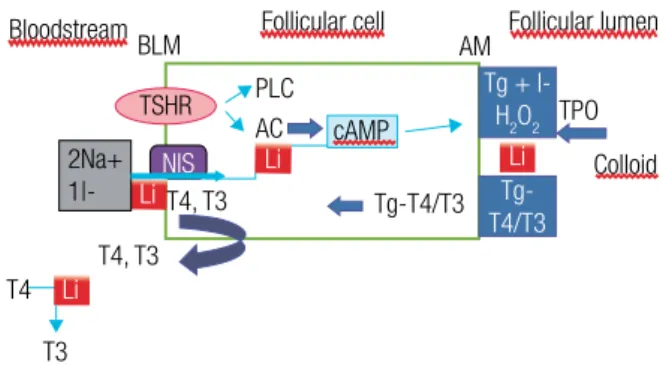
Lithium accumulates in thyroid tissue against a con-centration gradient, by active transport. This cation reduces iodine uptake by the thyroid gland, interfe-ring with tyrosine iodination, changing thyroglobulin structure and colloid formation in the apical pole of thyroid cells, thus interfering with iodotyrosine synthe-sis (Figure 1). It also inhibits deiodinase 2, leading to a decrease in T3 pituitary concentrations (31). Treat-ment with lithium may also lead to a hyper-response of TSH in the TRH test (32). Up to 30% of patients chronically treated with lithium develop increased TSH (subclinical hypothyroidism) that may progress to overt hypothyroidism, with or without goiter (33).
Lithium inhibition of thyroid iodine uptake is re-versible and dose-dependent (35). This inhibition is more pronounced in patients with hyperthyroidism.
Figure 1. Main points involved in lithium-induced thyroid dysfunction.
Adapted from: Williams Textbook of Endocrinology. 11th edition. 2008 (34).
BLM: basolateral membrane; AM: apical membrane; PLC: phospholipase C; AC: adenylate cyclase; cAMP: cyclic adenosine monophosphate; TPO: thyroperoxidase; Tg: thyroglobulin; T4: thyroxine; T3: triiodothyronine; Li: lithium; Na+: sodium; I-: iodide; NIS: sodium-iodide symport;
TSHR: TSH receptor.
Lithium in low doses is used as a therapeutic alternati-ve in thyrotoxicosis patients who cannot tolerate or do not respond to thyonamides (36). Another therapeutic use is the association of lithium and radioactive iodi-ne in the treatment of Graves’ disease. Several series show that this association leads to a more rapid control of thyrotoxicosis, increasing therapeutic eficacy when compared with radioiodine alone, due to the inhibition of radioiodine release by the thyroid (37). Silent thyroi-ditis and thyrotoxicosis have been less frequently re-ported after long-term lithium use, possibly as a direct effect of the drug on follicular cells (38).
A rare report is the occurrence of Hashimoto’s en-cephalopathy triggered by lithium, with increased an-timicrossomal antibody titers in cerebrospinal luid, relecting the exposure the thyroid and central nervous system to common antigens (39).
Thyroid function, antithyroid antibodies and ultra-sound of the gland are recommended before starting lithium therapy, with repeated screenings at regular in-tervals during treatment (26).
It is important to note that the presence of abnorma-lities in thyroid function is not an absolute contraindi-cation to the use of lithium, neither its discontinuation is required in the eventual onset of thyroid disturbances during lithium treatment. The management of thyroid dysfunction can be done even with the maintenance of lithium therapy, but the risks and beneits of such ap-proach always have to be assessed (26).
Bloodstream BLM
2Na+ 1|- Li
Li Li
T4, T3 Tg-T4/T3
T3 T4, T3
Follicular cell Follicular lumen AM
Li
NIS AC PLC
cAMP
Tg + l-H2O2
Tg-T4/T3
TPO
Colloid
T4
Cop
yright
© ABE&M t
odos os dir
eit
os r
eser
vados
.
Nephrogenic diabetes insipidus
Arginine-vasopressin or antidiuretic hormone (ADH) is secreted by the hypothalamus, stored, and released by the posterior pituitary. This hormone plays a key role in the control of body luids. Its signaling mecha-nism is mediated by G protein-coupled receptors and is directly related to increased intracellular cAMP.
The ability of the kidneys to retain water and con-centrate urine is regulated by ADH, the osmolality of the renal medulla, appropriate sodium transport and the function of aquaporins (40). Aquaporins are wa-ter channels inside of proteins expressed in renal tu-bules and collecting ducts. The greater the activation of aquaporins, the greater water reabsorption in renal collecting ducts, reducing the volume of urine. When the expression of aquaporins is inhibited, polyuria en-sues. Nephrogenic diabetes insipidus (NDI) is characte-rized by renal inability to concentrate urine, even in the presence of normal concentrations of ADH, causing a clinical polyuric syndrome.
The binding of the ADH to the V2 receptor stimu-lates the expression of aquaporins in the kidney (41). Lithium inhibits the expression of these aquaporins in the renal collecting duct, mainly aquaporin 2 (AQP2), by mechanisms still not fully understood (42). Most studies show an inhibition of adenylate cyclase activi-ty (43). However it has already been demonstrated in animal models that lithium-induced downregulation of AQP2 is independent of cAMP and adenylate cyclase, and is related to the reduction of AQP2 m-RNA syn-thesis (42), inhibition of adenosine triphosphatases, and interference with prostaglandin production (44). Lithium enters the collecting tubule cells via highly se-lective sodium and lithium channels, located in the api-cal membrane, causing increased sodium excretion and decreased renal tubule responsiveness to aldosterone and ADH. These channels are stimulated by aldostero-ne and inhibited by amiloride (45).
Up to 20% to 40% of patients chronically treated with lithium may develop NDI. Lithium use of the most common cause of acquired NDI (42,46), which is usually reversible after the withdrawal of the drug. However, in some cases it takes several months or years for the full re-establishment of the renal ability to concentrate urine (47). After prolonged use, even with discontinuation of the drug, some patients may have irreversible kidney damage due to a chronic interstitial nephropathy, with reports of evolution to end-stage
re-nal failure (46), but the absolute risk seems to be small (0.5% compared with 0.2% in the general population) as shown by a recent review (18). In order to prevent renal toxicity, besides monitoring serum lithium and creatinin levels, a single daily dose of lithium should be preferred (46).
Thiazide diuretics are a therapeutic option in NDI, but hydrochlorothiazide has the potential to increase lithium toxicity, so it should be used with caution in these cases. Amiloride would be a better option becau-se, besides its natriuretic action (causing contraction of extracellular volume, consequent decrease in glomeru-lar iltration, and ultimately leading to decreased urine volume), it also reduces the entry of lithium in distal tubule cells (40). It is also important to be aware of the possibility of the coexistence of NDI and hypercalcemia related to lithium, since dehydration can exacerbate hypercalcemia. Another treatment option is a nonste-roidal antiinlammatory drug, such as indomethacin, but it should not be carried out on a long-term basis due to its side effects (46).
Hypothalamic-pituitary-adrenal axis
A study with patients in treatment for major depres-sion showed that lithium led to an increased ACTH and cortisol response in the combined dexamethasone--CRH test, suggesting a possible effect of the drug on the hypothalamic-pituitary-adrenal axis (48).
In vitro studies demonstrate that lithium can inhibit apoptosis of human adrenal cortex, both in normal tis-sues and in tumors (49). On the other hand, lithium also inhibited the proliferation of pheochromocytoma cells by inhibiting the enzyme GSK3B (glycogen syn-thase kinase 3b), and promoting the suppression of chromogranin A, which represents a novel potential strategy for developing treatments of catecholaminer-gic tumors (50).
Glucose metabolism
pro-Cop
yright
© ABE&M t
odos os dir
eit
os r
eser
vados
.
moting glycogenolysis, and to the direct effect of the drug on pancreatic alpha-2 and beta-adrenergic recep-tors, determining the reduction of insulin secretion and increased levels of glucagon (53).
On the other hand, lithium has also been associa-ted with an insulin-like effect on glucose metabolism in skeletal muscle and adipocytes. In rat muscles, the drug increased the sensitivity of insulin-induced glu-cose transport, similar to the effects of exercise (54). Animal models also show that lithium promotes greater uptake of glucose by myocytes and glycogen synthesis, involving phosphorylation of AKT, GSK-3 inhibition, and increased p38-MAPK (mitogen-activated protein kinase) as mechanisms of action (55).
Effects on body weight
Weight gain up to 10 kg can occur in almost 30% of patients using lithium (44), by means of a mechanism that is still unclear, making therapy management more dificult (56). One possibility may be related to the sti-mulation of a greater intake of high-calorie beverages, especially in patients with polydipsia (44,57). Some studies also show changes in leptin levels, which ulti-mately can be involved in weight gain (58).
CONCLUSION
Considering all these aspects related to the use of lithium, it is important to be aware and familiar with all these po-tential endocrine disturbances when patients using this medication are followed up. Adequate monitoring is es-sential in order to identify possible complications and, thus, institute early and appropriate treatment.
Disclosure: no potential conlict of interest relevant to this article was reported.
REFERENCES
1. Baldessarini RJ, Tarazi FI. Tratamento farmacológico da psicose e da mania. In: Brunton LL, Lazo JS, Parker KL, eds. Goodman e Gilman: As bases farmacológicas da terapêutica. 11.ed. Rio de Janeiro: MacGraw-Hill. 2006; p. 411-46.
2. Freeman MP, Freeman SA. Lithium: clinical considerations in in-ternal medicine. Am J Med. 2006;119:478-81.
3. Collins N, Barnes TR, Shingleton-Smith A, Gerret D, Paton C. Standards of lithium monitoring in mental health trusts in the UK. BMC Psychiatry. 2010;10:80.
4. Simhandl C, Mersch J. [Lithium and bipolar disorder – a renais-sance?]. Neuropsychiatr. 2007;21(2):121-30.
5. Kusalic M, Engelsmann F. Effect of lithium maintenance thera-py on thyroid and parathyroid function. J Psychiatry Neurosci. 1999;24(3):227-33.
6. Chiu CT, Chuang DM. Molecular actions and therapeutic poten-tial of lithium in preclinical and clinical studies of CNS disorders. Pharmacol Ther. 2010;128(2):281-304.
7. Jope RS. Anti-bipolar therapy: mechanism of action of lithium. Mol Psychiatry. 1999;4(2):117-28.
8. Thomsen K, Shirley DG. A hypothesis linking sodium and lithium reabsorption in the distal nephron. Nephrol Dial Transplant. 2006;21(4):869-80.
9. Chan HH, Wing Y, Su R, Van Krevel C, Lee S. A control study of the cutaneous side effects of chronic lithium therapy. J Affect Disord. 2000;57:107-13.
10. Kayrak M, Ari H, Duman C, Gul EE, Ak A, Atalay H. Lithium in-toxication causing STsegment elevation and wandering atrial rhythms in an elderly patient. Cardiol J. 2010;17(4):404-7. 11. Hundley JC, Woodrum DT, Saunders BD, Doherty GM, Gauger
PG. Revisiting lithium associated hyperparathyroidism in the era of intraoperative parathyroid hormone monitoring. Surgery. 2005;138(6):1027-31.
12. Birnbaum J, Klandorf H, Giuliano A, Van Herle A. Lithium stimu-lates the release of human parathyroid hormone in vitro. J Clin Endocrinol Metab. 1987;66:1187-91.
13. Mallette LE, Khouri K, Zengotita H, Hollis BW, Malini S. Lithium treatment increases intact and midregion parathyroid hormone and parathyroid volume. J Clin Endocrinol Metab. 1988;68:654-60. 14. Haden ST, Stoll AL, McCormick S, Scott J, Fuleihan GE. Altera-tions in parathyroid dynamics in lithium-treated subjects. J Clin Endocrinol Metab. 1997;82:2844-8.
15. Mak TW, Shek CC, Chow CC, Wing YK, Lee S. Effects of lithium therapy on bone mineral metabolism: a two-year prospective longitudinal study. J Clin Endocrinol Metab. 1998;83:3857-9. 16. Szalat A, Mazeh H, Freund HR. Lithium-associated
hyperpara-thyroidism: report of four cases and review of the literature. Eur J Endocrinol. 2009;160(2):317-23.
17. Sloand JA, Shelly MA. Normalization of llithium-induced hyper-calcemia and hyperparathyroidism with cinecalcet hydrochloride. Am J Kidney Dis. 2006;489(5):832-7.
18. McKnight RF, Adida M, Budge K, Stockton S, Goodwin GM, Ge-ddes JR. Lithium toxicity proile: a systematic review and meta--analysis. Lancet. 2012;379:721-8.
19. Talwar N, Mohan S, Ravi B, Andley M, Kumar A. Lithium--induced enlargement of a lingual thyroid. Singapore Med J. 2008;49(3):254-5.
20. Bauer M, Blumentritt H, Finke R, Schlattman P, Adli M, Baethge C, et al. Using ultrasonography to determine thyroid size and preva-lence of goiter in lithium-treated patients with affective disorders. J Affect Disord. 2007;104(1-3):45-51.
21. Mori M, Tajima K, Oda Y, Matsui I, Mashita K, Tarui S. Inhibitory effect of lithium on the release of thyroid hormones from thyro-tropin-stimulated mouse thyroids in a perifusion system. Endo-crinology. 1989;124:1365-9.
22. Urabe M, Hershman J, Pang XP, Murakami S, Sugawara M. Effect of lithium on function and growth of thyroid cells in vitro. Endo-crinology. 1991;129:807-14.
23. Rao AS, Kremenevskaja N, Resch J, Brabant G. Lithium stimula-tes proliferation in cultured thyrocystimula-tes by activating Wnt/B-cate-nin signaling. Eur J Endocrinol. 2005;153:929-38.
24. Esposito S, Prange AJ Jr, Golden RN. The thyroid axis and mood disorders: overview and future prospects. Psychopharmacol Bull. 1997;33:205-17.
25. Henry C. Lithium side effects and predictors of hypothyroidism in patients with bipolar disorder: sex differences. J Psych Neuros-cience. 2002;27:104-7.
Cop
yright
© ABE&M t
odos os dir
eit
os r
eser
vados
.
27. Bocchetta A, Cocco F, Velluzzi F, Del Zompo M, Mariotti S, Loviselli A. Fifteen-year follow-up of thyroid function in lithium patients. J Endocrinol Invest. 2007;30(5):363-6.
28. Loviselli A, Bocchetta A, Mossa P, Velluzi F, Bernardi F, Del Zompo M, et al. Value of thyroid echography in the long term follow-up of Lithium Treated Patients. Neuropsychobiol. 1997;36:37-41. 29. Baethge C, Blumentritt H, Berhöfer A, Bschor T, Glenn T, Adli M, et
al. Finke R. Long-term lithium treatment and thyroid antibodies: a controlled study. J Psychiatry Neurosci. 2005;30:423-7.
30. Cooper DS, Greenspan FS, Ladenson PW. Thyroid gland. In: Gard-ner DG, Shoback D, eds. Greenspan’s Basic & Clinical Endocri-nology. 8th edition. New York: Lange/McGraw-Hill; 2007. p. 232. 31. Germain DLS. Regulatory effect of lithium on thyroxine
metabo-lism in murine neural and anterior pituitary tissue. Endocrinolo-gy. 1986;120:1430-8.
32. Livingstone C, Rampes H. Lithium: a review of its adverse meta-bolic effects. J Psychopharmacol. 2006;20(3):347-55.
33. Fagiolini A, Kupfer DJ, Scott J, Swartz HA, Cook D, Novick DM, et al. Hypothyroidism in patients with bipolar disorder treated primarily with lithium. Epidemiol Psichiatr Soc. 2006;15(2):123-7. 34. Larsen PR, Davies TF, Schlumberger MJ, Hay ID. Thyroid physio-logy and diagnostic evaluation of patients with thyroid disorders. In: Kronenberg HM, Melmed S, Polonsky KS, Larsen PR, eds. Williams Textbook of Endocrinology. 11th Edition. Philadelphia: WB Saunders Company. 2008;299-332.
35. Tsuchiya Y, Saji M, Isozaki O, Arai M, Tsushima T, Shizume K. Effect of lithium on deoxyribonucleic acid synthesis and iodine uptake in porcine thyroid cells in culture. Endocrinology. 1990;126:460-5. 36. Ng YW, Tiu SC, Choi KL, Chan FK, Choi CH, Kong PS, et al. Use of lithium in the treatment of thyrotoxicosis. Hong Kong Med J. 2006;12(4):254-9.
37. Bogazzi F, Bartalena L, Brogioni S, Scarcella G, Burelli A, Campo-moro A, et al. Comparison of radioiodine with radioiodine plus lithium in the treatment of graves hyperthyroidism. J Clin Endo-crinol Metab. 1999;84:499-503.
38. Pearce EM, Farwell AP, Braverman LE. Thyroiditis. N Engl J Med. 2003;348:2646-55.
39. Nagamine M, Yoshino A, Ishii M, Ogawa T, Kurauchi S, Yoshida T, et al. Lithium-induced Hashimoto’s encephalopathy: a case re-port. Bipolar Disord. 2008;10(7):846-8.
40. Robinson AG. Posterior pituitary. In: Gardner DG, Shoback D, eds. Greenspan’s Basic & Clinical Endocrinology. 8th edition. Lange McGraw-Hill; 2007. p. 164.
41. Naves LA, Vilar L, Costa ACF, Domingues L, Casulari LA. Distur-bances in the secretion and action of antidiuretic hormone. Arq Bras Endocrinol Metab. 2003;47:347-57.
42. Li Y, Shaw S, Kamsteeg EJ, Vandewalle A, Deen PMT. Development of lithium-induced nephrogenic diabetes insipidus is dissociated from adenyl cyclase activity. J Am Soc Nephrol. 2006;17:1063-72. 43. Jackson BA, Edwards RM, Dousa TP. Lithium-induced polyuria: effect of lithium on adenylate cyclase and adenosine
3´5´-mono-phosphate phosphodiesterase in medullary ascending limb of Henle’s loop and in medullary collecting tubules. Endocrinology. 1980;107:1693-8.
44. Grandjean EM, Aubry JM. Lithium: update human knowledge using an evidence-based approach: part III: Clinical Safety. CNS Drugs. 2009;23:397-418.
45. Nielsen J, Kwon TH, Frokiaer J, Knepper MA, Nielsen S. Lithium--induced NDI in rats is associated with loss of alpha-ENaC re-gulation by aldosterone in CCD. Am J Physiol Renal Physiol. 2006;290(5):F1222-33.
46. Le Roy V, Delmas Y, Verdoux H. Chronic renal complications indu-ced by lithium. Encephale. 2009;35(6):605-10.
47. Reeves WB, Bichet DG, TE Andreolli. The posterior pituitary and water metabolism. In: Wilson JD, Fotser DW, Kronemberg HM, Larsen PR, eds. Williams Textbook of Endocrinology. 9th Edition. Philadelphia: WB Saunders Company; 2003; p. 341-8.
48. Bschor T, Adli M, Baethge C, Eichmann U, Ising M, Uhr M, et al. Lithium augmentation increases the ACTH and cortisol respon-se in the combined DEX/CRH test in unipolar major depression. Neuropsychopharmacology. 2002;27:470-8.
49. Pushkarev VM, Tronko ND, Kostyuchenko NN, Mikoshi AS. Effect of o,p’-DDD and Li+ on apoptotic DNA fragmentation in conven-tionally normal and tumour tissues of human adrenal cortex. Ukr Biokhim Zh. 2007;79(2):44-9.
50. Kappes A, Vaccaro A, Kunnimalaiyaan M, Chen H. Lithium ions: a novel treatment for pheochromocytomas and paragangliomas. Surgery. 2007;141(2):161-5.
51. Anderson JH Jr, Blackard WG. Effect of lithium on pancreatic islet insulin release. Endocrinology. 1978;102:291-5.
52. Shah JH, Pishdad G. The effect of lithium on glucose and tolbuta-mide-induced insulin release and glucose tolerance in the intact rat. Endocrinology. 1980;107:1300-4.
53. Hermida OG, Fontela T, Ghiglione M, Uttenthal LO. Effect of li-thium on plasma glucose, insulin and glucagon in normal and streptozotocin-diabetic rats: role of glucagon in the hyperglycae-mic response. Br J Pharmacol. 1994;111:861-5.
54. Tabata I, Schluter J, Gulve EA, Holloszy OJ. Lithium Increases susceptibility of muscle glucose transport to stimulation by va-rious agents. Diabetes. 1994;43(7):903-7.
55. Macko AR, Benez AN, Teachey MK, Henriksen EJ. Roles of insulin signaling and p38 MAPK activation by lithium in the transport of glucose in insulin-resistant rats skeletal muscle. Arch Physiol Biochem. 2008;114:331-9.
56. Baptista T, Teneud L, Contreras Q, Sprawl T, Burquera J, Burque M, et al. Lithium and body weight gain. Pharmacopsychiatry. 1995;28(2):35-44.
57. Chen Y, Silverstone T. Lithium weight gain. Int Clin Psychophar-macol. 1990;5(3):217-25.