Cop
yright
© ABE&M t
odos os dir
eit
os r
eser
vados
.
Correspondence to:
Anthony C. Hackney University of North Carolina, CB # 8700, Fetzer Hall, Chapel Hill, 27599 − North Carolina, United States
Received on Nov/21/2010 Accepted on Feb/16/2011
Comparison of the hormonal
responses to exhaustive
incremental exercise in adolescent
and young adult males
Comparação das respostas hormonais ao exercício incremental até exaustão em adolescentes e adultos jovens do sexo masculino
Anthony C. Hackney1, Mehis Viru2, Mitch VanBruggen1, Tamara Janson3, Kalle Karelson3, Atko Viru3
ABSTRACT
Objective: Evaluate hormonal responses to incremental-stage exercise (EX) test to exhaustion in adolescents. Subjects and methods: Adolescents were tested at 16 years of age in Tanner Stage 4 (TS4) and at 17 years of age in Tanner Stage 5 (TS5) (n = 6). Adults were tested at 21 ± 1 y. (X ± SD) (n = 4) and served as controls. Blood samples were taken at rest, at the end of each EX stage.
Results: Main effects for EX in cortisol (p < 0.01, increasing with each EX stage) and for subject group for testosterone (T) occurred (p < 0.01; TS4 < TS5, adults). Interaction effect of group by EX stage occurred for GH (p < 0.05). GH increased in response to EX in all groups, however, the mag-nitude of increase was significantly less for TS5 and adults than TS4. Conclusions: Differences in T and GH responses for TS4 than those for TS5 and adults reflect the differing maturation levels of the endocrine system between Tanner Stages. TS5 adolescents are more similar to young adults in hormonal responses to EX than are TS4 adolescents. Arq Bras Endocrinol Metab. 2011;55(3):213-8
Keywords
Physical activity; endocrine system; Tanner Stage; youth
RESUMO
Objetivo: Avaliar as respostas hormonais ao teste de exercício em estágios incrementais (EX) até exaustão. Sujeitos e métodos: Foram examinados adolescentes com 16 anos de idade e índice Tanner 4 (TS4) e com 17 anos de idade e índice Tanner Stage 5 (TS5) (n = 6), e adultos com 21 ± 1 anos de idade. (X ± SD) (n = 4), estes últimos compondo o grupo controle. As amostras de sangue foram retiradas no repouso e ao final de cada estágio EX. Resultados: Os principais efeitos obser-vados no EX ocorreram no cortisol (p < 0,01, aumentou com a elevação do estágio EX) e no grupo de testosterona (p < 0,01; TS4 < TS5, adultos). Houve efeito de interação entre grupos e por estágio de EX no grupo de hormônio de crescimento (p < 0,05). O hormônio de crescimento aumentou em todos os grupos em resposta ao EX, no entanto, a magnitude dos aumentos observados foi signi-ficativamente menor em TS5 e nos adultos do que em TS4. Conclusões: As diferenças verificadas nas respostas dos grupos de testosterona e hormônio de crescimento em TS4 em relação ao TS5 e adultos refletem os diferentes níveis de maturação do sistema endócrino entre os estágios do índice de Tanner. Os adolescentes no TS5 se assimilam mais aos jovens adultos do que aos adoles-centes TS4, quanto a suas respostas hormonais ao EX.Arq Bras Endocrinol Metab. 2011;55(3):213-8
Descritores
Atividade física; sistema endócrino; Etapa Tanner; jovem
1 Endocrine Section – Applied
Physiology Laboratory, University of North Carolina, Chapel Hill, NC, USA
2 Institute of Sport Pedagogy and
Coaching Science, University of Tartu, Tartu, Estonia
3 Institute of Exercise Biology
and Physiotherapy, University of Tartu, Tartu, Estonia
INTRODUCTION
I
t is well established that physical exercise acts as a stress to the endocrine system (1).Particularly withCop
yright
© ABE&M t
odos os dir
eit
os r
eser
vados
.
studies examining the endocrine response to exercise has signiicantly increased over the last few decades as analytical methods have become more reined, avail-able, and affordable to researchers. These studies have carefully characterized and proiled the hormonal be-havior for exercise of different intensities, durations, modalities, and environmental settings. However, most of these studies have focused on examining the exercise hormonal responses of adults and not those of children and adolescents.
Many leading scientiic agencies, such as the World Health Organization (WHO), acknowledge that there is a public health crisis relative to the increasing preva-lence of obesity occurring worldwide (3). In particular, there is alarm concerning the rate of obesity develop-ment in children and adolescents; in fact, they are the most rapidly expanding segment of the population en-tering the obese ranks (3). Exercise science, nutrition and public health researchers all recognize that one of the key causative aspects to the developing obesity problem is an increase in sedentary lifestyle (i.e., which can lead to excessive positive energy balance). This has resulted in such researchers calling for increased levels of physical exercise in children and adolescents (3). However, the physiological responses to exercise in the pediatric population are not clearly understood, foste-ring the need for more research to characterize such responses (4). This point is especially true and critical to the endocrine system, which through its hormonal mediator system regulates many aspects of metabolism and energy balance at rest and during exercise.
Therefore, with the above points in mind the pre-sent investigation was undertaken. The study purpose was to characterize select hormonal responses to in-cremental exercise of maximal intensity levels (i.e., to exhaustion) in male adolescents at different Tanner Sta-ges of development in comparison to those of young adult males.
MATERIAL AND METHODS
Subjects
In accordance with the Helsinki Declaration, written informed consent was obtained from all subjects (ma-les, 6 adolescents and 4 young adults) after aspects of the study had been explained to them. The subjects ranged in age from 16 to 21 and were experienced with performing research testing as well as in regular sports
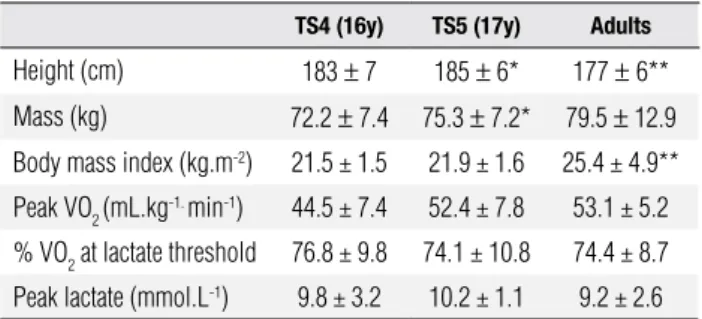
training (≥ 3 years of primarily aerobic exercise acti-vities; e.g., running, cross-country skiing, swimming). None of the subjects suffered from any chronic or acute diseases or health problems, they were all non-smokers and did not consume alcohol or take any prescription medications. For this study the adolescents were tested twice (in Tanner Stage 4 [TS4, 16 years old] and Tan-ner Stage 5 [TS5, 17 years old] separated by approxi-mately a one year period [± one week]) and the adults (21 ± 1 years old; X ± SD) were tested once. Tanner Stage status was based upon medical criteria, question-naire, and hormonal status (see Analytical Methods sec-tion) (5,6). The physical characteristics of the subjects appear in Table 1.
Table 1. Physical characteristics of the subjects and select physiological responses to the maximal exercise test in the Tanner Stage 4 (TS4) and Tanner Stage 5 (TS5) adolescents and young adult males (21 ± 1 years old). All values are means ± SD
TS4 (16y) TS5 (17y) Adults
Height (cm) 183 ± 7 185 ± 6* 177 ± 6** Mass (kg) 72.2 ± 7.4 75.3 ± 7.2* 79.5 ± 12.9 Body mass index (kg.m-2) 21.5 ± 1.5 21.9 ± 1.6 25.4 ± 4.9**
Peak VO2 (mL.kg-1. min-1) 44.5 ± 7.4 52.4 ± 7.8 53.1 ± 5.2
% VO2 at lactate threshold 76.8 ± 9.8 74.1 ± 10.8 74.4 ± 8.7 Peak lactate (mmol.L-1) 9.8 ± 3.2 10.2 ± 1.1 9.2 ± 2.6
*Differs from TS4; **Differs from TS4, TS5 (p < 0.05).
Procedures
Every effort was made to standardize and control the settings for the exercise testing of the subjects. The exercise tests were performed between 01:00 and 03:00 p.m. each day. To ensure stable blood glucose levels, the subjects were asked not to eat for the 3 hours before the exercise testing and to make their last meal small in size (~300 kcal). The subjects were also asked to avoid strenuous physical exertion or psychological strain during the 36 hours prior to all exercise testing. As noted, all subjects were experienced in exercise re-search participation, which minimized any potential anticipatory − anxiety responses in their physiological outcomes.
po-Cop
yright
© ABE&M t
odos os dir
eit
os r
eser
vados
.
wer output was increased by 40 W every 4 minutes up to 240 W (ifth stage). The next and inal stage of the incremental exercise consisted of a one-minute sprint at the highest possible rate of pedaling (i.e., simulating a competition scenario and to make the exercise effort maximal, exhaustive. A blood specimen was collected at the end of each exercise stage as well as at the very end of exercise. Blood specimens were collected into sterile vacutainer tubes, allowed to clot, and then immediately centrifuged at 4oC to separate serum. Serum specimens were refrigerated and stored at –20 oC until later bio-chemical analysis could be performed.
During the entire period of the incremental exer-cise test expired respiratory gases were collected and analyzed continuously, using a Parvo Medics TrueMax 2400 Metabolic Measurement System calorimetry sys-tem (Sandy, Utah, USA). The highest oxygen uptake obtained from the respiratory gases was considered to be the peak oxygen uptake for the exercise test (peak VO2). Throughout exercise testing strong verbal en-couragement was given to the subjects.
Analytical methods
Hormonal concentrations for cortisol, total testoste-rone, and growth hormone (GH) were determined in all serum specimens by a highly speciic automated immuno-chemoluminescence system (7). Assay de-tection limit, intra-assay variation, and inter-assay va-riation were: cortisol = 5.5 nmol·L-1, 7.0% and 10.3%; testosterone = 0.5 nmol·L-1, 6.7%, and 7.7%; GH = 0.7 ng·L-1, 7.2% and 9.1%, respectively. Blood lactate con-centrations were also measured in serum specimens to determine lactate threshold point (exercise intensity) and peak lactate responses, using methods previously described elsewhere (8). All specimen handling and analytical procedures were standardized and based on recommendations present in the literature to ensure viable biochemical outcomes (9).
Statistics
A mixed-model (age group vs. measurement time)
analysis of variance (ANOVA) was used in combination with post hoc testing (Bonferroni), where appropriate, to perform statistical analysis on mean responses of all measurements. For all statistical analyses the accepted probability level was designated as p ≤ 0.05. Additio-nally, for all signiicance between age group (TS4 vs.
TS5 vs. adult) hormonal indings, effect size calculations
(Cohen’s d) were conducted to determine the
physiolo-gical meaningfulness of outcome differences (10).
RESULTS
Physical characteristics – Exercise response
Table 1 presents the physical characteristics and outco-mes of exercise testing for all the subjects. Adolescents at TS5 were taller (p < 0.05) than they had been at TS4, and were taller (p < 0.05) than the adults in the study. Likewise, the adolescents increased in body mass from TS4 to TS5 (p < 0.05), but did not differ from adults at either Tanner Stage. The adults, however, did have a greater (p < 0.05) body mass index (BMI) than the adolescents at both TS4 and TS5.
Peak VO2 increased from TS4 to TS5 in the ado-lescents (p < 0.05), and the adult group peak VO2 was greater (p < 0.05) than that of the adolescents at TS4 but not at TS5. The percentage of peak VO2 that elici-ted the lactate threshold was similar in adolescents and adults regardless of the age group. Correspondingly, the peak lactate response to exercise did not vary be-tween the subjects regardless of age group.
Hormonal outcomes
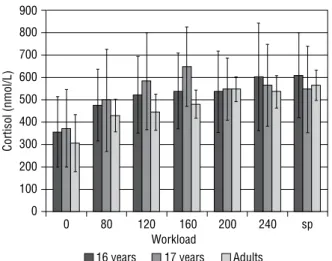
Cortisol responses of the adolescents at TS4 and TS5 as well as that of the adults progressively increased (p < 0.01) from rest (time 0) to the end of the exercise test at the inal sprint (sp) (Figure 1). However, no group differences occurred in the magnitude of responses between the adolescents (TS4 or TS5) and the adults. There was a slight tendency for cortisol levels of both the TS4 and TS5 adolescents to be elevated at rest in comparison to the young adults, but this effect only approaches statistical signiicance (p < 0.10 > 0.05) (TS4+TS5 vs. adults; Cohen’s d = 0.67).
Figure 2 displays the testosterone responses of the subjects. There was a signiicant difference (p < 0.05) between the age groups for this hormonal response. TS4 testosterone levels were signiicantly lower than those of the TS5 adolescents and adults across the en-tire exercise test sampling times (TS4 vs. TS5+adults;
Cohen’s d = 1.58); however, none of the responses of
Cop
yright
© ABE&M t
odos os dir
eit
os r
eser
vados
.
900
800
700
600
500
400
300
200
100
0
0 80 120 160 200 240 sp
Workload
Cortisol (nmol/L)
16 years 17 years Adults
35
30
25
20
15
10
5
0
0 80 120 160 200 240 sp
Workload
Testosterone (nmol/L)
16 years 17 years Adults
40
35
30
25
20
15
10
0
0 80 120 160 200 240 sp
Workload
Growth hormone (ng/mL)
16 years 17 years Adults
Figure 3. Growth hormone responses (X ± SD) of the adolescent subjects in Tanner Stage 4 (16 years old), in Tanner Stage 5 (17 years old), and in a group of young adults (21 years old). The y-axis in the figure represents the hormonal concentration in the blood of the subjects, while the x-axis is the resistance workload (i.e., power) in Watts (W) during the incremental cycling exercise test. The abbreviation “sp” denotes the sprint stage until exhaustion at the end of exercise.
Figure 1. Cortisol responses (X ± SD) of adolescent subjects in Tanner Stage 4 (16 years old), in Tanner Stage 5 (17 years old), and in a group of young adults (21 years old). The y-axis in the figure represents the hormonal concentration in the blood of the subjects, while the x-axis is the resistance workload (i.e., power) in Watts (W) during the incremental cycling exercise test. The abbreviation “sp” denotes the sprint stage until exhaustion, at the end of exercise.
Figure 2. Testosterone responses (X ± SD) of the adolescent subjects in Tanner Stage 4 (16 years old), in Tanner Stage 5 (17 years old), and in a group of young adults (21 years old). The y-axis in the figure represents the hormonal concentration in the blood of the subjects, while the x-axis is the resistance workload (i.e., power) in Watts (W) during the incremental cycling exercise test. The abbreviation “sp” denotes the sprint stage until exhaustion at the end of exercise.
GH responses are shown in igure 3. The resting and exercise GH levels of the TS4 adolescents tended to be greater than those of both the TS5 adolescents and adults. However, due to a large amount of varia-bility within the GH responses in all age groups, these between group differences only approached statistical signiicance (p = 0.10). Exercise did result, however, in signiicant increases (p < 0.05) in GH from rest (time 0)
to the inal sprint (sp) at the end of the exercise test for all age groups. Furthermore, peak GH (time sp) of the TS4 adolescents was greater (p < 0.05) than that of the TS5 adolescents and adults (TS4 vs. TS5+adults;
Cohen’s d = 1.86); although, the latter two age groups
did not differ from one another in peak GH responses.
DISCUSSION
ante-Cop
yright
© ABE&M t
odos os dir
eit
os r
eser
vados
.
rior pituitary GH response to exercise of Tanner Stage 4 adolescents is much greater than that of Tanner Stage 5 or of young adults.
On the whole, the hormonal indings for the ado-lescent groups in this study are in agreement with pre-viously published reports. For example, Viru and cols. showed that exercise induces increased cortisol respon-ses in adolescents and young adults (2,11,12). These investigators also found a lowering of cortisol levels at rest and with exercise as adolescents move from Tan-ner Stage 2 to Stage 5 (12). Boisseau and Delamarche and Wirth and cols. also reported similar occurrences (4,13). The adolescents in the present study, however, only tended to display this latter response; i.e., the data approached statistical signiicance. Kraemer and others reported equivalent cortisol responses in adolescents completing a very similar exercise protocol; although they studied only young girls (14). Relative to testoste-rone, Fahey and cols. reported nearly identical indin-gs as the present study for this hormone, both at rest and in response to exercise in Tanner Stages 4 and 5 adolescents (15). Likewise, the present GH indings, at rest and in response to exercise, also matched those reported by Fahey and associates in adolescents (15). Furthermore, the work of Veldhuis and colleagues has shown there is a strong inluence of age on the circu-lating levels of GH and GH production at the anterior pituitary in young versus older adults (i.e., decreasing with advancing age) (16). The present data support such phenomena occurring even when progressing from Tanner Stage 4 to young adulthood.
While our data replicates and support previous rese-arch indings, there is a unique aspect to our study. The hormonal proiling used involved a frequent blood sam-pling protocol during exercise to compare age groups. Many previous studies simply used a pre-post exercise blood sampling protocol approach. The present blood sampling protocol allows for a more dynamic charac-terization of the hormonal responses to exercise. This characterization revealed that the differences observed for testosterone and GH in the adolescents seem to emanate from the hormonal differences observed at rest prior to exercise, and are not due to differing response patterns during the exercise. Interestingly, the similarity of the exercise responses, once resting-basal differences are accounted for, suggest that the regulatory aspects of the endocrine system are responsive to the stimulus of physical exercise in a very similar fashion in males at Tanner Stage 4, 5, and in young adults. Thus, for
corti-sol, testosterone and GH the endocrine glands produ-cing these hormones are responsive to physical exercise as a stressful stimulus but relative to testosterone and GH the overall amount of hormone being produced is at variance with that of young adults (↓ testostero-ne, ↑GH). To our knowledge this inding has not been thoroughly reported previously in the literature.
The testosterone and GH differences observed at rest and throughout exercise in the Tanner Stage 4 ado-lescents most likely relect the less mature developmen-tal levels of the endocrine system within that age group (5,6,17). As would be expected, the Tanner Stage 5 adolescents are much more similar in their responses to that of young adults than the Tanner Stage 4 adoles-cents. This suggests that at this age level (16-17 years) a one-year period of time is critical to developmental progression not only of the endocrine system but also of the skeletal muscle and cardiopulmonary systems (as implied by the observed changes in body mass as well as peak VO2) (18).
The interpretation of our data is limited by the small sample size we employed in the study. This most cer-tainly added to the variability encountered in some of the observed hormonal outcomes. We acknowledge this constraint and therefore suggest that care be used in the application and use of our indings. However, for our between group differences we calculated effect size statistics, and all of our signiicant indings had “large” effect sizes (19). These substantially large effect sizes support the physiological importance and meaningful-ness of our indings and offset our small sample size. Furthermore, this study used extensive systematic con-trols and rigid standardization procedures throughout to ensure that the data gathered were highly valid and reliable, thus adding to the strength of the research stu-dy. Additionally, our unique blood sampling protocol allowed us to examine hormonal responses through the various stages of our incremental increases in exercise intensity. To our knowledge, this has not been done before (most exercise studies simply examine hormonal response immediately before and after exercise). Col-lectively, these points support the scientiic validity of our indings.
ad-Cop
yright
© ABE&M t
odos os dir
eit
os r
eser
vados
.
vised that exercise researchers who study young athletes at or across these two different Tanner Stages account for the pre-existing resting hormonal differences; and thus, treat such adolescents as two distinctly different subject groups. To not do so could result in confoun-ding effects in hormonal research outcomes and invali-date data interpretation and understanding.
Acknowledgements: This study was funded by the Estonian Scientiic Foundation, Grant 3962.
Disclosure: no potential conlict of interest relevant to this article was reported.
REFERENCES
1. Hackney AC. Stress and the neuroendocrine system: the role of exercise as a stressor and modifier of stress. Expert Rev Endo-crinol Metab. 2006;1(6):783-92.
2. Viru A. Plasma hormones and physical exercise. Int J Sports Med. 1992;13:201-9.
3. Population-based Prevention Strategies for Childhood Obesity. 2010. The World Health Organization. p. 3-37.
4. Boisseau N, Delamarche P. Metabolic and hormonal respon-ses to exercise in children and adolescents. Sports Med. 2000;30(6):405-22.
5. August GP, Grumbach MM, Kaplan S. Hormonal changes in pu-berty. III Correlation of plasma testosterone, LH, FSH, testicular size and bone age with male pubertal development. J Clin Endo-crinol Metab. 1972;34:319-26.
6. Preece MA. Prepubertal and pubertal endocrinology. In: Falkner F, Tanner JM, eds. Human growth: a comprehensive treatise. Post-natal growth Neurobiology. 2nd edition. New York: Plenum, 1986, vol. 2, p. 211-24.
7. Babson A. The IMMULITE. Automated immunoassay system. J Clin Immunoassay. 1991;14:83-8.
8. Port K. Serum and saliva cortisol response and blood lactate ac-cumulation during incremental exercise testing. Int J Sports Med. 1992;12:490-4.
9. Hackney AC, Viru A. Research methodology: endocrinologic mea-surements in exercise science and sports medicine. J Athl Train. 2008;43(6):631-9.
10. Cohen J. Statistical power analysis for the behavioral sciences. 2nd edition. Erlbaum, Hillsdale, NJ, 1988.
11. Viru A, Laaneots L, Karelson K, Smirnova T, Viru M. Exercise-in-duced hormone responses in girls at different stages of sexual maturation. Eur J Appl Physiol. 1998;77:401-8.
12. Viru A, Karelson K, Smirnova T. Stability and variability in hor-mone responses to prolonged exercise. Int J Sports Med. 1992;13:230-5.
13. Wirth A, Träger E, Scheele K, Mayer D, Diehm K, Reischle K, et al. Cardiopulmonary adjustment and metabolic response to maxi-mal and submaximaxi-mal physical exercise of boys and girls at diffe-rent stages of maturity. Eur J Appl Physiol. 1978;39:229-40. 14. Kraemer RR, Acevedo EO, Synovitz LB, Hebert EP, Gimpel T,
Cas-tracane VD. Leptin and steroid hormone responses to exercise in adolescent female runners over a 7-week season. Eur J Applied Physiol. 2001;86:85-91.
15. Fahey TD, Valle-Zuris AD, Oehlsen G, Trieb M, Seymour J. Pubertal stage differences in hormonal and hematological responses to maximal exercises in males. J Appl Physiol. 1979;46:823-7. 16. Veldhuis JD, Weltman JY, Weltman A, Iranmanesh A, Muller E,
Bowers CY. Age and secrtagogue type jointly determine dynamic growth hormone responses to exogenous insulin-like growth factor-negative feedback in healthy men. J Clin Endocrinol Me-tab. 2004;89(11):5542-8.
17. Grumbach MM. The neuroendocrinology of human puberty revi-sited. Horm Res. 2002;57 Suppl. 2:2-14.
18. Baxter-Jones A, Goldstein H, Helms P. The development of aero-bic power in young athletes. J Appl Physiol. 1993;74:1160-97. 19. Ferguson CJ. An effect size primer: a guide for clinicians and