TRABALHO DA ENFERMEIRA INTENSIVISTA: UM ESTUDO DA ESTRUTURA DAS REPRESENTAÇÕES SOCIAIS
EL TRABAJO DE LA ENFERMERA INTENSIVISTA: UN ESTUDIO DE LA ESTRUCTURA DE LAS REPRESENTACIONES SOCIALES
Iranete Almeida Sousa Silva1, Enêde Andrade da Cruz2
RESUMEN
En este estudio se caracteriza las represen-taciones sociales del trabajo de la enfer-mera en la unidad de cuidados intensivos (UCI), mediante la determinación del núcleo central y del sistema periférico. Se llevó a cabo en cinco UCIs de dos hospitales docen-tes de investigación y asistencia, siendo uno de ellos estatal y el otro filantrópico, ubicados en la ciudad de Salvador - Bahia. La recolección de datos se realizó a través de la asociación libre de palabras del térmi-no inductor: trabajo de la enfermera en la UCI, con noventa enfermeras. Los datos fueron procesados por el software EVOC y analizados por medio de la construcción de la tabla de cuatro casilleros basados en la teoría de las representaciones sociales con abordaje estructural. Los resultados indican como elementos centrales: estrés, respon-sabilidad, asistencia integral y gratificación. Como sistema periférico, elementos actitu-dinales, profesionales y personales nece-sarios al trabajo. Se concluye que el trabajo estresante de responsabilidad es ameniza-do por la gratificación de prestar asistencia integral, lo que exige una diversidad de atri-butos personales y profesionales.
DESCRIPTORES Cuidados de enfermería. Unidad de Cuidados Intensivos. Psicología social.
ABSTRACT
This study aims at characterizing the social representations of the nurse in the inten-sive care unit (ICU) by identifying the cen-tral core and the peripheral system. It was carried out in five ICUs from both public and philanthropic teaching, research and assis-tance hospitals in Salvador (Bahia, Brazil). Data were gathered from ninety nurses by means of free evocation from the phrase:
nurse's work in an ICU and then processed with the EVOC software. Analysis was per-formed by building a four-digit chart based on the structural approach to the theory of social representations. Results point out stress, responsibility, integral care and gratification as the core elements. The pe-ripheral system comprised personal and professional attitudes deemed necessary to perform the work. Therefore, it could be concluded that stress and responsible work are relieved by the gratifying feeling of pro-viding integral care, which demands a range of personal and professional attitudes.
KEY WORDS Nursing care. Intensive Care Unit. Social psychology.
The work of the intensive care
nurse: a study on the social
representations structure
*RESUMO
Buscou-se caracterizar as representações sociais do trabalho da enfermeira em uni-dade de tratamento intensivo (UTI) me-diante a determinação do núcleo central e do sistema periférico. Foi realizado em cin-co UTIs de dois hospitais de ensino, pes-quisa e assistência, sendo um público e outro filantrópico da cidade de Salvador-Bahia. A coleta de dados foi efetivada pela associação livre de palavras ao termo indu-tor: trabalho da enfermeira em UTI com noventa enfermeiras. Os dados foram processados pelo software EVOC e anali-sados por meio da construção da tabela de quatro casas, fundamentadas na teoria das representações sociais com abordagem estrutural. Os resultados indicam como elementos centrais: estresse, responsabi-lidade, assistência integral e gratificação. Como sistema periférico, elementos atitu-dinais profissionais e pessoais necessários ao trabalho. Conclui-se que o trabalho estressante de responsabilidade é ameni-zado pela gratificação de prestar assis-tência integral, o que exige uma diversi-dade de atributos pessoais e profissionais.
DESCRITORES Cuidados de enfermagem. Unidades de Terapia Intensiva. Psicologia social.
* Extracted from the dissertation “Trabalho em unidade de tratamento intensivo: representações sociais de enfermeiras”, School of Nursing, Federal University of Bahia, 2007. 1 Nurse. MSC. Intensive Care Unit Coordinator of the Complexo Hospital Universitário Professor Edgard Santos
(C-HUPES-UFBA). Salvador, BA, Brazil. [email protected] 2 Nurse. Ph.D. Professor at the Nursing Graduate Program of the School of Nursing, Federal
University of Bahia, 2007 (UFBA). Member of the Grupo de Estudos e Pesquisas em Administração dos Serviços de Enfermagem (GEPASE). Coordinator of
O
RIGINAL
A
R
INTRODUCTION
The work of the ICU nurse is covered by special character-istics, due to care demands, with technological and hu-man differentials. In this Unit, the nurse develops direct care activities to patients and to the administration of every resource that is necessary to achieve recovery.
The ICUs aim at assisting critical patients requiring com-plex and specialized care, performed by a multi-profes-sional team, in which the profesmulti-profes-sional nurse is a member. These Units, therefore, concentrate human resources and patient care materials on a permanent basis, using precise and advanced technologies, aimed at a continuous obser-vation that may support decisions and interventions un-der situations of decompensation(1).
The constant expectation of critical patient decompen-sation and the work complexity inherent to concentration and the cutting-edge technology make the ICU environment quite complex. This complexity, allied to the accumulation of emotional components derived from social interaction and communication processes, is built into a
demand for work development and emergency on patient care. Although this work is mani-fested on individual behavior, it can be fea-tured as a product of the multi-professional team in the ICU social context.
Under the social context of belonging, filled with diversities, the work of a nurse is con-ceived by the individual or the group as an extension of behaviors, attitudes and norms. And social representations(2) may arise.
The social representation theory […] is a private knowledge modality that has
behav-ior elaboration and communication among individuals (3) as its objective. It is featured as a compound of concepts, propo-sitions and explanations originated from daily life and in-tended for the interpretation of reality(4). It is, therefore, a
common sense knowledge produced within social groups during the process of interaction and communication, which reflects the individuals’ status regarding their everyday objects.
In the ICU work dynamics, the communication and inter-action among team members may initiate behavioral and attitude changes, responding to work conditions such as: constantly dealing with the limits of life; difficulties on accepting death; shortage of people and materials; con-flicting situations with team members, patients and fam-ily members(1), since the contact in which the changes
oc-cur causes alterations of conditions of production, circu-lation, functions and transformation of the SR(5).
These understandings are noted by social representa-tions theorists, when they say that the construction of so-cial representations (SR) is defined as […] a way of socially elaborating and sharing knowledge, presenting a practical
orientation and competing for the construction of a com-mon reality to a social compound(6). It is featured as a
prod-uct resulting from human activity, elaborated by communi-cation and interaction among individuals during their daily activities(3).
It is during everyday activities that individuals expose their reality, interpreted with subjective and intersubjective meanings(7). Accessing SR is trying to understand the ways
individuals use to create, transform and interpret feelings, perceptions and experiences about life within a social group. The SRs are built of beliefs, opinions, attitudes and values about a given social object, as a product of common sense knowledge.
The study about the work of the ICU nurse, by means of SR structure, may determine the recovery of professional work with a global overview that enables knowledge of the real work conditions and the process that articulates the rela-tion between work objectivity and the subjectivity of each professional in the group. The representing elements may be deduced from the discourse contained meanings, that is, the quantifying indicators. These indica-tors may be studied by the Central Nucleus Theory (CNT)(2). Studies using the CNT strengthen
the heuristic plurality of social representations and its ability to explain daily reality accord-ing to the social groups(8-11).
This way, the work reality represented by nurses is re-appropriated by them, rebuilt from their cognitive systems and integrated to their value systems, according to the his-tory and the ideological social context that surrounds them(3).
The central nucleus (CN) is featured by a compound of elements surrounded by SR. It holds the mean-ing determination – in other words, the social representation structure. It is the element that organizes and subsidizes the fundamental and flexible meaning of social represen-tation. The representing elements are organized, structured and constituted into an specific socio-cognitive system where one or more elements provides a greater meaning to representation – its own structure(2,11).
The SR structure is constituted of structured socio-cog-nitive elements that make the CN and the peripheral sys-tem. CN is featured as a rigid, stable, composed of elements that give sense to other more flexible nucleuses, named peripheral nucleuses. The peripheral system is organized around the CN. The elements are flexible and enable a bet-ter context inbet-teraction, accessing reality, achieving, regu-lating and defending the CN(2).
Identification of the CN and of the peripheral elements about the nurse’s work, the object of this study, may evi-dence what is really being represented by the quality group. Therefore, it is necessary to search for the inner nature of the work of an ICU nurse, since the work of these professionals in
In the ICU work dynamics, the communication and
interaction among team members may initiate behavioral and
attitude changes, responding to work
this sector reflects their view of the experiences and trans-formations within their professional activity.
The study of the work of an ICU nurse is, however, a social phenomenon that must be clarified, since it depends on individual conditions of those who perform the job and may also be influenced by internal and external situ-ations inherent to the established relsitu-ations within the group(3).
Facing the exposition, we aim, in the present study, at featuring social representations elaborated by ICU nurses about their work, by identifying the CN and peripheral system.
It achieves relevance as it explains the way the studied object is represented by nurses working in ICU, locus of the present study, revealing possible influences of this repre-sentation in these professionals’ work. It also may offer a contribution to knowledge, especially a reflection on the professional category of the unit, in order to improve this reality and motivate other investigations.
METHODS
This is a descriptive study, developed according to the Social Representation Theory (SRT)(3) regarding structural
approaches(2).
The study was performed in five Intensive Care Units of two large hospitals that provide services to the Single Health System (SUS – Sistema Único de Saúde) users, where one hospital is public and the other philanthropic, also providing private services in Salvador. Both were chosen according to the following criteria: Aiming at care, educa-tion and research; providing services to the SUS user; a structured and organized Nursing Service based on regu-lations in which the general ICU composes one of its sec-tors; with active nurses in the unit for twenty-four (24) hours a day.
Considering the quantifying and qualifying properties in the social representations determinations, by a central nucleus and a peripheral system, the Evocation or Free Word Association (FWA) technique was used to collect data. The study was performed after the research project was approved by the field studies ethics committee and autho-rized by the organization
The FWA is a projective psychology test that has been broadly used in SR structure studies. It helps locating a person’s blocking and repression zones, that is, the conscience field exclusion of certain ideas, feelings and desires that the individual may not want to admit; however, these are still part of their psychic life(9).
The informers were previously oriented of the impor-tance of this research, the procedures for data collection, their free will on participating or not on the study, based on their signature of the Term of Consent, according to
orientations of the 196/1996 Resolution of the National Health Council(12), as well as the free word association
test. Afterwards, for the FWA test, the subjects that ac-cepted to participate in the research were required to speak five words or expressions that immediately occurred to them after motivated by the following inducing question: when talking about work in the ICU, what comes to your mind? Afterwards, the most important evocation consid-ered was requested.
The test was performed in the period between May and June/2006, in both hospitals, on the active ICU nurses that held working time of six months or more, a period consid-ered necessary for the achievement of the representations and group belonging consolidation.
The product obtained by free evocation of words was processed and analyzed with the support of the software EVOC(13). This software calculates the simple frequency of
each evoked word, the average evocation orders and the average of the average order of evoked words. Moreover, it enables lexicographic and quantifying data analysis, con-sidering the four-digit chart. After the previous organiza-tion of the evoked elements, they constituted the corpus for analysis.
RESULTS AND DISCUSSION
The informant universe was constituted by 100 nurses. The following were excluded: one refused to participate in the study; three were on leave by the INSS (Social Security National Institute), with no return date set; one was being dismissed, and had no obligation on accomplishing the duty scale; four did not fit the working time criteria for the research; and one was the researcher. The sample was therefore, constituted by 90 subjects, composing 90% of the total.
The age of the interviewed varied between 23 and 47 years old, with an average of 32 years old, where (83) 92.23% were female and (seven) 7.77% were male. The working time length at the ICU varied from six months to 14 years, result-ing on an average of four years.
The collected data showed an average order of evoca-tions around three and the average frequency around four-teen. These data enables the construction of vertical and horizontal lines that divide the four-quadrant chart. The vertical axis corresponds to the average frequency; the horizontal, to the average evocation order.
This also reveals the subjects’ latent, spontaneous speeches, since evocation reminds them spontaneously and promptly of something really present in their memory, that is equiva-lent to their system of values, ideas and beliefs.
The elements located in the second quadrant (upper right) and in the third quadrant (lower left) are considered intermediate and may approach both the central and pe-ripheral elements. These are not analyzed by the CN Theory(2,11), but by the greater SRT theory(3).
Finally, the elements located in the fourth quadrant (lower right) are considered as integrants of the pe-ripheral system. These are the less frequent evocations holding a higher rate or a higher average order and compose the elaborated thinking, that is, the speakers
may intentionally elaborate the element, before express-ing it(3,9).
The 90 subjects evoked 450 words. However, 35 were eliminated, which were referred to only once, correspond-ing to 7.78% of the total evocation, to provide more con-sistency and explicitness to the representation according to the methodology orientation(14). The remaining
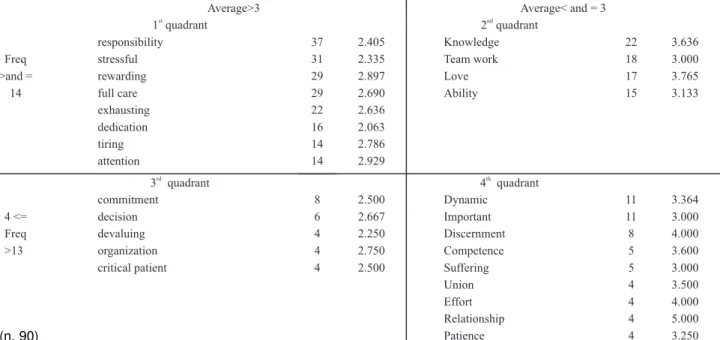
vocabu-lary totaled 415, and corresponded to 92.22% of the total. The research corpus was constituted by 54 different words. Table 1 is presented, elaborated by EVOC 2000, based on the inducing term work of an ICU nurse. The chart shows,
according to the speakers’ conception, the possible cen-tral system and peripheral system representation elements of the work of a nurse in this unit.
We observed the following elements in the upper left quadrant of this chart: stressful, responsibility, rewarding, full care, exhausting, dedication, tiring and attention, which indicate those words most promptly evoked and that held a higher frequency, which may constitute the CN, since they feature the ontological sense of representation, that is, its structural or figure nucleus.
In this present study, the constituting elements of the CN or of the SR structure are understood as those which repre-sent the most expressive meanings of the reprerepre-sentations of the work of an ICU nurse – in other words, the common sense of the group that guides its behaviors ad attitudes. Therefore, it is built of one or more elements that en-sure three functions as representation meaning: the gen-erating function that creates or transforms constituting representation elements and enables other elements to acquire value and sense, the organizing element that uni-fies and internally organizes the representation and the
stabilizing element that stabilizes the group’s representa-tion(2), which seems to be an essential condition for the work
of an ICU nurse.
The work of a nurse in this unit, due to its complexity, precision and urgency, requires the performers to have direct contact with risk situations and with the continu-ous eminence of death. These stressful situations, inher-ent to the ICU work, may interfere in the daily activities of an intensive nurse, as the studies on nurses’ emotional states during professional performance in critical units(15). Apart
from these situations, the inherent responsibility to the work of assisting life is a feature that constitutes an inher-ent eleminher-ent of the work of a nurse in their daily activities in the sector.
These evocations demonstrate the importance and value attributed by the group to the representative elements that constitute the work of an ICU nurse, which not only evi-dence the importance of their work in the sector, but also
Table 1 – Table 1 – Table 1 – Table 1 –
Table 1 – View of the work of an ICU nurse central nucleus according to the frequency and average order of evoked words. – Salvador, BA – 2006
Average>3 Average< and = 3
1 quadrantst
2 quadrantnd
responsibility 37 2.405 Knowledge 22 3.636
Freq stressful 31 2.335 Team work 18 3.000
>and = rewarding 29 2.897 Love 17 3.765
14 full care 29 2.690 Ability 15 3.133
exhausting 22 2.636
dedication 16 2.063
tiring 14 2.786
attention 14 2.929
3rd quadrant
4 quadrantth
commitment 8 2.500 Dynamic 11 3.364
4 <= decision 6 2.667 Important 11 3.000
Freq devaluing 4 2.250 Discernment 8 4.000
>13 organization 4 2.750 Competence 5 3.600
critical patient 4 2.500 Suffering 5 3.000
Union 4 3.500
Effort 4 4.000
Relationship 4 5.000
Patience 4 3.250
represent the SR functions, regarding their equivalence to systems of values and ideas of the normative and func-tional dimensions, where the autonomy of the nurse in the work development is included(3). This equivalence is shown
under two formats: one that establishes order, guiding the group’s behavior in their social world; and the other that enables communication between members of the group.
Also, the elements exhausting, tiring and attention are in this quadrant, and may act as supporting parties asso-ciated to the work of a nurse, as a consequence of its char-acteristics and operational conditions.
On the lower right quadrant, the elements featured are:
dynamic, important, discernment, competence, suffering, union, effort, relationship and patience. This quadrant in-dicates that words were less evoked and held the last po-sitions in the evocation order – that is, they hold high average orders and belong to an elaborated thinking pro-cess by the speakers, integrating the peripheral system. This way, they constitute less relevant meanings about the study object that may be activated to support the CN.
These elements promote an interface between actual reality experienced by nurses and the representation cen-trality about their work. It enables achievement and
adapt-ing the group to reality, due to the interaction of everyday experiences that generate more individual representations. Therefore, more accessibility and concrete components to the maintenance of CN functions were constituted(2).
Thus, the peripheral elements evidence a relation to pro-fessional and personal attributes needed to the work of an ICU nurse. These are, in a certain way, basic and organized under complex structures that cross the entire representation(16).
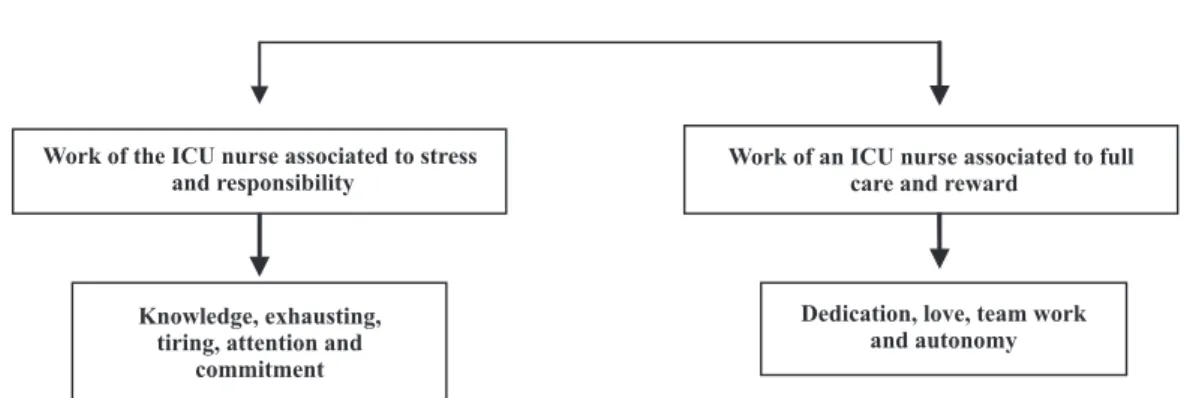
On the search for content in representations about the work of a nurse, which are related to several meanings, con-tents were rebuilt based on the hierarchy of the vocabu-lary evoked, ordered according to their place in the repre-sentation structure. Afterwards they were categorized ac-cording to the various nuclei of meanings they comprise. This way, the following nuclei were identified, composed by two central categories and two peripheral categories. For that, the words contained in the upper left and lower right quadrants were considered, among other elements, as complementary to explain the categories, respectively de-nominated: Work of an ICU nurse associated to stress and responsibility and the Work of an ICU nurse associated to full care and reward. The meaning nuclei of the elements in the upper left quadrant are presented in Figure 1.
CENTRAL CATEGORIES
Work of the ICU nurse associated to stress and responsibility
Work of an ICU nurse associated to full care and reward
Knowledge, exhausting, tiring, attention and
commitment
Dedication, love, team work and autonomy
Figure 1 – Figure 1 – Figure 1 –
Figure 1 – Figure 1 – Social representation central categories of working nurses in ICU about their work – Salvador - 2006
The first central category: Stressful and respon-sible work – determined by vocabulary as responsibility, stressful, exhausting, tiring, attention and commitment show the exact nature of the work of a ICU nurse for these pro-fessionals. Their behavior may be connected to history or to the memory of that group, to the values and norm system and to the nature of the group’s involvement in the social context lived by the sector. It corresponds to the general orientation of working nurses in the sector, for the develop-ment of professional work(2).
In this sense, responsibility is connected to appropri-ate knowledge by professionals throughout their working life or even by the way they think about their professional activity facing the world’s transformations, therefore, as a product of the communicationand interaction process(17).
The term stressful incorporates an expressive meaning of the work of an ICU nurse, when associated to the evoked terms exhausting, tiring. These terms are directly connected to the definition of stress and to its relation to demands that are greater than the dealing capacity of workers, as the term responsibility is connected to the element attention(18).
These elements are, therefore, components that support and expand the meanings of the category.
This is due to the continuous and effective care that the entire team needs to provide to critical patients admitted to the ICU. As members of this team, the nurses hold a major role, executing essential high complexity tasks, apart from controlling the execution of internal organizational pro-cesses in the unit, intent on effective full care. Studies on motivation confirm that the execution by itself, that is, pa-tient care, rewards the professional since they find fulfill-ment of their own aspirations within it(19).
Executing the task is what makes the professionals feel more complete, performing full care, achieving what is stated as their competence, where the autonomy of being a nurse is included, which may carry the rewarding feeling. Reward-ing understood by common sense as a situation that satis-fies internal feelings. It is supported here by the terms dedi-cation and love.
These categories show opposite meanings, since, on the one hand, they feature the work as stressful, responsi-bility work, and on the other hand as full and rewarding care. This dualism seems to be a compensatory process, since stressful work is understood as something negative that damages the global performance of individuals, re-sulting from experiences causing feelings of tension, anxi-ety, fear or threat(1). In this unit, it is common for nurses to
experience these situations as a member of the team. This category precisely evidences the meaning and the nature of the work of an ICU nurse in the conception be-tween workers of the sector. These behaviors might have a connection with history or with the collective memory of the group(2). The intensive care units, since their
concep-tion, have been featured as a reserved space for critical patient’s attention. It requires the active nurse of this sector to be in a constant state of alertness, ranging from minor alterations that might indicate complications in the
clini-cal status of patients to the most complex and severe, such as cardio respiratory arrest, which many times may lead to the death of the patient.
These situations, identified as stressful, may cause this work many moments that are hard to deal with, creating a negative understanding of the ICU work. The responsibility element represents every life care action, making it, by ex-cellence, indispensable to the care in an ICU context. It also demonstrates the seriousness attributed by the group to the representative and constituted work elements of a nurse in this unit, when they represent their values and ideas in work development, achieving their representations.
Moreover, the elements full care and rewarding arise in this care space, because the nurse holds the opportunity to fully assume the work in which he/she was graduated in. Providing direct care to patients is a source of reward-ing feelreward-ings for this professional, since it is common to per-form this profession in the sector, according to the features of the type of care that may be performed. It is necessary for the nurse to see results from the attention provided to patients in all the dimensions of which care is comprised. They arise as a lever to a fulfilling and rewarding work, since it is possible to aim at the objectives of care.
As the central contents, the peripheral contents also reveal their categories. The elements of the peripheral(2)
sys-tem are outlines organized around the CN that make the interface between concrete reality and the central system possible. They are flexible, evolutional and protect the cen-tral nucleus.
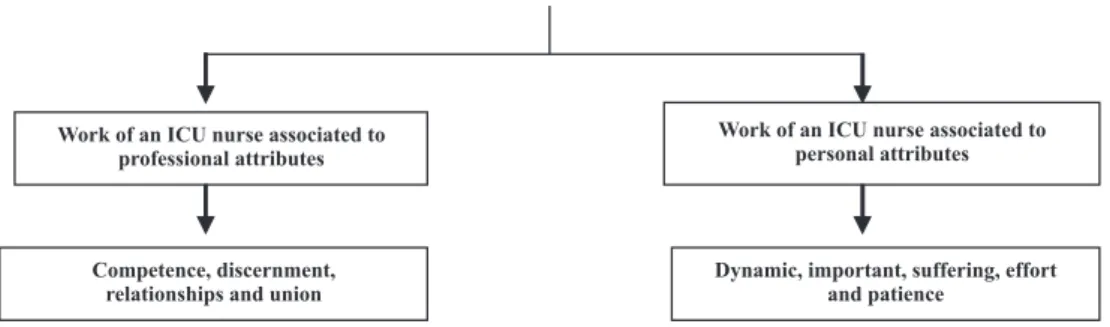
In this study, these elements present senses that achieve these functions and may be organized into two categories, as exposed in Figure 2: Work of an ICU nurse associated to professional attributes and Work of an ICU nurse in the associated to personal attributes.
PERIPHERAL CATEGORIES
Work of an ICU nurse associated to professional attributes
Work of an ICU nurse associated to personal attributes
Competence, discernment, relationships and union
Dynamic, important, suffering, effort and patience
Figure 2 - Figure 2 - Figure 2 - Figure 2 -
Figure 2 - Social representation peripheral categories of working nurses in ICU about their work - Salvador - 2006
The first peripheral category – Work of an ICU nurse associated to professional attributes – is represented by contents that evidence the necessary qualities to ICU work, such as: competence, discernment, relationship and union. These qualities enable the group’s adaptation to reality, due to interactions and daily experiences, and are comple-mentary, representing elements of the work of the profes-sionals in this unit.
The evolutive and flexible characteristics of the first peripheral elements in the upper right quadrant integrate or belong to the centrality of the representation, that is, they may evolve into CN representations(9,11), while the
The second peripheral category - Work of an ICU nurse associated to personal attributes - is expressed by means of meanings related to the personal characteristics needed to work in an ICU, such as: dynamic, important, suffering, effort
and patience. In the common sense, these elements point out the importance of being dynamic and diligent, of hold-ing resignation to patiently deal with distressful situations that mobilize physical, intellectual and moral efforts of the nurse to reach the aim of fully caring for the patient.
Acting as an ICU nurse requires knowledge mastering, in order to perform technologies skillfully, with the re-quired ability and competence for a satisfactory work. These professionals also face several situations that de-mand discernment in action prioritization, in which ac-tivities are permeated by relations between the nursing team and other professionals – As such, demonstrating that the nursing work is eminently about relationships, whether with patients, family members or with the team. Finally, union is understood as the element composing interdependent and shared work.
Dynamism is understood as a necessary attribute to the work in this unit, due to patients’ characteristics and the dynamics of clients’ care.
The ICU is a sector where patients are continuously evaluated. In the evaluation process, for conduct defini-tions, the work of a nurse is very important. It evidences a value attributed by their executors, which shows a certain valuation of common sense over the role of this profes-sional in a general manner. It expresses that the group’s self-esteem is guided to building a new social value para-digm of the nurse’s work in the sector.
Acquaintance with critical situations contributes for the suffering of this worker. Since it is inevitable, this feel-ing holds different meanfeel-ings and intensities in the social and cognitive individual scenario of this unit. Likewise, patients and family members’ suffering, human and tech-nology limitations, as well as the workload, require effort and patience from this professional. These attributes have become necessary contents for the active professional in ICU and are differentials of care, in the same way they value the professionals and the profession.
FINAL CONSIDERATIONS
This study showed that the analysis of free word evo-cations has guided us to the characterization of constitut-ing elements in the SR structures of the work of an ICU nurse, evidenced by words as stressful, responsibility, full care and rewarding as the social representation central nucleus of the work of a nurse in this sector, for the inves-tigated group. These evocations also reveal an evolution to the understanding of the nurse’s work at the ICU and their contents make it possible to determine the guiding and orientation of the daily work of these professionals, because rewarding and full care may be blocking manag-ers from seeing the seriousness of such representation and, consequently, the need for efficient interventions to reduce work stress.
For the peripheral system, words such as competence, discernment, relationship, union, dynamic, important, effort
and patience were evoked. Their meanings indicate pro-fessional and personal attributes adopted as attitudes in the work of an ICU nurse.
The CN composing elements point out to the need of reflecting about their contents, stressful and of responsibil-ity, which not only feature the work of a nurse, but also show the positive interventional strategies, such as re-duction of the workload, financial incentives that need to be implemented in order to reduce the negative aspects of this structure and thus consolidate the positive aspects of the attitude elements associated to full care, rewarding the representations evidenced.
Although not aiming to expend the topic with this study, we hope to contribute for the building of knowledge and for the reflection of nurses and all the professionals of this sector about the complexity of teamwork, as well as motivating the reflection of managers, with a view to value the work of the entire healthcare team in this sector.
Results still show the need for other studies aiming at expanding and understanding social representations of nurses, due to the transformations of their work at the ICU.
REFERENCES
1. Leite MA, Vila VSC. Dificuldades vivenciadas pela equi-pe multiprofissional na Unidade de Terapia Intensiva. Rev Lat Am Enferm. 2005;13(2):145-50.
2. Abric JC. A abordagem estrutural das representações sociais. In: Moreira ASP, Oliveira DC, organizadores. Es-tudos interdisciplinares de representação social. 2a ed.
Goiânia: AB; 2000. p. 27-38.
3. Moscovici S. A representação social da psicanálise. Trad. de Álvaro Cabral. Rio de Janeiro: Zahar; 1978.
4. Jodelet D. Representações sociais: um domínio em ex-pansão. In: Jodelet D, organizadora. As representações sociais. Rio de Janeiro: UERJ; 2001. p. 17- 44.
6. Jodelet D. Représentation sociale: phénomènes, concept et théorie. In: Moscovici S, organizador. Psychologie sociale. Paris: Presses Universitaires de France; 1984. p. 357-78.
7. Berger PL, Luckmann T. A construção social da realidade. 20ª ed. Petrópolis: Vozes; 2001.
8. Gomes AMT, Oliveira DC. Estudo da estrutura da repre-sentação social da autonomia profissional em enfer-magem: relato de pesquisa Rev Esc Enferm USP. 2005; 39 (2):145-53.
9. Oliveira DC, Marques SC, Gomes AMT, Teixeira MCTV. Análise das evocações livres: uma técnica de análise estrutural das representações sociais. In: Moreira ASP, organizador. Perspectivas teórico-metodológicas em re-presentações sociais e práticas educativas. Goiânia: UCG; 2003. p. 573-603.
10. Cruz EA. Práticas profissionais de trabalhadores em central de material e esterilização: representações sociais da equipe de enfermagem [tese]. Fortaleza: Faculdade de Farmácia, Odotonlogia e Enfermagem, Universidade Federal do Ceará; 2003.
11. Sá CP. Núcleo central das representações sociais. Pe-trópolis: Vozes; 1996.
12. Conselho Nacional de Saúde. Resolução n. 196, de 10 de outubro de 1996. Dispõe sobre diretrizes e normas regulamentadoras de pesquisas envolvendo seres hu-manos. Bioética. 1996; 4(2 Supl):15-25.
13. Vergés P. L’evocation de l’argent: une méthode pour la définition de noyau central d’une représentation. Bull Psychol. 1992;14(405):203-9.
14. Tura LFR. Os jovens e a prevenção da Aids no Rio de Ja-neiro [tese]. Rio de JaJa-neiro: Universidade Federal do Rio de Janeiro; 1997.
15. Martino MMF, Misko MD. Estados emocionais de enfer-meiros no desempenho profissional em unidades crí-ticas. Rev Esc Enferm USP. 2004;38(2):161-7.
16. Campos HF. A abordagem estrutural e o estudo das rela-ções entre práticas e representarela-ções sociais. In: Campos PHF, Loureiro MCS, organizadores. Representações soci-ais e práticas educativas. Goiânia: UCG; 2003. p. 21-36.
17. Santa Rosa DO. A compreensão do significado da res-ponsabilidade profissional da enfermeira à luz da análise existencial de Viktor Frankl [tese]. Ribeirão Preto: Escola de Enfermagem de Ribeirão Preto, Uni-versidade de São Paulo; 1999.
18. Batista KM, Bianchi ERF. Estresse do enfermeiro em unida-de unida-de emergência. Rev Lat Am Enferm. 2006;14 (4):534-9.
19. Pereira MCA, Fávero N. A motivação no trabalho da equi-pe de enfermagem. Rev Lat Am Enferm. 2001;9(4):7-12.