The most expeditious method for the design of concrete beams under ire situation is the tabular method, presented by the Brazilian standard ABNT NBR 15200:2012. Albeit simple, this method constrains the engineer’s work, as it prevents him to seek alternative solutions to the few tabulated values. Yet, the Brazilian standard allows employing more advanced methods. Hence, the purpose of this work was to perform a ther-mal and structural analysis of beams with several widths, heights, covers and diameters/layouts of steel reinforcement (upper and lower). From those results, graphs were constructed, associating the ratio between the applied bending moment in ire over the resistance bending moment at ambient temperature, for the ire resisting time of each situation. These graphs also allow taking into account the redistribution of moments from positive to negative, which will lead to savings in the solution found.
Keywords: ire, beam, concrete, design, thermal analysis.
O método mais expedito para o dimensionamento de vigas de concreto em situação de incêndio é o método tabular, apresentado na ABNT NBR 15200 [1]. Apesar de simples, esse método restringe o trabalho do engenheiro, uma vez que o impede de buscar soluções alternativas aos pou-cos valores tabelados. Contudo, a norma brasileira permite empregar métodos mais avançados. Sendo assim, o objetivo deste trabalho consistiu em realizar uma análise térmica e estrutural de vigas com diversas larguras, alturas, cobrimentos, diâmetros e disposições de armaduras (infe-riores e supe(infe-riores). A partir dos resultados, foram construídos gráicos que associam a relação entre o momento letor solicitante em incêndio e o momento letor resistente à temperatura ambiente, ao tempo de resistência ao fogo de cada situação. Esses gráicos permitem também levar em conta a redistribuição de momentos, do positivo ao negativo, o que conduzirá à economia na solução encontrada.
Palavras-chave: incêndio, viga, concreto, dimensionamento, análise térmica.
Concrete beams ire design using graphs
Dimensionamento de vigas de concreto armado
em situação de incêndio por meio gráico
G. B. M. L. ALBUQUERQUE a [email protected]
V. P. SILVA a [email protected]
Abstract
1. Introduction
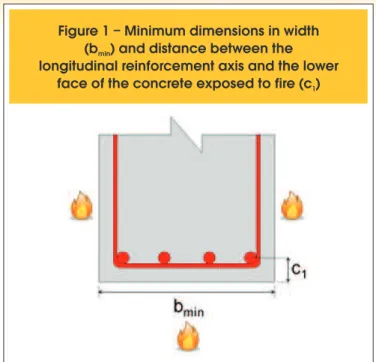
Fire structural engineering is a recent area in Brazil and the technical standards related to this topic only use simpliied methods to verify the safety of structures subjected to this accidental action. For the design of reinforced concrete beams in ire, the ABNT NBR 15200 [1] standard, inspired by the European standard Eurocode 2 part 1-2 [2], details only the tabular method (tables 1 and 2), in which it is only necessary for the beams to meet the minimum dimensions in width (bmín) and distance between the lower longitudinal reinforcement axis and the heated face of the concrete (c1), as shown in igure 1. These dimensions are a function of time required for ire resistance (TRRF), obtained from the type of occupation/use and the height of the con -struction. The tables that present these values are found in the Tech-nical Instructions (IT) of the Fire Department in each Brazilian State. The Brazilian standard ABNT NBR 15200 [1] states that in the tabular method:
n The hypothesis of beams heating on three faces (sides and
bottom) was considered, under slabs. However, the values may also be used in case of beams heated on four faces, provided that their height is not less than bmín and the cross-sectional area of the beam is not less than 2 bmín2
;
n There is a concentration of temperature close to the edges of the underside of the beams. For this reason, on sections with only one layer of reinforcement and width not exceeding the bmín indicated in column 3 of table 1 and column 2 of table 2, the distance between the longitudinal reinforcement axis of the corner and the side concrete face in ire (c1l) at the bottom of
the beams must be 10 mm larger than c1 given by the afore-mentioned tables, or for reinforced concrete, specify corner bars with a diameter immediately higher, according to ABNT NBR 7480 [3], to the calculated. The possibility of this alterna -tive was demonstrated in Silva [4];
n The values shown in table 2 can only be used if the coeficient of
moments redistribution at room temperature respects the limits set in ABNT NBR 6118 [5]. Otherwise, table 1 should be used;
n When the reinforcement bars are arranged in layers, the
aver-age distance to the concrete face (c1m) must obey the value c1mín tabulated. The c1m value should always be the lowest be -tween the values indicated in equations 1 and 2.
(1)
c1m
<
S
S
c
1viAsi
A
si(2)
c1m
<
S
S
c
1hiAsi
A
siFigure 1 – Minimum dimensions in width
(b ) and distance between the
minlongitudinal reinforcement axis and the lower
face of the concrete exposed to fire (c )
1Table 1 – Tabular method for designing reinforced concrete simply supported beams in fire
TRRF
(min)
1
Combinations of b /c (mm/mm)
2
min 13
4
(mm)
bwmin
developed for models of beams with the following characteristics:
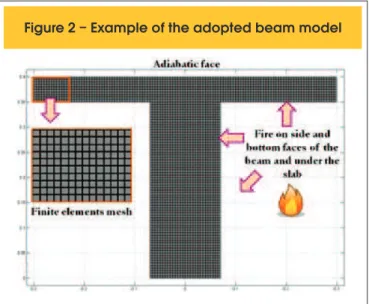
n Rectangular sections with 14 cm, 19 cm, 25 cm, 30 cm and 35 cm in width and 40 cm, 50 cm, 60 cm and 70 cm in height, all overlaid by a 5-cm thick and 60-cm wide slab, as illustrated in igure 2;
n Heating as per ISO 834 standard ire [9], on three faces of the
beam (side and bottom) and under the slab. The face not exposed to the ire was considered adiabatic for safety purposes (igure 2);
n Physical and thermal parameters of the concrete, variable
with temperature, in compliance with the equations indicated in ABNT NBR 15200 [1]: thermal conductivity (λc, θ),
specif-ic heat (cp, θ) for 1.5% relative moisture and density (ρc, θ), adopting ρ = 2400 kg/m3 at room temperature, according to
ABNT NBR 6118 [5];
n Heat transfer coeficient by convection (α
c) equal to 25 W/m 2 oC
and resulting emissivity (εr) on the faces exposed to ire 0.7,
recommended values in ABNT NBR 15200 [1];
n Domain discretized by a mesh of four-node rectangular ele
-ments with sides of 0.005 m. Time step, the increment of time for the thermal analysis, taken equal to 0.002 h, the value that led to satisfactory results for preliminary thermal analysis for time intervals of usual ires and boundary conditions (FSD [8]). About the dimension of the slabs, a relatively small thickness was considered for safety purposes, because the beams that will be sized through the graphs will have, at least, 5-cm thick slabs, which is the lowest value indicated by ABNT NBR 6118 [5] with respect to solid slabs, in this, case the roof ones, not cantilever. Considering that the increase in thickness is directly proportional to the mass of concrete that absorbs heat, the beams that have thicker slabs will be in a less critical situation when compared to Where: c1m is the average distance to the concrete face for
rein-forcement bars arranged in layers; c1vi is the distance from bar i, of
area Asi, to the bottom of the beam and c1hi is the distance of bar i, of area Asi, to the nearest side face.
It is also added that all tables were compiled for steel 25, CA-50 or CA-60 passive reinforcement, such that, in the centroid of the reinforcement, the temperature does not reach 500 °C (Eurocode 2 part 1-2 [2]).
As can be seen, this method, albeit practical, constrains the engineer, since it prevents him from studying the problem and from proposing different results. Therefore, in order to create tools to facilitate the work and contribute to this study area in our country, the objective of this research was to develop alternative solutions to the tabular method, based on thermal and structural analysis, considering that the standards also allow the use of more advanced design methods.
2. Graphic method
Owing to the precision of the results, more advanced methods re-quire speciic software that are rarely used in design ofices. For this reason, the option was to conduct a thermo-structural analysis of beams and to present the results in graphical form for ease of use. The graphs illustrated in section 2.3 are completed in Albuquerque [6] and Silva [7]. In this work, the Swedish Super Tempcalc software, developed by Fire Safety Design (FSD [8]), was used.
2.1 Thermal analysis
By means of the inite element method, the thermal analysis was
Figure 2 – Example of the adopted beam model
Figure 3 – Field of temperatures within
a beam model
high-strength concrete is outside the scope of this research.
n Effects of thermal deformations are neglected, according to ABNT
NBR 15200 [1]. Furthermore, no limit speciic strains were imposed both on concrete and on steel (FSD [8]). Introducing this informa -tion in the structural module of Super Tempcalc and from the tem-perature ield generated in the thermal analysis, parameter µ was determined, indicated in equation 3, as a function of heating time.
(3)
µ=
MRd,fi
M
Rd *Where: µ is the relative moment; MRd *e M
Rd,i correspond to the
design resistance bending moments of the concrete section, at room temperature and in ire situation, respectively, both with no consideration of limit strains.
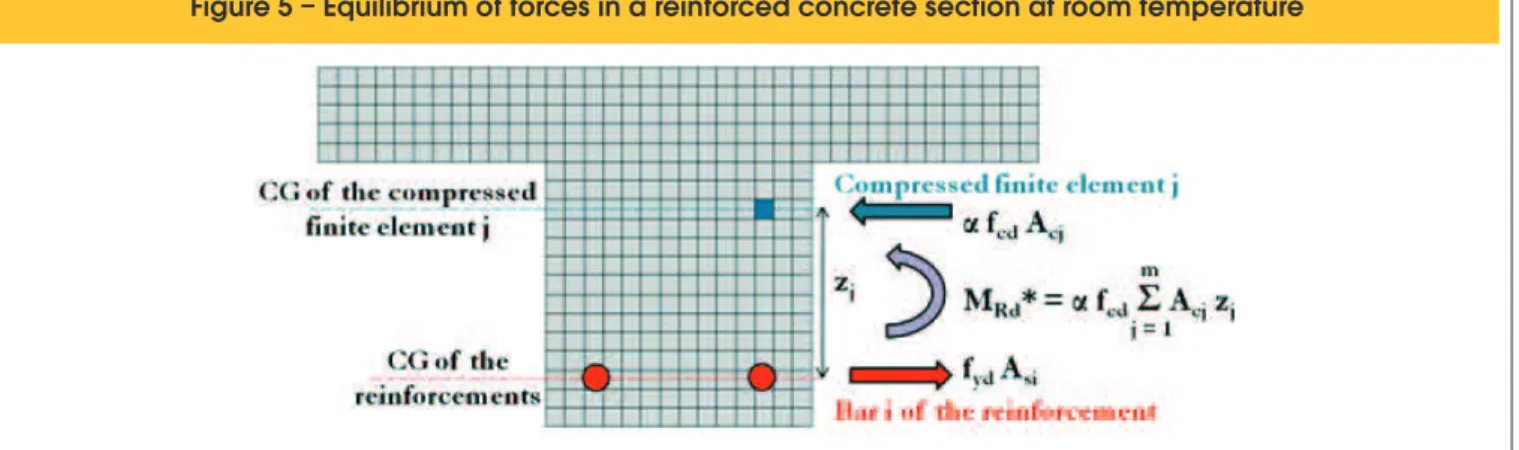
Such moments were determined by the equilibrium of forces, the only hypothesis of calculation of the program (equations 4 and 5 / igures 5 and 6). It is worth noting that the peak stress was considered in each one of the compressed concrete inite elements and, in the same way, total plastic strain was considered for the steel in the reinforcements, disconsidering the compatibility between deformations.
(4)
M
Rd *=
α
f
cdS
A
cjz
j mj=1
those that were used in the development of the graphic method. Thus, from these input data previously mentioned, the temperature ield with respect to the time for the beams under slabs was deter-mined (igure 3).
2.2 Structural analysis
For this analysis, the following were considered:
n Partial factors for strength (γc and γs) equal to 1.4 (concrete) and 1.15 (steel) for room temperature and equal to 1.0 (γc,i and γs,i) for both materials in ire situation, following ABNT NBR 6118 [5] and ABNT NBR 15200 [1], respectively;
n Reducer of the design value of the compressive strength of concrete at room temperature (α) equal to 0.85 and in ire situ -ation (αi) equal to 1.0, according to ABNT NBR 6118 [5] and FIB/CEB [10], respectively;
n Reinforcement diameter of 10 mm, 12.5 mm, 16 mm, 20 mm and 25 mm, arranged in one and two layers, positive and negative, with covers of 25 mm, 30 mm and 40 mm (igure 4); CA-50 steel; number of reinforcements possible for each width, according to the values of minimum free spacing between the faces of the longitudinal bars, as proposed by ABNT NBR 6118 [5]; stirrups diameter of 5 mm;
n For the purposes of processing, the characteristic strength of
concrete to compression (fck) equal to 25 MPa was admitted. However, due to a simpliication favorable to safety, adopted in the calculations made by Super Tempcalc, the results presented in 2.3 are independent of the value of fck. Therefore, it is only rec-ommended that this value be less than or equal to 50 MPa, since
Figure 5 – Equilibrium of forces in a reinforced concrete section at room temperature
(5)
S
M
Rd,fi=
a
fif
cd,fik
c,qj mfij=1
A
cjz
j,fiWhere: α and αi are reducers of the design values of the compressive
strength of concrete at room temperature and under ire conditions, respectively; fcd and fcd,i are the design strength to compression of
the concrete at room temperature and in ire, respectively; kc,θj is the strength reduction factor at temperature θ of the compressed inite element j; Acj is the area of the compressed inite element j; zj and zj,i are the distances between the CG of the compressed inite element j and the horizontal line that goes through the CG of the reinforce-ments at room temperature and under ire situation, respectively.
2.3 Results
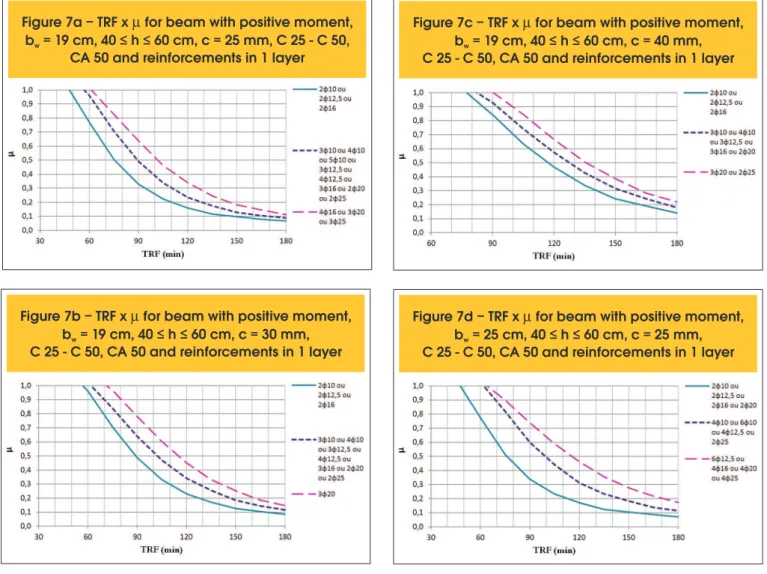
The graphs presented herein, which consist of results from the more ad-vanced method for sizing, depend on parameter µ shown in equation 6.
(6)
µ=
M
M
Sd,fiRd
Where: MSd,i is the design applied bending moment in case of ire
and MRd is the design resistance bending moment of the concrete
section at room temperature.
Safety is met when MSd,i ≤ MRd,i. Therefore, assuming MSd,i = MRd,i in
parameter µ provided by Super Tempcalc, it is possible to ind the maximum time for ire resistance (TRF) of the structural element. Note that, moreover, for simplicity, M*
Rd is replaced by MRd in the
expression of µ, where MRd is the design value, i.e., the one in
which limit strains are imposed on materials, which can be inserted by the engineer as input since, for MRd ≤ MRd
*, the graphs remain
in favor of safety.
The expression for the ultimate accidental combination of actions rec-ommended by the ABNT NBR 8681 [11] (equation 7), in which the ef-fects of thermal strains are neglected, can be used for calculating MSd,i.
(7)
S
S
F
d,fi=1.2
F
Gi,k mi=1
+0.7
ψ2
F
Qj,k nj=1
Where: Fd,i is the design value of action in accidental combination;
FGi,k is the characteristic value of permanent action i; FQj,k is the
characteristic value of variable action j and ψ2 is the combination
factor used to determine the reduced values of the variable actions (according to ABNT NBR 8681 [11], for accidental combinations, in which the main action is ire, reduction factor ψ2 can be reduced by
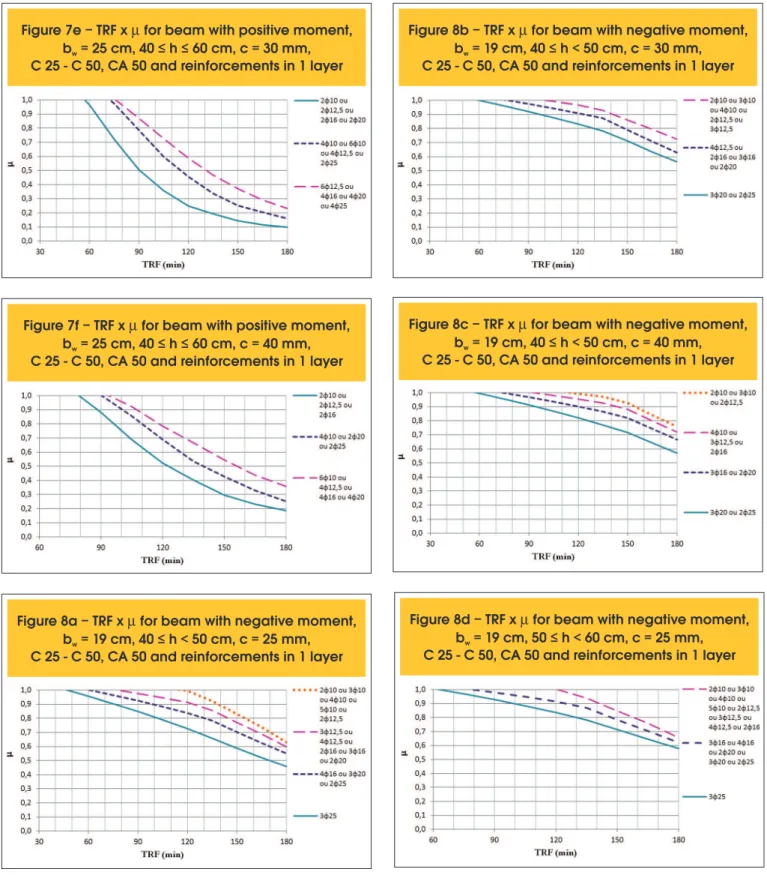
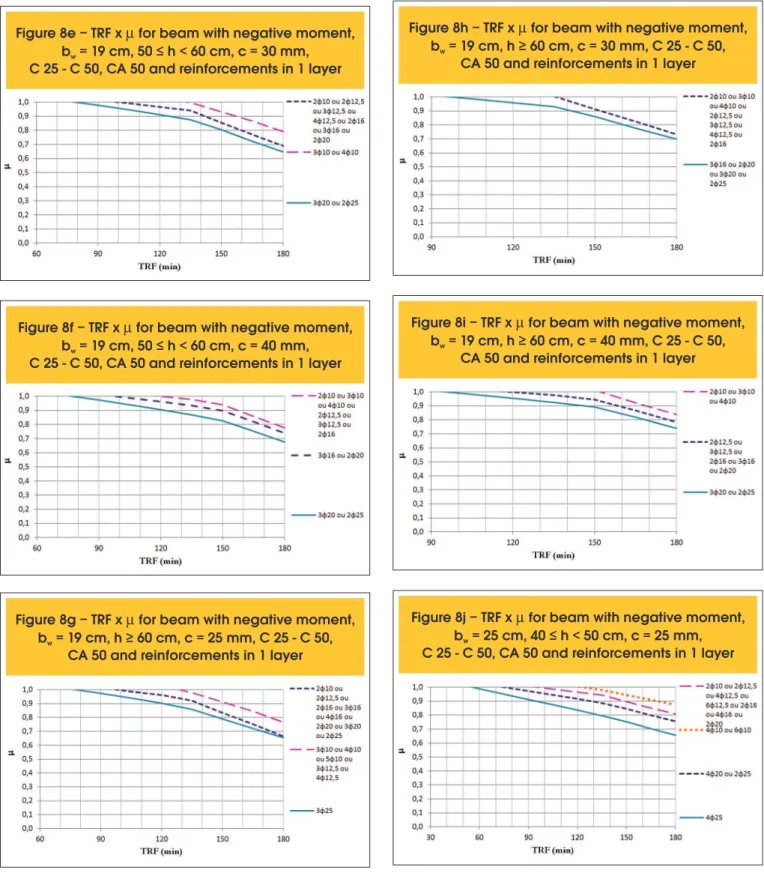
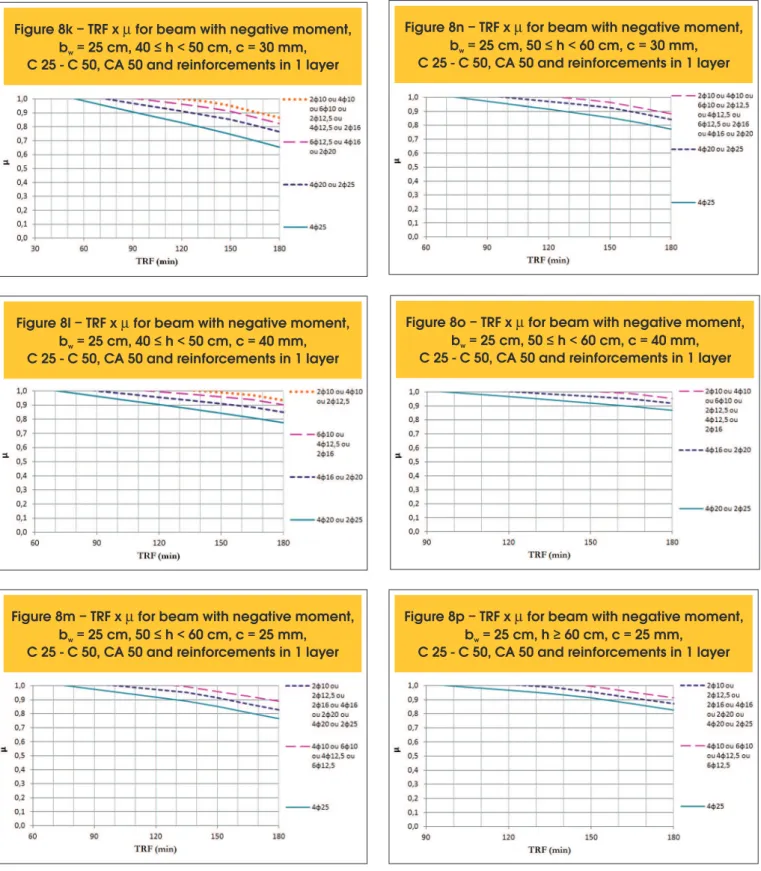
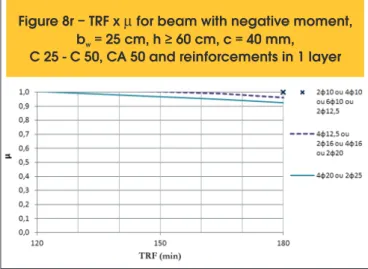
multiplying it by 0.7, as indicated in the equation under analysis). The following are some results compiled (figures 7a to 8r).
Figure 7a – TRF x
m
for beam with positive moment,
b = 19 cm, 40 ≤ h ≤ 60 cm, c = 25 mm, C 25 - C 50,
wCA 50 and reinforcements in 1 layer
Figure 7b – TRF x
m
for beam with positive moment,
b = 19 cm, 40 ≤ h ≤ 60 cm, c = 30 mm,
wC 25 - C 50, CA 50 and reinforcements in 1 layer
Figure 7c – TRF x
m
for beam with positive moment,
b = 19 cm, 40 ≤ h ≤ 60 cm, c = 40 mm,
wC 25 - C 50, CA 50 and reinforcements in 1 layer
Besides parameter µ, the variables related to the determina -tion of TRF are: posi-tion of the moment (positive or negative), the beam width (bw), height (h), cover thickness (c), concrete and steel categories and distribution of reinforcement (1 or 2 layers).
2.4 Moments redistribution
The structural behavior of beams in ire depends crucially on how they are supported. Simply supported beams are more susceptible to thermal action, as they do not have the ability to redistribute their
Figure 7e – TRF x
m
for beam with positive moment,
b = 25 cm, 40 ≤ h ≤ 60 cm, c = 30 mm,
wC 25 - C 50, CA 50 and reinforcements in 1 layer
Figure 7f – TRF x
m
for beam with positive moment,
b = 25 cm, 40 ≤ h ≤ 60 cm, c = 40 mm,
wC 25 - C 50, CA 50 and reinforcements in 1 layer
Figure 8a – TRF x
m
for beam with negative moment,
b = 19 cm, 40 ≤ h < 50 cm, c = 25 mm,
wC 25 - C 50, CA 50 and reinforcements in 1 layer
Figure 8b – TRF x
m
for beam with negative moment,
b = 19 cm, 40 ≤ h < 50 cm, c = 30 mm,
wC 25 - C 50, CA 50 and reinforcements in 1 layer
Figure 8c – TRF x
m
for beam with negative moment,
b = 19 cm, 40 ≤ h < 50 cm, c = 40 mm,
wC 25 - C 50, CA 50 and reinforcements in 1 layer
moments and create a favorable situation for ire resistance, unlike continuous beams that have this property.
A continuous beam is exposed to ire by the underside of its spans, while the top remains relatively cool. This situation is favorable, since the upper ibers of the beam, with small strength impairment,
are able to support higher negative moments, while the lower i -bers, with reduced strength due to the exposure to ire, will support an also reduced positive moment. Therefore, there may be a redis -tribution of moments from positive to negative (igure 9).
The graphic method presented here allows incorporating the
redistribu-Figure 8e – TRF x
m
for beam with negative moment,
b = 19 cm, 50 ≤ h < 60 cm, c = 30 mm,
wC 25 - C 50, CA 50 and reinforcements in 1 layer
Figure 8f – TRF x
m
for beam with negative moment,
b = 19 cm, 50 ≤ h < 60 cm, c = 40 mm,
wC 25 - C 50, CA 50 and reinforcements in 1 layer
Figure 8g – TRF x
m
for beam with negative moment,
b = 19 cm, h ≥ 60 cm, c = 25 mm, C 25 - C 50,
wCA 50 and reinforcements in 1 layer
Figure 8h – TRF x
m
for beam with negative moment,
b = 19 cm, h ≥ 60 cm, c = 30 mm, C 25 - C 50,
wCA 50 and reinforcements in 1 layer
Figure 8i – TRF x
m
for beam with negative moment,
b = 19 cm, h ≥ 60 cm, c = 40 mm, C 25 - C 50,
wCA 50 and reinforcements in 1 layer
tion of moments for continuous beams in ire. For this, it is only necessary to apply the coeficient of redistribution (δ) in the positive applied bending moment in case of ire (MSd,i+) and calculate the negative applied bending
moment in case of ire (MSd,i-) imposing the equilibrium of forces. In the
following section, further details on this subject are presented.
2.5 Application example
In the static scheme of the beam, “L” is the span length and “pk” the characteristic value of the uniformly distributed load. The cross-sec -tion was taken according to the models used in the graphic method,
Figure 8k – TRF x
m
for beam with negative moment,
b = 25 cm, 40 ≤ h < 50 cm, c = 30 mm,
wC 25 - C 50, CA 50 and reinforcements in 1 layer
Figure 8l – TRF x
m
for beam with negative moment,
b = 25 cm, 40 ≤ h < 50 cm, c = 40 mm,
wC 25 - C 50, CA 50 and reinforcements in 1 layer
Figure 8m – TRF x
m
for beam with negative moment,
b = 25 cm, 50 ≤ h < 60 cm, c = 25 mm,
wC 25 - C 50, CA 50 and reinforcements in 1 layer
Figure 8n – TRF x
m
for beam with negative moment,
b = 25 cm, 50 ≤ h < 60 cm, c = 30 mm,
wC 25 - C 50, CA 50 and reinforcements in 1 layer
Figure 8o – TRF x
m
for beam with negative moment,
b = 25 cm, 50 ≤ h < 60 cm, c = 40 mm,
wC 25 - C 50, CA 50 and reinforcements in 1 layer
Figure 8p – TRF x
m
for beam with negative moment,
b = 25 cm, h ≥ 60 cm, c = 25 mm,
wconsidering one beam under a 5-cm thick, 60-cm wide slab (for se-curity), as illustrated in Figure 10. 25 mm of cover, stirrups diameter of 5 mm, concrete fck equal to 25 MPa and steel fyk equal to 500 MPa were stipulated. Due to the symmetry of the spans, calculations were performed only for a portion of the structure.
The redistribution of moments at room temperature, from negative to positive, was performed according to ABNT NBR 6118 [5]. Analyz
-ing the position of the neutral line in section (x), its relationship with the redistribution coeficient (δ) and considering a structure of ixed nodes, the maximum allowed redistribution was 25% (δ = 0.75). The diagrams of the design bending moments and the results of the siz-ing at room temperature, before and after the redistribution of moments, for the beam under study are shown in igures 11 and 12. In the two cases, both the positive and negative sections are in domain 2.
Figure 8q – TRF x
m
for beam with negative moment,
b = 25 cm, h ≥ 60 cm, c = 30 mm,
wC 25 - C 50, CA 50 and reinforcements in 1 layer
Figure 8r – TRF x
m
for beam with negative moment,
b = 25 cm, h ≥ 60 cm, c = 40 mm,
wC 25 - C 50, CA 50 and reinforcements in 1 layer
Figure 9 – Redistribution of applied moments in a continuous beam exposed to fire
From the adopted steel section, given the redistribution, it is possible to calculate the resistance bending moments, negative and positive, which are needed in parameter μ, used as input in the graphs. Positive resistance bending moment (MRd
+): 89 kN m
Negative resistance bending moment (MRd
-): 112.5 kN m
In the veriication of the structure in ire situation, equation 7 was used for determining of the design value of the uniformly distributed load. 60% permanent actions and 40% variable were considered. It was assumed that this was a beam located in a residential building (ψ2 = 0.7 x 0.3 = 0.21; value recommended by
ABNT NBR 8681 [11]). The new load (pd,i) is shown in igure 13.
At elevated temperatures, the concrete beams become more duc-tile. Therefore, the coeficient of moments redistribution in ire situa-tion can be greater than that applied at room temperature, since the capacity of rotation of supports is increased under these conditions. However, for simplicity and for safety, we adopted the same coef -icient for redistributing moments, now from positive to negative, used in the previous analysis (δ = 0.75).
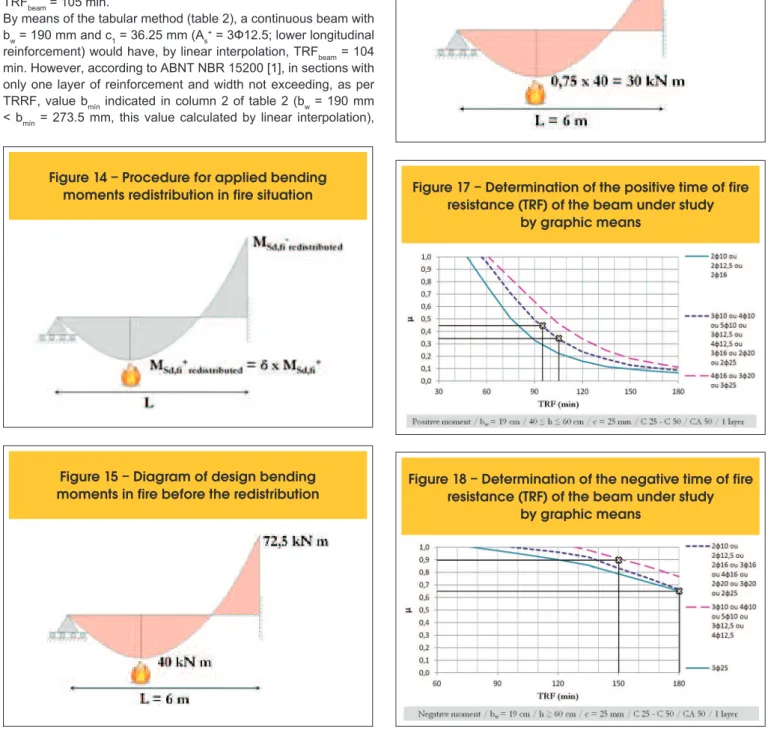
Hence, we calculated the new negative moment, illustrated in igure 14, by means of equation 8, which was also used in the cal -culations at room temperature, but with different safety coeficients. The diagrams of the design bending moments in ire situation, be -fore and after the redistribution, are shown in igures 15 and 16.
(8)
-
pd,fi
L
2Ö
2 MSd,fi
+redistributedFigure 11 – Diagram of design bending moments and reinforcement bars
at room temperature before the redistribution of moments
Figure 12 – Diagram of design bending moments and reinforcement bars at room temperature
after the redistribution of moments
µ
-=
MSd,fi
-MRd
-=
112.5
72.5
@
0.65 (A
-S=4
Ф
12.5)
Considering the redistributed moments:
µ
+=
MSd,fi
+redistributedMRd
+=
30
89
@
0.35 (AS
+=3
Ф
12.5)
µ
-=
MSd,fi
-redistributed
MRd
-=
102
112.5
@
0.90 (A
S -=4
Ф
12.5)
From the graphs shown in igures 17 and 18, for the irst case studied, TRF+ = 95 min and TRF- ≥ 180 min. Therefore, TRF
beam =
95 min. In the second case, in which the redistribution of moments was applied, TRF+ = 105 min and TRF- = 150 min. Consequently,
TRFbeam = 105 min.
By means of the tabular method (table 2), a continuous beam with bw = 190 mm and c1 = 36.25 mm (As+ = 3Ф12.5; lower longitudinal
reinforcement) would have, by linear interpolation, TRFbeam = 104
min. However, according to ABNT NBR 15200 [1], in sections with only one layer of reinforcement and width not exceeding, as per TRRF, value bmín indicated in column 2 of table 2 (bw = 190 mm
< bmín = 273.5 mm, this value calculated by linear interpolation),
some changes in design should be made: increase c1l at the bot-tom of the beams by 10 mm or specify corner bars with a diameter immediately above. If these changes are not met, TRF must be recalculated, considering c1 reduced by 10 mm, for safety reasons. Therefore, in this situation, TRFbeam = 86 min.
Figure 14 – Procedure for applied bending
moments redistribution in fire situation
F
igure 15 – Diagram of design bending
moments in fire before the redistribution
Figure 16 – Diagram of design bending moments
in fire after the redistribution
Figure
17 – Determination of the positive time of fire
resistance (TRF) of the beam under study
by graphic means
Figure 18 – Determination of the negative time of fire
resistance (TRF) of the beam under study
As noted, the comparison of results obtained by means of graphi -cal tools and the tabular method is not immediate, due to the large number of variables. Due to the simplicity of the method presented in the Brazilian standard, it is recommended, a priori, to use it for design. If the requirements regarding the time of ire resistance (TRF) are not met, one can use the graphic method as a tool for solving the problem, for the satisfactory results presented in this application example, when applied the redistribution of moments in a ire situation.
3. Conclusions
ABNT NBR 15200 [1] indicates a simple method for designing beams under ire conditions: the tabular. This method, albeit prac-tical, restricts the engineer’s work for not allowing alternatives for design. From structural and thermal analysis, using the inite ele-ment method, graphical tools were developed that allow inding more realistic structural solutions than those prescribed by the tabular method. Part of them we presented in this article. In ire, the loors (slab on beams) are heated on the underside. Thus, it is possible to redistribute part of the positive moments in the beams for the negatives. The same graphs may also be used in the case of employing this redistribution of moments. In the application ex -ample, the graphical method showed that it may, in a given situa-tion, be more economic than the tabular one.
4. Acknowledgments
The authors thank FAPESP - the State of São Paulo Research Foundation, CAPES - Coordination for the Improvement of Higher Education Personnel and CNPq - Brazilian National Council of Sci -entiic and Technological Development.
5. References
[01] ASSOCIAÇÃO BRASILEIRA DE NORMAS TÉCNICAS. Projeto de estruturas de concreto em situação de incêndio. NBR 15200:2012. Rio de Janeiro, 2012. 52 p. [02] EUROPEAN COMMITTEE FOR STANDARDIZATION.
EN 1992-1-2: Eurocode 2: design of concrete structures - part 1.2: general rules - structural ire design. Brussels: CEN, 2004. 97 p.
[03] ASSOCIAÇÃO BRASILEIRA DE NORMAS TÉCNICAS. NBR 7480: aço destinado a armaduras para
estruturas de concreto armado - especiicação. Rio de Janeiro, 2007. 13 p.
[07] SILVA, V. P. Projeto de estruturas de concreto em situação de incêndio. São Paulo: Edgard Blücher, 2012. 238 p.
[08] FSD - Fire Safety Design. TCD 5.0 User’s manual. Lund: Fire Safety Design AB, 2007. 129 p. [09] INTERNATIONAL ORGANIZATION FOR
STANDARDIZATION. ISO 834: Fire-resistance tests: elements of building construction - part 1.1: general requirements for ire resistance testing. Geneva, 1999. 25 p. (Revision of irst edition ISO 834:1975). [10] FÉDÉRATION INTERNATIONALE [du] BÉTON (FIB).
Fire design of concrete structures: structural behaviour and assessment. Lausanne: International Federation for Structural Concrete, 2008. 209 p. (Bulletin. FIB; 46). [11] ASSOCIAÇÃO BRASILEIRA DE NORMAS TÉCNICAS.