E-ISSN 2237-2660
Composition/Teaching/
Learning Processes in Dance
Emyle Daltro Universidade Federal do Ceará – UFC, Fortaleza/CE, Brazil Roberta Kumasaka Matsumoto Universidade de Brasília – UnB, Brasília/DF, BrazilABSTRACT – Composition/Teaching/Learning Processes in Dance – This article is about contemporary dance solo productions which have been called choreographic installations. It is focused on the relations between humans and non-humans in performance and presents an approach of teaching/learning in dance. It departs from the idea that the choreographic installation responds to a search for experience, which is operated by means of relations to non-humans when these become coauthors of bodies, dance and performance. The solo notion is thus called into question, as we are never alone in it, but rather with, which leads us to emphasize dance composition and learning as a collective experimentation. Keywords: Solo in Dance. Choreographic Installation. Humans and Non-Humans Relations. Learning in Dance. Dance Composition.
RÉSUMÉ – Composition/Enseignement/Apprentissage en Danse – Cet article est une réflexion au sujet du solo dans le cadre des productions contemporaines dites installations chorégraphiques. Cette réflexion est basée sur l’étude des rapports entre humains et non/ humains sur scène et elle propose une approche pour l’enseignement/l’apprentissage de la danse. Nous partons de l’idée que de telles créations répondent à un besoin qui se configure comme la quête de l’expérience, à travers les relations avec les non/humains en tant que co-auteurs de corps, de danses et de scènes. Ainsi, la notion de solo est mise en question, puisqu’en solo on n’est jamais seul, mais on est toujours avec, ce qui nous permet de mettre en valeur la composition et l’apprentissage en danse en tant qu’expérimentation collective. Mots-clés: Danse en Solo. Installation Chorégraphique. Rapports entre Humains et Non/Humains. Apprentissage de la Danse. Composition en Danse.
RESUMO – Processos de Composição/Ensino/Aprendizagem em Dança – Reflexão sobre o solo no contexto de produções contemporâneas nomeadas instalações coreográficas, baseada no estudo das relações entre humanos e não/humanos em cena, e, por meio dela, a apresentação de uma abordagem para o ensino/aprendizagem em dança. Parte-se da ideia de que tais criações respondem a uma necessidade que se configura como busca pela experiência, operada por meio das relações com não/humanos quando estes são levados em conta como coautores de corpos, danças e cenas. A noção de solo é problematizada, uma vez que, em solo, nunca estamos sós, mas estamos e somos com, o que nos conduz a enfatizar composição e aprendizagem em dança como experimentação coletiva.
Introduction
In this work1 we propose a reflection upon the solo within the
context of contemporary dance productions, named as choreographic installations2, from the relationalities that are produced among
humans and non/humans3 in performance. This is where we
find possibilities, from the investigation of two choreographic installations, Vestígios [Vestiges] – proposed by Marta Soares – and Verdades Inventadas [Invented Truths] – by Thembi Rosa, to jolt the established borders, mainly by means of the vision, in the dualism between subject and object, nature and culture, body and mind, among others, and to experiment studies of movement and composition in dance comprising humans and non/humans in horizontal relations of mutual constitution. We intend to think which dances – and dances of who/what – are engendered in the choreographic installations followed by us, and to articulate to these works the notion of intra-action, proposed by Karen Barad and connected by Donna Haraway to the processes of “becoming with” (Haraway, 2008; 2009; Haraway; Azerêdo, 2011) discussed by her, as we perceive which interaction – a term a little bit trivial within the visual arts scope – quite often misses the dimension of mutual constitution (Galindo; Milioli; Méllo, 2013) that occurs with the agencies that constitute these dances. The notion of choreographic installation made it possible for us to think installation as dance and choreography as composition, engendered not anymore by certain subjects – humans – only, separate from the diverse non/humans that constitute them within the condition of moving human subjects.
We depart from the idea that such creations answer to a need4
that is set as the search for the experience, on part of the dancer, when surrendering to the unpredictability of the relationships with non/ humans, when these are taken into account as coauthors of bodies, dances and performances.
Experience, Things and Solos
We understand the experience as a happening that modifies us, transforms us, that happens as an instant, but that needs to extend itself in /with time, to last to be able to become knowable.
In order the experience to happen, it is necessary a movement of going – which would be the abandonment of the self, that is, the necessary divest that puts in suspense standards and values and allows one to move towards the different – and coming – the one of an understanding where I become another one and by which I am another one (Larrosa, 2002; 2011).
This movement of coming and going presents itself as duration and intensity. Thus, experience would be just like the awareness of time itself, recognition of the instant in its intensity.
However, Saint Augustine already asked us (1980, Book XI, p. 14):
For what is time? Who can readily and briefly explain this? Who can even in thought comprehend it, so as to utter a word about it? But what in discourse do we mention more familiarly and knowingly, than time? And, we understand, when we speak of it; we understand also, when we hear it spoken of by another. What then is time? If no one asks me, I know: if I wish to explain it to one that asketh, I know not.
In this excerpt, one of most renown quotations when we approach the concept of time, the author already points out to us the complexity of the issue: if, on one hand, time is something trivial and familiar, in view of its naturalization by means of different mechanisms, since our earliest age, on the other hand its explanation, its conceptual apprehension is an extremely difficult task.
Time pursues us. We pursue the time. Understanding and explaining it would be like explaining life itself – the being in movement, constant transformation – and controlling our finitude in a certain way. Hartmut Rosa (2010, p. 31 – our translation) quotes Robison and Godbey: “Being hungry for time does not cause death but, as the early philosophers had noted, it hinders starting to live”.
by means of the excess of stimuli largely generated by the countless technologies of communication and production that begin to emerge.
Walter Benjamin and Martin Heidegger, among others, as Charney reminds us (2001, p. 387), “[...] will try to bring back the possibility of the sensorial experience in face of the ephemeral character of modernity” through the concept of instant. Among these assumptions, two points can be raised: one, referring to the presence that is made when the individual does not only feel, but experiences a tangible and intense sensation. As we already said, if the experience is, just like the conscience of time itself, recognition of the instant in its intensity, it is made by the presence of something that crosses me, as Larrosa says (2002; 2011), something that passes through me – sensitive – and that transforms me – knowable. The other point refers to the transience of the experience.
If the instant allows the understanding of what the experience would be, such study also allows to understand that, in the modernity, the possibility of experience becomes increasingly rare due to its excess. Larrosa (2002, p. 23) mentions some of these excesses – information, opinion, lack of time, work and reminds us that “[...] to the subject of the stimulus, the punctual experience, everything crosses him, everything excites him, everything agitates him, everything shocks him, but nothing happens to him”. Due to excess, we blunt our senses, we start to suffer from an anesthesia or, as João-Francisco Duarte Jr. says (2001), a crisis of our senses.
From then on, we can ask ourselves if the choreographic installation, especially when it is identified as a solo – here understood as being constituted when one human only is performing – would not be a search for experience or one of the places of resistance to the loss of the faculty to narrate, to the poverty of communicable experiences (Benjamin, 1985, p. 197-198), as it makes scenically evident a multiplicity of voices and movements of non/human dancers/creators?
ways, of the modification of the quality and the type of relationship between humans, not subduing the objects anymore, just like the objects not subduing the humans (Lepecki, 2012). Everything would become a thing, objects free of the utilitarism and subjectivity not “[...] defined by the ownership that the subject has of himself and his objects” anymore (Moten apud Lepecki, 2012, p. 96). We can expand this claim by Andres Lepecki based on the studies by Donna Haraway and Bruno Latour.
Haraway (2011) invites us to think the notion of intra-action, coined by Karen Barad, a North-American feminist physicist. Intra-action refers to the mutual definition of the constituents of a relationship, in which they emerge together and begin to exist with this relationship. In Barad’s terms, Haraway says, the interaction notion becomes insufficient to explain the relationships between different agents, as, usually, when one speaks about interaction, it is assumed that there are individual entities or agents, with inherent characteristics, existing independently and that preexist to their acting one on the other. With the notion of intra-action, Barad (2003) works in another perspective, as she thinks the reality without the previous existence of separate elements, with inherent or own properties. Individuals do not preexist as such, but rather materialize themselves in intra-action.
From the intra-action, Donna Haraway (2011) proposes the expression to become with, which never refers to a thing in itself, but to co-constitution processes that keep – among those that constitute them and those that are constituted by these processes – the shared consideration, respect and responsibility. In this movement, the author thinks the word human as:
[...] its Latin links with the land, the ground, the humus – with the warm matter where many things are developed and coexist, the pile of fertilizer that becomes humus to make blossom other plants, animals, microbes and people (Haraway; Azerêdo, 2011, p. 10).
idea of thing, but writing it in the following way: human and non/ human. When we speak about non/humans, we can be referring to particles, grains of sand, videographic projections, lightening equipment, clothes, trees, non-human animals, fences, walls…, that is, relational materialities that usually are no taken into account as subjects, agents of actions.
Danielle Milioli (2012) reminds us that non/humans have always been in dance, performing objects consistently integrate compositional processes of dance and she reminds us of the questionings made on their use by artists and researchers like António Pinto Ribeiro and Helena Katz (Milioli, 2012).
We have also to remember the different experimentations with objects accomplished by artists of the Judson Dance6 in the 1960s, in a
movement of distancing from subjectivity, eroticism and theatricality, where the interest for the object was:
[…] its material specificity, its weight-shape-volume with which the dancers should interact. The use of objects (dragging heavy furniture in the stage, for example), changed the type of movement to be used in scene, removing the drama of the performance (Fernandes, 2010, n.p.).
The human body was thought as an object “[…] that should then be examined coldly without any social, psychological or even formal motivations” (Banes apud Fernandes, 2010, n.p.).
Lepecki (2012, p. 98) allows us to advance in the question when proposing that it is necessary:
To invest in things, not as substitute of the body, nor as significant or representative elements of a narrative, but as partners, as co-extensive entities in the field of the matter, is to activate an essential change in the relationship between objects and their aesthetic effects (in dance, theater, visual arts, performance and installation).
Although the theoretician calls attention to the fact that this ontological attitude is not dominant yet, we understand, just like him, that it presently is a line of flight that we find in the contemporary performing works here approached. Coupled to this idea ofbeing with and making oneself with, being a thing (human and non/human), the search for the experience is placed in a more intense and explicit way in thesolo.
non/humans who respectively composed the performing works Verdades Inventadas e Vestígios.
In the first one, we see Thembi Rosa climbing on the board at the end of a kind of stage, sinking it a little with a light step. She walks all over this wood floor, perceiving the sounds that emerge at each step, when stepping on the boards in different ways. We follow dances on/from a moving floor that emits sounds, an alarm floor, a safety mechanism, but that becomes installation, partner of dance and music improvisations, coauthor of movement scores; it also become images in video and, in the roaming of the artistic work, has already become shelves…
Figure 1 – Thembi Rosa, Verdades Inventadas, 2011. Picture: Renato Paschoaleto.
In the second one, Vestígios, we also follow dances of/on sambaqui-floors that become photographs, projections in screens, floor-table of rocks and flying sand lightly blew by the wind from a fan, that become poetical exhumation. We watch, during 55 minutes, a fan that is turned in high power to produce the wind that blows the sand that leaks through the openings of the cracked sandstone rocks that, fitting one into the others, form the board of an iron and mdf table.
A pile of sand – a little heavier than 100 kg – dances on top of this table, to a sound of noises sometimes more, sometimes less strident, so that vestiges of a human body, slowly, announce its presence7.
Figure 3 – Marta Soares. Vestígios, 2012. Picture: João Caldas.
Both works are what is usually called solo. However, Thembi Rosa calls our attention when she says that it is necessary to evidence the solo work as something that is not only hers and show how it moves all the constituted mechanism. That is, the research of movement in Verdades Inventadas is only possible considering all the agencies that constitute this work, and the installation provokes us in terms of thinking the physical space as a dance partner8.
Considering that we are never alone, but we are with, the solo concept, as a space where a human is placed alone, must be problematized. It becomes necessary to rethink it as a multitude inventor of worlds.
This situation would lead to a tension between being alone and being with, an alterity game. When we think about the solo, we can understand that I am not alone, I am with, but I must be with, to be alone. It is a game between the solitude (a choice to be without other human beings in scene) and the loneliness (state). These layers are thus worked by contrast. They poetically compose a non-antagonistic contradiction subverting what in itself would be an antagonistic contradiction. We may be alone, detached, disarticulated from us and the others loneliness even amidst a crowd of people and we can be with a crowd of humans and non/humans, with their actions, spatialities and temporalities embodied in/with our experience that individuates itself (solitude) in/with the performance. In this sense, it is worthwhile to connect our thought to the studies of Gilbert Simondon on individuation processes.
Virginia Kastrup (2007, p. 83) writes that Simondon indicates that we should approach the cognition as a meta-stable system, “[...] that is, a system that carries a difference of potential. Using an energetic language, he describes the functioning of a complex and heterogeneous system, a carrier of an internal difference”. Kastrup (2007, p. 83) registers that:
[...] the individuated being has problematic conditions. In such conditions, the individuation emerges as solution of a problem. But Simondon warns that it is about a ‘partial and relative resolution’, which means that the individuation does not abolish the meta-stability [...] There are always remains. The system continues keeping a certain incompatibility in relation to itself.
The forms emerge from a background of processuality and are immersed in it. The shape conditions are not
formal, but meta-stable or complex. If the individual is not given, but results from the individuation, it is necessary to conceive a regimen previous to the one of the individuated shapes. Simondon calls it the pre-individual regimen. He
thinks of a reality level where there are no defined units, but singularities, discontinous particles, similar to the ones
conceived by the quantic physics (Kastrup, 2007, p. 83, our emphasis).
In this background of processuality, singularities dance with their memories – that we articulate to humus –, activated in the present, that turn towards the becoming of the materialities/ socialities, nourishing co-constituted processes of change in the relationship. According to Kastrup (2007, p. 84 – our emphasis), quantic physics has evidenced that:
[...] the real unfolds in two distinct and coexistent planes or regimes, the macroscopic and the microscopic. For Simondon, the pre-individual level [which is also pre-representational] is similar to the quantic level, corresponding to a plane of invisible forces or particles, that condition the visible individuated forms and answer
for its becoming. The important is that, even after the individuation operation, the pre-individual regimen persists in a level of its own, distinct from the one of the individuated forms. The internal difference appears in the shape of two
orders of magnitude, or two coexistent regimens: the pre-individual one and the one of the individuated system.
We associate the notion of memory to this pre-individual regimen that persists even in the individuation results, with which we want to inhabit, even temporarily, this place of the difference of ourselves in the quality of individuated beings. It is with the individuation processes, understood according to Simondon’s terms, that the solo as multitude finds possibilities of being constituted and thought.
It is interesting to remember the argument of Josette Féral when she defends that the denomination of performative theater would be more appropriate than post-dramatic theater, based on the central aspect of this theater, the performativity. Among other things, the author calls attention to Derrida’s notes:
not. Therefore, in the extent that this observation becomes a real principle inherent to the nature itself of this locution category, the ‘value of risk’, ‘the failure’ become constituent of the performativity and must be considered as law (Féral, 2008, p. 203 – quotation marks from the author)
If we consider that, just like the performative theater, the choreographic installation has as an essential aspect the performativity, we understand that they bring in themselves the principle of risk.
The performing writing is not there hierarchic and ordered anymore; it is deconstructed and chaotic, it introduces the event [événement], recognizes the risk. More than the
dramatic theater, and just like the art of performance, it is the process, even more than product, that the performative
theater places into stage (Féral, 2008, p. 04 – author’s emphasis).
This value of risk, which is proper to the performativity, is presented in the solo as a need of launching oneself into the abyss, a need that something happens, to confront with another other, in a movement of exhibition and displacement triggered by the alterity. Placing oneself in solo is to allow a space so that the experience can happen for humans and for non/humans, all becoming a thing.
This way, the search for the experience would be for the capture of the instant itself by means of the “reciprocal recognition of existences” (Hope, 2006) and also, over all, for the following and mediation of the problematization processes of these ways of life, that is, of its continued invention9. When this happens, we perceives
the instant in a sensitive way and in it, by it and with it, there is a potentialized presence.
Next, we will make it explicit how these reflections could reverberate in a teaching/learning proposal within the scope of an undergraduate dance course.
Bodies/Spaces: constituting collective and inventive learning and experimentations in dance
We present some considerations on our proposal aimed towards teaching/learning in dance, within the scope of higher education, that we constituted with students10 enrolled in the Body and Space
We have conducted the course thinking objects as non/humans, in order to create tension in the hierarchizing separation between subject and object. The objects, which always have permeated dance, had been considered, in our proposal with the students of the Body and Space course, non/humans co-choreographers of bodies and dances. In our classes, we discussed non/humans not as elements separate from us subjects who, usually, reduce them to mere resources, but we approach them as dance partners, as actantes11, as agencies
that act, that act actively in movement and compositions research in dance, as well as those that “[…] already found in the process when this starts, constitute the creation. They are, therefore, creators; they are in the origin of the creation” (Latour apud Milioli, 2012, p. 12). Thus, just like Danielle Milioli (2012), we speak about a dancing with, to think dance less as a movement of a dancer – who becomes not taken as an one only, but is understood as multiplicity – however, also emerging from other associations. This thought tends to favor the diversity, the alterity in/of dance, considering different ways of connection between different actors, as powerful means of doing/ composing dances able to release the bodies – that become dancing in these relationships – from hegemonic standardizations, classifications and normatizations.
It is in this sense that we proposed ways of doing that could be connected to the notion of experimental dance, in an approach whose emphasis is on articulations that are defined and redefined in a network, composing collectives governed by provisory stabilizations. We come closer to Bruno Latour’s notion of collective to think an experimentation that is not autonomous, but rather collective, in which one experiences with, being affected and modified by the world and affecting it, modifying it. It was this way that we started to think/make collective experimental dances.
With Bruno Latour (2012), we learn that it is necessary to gather an increasing amount of socially – and, in our case, artistically – active participants that will be stabilized and de-stabilized in dances. Thus, our classes were conducted taking into account humans and non/humans as choreographically active dancers, an understanding articulated to the sociotechnical studies.
[...] the importance of the man in a similar way to that of his productions, creations, in other terms, of his objects, his techniques, his practices, his machines, his ambiances; however, without the intention to equal them, it is enough to us to insert them in one same sociotechnical plot. The sociotechnical studies, therefore, propose a valuation of symmetry of acting (Leite, 2012, p. 24).
We will begin to use, from this point of the text on, the expressions human/non-human, body/space, materialities/socialities, where the slashes between the terms were used to make us to see them in processes of mutual constitution, always in the relationship.
By means of the production both of questionings and answers in collective processes of experiencing and knowing, our investigation with the Body/Space course paralleled the epistemological bias of the feminist objectivity of Donna Haraway, which can be translated as Situated Knowledge (Haraway, 1995). The author reminds us that:
All Western cultural narratives about objectivity are allegories of the ideologies governing the relations of what we call mind and body, distance and responsibility. Feminist objectivity is about limited location and situated knowledge, not about transcendence and splitting of subject and object. It allows us to become answerable for what we learn how to see (Haraway, 1988, p. 583).
When a collective is constituted in artistic compositions that (re) make ways of seeing/ways of life, there are, as far as we understand, partial visions acting there that are situated and specified, incarnate visions that lead to the acting of other visions of this same type. Skilled visualization practices (Haraway, 1995) that, when being shared, instigate questionings.
We are interested for the possibility of composing a collective with undergraduate dance students and their studies of movement initially with a classroom of the Instituto de Cultura e Arte (ICA) of Universidade Federal do Ceará and later with the Rectory woods of this same institution.
With the Body/Space students, we accomplished experimentations that comprised each one of the students with one thing, or things; several students with one thing; besides accomplishing experimentations involving the teachers with the classroom and later with UFC’s Rectory woods.
Concerning to the things with which we dance, it is necessary to highlight the discussion proposed by Latour related to the separation operated by all the scientific courses between the “mute things” and the “speaking men”, informing us that “[…] things become, in the laboratory, by an indirect way of the instruments, pertinent to what we say of them” (Latour, 2004, p. 129 – author’s emphasis). Such a situation placed, and still does, the word of the scientist as unquestionable, but when such entities – the “mute things” – are free from the obligation, traditionally delegated to them by the scientific disciplines, “to close the humans’ mouth” (Latour, 2004, p. 128), we have another way to recognize the exterior reality.
We know that the separation of which Latour speaks is also embodied in the scope of the western performing dances, in which the mute things – remembering that, for a long time and still today, dancers behave as mute things – become, in the classroom, of rehearsal (laboratories), by indirect means of the instruments (codified dance techniques, hierarchization of functions, type of floor and appropriate music for these dances, bars, ballerina shoes, among others), pertinent to what we say about them, what considered and, in many cases, still considers the word of the choreographer and the teacher as unquestionable. Attentive to this situation and betting that, with the focus on the movement, that is, on who/what moves; who/what it makes to move; who/what composes dance, we can make a difference in these relationships, we proposed to de-stabilize the division between dancing humans and still things, perceiving in which way the relationships that constitute them are extended beyond these categorizations, resulting that dances jointly composed can appear in diverse ways.
that make to dance. This exactly procedure was accomplished with the UFC’s Rectory woods.
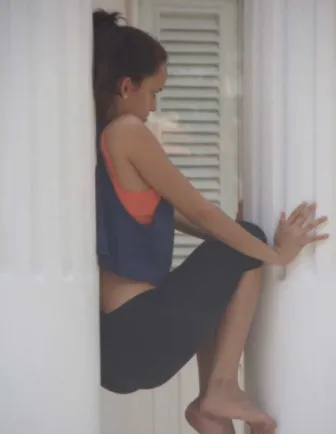
Classroom number 18 of the Instituto de Cultura e Arte and the Rectory woods, both belonging to the Universidade Federal do Ceará (UFC) – places with which our proposal gained bodies/spaces – have had and have a range of humans/non-humans working in associations in its construction and maintenance, whose actions have acted and act composing these spaces, besides making to act who/what comes to compose with them. This way, our proposal was to accomplish movement research with room 18 e, later, with the Rectory woods, as collective experimentations that favored compositions of humans/ non-humans in dance.
Figure 5 – Student Luisa dance improvisation with two pilastersin front of the UFC’s Rectory building, 2013. Picture: Emyle Daltro.
In Body/Space, our purpose was to work with a dancing that does not happen with an adaptation to given standards of corporal movement and certain spaces and figures already stabilized, but we have provoked situations where we were impelled to meet with the residues, with what still remains unstable in the things, in us, with what can open invention possibilities with bodies and with spaces – where there is invention of both – and that can constitute itself as partial and relative solution – as a dance product as well as learning in dance.
In this trail, we understand that inventing, following Virginia Kastrup (2007), it is not to un-cover solutions already predicted, but to be attentive to the creation of problems different from those already given, being that not always are the humans those who place these problems. Following this path, during the development of the Body/Space course, we felt that we needed to step out from ourselves as generating centers of actions controlled by us and efficiently consummated; step out from the apprehension of the already represented; to activate the memories of/in room 18, so that we would dance with them, making ourselves aware of them; to step out from the classroom to dance with other bodies/spaces; to step out from the understanding of relationships of types already experimented, to search for conditions of choreographing with the things, with spaces/bodies.
It is important to situate the notion of memory in this process lived with the students, understanding it not as representation, but as compound – humus memories, we come closer to the studies of cognition carried through by Virginia Kastrup, and that we have already mentioned in this text.
We want to dance opening ourselves to processes of dancing with, exercising possibilities of problematizing ourselves, inventing ourselves and inventing worlds. This is why we need to activate memories with which we become others, being able then to consider them as inventive memories – according to Kastrup’s words – that can be activated by humans and by non/humans.
The learning that is instituted as the posing of problems, that is, as invention, for us, is aligned with collective experimentation and composition, in Latour’s terms. In our proposal with the Body/Space students, we do not close the possibilities in terms of composition, we did not choose models, but we tried to learn to follow human/ non/humans in movement and permanent becoming, co-constituting themselves as dancers and choreographers.
The knowing self is partial in all its guises, never finished, whole, simply there and original; it is always constructed and stitched together imperfectly, and therefore able to
join with another, to see together without claiming to be another (Haraway, 1988, p. 586).
Our proposal with the learners of Body/Space was based on an understanding that “[...] it is not individuals who have experience, but subjects who are constituted through experience”, as Joan W. Scott wrote (1991, p. 779). Scott (1991, p. 797) also writes that “[...] experience is at the once always already an interpretation and is in need interpretation. What counts as experience is neither self-evident, nor strainghtforward; it is always contested, always therefore political”. She also speaks of the need of a project not of “[...] reproduction and transmission of a knowledge said to be arrived at through experience”, but rather of “analysis of the production of that knowledge itself” (Scott, 1991, p. 797).
Larrosa (2011, p. 19) also alerts us:
of an experience will be, where it may lead us to, what it is going to do of us. This is so because the experience has nothing to do with the linear time of planning, foresight, prediction, prescribing, other than with the opening time. The experience always has something of unpredictable (of what one cannot see beforehand), of unspeakable (of what one cannot say beforehand, of what is not said), of imprescriptible (of what one cannot write beforehand, of what is not written). And even more, uncertainty is its constituent.
Thus, the proposals conducted in Body/Space tried to tension this relationship between experiment and experience when trying to constitute a space of indetermination and unpredictability so that something could happen forming and transforming, in the becoming of the relationalities, humans and non/humans.
With the proposals developed in Body/Space, we could evidence a potentialization of our presences in dance. When working the attention to the other – human/non/human –, we get to know him/ her/it and not to recognize him/her/it only, and to produce dances that experiment to comprise the movement of its becomings, we create conditions to become present in ways not yet experimented. The presence of the students, in the research of movement jointly constituted, acquired more complexity. Their movements, when being thought/accomplished opening to the awareness of human/ non/human actions – not taken into account before in the way we have experimented –, rehearsed possibilities of change of standards both in relation to movements, bodies and dances and in relation to the spaces to be mobilized for classes, experimentations and compositions in dance.
Dancing can be an intransitive verb, with emphasis only on action; it can also be transitive direct, meaning to execute steps. However, in these classes and in the experience in the woods of the Rectory, I saw that it is the adverbial adjunct ‘dancing with the space’ that makes the difference12.
The learners, when using notebooks to register the process, wrote down situations, tried to translate sensations and perceived differences that enriched the learning of all of us. Such comments also provided the elaboration of texts in groups, besides the composition of this paper.
the passers-by and the guards? How to compose with the sand and the concrete of the parking lot? How to move in the stairs with remnant portions of birds poop? How to compose with the greenish dancing of the leaves of the trees? Surrender yourself. This was the strategy of some!13
The Rectory woods, at least in the days of our gatherings, gained movements, looks, differentiated attention from those who work, pass by, live there.
Oxygen emanated from the trees with the carbon dioxide from the cars. People who walk by. People who are hampered to move by the fences. Looks that come and go. Curious looks. Looks that relate with what is happening behind the fences. Looks that dare and occupy the same space14.
The Body/Space course allowed us to experience and invented us as dancing beings, who learn, teach, compose; invented us as researchers and researched ones, made us to transit through positions of subject, object, thing, human, non/human – agencies that began a learning trajectory adding and not separating, opposing or hierarchizing…
The curiosity; the opening to the other; relationships of closeness between materialities/socialities; intensification of exchanges by means of the touch and other ways of contact, involving all senses; collection of humans and non/humans to compose collectives in dance; shared authorship, between humans/non/humans, of research of movement and situations that would generate improvisations in dance; not hierarchization of roles and positions in the stages of the creation processes; dancing/composing together and jointly; activation of humus, humans/non/humans memories in the process of constitution of movements and behavior; listening/invitation, that is, to listen in order to perceive how one is being invited to dance – all these procedures composed our collective experimentation in dance.
the woods, we can speak of three different collective compositions in dance. We did not conduct the class, improvisations, compositions stimulating mechanistic repetitions, but rather agencies, being that some of them were temporarily stabilized.
Submitting the learning to the repetition is to subsume it to the shape of the recognition. Both as production of answers and as production of rules, it is about the emphasis on the consolidation of its results in the stable figures of recognition and knowledge (Kastrup, 2007, p. 95).
We propose that the thoughts/movements that need to be experimented are the ones that involve technique as agency with flows, not as mechanic repetition (Kastrup, 2007), in order to forge a learning that involves equipped becomings, a learning that demands “skill when dealing with the becoming” (Kastrup, 2007, p. 175). Repeating yes, but only to differentiate, to problematize, to perceive differences being produced, and all of this takes time…
More time to collect… More time to register the processes… More time to experience with, to dance with… More time to unfold compositions, in a way to also generate products… More time to invent the collective... This is only the beginning…15.
More time of learning as invention, as posing problems, aimed towards the present time, to articulate itself with a memory understood as humus memory that we all have, humans and non/ humans, as something that vibrates and makes vibrating, a compound that nourishes becomings.
Final Remarks
The choreographic installation, especially when it is identified as solo, in the way that happens with the two artistic works studied, seems to be constitute as a search for the experience or as one of the places of resistance to the loss of the faculty to narrate, to the poverty of communicable experiences, as it evidences scenically a multiplicity of voices and movements of non/human dancers/creators.
notions of choreography and installation and strengthen the practice of the composition as a way of dancing, knowing and living that we consider more promising than the practice of domination.
With the students of Body/Space course, we aimed to compose with the space and not dominate the space; to compose with techniques and not to dominate them; to compose with objects that transit between object and subject position, positions which we also occupy. These procedures that emphasize the composition were also observed in the choreographic installations Vestígios and Verdades Inventadas.
We are not self-sufficient nor self-moving (Lepecki, 2010), we compose dance and ourselves in relationships, what has been accompanied with the study of the two choreographic installations and with the experimentation that we proposed with the learners of Body/Space. This thought/procedure, which considers humans/non/ humans as co-choreographers of dances, promotes an articulation – in the terms of Bruno Latour (2008) - between different temporalities and spatialities, showing how bodies, movements and dances are relational effects of performances with objects, realities, people, among others agencies.
It is in this trail that we propose the composition in dance in terms of collective experimentation (Latour, 2004), where processes of becoming with (Haraway, 2008; Haraway; Azerêdo, 2011) mutually engender dancers – humans/non/humans – and dances. When following this process, in the studied works, we verify the insurgence in multiple ways of moving, being and living forging a dancing with (Milioli, 2012) that activates inventive memories. Memories that differ from the traditional understanding that postulate them in terms of representation, based on the resolution of problems pertinent to the individuation processes (Simondon apud Kastrup, 2007), but that come closer to the residues, remnants of these processes, which make possible constants becomings even to the individuated forms – humus memories, which allow us to infringe borders and differentiate ourselves, even temporarily, of what we are; memories that nourish changes.
Notes
1 Based on the paper Sentidos do corpo em cena, by Roberta K. Matsumoto, VIII Congresso
da ABRACE (2014) and the dissertation Corporrelacionalidades e coletivo na composição
e aprendizagem inventivas em dança, by Emyle Daltro, Post-Graduation Program in Art,
Universidade de Brasília (2014).
2 As far as we know, Marta Soares was the who began to use the term choreographic
installation referring to some of her works like O Banho, premiered in 2004 in the city of São Paulo. In the same way, she called Vestígios as a choreographic installation so that the work could be considered a research work in dance (Information provided by Marta Soares in an interview to Emyle Daltro in São Paulo in 2012).
3 We adopted such an expression based on the studies of the Grupo de Pesquisa Tecnologias,
Ciências e Criação [Technologies, Sciences and Creation Research Group] (Lab. TeCC/ UFMT) that use the expression non/humans, instead of not-humans, or not humans, to activate a thought/practice that does not establish fixed frontiers between humans and non// humans (Galindo; Milioli; Méllo, 2013). They also call attention to the fact that “The prefix ‘non’, even though it can remind of antagonisms between humans and non/humans, is kept to suggest resistance to such conceptions” (Giffney; Hird apud Milioli, 2012, p. 13).
4 For Deleuze, all act of creation departs from a need. “A creator is not a being who works
for pleasure. A creator only does what he absolutely needs” (1987, oral information).
5 We write teaching/learning to think teaching and learning as mutually constituted in the
relationship.
6 The Judson Dance was a group of dancers who performed in the Judson Memorial Church,
in Greenwich Village, New York city, between 1962 and 1964. According to Jorge Glusberg
(2008, p. 37), “[...] the Judson Dance Company will develop an effervescent activity, through the innovative works of Steve Paxton, Simone Forti, Yvonne Rainer, Trisha Brown, Deborah Hay, Lucinda Childs, Philip Corner, among others, attracting the attention of uncountable artists whose collaboration with the dancers and choreographers fosters creations that break through the the borders of dance – even modern dance –, injecting new and rich elements to the happening and designing the contours that will characterize
the bodyart in the Seventies”.
7Vestígios, by Marta Soares and Verdades Inventadas, by Thembi Rosa, are widely analyzed
in the PhD Dissertation Corporrelacionalidades e coletivo nacomposição e aprendizagem
inventivas em dança by Emyle Daltro (2014).
8 Information provided by Thembi Rosa in an interview to Emyle Daltro, Belo Horizonte
/MG, 2013.
9 With Virginia Kastrup (2007) we understand invention as posing of problems.
10 We thank to the students Ana Carla de Souza Campos, Ana Carolina Moreira de
the Body and Space course in the second semester of 2013, and with whom we were able to share the experimentations that compose the study mentioned in this text.
11 Danielle Milioli (2012, p. 13) reminds us that in the sociotechnical studies “[...] the
actante term is used to allude to the non-differentiation between human and not humans
against the use of the actors notion linked to the former”.
12 Excerpt of the process report written by the student Bruno Mendonça, in Fortaleza/
CE, 2013.
13 Process report written jointly by the students: William, Victory, Ana Carla, Ariel and
Inélia, in Fortaleza/CE, 2013.
14 Process report written jointly by the students: Isabella, Vanessa, Leonice and Carolina,
in Fortaleza/CE, 2013.
15 Excerpt of the process report written by Emyle Daltro, in Fortaleza/CE, 2013.
References
AGOSTINHO, Santo. Confissões. Tradução de J. Oliveira Santos, S. J., e A. Ambrosio de Pina, S. J. São Paulo: Abril Cultural, 1980. (Coleção Os Pensadores).
ALLSOPP, Ric; LEPECKI, André. On Choreography. Performance Research Journal, v. 13, n. 1, 2008. Disponível em: <http://on-the-move.org/news/article/12494/call-for-papers-performance-research-on/>. Acesso em: 04 Abr. 2011.
BARAD, Karen. Posthumanist performativity: toward an understanding of how matter comes to matter. Signs - Journal of Women in Culture and Society, Chicago, University of Chicago Press, v. 28, n. 3, p. 801-831, 2003.
BENJAMIN, Walter. Obras Escolhidas. Magia e técnica, arte e política. Ensaios sobre litera-tura e história da cullitera-tura. V. 1. Tradução de Sérgio Paulo Rouanet. São Paulo: Brasiliense, 1985. CHARNEY, Leo. Num instante: o cinema e a filosofia da modernidade. In: CHARNEY, Leo; SCHWARTTZ, Vanessa R. (Org.). O Cinema e a Invenção da Vida Moderna. Tradução de Regina Thompson. São Paulo: Cosac & Naify, 2001. P. 386-408.
DALTRO, Emyle. Corporrelacionalidades e Coletivo na Composição e Aprendizagem Inventivas em Dança. 2014. 233f. Tese (Doutorado em Arte) – Departamento de Artes Visuais, Programa de Pós-Graduação em Arte, Universidade Federal de Brasília, Brasília/DF, 2014. DELEUZE, Gilles. Qu’Est-ce que l’Acte de Création? Palestra proferida no âmbito do
“Mardi de la Fondation” da FEMIS, em 17 mar. 1987. Tradução de José Marcos Macedo.
DUARTE Jr., João-Francisco. O Sentido dos Sentidos: a educação (do) sensível. Curitiba: Criar Edições, 2001.
FÉRAL, Josette. Por uma Poética da Performatividade: o teatro performativo. Sala Preta, São Paulo, v. 8, p. 97-210, nov. 2008.
GALINDO, Dolores; MILIOLI, Danielle; MÉLLO, Ricardo. Dançando com Grãos de Soja, espécies companheiras na deriva pós-construcionista. Psicologia & Sociedade, Belo Horizonte, v. 25, n. 1, p. 48-57, 2013. Disponível em: <http://www.scielo.br/pdf/psoc/ v25n1/07.pdf>. Acesso em: 12 jun. 2013.
GLUSBERG, Jorge. A Arte da Performance. Tradução de Renato Cohen. São Paulo: Perspectiva, 2008.
HARAWAY, Donna. Situated Knowledges: The Science Question in Feminism and the Privilege of Partial Perspective. Feminist Studies, v. 14, n. 3, p. 575-599, Autumn 1988. HARAWAY, Donna. Saberes Localizados: a questão da ciência para o feminismo e o pri-vilégio da perspectiva parcial. Cadernos Pagu, Campinas, v. 5, p. 07-41, 1995.
HARAWAY, Donna. When Species Meet. Minneapolis: University of Minnesota Press, 2008. (Posthumanities. Vol. 3).
HARAWAY, Donna. A Partilha do Sofrimento: relações instrumentais entre animais de laboratório e sua gente. Horizontes Antropológicos, Porto Alegre, v. 17, p. 27-64, 2011. HARAWAY, Donna; GANE, Nicholas. Se nós Nunca fomos Humanos, o que fazer? En-trevista com Donna Haraway. Ponto Urbe, Revista do Núcleo de Antropologia Urbana da USP, São Paulo, v. 6, p. 1-5, 2009.
HARAWAY, Donna; AZERÊDO, Sandra. Companhias Multiespécies nas Naturezacul-turas: uma conversa entre Donna Haraway e Sandra Azerêdo. In: MACIEL, Maria Esther (Org.). Pensar/Escrever o Animal – ensaios de zoopoética e biopolítica. Florianópolis: Editora da UFSC, 2011. P. 389-417.
HOPE, Jonathan. Considérations sur la Présence (Relatório de pesquisa - 2006). Dis- Dis-ponível em: <http://effetsdepresence.uqam.ca/publications/articles/188-considerations-sur-la-presence.html>. Acesso em: 20 nov. 2014.
KASTRUP, Virgínia. A Invenção de Si e do Mundo: uma introdução do tempo e do coletivo no estudo da cognição. Belo Horizonte: Autêntica, 2007.
LARROSA, Jorge. Notas sobre a Experiência e o Saber de Experiência.Revista Brasileira de Educação, Rio de Janeiro, n. 19, p. 20-28, 2002.
LARROSA, Jorge. Experiência e Alteridade em Educação. Revista Reflexão e Ação, Santa Cruz do Sul, v. 19, n. 2, p. 04-27, jul./dez. 2011.
LATOUR, Bruno. Políticas da Natureza: como fazer ciência na democracia. Tradução Carlos Aurélio Mota de Souza. Bauru, São Paulo: Edusc, 2004.
LATOUR, Bruno. Como Falar do Corpo? A dimensão normativa dos estudos sobre a ciência. In: NUNES, João Arriscado; ROQUE, Ricardo. Objetos Impuros: experiências em estudos sobre a ciência. Porto: Edições Afrontamento e autores, 2008. P. 39-61. LATOUR, Bruno. Reagregando o Social: uma introdução à teoria do Ator-Rede. Salva-dor: Edufba; Bauru: São Paulo: Edusc, 2012.
Estu-dos de Cultura Contemporânea) – Instituto de Linguagens, Programa de Pós-Graduação em Estudos de Cultura Contemporânea, Universidade Federal de Mato Grosso, Cuiabá, 2012. LEPECKI, André. Planos de Composição. In: GREINER, Christine; SANTO, Cristina Espírito; SOBRAL, Sonia. CARTOGRAFIA Rumos Itaú Cultural Dança2009-2010. São Paulo, 2010. P. 13-20.
LEPECKI, André. 9 variações sobre coisas e performance. Urdimento, Florianópolis, n. 19, p. 95-101, nov. 2012.
MATSUMOTO, Roberta Kumasaka. Sentidos do corpo em cena. In: CONGRESSO DA ABRACE, 8, 2014, Belo Horizonte, UFMG. (No prelo).
MILIOLI, Danielle. Dançando com não/humanos: processos sociotécnicos em dança contemporânea como experimentos em pesquisa. 2012. 89 f. Dissertação (Mestrado em Cultura Contemporânea) – Instituto de Linguagens, Programa de Pós-Graduação em Es-tudos de Cultura Contemporânea, Universidade Federal de Mato Grosso, Cuiabá, 2012. ROSA, Hartmut. Accélération: une critique sociale du temps. Paris: La Découverte, 2010. SCHNEIDER, Joseph. Donna Haraway: live theory. New York; London: Continuum, 2005. SCOTT, Joan W. The Evidence of Experience. Critical Inquiry, v. 17, n. 4, p. 773-797, Summer 1991.
SCOTT, Joan W. Experiência. Tradução de Ana Cecília Adoli Lima. In: SILVA, Alcione L.; LAGO, Mara C. S; RAMOS, Tânia R. O. Falas de Gênero. Santa Catarina: Editora Mulheres, 1999. P. 21-55.
Emyle Daltro is a PhD in Contemporary Art by Universidade de Brasília (UnB). Dance artist and teacher in the Bachelor’s and Licentiate in Dance course of the Instituto de Cultura e Arte of Universidade Federal do Ceará (UFC), Fortaleza/CE, Brazil.
E-mail: [email protected]
Roberta Kumasaka Matsumoto is a PhD in filmic Anthropology by Université Paris X - Nanterre. Teacher of the Performing Arts Department, of the Post-Graduation Program in Art and of the Performing Arts MSc of Universidade de Brasília (UnB), Brasília/DF, Brazil.
E-mail: [email protected]
This unpublished text, translated by Ananyr Porto Fajardo, is also published in Portuguese in this issue.