_____________________________
*) Corresponding author: [email protected]
UDK 620.178.15:676.017.
Application of the Plasticity Characteristic Determined by
the Indentation Technique for Evaluation of Mechanical
Properties of Coaatings: II. Guidelines to Coating
Development and Processing Control
A.V. Byakova
1,2*,Yu.V. Milman
1, A.A. Vlasov
21
Institute for Problems of Materials Science, Ukrainian National Academy of
Sciences, 3 Krzhyzhanivsky St., 03142, Kiev, Ukraine
2
National Technical University of Ukraine “Kiev Polytechnic Institute”,
37 Prospect Peremohy, 04056, Kiev, Ukraine
Abstract:
The equilibrium between solid and 1iquid phases in sintered composite materials has been studied. It is shown that closed surfaces, which bound dispersed phases, influence the mechanical equilibrium between these phases. An expression is derived for a dihedral angle in composite materials, which includes values of surface tensions at the phase interfaces as well as parameters of a composite equilibrium structure (phase composition, particle contiguity and coefficients of a particle geometry).
Keywords: Coating; Mechanical properties; Plasticity characteristic.
1. Introduction
Besides microhardness that is generally used for the certification of coating properties, a complete set of mechanical parameters has to be determined for reliable predicting of their behaviour under loading during exploitation. These mechanical parameters include the plasticity characteristic δH, yield stress σy, Young’s modulus, characteristic
temperature of deformation T*, fracture toughness KIc, etc. [1-4].
All these parameters can be determined by the indentation technique. Evidence referring to effective application of the fracture toughness criterion KIc for control of the
structure and stressed state of ceramic coatings and metallic surface layers of low ductility have been justified in literature [4-12]. Nonetheless, only a few attempts dealing with determination of the plasticity characteristic δH for coatings were made recently [7].
Using the data published in Part I of this study (see Tab. III) [13] values of the plasticity characteristic δH and elastic deformation over indentation εe, which were determined
for coatings, and those published previously for single crystals and bulk materials [3], are compiled in Tab. I. It could be seen that discrepancies appear when the results attributed to coatings and those determined for single crystals and bulk materials are compared. For carbide coatings based on metals of group IV-A values of the δH characteristic are much
lower and the values of parameter εe are sufficiently greater than those determined for single
One could reasonably to think that this discrepancy could be attributed at the most to strain hardening caused by the grain structure of coatings. However, a comparison of the data for NbC-coating and those published for a NbC single crystal indicates that the opposite relation between the values of Vickers hardness and parameters δH and εe is true. The same
situation could be demonstrated for coating and polycrystalline material made of titanium nitride, TiN (see Tab. I). If so, it was assumed that variation of Vickers hardness and, hence, the values of parameters δH and εe is caused by the non-metal fluctuations since this
phenomenon is typical for carbides and nitride compounds [14, 15], which have a wide range of homogeneity.
Table I Comparison of the data for the plasticity characteristic δH and elastic deformation εe
determined for coatings, single crystals and pieces of polycrystalline materials.
Composition Coating Single crystal∗ or polycrystalline material∗∗ [3]
HV, GPa εe, % δΗ HV, GPa εe, % δΗ
TiC 35.9 6.43 0.22 24.0∗ 4.10∗ 0.46∗
ZrC 29.7 6.64 0.23 22.0∗ 3.60∗ 0.51∗
NbC 21.0 2.81 0.61 24.0∗ 3.30∗ 0.54∗
TiN 18.7 2.86 0.60 20.0∗∗ 3.06∗∗ 0.57∗∗
Cr 9.6 1.85 0.74 1.3∗∗ 0.25∗∗ 0.97∗∗ Notes: The plasticity characteristic was calculated according to a modified model [3] using Eqs. (1), (3), (7), (8) presented in [13].
Thus, the chemical composition of the coating was assumed to be the dominating factor that defines Vickers hardness and, hence, the values of parameters δH and εe. A
comparison of the data for chromium coating and those published for bulk metallic chromium confirmed this suggestion. Tab. I illustrates that higher values of Vickers hardness for coating of galvanic chromium result in smaller values of the δH characteristic and, so, larger values of
parameter εe compared to those determined previously for bulk metallic chromium. Allowing
for application of the galvanising process, fluctuation of the elementary composition for Cr-coating can occur due to its contamination by foreign additives.
This paper aims to study sensitivity of the plasticity characteristic δH to the phase and
elementary composition of coatings. Effective application of the δH characteristic to the
development of coatings and design purposes will be clarified also.
2.
Experimental
Phase compositions and structural parameters of coatings employed in the present study as well as conditions of coating applications were shown in Tabs. I, II presented in Part I of this study [13]. In addition, both TiC-coating and TiN-coating, which contained different amountс of interstitial elements, were performed to study the effect of the elementary composition on the plasticity characteristic δH of compounds with a wide range of
homogeneity.
The elementary composition of coatings was determined by electron-probe microanalysis (EPMA) supplied with the ZAF correction method. The compositional depth profiles for TiN-coatings were measured by Auger-electron spectrum analysis (AES).
Specific features of the test method procedure used in indentation experiments with coatings were described previously [13]. The plasticity characteristic δH, was determined
Poisson’s ratio relevant to the coating material was adopted from a handbook [16] whereas Young’s modulus was both adopted from a handbook [16] and determined experimentally by the nanoindentation technique. The values of Young’s modulus and Poisson’s ratio applied for coatings were listed in Part I of the present study (see Tab. III) [13].
3. Results
3.1. Elementary composition of coatings
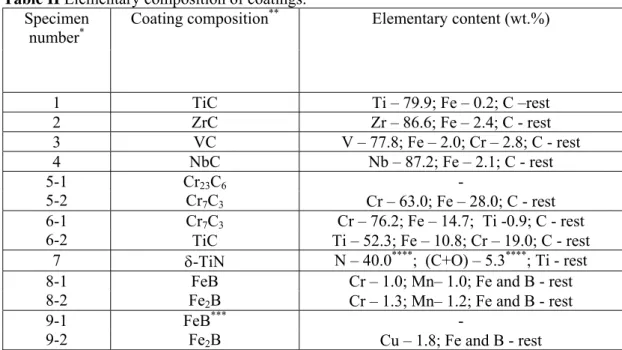
A typical elementary composition of coatings is shown in Tab. II. The results showed that coating compositions are believed to be different compared to those typical for similar bulk compounds [15]. Foreign metals because of element diffusion from the substrate or surrounding mixtures when the DSM technique was employed alloyed coatings. A small amount of iron was found in carbide coatings when they were performed on carbon steels (see samples 1-4 indicated in Tab. II). The essential content of foreign metals was recorded additionally in carbide layers when stepwise processing capable of forming several layers of different composition was used (see sample 6 indicated in Tab. II).
Table II Elementary composition of coatings. Specimen
number*
Coating composition** Elementary content (wt.%)
1 TiC Ti – 79.9; Fe – 0.2; C –rest
2 ZrC Zr – 86.6; Fe – 2.4; C - rest
3 VC V – 77.8; Fe – 2.0; Cr – 2.8; C - rest
4 NbC Nb – 87.2; Fe – 2.1; C - rest
- 5-1
5-2
Cr23C6
Cr7C3 Cr – 63.0; Fe – 28.0; C - rest
Cr7C3 Cr – 76.2; Fe – 14.7; Ti -0.9; C - rest
6-1
6-2 TiC Ti – 52.3; Fe – 10.8; Cr – 19.0; C - rest 7 δ-TiN N – 40.0****; (C+O) – 5.3****; Ti - rest
Cr – 1.0; Mn– 1.0; Fe and B - rest 8-1
8-2
FeB
Fe2B Cr – 1.3; Mn– 1.2; Fe and B - rest
- 9-1
9-2
FeB***
Fe2B Cu – 1.8; Fe and B - rest
Notes: * - specimen numbers are similar to those indicated in Tabs. I, II, III presented in Part I of this study [13], **- the composition is appointed in the direction from specimen surface to substrate; *** - the phase is presented in the form of individual crystals; **** - the content is defined by at. %.
A certain amount of carbon and oxygen ranging from 5 to 8 at.% was found in the composition of TiN-coatings. Probably, carbon and oxygen, which are typical foreign elements of the surrounding gas atmosphere, diffused in the condensate during its deposition. If so, TiN-coatings could be attributed actually to oxycarbonitride compounds.
It is notable that coatings made of titanium carbide and titanium nitride were referred to compounds of under- and over stoichiometric compositions ranging from TiC0.92 to TiC1.15
interstitial element solubility could be caused by the nanocrystalline structure of these coatings.
Foreign metals were found in boride coatings performed on alloyed carbon steel (see sample 8 indicated in Tab. II) and those formed using the DSM technique with a powder mixture (see sample 9 indicated in Tab.II).
3.2. Influence of the elementary composition on the plasticity characteristic
δ
H ofcoatings
Generally fluctuation of the material elementary composition causes variation of both of the hardness value and of Young’s modulus, resulting in the final value of plasticity characteristic δH. The effect of alloying on Young’s modulus has a complicated character
dependent on both the type of interatomic interaction and the strength of interatomic bonds. If so, the values of Young’s modulus for certain coatings were determined experimentally by the nanoindentation technique. The values of Young’s modulus, E, determined experimentally for some types of coatings (TiC, VC, Cr7C3) are listed in Tab. III presented in Part I of the
present study [13].
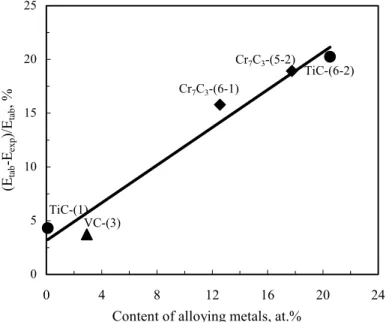
Fig. 1 Summary of the data concerning the difference between the values of Young's modulus for coatings from a handbook,Etab, and thosedetermined experimentally, Eexp, vs. the content
of alloying metals in the carbide compound. Coating compositions are marked by symbols and shown on the plot. Numbers by thesymbols indicate the samples listed in Table II.
It can be seen that values of Young’s modulus determined experimentally and those found in a handbook for bulk compounds of the same phase composition [16] are quite similar. When coatings contained a small amount of foreign metals, Me < 4 at.%, (see Tab. III presented in Part I [13], samples 1, 1’, 3, 3’) the difference between experimental data and those published in literature [16] was believed to be as great as 5%, satisfying the scatter of data that is met typically in tests targeted to determination of Young’s modulus. However, the opposite is true for coatings alloyed strongly by foreign metals (see Tab. III presented in Part
0 5 10 15 20 25
0 4 8 12 16 20 24
Content of alloying metals, at.%
(E
tab
-E
exp
)/E
tab
, %
TiC-(1) VC-(3)
Cr7C3-(6-1)
Cr7C3-(5-2)
I [13], samples 5-2, 5-2’, 6-1, 4-1, 6-2). Generally, for ceramic coatings the value of Young’s modulus increases almost proportionally as the content of foreign metals increases up to 22 at. %, as shown in Fig. 1.
It is considered usually that alloying of metals either by interstitial elements or substitution results in metal hardening, which causes a decrease in plasticity characteristics δH
[2]. Compared to metallic materials, Vickers hardness of ceramic coatings is found to vary in a different manner when composition fluctuation occurs.
0 10 20 30 40
0.8 0.85 0.9 0.95 1 1.05 1.1 1.15 1.2 1.25
C/Me; N/Me
HV, GPa
0.2 0.4 0.6 0.8 1
δH
TiC1±x
TiN1±x
TiC1±x
TiN1±x
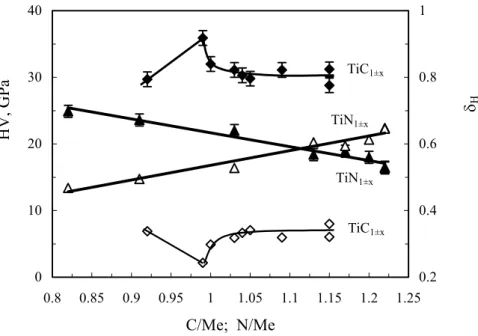
Fig. 2 Correlation of Vickers hardness, HV, and the plasticity characteristic δH for coatings
made of TiC and TiN vs. interstitial element content, C/Me, N/Me. Closed and open symbols indicate parameters such as HV and δH, respectively.
Fig. 2 shows a summary of the data referring to Vickers hardness, HV, and plasticity characteristic δH for coatings made of TiC1±x and TiN1±x plotted against the interstitial element
content. It could be seen that Vickers hardness for the TiN1±x–coating decreases and, so, its
plasticity characteristic δH increases continuously as the nitrogen content increases in the
region from N/Ti ≈ 0.8 to N/Ti ≈1.2.
Unlike the TiN1±x–coating the results determined for the TiC1±x–coating demonstrate
that Vickers hardness, HV, increases and the plasticity characteristic δH decreases when the
carbon content increases in the region from C/Ti ≈ 0.9 to C/Ti ≈ 1.0, as shown in Fig. 2. However, Vickers hardness decreases rapidly and, so, the plasticity characteristic δH increases
in the same manner when the carbon content is higher than the point referring to the stoichiometric composition of titanium carbide, C/Me>1. As the carbon content further increases up to C/Ti ≥ 1.5, the values of Vickers hardness, HV, and the plasticity characteristic δH tend to be stabilized.
In addition, indications were obtained that alloying of a Fe2B-layer with a small
amount of foreign metals (see samples 8-2 and 9-2 marked in Tab. II) results in the actual change of parameters HV and δH, (see Tab. III presented in Part I of this study [13], samples
4. Discussion
4.1. Influence of the elementary composition on the plasticity characteristic
δ
H forcarbides and TiN-nitride
Using data published in literature for Vickers hardness for carbides based on metals of groups IV-A and Y-A and also for titanium nitride [14, 15], enabled correlation of values of the plasticity characteristic δH for the compounds given above vs. content of interstitial
element, as shown in Fig. 3.
0.2 0.3 0.4 0.5 0.6 0.7 0.8
0.6 0.7 0.8 0.9 1 1.1
C/Me, N/Me δH
TiC
ZrC
HfC
VC
NbC
TaC
TiN
Fig. 3 Correlation of the plasticity characteristic δH for bulk materials made of carbides and
TiN-nitride, vs. interstitial element content, C/Me, N/Me. The values of hardness numbers used for calculations are adopted from data published in [14, 15].
For carbides based on metals of group IV-A (TiC1-x, ZrC1-x, HfC1-x) a strong decrease
of the plasticity characteristic δH occurred with increasing carbon content up to C/Me ≈ 0.98 -
0.99. The same is true for TiN- nitride when the nitrogen content increases up to N/Me ≈ 0.97. For carbides based on metals of group V-A (VC1-x, NbC1-x, TaC1-x) different correlations of
the plasticity characteristic δHvs. carbon content were revealed. Particularly, for VC1-x carbide
the plasticity characteristic δH decreases slightly as the carbon content increases to the point
indicated by C/Me ≈ 0.87 - 0.88. However, for carbides made of NbC1-x and TaC1-x the
minimum value of the plasticity characteristic δH occurs when C/Me ≈ 0.82 - 0.85. Generally,
values of the plasticity characteristic δH for carbides based on metals of group V-A (VC1-x,
NbC1-x, TaC1-x) are shown to be greater than those for carbides based on metals of group IV-A
(TiC1-x, ZrC1-x, HfC1-x). Compared to carbide compounds, TiN-nitride demonstrates the
greatest value of the plasticity characteristic δH only if the nitrogen content corresponds to the
relation N/Ti < 0.9.
titanium carbide (see Figs. 2 and 3). Furthermore, the value of the plasticity characteristic δH
for TiC-coating alloyed with a small amount of iron and the one obtained for an unalloyed bulk compound are found to be quite similar if only the carbon content in them was comparable, i.e. C/Ti ≈ 0.9. The results indicate that Vickers hardness increases and, so, the plasticity characteristic δH decreases as the carbon content further increases up to the
stoichiometric composition (C/Ti ≈ 1.0), as shown in Fig.2. The decrease of Vickers hardness and, so, increase of the plasticity characteristic δH that was recorded when the carbon content
was just over the point referring to the stoichiometric composition of titanium carbide could be caused by precipitation of free carbon located at the grain boundaries when the TiC1+x
compound with a composition higher than the stoichiometric one is formed. The presence of free carbon located at the grain boundaries was assumed to cause the decrease of Vickers hardness for VC1-x -carbide if even its composition does not exceed the stoichiometric one,
C/V ≈ 0.98 [15].
Attention should be drawn to the fact that the plasticity characteristic δH for
TiN1±x-coatings increases continuously as the nitrogen content increases whilst the opposite is
believed to be true for bulk titanium nitride, as shown in Figs. 2 and 3. In addition, for a stoichiometric composition the plasticity characteristic δH for TiN1±x–coating is found to be
smaller than the value typical for bulk titanium nitride. Additive interstitial elements such as carbon and oxygen, which are contained in TiN1±x–coating, can cause this phenomenon. It
was found previously that the presence of carbon and oxygen in the composition of bulk nitrides results in microhardness changes[18].
Thus, the results determined in the present study indicate that the plasticity of coatings can be affected both by the content of interstitial elements and grain structure of the material.
The effect of alloying by foreign metals on coating plasticity is discussed also. The most interesting data was determined for a double layer coating performed by consecutive application of a TiC-layer and then Cr7C3-layer (see Tab. I presented in Part I of this study
[13], sample 6). After application of the inner TiC-layer the amount of iron contained in the outer Cr7C3-layer decreased by about twice (see Tab. II, sample 6-1) compared to the value
found for a Cr7C3-layer, which was formed by application of Cr23C6/Cr7C3 coating (see Tab.
II, sample 5-2). Furthermore, the Cr7C3-layer marked by number 6-1 is alloyed additionally
by a small amount of titanium unlike to that formed in Cr23C6/Cr7C3 coating and marked by
number 5-2. Fluctuation of the elementary composition, which was found for the Cr7C3-layer
marked by number 6-1, results in the increase both of Vickers hardness and of Young’s modulus, while its plasticity characteristic δH remains quite similar to that determined for the
Cr7C3-layer marked by number 5-2’ (see Tab. III presented in Part I of this study [13]). Since
strong alloying of the inner TiC0.90 – layer of Cr7C3-TiC composite coating (see Tab. II,
sample 6-2) results in a more pronounced decrease of Vickers hardness than Young’s modulus its plasticity characteristic δH increases by twice compared to that found for an
unalloyed TiC0.99-layer (see Tab. III presented in Part I of this study [13], sample 1) whereas
the carbon content for both layers was comparable.
Thus, the results determined in the present study indicate certainly that the plasticity characteristic δH is highly sensitive to the elementary composition of coatings.
4.2. Application of the plasticity characteristic
δ
H for design purposesThe plasticity characteristic δH is of increasing significance in a number of cases
reasonable hardness should be taken into account to provide an adequate response of ceramic coatings to mechanical loading.
Several examples could be mentioned to demonstrate the role of the plasticity characteristic δH in the subject matter. As the first example let us consider high performance
of coatings under the fretting-fatigue condition. Coatings made of TiN, VC, Cr7C3 were found
previously to be effective against fretting-fatigue [19]. Compared to other types of carbide and nitride coatings (e.g. Ti2N - TiN, TiC, ZrC) this phenomenon was attributed originally to
high crack resistance of these coatings for which the value of criterion KIc varied in the range
from 2.5 to 2.7 MPa· m½. However, it seems to be strange that Vickers hardness determined for these coatings varied in a wide range of values (from 15 to 25 GPa) and in spite of the KIc
values were found to be comparable. Indeed, the relation between microhardness of the coating and that of the abrasive particles of wear debris, HVm/HVa, should be taken also into
account when coating behaviour under fretting-fatigue is considered [20, 21]. Nonetheless, the results showed that different mechanical response of coatings to fretting-fatigue was found to be real in spite of the same relation HVm/HVa< 0.6 typical for mechanical injuring of the
material [19].
а) b)
Fig. 4 SEM images of coatings made of (a) TiC and (b) VC, which demonstrate (a) poor and (b) reasonably good resistance to wearing under fretting-fatigue conditions. The plasticity characteristic and fracture toughness for TiC-coating were approx. δH = 0.45; KIc = 1.8
MPa·m½ whilst for VC- coating they were as high as δH = 0.55; KIc = 2.8 MPa·m½. SEM
images of coatings are reproduced from [21].
If so, an alternative explanation of this phenomenon could be given additionally using the results determined in the present study. The data listed in Tab. III included in Part I of this study indicate that values of the plasticity characteristic δH for the effective coating vary
between 0.55 and 0.65 whereas coatings made of other types of coatings (for example, TiC, ZrC, Ti2N-TiN), which could not be successfully applied, have values of δH << 0.5.
Fig. 4 shows that worn surfaces of coatings made of effective coatings demonstrate only a few damages typical for pitting and fatigue furrows whilst the opposite is true for unsuccessful coatings for which fragmentation of fatigue furrows and a lot of pitting damages occurred since their plasticity characteristic and fracture toughness were inadequate δH < 0.55
and KIc < 2.2 MPa· m½. If so, coating plasticity adequate to resistance against fretting-fatigue
occurs for actual values of the δH characteristic ranging between 0.55 and 0.65. Coatings of
this plasticity were used for effective application against fretting-fatigue conditions occurring in the application of fuel pump parts; blocks for air supply; hydraulic systems; screwed valves [21].
Attention should be drawn to the fact that high performance of coatings was ensured by methods and procedures for their application. For example, for TiN-coating that was effective against fretting-fatigue conditions certain nitrogen pressure and substrate temperature values were found experimentally using the method of Ion Bond Deposition [12].
Additionally, it was shown in [20, 21] that for application of a coating made of VC and Cr7C3, successful under fretting-fatigue conditions, use of the DSM procedure performed
with molten salts [22] is preferable compared to the CVD technique [23-25].
Another example concerns application of carbide coatings for tool engineering. Effective application of double layer coating Cr7C3-TiC (see Tab. I presented in Part I of the
present study [13], sample 6) for thread cutting and heading tools made of low-alloy steel (steel 9HS, HVG) was grounded by industrial tests [21]. This coating demonstrated a substantial increase of serviceability for the above tools, making them competitive with those made of high-speed steel. Application of only a single layer made of either TiC or Cr7C3
demonstrated a much smaller effect. Explanation of effective application of double layer Cr7C3-TiC coating was grounded previously [21] by higher resistance to oxidation of the outer
Cr7C3-layer compared to that typical for the inner TiC-layer. Nonetheless, alternative
explanation of effective application of Cr7C3-TiC coating takes into account the plasticity
characteristic δH. The results show that both the Cr7C3-layer and TiC–layer (see Tab. III
presented in Part I of the present study [13], sample 6) demonstrate reasonably high values of Vickers hardness (19.3 and 20.2 GPa) for almost the same values of the plasticity characteristic, δH = 0.47 and δH = 0.45, respectively. It is notable that the values of the δH
characteristic for single layer TiC-coatings are smaller by twice in spite of an adequately high hardness value (see Tab. III presented in Part I of the present study [13], sample 1). Unfortunately, for a single Cr7C3-layer the hardness value is too small in spite of the an
adequate value of the δH characteristic (see Tab. III presented in Part I of the present study
[13], sample 6-2). Possibly, a combination of high hardness (HV >18 GPa) and a reasonable value of the plasticity characteristic (δH ≈ 0.45) that was typical for layers in the system
Cr7C3-TiC could be assumed to be adequate properties for coatings used in cutting and
heading conditions.
It was shown in literature [2] that the plasticity characteristic should be as high as δH
> 0.90 in order for bulk materials to demonstrate plasticity before fracture under standard tests for tension and bending. However, the results indicate that effective application of thin ceramic coatings can be achieved even under conditions when the plasticity characteristic δH
has values smaller than the critical one, δH < 0.9, when bulk materials are believed to be
brittle. Possibly, this phenomenon occurs since the coating thickness is very small and, if so, elastic deformation has developed preferably under bending conditions, decreasing the risk of brittle fracture.
Allowing for the consideration above it can be concluded that the plasticity characteristicδH is actually quite informative for coating development and design purposes.
5. Conclusions
(1) Comparative analysis have shown that the difference between values of the plasticity characteristic δH for coatings and those published in literature for single crystals and
bulk polycrystalline materials of the same phase composition could be associated both with fluctuation of the elementary composition and with the difference of grain structure.
(2) Using the data given in literature for Vickers hardness of carbides based on metals of groups IV-A and V-A and TiN-nitride, correlations of the plasticity characteristic δH vs.
Compared to carbide compounds TiN-nitride demonstrates the highest values of the plasticity characteristic δH only if the nitrogen content corresponds to the relation N/Ti < 0.9.
(3) Contrary to bulk titanium nitride, the plasticity characteristic δH for TiN1±x –
coating was found to increase continuously as the nitrogen content increases in the region from N/Ti ≈ 0.80 to N/Ti ≈ 1.22. The opposite was found to be true for TiC1-x –coating when
the carbon content increases up to C/Ti ≈1. However, the plasticity characteristic δH for
TiC1+x - coating increases rapidly only if the carbon content is higher than the point referring
to the stoichiometric composition and then it tends to stabilize when the carbon content further increases in the region from C/Ti =1.05 to C/Ti=1.15.
(4) Allowing for high sensitivity of the plasticity characteristic δH both to phase and
elementary compositions of coatings, the importance of the plasticity characteristic δH for
processing control and design purposes was founded on actual examples referring to engineering practice of effective coating applications. In particular, it was shown that ceramic coatings were effective against fretting-fatigue if actual values of the plasticity characteristic
δH lie in the range between 0.55 and 0.65 and fracture toughness is not less than KIc=2.2-2.7
MPa×m½ while the value of Vickers hardness varied in the range from 15 to 25 GPa. Under cutting and heading conditions high hardness of about HV ≈ 20 GPa combined with the plasticity characteristic of about δH≥ 0.45 could be assumed, possibly, as adequate properties
for effective usage of ceramic coatings.
(5) It was assumed that for wear resistant ceramic coatings efforts aimed at the increase of the plasticity characteristic δH are reasonable only if no substantial decrease of hardness
occurs. In addition, the results indicate that effective application of thin ceramic coatings can be achieved even under conditions when the plasticity characteristic δH has values less than
critical, δH < 0.9, when bulk materials are believed to be brittle. Possibly, this phenomenon
occurs since the coating thickness is very small and, if so, elastic deformation has developed preferably under bending conditions, decreasing the risk of brittle fracture.
Acknowledgements
The authors wish to thank Dr. S. N. Dub for help with nanoindentation experiments. The research was supported, in part, by the Science and Technology Centre in Ukraine, Project No 1997, by the National Academy of Science of Ukraine, Scientific Programme N4-004, and by the Ministry of Education and Science of Ukraine, Project No 2530.
References
1. Yu. V. Milman, in Advanced Materials Science 21st Century, International Science Publishing, Cambridge, 1998, p 638-659.
2. Yu. V. Milman, B. A. Galanov, S.I. Chugunova, Acta. Metall. Mater., 41 (9) (1993) 2523.
3. B. A. Galanov, Yu. V. Milman, S.I. Chugunova, I. V. Goncharova, J. Superhard Materials, 21 (3) (1999) 23.
4. A.V. Byakova, V.G. Gorbach, Strength of Materials, 26 (1994), 40.
5. Yu. Lahtyn, Ya. Kogan, G.-I. Shpies, Z Beller, Theory and Technology of Nitriding, Metallurgia, Moscow, 1991 (in Russian).
6. Iost, J. J. Foct, Mater. Sci. Lett., 12 (1993) 1340.
7. A.V. Byakova, J. Powd. Metal. and Metal Ceram., 39 (2000) 85.
9. A.V. Byakova, Problemy Spetzialnoy Electro-Metallurgii, (4) (1995) 29 (in Russian). 10. A.V.Byakova, J. Powd. Metal. and Metal Ceram., 32 (1993) 364.
11. A.V.Byakova, V.G.Gorbach, A.A. Vlasov, Strength of Materials, 9 (1993) 662. 12. A.V,Byakova, Superhard Materials, 5 (1992) 30.
13. A.V.Byakova, Yu. Milman, A. Vlasov, Sci. Sinter. (be published).
14. G.V. Samsonov, I.M. Vinitzkiy, Refractory Compounds: Handbook, Metallurgiya, Moscow, 1976 (in Russian).
15. G.V. Samsonov, G. Sh. Upadhaya, V.S. Neshpor, Physical Material Science for Carbides, Naukova dumka Press, Kiev, 1974 (in Russian).
16. I.N. Frantzevich, F.F. Voronov, S.A. Bakuta, Elastic Constants and Elastic Modulus for Metals and Nonmetals: Handbook, Naukova Dumka Press, Kiev, 1982 (in Russian).
17. V.V. Skorohod, I.V. Uvarova, A, V. Ragulya, Physical and Chemical Kinetics in nanostructured systems, Academperiodica, Kiev, 2001 (in Russian).
18. S.I. Alyamovskiy, Yu. G. Zainulin, G. P. Shveikin, Oxycarbides and oxynitrides based on metals belonged to IVA and VA groups, Nauka, Moscow, 1981 (in Russian).
19. A.V. Byakova, in “ Tribo-Fatigue ISTF 2000”, Hunan University Press, Beijing, 2000, p. 253-257.
20. B. I. Kostetskiy, Friction, Lubricant, and Wear in Machines, Technika Press, Kiev, 1970 (in Russian).
21. A.V. Byakova, Development of Fundamental Scientific Principles for Evaluation of Engineering Strength of Brittle and Low Plastic Coatings: Prof. Sci. Thesis., Kiev, 1993 (in Russian)
22. Yu. S. Borisov, K.A. Yuschenko, E.N. Shavlovskiy, et al., in “Zaschitnie Pokritiya na Metalah”, Naukova dumka Press, Kiev, 24, 1990, p. 40-43 (in Russian).
23. Invention of USSR, Method for Application of Carbide Coatings, 1036071, 15.04.1980 (in Russian).
24. Invention of USSR, Method for Application of Carbide Coatings on Surface of Steel Makes, 1162240, 15.02.1985 (in Russian).
25. Invention of USSR, Composition of Mixture for Application of Carbide Coatings 513114, 14.01.1976 (in Russian).
ю : С
δH
. С
- , .
К юч вы ва: ; ; .
а а: П ђ
δH ђ
. З
- ,
.