β
-cyclodextrin
Goran M. Petrović1, Gordana S. Stojanović1, Olga P. Jovanović1, Aleksandra S. Đorđević1, Ivan R. Palić1, Sofija V. Sovilj2
1
University of Niš, Faculty of Mathematics and Natural Sciences, Niš, Serbia
2
University of Belgrade, Faculty of Chemistry, Belgrade, Serbia
Abstract
The disadvantage of some organic pesticides is their low water solubility. Among other substances, cyclodextrins and modified cyclodextrins were considered as agents for im-proving pesticide water solubility. The solubility of poorly soluble pesticides, dimethoate, simazine, linuron and thiram, was determined in aqueous solution of methylated β -cyclo-dextrin (mβCD) by ultraviolet spectrophotometry. Methylated β-cyclodextrin was obtained by the modified Hawort method and characterized by 1H-NMR and HPLC data. The average degree of substitution was 13.8. Methylation was done either on C-2, C-3, and C-6 atoms of the glucopyranose unit; therefore, obtained product can be asserted as randomly me-thylated β-cyclodextrin. Solubility of the studied pesticides in aqueous solution of mβCD increases in relation to their solubility in water for dimethoate 506, for simazine167, for thiram 44, and for linuron 20 times. Reactions of dimethoate and simazine with mβCD were entropy-driven while the inclusion complexation of mβCD with the linuron and thi-ram were driven by both, enthalpy and entropy, as determined by calorimetric measu-rements. The observed solubility increment of the investigated pesticides in aqueous solu-tion of mβCD, suggests that it can be efficiently used in pesticide solutions formulations and increase their bioavailability and biodegradability.
Keywords: inclusion complexes, methylated β-cyclodextrin, pesticides.
SCIENTIFIC PAPER
UDC 547.458.68:661.16
Hem. Ind. 67 (2) 231–237 (2013)
doi: 10.2298/HEMIND120413068P
Available online at the Journal website: http://www.ache.org.rs/HI/
The application of pesticides has become inevitable to protect crop plants from pests and diseases. At the same time, pesticide pollution in the environment has caused increasing concern among the public. Some hydrophobic organic pesticides have limitations for ex-tensive application due to their low water solubility and difficulties of their removal from soil. Agents such as organic cosolvents and surfactants have been consi-dered for improving solubility of organic pesticides [1]. Significant increase of pesticide solubility could be achieved with cosolvent volume fractions above 10%. Because of this disadvantage, cyclodextrins might be-come a good alternative as agents for increasing pesti-cide solubility [2–4] and remediation of contaminated soil and groundwater [5,6].
β-Cyclodextrin (cyclomaltoheptaose) is a cyclic oli-gomer of glucose containing 7 glucose residues, which are arranged in a circle with a toroidal shape. In this compound, the C-1 chain conformation of the glucose monomers imparts to the molecule a cone-like struc-ture in which the hydroxyl groups are oriented on the exterior of the torus. This arrangement makes the
Correspondence: G. Petrović, Faculty of Mathematics and Natural Sciences, Višegradska 33, 18000 Niš, Serbia.
E-mail: [email protected] Paper received: 13 April, 2012 Paper accepted: 19 June, 2012
complexa-tion phenomena between molecular receptor “host” and substrate “guest” molecule. The driving forces leading to the inclusion complexation of cyclodextrins include electrostatic interaction, van der Waals inter-action, hydrophobic interinter-action, hydrogen bonding, re-lease of conformational strain, exclusion of cavity-bound high-energy water and charge-transfer interac-tion [11]. Although, concerning the enthalpy-entropy compensation, the enthalpy and entropy changes of the complex formation are not good criteria to be used in judging whether a particular driving force is present, they can be useful in predicting which driving forces are important. Due to the fact that the cost of cyclodextrins is declining, the potential use of methylated β -cyclo-dextrin (mβCD) could be of very large interest in the pesticide solutions formulations and enhancement of the bioavailability and biological activity of the active compounds [12].
Continuing our investigation on properties and ap-plications of cyclodextrins [13,14], herein we report the methylation of the β-cyclodextrin, characterisation of obtained mβCD, and its complexation with poorly so-luble pesticides, dimethoate, simazine, linuron and thi-ram. Selected pesticides are typically used as water suspensions in following concentrations of active com-ponents: “dimethoate” 3–4 g/10 dm3, “simazine” 2–3 kg/Ha, “linuron” 0.65–1.35 kg/Ha and “thiram” 15–26 g/10 dm3. Additionally, thermodynamic parameters of complexation reactions were determined.
EXPERIMENTAL
The active components of the “dimethoate”, “sima-zine”, “linuron” and “thiram” (generic names of the pesticides) were obtained from “Župa” (Serbia) and were used without further purification. Chemical names of active ingredients are: O,O-dimethyl-S-(N-monome-thyl)-carbamoyl-methyl dithiophosphate, 6-Cl-2,4-di-aminoethyl-1,3,5-triazine, 3,4-dichlor-carbamoylaniline and Zn-dimethyldithiocarbamate, respectively. β -cyclo-dextrin was purchased from Merck (Germany) and was dried in vacuum prior to use. Dimethyl sulfate and all other chemicals were of analytical grade. Column chro-matography was performed on Silica gel 60, 70–230 mesh ASTM, Merck (Germany) and the mobile phase was benzene:ethanol mixture (65:35, v/v) at a flow rate of 1 cm3/min.
NMR spectra were obtained with deuterated di-methyl sulfoxide (DMSO-d6) as solvent and referenced to the TMS signal using a Gemini-200 spectrometer operating at 199.98 MHz for 1H. The HPLC system con-sisted of a LKB-Pharmacia 2248 pump, YMC-Pack Poly-amine II (250 mm×4.6 mm) column, SP6040 Differential Refractometer detector and a SP 4200 Computing Inte-grator data module. Optical rotations were measured with model P16 polarimeter (Karl Zeiss). Ultraviolet
spectra were recorded using a Perkin Elmer Lambda 15 spectrophotometer. A TRONAC model 458 isoperibol titration calorimeter was used for all of the thermo-dynamic measurements.
The reaction of methylation was performed by the modified Hawort method [15]. Shortly, the β -cyclo-dextrin (0.001 mol) was methylated with dimethyl sul-fate in aqueous sodium hydroxide solution in a nitro-gen atmosphere. Dimethyl sulfate (0.007 mol) was in-troduced drop-by-drop into the ice cooled, magneti-cally stirred solution. After that, the temperature was raised to 40 °C over a period of 3 h during the dropwise addition of dimethyl sulfate (0.007 mol), and the mix-ture was stirred at room temperamix-ture overnight. The solution was neutralized with diluted sulfuric acid, eva-porated under a reduced pressure to give light-yellow powder and purified on the silica gel column. The elu-ent was removed under a reduced pressure to obtain white powder (yield 48%). The final product of me-thylation was dried in vacuum oven at 60 °C until the constant weight and characterized using the 1H-NMR and HPLC spectroscopy methods.
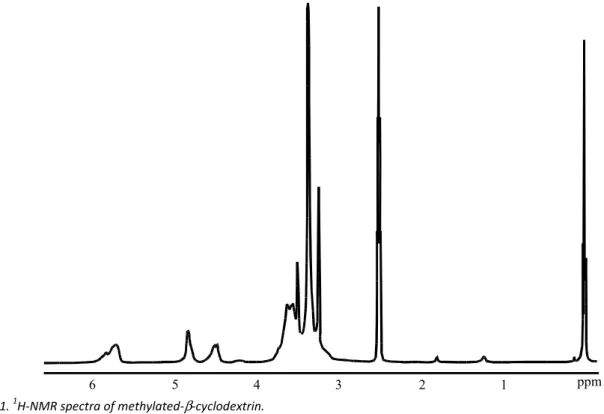
1H-NMR (DMSO-d6,
δ/ppm): 4.86–4.78 (broad doublet, anomeric protons, 1H); 4.58–4.44 (broad mul-tiplet, OH, 1.05H, disappears on addition of D2O); 3.74– –3.47 (multiplet, cyclodextrin protons); 3.24 (singlet, methyl protons, 5.9H) (Figure 1). The average degree of substitution is 13.8, measured by comparing the in-tegration of the seven anomeric protons of the carbo-hydrate with the observed methyl protons.
The results obtained from the HPLC measurements (Figure 2) show the presence of the new product (Rt = 2.14) of methylated β-cyclodextrin vs. standard of β-cyclodextrin) and confirm the high purity of the syn-thetized compound (area % is 99.4).
Optical rotation (20 cm path, 1% solution in water, sodium D line) α = +0.88.
Analytically calculated values for (C6H10O5)7(CH3)13.8 are: C, 50.47%; H, 7.35%. Found: C, 50.53%; H, 7.42%.
Standard aqueous solutions of the active compo-nents of pesticides were prepared in the range of con-centrations up to the maximum solubility of each pes-ticide in water. Analytical curves of pespes-ticides are shown in Figures 3–6, respectively. Some of the active components of pesticides had to be dissolved in small amounts of ethanol and diluted with water (15% v/v), because they are practically insoluble in water.
2,14
4,07
Time (min)
Figure 2. HPLC chromatogram of methylated β-cyclodextrin. Conditions: mobile phase, acetonitrile:H2O = 310:190 (v/v); flow rate, 1 cm3/min, sample concentration, 2 mg/cm3.
Concentrations of the active components of pesti-cides were determined as absorbance at the wave-length at which absorbance was maximum (Table 1). There are no significant differences in the position of the absorption bands between pesticides solutions in water and in the aqueous methylated β-cyclodextrin solutions due to very weak intermolecular bonds be-tween “host” (mβCD) and “guest” (pesticide) molecules [17].
Calorimetric measurements were performed by the calorimetric titrations in an aqueous phosphate buffer
solution at pH 7.20 in a temperature-controlled water bath maintained at 22 °C. A titration curve was ob-tained by plotting the temperature change against the amount of the pesticide solution added, from which the complex stability constant, K, and the enthalpy change, ΔH, were calculated.
RESULTS AND DISCUSSION
Characterization of methylated β-cyclodextrin, was based on 1H-NMR and HPLC data (Experimental part). The average degree of substitution was 13.8, measured by comparing the integration of the seven anomeric protons of the carbohydrate with the observed methyl protons. According to HPLC chromatogram (Figure 2), the purity of the synthesized complex was 99.4%.
The solubility of investigated pesticides in water and inaqueous mβCD solutions is presented in Table 2. The obtained results showеd that the effective solu-bility of the investigated pesticides was substantially increased in the presence of mβCD. The solubility of some pesticides in aqueous mβCD solutions was up to three orders of magnitude higher than those in water (Table 2).
Increase the pesticide solubility with methylated β-cyclodextrin complexation reduces the average amount of pesticide applied in practice from 1.6×10⁻² to 3×10⁻⁵ mol/10 dm3 for “dimethoate”, 12.3 to 7.4×10⁻² mol/Ha for “simazine”, 4 to 9.1×10⁻² mol/Ha for “linuron” and from 8.6×10⁻² to 4.3×10⁻³ mol/10 dm3 for “thiram”. For their complexation, assuming a 1:1 stoichiometry, the
6 5 4 3 2 1 ppm
0 2 4 6 8 10 0.2
0.4 0.6 0.8 1.0 1.2 1.4 1.6
A
C (1x10⁻⁵mol/dm3)
Figure 3. Analytical curve of dimethoate.
1 2 3 4 5 0.4
0.6 0.8 1.0 1.2 1.4 1.6 1.8
A
C (1x10⁻⁵mol/dm3)
Figure 4. Analytical curve of simazine.
1 3 5 7 9 0.2
0.4 0.6 0.8 1.0 1.2 1.4 1.6 1.8
A
C (1x10⁻⁵mol/dm3)
1 2 3 4 5 0.4
0.6 0.8 1.0 1.2 1.4 1.6 1.8
A
C (1x10⁻⁵mol/dm3)
Figure 6. Analytical curve of thiram.
following masses of methylated β-cyclodextrin are re-quired: for “dimethoate” 0.41 g, for “simazine” 98.28 g, for “linuron” 121.33 g and for “thiram” 5.73 g.
Table 1. λmax and absorbencies of the dilute mβCD-pesticide complexes
Pesticide λmax / nm A
Dimethoate 192 1.47
Simazine 221 0.87
Linuron 246 0.67
Thiram 207 0.86
The difference between the solubility enhance-ments is due to the molecular structure of the inves-tigated pesticides, and binding ability and selectivity of intact molecular guest accommodated in the cyclo-dextrin cavity.
Assuming a 1:1 stoichiometry for the inclusion com-plexation of selected guest molecules (G) with me-thylated β-cyclodextrin (Eq. (1)), the complex stability constant, K, and the enthalpy change, ΔHo were deter-mined simultaneously (Eq. (2)) by using the least-squa-res method to minimize the error square sum (U):
G+CD ←⎯⎯⎯K⎯→G CD (1)
2
1
( , ) ( )
m
o o
t t
t
U K H Q H N
=
Δ =
− Δ × (2)where Qt refers to the net heat of complexation
mea-sured at time t in minutes and Nt denotes the amount
in moles of the complex formed at time t and is directly related to the complex stability constant K.
The stability constant K and the enthalpy change ΔH° were calculated by computer simulation by conti-nuously changing K, i.e., Nt, to minimize the U value.
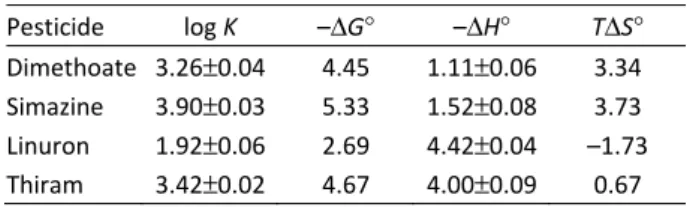
The measurements were repeated more than three times and the U value obtained was minimized satis-factorily to give the optimized set of K and ΔH° with standard deviations. No serious deviation was found in fitting process, verifying the 1:1 stoichiometry of com-plexation. The complex stability constants and thermo-dynamic parameters obtained are listed in Table 3.
As can be recognized, the ΔH values for the in-clusion complexation of methylated-β-cyclodextrin with the pesticide molecules are all negative and sta-bilizing, whereas the TΔS values are either negative or positive. Combination of dimethoate and simazine with mβCD formed typical entropy-driven complexes. Thus, the complexes are inferred to be stabilized primarily by the entropic gain arising from the desolvation of the host and guest molecules upon complexation, as well as the release of water molecules trapped originally in the cavity. On the other hand, inclusion complexation of methyl-β-cyclodextrin with the linuron and thiram are enthalpy-driven reactions. In the case of thiram, ne-gative enthalpy change indicates the dominance of van der Waals interaction but the entropy evidently assists
Table 2. The solubility of investigated pesticides in water and in aqueous mβCD
Pesticide Solubility in water (mol/dm3) Solubility in aqueous mβCD (mol/dm3) Increase of solubility
Dimethoate 1.70×10⁻⁴ 8.6×10⁻² 506
Simazine 1.44×10⁻⁷ 2.4×10⁻⁵ 167
Linuron 3.19×10⁻⁶ 1.4×10⁻⁴ 44
process. Although it affords comparable K value with those of dimethoate and simazine, their thermody-namic profiles are completely different. Linuron gives the poor inclusion abilities forming the complex, which is evidently enthalpy-driven, but the enthalpic gain is exceedingly canceled out by the accompanying entro-pic loss. This enthalpy-entropy compensation indicates that the van der Waals interaction is the major driving force for linuron–mβCD complexation.
Table 3. Complex stability constant and their thermodynamic parameters (kcal/mol)
Pesticide log K –ΔG° –ΔH° TΔS°
Dimethoate 3.26±0.04 4.45 1.11±0.06 3.34 Simazine 3.90±0.03 5.33 1.52±0.08 3.73 Linuron 1.92±0.06 2.69 4.42±0.04 –1.73 Thiram 3.42±0.02 4.67 4.00±0.09 0.67
CONCLUSION
Methylated β-cyclodextrin was synthesized and characterized, and its impact on solubility of commer-cial pesticides dimethoate, simazine, linuron, and thi-ram was investigated. The obtained results showed that solubility of examined pesticides was greater in the presence of mβCD than in the presence of cyclo-dextrin [13] or in pure water. The solubility depends of modified cyclodextrin concentration. In comparison with cosolvents and surfactants as additives in the pes-ticide solutions formulations, cyclodextrin derivatives have some advantages. For example, they are extre-mely water soluble relative to many cosolvents and surfactants, they do not form emulsions as do many surfactants and they are nontoxic and biodegradable, thus posing no hazard to the ecosystem. Because the cost of cyclodextrins is declining, water soluble me-thylated β-cyclodextrin may be potentially useful for improving the application of hydrophobic organic pesti-cides and enhancing their removal from the environment.
Acknowledgment
The research was supported by Ministry of Educa-tion, Science and Technological Development of the Republic of Serbia (Grant no. 172047).
REFERENCES
[1] D.E. Kile, C.T. Chiou, Water solubility enhancements of DDT and trichlorobenzene by some surfactants below and above the critical micelle concentration, Environ. Sci. Technol. 23 (1989) 832–838.
[2] J. Szejtli, Cyclodextrins in pesticides, Starch 37 (1985) 382–386.
[3] O. Dailey, J. Bland, B. Trask-Morrell, Preparation and characterization of cyclodextrin complexes of the insec-ticides aldicarb and sulprofos, J. Agric. Food. Chem. 41
(1993) 1767–1771.
[4] M. Lezcano, W. Al-Soufi, M. Novo, E. Rodriguez-Nunez, J. Vazquez, Complexation of several benzimidazole-type fungicides with α- and β-cyclodextrins, J. Agric. Food Chem. 50 (2002) 108–112.
[5] E. Morillo, J. Perez-Martinez, J. Gines, Leaching of 2,4-D from a soil in the presence of β-cyclodextrin: laboratory columns experiments, Chemosphere 44 (2001) 1065– –1069.
[6] B.B. Mamba, R.W. Krause, T.J. Malefetse, E.N. Nxumalo, Monofunctionalized cyclodextrin polymers for the re-moval of organic pollutants from water, Environ. Chem. Lett. 5 (2007) 79–84.
[7] Y. Liu, B.H. Han, B. Li, Y.M. Zhang, P. Zhao, Y.T. Chen, T. Wada, Y. Inoue, Molecular recognition study on supra-molecular systems. Synthesis of modified cyclodextrin and their inclusion complexation thermodynamics with L-tryptophan and some naphthalene derivatives, J. Org. Chem. 63 (1998) 1444–1454.
[8] J. Szejtli, The cyclodextrins and their applications in bio-technology, Carbohyd. Polym. 12 (1990) 375–392. [9] M.E. Brewster, J.W. Simpkins, M.S. Hora, W.C. Stern, N.
Bodor, The potential use of cyclodextrins in parenteral formulations, J. Parent. Sci. and Tech. 43 (1989) 231– –240.
[10] J. Szejtli, Cyclodextrins and Their Inclusion Complexes, Akademiai Kiado, Budapest, 1982.
[11] L. Liu, Q.X. Guo, The Driving forces in the inclusion complexation of cyclodextrins, J. Incl. Phenom. 42
(2002) 1–14.
[12] T. Nagai, H. Ueda, Aspects of drug formulation with cyc-lodextrins. In: Comprehensive Supramolecular Chemis-try, Vol. 3: Cyclodextrins, Elsevier Science, Oxford, 1996, pp. 441–450.
[13] G. Petrović, G. Stojanović, R. Palić, Modified β -cyclo-dextrins as prospective agents for improving water solu-bility of organic pesticides, Environ. Chem. Lett. 9 (2011) 423–429.
[14] G. Petrović, G. Stojanović, N. Radulović, Encapsulation of cinnamon oil in β-cyclodextrin, J. Med. Plants Res. 4
(2010) 1382–1390.
[15] R.L. Whistler, M.L. Wolfram, Methods in Carbohydrate Chemistry, Vol. II, Academic Press, New York, 1963. [16] J. Pitha, J. Milecki, H. Fales, L. Pannell, K. Uekama,
Hyd-roxypropyl-β-cyclodextrin: preparation and characteri-zation; effects on solubility of drugs, Int. J. Pharm. 29
(1986) 73–82.
IZVOD
INKLUZIONI KOMPLEKSI PESTICIDA U VODENOM RASTVORU METILOVANOG β-CIKLODEKSTRINA
Goran M. Petrović1, Gordana S. Stojanović1, Olga P. Jovanović1, Aleksandra S. Đorđević1, Ivan R. Palić1, Sofija V. Sovilj2
1
Univerzitet u Nišu, Prirodno–matematički fakultet, Niš, Srbija
2
Univerzitet u Beogradu, Hemijski fakultet, Beograd, Srbija
(Naučni rad)
Nedostatak većine organskih pesticida je njihova mala rastvorljivost u vodi. Pored ostalih supstanci za povećanje rastvorljivosti u vodi, razmatrani su ciklo-dekstrini i modifikovani ciklociklo-dekstrini. U ovom radu ispitivana je rastvorljivost č e-tiri slabo rastvorna organska pesticida, dimetoata, simazina, linurona i cirama, u rastvoru metil-β-cyclodextrina (mβCD), dobijenom metilovanjem β-cyclodextrina (βCD) modifikovanom Hawort-ovom metodom. Analizom NMR spektra utvrđeno je da je prosečan stepen supstitucije 13,8 i da je metilovanje izvršeno neselektivno u položajima 2, 3 i 6 glukopiranoznih jedinica i da dobijeni proizvod spada u klasu nasumično metilovanih β-ciklodekstrina. Rastvorljivost svih ispitivanih pesticida kompleksiranih sa metil-β-ciklodekstrinom se povećava u odnosu na njihovu ras-tvorljivost u vodi i to za: dimetoat 506 puta, simazin 167 puta, ciram 44 puta i li-nuron 20 puta. Metodom kalorimetrijske titracije utvrđeno je da je građenje kompleksa dimetoata i simazina sa metil-βCD-om uslovljeno pretežno entropij-skim faktorom, dok na komplekse linurona i cirama utiču i entalpijski i entropijski. Dobijeni rezultati ukazuju na moguću primenu metilovanog β-ciklodekstrina kao agensa za povećanje rastvorljivosti ispitivanih pesticida što bi omogućilo njihovu efikasniju primenu kroz smanjenje njihove aplikovane količine, povećanje biodos-tupnosti i biodegradibilnosti.