Vol-7, Special Issue-Number2-April, 2016, pp170-180
http://www.bipublication.com
Research Article
Identify and Prioritize Factors Affecting the Date Export by
MADM Techniques
Abdolhamid Bazyari1 and Mohammad Amin Kouhbor2
1M.A student ofExecutive Management, Department of Management,
Islamic Azad University, Kish International Branch
2Assistant Professor, Department of Management,
Islamic Azad University, Kish International Branch
ABSTRACT
To enter the global market, companies have taken different approaches, one of which is export promotion. The use of proper export procedures has high impact on corporate performance in these areas. The main objective of this study was to evaluate and select the best method for date export that the Analytic Hierarchy Process is used. The sample size of this study consisted of 30 experts have been involved in the date export and to gather information the Analytic Hierarchy Process software and TOPSIS used. The results of weighing criteria showed that among the factors, ads with weight (0.210), distribution (0.173), the risk of Sale (0.142), price (0.117), external competitiveness (0.099) packaging (0.088), quality ( 0.066), the risk of failure (0.044), internal competition (0.025), and delivery (0.025) shown the highest and lowest weight among the elements. The review found that the methods of export for export to the intermediate state (0.72) State (0.55) and personal (0.19), respectively, the highest and the lowest priority among the options have investigated.
Keywords: Export, date, AHP, TOPSIS
INTRODUCTION
To enter the global market, companies have taken different approaches, one of which is export promotion. Success in export of a company can br effective in survive and grow in the company. A growing number of companies in this space are an opportunity to expand their international activities in order to achieve goals such as growth, profit and sales, diversification of business risks and even retaliate foreign presence in the market have found.
In this situation, almost all companies regardless of their size and industry are working or their nationality has found the fact that the choice of activity in world markets soon will not exist for
STATEMENT OF PROBLEM
For several years, the business environment with features such as increased competition and lack of stability is clear. For all businesses in the
current environment, export performance
represents a serious distinction between different countries [2]. In view of the competitive conditions prevailing in global markets, entry to export markets and achieving good results of these markets, have obstacles and problems. The export companies are trying to overcome these barriers, improve their export performance. This is not possible unless businesses have a scientific marketing system. Changing global economic situation and its complexity would have made all the companies that turn to scientific methods and new marketing and coordinate with the international community needs [3].
Active firms in different countries as saturated domestic markets or by the attraction of foreign markets, their products exported to other countries. Among the different ways of entering international markets, exporting as a simple method, yet critical, and it is used by companies in order to benefit from the opportunities and revenue and financial and other benefits are constantly looking for export promotion, as in many developing countries such as Iran, export rebound as traders defined strategies [4].
Exports of goods and services organization considered as a dynamic process deciding on three main activities in the process done. These subsystems are in the process of exporting goods and services, target market selection, entry into the international market and subsystems mix the international market [5]. Warren J. Keegan believed some of the problems associated with exporting companies are often faced with the problems associated with promoting sales
(advertising, packaging, vendors activities,
marketing information and coordination in the field of distribution) and problems associated
with information about foreign markets
(identifying and selecting markets, trade
restrictions and study competition in abroad) [6]. In general, the effects of foreign trade can be divided into two parts: direct impacts such as international business, expand markets, increase the side effects of investment, resource allocation, and indirect effects such as the supply of items needed, transfer knowledge and modern technology , transfer of foreign investment and encourage competition divided [7]. It seems that oil exports overall has not effects on economic development in Iran. But what is certain, based on the studies can be said that the largest share of national income is related to the growth rate of oil exports, indicating the high dependence of the Iran economy on oil exports [8].
The dependence on oil exports had many disadvantages during the period of economic
sanctions on Iran, which lack proper
RESEARCH LITERATURE
Karimi Fard et al (2011) in a study to determine the issues of marketing and date export in the Khozestan province have expressed in this study, to investigate the problems of marketing and date export in the Khozestan province as one of the most important producing regions of dates. To this end, the marketing margin, the share of marketing, and marketing cost coefficient of performance for 5 kinds of dates (Kabkab, Gentar, Stemaran, Brim and Zahedi) calculated. The marketing margin function using the mark-up (surcharge), relative margin and marketing costs estimated. The data required for the study both documents with the resources and survey through random sampling and completed 240questionnaires were collected and using SPSS software and EVIEWS analyzed. The results showed that among types of date, Kabkab date with marketing cost 6000 rials per kg had the lowest, Zahedi dates with 12,000 rials per kg had the highest marketing costs.
The results of marketing efficiency, shows that in terms of technical performance, the highest for all dates related to the Stemaran date (67%) and lowest for Kabkab date (13%) and the price efficiency for all kind was high.
The results of marketing margins function showed that marketing margins in relative margin and mark-up models have a direct relationship with the retail price, as well as in the marketing cost model-marketing margin directly related to the marketing cost. According to the results, it suggested that due to the low share of proportion of the final price of the product, has taken steps to marketing services by farmers and by forming marketing cooperatives in order to decrease the
role of intermediaries and increase
manufacturing's share of the final price of the product. It is also possible by holding classes in various stages of production, and enhances product quality and thus increased the products export with high quality [11].
Jafreh and Farajollahi (2009) in a study entitled analysis of factors affecting export of pistachio in
Iran have expressed that the lack of
understanding of global business conditions and factors affecting the exports of goods and services export is a major issue in pistachio. The Dutch disease relies on oil exports have led to reduced export in recent decades. Export growth of pistachio due to two essential factors, the first batch of economic variables such as real exchange rate, foreign income and amount of pistachio production have a positive impact in the development of export of this product. For this purpose, we have used econometric models and time series statistical data. Second, business and marketing variables that are factors affecting it is using a field study we have obtained. Factors such as laws and regulations, marketing, advertising costs, product quality, customs support, macroeconomic instability on pistachio export rules and conditions are effective [12]. Hosseini and Homan (2007) in a study as the study of the date global market and date target markets for Iran's export expressed in this paper
after presents research theoretical and
methodological foundation (in both the market structure and target markets), the structure of date global production, the global structure of trade (imports and exports) structure of Iran's date export, Iran's export target markets and, finally,
conclusions and policy recommendations
discussed. The results of this study indicate that global production of date had fluctuations during
the period 1989-2001, have multilateral
monopolyand Iran's share of world production has increased and the share of Saudi Arabia, and Iraq is declining [13].
Comparing the structure of the global import and export of dates shows that the monopoly is for the importers than export it. Iran's date export structure shows that importers of dates from Iran have not been relatively stable during the years 1979-1989 and joined the bargaining power of Iran in the importers of date reduced. Nevertheless, during the years 1989-1999, especially in the first development plan, with the arrival of a large number of the country to total imports from those countries has reduced monopoly power and major importer of Iranian dates, are countries that have begun to re-export the product. Finally, 29 countries have similar characteristics with Iran's export target market as export target markets of Iran's date have introduced. This study concluded that late policy
recommendations, suggestions and
considerations end.
Rastegari Pour and Homayooni (2007) in a study to determine the economic and political factors that affect the non-oil exports of Iran have suggested that crude oil exports due to fluctuations in the price of these products in global markets, leading to fluctuations in GNP, per capita income and other the country’s economic variables. As a result, the growth of non-oil exports and its determinants has great importance. The effects of economic and political variables are some most important trading partners of Iran, have been studied in non-oil exports. The corresponding figures for the 15 countries for 10 years (1995-2005) collected and analyzed and categorical variables and time series by combined models have evaluated. In the economic sector factors such as per capita income, population, consumer price index and exchange rate in trading partners of Iran, are factors affecting Iran's non-oil commodity exports. Political instability in these countries will also affect the exports of Iran. The results showed that the population, per capita income and consumer price index increased trading collaborates of Iran; Iran's exports to those
countries increased. However, exchange rates and political instability in these countries with Iran's exports has inverse relationship [14].
Mohammad Zadeh and colleagues (2003) in his research on date production and marketing in Iran has stated that the comprehensive review of date from production to export, have comparative advantage in production and exports, production and export growth as well as efficiency and marketing margins was calculated. Bushehr, Kerman select as index zones in date production and by the use of classified sampling from production to export, tries to interview and complete the questionnaire. The results of the policy analysis matrix represent a significant comparative advantage in production and earnings potential through breeding base product. Taking advantage of the techniques of marketing
and the respect product earn standards
intensified. The results confirmed the existence of a comparative advantage in the export of Iran [15].
shortterm price elasticity of export demand was -0.53, respectively, which are smaller than the long-term (-1.18). For short-term price elasticity, export supply 7.21estimated [16].
Khalilian and Farhad in 2002 investigate the factors affecting the agricultural sector's exports during the period studied 1962-1999. Their results showed that GDP (production capacity), the relative prices of exports and domestic consumption have a significant impact on the supply of agricultural exports [17].
Amornkitvikai et al (2012) study factors influencing participation of exports and export performance in the small and medium enterprises in Taiwan to categorize these factors discussed. He corporate level factors as size, age, investment, productivity, skills, staff, location, company, government support introduced [18]. Nadeem et al (2012) study the factors affecting the exports have suggested that the results of this research showed that global revenue, industry value added, excise, exchange rates, and save the export of factors affecting export in Pakistan [19].
Sidin (2008) the impact of environmental factors
as an intermediary in export marketing
performance in the wood industry has stated that in the study of factors affecting export performance of the environmental factors is studied. The results showed that the export of strategic performance has no direct impact on export performance. However, the relationship between marketing mix of products and export performance is significant [20].
Calantone et al (2004) in study as internal and external factors of the adaptation of international companies and export factors affecting export performance in the three sectors of business, industry factors and factors related to its market categorized [21].
Mattson and colleagues (2004) concluded that effective factors on beef exports from Canada to America and exchange rate, production, price differences and limited trade in Canada and
America Free Trade Agreement, Canada and America is in 1989 [22].
Conceptual Model
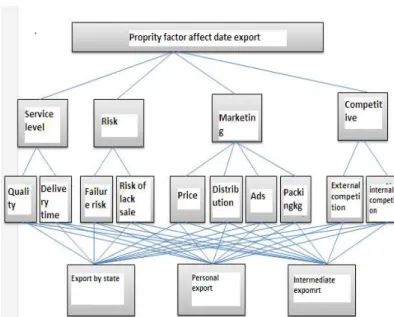
Research conceptual model presented in Figure 1:
Figure 1 Model prioritize factors affecting date export
In this model, according to the date need in the country's three-export method in the form of
self-exporting manufacturer, export through
intermediaries and eventually export through government in the different aspects with respect the need for export through the literature. It is outside the scope of export factors, analyzed, and determines the most important factors in addition to export are most effective aspects of export performance identified the product.
HYPOTHESES
- Marketing is the most important factor in the export.
- The best way to date export in the current conditions of export by the government
RESEARCH METHODOLOGY
the variables we can considered research survey and due to the applicability of the results of this research is in the applied group. Depending on the type and nature of the research, the following methods used to collect the information needed: Using the library to gather information and achieve theory required the university library
named.Using questionnaires to collect
information about the study used a sample. Based on theoretical studies, library and Internet (books, articles, theses available in English and Persian) is used. Then, the collected data will be preparing a questionnaire. Questionnaire using questions are paired comparison is made. In these questionnaires, the respondents want to the priority or importance of each item to determine each component. In order to confirm validity, content validity and for reliability, questionnaire compatibility rate ahp used. If this rate is less than 1.0, questionnaire compatibility verified and the data are reliable. In this study, to analyze the information and determine the priority dates of factors affecting date product export Analytic Hierarchy Process to determine the weighting of criteria and TOPSIS method used to determine the priority options.
In the study after collected data through questionnaires in accordance with the procedures of the conceptual model;after making hierarchy and experts paired comparisons, the weight of criteria and sub-components are calculated using the Analytic Hierarchy Process and the final ranking is determined using TOPSIS. For the implement, the Analytic Hierarchy Process used Expert Choice software and to implement the method used Excel spreadsheet software.
ANALYSIS OF THE RESULTS Descriptive analysis results
In the Study of respondent’s gender appear to be the dominant subjects were men. In this group, 85% of the samples examined. Women accounted to have only 15% of the sample population. In the education sector can be said that 50% of
subjects in the group with a master's degree. In addition, 40% of people with bachelor's degrees and 10 percent have a doctoral degree. Finally, in terms of age, according to results presented in this section make up 45% of the predominant group of middle-aged people in the group aged 41 to 50 years. In addition, 35% of people aged between 30 to 40 years, and finally 20 percent are older than 51 years.
This age group has the lowest groups have formed in the age component.
Hierarchical analysis of data
In Figure 1 the weight of research metrics
obtained through hierarchical analysis is
provided:
Figure 1 shows the weight of criteria
According to Figure 1 through agents, advertising with weight (0.210), distribution (0.173), the risk
of sale (0.142), price (0.117), external
competitiveness (0.099) packaging (0.088), quality (0.066) the risk of failure (0.044), internal competition (0.025), and delivery (0.025) the highest and lowest weight among the elements are shown.
Prioritize different parts of the population, using TOPSIS
The first step: decision-making matrix
The results of the expert opinions presented in the following table. In this context, the
respondents and were asked to rate the importance of each factor on export procedures in the selection of a specific method determined. Experts in this field based on the average number
calculated determined numerical value based on geometric mean known. The operation performed for all the empty cells until eventually all cells of the matrix completed.
Table 1 decision matrix
Type export Internal
competitiveness
External
competitiveness Price Distribution Advertising Packing risk
of lack Sale
risk of failure
delivery
time Quality
Intermediate 3.24 3.57 3.49 3.60 4.49 1.82 1.79 1.45 1.36 3.18
Personal 1.82 2.05 2.06 1.73 1.68 3.32 2.61 2.39 2.06 2.08
State 2.16 2.19 4.33 2.43 2.83 3.03 2.74 2.19 4.33 2.43
Second step: without scaling decision matrix
In this step, each decision matrix of cell values on vector size of the index divided. Dimensionless matrix provided in Table 4-6.
Like other methods of multi-criteria of decision-making matrix should be normal. To normalize the values the vector method used. Unlike normal operation, simple linear method is as follows:
Table 2 matrix of without scaled
Type export Internal
competitiveness
External
competitiveness Price Distribution Advertising Packing
risk of lack Sale
risk of failure
delivery
time Quality total
Intermediate 0.44 0.50 0.52 0.54 0.41 0.25 0.25 0.21 0.20 0.44 3.76
Personal 0.25 0.28 0.29 0.26 0.25 0.30 0.36 0.33 0.29 0.31 2.92
State 0.32 0.33 0.39 0.37 0.39 0.42 0.39 0.33 0.39 0.37 3.7
Intermediate 1.01 1.11 1.2 1.17 1.05 0.97 1 0.87 0.88 1.12
Table 2 without scale matrix associated with the decision matrix is provided. As can be seen largest collection of rows in connection with the intermediate export (3.76), also the maximum amount of columns in relation to price observed. Values in each cell represent without scale value each method after the agent is any method that as the average of the experts proposed.
Third stage: the probability multiple (weight) in the soft matrix
The next step is a normal matrix weighted based on the weight criteria. So should the criteria weights using a technique such as AHP or Shannon entropy calculated. Rhythmic is very simple and the weight of each criterion multiplied by in the column values.
In this sector, calculated weight on the Analytical Hierarchy Process (Figure 1) in the column values of each indicator, multiplied by the probability matrix multiplied.
Table 3 shows the probability criteria
Type export Internal competitiveness
External competitiveness
Price Distribution Advertising Packing risk of
lack Sale
risk of failure
delivery time
Quality
Probability 0.025 0.099 0.117 0.173 0.21 0.088 0.142 0.044 0.025
Table 4 shows the probability (weights) in the decision matrix
Type export Internal
competitiveness
External
competitiveness Price Distribution Advertising Packing
risk of lack Sale risk of failure delivery
time Quality
Intermediate 0.009 0.045 0.057 0.092 0.086 0.020 0.035 0.008 0.004 0.026
Personal 0.005 0.025 0.032 0.044 0.053 0.024 0.050 0.013 0.006 0.019
State 0.006 0.030 0.043 0.063 0.080 0.034 0.055 0.013 0.008 0.022
Fourth Step: Determine the ideal and anti-ideal solution
At this point, should the options of respondents as the most important and minor factors have been identified. In other words, the positive indicators, positive ideal have maximum value v and negative ideal smallest value v, as well as for negative indicators, positive ideal have smallest value v and negative ideal have maximum value v.
Equation 3 and 4 states it. Ideal
Equation (3):
n i ij i
ij j J V j J i m V V V
V
A max , min | 1,2,..., 1 , 2 ,..., Positive
ideal
Equation 4:
n i ij i
ij j J V j J i m V V V
V
A min , max | 1,2,..., 1 , 2 ,..., negative ideal
In this relationship, J the positive indicators andJ are negative indicators.
Table 5 ideal and anti-ideal solution
Solution value Internal
competitiveness
External
competitiveness Price Distribution Advertising Packing
risk of lack Sale risk of failure delivery time Quality
Ideal solution 0.009 0.045 0.057 0.092 0.086 0.034 0.055 0.013 0.008 0.026
Anti-ideal
solution 0.005 0.025 0.032 0.044 0.053 0.02 0.035 0.008 0.004 0.019
Table 6 ideal is the positive mode, as the highest values of the criteria in one column will display. The purpose of anti-ideal state is negative mode. The lowest number in the harmonious matrix related with any standard display.
Fifth step: gaining size of distance
At this stage, the distance of each of the positive and negative ideal with respect to 5 and 6 equation determined.
(5):
V V
i ms
n
j
j ij
i ; 1,2,...,
1 2
:Distance i th options from positive ideal
Equation 6:
V V
i mS
n
j
j
ij ; 1,2,...,
1 2
: The
distance i th options from negative ideal The distance from the ideal point and anti-ideal Distance from the ideal
Table 6 Distance size from the ideal Options Ideal Intermediate 0.0252
Personal 0.0679
State 0.0361
Accordingly, Euclidean distance to positive ideal displayed.
Distance from the anti-ideal:
Table 7 Distance size from the anti-ideal Options anti-ideal Intermediate 0.0670
Personal 0.0164
State 0.0447
As explained in the above table distance from any of the options to the ideal shown.
Accordingly, Euclidean distance to negative ideal displayed.
Close to ideal solution
In this section, based on distance values from the ideal of positive and negative are as close to the ideal state is calculated. At this point, the following formula is used:
In this formula: C * = close to ideal
S1- = Distance size from anti-ideal S1 + = Distance size from the ideal
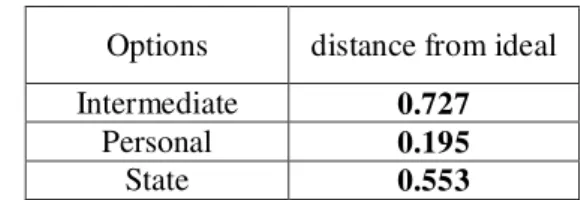
The close distance values to the ideal per option were as follows:
Clearly, that is0Ci* 1. If 1
*
i
C the option
Ci positive ideal solution and if * 0
i
C the
option Ci is negative ideal solution. The different options can be ranked according to how close to the positive ideal solution and avoid the negative ideal solution.
Table 8 close distance to ideal
Options distance from ideal
Intermediate 0.727
Personal 0.195
State 0.553
According to Table 8, it said that the procedures for export to the intermediate state (0.72) State (0.55) and personal (0.19), respectively, the highest and the lowest priority among the options have investigated.
DISCUSSION AND CONCLUSION
Emphasis on competitive advantages products can be effective in creating new markets.
In marketing, advertising the use of appropriate packaging and packaging methods and also evaluate price offer products with competitive price along with extensive distribution channels in order to rapidly provide the product can create a mental picture for the export of this product is effective functions.
In the risk section, multiple buyers and sell some products to the public sector cannot will often reduce the risk of lack sales. The risk of failure of timely delivery and flexible system can solve the problems of the risk of crop failure.
Also in the field of provision of services, as soon as possible and to farmers in order to export quality products can be effective in creating a brand for export.
Suggestions for future research
The implementation of various services export model, and compare the results with the more detailed planning can be effective for different industry.
The test model through structural equation analysis to identify effective dimensions
Test the model in different countries in order to compare the results
Evaluation of export and identify the methods by Fuzzy Delphi method
Use of different control variables such as climate and organizational culture and organizational structure in order to provide a more detailed analysis
REFERENCES
1. Phyllis. Gabriel (2002). Mental health in the
workplace. Situation analysis United States. Geneva, International Labour Organisation (in preparation).
2. Eusebio,,R Llonch Andre ,J, (2007)
Fashion Marketing and Management, pp. 24-40
3. Ahmadi, Hossein; M. Virjinari (2003). "The
application of marketing and the Internet", First Edition, Tehran, Iran 'training center for 104.
4. Aghazadeh, Hashem et al. (2006),
"Designing the necessary steps for the implementation of e-commerce to develop exports of goods and services", Proceedings
of the International Conference on
Management.
5. Rahnavard, Farajollah; TaherPour Kalantari,
Habibullah, Tajrishi, Mohammad Ali.
(2011). "Effect of mainstream vertical and horizontal alignment of the export strategy on export performance in the hundred best companies to Iran", management and development.
6. Warren J. Keegan (2004), "International
Marketing Management", translation
Abdelhamid Ebrahimi, Second Edition, Tehran, Iran Cultural Research Office Page 264.
7. Eghbali A. R; Halafi H. R; Gaskari R.
(2004). Oil export and economic growth; Economical Research Journal (in Persian).
8. Anafche E; Kahram A. M. (2007) An
overview of completed projects in economic affairs research center between 2001-2003; economic affairs research Press; Vol.
9. Abounour, A; Kazemzadeh; L (2006). the
Estimation of Supply and Demand for Iranian Date Export by Applying Systems of
Equations, Journal of Agricultural
Economics and Development,.
10. Calantone,R., Kim,D., Schmidt,J.,
Cavusgil,T(2006), The influence of internal and external firm factors on international product adaptation strategy and export performance: A three-country comparison, Journal of Business Research 59 (2006) 176 – 185
11. Kazem Zadeh, L.; Abounori, AA. (2006),
"estimate Iran's date export supply and demand functions using a simultaneous
equations model", agriculture and
development of the summer, 14 (54): 103-124.
12. Jafreh, M.; Farajullahi, G. (2009), "An
Analysis of the factors affecting the export of pistachio in Iran," Spring Economic Sciences, 2 (6): 67-82.
13. Hosseini, Mīr AbduAllāh, H., Taghi (2007). "The study of the global market and target markets for Iran's export of palm" Spring Agricultural Economics and Development, 15 (57 (especially agricultural markets), 1-29.
14. Rastegari, F.; Homayounifar, M. (2007),
"The economic and political factors that affect the non-oil exports of Iran",
agriculture (agricultural economy),
especially a sixth conference of the agricultural economy): 379-388.
15. Sultan-Mohammad-zadeh, M., Keshavarz,
H., Mohebali, M., Holakouie-Naieni, K .,
Arsh, S.H., 2003. Seroepidemiologic study of human Toxoplasma infection in residents of Meshkin-Shahr. J. Sch. Public Health Inst. Public Health Res. 1,57–72.
16. Abounour, A; Kazemzadeh; L (2006). the
Estimation of Supply and Demand for Iranian Date Export by Applying Systems of
Equations, Journal of Agricultural
Economics and Development,.
17. Khalilian, S Farhadi, A. (2002), "Factors
affecting agricultural exports of Iran", Journal of Agricultural Economics and Development, 39: 84-71.
18. Amornkitvikai,Y., Harvie,C.,
Charoenrat,T(2012), Factors affecting the export participation and performance of Thai manufacturing small and medium sized
Enterprises (SMEs), University of
19. Nadeem,M., Azam,M., Islam,R(2012), An
Investigation of the Various Factors
Influence on Exports, Global Journal of
Management and Business Research,
Volume 12 Issue 19 Version 1.0.
20. Sidin,S(2008), Impact of environmental
factors as moderator on export marketing performance in wooden furniture industry, Jurnal Kemanusiaan bil.11.
21. Calantone, R.J., Cavusgil, S.T., Schmidt,
J.B., & Shin, G.-C. (2004),
“Internationalization and the dynamics of
product adaptation - An empirical
investigation”, Journal of Product
Innovation Management, Vol. 21, No. 3, pp. 185-198.
22. Mattson SN, Gramling L, Delis D, Jones
KL, Riley EP (2004). Global-local