www.atmos-chem-phys.net/11/11745/2011/ doi:10.5194/acp-11-11745-2011
© Author(s) 2011. CC Attribution 3.0 License.
Chemistry
and Physics
Black carbon fractal morphology and short-wave radiative impact:
a modelling study
M. Kahnert and A. Devasthale
Swedish Meteorological and Hydrological Institute, 601 76 Norrk¨oping, Sweden Received: 5 August 2011 – Published in Atmos. Chem. Phys. Discuss.: 16 August 2011 Revised: 11 November 2011 – Accepted: 14 November 2011 – Published: 24 November 2011
Abstract. We investigate the impact of the morphological properties of freshly emitted black carbon aerosols on optical properties and on radiative forcing. To this end, we model the optical properties of fractal black carbon aggregates by use of numerically exact solutions to Maxwell’s equations within a spectral range from the UVC to the mid-IR. The results are coupled to radiative transfer computations, in which we con-sider six realistic case studies representing different atmo-spheric pollution conditions and surface albedos. The spec-trally integrated radiative impacts of black carbon are com-pared for two different fractal morphologies, which brace the range of recently reported experimental observations of black carbon fractal structures. We also gauge our results by per-forming corresponding calculations based on the homoge-neous sphere approximation, which is commonly employed in climate models. We find that at top of atmosphere the ag-gregate models yield radiative impacts that can be as much as 2 times higher than those based on the homogeneous sphere approximation. An aggregate model with a low fractal di-mension can predict a radiative impact that is higher than that obtained with a high fractal dimension by a factor ranging between 1.1–1.6. Although the lower end of this scale seems like a rather small effect, a closer analysis reveals that the sin-gle scattering optical properties of more compact and more lacy aggregates differ considerably. In radiative flux compu-tations there can be a partial cancellation due to the opposing effects of different error sources. However, this cancellation effect can strongly depend on atmospheric conditions and is therefore quite unpredictable. We conclude that the fractal morphology of black carbon aerosols and their fractal pa-rameters can have a profound impact on their radiative
forc-Correspondence to:M. Kahnert ([email protected])
ing effect, and that the use of the homogeneous sphere model introduces unacceptably high biases in radiative impact stud-ies. We emphasise that there are other potentially important morphological features that have not been addressed in the present study, such as sintering and coating of freshly emitted black carbon by films of organic material. Finally, we found that the spectral variation of the absorption cross section of black carbon significantly deviates from a simple 1/λscaling law. We therefore discourage the use of single-wavelength absorption measurements in conjunction with a 1/λscaling relation in broadband radiative forcing simulations of black carbon.
1 Introduction
and locally. Further, deposition on snow and ice reduces the surface albedo, (Hansen and Nazarenko, 2004), thus increas-ing the absorption of solar radiation at the surface in polar regions. Also, an increase in BC concentrations could po-tentially impact the hydrological cycle over the south Asian monsoon region by suppressing land-sea thermal contrast via its cooling effect on the surface (Ramanathan et al., 2001). BC interacts with clouds (influencing its microphysical prop-erties) in a complex manner that is not yet fully understood, let alone quantified with sufficiently high confidence (Koch and Genio, 2010). It is, therefore, essential that we are able to represent BC and its complex interplay with other Earth system components realistically in global climate models so as to better understand relevant feedback processes and even-tually to reduce uncertainties in the future projections of our climate.
With the advent of Earth-system modelling, considerable efforts aim at improving the description of aerosols in global and regional climate models. By coupling atmosphere-ocean general circulation models to atmospheric chemical trans-port and aerosol dynamic models, prescribed aerosol fields are being replaced by a more realistic dynamic description of aerosol. Despite these efforts, significant uncertainties re-main, such as those related to errors in emission estimates, poorly represented vertical distributions, uncertainties in the mixing state of BC with other aerosols, or errors in the size distributions.
One of the most drastic approximations in modelling the radiative forcing effect of BC is what is known as the homo-geneous sphere approximation. In order to simplify aerosol optics computations, it is common to approximate aerosols as homogeneous spheres, which allows one to use simple Lorenz-Mie theory for computing the optical cross sections, phase function, and other optical properties. However, the morphology of dry black carbon aerosols is more realistically represented by fractal aggregates described by the scaling re-lation
Ns=k0
Rg
a
Df
. (1)
HereNsdenotes the number of spherical monomers of radius ain the aggregate,Dfis the fractal dimension,k0denotes the fractal prefactor, and
Rg= v u u t
1 Ns
Ns
X
n=1
r2
n (2)
is the radius of gyration of the aggregate (whererndenotes the distance of thenth monomer from the centre of mass). The optical properties of black carbon aggregates can be highly sensitive to their morphological characteristics. There is mounting evidence that neglecting aerosol morphology can be one of the dominant sources of error in estimating the ra-diative impact of black carbon (e.g. Jacobson (2001); Kahn-ert (2010c)).
However, accounting for morphological properties in aerosol optics computations can be highly challenging. Such studies usually require the use of numerical methods based on rigorous electromagnetic scattering theory, since methods that introduce ad hoc approximations to solving Maxwell’s equations are often not sufficiently accurate when applied to black carbon aggregates (e.g. Kahnert (2010b)). Another dif-ficulty is to obtain sufficiently reliable information about the input parameters for numerical aerosol optics calculations. For instance, by performing sensitivity studies that braced a large range of fractal parameters and refractive indices, it was found that the optical cross sections and asymmetry param-eter of black carbon aggregates can vary considerably (Liu et al., 2008). On the other hand, a recent review by Bond and Bergstrom (2006) concluded that both the refractive in-dex and the fractal dimension of freshly emitted black carbon aggregates can be narrowed down to a range that is much smaller than previously assumed. For instance, Liu et al. (2008) varied the fractal dimension of soot aggregates within the range betweenDf= 1–3. The literature review by Bond and Bergstrom (2006) concluded that the available measure-ments strongly support a fractal dimension of freshly emitted black carbon of aboutDf= 1.8.
Based on the conclusions of Bond and Bergstrom (2006), extensive aerosol optics computations for black carbon that covered the spectral range from 200 nm up to 12.2 µm have been performed with numerically exact methods for solv-ing the electromagnetic scattersolv-ing problem (Kahnert, 2010c). The aerosol optics calculations have been coupled to chem-ical transport and radiative transfer models, which revealed that accounting for aggregate morphology can yield a top-of-atmosphere radiative impact that is larger by a factor of 2 as compared to corresponding results obtained with the homo-geneous sphere approximation (Kahnert, 2010c).
These model computations where based on using a frac-tal dimension of Df= 1.8 as recommended by Bond and Bergstrom (2006). However, more recent measurements sug-gest that this value may be too low. By use of 3-D electron tomography measurements, Adachi et al. (2007) observed a fractal dimension of Df= 2.4. The large difference of this value to previously reported results is attributed to the use of 2D measurement techniques in earlier studies, which are less reliable in retrieving fractal parameters. The study by Liu et al. (2008) suggests that aggregates with a fractal di-mension as high as Df= 2.4 will have very different opti-cal properties than aggregates with Df= 1.8. Although the study by Liu et al. (2008) was limited to a single wavelength, it is quite possible that a change in fractal dimension from Df= 1.8 toDf= 2.4 can significantly alter the broadband ra-diative impact of black carbon. The purpose of the present study is to investigate what kind of consequences these most recent experimental results have for modelling the broadband radiative forcing effect of freshly emitted black carbon.
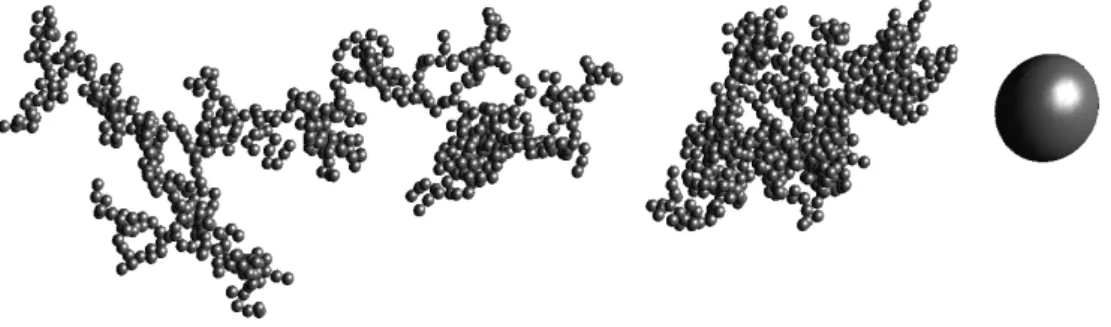
Fig. 1. Examples of model particles considered in this study: Lacy aggregates (left,Df=1.8, k0=1.3), compact aggregates (centre,
Df=2.4,k0=0.7), volume-equivalent, homogeneous spheres (right).
dimensions Df= 1.8 and Df= 2.4, as well as for homoge-neous BC spheres. We use numerically exact methods to compute optical properties of fractal aggregates in the wave-length range from 200 nm–12.2 µm. We emphasize that we limit this study to freshly emitted, externally mixed BC aerosols. Aged BC aggregates typically have a higher fractal dimension and, most importantly, are characterised by encap-sulated geometries, i.e. they are covered by a thick coating of other aerosol compounds, such as sulphate and organics (e.g. Bond et al. (2006)). Computations are performed for the 14 wavelength bands used in the radiation scheme of the Inte-grated Forecasting System developed and operated at the Eu-ropean Centre for Medium-Range Weather Forecast. We in-vestigate six realistic cases of aerosol distributions generated by the Multiple-scale Atmospheric Transport and Chemistry (MATCH) model over Europe. These cases are selected in such a way that they cover different surface types and differ-ent BC concdiffer-entrations. We also investigate the sensitivity of the radiative impact to solar zenith angle. Section 2 describes the detailed methodology, while the results are presented and discussed in Sects. 3 and 4. Conclusions are given in Sect. 5
2 Methods
2.1 Model geometries
Examples of the model geometries employed in this study are shown in Fig. 1. We consider fractal aggregates with Df= 1.8, k0= 1.3 (left, hereafter referred to as lacy ag-gregates), aggregates withDf= 2.4, k0= 0.7 (centre, here-after referred to as compact aggregates), and homogeneous, volume-equivalent spheres (right). The lacy aggregates have fractal parameters taken from the recent review by Bond and Bergstrom (2006), which are based on both observations and diffusion-limited cluster aggregation simulations (e.g. Sorensen and Roberts (1997)). The fractal parameters of the compact aggregates are taken from the more recent measure-ments of Adachi et al. (2007), which are based on modern 3-D electron tomography techniques (e.g. van Poppel et al. (2005)). These measurements may suggest that earlier 2D
measurements tended to underestimate the fractal dimension of freshly emitted black carbon aerosols.
The monomer radius a in either aggregate model is as-sumed to be 25 nm. This value was found to give good agreement of modelled single-scattering albedos with mea-surements (Kahnert, 2010b). It is also reasonably consistent with recent field observations, which gave a median value of a=22 nm (Adachi and Buseck, 2008).
In the same field observation study, aggregate sizes up to Ns= 800 have been observed (Adachi and Buseck, 2008). Fora=25 nm, this would correspond to mass-equivalent ag-gregates withNs= 800×(22/25)3= 545. In our calculations, we consider aggregates up toNs= 600. Thus our model par-ticles cover a size range up to volume-equivalent diameters of 420 nm. We note that this range may be slightly larger than necessary. For instance, Kondo et al. (2011) report mass me-dian diameters of black carbon of 150 nm. We also note that aggregates consisting of a smaller number of monomersNs often are composed of primary monomers with a smaller ra-diusa. Although this would not have an effect on the absorp-tion cross secabsorp-tion, smaller values ofamay give slightly lower values of the single scattering albedo (e.g. Kahnert (2010b)). In the construction of our model particles we have neglected this effect by assuming a constant value of a. The model geometries are generated by use of a random cluster aggre-gation algorithm (Mackowski, 1994).
2.2 Aerosol optics modelling
To compute the optical properties of fractal black carbon aggregates, we entirely rely on numerically exact methods for solving Maxwell’s equations. A recent study indicated that numerical electromagnetic scattering methods that em-ploy ad hoc approximations based on partially or entirely ne-glecting electromagnetic interactions among the monomers can introduce large errors in computing optical properties of black carbon aggregates (Kahnert, 2010b). We use the su-perposition T-matrix code by Mackowski and Mishchenko (1996) for solving Maxwell’s equations.
14-band shortwave radiation scheme of the Integrated Forecasting System IFS (http://www.ecmwf.int/research/ ifsdocs/CY36r1), developed at the European Centre for Medium-range Weather Forecast (ECMWF). IFS is em-ployed as a numerical weather forecasting model, and as the atmospheric module in the Earth system climate model EC-EARTH (http://ecearth.knmi.nl). We compute black carbon optical properties for each of the 14 band mid-points. The spectral variation of the refractive index of black carbon is taken from Chang and Charalampopoulos (1990).
2.3 Radiative transfer modelling
Aerosol optics off-line computations can be coupled to re-gional (e.g. Kahnert (2010a)) and global (e.g. Aan de Brugh et al. (2011)) chemical transport models to produce 3-D fields of aerosol optical properties. Here, we use the Multiple-scale Atmospheric Transport and CHemistry modelling sys-tem (MATCH) (Andersson et al., 2007) to generate a few re-alistic scenarios over Europe for 1-D radiative forcing stud-ies. We use the radiative transfer modelling system libRad-tran (http://www.libRadlibRad-tran.org) in conjunction with the ra-diative transfer solver DISORT (Stamnes et al., 1988). The DISORT model is based on the discrete ordinate method (Thomas and Stamnes, 1999). The main physical approxi-mations in DISORT are the assumption of a plane-parallel atmosphere (thus neglecting 3-D effects caused by horizon-tal inhomogeneity), and the use of the scalar radiative trans-fer equation (thus neglecting polarisation effects). The nu-merical accuracy is controlled by the number of “streams” (i.e. discretised polar angles) used in the calculations. In our study we use 32 streams, and we verified that the radiative transfer results have numerically converged for this choice.
3 Results
3.1 Spectral optical properties of black carbon aggregates
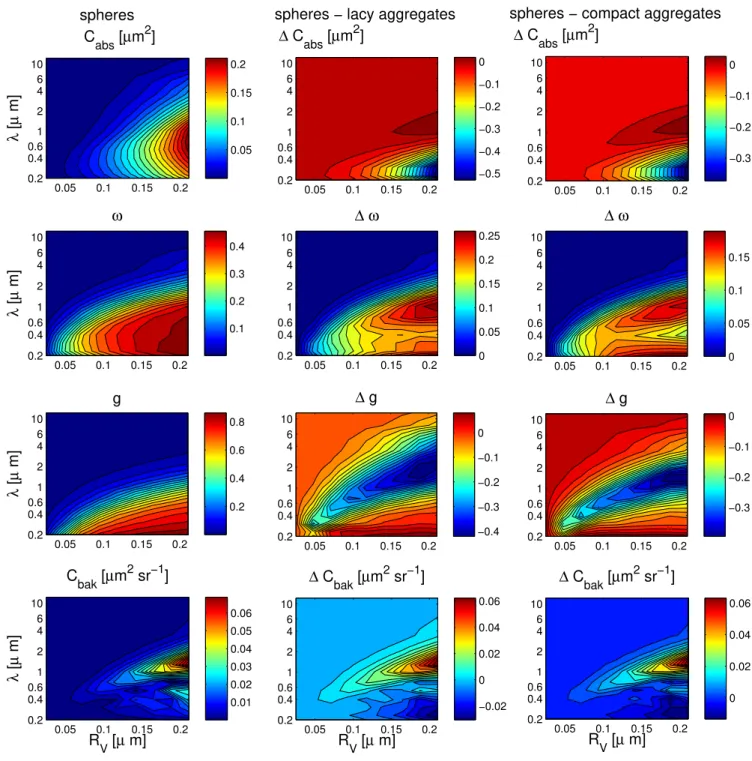
Figure 2 (first column) shows the optical properties of ho-mogeneous spheres as a function of particle radiusRV and wavelengthλ. The different rows show the absorption cross sectionCabs (first row), the single scattering albedoω (sec-ond row), the asymmetry parameterg (third row), and the backscattering cross sectionCbak(fourth row).
The dependency ofCabsonRVdisplays the characteristic monotonic increase. A closer analysis of the data reveals that Cabs∝R3Vin accordance with well-known theoretical results (van de Hulst, 1957). For any fixed particle sizeRV,Cabs ini-tially increases with wavelengthλ, and then it monotonically decreases. The decrease reflects the monotonic dependency ofCabs on the size parameterx=2π RV/λ. The initial in-crease in the UV and blue part of the spectrum is caused by changes in the refractive indexmof black carbon, which out-weighs the size-parameter effect in this part of the spectrum.
This is a very important observation for the following rea-son. Due to the challenges involved in computing the optical properties of black carbon aggregates with electromagnetic theory, some investigators have suggested to simply use the measured value of the mass absorption cross section (MAC) at a wavelength of 550 nm, and to extrapolate this value to other wavelengths by a 1/λ scaling – see, e.g., Bond and Bergstrom (2006). Our results clearly show that such an ap-proach only works over the red and IR part of the spectrum, while it completely fails in the blue and UV part of the spec-trum. Thus it is essential to properly account for the spectral variation of the dielectric properties of black carbon to ob-tain accurate results of the spectral variation ofCabs, which is crucial for obtaining reliable estimates for the shortwave radiative forcing effect of BC.
The single scattering albedo qualitatively displays a simi-lar dependency on size and wavelength. The asymmetry pa-rametergmainly depends on the size parameter. It therefore reaches its highest values at large particle sizesRVand low wavelengthsλ. The backscattering cross sectionCbakof ag-gregates (not shown) are rather smooth functions ofλandRV that qualitatively behave similarly toCabs. By contrast,Cbak for homogeneous spheres displays conspicuous oscillations. It reaches its maximum values for large particle sizes at IR wavelengths.
The second column presents the differences between the optical properties of spheres and lacy aggregates. The third row shows corresponding differences between spheres and compact aggregates. Qualitatively, the second and third col-umn look rather similar. However, Inspection of the colour bars reveals that the magnitude of the deviation between lacy aggregates and spheres is generally larger than that between compact aggregates and spheres. The most important obser-vation is that spheres generally yield lower values of Cabs than both aggregate models, and that lacy aggregates yield larger values ofCabsthan compact ones. The reason for this is that the electromagnetic field cannot penetrate deeply into a massive black carbon sphere. For this reason, much of the mass inside a spherical black carbon particle does not contribute to the absorption cross section. By contrast, in a fractal aggregate the mass is distributed such that more of the absorbing material can interact with radiation. The more lacy the aggregate, the more material interacts with the electromagnetic field, the higherCabsfor any given volume-equivalent particle sizeRV. Quantitatively, the differences in Cabsare larger between spheres and compact aggregates than between lacy and compact aggregates.
The second most important observation is that the compact sphere model predicts significantly higher values ofωthan the aggregate models. Lacy aggregates yield somewhat lower values ofωthan compact aggregates. The discrepancies in Cabsandωare very important for radiative forcing studies.
spheres C
abs [µm 2 ] λ [ µ m]
0.05 0.1 0.15 0.2 0.2 0.4 0.6 1 2 4 6 10 0.05 0.1 0.15 0.2
spheres − lacy aggregates
Δ C abs [µm
2]
0.05 0.1 0.15 0.2 0.2 0.4 0.6 1 2 4 6 10 −0.5 −0.4 −0.3 −0.2 −0.1 0
spheres − compact aggregates
Δ C abs [µm
2]
0.05 0.1 0.15 0.2 0.2 0.4 0.6 1 2 4 6 10 −0.3 −0.2 −0.1 0 ω λ [ µ m]
0.05 0.1 0.15 0.2 0.2 0.4 0.6 1 2 4 6 10 0.1 0.2 0.3 0.4 Δω
0.05 0.1 0.15 0.2 0.2 0.4 0.6 1 2 4 6 10 0 0.05 0.1 0.15 0.2 0.25 Δω
0.05 0.1 0.15 0.2 0.2 0.4 0.6 1 2 4 6 10 0 0.05 0.1 0.15 g λ [ µ m]
0.05 0.1 0.15 0.2 0.2 0.4 0.6 1 2 4 6 10 0.2 0.4 0.6 0.8
Δ g
0.05 0.1 0.15 0.2 0.2 0.4 0.6 1 2 4 6 10 −0.4 −0.3 −0.2 −0.1 0
Δ g
0.05 0.1 0.15 0.2 0.2 0.4 0.6 1 2 4 6 10 −0.3 −0.2 −0.1 0 C bak [µm
2 sr−1]
R V [µ m]
λ
[
µ
m]
0.05 0.1 0.15 0.2 0.2 0.4 0.6 1 2 4 6 10 0.01 0.02 0.03 0.04 0.05 0.06
Δ C bak [µm
2 sr−1]
R V [µ m] 0.05 0.1 0.15 0.2 0.2 0.4 0.6 1 2 4 6 10 −0.02 0 0.02 0.04 0.06
Δ C bak [µm
2 sr−1]
R V [µ m] 0.05 0.1 0.15 0.2 0.2 0.4 0.6 1 2 4 6 10 0 0.02 0.04 0.06
Fig. 2. Left column: optical properties of homogeneous spheres as a function of sizeRVand wavelengthλ. Middle column: difference
in optical properties between spheres and lacy aggregates. Right column: difference in optical properties between spheres and compact aggregates. The four rows showCabs,ω,g, andCbak, respectively.
300 nm) up to (200 nm, 1.5 µm), which can be seen in the form of a band of minima in1gand maxima in1Cbak.
3.2 Comparison with measurements
The information available from observations is considerably more scarce than the wealth of optical data we can produce
the available experimental data are discussed in Kahnert (2010b).
A recent review of available measurements (Bond and Bergstrom, 2006) concludes that a good estimate of MAC of freshly emitted, externally mixed black carbon aerosols atλ= 550 nm is MAC = 7.5±1.2 m2g−1. The best available measurements of the single scattering albedo suggest a value around 0.25±0.5. Comparison of computational results for Cabsand observed values of MAC are complicated by the fact that the conversion between these two quantities relies on the mass densityρ, i.e.
MAC= Cabs 4 3π R
3 Vρ
. (3)
For ρ we can find a wide range of values in the litera-ture. However, a critical review of the representativeness of reported data for atmospheric black carbon (Bond and Bergstrom, 2006) concludes that the most reliable estimates lie in the rangeρ= 1.7–1.9 g cm−3.
At a wavelength of λ= 550 nm, and as-suming ρ= 1.8 g cm−3, our calculations yield MAC = 5.2±0.1 m2g−1for lacy aggregates, 4.9±0.1 m2g−1 for compact aggregates, and 3.3±0.4 m2g−1 for spheres. The error range indicates a 95 % confidence level in the least-squares fitting ofCabs∝RV3, which is used in the com-putation of MAC according to Eq. (3). To obtain an overlap between the recommended value of MAC = 7.5±1.2 m2g−1 and the computational results, we would have to assume ρ∼<1.5 g cm−3, 1.4 g cm−3, and 1.0 g cm−3 in the case of lacy aggregates, compact aggregates, and spheres, respec-tively. These results generally agree with those reported in Kahnert (2010b), namely, that an agreement between observed and modelled MAC values is achieved by assum-ing a relatively low value of the mass densityρ. For the compact aggregates we need to assume even lower values of ρ than for lacy aggregates. For spheres we only obtain an agreement between computed and observed values of MAC by assuming a value ofρthat clearly lies outside the range of reasonable mass densities. In fact, it was one of the main conclusions of the recent review by Bond and Bergstrom (2006) to abandon the use of the value of ρ= 1.0 g cm−3, which still can be found in some older studies on black carbon.
The single scattering albedo we obtain atλ= 550 nm for the larger aggregates lies atω= 0.25 for lacy aggregates, 0.32 for compact aggregates, and 0.46 for spheres. Again, we see that the results obtained for the lacy aggregates seem to yield a better agreement with observations than the compact aggre-gates, while the results obtained for spheres are completely off the mark.
3.3 Short-wave radiative impact of black carbon aggregates
To generate a few realistic scenarios for radiative transfer studies, we couple the single-scattering optical properties to the regional chemical transport model MATCH. The aerosol scheme in MATCH comprises sulphate, nitrate, and ammo-nium aerosols as well as black carbon, primary organic car-bon, mineral dust, and sea salt in four different size bins. The aerosol optical properties of all aerosols other than black car-bon are currently computed by use of Mie theory, thus in-voking the homogeneous sphere approximation. Details of the chemistry-optics coupling can be found in Kahnert (2009, 2010c).
As an example, Fig. 3 shows black carbon mixing ratios computed for 25 July 2006, 18:00 UTC in the lowest model layer (closest to the surface). Results are shown for ultra-fine particles (RV<50 nm, upper left), accumulation mode parti-cles (50≤RV<500 nm, upper right), and coarse mode parti-cles (RV>500 nm, lower left). The lower right panel displays the single scattering albedo atλ= 533 nm in the lowest model layer. Note that the optical properties computed in MATCH involve an ensemble average over all size bins and aerosol chemical compounds. Although black carbon usually makes a small contribution to the total aerosol mass density (typi-cally on the order of ∼5 %), it clearly has a strong impact on the single scattering albedo. Low values ofωoften cor-relate with high values of black carbon mixing ratios, espe-cially in the accumulation mode. This becomes particularly apparent when focusing in Fig. 3 on some urban emission hot spots, such as Stockholm, Oslo, Madrid, or London, which are more remote from extensive continental area sources.
We pick six geographic locations (indicated by circles in Fig. 3) for which we conduct detailed radiative transfer stud-ies. Among those, we have chosen two continental sites (one North and one South of the Alps) which represent more pol-luted conditions, one site in Scandinavia, which represents a situation with both long-range transported air pollution and local emissions, and one at the West coast of Ireland, which is dominated by marine aerosols. We also pick two locations over water, one over the North Sea with rather clean air, and one over the Mediterranean Sea with more polluted air.
1e-4
3e-4
3e-4 3e-4
3e-4
3e-4
1e-3
3e-3
0.01
0.01
0.03 0.03
SMHI WED 25 JUL 2006 18UTC+000 LAC coarse [ppb-m], surface layer
1e-4 3e-4 1e-3 3e-3 0.01 0.03 0.1 0.3 1 3e-4
3e-4
1e-3
1e-3
1e-3
3e-3
3e-3
3e-3
0.01 0.03
0.03 0.1
0.1
0.1 0.1
0.1 0.1
0.3
0.3 0.3
0.3
SMHI WED 25 JUL 2006 18UTC+000 LAC UFP [ppb-m], surface layer
1e-4 3e-4 1e-3 3e-3 0.01 0.03 0.1 0.3 1
0.7
0.7 0.7
0.8
0.8 0.8
0.8 0.8
0.8
0.9
0.90.9
SMHI WED 25 JUL 2006 18UTC+000 Single scattering albedo, surface layer, 533 nm
0.4 0.5 0.6 0.7 0.8 0.9 1 3e-4
3e-4 3e-4
1e-3
1e-3
3e-3
3e-3
0.01 0.01
0.01
0.01
0.01
0.01
0.1
0.1
SMHI WED 25 JUL 2006 18UTC+000 LAC accumulation [ppb-m], surface layer
1e-4 3e-4 1e-3 3e-3 0.01 0.03 0.1 0.3 1
Fig. 3.Black carbon mass mixing rations (µg/kg) for size bins with diameters<100 nm (upper left), 100 nm–1 µm (upper right), and>1 µm (lower left), as well as single scattering albedoω(lower right) atλ= 533 nm. The maps show results for 25 July 2006 18:00 UTC in the model layer closest to the surface. Also indicated are six locations chosen for radiative transfer case studies.
of Berlin (52◦N 14◦E, upper right) displays a similar peak near the ground. In addition, there is a pronounced maxi-mum at around 1.3 km, and a smaller peak at 2.2 km, which indicate contributions from long-range transported aerosols. This becomes even more pronounced at the site near Uppsala (60◦N 17◦E, centre left), where the long-range peak near
0 0.01 0.02 0.03 0.04 0
1 2 3 4 5
altitude [km]
45°N 12°E
Lacy aggregates Compact aggregates Spheres
0 0.002 0.004 0.006 0.008 0.01
0 1 2 3 4 5
52°N 14°E
0 0.5 1 1.5 2 2.5
x 10−3 0
1 2 3 4 5
altitude [km]
60°N 17°E
0 0.02 0.04 0.06 0.08 0.1 0.12
0 1 2 3 4 5
53°N 9°W
0 0.2 0.4 0.6 0.8
0 1 2 3 4 5
Spectral extinction [m−1 nm−1]
altitude [km]
62°N 0°
0 0.1 0.2 0.3 0.4
0 1 2 3 4 5
Spectral extinction [m−1 nm−1] 36°N 18°E
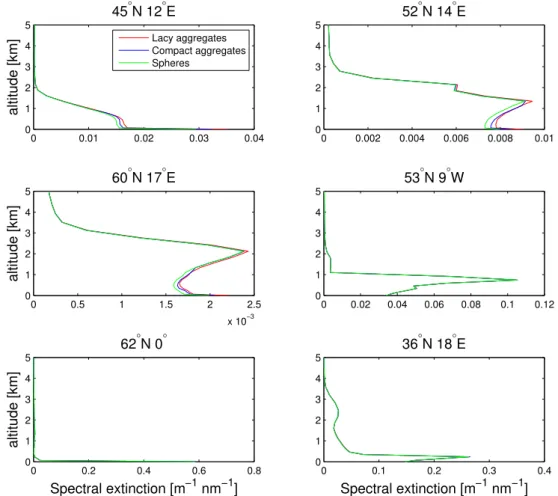
Fig. 4. Vertical profiles of the spectral extinction atλ=532 nm for six different locations as indicated in the figure headings. Results are based on the lacy aggregate (red), compact aggregate (blue), and homogeneous sphere models (green).
local sea salt emissions. By contrast, the Mediterranean site (36◦N 18◦E, lower right) displays higher spectral extinction
a bit higher up in the boundary layer, as well as another broad maximum between 2–3 km, which is caused by long-range transported aerosols.
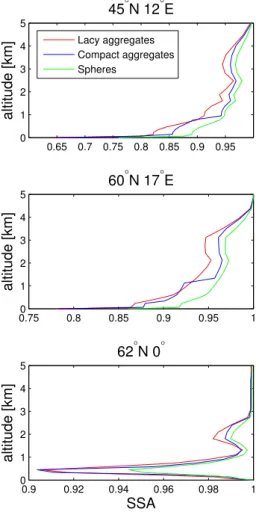
Figure 5 shows corresponding profiles of the single scat-tering albedo. As expected, we observe much stronger vari-ations among the three different models for black carbon op-tics than for the spectral extinction. In general, the lacy ag-gregate model gives the lowest, while the sphere model gives the highest values ofω. This agrees with our expectations based on the single-scattering results shown in Fig. 2. The sites in Italy (upper left), Germany (upper right), and Sweden (centre left) display a steady decrease towards the surface, which is caused by elevated black carbon concentrations due to local emissions. Qualitatively, a similar decrease inωis seen at the Irish site (centre right); but quantitatively, this de-crease is rather small. Over the North Sea (lower left),ωis almost unity near the surface, thus confirming the dominance of non-absorbing sea salt. The local minima higher up in the boundary layer as well as around 2 km altitude indicate the presence of somewhat higher contributions from long-range
transported black carbon. The Mediterranean location (lower right) displays two local minima around 1 km and 4.5 km.
Figure 6 presents profiles of the asymmetry parameterg. The most noteworthy observation is that the order of the three models is now changed. Compact aggregates yielded results for the extinction and single scattering albedo that lied in be-tween those computed for spheres and lacy aggregates. By contrast, the compact aggregate model gives the highest val-ues ofgamong the three different models. A closer analy-sis of the single-scattering optical properties of black carbon shows that for larger particles in the visible part of the spec-trum, the asymmetry parameter of black carbon computed with the compact aggregate model can be larger than that computed with the lacy aggregate model by as much as 0.1. This will soon become important when we try to understand the radiative impact computed with the aggregate models.
0.65 0.7 0.75 0.8 0.85 0.9 0.95 0
1 2 3 4 5
altitude [km]
45°N 12°E
Lacy aggregates Compact aggregates Spheres
0.7 0.75 0.8 0.85 0.9 0.95 1
0 1 2 3 4 5
52°N 14°E
0.750 0.8 0.85 0.9 0.95 1
1 2 3 4 5
altitude [km]
60°N 17°E
0.980 0.985 0.99 0.995 1 1.005
1 2 3 4 5
53°N 9°W
0.9 0.92 0.94 0.96 0.98 1
0 1 2 3 4 5
SSA
altitude [km]
62°N 0°
0.940 0.95 0.96 0.97 0.98 0.99 1
1 2 3 4 5
SSA 36°N 18°E
Fig. 5.As Fig. 4, but for the single scattering albedo.
Spectroradiometer (MODIS) Statistical Product that has 16-day periodicity and provides albedo values at 1x1 degree resolution at 7 spectral and 3 broadband intervals (0.47 µm, 0.555 µm, 0.659 µm, 0.858 µm, 1.24 µm, 1.64 µm, 2.1 µm, and broadband 0.3–0.7 µm, 0.3–5.0 µm, 0.7–5.0 µm). The white-sky albedo values from year 2004 are used. The com-puted spectral radiative net fluxes are integrated over the so-lar spectrum to obtain the broadband net fluxF. These com-putations are repeated with the three different models used for black carbon, as well as for an atmosphere free of black carbon. The radiative impact is defined as the difference be-tween the net fluxes computed with and without black car-bon, i.e.
1F=F (with BC)−F (without BC) (4) Figure 7 presents results computed for 25 July at 13:00 UTC. Depending on geographic location, this corre-sponds to a solar zenith angle (SZA) in the range 32◦–46◦, see Table 1 for details. At all six locations, we clearly see that the simple homogeneous sphere model (green) underes-timates the radiative impact at the top of atmosphere (TOA) as compared to the more realistic aggregate models. At the
Table 1. Ratios of SW radiative impactsδF (as explained in the text) at TOA and BOA at six different locations. Also shown are the solar zenith angles (SZA) at 13:00 UTC.
TOA BOA
Lat Lon SZA δF1 δF2 δF3 δF1 δF2 δF3
45◦N 12◦E 33◦ 1.73 1.62 1.07 1.79 1.55 1.15 52◦N 14◦E 39◦ 1.76 1.61 1.09 1.80 1.57 1.15 60◦N 17◦E 46◦ 2.02 1.66 1.22 1.87 1.87 1.00
53◦N 9◦W 33◦ 1.93 1.35 1.43 1.83 1.42 1.29
62◦N 0◦ 43◦ 2.09 1.34 1.56 1.75 1.42 1.23
36◦N 18◦E 32◦ 1.71 1.47 1.16 1.75 1.37 1.28
0.720 0.73 0.74 0.75 0.76 0.77 0.78 1
2 3 4 5
altitude [km]
45°N 12°E
Lacy aggregates Compact aggregates Spheres
0.720 0.74 0.76 0.78 0.8
1 2 3 4 5
52°N 14°E
0.730 0.74 0.75 0.76 0.77 0.78 0.79
1 2 3 4 5
altitude [km]
60°N 17°E
0.740 0.76 0.78 0.8 0.82
1 2 3 4 5
53°N 9°W
0.770 0.78 0.79 0.8 0.81 0.82 0.83
1 2 3 4 5
g
altitude [km]
62°N 0°
0.750 0.76 0.77 0.78 0.79 0.8 0.81
1 2 3 4 5
g 36°N 18°E
Fig. 6.As Fig. 4, but for the asymmetry parameter.
Table 1 shows a quantitative comparison of the radiative impacts at TOA an BOA obtained with the three aggregate models. The table shows the quantities
δF1=1F (lacy aggregates)/1F (spheres) (5) δF2=1F (compact aggregates)/1F (spheres) (6) δF3=1F (lacy aggregates)/1F (compact aggregates) (7) At TOA lacy aggregates yield a radiative impact that is larger than that computed with the sphere model by a factor of 1.7–2.1. The compact aggregate model gives a radiative im-pact that exceeds that of spheres by a factor of 1.3–1.7. The radiative impact computed with the lacy aggregate model is higher than that obtained with the compact aggregate model by a factor of 1.1–1.6 %. Table 2 shows a similar comparison for only the Italian site but for different values of SZA. Al-though the radiative impact1F strongly depends on SZA, the ratios 1F (model1)/1F (model2) vary only little with SZA.
In general, the tables clearly show that the errors intro-duced by the homogeneous sphere model are substantial. There can be little doubt that neglecting the fractal morphol-ogy of BC in radiative impact studies will result in large
er-Table 2. δF as in Table 1 at TOA and BOA at a location 45◦N 12◦E for three different SZA.
TOA BOA
SZA δF1 δF2 δF3 δF1 δF2 δF3
22◦ 1.75 1.61 1.09 1.79 1.55 1.15
40◦ 1.72 1.62 1.06 1.76 1.54 1.14
60◦ 1.77 1.68 1.05 1.76 1.54 1.14
−0.150 −0.1 −0.05 0 0.05 0.1 1
2 3 4 5
altitude [km]
45°N 12°E
Lacy aggregates Compact aggregates Spheres
−0.080 −0.06 −0.04 −0.02 0 0.02 0.04
1 2 3 4 5
52°N 14°E
−20 −15 −10 −5 0 5
x 10−3 0
1 2 3 4 5
altitude [km]
60°N 17°E
−0.0150 −0.01 −0.005 0 0.005 0.01
1 2 3 4 5
53°N 9°W
−10 −8 −6 −4 −2 0 2
x 10−3 0
1 2 3 4 5
altitude [km]
Radiative impact [W m−2] 62°N 0°
−0.20 −0.15 −0.1 −0.05 0 0.05
1 2 3 4 5
Radiative impact [W m−2] 36°N 18°E
Fig. 7.As Fig. 4, but for the shortwave radiative impact (integrated over all SW wavelengths).
A plausible explanation for these observations can be found by inspecting the single scattering optical properties. Briefly stated, we have, over large parts of the size range and wavelength spectrum
Cabs(spheres) < Cabs(lacy aggregates) (8) ω(spheres) > ω(lacy aggregates) (9) g(spheres) < g(lacy aggregates). (10) So, spheres yield less absorption, more scattering in rela-tion to absorprela-tion, and more isotropic scattering, hence more side- and backscattering. All three effects are additive in ra-diative net flux computations, resulting in a lower positive TOA radiative impact for spheres. On the other hand, we have (over a large part of the size range, and at least over the visible part of the spectrum, where the solar spectral radiance is highest)
Cabs(compact aggregates) < Cabs(lacy aggregates) (11) ω(compact aggregates) > ω(lacy aggregates) (12) g(compact aggregates) > g(lacy aggregates). (13) So, compact aggregates yield less absorption and more scat-tering in relation to absorption. Again, these two effects
compact aggregates closer together. This may explain why the differences between the radiative impacts of lacy and compact aggregates are smallest at the more polluted sites. However, we note that under extremely polluted conditions multiple scattering effects may become important. With each order of scattering the form of the phase function, thus the asymmetry parameter becomes less important. So, multiple scattering would reduce the impact of differences in asym-metry parameters.
These considerations make it clear that the relatively good agreement between the two aggregate models under polluted conditions are caused by a rather fortuitous error cancella-tion, rather than by a close agreement of the single-scattering optical properties. As we saw, this error cancellation depends on the chemical state of the atmosphere. It may also de-pend on other conditions, such as surface albedo, underlying clouds, vertical distributions of aerosols, etc. We therefore conclude that model calculations that use an aggregate model with non-representative fractal parametersDf andk0 will, in general, yield incorrect estimates of the radiative forcing effect of black carbon, even though under favourable condi-tions there may occur some lucky error cancellacondi-tions due to the opposing effects of different error sources.
4 Discussion
We studied the significance of morphological properties for the radiative impact of black carbon aerosols. The general idea was to employ morphologically faithful model particles and numerically exact electromagnetic scattering and radia-tive transfer models. By numerically exact models we mean numerical methods of which the accuracy is only limited by numerical aspects, rather than by inaccuracies caused by ap-proximations in the description of the relevant physics. The radiative impacts under different conditions were studied for two different assumptions about the fractal aggregate struc-ture of the aerosols, and the results were compared to com-putations based on the frequently employed homogeneous sphere approximation. With this approach we can gauge the importance of aerosol optics for climate forcing studies, and understand the complex interplay of microphysical aerosol morphology, single-particle optical properties, and macro-scopic radiative transfer processes.
Our study of the optical properties of single particles re-vealed that the homogeneous sphere model generally pre-dicts the lowest values of the absorption cross sectionCabs, while the lacy aggregate model predicts the highest values. The physical reason is that the electromagnetic energy is quickly attenuated inside a massive, highly absorbing black carbon sphere. As a result, much of the mass residing inside the sphere does not interact with the radiation, and therefore does not contribute to the absorption. Even in a compact ag-gregate, some of the mass near the centre of the aggregate is partially screened by the surrounding monomers. By
con-trast, in a lacy aggregate the material is distributed such that most of the mass can interact with the electromagnetic field. We further found that spheres predict significantly larger values of the single scattering albedo ωthan the aggregate models. These differences in single-scattering optical prop-erties result in significant differences in radiative impacts. The homogeneous sphere model under-predicts the TOA ra-diative impact as compared to the more realistic aggregate models. For lacy aggregates we computed TOA radiative impacts that exceeded those obtained with the sphere model by more than a factor of 2. This is consistent with results reported in Kahnert (2010c). The errors introduced by the homogeneous sphere approximation are caused by the com-bined effect of underestimating absorption and overestimat-ing the relative importance of scatteroverestimat-ing. We used our chem-ical transport model MATCH to generate six case studies, which were meant to represent different conditions in terms of local emission sources, long-range transport of air pollu-tion, and different surface albedos. In all cases we consis-tently found a significant bias of the radiative impact pre-dicted by the homogeneous sphere model.
Differences in radiative impacts computed by the lacy and compact aggregate models were generally smaller than those between spheres and aggregates. This was especially the case under more polluted conditions, under which the radiative impact of black carbon is largest. The differences in asym-metry parameters g among the different models may play an essential role in explaining these results. Spheres gen-erally yield smaller values ofgthan each of the two aggre-gate models. Consequently, spheres predict more side- and backscattering, which reduces the radiative warming effect at TOA. The small values ofCabsand the high values ofω obtained for spheres have exactly the same effect, resulting in a smaller TOA radiative impact as compared to the aggre-gate models in all six case studies. By contrast, analysis of the optical properties of lacy and compact aggregates reveals that there are two competing effects. On the one hand, com-pact aggregates give lower values ofCabsand higher values ofωthan lacy aggregates, which results in a lower positive TOA radiative impact. On the other hand, for visible wave-lengths compact aggregates give higher values ofgthan lacy aggregates, which results in less radiative cooling, thus more radiative warming at TOA. To what extent this can partially cancel the effects ofCabsandωstrongly depends on atmo-spheric conditions.
Error cancellation is a highly unpredictable and unreliable mechanism for producing accurate modelling results. In par-ticular, differences in radiative impact between lacy and com-pact aggregates can also depend on other conditions not in-vestigated in this study. This suggests that obtaining reli-able information on the fractal parameters of black carbon aerosols is an important prerequisite for reliable modelling estimates of the radiative impact of black carbon.
importantly, there are unresolved issues in the comparison of computed and measured mass absorption cross sections (MAC) of black carbon. We noted a clear discrepancy be-tween MAC results obtained with the homogeneous sphere model and the range of observations reported in Bond and Bergstrom (2006). However, we also noted some difficulties in reproducing the measurements with the aggregate models. Although the aggregate models give much more reasonable MAC values than the homogeneous sphere model, they still seem to be too low in comparison to the measurements. Also, the presumably more realistic compact aggregate model gave less agreement with the observed MAC values than the lacy aggregate model. There are different possible explanations for these discrepancies.
1. A potentially important source of uncertainty is the re-fractive index of black carbon (Kahnert, 2010b). An increase in MAC could be achieved by assuming a higher value of Im(m). However, this would be dif-ficult to reconcile with the available measurements of m. Our calculations rely on refractive index values re-ported by Chang and Charalampopoulos (1990), which are among the highest values of Im(m)within the range recommended by Bond and Bergstrom (2006). Also, as pointed out by Bond and Bergstrom (2006), the varia-tion inmamong different measurements of black car-bon is most plausibly explained by varying amounts of void fractions within the carbonaceous material. Phys-ically, and increase in Im(m) would be caused by a decrease in the amount of void fractions. This would only be consistent with assuming a higher mass density, which, in turn, would reduce MAC and thereby coun-teract the effects of increasing Im(m).
2. Calculations and comparisons with measurements rely on a fairly precise knowledge of optical properties (MAC,ω), material properties (m,ρ), and morphologi-cal properties (a,Df,k0). In our study, we largely rely on the recent review by Bond and Bergstrom (2006) (which provides a critical and comprehensive evalua-tion of the available experimental data) and on other re-cent studies (Adachi et al., 2007; Adachi and Buseck, 2008). However, many of these data originate from dif-ferent sources, in which difdif-ferent sub-sets of black car-bon properties have been measured. It is unclear to what extent various properties compiled from different stud-ies on different samples can yield closure of morpholog-ical, material, and optical properties. It would therefore be extremely helpful to conduct more observations in which a complete characterisation of black carbon sam-ples is achieved, i.e. studies that comprise both optical, material, and morphological propertiessimultaneously. Also, it would be desirable to have a more complete characterisation of the optical properties of black car-bon. Although less relevant for understanding the cli-mate forcing effect of black carbon, measurements of
differential scattering behaviour and polarisation prop-erties would be extremely helpful for further constrain-ing aerosol optics models.
3. The discrepancies between modelled and observed MAC values may even be caused by over-simplifying assumptions in our aggregate models. This possibil-ity may seem surprising in view of the highly complex fractal aggregate models we used (see Fig. 1). How-ever, despite the high level of geometrical details in our model particles, there are certain aspects that we have not taken into account. We assumed that the aggregates consist of monomers that touch each other in only one point. More realistic models would account for sintered morphologies. For TiO2aggregates, it has been shown that sintering can increase the extinction cross section, especially in the UV and visible spectral range (Wriedt et al., 2010). Perhaps even more importantly, we know that freshly emitted black carbon aggregates are usually not “naked” particles, but coated by a fine film of or-ganic material. Such morphological features have been neglected in our computations. As we mentioned in the introduction section, it is well understood that encapsu-lation of aged black carbon particles in larger (typically accumulation size) liquid aerosol droplets significantly enhances their absorption properties (e.g. Bond et al. (2006)). By encapsulation we mean a coating that is so thick that the black carbon aggregate is completely or almost completely covered by the soluble material. The black carbon volume fraction of such encapsulated ge-ometries is typically below 10 %, and it rarely exceeds 20 %. It is possible, but as yet not known, that a thin coating with organic material somewhat increasesCabs and thus MAC of freshly emitted black carbon aggre-gates. Both sintering and coating are morphological fea-tures that cannot be accounted for in the superposition T-matrix method we used for solving Maxwell’s equa-tions. Such studies would require the use of different numerical methods, such as the discrete dipole approxi-mation (e.g. Draine (2000)).
5 Conclusions
is mainly caused by error cancellations that can be highly sensitive on atmospheric conditions. To thoroughly under-stand the connection between aerosol morphology and radia-tive impact, more comprehensive measurements are needed of morphological, physical, and optical properties. Exper-imental studies need to be supplemented by more detailed theoretical studies of potentially important effects, such as sintering and coating.
Another important finding of our study is that the spectral variation of the absorption cross section is non-monotonic. The simple 1/λscaling law only holds in the red and IR part of the spectrum, but not at shorter wavelengths. Thus we strongly discourage the use of measured values of the mass absorption cross section at a single wavelength in conjunc-tion with a simple 1/λ extrapolation to other wavelengths; it is essential to properly account for the spectral variation of the dielectric properties of BC in broadband radiative forcing simulations.
Acknowledgements. The authors thank D. Mackowski for
provid-ing his program for aggregated-particle generation. D. Mackowski and M. Mishchenko are acknowledged for making their super-position T-matrix program publicly available. Y. Okada and A. Kokhanovsky are acknowledged for making their numerical orientational averaging routines publicly available. This work was supported by the Swedish Research Council under contract number 80438701.
Edited by: N. Riemer
References
Aan de Brugh, J. M. J., Schaap, M., Vignati, E., Dentener, F., Kah-nert, M., Sofiev, M., Huijnen, V., and Krol, M. C.: The European aerosol budget in 2006, Atmos. Chem. Phys., 11, 1117–1139, doi:10.5194/acp-11-1117-2011, 2011.
Adachi, K. and Buseck, P. R.: Internally mixed soot, sulfates, and organic matter in aerosol particles from Mexico City, At-mos. Chem. Phys., 8, 6469–6481, doi:10.5194/acp-8-6469-2008, 2008.
Adachi, K., Chung, S. H., Friedrich, H., and Buseck, P. R.: Frac-tal parameters of individual soot particles determined using elec-tron tomography: Implications for optical properties, J. Geophys. Res., 112, D14202, doi:10.1029/2006JD008296, 2007.
Andersson, C., Langner, J., and Bergstr¨om, R.: Interannual varia-tion and trends in air polluvaria-tion over Europe due to climate vari-ability during 1958-2001 simulated with a regional CTM coupled to the ERA40 reanalysis, Tellus, 59B, 77–98, 2007.
Bond, T. C.: Can warming particles enter global climate discus-sions?, Env. Res. Lett., 2, 045030, 2007.
Bond, T. C. and Bergstrom, R. W.: Light absorption by carbona-ceous particles: An investigative review, Aerosol Sci. Technol., 40, 27–67, 2006.
Bond, T. C., Habib, G., and Bergstrom, R. W.: Limitations in the enhancement of visible light absorption due to mixing state, J. Geophys. Res., 111, D20211, doi:10.1029/2006JD007315, 2006.
Chang, H. and Charalampopoulos, T. T.: Determination of the wavelength dependence of refractive indices of flame soot, Proc. R. Soc. Lnd. A, 430, 577–591, 1990.
Draine, B. T.: The discrete dipole approximation for light scattering by irregular targets, in: Light Scattering by Nonspherical Parti-cles, edited by Mishchenko, M. I., Hovenier, J. W., and Travis, L. D., Academic Press, San Diego, CA¡ USA, 131–144, 2000. Hansen, J. and Nazarenko, L.: Soot climate forcing via snow and
ice albedos, Proc. Natl. Acad. Sci., 101, 423–428, 2004. Henyey, L. C. and Greenstein, J. L.: Diffuse radiation in the galaxy,
Astrophys. J., 93, 70–83, 1941.
Jacobson, M. Z.: Strong radiative heating due to the mixing state of black carbon in atmospheric aerosols, Nature, 409, 695–697, 2001.
Kahnert, M.: On the observability of chemical and physical aerosol properties by optical observations: Inverse modelling with varia-tional data assimilation, Tellus, 61B, 747–755, 2009.
Kahnert, M.: Modelling the optical and radiative properties of freshly emitted light absorbing carbon within an atmospheric chemical transport model, Atmos. Chem. Phys., 10, 1403–1416, doi:10.5194/acp-10-1403-2010, 2010a.
Kahnert, M.: On the discrepancy between modelled and mea-sured mass absorption cross sections of light absorbing carbon aerosols, Aerosol Sci. Technol., 44, 453–460, 2010b.
Kahnert, M.: Numerically exact computation of the optical prop-erties of light absorbing carbon aggregates for wavelength of 200 nm–12.2 µm, Atmos. Chem. Phys., 10, 8319–8329, doi:10.5194/acp-10-8319-2010, 2010c.
Koch, D. and Del Genio, A. D.: Black carbon semi-direct effects on cloud cover: review and synthesis, Atmos. Chem. Phys., 10, 7685–7696, doi:10.5194/acp-10-7685-2010, 2010.
Kondo, Y., Sahu, L., Moteki, N., Khan, F., Takegawa, N., Liu, X., Koike, M., and Miyakawa, T.: Consistency and traceabil-ity of black carbon measurements made by laser-induced incan-descence, thermal-optical transmitance, and filter-based photo-absorption techniques, Aerosol Sci. Technol., 45, 295–312, 2011.
Liu, L., Mishchenko, M. I., and Arnott, W. P.: A study of radiative properties of fractal soot aggregates using the superpositionT -matrix method, J. Quant. Spectrosc. Radiat. Transfer, 109, 2656– 2663, 2008.
Mackowski, D. W.: Calculation of total cross sections of multiple-sphere clusters, J. Opt. Soc. Am. A, 11, 2851–2861, 1994. Mackowski, D. W. and Mishchenko, M. I.: Calculation of the T
matrix and the scattering matrix for ensembles of spheres, J. Opt. Soc. Am. A, 13, 2266–2278, 1996.
Mie, G.: Beitr¨age zur Optik tr¨uber Medien, speziell kolloidaler Metall¨osungen, Ann. Phys., 25, 377–445, 1908.
Ramanathan, V. and Carmichael, G.: Global and regional climate changes due to black carbon, Nature Geosci., 1, 221–227, 2008. Ramanathan, V., Crutzen, P. J., Kiehl, J. T., and Rosenfeld, D.: Aerosols, Climate, and the Hydrological Cycle, Science, 294, 2119–2124, 2001.
Sorensen, C. M. and Roberts, G. M.: The prefactor of fractal aggre-gates, J. Colloid. Interface Sci., 186, 447–452, 1997.
Thomas, G. E. and Stamnes, K.: Radiative transfer in the at-mosphere and ocean, Cambridge University Press, Cambridge, 1999.
van de Hulst, H. C.: Light Scattering by Small Particles, John Wiley & Sons, Inc., New York, USA, p. 70, 1957.
van Poppel, L. H., Friedrich, H., Spinsby, J., Chung, S. H., Seinfeld, J. H., and Buseck, P. R.: Electron tomography of nanoparticle clusters: Implications for atmospheric lifetimes and radiative forcing of soot, Geophys. Res. Lett., 32, L24811, doi:10.1029/2005GL024461, 2005.