Submitted 15 September 2015 Accepted 3 November 2015 Published19 November 2015
Corresponding author
Jose M. Eirin-Lopez, [email protected]
Academic editor
Mar´ıa ´Angeles Esteban
Additional Information and Declarations can be found on page 15
DOI10.7717/peerj.1429
Copyright
2015 Suarez-Ulloa et al.
Distributed under
Creative Commons CC-BY 4.0
OPEN ACCESS
Unbiased high-throughput
characterization of mussel
transcriptomic responses to sublethal
concentrations of the biotoxin okadaic
acid
Victoria Suarez-Ulloa1, Juan Fernandez-Tajes2, Vanessa Aguiar-Pulido3, M. Veronica Prego-Faraldo1,4, Fernanda Florez-Barros5,
Alexia Sexto-Iglesias4, Josefina Mendez4and Jose M. Eirin-Lopez1 1Chromatin Structure and Evolution Group (Chromevol), Department of Biological Sciences,
Florida International University, Miami, FL, United States of America
2McCarthy Group, Wellcome Trust Center for Human Genetics, University of Oxford, Oxford,
United Kingdom
3Bioinformatics Research Group (BioRG), School of Computing & Information Sciences,
Florida International University, Miami, FL, United States of America
4Xenomar Group, Department of Cellular and Molecular Biology, University of A Coru˜na,
A Coru˜na, Spain
5Centre for Nephrology, Royal Free Hospital, University College London, London, United Kingdom
ABSTRACT
Background.Harmful Algal Blooms (HABs) responsible for Diarrhetic Shellfish Poisoning (DSP) represent a major threat for human consumers of shellfish. The biotoxin Okadaic Acid (OA), a well-known phosphatase inhibitor and tumor promoter, is the primary cause of acute DSP intoxications. Although several studies have described the molecular effects of high OA concentrations on sentinel organisms (e.g., bivalve molluscs), the effect of prolonged exposures to low (sublethal) OA concentrations is still unknown. In order to fill this gap, this work combines Next-Generation sequencing and custom-made microarray technologies to develop an unbiased characterization of the transcriptomic response of mussels during early stages of a DSP bloom.
Methods.Mussel specimens were exposed to a HAB episode simulating an early stage DSP bloom (200 cells/L of the dinoflagellateProrocentrum limafor 24 h). The unbiased characterization of the transcriptomic responses triggered by OA was carried out using two complementary methods of cDNA library preparation: normalized and Suppression Subtractive Hybridization (SSH). Libraries were sequenced and read datasets were mapped to Gene Ontology and KEGG databases. A custom-made oligonucleotide microarray was developed based on these data, completing the expression analysis of digestive gland and gill tissues.
modifications. Both digestive gland and gill tissues responded similarly to OA, although expression modifications were more dramatic in the former, supporting the choice of this tissue for future biomonitoring studies.
Discussion.Exposure to OA concentrations within legal limits for safe consumption of shellfish is enough to disrupt important cellular processes in mussels, eliciting sharp transcriptional changes as a result. By combining the study of cDNA libraries and a custom-made OA-specific microarray, our work provides a comprehensive characterization of the OA-specific transcriptome, improving the accuracy of the analysis of expresion profiles compared to single-replicated RNA-seq methods. The combination of our data with related studies helps understanding the molecular mechanisms underlying molecular responses to DSP episodes in marine organisms, providing useful information to develop a new generation of tools for the monitoring of OA pollution.
Subjects Aquaculture, Fisheries and Fish Science, Marine Biology, Toxicology
Keywords Okadaic acid, Marine pollution, Transcriptomics, Diarrhetic shellfish poisoning, Biomonitoring, Harmful algal blooms, Microarray
INTRODUCTION
Harmful Algal Blooms (HABs) constitute an environmental phenomenon encompassing critical relevance due to their increasing frequency and impact in coastal areas (Anderson, 2009). Diarrhetic Shellfish Poisoning (DSP) blooms represent a major threat in widespread geographic areas comprising the Atlantic coast of Europe, Chile and Japan (Reguera et al., 2014), where natural outbreaks of toxicDinophysisandProrocentrummicroalgae produce large amounts of DinophysisToXins (DTXs) and Okadaic Acid (OA) biotoxins (Sellner, Doucette & Kirkpatrick, 2003). OA is the primary cause of acute DSP intoxication of human consumers of shellfish, causing strong economic losses for the aquaculture industry. This biotoxin constitutes a well-known phosphatase inhibitor encompassing tumorigenic and apoptotic effects, even at low concentrations (Prego-Faraldo et al., 2015). Indeed, OA is capable of inducing genotoxic and cytotoxic damage, representing a hazard under chronic exposure conditions (Prego-Faraldo et al., 2013;Valdiglesias et al., 2013).
the last decade, the increasing availability of genomic resources in bivalves has improved classical biomonitoring approaches (e.g., quantification of biotoxin content in mollusc tissues), notably by developing molecular high-throughput studies evaluating omic (transcriptomic and proteomic) responses to HAB stress and their potential biomarker application (Manfrin et al., 2010;Suarez-Ulloa et al., 2013a;Gerdol et al., 2014;Huang et al., 2015). Nonetheless, while this approach has proven to be a promising venue for pollution biomonitoring (Campos et al., 2012;Suarez-Ulloa et al., 2013b), additional efforts are still required to clarify the cause–effect relationships between environmental stressors and changes in gene expression patterns. In doing so, it will be possible to transform the extraordinary amount of molecular data resulting from omic experiments into a practical tool for marine pollution biomonitoring.
Mussels start accumulating OA in their tissues during early stages of DSP blooms, however, their commercialization is still allowed by the applicable legislation as long as the concentration of this biotoxin does not exceed the legal threshold of 160µg OA
equivalents/kg shellfish meat (European Union legislation). Nonetheless, it has been demonstrated that exposure to low OA concentrations for short periods of time is enough to produce genotoxic and cytotoxic effectsin vitro(Prego-Faraldo et al., 2015). The present work aims to provide a better understanding of the molecular mechanisms underlying the environmental responses of bivalve molluscs to sublethal concentrations of OA. For this purpose, Next-Generation sequencing and custom-made microarray technologies were combined to develop an unbiased characterization of the transcriptomic response of bivalve molluscs (mussels) to OA during early stages of a DSP bloom. These analyses build on previous studies (including our own) focused on specific subsets of genes (i.e., chromatin structure/function (Suarez-Ulloa et al., 2013a); oxidative stress, cell cycle regulation and immune response (Romero-Geraldo, Garcia-Lagunas & Hernandez-Saavedra, 2014;Romero-Geraldo & Hernandez-Saavedra, 2014)), as well as on the application of microarray technology to study the OA-specific transcriptome (Manfrin et al., 2010). Our results expand the scope, dimension and methodological approaches of these studies, improving the description of the cellular processes involved in the mussel response to OA toxicity. In doing so, this study generates omic information useful for identifying molecular signatures of marine pollution during DSP blooms. Contrary to quantitative analytical methods (i.e., LC-MS), this approach selectively identifies stressors of very different nature, assessing the magnitude of the toxic effects for organisms and communities. In addition, it provides further insights into the molecular strategies underlying the extraordinary resilience of bivalve molluscs to environmental stress.
METHODS
Specimen collection and experimental simulation of DSP HABs
Mussel specimens (Mytilus galloprovincialis(Lam.)) were collected in Valcobo beach, Galicia, NW Spain (43◦
19′ 02.71′′
N 8◦ 21′
56.35′′
exposed (exposed group) and non-exposed (control group) to the OA-producing dinoflagellateProrocentrum lima.Both groups were kept in aerated seawater tanks and fed continuously with a suspension of the microalgaeTetraselmis suecicaandIsochrysis galbana. After acclimation (one week), the exposed group was fed with 200 cells/L of aProrocentrum limaculture (exponential phase) for 24 h. Specimens were dissected immediately after exposure, collecting samples from digestive gland and gill tissues. Each experimental sample consisted of tissue obtained from 5 individuals per group, dissected and pooled for RNA extraction.
RNA extraction and construction of cDNA libraries
The OA content in exposed and control samples was quantified using high-resolution mass spectrometry (Domenech et al., 2014). Total RNA was extracted from digestive gland and gill tissues using TRIzol®(Thermo Scientific, Waltham, Massachusetts, USA) following the manufacturer’s instructions. RNA concentration and quality check was measured using a NanoDrop spectrophotometer (Thermo Scientific, Waltham, Massachusetts, USA) and a Bioanalyzer (Agilent Technologies, Santa Clara, California, USA). cDNA library construction and pyrosequencing were performed using digestive gland samples, based on the larger absorption and accumulation of OA in this tissue. cDNA libraries were obtained from digestive gland tissue using the SMARTerTMPCR cDNA synthesis kit (Clontech, Mountain View, California, USA) and purified with GeneJETTMPCR Purification Kit (Thermo Scientific, Waltham, Massachusetts, USA) according to the manufacturer’s instructions.
The construction of normalized cDNA libraries (norm), for both exposed (mgt) and control (mgc) samples was carried out using the Trimer cDNA Normalization Kit (Evrogen, Moscow, Russia) following manufacturer’s protocol. This method enhances the detection of rare (lower concentration) transcripts by decreasing the prevalence of highly abundant transcripts (Bogdanova et al., 2011). The Suppression Subtractive Hybridization (SSH) libraries were constructed using the PCR-SelectTMcDNA subtraction kit (Clontech, Mountain View, California, USA), following manufacturer’s instructions. Accordingly, two types of SSH libraries were produced: forward (fwd) and reverse (rev), representing upregulated and downregulated transcripts, respectively. This method was used to optimize the isolation of differentially expressed transcripts by removing commonly abundant cDNAs (Diatchenko et al., 1996).
Library sequencing and characterization
Normalized (exposed and control) and SSH (forward and reverse) libraries were sequenced by means of Roche-454 FLX+Titanium pyrosequencing (Roche Diagnostics,
Indianapolis, Indiana, USA), with a sequencing depth of 40×. The obtained read datasets
The generated contigs were annotated using BLAST (blastx) against the non-redundant protein sequence database (nr), setting a threshold e-value of 1e−6(Altschul et al., 1997). Contigs were subsequently annotated with GO terms using the Blast2GO suite (Conesa et al., 2005;Gotz et al., 2008), including those terms obtained from InterPro and Annex analyses (Apweiler et al., 2001;Myhre et al., 2006).
Custom-made microarray construction and differential expression analysis
The sequencing and assembly of normalized and SSH libraries allowed to design specific probes targeting many of the transcripts identified. Accordingly, an Agilent oligonucleotide microarray encompassing 51,300 probes was constructed using the eArrayTMdesign tool (Agilent Technologies, Santa Clara, California, USA) following a two-color Microarray-Based Gene Expression Analysis v.6.5 Agilent-specific protocol with dye swap. Two bio-logical replicates per tissue sample were analyzed in microarray experiments. Expression analyses were conducted using the R package limma from the Bioconductor repository (Ritchie et al., 2015). Results are organized based on the magnitude of the observed change in expression or Fold Change in a logarithmic scale (logFC) and the statistical significance of the observed change in expression represented by an adjustedp-value or False Discovery Rate by the Benjamini–Hochberg procedure (FDR). Probes showing an FDR<0.05 were considered as differentially expressed. The correlation between logFC values of differen-tially expressed transcripts commonly observed in both digestive gland and gill tissues was analyzed using a linear regression based on Pearson’s coefficient of determination. The GO terms for the most representative biological processes in both upregulated and downreg-ulated groups of transcripts were determined using topGO with statistical significance (p -values) calculated according to the weight algorithm (Alexa & Rahnenfuhrer, 2010). Lastly, contigs were also mapped to the KEGG database for pathway analysis (Kanehisa, 2002).
RESULTS AND DISCUSSION
Characterization of OA-specific cDNA libraries in the mussel
Mytilus
Table 1 Reads and annotated contigs obtained from the cDNA libraries constructed.
Normalized libraries SSH libraries
Exposed Control Forward Reverse
Reads 514,276 404,901 469,795 752,133
Contigs 24,624 16,395 21,591 33,437
Annotated contigs 10,617 (43%) 7,335 (45%) 6,448 (30%) 18,553 (55%)
Figure 1 Venn diagram showing the extent of redundancy between the different libraries constructed in the present work: norm mgc, normalized control library; norm mgt, normalized exposed library; ssh fwd, SSH forward library; ssh rev, SSH reverse library.
a total of 21,591 contigs and 33,437 contigs were obtained, respectively. Overall, blastx searches against the nr database resulted in the identification of 17,952 contigs from normalized libraries and 25,001 contigs from SSH libraries (see details inTable 1).
Given the high level of redundancy amongde novoassembled libraries (Fig. 1), contigs were combined into unigenes according to their annotation and were considered equivalent to the annotated transcripts (unigenes are therefore considered a set of uniquely identified transcripts). The normalized and SSH libraries constructed expand and complement partial sequence data previously released by our group in the Chromevaloa database (Suarez-Ulloa et al., 2013a). By combining both sets of sequences, the present work was able to produce a microarray tool increasing the coverage of OA-specific transcriptome in the musselMytilus, improving the unbiased analysis of the differences in gene expression.
Microarray-based analysis of transcriptomic responses to OA
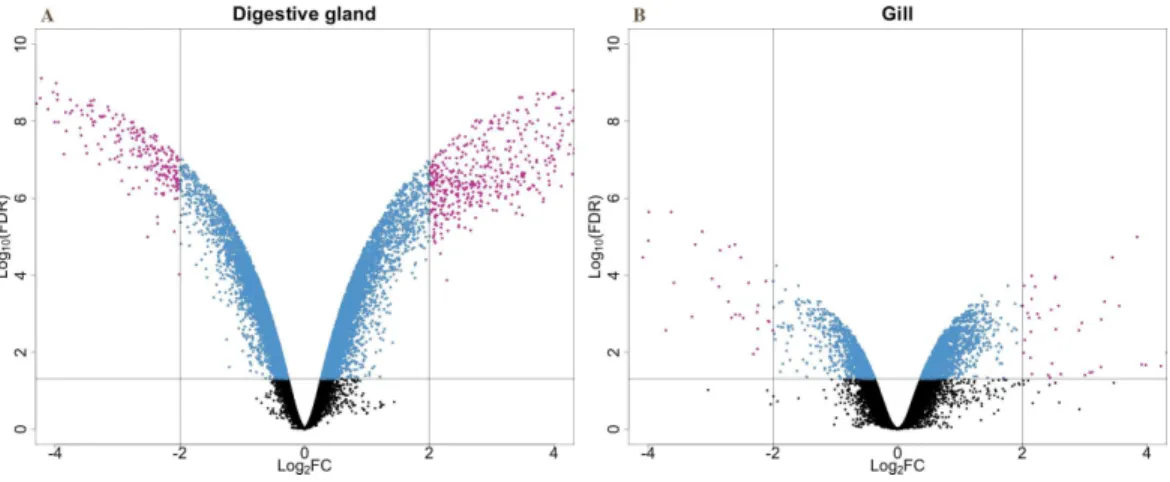
Figure 2 V-plots showing gene expression differences detected through microarray analysis in diges-tive gland (A) and gill (B) tissues.These differences are represented as net expression change (logFC) with statistical significance (FDR) indicated as a logarithmic scale. Probes highlighted in blue (FDR <0.05) and purple (FDR<0.05 and logFC>2) represent the groups of transcripts displaying largest changes in gene expression between exposed and control treatments.
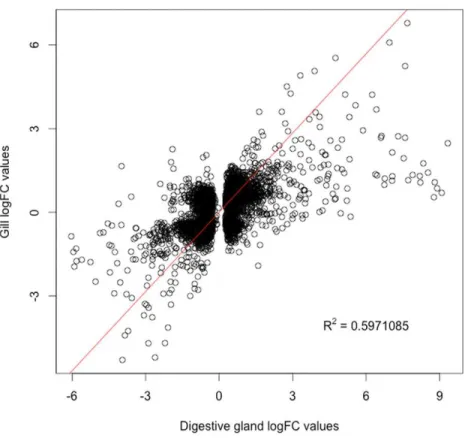
microarray (51,300 probes) was designed and developed using the sequences (contigs) obtained from the cDNA libraries constructed in this work. The hybridization of the microarray with RNA samples from exposed and control groups revealed a total number of 14,160 probes (digestive gland) and 6,913 probes (gill) differentially expressed (Fig. 2). The consistency between expression profiles in digestive gland and gill was assessed performing a linear regression of the logFC values of differentially expressed transcripts common for both tissues (i.e., those showing FDR<0.05 in both cases), showing a good correlation between both sets of transcripts (Fig. 3). The detailed description of the transcripts displaying the highests differences in expression levels in both tissues, along with the maximum observed logFC value in the microarray analysis, is indicated inSupplemental Information 1and2.
The microarray analysis identified a set of transcripts displaying sharp expression differences between exposed and control treatmentsSupplemental Information 1and
Figure 3 Correlation between paired logFC values calculated for transcripts identified in digestive gland and gill tissues between exposed and control treatments.Overall, a good level of agreement is found for gene expression changes(R2∼=0.6).
the benthic settlement stage (He et al., 2014) and it has only been identified in bivalves, being particularly abundant in the digestive gland. On the other hand, the elongation factor 2 (EEF-2) is widely ubiquitous across eukaryotic taxa, playing an essential regulatory role in protein synthesis as a housekeeping gene. Although the functional implications of vdg3 and EEF-2 in the context of this study are still unclear, the obtained results support previous reports discouraging the use of EEF-2 as an internal control for qPCR analyses on bivalves without further validation (Du et al., 2013).
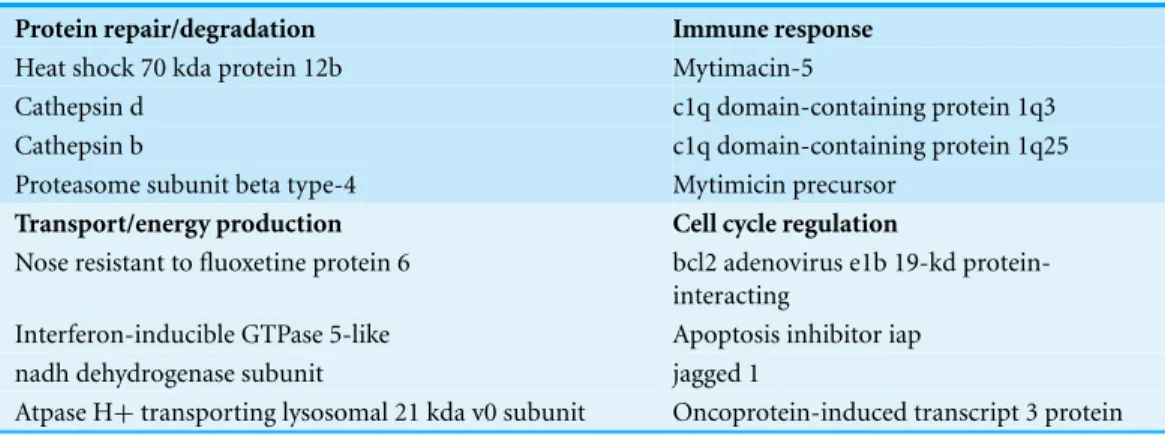
Table 2 Selected subsets of differentially expressed transcripts identified by microarray analysis representative of the following functional categories: (a) protein repair or degradation, (b) immune response, (c) transport and energy production and (d) cell cycle regulation.
Protein repair/degradation Immune response
Heat shock 70 kda protein 12b Mytimacin-5
Cathepsin d c1q domain-containing protein 1q3
Cathepsin b c1q domain-containing protein 1q25
Proteasome subunit beta type-4 Mytimicin precursor
Transport/energy production Cell cycle regulation
Nose resistant to fluoxetine protein 6 bcl2 adenovirus e1b 19-kd protein-interacting
Interferon-inducible GTPase 5-like Apoptosis inhibitor iap
nadh dehydrogenase subunit jagged 1
Atpase H+transporting lysosomal 21 kda v0 subunit Oncoprotein-induced transcript 3 protein
accross tissues). Indeed, lysosomal uptake has been suggested as a possible explanation for the extraordinary tolerance of mussels to the effects of DSP pollution (Svensson, Sarngren & Forlin, 2003).
In addition to transcripts previoulsy linked to OA responses, our results found an upregulation of an antimicrobial peptide (mytimacin) as well as an antifungal peptide (mytimycin) specific from mussels (Sonthi et al., 2011;Gerdol et al., 2012). Interestingly, mytimacin-5 (partial) was identified as one of the most upregulated transcripts in both gill and digestive gland. This peptide is especially interesting among the mytimacin family due to two additional cysteines in conserved positions predicted to form an extra disulfide bridge with yet unknown functional implications (Gerdol et al., 2012). C1q domain-containing proteins 1q3 and 1q25 showed a strong upregulation in the digestive gland. C1q is involved in the mammalian classical component pathway, playing an important role in innate immunity. Although no clear homologues to the vertebrate C1q complex subunits have been found in invertebrates yet, a massive expansion in the C1q domain-containing protein family has been suggested in bivalves, includingMytilus (Gerdol, Venier & Pallavicini, 2015). C1q domain-containing proteins are very versatile and might display a wide range of ligand interactions and functions such as clearance of apoptotic cells through direct binding (Kishore et al., 2004). They have been found upregulated in molluscs challenged with different pathogens (Perrigault, Tanguy & Allam, 2009;Taris et al., 2009). Although their specific function remains unclear, the substantial upregulation found in the present work might be indicative of a relevant role during environmental stress responses.
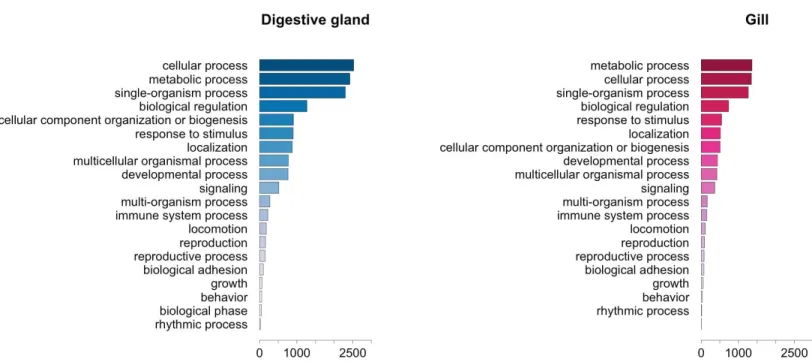
Figure 4 Graphical representation of the GO terms (general sub-categories in Biological Process ontology) most represented in transcripts differentially expressed for each mussel tissue according to the microarray analysis.The length of the bars is proportional to the number of sequences annotated for each specific GO term.
regulation of antimicrobial and antifungal peptides might be influenced by the presence of infiltrated hemocytes in digestive gland tissue.
Expression and function profiles of transcripts differentially expressed in response to OA
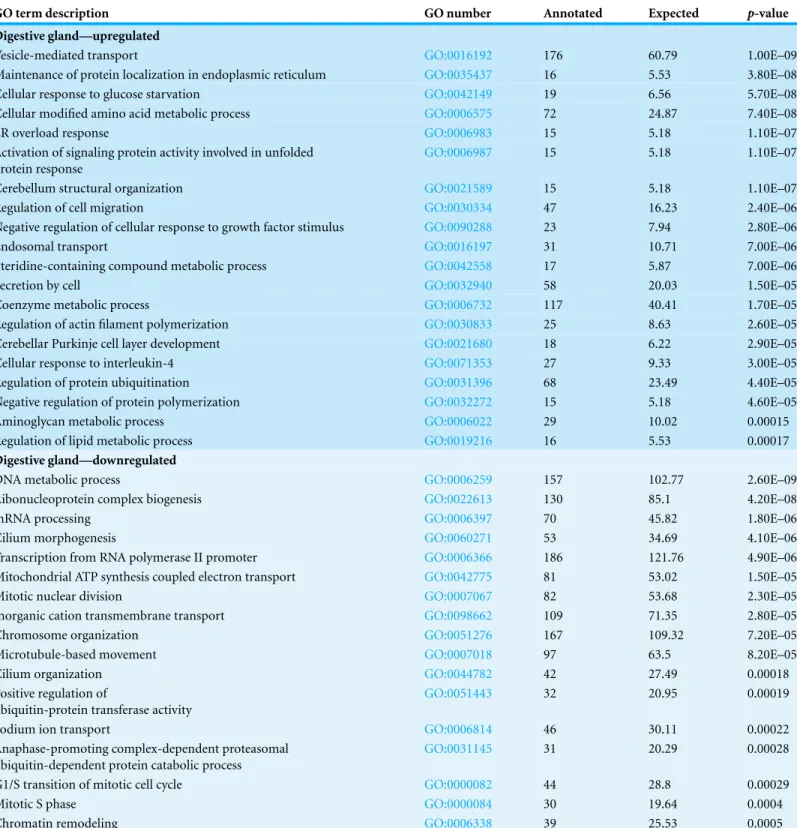
The GO term annotation of transcripts differentially expressed in response to OA allowed the analysis of the biological processes in which their enconding genes are involved. A comparison of the functional profile for the two tissues studied is shown inFig. 4. These profiles are based on the levels of representation for the most general sub-categories in GO stemming from Biological Process (Ashburner et al., 2000). Although absolute differences in magnitude are evident between digestive gland and gill (Fig. 2), no major functional differences were found when comparing the profiles for both tissues (Figs. 3and4). Nonetheless, such comparison might be hampered by sample size differences (e.g., subtle tissue-specific differences could remain undetected) and the fact that the microarray could lack gill-specific transcripts. Indeed, recent reports suggest that OA might display tissue-specific effects. Accordingly, different cytotoxic effects of OA specific for different human cell types had been demonstratedin vitro(Rubiolo et al., 2011). Furthermore, it has been reported that mussel gills display higher sensitivity to OA than hemocytes after one hour exposure (Prego-Faraldo et al., 2015). Tissue specificity is further evidenced by comparisons among enriched GO terms determined for transcripts upregulated and downregulated in digestive gland and gill (Table 3).
Table 3 Enriched GO terms in sets of differentially expressed transcripts in both digestive gland and gill tissues. Data is sorted based onp-value
in increasing (p-values are calculated according to the weight algorithm in TopGO).
GO term description GO number Annotated Expected p-value
Digestive gland—upregulated
Vesicle-mediated transport GO:0016192 176 60.79 1.00E–09
Maintenance of protein localization in endoplasmic reticulum GO:0035437 16 5.53 3.80E–08
Cellular response to glucose starvation GO:0042149 19 6.56 5.70E–08
Cellular modified amino acid metabolic process GO:0006575 72 24.87 7.40E–08
ER overload response GO:0006983 15 5.18 1.10E–07
Activation of signaling protein activity involved in unfolded protein response
GO:0006987 15 5.18 1.10E–07
Cerebellum structural organization GO:0021589 15 5.18 1.10E–07
Regulation of cell migration GO:0030334 47 16.23 2.40E–06
Negative regulation of cellular response to growth factor stimulus GO:0090288 23 7.94 2.80E–06
Endosomal transport GO:0016197 31 10.71 7.00E–06
Pteridine-containing compound metabolic process GO:0042558 17 5.87 7.00E–06
Secretion by cell GO:0032940 58 20.03 1.50E–05
Coenzyme metabolic process GO:0006732 117 40.41 1.70E–05
Regulation of actin filament polymerization GO:0030833 25 8.63 2.60E–05
Cerebellar Purkinje cell layer development GO:0021680 18 6.22 2.90E–05
Cellular response to interleukin-4 GO:0071353 27 9.33 3.00E–05
Regulation of protein ubiquitination GO:0031396 68 23.49 4.40E–05
Negative regulation of protein polymerization GO:0032272 15 5.18 4.60E–05
Aminoglycan metabolic process GO:0006022 29 10.02 0.00015
Regulation of lipid metabolic process GO:0019216 16 5.53 0.00017
Digestive gland—downregulated
DNA metabolic process GO:0006259 157 102.77 2.60E–09
Ribonucleoprotein complex biogenesis GO:0022613 130 85.1 4.20E–08
mRNA processing GO:0006397 70 45.82 1.80E–06
Cilium morphogenesis GO:0060271 53 34.69 4.10E–06
Transcription from RNA polymerase II promoter GO:0006366 186 121.76 4.90E–06
Mitochondrial ATP synthesis coupled electron transport GO:0042775 81 53.02 1.50E–05
Mitotic nuclear division GO:0007067 82 53.68 2.30E–05
Inorganic cation transmembrane transport GO:0098662 109 71.35 2.80E–05
Chromosome organization GO:0051276 167 109.32 7.20E–05
Microtubule-based movement GO:0007018 97 63.5 8.20E–05
Cilium organization GO:0044782 42 27.49 0.00018
Positive regulation of
ubiquitin-protein transferase activity
GO:0051443 32 20.95 0.00019
Sodium ion transport GO:0006814 46 30.11 0.00022
Anaphase-promoting complex-dependent proteasomal ubiquitin-dependent protein catabolic process
GO:0031145 31 20.29 0.00028
G1/S transition of mitotic cell cycle GO:0000082 44 28.8 0.00029
Mitotic S phase GO:0000084 30 19.64 0.0004
Chromatin remodeling GO:0006338 39 25.53 0.0005
Table 3 (continued)
GO term description GO number Annotated Expected p-value
Regulation of multi-organism process GO:0043900 43 28.15 0.00058
Cilium or flagellum-dependent cell motility GO:0001539 17 11.13 0.00073
Histone acetylation GO:0016573 33 21.6 0.00078
Gill—upregulated
Biological process GO:0008150 926 516.95 1.60E–06
Positive regulation of cell growth GO:0030307 12 6.7 0.00087
Carbohydrate metabolic process GO:0005975 39 21.77 0.00149
Cellular catabolic process GO:0044248 30 16.75 0.04401
Protein folding GO:0006457 23 12.84 0.05753
Protein polyubiquitination GO:0000209 17 9.49 0.06629
Lipid metabolic process GO:0006629 24 13.4 0.09686
Intracellular transport GO:0046907 18 10.05 0.11899
Nucleobase-containing compound catabolic process GO:0034655 12 6.7 0.14577
Proteolysis GO:0006508 22 12.28 0.16789
Single-organism developmental process GO:0044767 94 52.48 0.19993
Cellular macromolecular complex assembly GO:0034622 11 6.14 0.20518
Protein complex subunit organization GO:0071822 11 6.14 0.20518
Generation of neurons GO:0048699 16 8.93 0.21463
Vesicle-mediated transport GO:0016192 21 11.72 0.21627
Response to oxygen-containing compound GO:1901700 10 5.58 0.28271
Protein complex assembly GO:0006461 10 5.58 0.31076
Cell cycle GO:0007049 17 9.49 0.31266
Response to external stimulus GO:0009605 17 9.49 0.31266
Positive regulation of transcription, DNA-templated GO:0045893 12 6.7 0.32401
Gill—downregulated
Microtubule-based process GO:0007017 25 7.31 1.40E–07
Energy derivation by oxidation of organic compounds GO:0015980 10 2.92 0.0012
Heterocycle biosynthetic process GO:0018130 35 10.23 0.0041
Aromatic compound biosynthetic process GO:0019438 35 10.23 0.0041
Cellular nitrogen compound biosynthetic process GO:0044271 37 10.82 0.0086
Organic cyclic compound biosynthetic process GO:1901362 38 11.11 0.0121
Biological process GO:0008150 926 270.74 0.0161
Regulation of signal transduction GO:0009966 18 5.26 0.0165
Cellular protein modification process GO:0006464 57 16.67 0.0537
Nucleotide metabolic process GO:0009117 11 3.22 0.0687
Response to organic substance GO:0010033 26 7.6 0.1048
Single-organism transport GO:0044765 66 19.3 0.1202
Cell morphogenesis involved in differentiation GO:0000904 10 2.92 0.1363
Regulation of multicellular organismal process GO:0051239 10 2.92 0.1363
Purine-containing compound metabolic process GO:0072521 10 2.92 0.1363
Single-organism biosynthetic process GO:0044711 19 5.56 0.1603
Cell surface receptor signaling pathway GO:0007166 31 9.06 0.1635
Regulation of biological quality GO:0065008 17 4.97 0.202
Anatomical structure morphogenesis GO:0009653 33 9.65 0.2438
polymerase II promoter, histone acetylation, mitotic nuclear division, mitotic S phase). On the contrary, these terms are mostly represented in the upregulated set of transcripts in the gill (e.g., positive regulation of cell growth, cell cycle, positive regulation of transcription, DNA-templated). Although this might suggest a higher degree of stress in digestive gland, both tissues consistently show enrichment in GO terms connected to DNA repair and degradation of damaged proteins. Therefore, while the mechanisms involved in OA toxicity could be consistent across these tissues, different responses could be elicited depending on the level of the accumulation. Further research will be required to clarify the extent in which the effects of OA are determined by the nature of the tissue, the time/dose or a combination of both.
Our results show an overall larger number of upregulated transcripts compared with those downregulated, in agreement with previous reports although a strong dependence of the expresion profiles with time was demonstrated (Manfrin et al., 2010). Such findings are further supported by the analysis of the response of the Pacific oyster Crassostrea gigasto OA exposure using time-series (Romero-Geraldo, Garcia-Lagunas & Hernandez-Saavedra, 2014), showing a strong dependence on time and dose. Altogether, it seems that expression profiles can hardly be extrapolated to other conditions different to those being studied. Given the highly dynamic nature of the transcriptome, only consistent patterns in expression can be informative of environmental stress conditions (Aardema & MacGregor, 2002). This supports the use of expression signatures rather than individual biomarkers for biomonitoring purposes. Modeling systems of greater complexity including time and dose as variables would provide valuable information about the dynamics of the expression profiles.
differential expression of enzymes involved in immunity-related pathways like biosynthesis of antibiotics further supports a link between environmental stress and changes in the immunity system (Malagoli et al., 2007).
CONCLUSIONS
The present work dissects the gene expression changes in different mussel tissues during early stages of DSP HAB episodes, suggesting that low concentrations of OA (below the legal OA limit established for safe consumption of shellfish) are enough to elicit sharp changes in the expression of genes involved in the response to this biotoxin. Prior to this work, a few studies attempted to investigate the transcriptomic changes in bivalves during HABs using high-throughput methods (Manfrin et al., 2010;Suarez-Ulloa et al., 2013a;
Gerdol et al., 2014). However, the combined application of normalized and SSH libraries together with the development of a custom-made OA-specific microarray in the present work, provides a more comprehensive characterization of the OA-specific transcriptome, improving the accuracy of the analysis of expresion profiles compared to single-replicated RNA-seq methods (Suarez-Ulloa et al., 2013a). The custom-made microarray platform generated in this work represents a convenient tool for long-term monitoring projects, offering a good level of standardization with lower requirements in computational resources comparing to the otherwise more informative RNA-seq methodology (Guo et al., 2013). In addition, the transcriptomic coverage of this microarray is comparable to recent estimations for the size of the complete transcriptome in digestive gland of Mytilus galloprovincialis(Gerdol et al., 2014) as well as for the transcriptome of the Pacific oysterCrassostrea gigas(Zhang et al., 2012), thus representing a good approximation to an unbiased tool for expression analysis.
pathogens present in the microbiota of the mussels. Current efforts are directed to clarify this question (De Rijcke et al., 2015).
Further work studying more restricted conditions with shorter periods of exposure and lower concentrations of dinoflagellates would better inform about the sensitivity of the transcriptomic approach for the detection of OA-pollution in the ocean. Complementary, long-term monitoring projects in combination with meta-analysis of publicly available data could provide valuable information on the basal trancriptomic changes constituting a general environmental response as well as on the specific transcriptomic signature of DSP toxicity stress.
ADDITIONAL INFORMATION AND DECLARATIONS
Funding
The present work was supported by grants from the Biomolecular Sciences Institute (800005997) and start-up funds from the College of Arts and Sciences at Florida International University (JME-L), and from the Spanish Ministry of Economy and Competitivity (AGL2012-30897, JM). VS-U was supported by a Graduate Assistantship from the Department of Biological Sciences at FIU. VA-P was supported by the College of Engineering and Computing at Florida International University, under the supervision of Dr. Giri Narasimhan. The funders had no role in study design, data collection and analysis, decision to publish, or preparation of the manuscript.
Grant Disclosures
The following grant information was disclosed by the authors: Biomolecular Sciences Institute: 800005997.
College of Arts and Sciences at Florida International University. Spanish Ministry of Economy and Competitivity: AGL2012-30897.
Competing Interests
The authors declare there are no competing interests.
Author Contributions
• Victoria Suarez-Ulloa conceived and designed the experiments, performed the
experiments, analyzed the data, wrote the paper, prepared figures and/or tables, reviewed drafts of the paper.
• Juan Fernandez-Tajes conceived and designed the experiments, performed the
experiments, analyzed the data, wrote the paper, reviewed drafts of the paper.
• Vanessa Aguiar-Pulido and M. Veronica Prego-Faraldo analyzed the data, reviewed
drafts of the paper.
• Fernanda Florez-Barros performed the experiments, reviewed drafts of the paper.
• Alexia Sexto-Iglesias performed the experiments.
• Josefina Mendez conceived and designed the experiments, contributed
• Jose M. Eirin-Lopez conceived and designed the experiments, analyzed the data,
contributed reagents/materials/analysis tools, wrote the paper, prepared figures and/or tables, reviewed drafts of the paper.
DNA Deposition
The following information was supplied regarding the deposition of DNA sequences: Normalized and SSH read datasets are available in the NCBI’s Bioproject database under the accession numberPRJNA167773.
Data Availability
The following information was supplied regarding data availability:
The accession number for our raw microarray dataset in the GEO database is:
GSE72817.
Supplemental Information
Supplemental information for this article can be found online athttp://dx.doi.org/ 10.7717/peerj.1429#supplemental-information.
REFERENCES
Aardema MJ, MacGregor JT. 2002.Toxicology and genetic toxicology in the new era of
“toxicogenomics”: impact of “-omics” technologies.Mutation Research/DNA Repair499:13–25.
Alexa A, Rahnenfuhrer J. 2010.topGO: enrichment analysis for gene ontology. R package version 2.18.0.
Altschul SF, Madden TL, Schaffer AA, Zhang J, Zhang Z, Miller W, Lipman DJ. 1997.Gapped BLAST and PSI-BLAST: a new generation of protein database search programs.Nucleic Acids Research25:3389–3402DOI 10.1093/nar/25.17.3389.
Anderson DM. 2009.Approaches to monitoring, control and management of harmful algal blooms (HABs).Ocean & Coastal Management52:342–347
DOI 10.1016/j.ocecoaman.2009.04.006.
Anderson K, Taylor DA, Thompson EL, Melwani AR, Nair SV, Raftos DA. 2015.Meta-analysis of studies using suppression subtractive hybridization and microarrays to investigate the effects of environmental stress on gene transcription in oysters.PLoS ONE10:e0118839
DOI 10.1371/journal.pone.0118839.
Apweiler R, Attwood TK, Bairoch A, Bateman A, Birney E, Biswas M, Bucher P, Cerutti L, Corpet F, Croning MD, Durbin R, Falquet L, Fleischmann W, Gouzy J, Hermjakob H, Hulo N, Jonassen I, Kahn D, Kanapin A, Karavidopoulou Y, Lopez R, Marx B, Mulder NJ, Oinn TM, Pagni M, Servant F, Sigrist CJ, Zdobnov EM. 2001.The InterPro database, an integrated documentation resource for protein families, domains and functional sites.Nucleic Acids Research29:37–40DOI 10.1093/nar/29.1.37.
Ashburner M, Ball CA, Blake JA, Botstein D, Butler H, Cherry JM, Davis AP, Dolinski K, Dwight SS, Eppig JT, Harris MA, Hill DP, Issel-Tarver L, Kasarskis A, Lewis S, Matese JC, Richardson JE, Ringwald M, Rubin GM, Sherlock G. 2000.Gene ontology: tool for the unification of biology. The gene ontology consortium.Nature Genetics25:25–29
Astuya A, Carrera C, Ulloa V, Aballay A, Nunez-Acuna G, Hegaret H, Gallardo-Escarate C. 2015.Saxitoxin modulates immunological parameters and gene transcription inMytilus chilensishemocytes.International Journal of Molecular Sciences16:15235–15250
DOI 10.3390/ijms160715235.
Bai Y, Wang S, Zhong H, Yang Q, Zhang F, Zhuang Z, Yuan J, Nie X, Wang S. 2015.Integrative analyses reveal transcriptome-proteome correlation in biological pathways and
secondary metabolism clusters in A. flavus in response to temperature.Scientific Reports 5:14582DOI 10.1038/srep14582.
Banni M, Negri A, Mignone F, Boussetta H, Viarengo A, Dondero F. 2011.Gene expression rhythms in the musselMytilus galloprovincialis(Lam.) across an annual cycle.PLoS ONE 6:e18904DOI 10.1371/journal.pone.0018904.
Bogdanova EA, Barsova EV, Shagina IA, Scheglov A, Anisimova V, Vagner LL, Lukyanov SA, Shagin DA. 2011.Normalization of full-length-enriched cDNA.Methods in Molecular Biology 729:85–98DOI 10.1007/978-1-61779-065-2 6.
Campos A, Tedesco S, Vasconcelos V, Cristobal S. 2012.Proteomic research in bivalves: towards the identification of molecular markers of aquatic pollution.Journal of Proteomics75:4346–4359
DOI 10.1016/j.jprot.2012.04.027.
Chapman RW, Mancia A, Beal M, Veloso A, Rathburn C, Blair A, Holland AF, Warr GW, Didinato G, Sokolova IM, Wirth EF, Duffy E, Sanger D. 2011.The transcriptomic responses of the eastern oyster,Crassostrea virginica, to environmental conditions.Molecular Ecology 20:1431–1449DOI 10.1111/j.1365-294X.2011.05018.x.
Chevreux B, Wetter T, Suhai S. 1999.Genome sequence assembly using trace signals and additional sequence information. In:Proceedings of the German conference on bioinformatics (GCB), 45–56.
Clark MS, Thorne MAS, Amaral A, Vieira F, Batista FM, Reis J, Power DM. 2013.Identification of molecular and physiological responses to chronic environmental challenge in an invasive species: the Pacific oyster,Crassostrea gigas.Ecology and Evolution3:3283–3297
DOI 10.1002/ece3.719.
Conesa A, Gotz S, Garcia-Gomez JM, Terol J, Talon M, Robles M. 2005.Blast2GO: a universal tool for annotation, visualization and analysis in functional genomics research.Bioinformatics 21:3674–3676DOI 10.1093/bioinformatics/bti610.
Contardo-Jara V, Pflugmacher S, Wiegand C. 2008.Multi-xenobiotic-resistance a possible explanation for the insensitivity of bivalves towards cyanobacterial toxins.Toxicon52:936–943
DOI 10.1016/j.toxicon.2008.09.005.
De Rijcke M, Vandegehuchte MB, Bussche JV, Nevejan N, Vanhaecke L, De Schamphelaere KA, Janssen CR. 2015.Common European Harmful Algal Blooms affect the viability and innate immune responses ofMytilus edulislarvae.Fish & Shellfish Immunology47:175–181
DOI 10.1016/j.fsi.2015.09.003.
Diatchenko L, Lau YF, Campbell AP, Chenchik A, Moqadam F, Huang B, Lukyanov S, Lukyanov K, Gurskaya N, Sverdlov ED, Siebert PD. 1996. Suppression subtractive
hybridization: a method for generating differentially regulated or tissue-specific cDNA probes and libraries.Proceedings of the National Academy of Sciences of the United States of America 93:6025–6030DOI 10.1073/pnas.93.12.6025.
Du Y, Zhang L, Xu F, Huang B, Zhang G, Li L. 2013.Validation of housekeeping genes as internal controls for studying gene expression during Pacific oyster (Crassostrea gigas) development by quantitative real-time PCR.Fish & Shellfish Immunology34:939–945
DOI 10.1016/j.fsi.2012.12.007.
Fernandez-Tajes J, Florez F, Pereira S, Rabade T, Laffon B, Mendez J. 2011.Use of three bivalve species for biomonitoring a polluted estuarine environment.Environmental Monitoring and Assessment177:289–300DOI 10.1007/s10661-010-1634-x.
Gerdol M, De Moro G, Manfrin C, Milandri A, Riccardi E, Beran A, Venier P, Pallavicini A. 2014.RNA sequencing and de novo assembly of the digestive gland transcriptome inMytilus galloprovincialisfed with toxinogenic and non-toxic strains ofAlexandrium minutum.BMC Research Notes7:722DOI 10.1186/1756-0500-7-722.
Gerdol M, De Moro G, Manfrin C, Venier P, Pallavicini A. 2012.Big defensins and mytimacins, new AMP families of the Mediterranean musselMytilus galloprovincialis.Developmental and Comparative Immunology36:390–399DOI 10.1016/j.dci.2011.08.003.
Gerdol M, Venier P, Pallavicini A. 2015.The genome of the Pacific oysterCrassostrea gigasbrings new insights on the massive expansion of the C1q gene family in Bivalvia.Developmental and Comparative Immunology49:59–71DOI 10.1016/j.dci.2014.11.007.
Gotz S, Garcia-Gomez JM, Terol J, Williams TD, Nagaraj SH, Nueda MJ, Robles M, Talon M, Dopazo J, Conesa A. 2008.High-throughput functional annotation and data mining with the Blast2GO suite.Nucleic Acids Research36:3420–3435DOI 10.1093/nar/gkn176.
Gotze S, Matoo OB, Beniash E, Saborowski R, Sokolova IM. 2014.Interactive effects of CO2 and trace metals on the proteasome activity and cellular stress response of marine bivalves
Crassostrea virginicaandMercenaria mercenaria.Aquatic Toxicology149:65–82
DOI 10.1016/j.aquatox.2014.01.027.
Guo Y, Li CI, Ye F, Shyr Y. 2013.Evaluation of read count based RNAseq analysis methods.BMC Genomics14:S2DOI 10.1186/1471-2164-14-S8-S2.
He TF, Chen J, Zhang J, Ke CH, You WW. 2014.SARP19 and vdg3 gene families are functionally related during abalone metamorphosis.Development Genes and Evolution224:197–207
DOI 10.1007/s00427-014-0478-8.
Huang L, Zou Y, Weng H-W, Li H-Y, Liu J-S, Yang W-D. 2015.Proteomic profile inPerna viridis
after exposed toProrocentrum lima, a dinoflagellate producing DSP toxins.Environmental Pollution196:350–357DOI 10.1016/j.envpol.2014.10.019.
Kagedal K, Johansson U, Ollinger K. 2001.The lysosomal protease cathepsin D mediates apoptosis induced by oxidative stress.FASEB Journal15:1592–1594.
Kanehisa M. 2002.The KEGG database. In:Novartis Foundation Symposium,247:91–101.
Kishore U, Gaboriaud C, Waters P, Shrive AK, Greenhough TJ, Reid KB, Sim RB, Arlaud GJ. 2004.C1q and tumor necrosis factor superfamily: modularity and versatility.Trends in Immunology25:551–561DOI 10.1016/j.it.2004.08.006.
Malagoli D, Casarini L, Sacchi S, Ottaviani E. 2007.Stress and immune response in the mussel
Mytilus galloprovincialis.Fish & Shellfish Immunology23:171–177
DOI 10.1016/j.fsi.2006.10.004.
Manfrin C, Dreos R, Battistella S, Beran A, Gerdol M, Varotto L, Lanfranchi G, Venier P, Pallavicini A. 2010.Mediterranean mussel gene expression profile induced by okadaic acid exposure.Environmental Science and Technology44:8276–8283DOI 10.1021/es102213f.
Myhre S, Tveit H, Mollestad T, Laegreid A. 2006.Additional gene ontology structure for im-proved biological reasoning.Bioinformatics22:2020–2027DOI 10.1093/bioinformatics/btl334.
Perrigault M, Tanguy A, Allam B. 2009.Identification and expression of differentially expressed genes in the hard clam,Mercenaria mercenaria, in response to quahog parasite unknown (QPX).
BMC Genomics10:377DOI 10.1186/1471-2164-10-377.
Prado-Alvarez M, Florez-Barros F, Mendez J, Fernandez-Tajes J. 2013.Effect of okadaic acid on carpet shell clam (Ruditapes decussatus) haemocytes byin vitroexposure and harmful algal bloom simulation assays.Cell Biology and Toxicology29:189–197
DOI 10.1007/s10565-013-9246-1.
Prado-Alvarez M, Florez-Barros F, Sexto-Iglesias A, Mendez J, Fernandez-Tajes J. 2012.Effects of okadaic acid on haemocytes fromMytilus galloprovincialis: a comparison between field and laboratory studies.Marine Environmental Research81:90–93
DOI 10.1016/j.marenvres.2012.08.011.
Prego-Faraldo MV, Valdiglesias V, Laffon B, Eirin-Lopez JM, Mendez J. 2015.In vitroanalysis of early genotoxic and cytotoxic effects of okadaic acid in different cell types of the mussel
Mytilus galloprovincialis.Journal of Toxicology and Environmental Health, Part A78:814–824
DOI 10.1080/15287394.2015.1051173.
Prego-Faraldo MV, Valdiglesias V, Mendez J, Eirin-Lopez JM. 2013.Okadaic Acid meet and greet: an insight into detection methods, response strategies and genotoxic effects in marine invertebrates.Marine Drugs11:2829–2845DOI 10.3390/md11082829.
Reguera B, Riobo P, Rodriguez F, Diaz PA, Pizarro G, Paz B, Franco JM, Blanco J. 2014.
Dinophysis toxins: causative organisms, distribution and fate in shellfish.Marine Drugs 12:394–461DOI 10.3390/md12010394.
Ritchie ME, Phipson B, Wu D, Hu Y, Law CW, Shi W, Smyth GK. 2015.limma powers differential expression analyses for RNA-sequencing and microarray studies.Nucleic Acids Research43 DOI 10.1093/nar/gkv007.
Romero-Geraldo RDJ, Garcia-Lagunas N, Hernandez-Saavedra NY. 2014.Effects ofin vitro
exposure to diarrheic toxin producerProrocentrum lima on gene expressions related to cell cycle regulation and immune response inCrassostrea gigas.PLoS ONE9:e97181
DOI 10.1371/journal.pone.0097181.
Romero-Geraldo RDJ, Hernandez-Saavedra N. 2014.Stress Gene Expression inCrassostrea gigas
(Thunberg, 1793) in response to experimental exposure to the toxic dinoflagellateProrocentrum lima(Ehrenberg) Dodge, 1975.Aquaculture Research45:1512–1522DOI 10.1111/are.12100.
Rubiolo JA, Lopez-Alonso H, Vega FV, Vieytes MR, Botana LM. 2011. Okadaic acid and dinophysis toxin 2 have differential toxicological effects in hepatic cell lines inducing cell cycle arrest, at G0/G1 or G2/M with aberrant mitosis depending on the cell line.Archives of Toxicology 85:1541–1550DOI 10.1007/s00204-011-0702-5.
Sellner KG, Doucette GJ, Kirkpatrick GJ. 2003.Harmful algal blooms: causes, impacts and detection.Journal of Industrial Microbiology and Biotechnology30:383–406
DOI 10.1007/s10295-003-0074-9.
Shenolikar S. 1994.Protein Serine/Threonine phosphatases—new avenues for cell regulation.
Annual Review of Cell Biology10:55–86DOI 10.1146/annurev.cb.10.110194.000415.
Sonthi M, Toubiana M, Pallavicini A, Venier P, Roch P. 2011.Diversity of coding sequences and gene structures of the antifungal peptide mytimycin (MytM) from the Mediterranean mussel,
Suarez-Ulloa V, Fernandez-Tajes J, Aguiar-Pulido V, Rivera-Casas C, Gonzalez-Romero R, Ausio J, Mendez J, Dorado J, Eirin-Lopez JM. 2013a.The CHROMEVALOA database: a resource for the evaluation of okadaic acid contamination in the marine environment based on the chromatin-associated transcriptome of the musselMytilus galloprovincialis.Marine Drugs 11:830–841DOI 10.3390/md11030830.
Suarez-Ulloa V, Fernandez-Tajes J, Manfrin C, Gerdol M, Venier P, Eirin-Lopez JM. 2013b.
Bivalve omics: state of the art and potential applications for the biomonitoring of harmful marine compounds.Marine Drugs11:4370–4389DOI 10.3390/md11114370.
Svensson S, Sarngren A, Forlin L. 2003.Mussel blood cells, resistant to the cytotoxic effects of okadaic acid, do not express cell membrane p-glycoprotein activity (multixenobiotic resistance).
Aquatic Toxicology65:27–37DOI 10.1016/S0166-445X(03)00097-3.
Taris N, Lang RP, Reno PW, Camara MD. 2009.Transcriptome response of the Pacific oyster (Crassostrea gigas) to infection withVibrio tubiashiiusing cDNA AFLP differential display.
Animal Genetics40:663–677DOI 10.1111/j.1365-2052.2009.01894.x.
Valdiglesias V, Prego-Faraldo M, P´asaro E, M´endez J, Laffon B. 2013.Okadaic acid: more than a diarrheic toxin.Marine Drugs11:4328–4349DOI 10.3390/md11114328.