171
Rev Bras Med Esporte – Vol. 17, No 3 – Mai/Jun, 2011 Eduardo Alexandre Loth1
Carlos Eduardo Albuquerque1 Adriano Policam Ciena2 Ângela Garcia Rossi1
1. Laboratory of the Study Group of the Physiotherapeutic Injuries and Resources (GELRF) of the State University of Western Paraná (Unioeste) - Cascavel - Paraná. 2. University of São Paulo in the Morphology Program.
Mailing address:
Rua: Rio de janeiro, 713 - Edifício Resid. Leblon - apto 23 - Centro CEP 85801-030 - Cascavel - Paraná
ABSTRACT
One of the most important tasks of the human postural control system is to keep the body balanced on the base of support provided by the feet. As a gravity sensor, the vestibular system is one of the most important tools of the nervous system in the control of the posture. When there is malfunction in this system, the individual starts to present a group of symptoms in which vertigo is generally preponderant. The present study had as objective to correlate the results of the postural control evaluation in young people obtained through the Foam-Laser Dynamic Posturography (FLP) and force platform. For the accomplishment of the study, 31 volunteers were invited (19 men and 11 women) who were submitted to the evaluation of the postural control through the Dynamic Foam-Laser Posturography and force platform simultaneously. The results reveled that there was strong correlation among the values obtained in the sensory organization tests (SOT) and pressure center (PC) displacement area on force platform in all TOS. In TOS III, V and VI respectively, strong correlation was observed in the results of the examinations in FPL and force platform, with r = - 0.79, r = 0.70 and r = - 0.80. This study concludes that the FLP is a very useful method for balance evaluation, and its results show strong correlation with the pressure center displacement area.
Keywords: postural control, stabilometry, dynamic posturography, power platform.
INTRODUCTION
The postural control is played by the extremely accurate convergence of the vestibular, visual and proprioceptive sys-tems. Constantly active, the postural control is responsible for allowing simple actions of the human routine. However, one of the most important tasks of the human postural system control is the body’s balance on a small base of support pro-vided by the feet(1).
The evaluation of the postural control represents a challenging task; however, it presents very useful implications for professionals if many fields, such as otoneurology, phonoaudiology, physio- therapy, sports medicine and others. The body oscillations of a person can be assessed with the use of many methods, but the Foam-Laser Dynamic Posturography, devised by Castagno(2), termed FLP assesses the vestibular, proprioceptive and visual functions through Dynamic Posturography.
Castagno(2) reports that FLP is a method analog to the Equit-est of Neurocom Int Inc, Clackams, Oregon, USA, with the aim to test the Sensory Organization (SO) in six different stance condi-tions, with scores which range from a minimum value of zero and maximum of 100%, depending on the body oscillations.
Loth et al.(3) used this method and its association with the force platform in a trial to assess the influence of the vestibular system in the balance of young adults and observed strong cor-relation between methods.
Therefore, the aim of the present study was to evaluate and correlate the postural control of young adults through Foam-laser dynamic posturography and the force platform.
Evaluation of the Postural Control in Young Adults by
use of Foam-Laser Dynamic Posturography
and Power Plataform
MATERIAL AND METHOD
This study was developed in the Laboratory of Biomechan-ics of the Physical Education Course of the Federal University of Santa Maria (UFSM), after having being approved by the ethics committee of the State University of Western Paraná (UNIOESTE), according to registration number 19366/2006 and resolution 226/2006, during the period from March 18 to 26, 2006. The 30 participants of the study (19 men and 11 women), students of the Physical Education course of UFSM, were randomly selected and had mean age of 21.17 ± 1.45 years.
The following criteria were followed for subjects’ inclusion in the study: any student of the Physical Education course of UFSM/RS, aged between 18 and 30 years and who agreed on signing the Free and Clarified Consent Form. Those who pre-sented amputation of any limb, known neurologic disease, acute orthopedic trauma and severe visual disabled were excluded.
Subsequently, the volunteers were submitted to the evalu-ation of postural control with the force platform (OR6-6, Ad-vanced Mechanical Technology Incorporation, USA) and FLP, simultaneously. Therefore, each participant was placed in a 1m² and 2m high cabin, placed on a force platform, cov-ered with a fabric with 10cm orange and beige stripes and a foam cushion of mean density and 10cmthick (figure 1). The volunteer had a nylon belt attached to his posterior region, adjustable to the patient’s waist, and containing a laser-beam pen pointed to a scale in centimeters attached above the cabin, on the horizontal plane (figures 2 and 3). This laser beam enabled the assessment of the anteroposterior dislocation during the SOT.
ORIGINAL ARTICLE
172 Rev Bras Med Esporte – Vol. 17, No 3 – Mai/Jun 2011 Figure 1. Foam-Laser Dynamic Posturography cabin proposed by Castagno (1994).
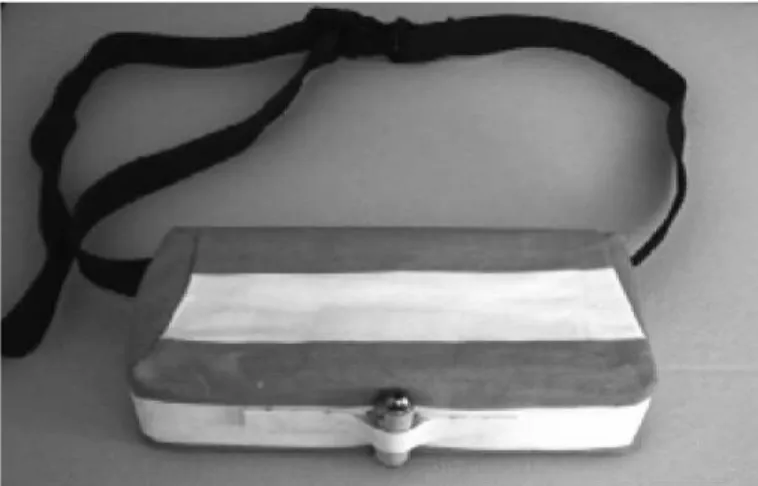
Figure 2. Belt made with nylon and foam fabric, with attachment on the ends adjustable to the participant’s waist level, with attached laser beam pen.
Figure 3. Scale in centimeters attached above the cabin in order to note the greatest dislocation in centimeters for performance of the calculation.
Figure 4. Mathematical formula for the calculation of the body oscillation angle proposed by the Foam-Laser Dynamic Posturography technique (Castagno, 1994).
The results were obtained during each SOT through the mea-surement of the distance in between the light source (laser pen) set on the volunteer and the obstacle placed above the fabric cabin (centimeter paper); this distance represents the measure between letters C and L and the maximal anteroposterior dis-location of the volunteer, through the light beam on the
cen-timeter paper, during the performance of all SOT. This distance represented the mean between letters C and A of the formula contained in figure 4.
SOT I, II and III were performed with the participant at ortho-static position, feet united and arms along the body. SOT IV, V and VI were performed with the volunteer at the same previous position, but he would be placed on a 10-cm thick foam cushion of medium density, with the aim to attenuate his proprioception. Positions II and V were performed with eyes closed. During SOT III and VI the cabin is slightly tilted, approximately 20° forward, during 10s and returns to the initial position also in 10s.
Analysis of the data recorded on the force platform used the MATLAB® 7.4 program which calculated the dislocation area of
the pressure center in cm2. The FLP results were obtained by a mathematic formula for oscillation angles calculation presented in figure 4. The level of association between results was evalu-ated with the Spearman correlation index and significance level adopted was of 5% with p > 0.05 through the software GraphPad Prism®, version 3.0.
RESULTS
The results obtained through FLP indicate that the sample scores mean decreased from 88.27 points to 80.27 and 76.51 points, respectively, until SOT III. On the fourth position of this exam though, increase in the results’ mean to 81.04 points, and it decreased again on he two last positions, with mean of 68.83 and 64.86 points, according to what is presented in table 1.
173
Rev Bras Med Esporte – Vol. 17, No 3 – Mai/Jun, 2011
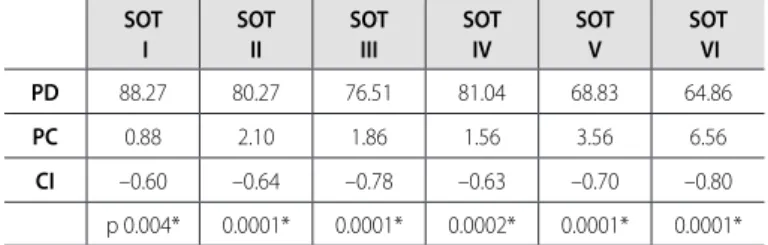
Moderate correlation between SOT I, II and IV, respectively with r = –0.60, r = –0.64 and r = –0.63, was observed after cor-relation analysis to evaluate the association level of the results obtained by the experimental group between the FLP condi-tions with the dislocation area of the PC recorded by the force platform.
In SOT III, V and VI, respectively, strong correlation between the results of the FLP exams and the force platform with r = –0.78, r = -–0.70 and r = –0.80 was observed (Table 3).
first is that once the participants of this study had intact postural control and were already familiarized with the test after having gone through the first SOT, they would be able to present goof performance, even when facing a greater imbalance situation, such as the one imposed by SOT IV, in which the subjects re-mained standing, on a 10 cm foam surface. The second explana-tion has to do with the fact that the participants could have used different postural control strategies to maintain body balance, in the several FLP conditions, increasing their body balance. In order to support the obtained results, Horak et al.(5) report in their studies that the hip strategy is useful to respond to disturbances of great amplitudes, in which it is difficult to produce torque at the ankle level, as for example, when the individual is on a deformable surface.
Similarly, other authors such as Diener et al.(6), Runge et al.(7) and Nashner(8), mention that the hip strategy is used to restore balance in responses when facing greater and quicker distur-bances of the postural control, or when the support surface is smaller than the feet or deformable.
After performance of analysis of correlation of the obtained results through the evaluation procedures of postural control in the sample, it was possible to observe that there was strong negative correlation index (inversely proportional) between FLP and the dislocation area of PC obtained on the force platform during the SOT performance – note: the bigger the dislocation area of PC recorded by the force platform, the bigger the oscil-lation detected in FLP as well. The FLP scores are considered values in percentage, and in total absence of body oscillation the score obtained is 100%, decreasing according to the increase in oscillations. Thus, the bigger the dislocation area of the PC on the force platform, the smaller the score obtained in FLP will be, which determines a negative correlation index between analyses.
Nevertheless, no study which has used the force platform in investigations involving FLP was found in the consulted lit-erature, which makes the comparison of the obtained results in this study with the ones found by other authors impossible. However, strong correlation index of FLP results with the force platform was observed in all SOT.
Based on results in this study, it was observed that FLP rep-resents a useful method for analysis of postural control which assesses the influence of the systems involved in this complex mechanism, and its application in rehabilitation clinics of patients with balance disorders should be used.
FLP used in this study also served as a diagnostic instru-ment for Yassue et al.(9), who found alterations in the balance of older subjects with diabetes mellitus through FLP. The author suggested that this technique constitutes a very sensitive instru-ment for balance evaluation in diabetic subjects.
Further studies, such as the ones by Savoldi et al.(10), used FLP with the aim to find a method for assessing propriocep-tion of patients submitted to reconstrucpropriocep-tion surgery of the knee anterior cruciate ligament. The authors concluded that FLP is a useful method for proprioception evaluation in these patients. In order to evaluate the effect of low visual acuity on the balance of patients with senile cataract, Rubin(11) used FLP as a complement in the evaluation by computer vectoelectronistagmography.
DISCUSSION
In this study, it was observed that the analyses of the FLP means and the dislocation area obtained on the force platform were inversely proportional, justifying hence why the FLP means decrease while the force platform ones increase. However, inver-sion of these results occurred during SOT IV, in which increase in the scores means was observed, while in the force platform recordings there was inversion in the scores means in SOT III and IV. Similar data were described by Mendonça et al.(4) who also observed inversion in the mean values in SOT IV.
Based on the scientific principles of postural control, two explanations are suggested to the results mentioned above. The Table 1. Presentation of results through central tendencies measurements and percentage dispersion measurements (%), obtained in the best response of the Foam-laser dynamic posturography test.
SOT I SOT II SOT III SOT IV SOT V SOT VI
M 88.27 80.27 76.51 81.04 68.83 64.86
MD 4.60 8.35 6.74 8.50 10.86 15.91
Max 95.51 90.65 86.52 90.45 86.91 91.35
Min 73.85 55.71 63.45 47.91 41.96 33.93
VR 90 83 82 79 60 54
Table 2. Presentation of the results through central tendencies measurements and dispersion measurements of the dislocation areas of PC in cm2 recorded by the force platform.
SOT I SOT II SOT III SOT IV SOT V SOT VI
Mean 0.88 2.10 1.86 1.56 3.56 6.56
Standard
deviation 0.64 1.66 0.97 0.97 1.55 4.31
Maximum 1.98 5.72 3.95 4.29 8.10 14.78
Minimum 0.17 0.32 0.47 0.19 0.89 0.73
Table 3. Presentation of the correlation indices (CI) of the results obtained through performance of Foam-laser dynamic posturography (FLP) and mean of dislocation area of the pressure center (PC) in cm2 obtained, simultaneously, with the force platform of the experimental group.
SOT I SOT II SOT III SOT IV SOT V SOT VI
PD 88.27 80.27 76.51 81.04 68.83 64.86
PC 0.88 2.10 1.86 1.56 3.56 6.56
CI –0.60 –0.64 –0.78 –0.63 –0.70 –0.80
174 Rev Bras Med Esporte – Vol. 17, No 3 – Mai/Jun 2011 Castagno(2) reports that the Foam-laser dynamic
posturogra-phy technique cannot completely substitute the computer dy-namic posturography. Considering cost, few dollars are needed to purchase a fabric cabin, a laser pen and a piece of foam of medium density. On the other hand, the computer dynamic posturography costs approximately 80,000 dollars. To the same authors Voorhess(12) reports that FLP cannot detect the latencies which are useful in the neurological diagnosis, neither analyse whether the hip or ankle strategies are being used nor mark the dislocation of the gravity center. However, it is a simple, cheap and useful technique which produces analysis of the sensory organization test very comparable to the ones obtained with the EquiTest®
.
Zammit et al.(13) report that the conventional methods, such as caloric test, rotatory tests and electrovectonistagmography, may define many ways of vertigo through evaluation of the ves-tibular component; however, the computer dynamic posturog-raphy provides information about the visual and proprioceptive systems as well.
In the present study, it is worth mentioning that the mediolat-eral dislocation during the SOT in FLP has not been measured, a fact which could generate further information and hence provide greater sensitivity to the test, supporting also its greater useful-ness for the assessment of postural control in many areas.
Regarding other limiting factors of this investigation which deserve attention and which will be able to contribute to further
studies using FLP, we can mention the possibility to film the laser beam emitted by the pen on the paper obstacle during the test, allowing hence to decrease possible questioning on the disloca-tion of the subjects which may happen during a test.
Nevertheless, when applying a test using FLP, the examiner should not intend to obtain data on the postural control kinetics, such as the ones obtained by the force platform, baropodometry and electronic or DPC. FLP represents a method which contributes to postural control assessment and diagnosis in balance disorders patients, though. It is a quanti-qualitative instrument of low cost which evaluates body balance both in the academic research and clinical fields.
CONCLUSION
It is concluded that the results obtained by Foam-laser dy-namic posturography represented strong correlation with the dislocation area of the pressure center recorded by the force platform in the six SOT.
This study’s performance was extremely important since it ventures to consolidate a new quanti-qualitative method to as-sess postural control, and mainly to collect information on its restrictions and advantages, serving as a source in the literature for future studies which will be certainly needed.
All authors have declared there is not any potential conflict of interests concerning this article.
REFERENCES
1. Maki BE, Mcilroy WE. Postural control in the oder adult. Clin Geriatr Med. 1996;12:635-58. 2. Castagno LAA. New method for sensory organization tests: the foam-laser dynamic posturog-New method for sensory organization tests: the foam-laser dynamic
posturog-raphy. Rev Bras Otorrin. 1994;60;287-96.
3. Loth EA, Rossi AG, Cappellesso PC, Ciena AP. Avaliação da influência do sistema vestibular no equilíbrio de adultos jovens através de posturografia dinâmica foam-laser e plataforma de força. Semina. 2008;29:57-64.
4. Mendonça AC, Rossi AG, Flores FT, Teixeira CS. Alterações do equilíbrio em indivíduos ex -usuários de álcool e drogas ilícitas. ACTA ORL/Téc Em Otorrin. 2006;24:255-8.
5. Horak FB, Shupert CL, Mirka A. Components of postural dyscontrol in the elderly: A review. Neurobiol Aging. 1989;10:727-38.
6. Diener HC, Horak FB, Naschener LM. Influece of stimulus parameters on human postural response. J Neurophysiol. 1989;59:1888-905.
7. Runge CF, Shupert CL, Horak FB, Zajac FE. Ankle and hip postural strategies defined by joint torques. Gait Posture. 1999;10:161-70.
8. Nashner LM. Analysys of stance posture in humans. In: Towe AL, Luschei ES. Motor coordination. New York, (Handbook of behavioral neurology. Plenum Press, 1981;5:527-65.
9. Yassue MM, Loth EA, Rossi AG, Bertolini GRF. Avaliação do equilíbrio em idosos portadores de diabetes mellitus através de posturografia dinâmica foam-laser. Anais do 5° Congresso Sul-Brasileiro de Medicina o Esporte, Bento Gonçalves – RS, 2006.
10. Savoldi AP, Montijo JPR, Loth EA, Bertolini GRF. Avaliação da propriocepção no equilíbrio de indivíduos submetidos à reconstrução do LCA através do método de posturografia dinâmica Estudo Piloto. Anais do 2° Congresso SLARD. Foz do Igaçu - PR, 2006.
11. Rubin ASB. Estudo do equilíbrio corporal de pacientes com catarata senil antes e após o tratamento cirúrgico. (Dissertação de Mestrado). Santa Maria: Universidade Federal de Santa Maria – UFSM, 2002.
12. Voorhess RL. The role of dynamic posturography in neurotologic diagnosis. Laryngosc. 1989;99:995-1001.