www.eerp.usp.br/rlae
Corresponding Author: Rosicler Xelegati
Universidade de São Paulo. Escola de Enfermagem de Ribeirão Preto Departamento de Enfermagem Geral e Especializada
Av. dos Bandeirantes, 3900 Monte Alegre
CEP: 14040-902, Ribeirão Preto, SP, Brasil E-mail: [email protected]
Development of a virtual learning environment addressing
adverse events in nursing
1Rosicler Xelegati
2Yolanda Dora Martinez Évora
3The authors have developed a Virtual Learning Environment (VLE) addressing the management
of adverse events to promote continuing education for nurses, including the following
themes: pressure ulcer, medication errors, phlebitis, fall, and loss of nasogastroenteral
probes. The pedagogical framework was grounded on the information processing theory
and this applied study used the Computer Assisted Instruction (CAI) model to develop the
program. The environment was developed with HTML language through Microsoft Office
Word 2003®. The authors developed evaluation exercises in each module through the Hot
Potatoes program, version 6.0 for Windows. The conclusion is that the methodology utilized
was appropriate for achieving the proposed objectives. In the future, the authors will assess
the developed product and verify the possibility of using it in nursing services.
Descriptors: Nursing; Sentinel Surveillance; Software; Distance Education.
1 Paper extracted from Master’s Dissertation “Desenvolvimento de um Ambiente Virtual de Aprendizagem sobre Gerenciamento em Eventos Adversos nos Serviços de Enfermagem” presented to Escola de Enfermagem de Ribeirão Preto, Universidade de São Paulo, WHO Collaborating Centre for Nursing Research Development, SP, Brazil. Supported by Fundação de Amparo à Pesquisa do Estado de São Paulo (FAPESP), Process # 2009/18547-0.
2 RN, M.Sc. Nursing, Escola de Enfermagem de Ribeirão Preto, Universidade de São Paulo, WHO Collaborating Centre for Nursing Research Development, SP, Brazil. E-mail: [email protected].
Desenvolvimento de ambiente virtual de aprendizagem em eventos adversos em enfermagem
O estudo teve como objetivo desenvolver um ambiente virtual de aprendizagem (AVA)
sobre gerenciamento em eventos adversos, para educação permanente de enfermeiros, abordando as temáticas: úlcera por pressão, erros de medicação, lebite, queda e perda de sonda nasogastroenteral. O referencial pedagógico foi fundamentado na teoria de
processamento de informação e a metodologia, uma pesquisa aplicada, utilizou o modelo
de desenvolvimento de programas de instrução auxiliada pelo computador (CAI). O ambiente foi desenvolvido na linguagem HTML, utilizando o programa Microsoft Ofice Word 2003®. Os exercícios de avaliação, inseridos em cada módulo, foram criados pelas
autoras deste estudo, com a utilização do programa Hot Potatoes, versão 6.0, para
Windows. Conclui-se que a metodologia adotada foi adequada para o alcance do objetivo proposto. Como metas futuras, as autoras avaliarão o produto desenvolvido e veriicarão a possibilidade de seu uso nos serviços de enfermagem.
Descritores: Enfermagem; Vigilância de Evento Sentinela; Software; Educação a
Distância.
Desarrollo de ambiente virtual de aprendizaje en eventos adversos en enfermería
El estudio tuvo como objetivo desarrollar un ambiente virtual de aprendizaje (AVA)
sobre administración en eventos adversos para educación permanente de enfermeros, abordando las temáticas: úlcera por presión, errores de medicación, lebitis, caída y pérdida de sonda nasogastroenteral. El marco pedagógico fue fundamentado en la
teoría de procesamiento de información y la metodología, una investigación aplicada,
utilizó el Modelo de desarrollo de programas de Instrucción Auxiliado por Computador
(IAC). El ambiente fue desarrollado en el lenguaje HTML utilizando el programa Microsoft Ofice Word 2003®. Los ejercicios de evaluación de cada módulo fueron creados por las autoras de este estudio con la utilización del programa Hot Potatoes versión 6.0 para
Windows. Se concluyó que la metodología adoptada fue adecuada para el alcance del
objetivo propuesto. Como metas futuras, las autoras evaluaran el producto desarrollado y veriicaran la posibilidad de su uso en los servicios de enfermería.
Descriptores: Enfermería; Vigilancia de Guardia; Programas Informáticos; Educación a
Distancia.
Introduction
Given the rapid development of computer
science currently in the world, computer technology
tends to be routinely used in all areas of knowledge,
including health and education, which in turn have
experienced increasing changes given the current
global computerization process.
The internet has a high level of connectivity
that enables rapid access and sharing of information.
Search engines, e-mail, access to databases, forums,
videoconferences and homepages are some of the
resources available. The distance between educational
centers and researchers is minimized, enabling an
increased exchange and development of studies(1). Distance education has also greatly beneited from this optimization of resources from the Internet. The
creation of sites intended for distance education in nursing enabled professional qualiication and continuing education of professionals and professors(2).
Appropriating new education technologies and
and developed distance learning courses, websites,
educational software, learning virtual environments,
among others.
The search for knowledge to improve nursing
health care is a daily quest and the adoption of
new technologies would greatly favor professionals’
continuing education. Many issues relevant to care,
such as adverse events, could be learned and discussed
in virtual environments.
Adverse events are deined as non-intentional injuries that result in temporary or permanent
disability and/or prolonged hospitalization or death as
a consequence of health care delivery(3-4).
The magnitude of the problem that involves the
occurrence of adverse events and its consequences
is still poorly investigated in Brazil, even though the
National Sanitary Surveillance Agency (ANVISA) has
taken the initiative to report adverse events caused
by medication (pharmaco-surveillance), hemotherapy
(hemosurveillance), and equipment and
medical-hospital items (technosurveillance)(5).
The analysis of adverse events is an essential
tool to indicate the quality of nursing care and it has
currently been used as an indicator of care results by
organizations such as: Commitment to hospital Quality
(CHQ), National Accreditation Organization (NAO)
and Joint Commission on Accreditation of Healthcare
Organizations (JCAHO).
Based upon the preceding discussion, the following
guiding question emerged:“Does the use of new
educational technologies such as a Virtual Learning
Environment (VLE) work with the service of continuing
nursing education to prevent the occurrence of adverse
events?”
The general objective of this study was to develop
a VLE concerning the management of adverse events
focused on the continuous education of nurses working
in health care services. We opted to include pressure
ulcers, medication errors, phlebitis, falls and loss of
nasogastroenteral probe, disregarding events that occur in speciic units such as accidental extubation in intensive care units and perioperative injury in surgical
centers, among others.
Method
The pedagogical reference of this study is based on
the theory of information processing, which holds that
the individual learns in the face of successive treatments
of information, including processing of information in
the mind. There are eight learning phases in this theory:
attending, motivation, apprehension, acquisition,
retention, retrieval, generalization, performance and
feedback(6).
This is an applied study that focuses on discovering an immediate problem. The inal goal is the scientiic planning of change required by the identiied situation(7).
The VLE was constructed using a three-stage
Computer Assisted Instruction (CAI) model to
develop programs: 1. Initial planning; 2. Planning and
development of instructional content; 3. Evaluation and
review(8).
CAI programs can be classiied into the categories: Exercise and Practice, Tutorial and Simulation, and
Problem Solving. The tutorial uses branch techniques
that permit users to move from an easier leaning level to a more dificult one and the non-linear “interactive book” structure that encompasses resources such
as interactions of hypertexts, videos, sounds, static
images or animation, among others(9).
This study opted for the category Tutorial as
“interactive book” of non-linear structure. During stage
1 the target public was characterized, the theme was
chosen, and the educational objectives and available resources were deined, as well as the instructional design and modeling techniques. In stage 2, content
was developed in modules constituted by the following structures: identiication of the module, learning objectives, content, exercises, references and support
texts.
The VLE was developed in Hyper Text Markup Language (HTML) language using Microsoft Ofice Word 2003®, since this is the best language for developing
websites.
The content of the presentation and of the ive modules, as well as the evaluation of exercises included
in each module, were developed by the study’s author. The content was formatted in Microsoft Ofice PowerPoint 2003® and the exercises in Hot Potatoes for Windows version 6.0.
Results
A VLE addressing adverse events in nursing
services is available at http://www.eerp.usp.br/nepien/
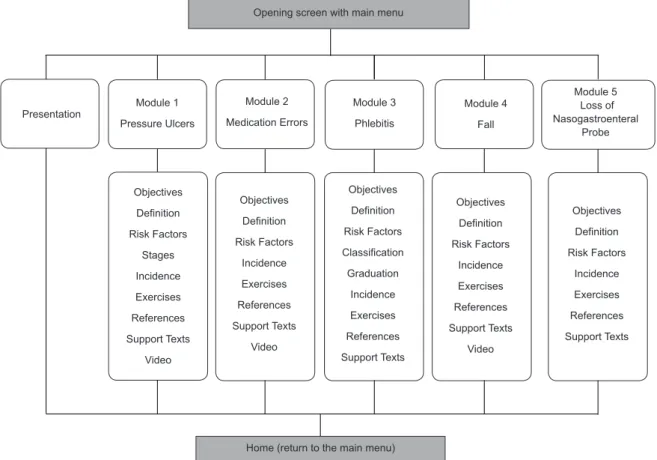
eventosadversos. Figure 1 presents the environment
Rev. Latino-Am. Enfermagem 2011 Sep.-Oct.;19(5):1181-7.
Figure 1 – VLE navigation structure addressing Adverse Events in Nursing Services. Ribeirão Preto, SP, Brazil, 2010
Opening screen with main menu
Presentation
Module 1
Pressure Ulcers
Module 2
Medication Errors
Module 3
Phlebitis
Module 4
Fall
Module 5 Loss of Nasogastroenteral
Probe
Objectives
Definition
Risk Factors
Stages
Incidence
Exercises
References
Support Texts
Video
Objectives
Definition
Risk Factors
Incidence
Exercises
References
Support Texts
Video
Objectives
Definition
Risk Factors
Classification
Graduation
Incidence
Exercises
References
Support Texts
Objectives
Definition
Risk Factors
Incidence
Exercises
References
Support Texts
Video
Objectives
Definition
Risk Factors
Incidence
Exercises
References
Support Texts
Home (return to the main menu)
The environment developed is presented on an
opening screen containing the title, authorship, and main
menu, which includes the presentation and navigation to the ive modules (Pressure Ulcers, Medication Errors, Phlebitis, Fall, Loss of Nasogastroenteral Probe).
The environment is composed of approximately
123 pages (HTML language): one is the main menu and
six are considered sub-menus that guide the themes
of interest. The link ‘Presentation of the Main Menu’
contains a welcome message to users, the description
of the environment’s general objective, content to
be navigated, and three links—two national and one
international— and organizations involved with the
studied theme.
On the access screen of each module, the user inds learning objectives, the deinition of the adverse event in question, risk factors that predispose the occurrence of such an event, incidents of the event, ixation exercises, references used in constructing content, and support
texts indicated to improve the theme. There are also hypertext links for speciic module content, such as the link for stages in module 1 (pressure ulcers) and classiication and graduation in module 3 (phlebitis). It is worth noting that links of videos were made available
for modules 1 (ulcer pressure), 2 (medication errors)
and 4 (Fall).
Aiming to promote interactivity and provide
feedback to the VLE users, the Exercises link offer three ixation exercises for each module: one in the format of crossword puzzles and two in the format of a multiple
choice test.
Discussion
VLE are computer systems available on the internet,
intended to support activities mediated by information
and communication technology. Such environments
allow integrating multiple media, languages and
resources, presenting information in an organized
manner, developing interactions among people and
objects of knowledge and developing and the socializing
of productions. The activities are developed at the time,
speed, and place of each participant according to each
one’s purpose(10).
Digital learning environment resources enable
the management of information according to a pre-established organization criterion deined according to the characteristics of each software program. These
in different media (such as texts, images, videos,
hypertexts) interconnected with texts, internal or
external, in the system(10).
The representation of information in hypertexts
with the use of distinct media and languages permit
breaking with static and linear sequences of a one-way route, with a previously ixed beginning, middle and end. A hypertext makes available a range of possibilities
of information that allow a reader to interconnect
information according to his/her interests and needs,
navigating and constructing his/her own sequences
and routes. When the user jumps among groups of
information and establishes his/her own connections
and associations, s/he interacts with the hypertext and
can assume a more active role than merely reading a
text in the linear space of a printed material(10).
The use of hypertext in the nursing ield has great potential for professionals who work in direct care with
patients. It can be employed as a rapid means to access
clinical information and guidance concern nursing care(11).
The use of hypertexts in the environment in question
enables a greater level of interactivity of users with the
resource as well as the creation of non-linear sequences
of study or consultation, in which the starting point of
the visited subject can also be the point of arrival. The
use of hypertexts enables users to navigate quickly
through a great quantity of information.
The use of VLE conigures a new educational possibility that can be explored by nursing professionals,
be it in teaching at universities or in continuing education
provided in services.
In addition to competencies already employed
during their activities, nursing professionals are being
required to show new competencies to meet political,
social, and productive transformations of human work.
Hence, such professionals need to acquire knowledge
concerning new resources enabled by computer technologies in their ield as a source of information and strategies of action(12).
This virtual learning environment on “Management
of Adverse Events in Nursing Services” was created to
follow the tendency of introducing new technologies in
nursing teaching as part of the continuing education of
nurses.
During the development of this environment the
following stages were followed in the process of creation:
development of content, programing, navigation tests
and creation of an interface.
When the diagram of navigation of a VLE interface
is examined as a whole, it may shown to the author
to determine whether the elements of the program are
where they were expected to be, whether the questions
are being used at appropriate intervals, and whether
there is balance between the visual and textual aspects
of the program(8).
An interface is deined as a connection between the system and the user, the means that allows access to the system. When deining an interface, one has the responsibility to demonstrate, through icons and menus,
the entire content of the VLE, all its functionalities, to
minimize the resources available in the system. However,
it is not advisable to show the content in a single screen,
since it would cause an excess of information, possibly
confusing the user(13).
To construct the interfaces, rules and techniques of
interface are utilized that cover characteristics such as:
layout, size and representations of icons, colors, balance
of objects arranged on the screen and other important
points to obtain applications with visual resources at an
acceptable level of interactivity(8,14).
Each module in this environment has a similar layout
of elements and titles; the links among the screens are
highlighted with different colors and with fonts larger than
the normal text. We opted to reveal content over several
pages to avoid an excess of information in a single screen
and enable greater interactivity for the user.
Language used in the interfaces should be
simple; clarity, objectivity, and accessibility are the
most important characteristics in language offered by
distance education environments. The purpose is to
make content more accessible to users, so they learn
and easily advance through the program(15-16).
The advantage of using the HTML language, that is,
hypertexts, is the possibility to rapidly navigate through
a large quantity of information. It allows exploring the
subject in a non-linear manner, because access to texts
of interest occurs through simply clicking on the desired
link(17).
Some authors highlight the use of techniques
that facilitate study in environments through the Web,
such as: the style of language adopted should be
simple and adapted to normal usages; sans serif fonts
(Arial, Verdana, and Tahoma) should be used because
these are more readable on screen; paragraphs and
sentences should be short; the usage of hyperlinks at
the end of each screen should be encouraged; massive
bodies of information should be divided into parts;
quantity of text per screen should be limited; citations
and bibliographies should come from reputable sources,
Rev. Latino-Am. Enfermagem 2011 Sep.-Oct.;19(5):1181-7.
The same information should appear in the same
position on the screen during an activity or in various
activities of a module. The use of various windows offers
the user the advantage of accessing multiple sources of information. An activity may be identiied through the title of the activity, the option in use marked in the
menu or by icons. Links should be clearly indicated to
the users, presented in colors and styles different from
the standard text (16).
In relation to the use of colors in the interface, these
should be sparingly used in order to avoid distracting
users from the main objective. It is not advisable to use
dark background colors or textures that may reduce the
readability of the text or interfere when users print the
material(16).
Only three colors were used in the title fonts, content
and links. The background was white (except for the
exercises screens, in which two light colors were used).
In relation to the inclusion of exercises, some
authors assert that the use of this resource enables users
to evaluate knowledge they acquire and that responses
provide feedback concerning their learning(18). Users can
verify the answers of each exercise proposed in this VLE
and obtain their percentage of right answers.
There is literature in the ield highlighting that the inclusion of videos in education evokes an immediate
response from users. Such a reaction may be determinant
in motivating users to engage in a given task(16).
Based on guidelines for the development of virtual
learning environments, some nurses and professors from the nursing ield have taken the initiative to construct such environments.
The author of a VLE addressing the teaching of
physiology in a nursing teaching diploma program
highlights that, with the use of this type of technology,
students have a supply of different learning styles available
for given content in multiple formats and sequences, and
are able to choose the most convenient one(19).
Researchers who developed a VLE for a vocational
nursing program encouraged educators and students
to navigate through the large supply of possibilities of
information and to work with the knowledge available
whether through the internet or existing technological
means, not only to aid the teaching-learning process but
also to develop future professionals, especially in the nursing ield(12).
We highlight that the development of a VLE is a
strategy that still needs to be better developed and
requires furthers studies to validate methodologies and educational strategies speciic to nursing(20).
The VLE addressing “Management of Adverse
Events in Nursing Services” will undergo technical and
content evaluation to be used in the continuing education
of nurses.
Conclusion
Given the results found for the proposed objectives,
we conclude that the search for knowledge within the
subject of Adverse Events reveals how to produce quality and safe nursing care for professionals and also that the
use of a new educational technology such as a VLE is
an innovative strategy and a change of paradigm in the qualiication of professionals in health institutions.
The development of a virtual learning environment
addressing the management of adverse events approaching the themes of pressure ulcers, medication
errors, phlebitis, falls, and loss of nasogastroenteral
probes will contribute to sensitizing nurses in relation to the types of events, risk factors, classiication, and incidence of such events.
It is worth noting that the pedagogical reference
grounded in information processing theory, as well as the methodology using the model Computer Assisted
Instruction for developing programs proved to be
appropriate for the development of this study.
This study’s objective was achieved and the VLE
entitled “Management of Adverse Events in Nursing
Services” can be fully consulted at: <http://www.eerp.
usp.br/nepien/eventosadversos>. The development of this environment still requires signiicant work because there is a need to deepen the theme both in
the pedagogical aspects and in relation to technical
resources.
The limitations found in the development of this
study are related to a lack of illustrative material and
videos depicting adverse events. Additionally, the cost of
producing online educational material is high, and may restrict initiatives to create such materials in the ield of nursing.
The authors will in the future proceed with the
technical and content evaluation of the VLE “Management
of Adverse Events in Nursing Services,” aiming to use
this educational material in the continuing education of
nurses in health institutions.
References
1. Évora YDM. As possibilidades de uso da internet na
pesquisa em enfermagem. Rev Eletr Enferm. [periódico
Disponível em: http://www.fen.ufg.br/revista/revista6_3
/pdf/11_Revista1.pdf
2. Novaes CC. Os recursos da tecnologia de informática:
um estudo sobre sua utilização no ensino de graduação
nas Escolas de Enfermagem do Município de São Paulo
[dissertação de mestrado]. São Paulo (SP): Escola de
Enfermagem da Universidade de São Paulo; 2005. 196 p.
3. Leape LL, Brennan TA, Laird N, Lawthers AG, Localio
AR, Barnes BA, et al. The nature of adverse events in
hospitalized patients. Results of the Harvard Medical
Practice Study II. N Engl J Med. 1991; 324:377-84.
4. Mendes W, Travassos C, Martins M, Noronha JC.
Revisão dos estudos de avaliação da ocorrência de
eventos adversos em hospitais. Rev Bras Epidemiol.
2005;8(4):393-406.
5. Ministério da Saúde (BR). Agência Nacional de
Vigilância Sanitária (ANVISA). 2010 [acesso 23 abr
2010]. Disponível em: http://portal.anvisa.gov.br
6. Gagné RM. Princípios essenciais da aprendizagem
para o ensino. Porto Alegre: Globo, 1980. p.15, 28-43.
7. Polit DF, Beck CT, Hungler BP. Fundamentos de pesquisa
em enfermagem: métodos, avaliação e utilização. Porto
Alegre: Artmed, 2004.
8. Price RV. Computer-aid instruction: a guide for
authors. California: Brooks/Cole Publishing Company,
1991.
9. Peres HHC, Leite MMJ. Informática no ensino de
enfermagem. In: Kalinowski C, Martini JG, Felli VEA.
Programa de Atualização em Enfermagem: saúde do
adulto (PROENF/ABEN) – Ciclo 1, Módulo 1. Porto Alegre:
Artmed/Panamericana; 2006. p. 58-74.
10. Almeida MEB. Educação a distância na internet:
abordagens e contribuições dos ambientes digitais de
aprendizagem. Edu Pesqui. 2003;29(2):327-40.
11. Caetano KC, Peres HHC. Metodologia para
estruturação de hipertexto aplicada ao ensino de
enfermagem. Acta Paul Enferm. 2007;20(2):175-9.
12. Aguiar RA, Cassiani SHB. Desenvolvimento e
avaliação de ambiente virtual de aprendizagem em curso
profissionalizante de enfermagem. Rev. Latino-Am.
Enfermagem. [periódico na Internet]. 2007 [acesso 5
jun 2010]; 15(6):1086-91. Disponível em: http://www.
scielo.br/scielo.php?script=sci_arttext&pid=S0104-116
92007000600005&lng=en&nrm=iso&tlng=pt
13. Salles JAG, Costa CA, Cardoso RC. Necessidades
para o desenvolvimento de uma interface adequada para
resultados de ensino-aprendizagem bem sucedidos. In:
Anais do 4° Seminário Nacional de Educação a Distância
[internet]. 2006 [acesso 4 jun 2010]. Disponível em:
http://www.abed.org.br/seminario2006/pdf/tc047.pdf
14. Pressman RS. Engenharia de software. São Paulo:
Makron Books; 1995. 15. Freitas AA, Loyolla W, Prates
M. Linguagem e arquitetura de conteúdos em educação
à distância mediada por computador. 2002 [acesso 4
jun 2010]. Disponível em: http://www.abed.org.br/
Congresso2002/trabalhos/texto03.htm
16. Nascimento CA. Princípios de design na elaboração
de material multimídia para a web. In: Núcleo de
Educação a Distância/UNISAL [internet]. 2006 [acesso
4 jun 2010]. Disponível em: http://www.nead.unisal.br/
files/principios_de_design%5B3%5D.pdf
17. Mitushima SM. Desenvolvimento de um web
site educacional sobre monitorização hemodinâmica
[dissertação de mestrado]. São Paulo (SP): Escola
Paulista de Medicina da Universidade Federal de São
Paulo; 2004. 126 p.
18. Évora YDM, Melo MRAC, Bernardes A, Seixas CA. O
uso da tecnologia interativa no ensino de Administração
Aplicada à Enfermagem. In: Anais eletrônicos do
Congresso Brasileiro de Informática na Saúde (CBIS)
[internet]. 2008 [acesso 24 ago 2009]. Disponível em:
http://www.sbis.org.br/cbis11/arquivos/979.pdf.
19. Rangel EML. Avaliação do ambiente virtual de
aprendizagem no ensino de fisiologia em um curso
de licenciatura em enfermagem [tese de doutorado].
Ribeirão Preto (SP): Escola de Enfermagem de Ribeirão
Preto da Universidade de São Paulo; 2009. 208 p.
20. Caetano KC. Desenvolvimento e avaliação de um
ambiente virtual de aprendizagem em administração
em enfermagem [dissertação de mestrado]. São Paulo
(SP): Escola de Enfermagem da Universidade de São
Paulo; 2006. 155 p.