Corresponding Author: www.eerp.usp.br/rlae
Corresponding Author: Rosana Aparecida Spadoti Dantas
Universidade de São Paulo. Escola de Enfermagem de Ribeirão Preto Departamento de Enfermagem Geral e Especializada
Av. dos Bandeirantes, 3900 Bairro: Monte Alegre
CEP: 14040-902, Ribeirão Preto, SP, Brasil E-mail: [email protected]
Health-related quality of life in patients admitted after a first
episode of acute coronary syndrome
Carina Aparecida Marosti Dessotte
1Rosana Aparecida Spadoti Dantas
2André Schmidt
3Lídia Aparecida Rossi
4This study aimed to investigate health-related quality of life based on the four weeks
antecedent to first admission for acute coronary syndrome and describe potential
associations between quality of life, gender and prior treatment for any other cardiovascular
condition. An exploratory, descriptive and cross-sectional study was conducted in two public
hospitals in an inner state city of the State of São Paulo. Of 253 participants studied, 69.2%
were male, 69.6% were married or living with a partner, and 58.1% were professionally
active before the current hospital admission. Mean age was 57.9 years old. Higher scores
were seen in the Social Functioning (
x
=86.1) domain, while the domain perceived asmore compromised was Role Physical (
x
=57.7). Female participants and those who hadpreviously been treated for any other cardiovascular condition had lower quality of life, and
these differences were all statistically significant (p<0.05).
Descriptors: Quality of Life; Coronary Disease; Acute Coronary Syndrome.
1 RN, Doctoral Student, Escola de Enfermagem de Ribeirão Preto, Universidade de São Paulo, WHO Collaborating Centre for Nursing
Research Development, SP, Brazil. E-mail: [email protected].
2 RN, Ph.D. in Nursing, Associate Professor, Escola de Enfermagem de Ribeirão Preto, Universidade de São Paulo, WHO Collaborating
Centre for Nursing Research Development, SP, Brazil. E-mail: [email protected].
3 Physician, Ph.D. in Medicine, Professor, Faculdade de Medicina de Ribeirão Preto, Universidade de São Paulo, SP, Brazil. E-mail:
4 RN, Ph.D. in Nursing, Full Professor, Escola de Enfermagem de Ribeirão Preto, Universidade de São Paulo, WHO Collaborating Centre
Qualidade de vida relacionada à saúde de sujeitos internados, decorrente da primeira síndrome coronariana aguda
O objetivo deste estudo foi investigar a qualidade de vida relacionada à saúde, baseada
nas últimas quatro semanas que antecederam a primeira internação, por uma síndrome
coronariana aguda, e descrever potenciais associações entre a qualidade de vida, sexo
e tratamento prévio para outras doenças cardiovasculares. Usou-se, como método, o
estudo descritivo e exploratório, do tipo transversal, realizado em dois hospitais públicos
no interior do Estado de São Paulo. Dos 253 sujeitos estudados, 69,2% eram homens,
69,6% casados, ou viviam com um parceiro, e 58,1% eram proissionalmente ativos
antes da internação. A idade média era de 57,9 anos. Os maiores escores obtidos foram
no domínio aspectos sociais (
x
=86,1), enquanto o domínio mais comprometido foiaspectos físicos (
x
=57,7). Conclui-se que as mulheres, assim como os sujeitos quejá faziam tratamento prévio para outras doenças cardiovasculares, apresentaram pior
qualidade de vida, e as diferenças foram todas estatisticamente signiicantes (p<0,05).
Descritores: Qualidade de Vida; Doença das Coronárias; Síndrome Coronariana Aguda.
Calidad de vida relacionada a la salud de sujetos internados, como consecuencia del primer síndrome coronario agudo
El objetivo de este estudio fue investigar la calidad de vida relacionada a la salud,
basada en las últimas cuatro semanas que antecedieron a la primera internación, por
un síndrome coronario agudo, y describir potenciales asociaciones entre la calidad
de vida, sexo y tratamiento previo para otras enfermedades cardiovasculares. Como
método, se utilizó el estudio descriptivo y exploratorio, de tipo transversal, realizado
en dos hospitales públicos en el interior del Estado de Sao Paulo. De los 253 sujetos
estudiados, 69,2% eran hombres, 69,6% casados, o vivían con un compañero, y 58,1%
eran profesionalmente activos antes de la internación. La edad promedio fue de 57,9
años. Los mayores puntajes obtenidos fueron en el dominio aspectos sociales (
x
=86,1), en cuanto el dominio más comprometido fue aspectos físicos (
x
=57,7). Seconcluye que las mujeres, así como los sujetos que ya hacían tratamiento previo para
otras enfermedades cardiovasculares, presentaron peor calidad de vida, y las diferencias
fueron todas estadísticamente signiicativas (p<0,05).
Descriptores: Calidad de Vida; Enfermedad Coronária; Síndrome Coronario Agudo.
Background
Atherosclerotic cardiovascular diseases are the
main causes of death and disability worldwide today. It is
estimated that around 81 million U.S. adults have one or
more cardiovascular diseases. Myocardial infarction and
angina are the most prevalent conditions among men and
they increase with age and education(1). The Pan American
Health Organization has considered chronic diseases
devastating, not only to patients and their families but also
to their communities, especially poor ones, and a growing
threat to economic development. It is estimated that
Latin American and Caribbean countries will experience a
threefold increase in the incidence rates of ischemic heart
disease and stroke in the next 20 years. In most Latin
American and Caribbean countries, chronic diseases are
now the main cause of premature mortality and disability,
accounting for almost 50% of disability-adjusted life
years lost in the region. It is projected for the irst 10
years of the 21th century that cardiovascular diseases
will cause around 20.7 million deaths. The projections
for the next 20 years include almost a threefold increase
in mortality due to ischemic heart disease and stroke
(deaths per 100,000) for ischemic disease in individuals
aged 40 to 49 is 29, reaching 425 in those aged 70 to 79
years, and 914 in those 80 years or more. Total deaths in
absolute numbers due to cardiovascular diseases reported
in Brazil in 2005 were 283,565, 84,871 of which were due
to ischemic disease(3).
Coronary artery disease (CAD) is the most common
cause of acute coronary syndrome (ACS). ACS is
characterized mainly by clinical symptoms, such as chest
tightness or pain, shortness of breath and fatigue(4).
Patients have to face different new life situations after
diagnosis, such as having to learn how to live with a heart
condition and potential disability for the rest of their life,
which has lead to many investigations focusing on these
individuals’ health-related quality of life (HRQoL).
A comparison of HRQoL between individuals from the
general population and those with CAD has shown that the
latter have lower scores in both physical and emotional
aspects when compared to those without CAD(5-6).
Most studies assessing HRQoL in patients with CAD
have been carried out in the United States(6-8), European
countries(5,9-10) and a smaller number of studies have
been conducted in countries like Canada(11). Their
assessments of HRQoL have been largely based on the
Medical Outcomes Study: 36-Item Short Form Survey (SF-36) questionnaire and researchers have conducted
these assessments at different time points after irst
hospital admission due to CAD(7,9-15). However, there
are scarce studies using a retrospective approach that
assess HRQoL during the irst hospital admission, and
the few studies available have focused on patients
with acute myocardial infarction (AMI)(10). Patients with
unstable angina (UA), the other common presentation of
ACS, have been barely explored.
Most knowledge on HRQoL in individuals with
CAD has been produced in developed countries and
predominantly studied patients during rehabilitation
after hospital discharge. Bearing in mind the multiplicity
of factors involved in the diagnosis and treatment
of CAD and the subjective component of quality
of life assessment, there is a need to extend this
investigation to involve other populations with different
sociodemographic and cultural characteristics. People
living in developing countries like Brazil may have
different perceptions of the domains associated to their
HRQoL after being diagnosed with CAD.
Few Brazilian studies have been conducted on
HRQoL in CAD patients(15-19). There is a need to explore
how these individuals perceive their HRQoL in the month
prior to their irst hospital admission due to ACS. This
knowledge can help health care professionals to better
understand how they perceive the manifestations of
a diseased heart and, thus, how the health care team
should approach them to prevent more severe events
and eventually help to develop a care plan during hospital
admission and rehabilitation. Based on a literature search and our clinical experience, we decided to explore the
following question: are there any differences in HRQoL
in patients admitted for the irst time due to ACS (AMI
and UA) according to gender and prior treatment for
any other cardiovascular condition? Some studies have
reported lower scores of HRQoL among women with
CAD(6,8,11,13,16) and other cardiovascular conditions(14).
The objectives of the present study were to
investigate HRQoL based on the patients’ four weeks of
life prior to irst hospital admission due to ACS and to
describe any potential associations between HRQoL and
gender and prior treatment for any other cardiovascular
condition.
Methods
Design, Setting and Sample
An observational, descriptive, cross-sectional
study was conducted in two public hospitals. One of
them was the University Hospital, a tertiary care facility
afiliated to the School of Medicine of the University of
São Paulo, campus of Ribeirão Preto. The University
Hospital is considered one of the most advanced public
health centers in the country, serving a large population
in the metropolitan area around the city, as well as
patients from other parts of the state and country. The
other hospital was a tertiary care facility too, and had
philanthropic purposes (Santa Casa de Misericórdia). Approval for the study was obtained from the
hospitals’ Research Ethics Committees. All participants
received appropriate verbal and written explanations on
the study and both researchers and participants signed
an informed consent form.
Potential participants were patients receiving care at the study hospital who met the following inclusion
criteria: hospital admission due to a irst episode of ACS;
admission for at least 24 hours and no more than seven
days; age over 21 years old; good clinical (physical
and psychological) condition to be able to undergo an
interview and participate in the study. In total, 253
participants were included in the study between May
2006 and July 2009. The enrollment period was deined
by time and human resources available to conduct the
this study was an observational study, whose primary
objective was exploratory and not conirmatory.
Measure
All data were collected during individual interviews
with participants during their admission. The collection
instrument comprised sociodemographic (gender,
marital status, employment status and date of birth)
and clinical (diagnosis of ACS during admission and
prior treatment for any other cardiovascular condition)
variables. Clinical data were obtained through review
of the patient’s medical records. Psychoactive drug use
during admission was investigated as it can compromise
patients’ perception of HRQoL.
The HRQoL was assessed using the Medical
Outcomes Study (MOS): 36-Item Short Form Survey
(SF-36)(20) instrument in a version adapted to Brazilian
Portuguese(21), with proven reliability and validity among
CAD patients(15-18).
Subjects were asked to consider the last four
weeks to answer the questions, which supports the
questionnaire’s adequacy for the present study. The
internal consistency of the items in each SF-36 domain
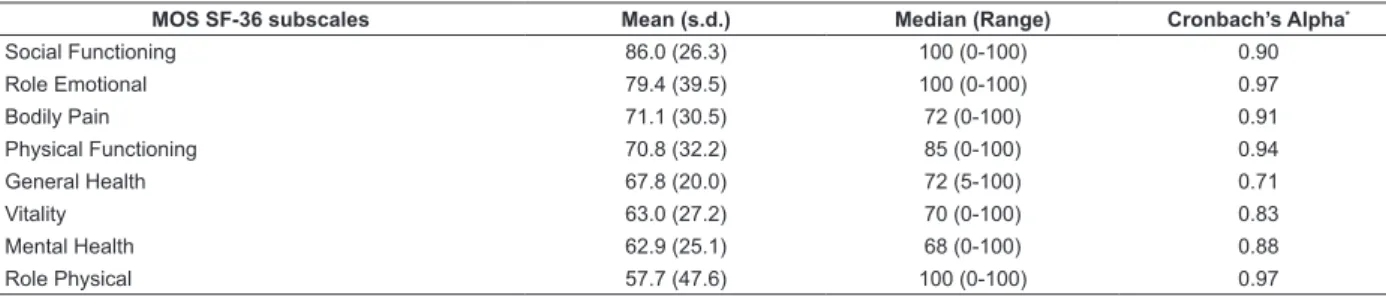
had Cronbach’s alpha coeficients ranging from 0.71
(General Health) to 0.97 (Role Emotional and Role
Physical), which corresponds to good internal reliability.
Analyses
Data were processed and analyzed using the
Statistical Package for Social Science (SPSS) version
15.0. To assess potential differences between groups
(according to gender and prior treatment), Student’s
t-test for independent samples was used. A 5%
signiicance level was set.
Results
Of 253 participants studied, 175 (69.2%) were
male, 176 (69.6%) were married or living with a partner,
and 147 (58.1%) were professionally active before the
current hospital admission due to ACS. Mean age was
57.9 years old (s.d.=12.2), ranging between 25.4 and
82.2 years.
As for diagnosis upon admission, 142 (56.1%)
were admitted due to AMI and 111 (43.9%) due to
UA. It was found that 141 (55.7%) participants had
been treated for any other cardiovascular condition
before the irst episode of ACS, and the most common
associated condition was arterial hypertension (135;
53.0%). Among all participants, 62 (24.5%) were taking
psychoactive drugs during hospital admission.
The results of the HRQoL assessment in patients
irst admitted due to ACS are shown in Table 1. Higher
scores were seen in the Social Functioning (
x
=86.0;s.d.=26.3) and Role emotion domains (
x
=79.4;s.d.=39.5), while the domains perceived as more
compromised were Role Physical (
x
=57.7; s.d.=47.6),Mental Health (
x
=62.9; s.d.=25.1) and Vitality(x
=63.0; s.d.=27.2).Table 1 - Descriptive statistics and reliability of MOS SF-36 subscales (n = 253). Ribeirão Preto, Brazil, 2006 – 2009
With respect to psychoactive drug use and HRQoL,
higher mean scores were found in the eight SF-36
domains among participants not taking any psychoactive
drugs (means ranging between 59.0 in the Role Physical
domain and 87.0 in the Social Functioning). Among
those taking psychoactive drugs, the most compromised
domain was also Role Physical (
x
=53.6) and theleast compromised was Social Functioning (
x
=82.2).However, the difference between the groups studied was
only statistically signiicant for Role Emotional (p=0.034),
Mental Health (p=0.004) and Vitality (p=0.032).
The analysis of potential differences in
HRQoL according to prior treatment for any other
cardiovascular condition showed that those without
prior treatment had signiicantly higher mean scores
in all SF-36 domains (67.1 to 91.5) than those with
prior treatment (mean scores ranging between 47.7
and 81.6) (Table 2).
MOS SF-36 subscales Mean (s.d.) Median (Range) Cronbach’s Alpha*
Social Functioning 86.0 (26.3) 100 (0-100) 0.90
Role Emotional 79.4 (39.5) 100 (0-100) 0.97
Bodily Pain 71.1 (30.5) 72 (0-100) 0.91
Physical Functioning 70.8 (32.2) 85 (0-100) 0.94
General Health 67.8 (20.0) 72 (5-100) 0.71
Vitality 63.0 (27.2) 70 (0-100) 0.83
Mental Health 62.9 (25.1) 68 (0-100) 0.88
Role Physical 57.7 (47.6) 100 (0-100) 0.97
The analysis of HRQoL by gender evidenced that
men had higher mean scores (89.3 to 65.1) than women
(78.7 to 41.0) in all domains, and these differences were
statistically signiicant (Table 3).
Table 2 - Means of MOS SF-36 subscales by presence of prior treatment for any other cardiovascular condition and
probability values (p) associated to Student’s t-test for independent samples. Ribeirão Preto, Brazil, 2006 – 2009
MOS SF-36 subscales With prior treatment (n= 141) Without prior treatment (n= 112) p Mean (s.d.) Mean (s.d.)
Social Functioning 81.6 (29.7) 91.5 (20.3) 0.002*
Role Emotional 74.2 (42.8) 86.0 (33.9) 0.015*
Bodily pain 66.7 (31.4) 76.6 (28.4) 0.009*
General Health 64.4 (20.2) 72.1 (19.0) 0.002*
Physical functioning 62.2 (33.2) 81.8 (27.2) <0.001†
Mental Health 59.7 (26.3) 67.1 (23.1) 0.018*
Vitality 57.8 (28.3) 69.6 (24.3) <0.001†
Role Physical 47.7 (48.9) 7.03 (42.9) <0.001†
*0.01<p<0.05; †p<0.01: statistically signiicant
Table 3 - Means of MOS SF-36 subscales by gender and
probability values (p) associated to Student’s t-test for
independent samples. Ribeirão Preto, Brazil, 2006 –
2009
MOS SF-36 subscales
Male (n=175) Female (n=78) p Mean (s.d.) Mean (s.d.)
Social Functioning 89.3 (23.1) 78.7 (31.5) 0.009*
Role Emotional 88.2 (30.9) 59.8 (48.7) <0.001†
Physical Functioning 78.0 (27.7) 54.8 (35.8) <0.001†
Bodily Pain 75.6 (28.7) 61.1 (32.1) <0.001†
General Health 70.3 (18.4) 62.2 (22.3) 0.006*
Mental Health 68.9 (21.5) 46.5 (27.4) <0.001†
Vitality 68.8 (23.8) 50.0 (29.8) <0.001†
Role Physical 65.1 (4.8) 41.0 (47.6) <0.001†
*0.01<p<0.05; †p<0.01: statistically signiicant
Discussion
The age distribution of our study participants was
similar to that reported in other studies investigating
patients with CAD(10,13-16,22). There was a greater
proportion of men in our sample, which was also
reported in other studies of HRQoL in patients with heart
disease(10,12-17,22-23).
With regard to participants’ assessment of HRQoL
in the SF-36 for the four weeks prior to hospital
admission due to a irst episode of ACS, lower scores
were seen in the Role Physical domain, with an overall
mean score of 57.7. This domain assesses how health
(physical) problems interfere in their daily activities
and work. When this domain was analyzed according
to the variables treatment for any other cardiovascular
condition, psychoactive drug use during admission and
gender, greater compromise was seen among those
who had been under treatment (
x
=47.7), were takingpsychoactive drugs during admission (
x
=53.6), andfemales (
x
=41.0). This same impairment was alsoseen in other studies, but their mean scores were higher
than those found in the present study(13-14). However,
another Brazilian study on coronary patients reported a
mean score of 19 among female patients(16), well below
the mean score found in our study.
The highest scores of HRQoL were seen in the
Social Functioning domain, with a mean score of 86.0.
This domain assesses how (physical or emotional) health
problems affect the patients’ social activities. The study
sample predominantly consisted of low-income patients,
a common feature in public hospitals in Brazil. Because
they have few opportunities for social life and recreation,
these activities usually involve paying family visits and
attending church, which do not require much physical
exertion.
A comparison of the study results with those of
other investigations is limited to a small number of
publications that also studied patients with CAD during
hospital admission(13-14). However, when the domains with
the highest scores before the irst hospital admission due
to ACS are compared to those found in coronary patients
within one year of hospital discharge, the highest scores
are still found in the Social Functioning domain(9,14,16,24).
The lowest scores of HRQoL were seen in the Role
Physical domain, which was expected due to limitations
caused by CAD. The lowest scores in this domain were
also reported in other coronary patients assessed within
one year after discharge(12,16,24), though other domains
remained compromised as well, such as Vitality(9) and
General Health(14).
We expected patients who had been treated for
any other cardiovascular condition to have a different
never been treated, and so compared both groups.
The results demonstrated that participants with prior
treatment had signiicantly lower scores in the eight SF-36 domains one month prior to their irst admission due
to ACS. When HRQoL was analyzed by prior treatment,
it was veriied that the highest mean scores were
in the Social Functioning and Role Emotion domains
in both groups. However, mean scores were higher
among subjects without prior treatment for any other
cardiovascular condition. A similar inding was reported
in another study, showing lower mean scores among
subjects with prior cardiovascular diseases(13).
Potential gender differences in HRQoL were found.
Compared to men, women admitted due to a irst
episode of ACS had statistically lower scores in all SF-36
domains. This inding is corroborated in studies conducted
in other countries(10,12-14,22) and in Brazil as well(15-17).
Lower HRQoL among women with CAD remained in the
assessments after hospital discharge, regardless of their
treatment(16,22). These indings suggest that women are
more vulnerable, overall have more physical limitations,
greater emotional impairment, and suffer more from
distress and anxiety than men(25).
In our study, we opted to investigate HRQoL
during the four weeks of a patient’s life prior to hospital
admission, so as to be consistent with the time frame
covered in the SF-36 questionnaire. But the assessment
of HRQoL during this time period may not have captured
the actual variability of health conditions coronary
patients experience(18,26).
Implications for clinical practice
In Brazil, to date, there are no other studies
assessing HRQoL in persons experiencing their irst
episode of ACS focusing on the month prior to the event.
Most Brazilian and international studies have studied
coronary patients after hospital discharge while receiving
outpatient treatment, during repeat hospitalization and
rehabilitation.
A limitation of our study is that our results could
not be compared with the general Brazilian population,
as there were no studies using SF-36 in the general
population. Another limitation is that participants
represented only a fraction of patients attending public
health settings and that better-off patients attending
private clinics and hospitals were not investigated.
The present study was based on a generic
HRQoL questionnaire. Further studies using speciic
questionnaires for this group of patients, e.g. Seattle
Angina Questionnaire and MacNew Questionnaire, are
needed to produce more knowledge to develop new care
protocols for coronary patients, aiming to provide better care and improve their recovery and rehabilitation.
In this sense, the current care model available
at coronary units and cardiology wards for treating
patients with a irst episode of ACS should be reviewed,
paying special attention to gender issues, as the present study demonstrated. Based on this information, the
multidisciplinary team can develop care plans to minimize physical and emotional impairment of female patients.
This can also help to improve their rehabilitation, as some longitudinal studies have demonstrated that their
perception of HRQoL tends to get worse over time, i.e.
their physical and psychological impairment increases over the years.
Conclusions
In conclusion, we found an association between
HRQoL measured by the eight domains of the SF-36 and prior treatment for any other cardiovascular condition
and HRQoL and gender. The patients admitted due to a
irst episode of ACS already experienced both physical
and emotional impairments in several domains of
their life. Female participants and those who had been previously treated for any other cardiovascular condition
had lower HRQoL.
These study results emphasize the need to
individualize care for CAD patients, considering the illness experience and including gender-related aspects.
Multidisciplinary teams, composed of psychologists, occupational therapists and nurses for example, could
coordinate support groups for these persons. The focus of these groups would be on the persons as a whole,
not only on their physical and clinical rehabilitation
measures.
Future follow-up research for these patients could
reveal whether these differences continue throughout the rehabilitation process.
References
1. Rosamond W, Flegal K, Furie K, Go A, Greenlund
K, Haase N, et al. Heart disease and stroke statistics – 2008 Update: a report from the American Heart
Association Statistics Committee and stroke statistics
Subcommittee. Circulation. 2008;117:e25-e146. 2. Pan American Health Organization – World Health
Organization. 47th Directing Council-58th session of the regional committee 2006. [acesso 04 dez 2009].
Disponível em: http://search.bvsalud.org/regional/
3. Indicadores e Dados Básicos - Brasil. Rede
Interagencial de Informação para a Saúde. [acesso 04
dez 2009]. Disponível em: http://tabnet.datasus.gov.
br/cgi/idb2007/matriz.htm.
4. Anderson JL, Adams CD, Antman EM, Bridges CR,
Califf RM, Casey DE, et al. ACC/AHA 2007 Guidelines
for the Management of patients with Unstable Angina/
Non-ST Elevation Myocardial Infarction: a Report of
the American College of Cardiology/American Heart
Association Task Force on Practice Guidelines (Writing
Committee of Revise the 2002 Guidelines for the
Management of patients with Unstable
Angina/Non-ST Elevation Myocardial Infarction) Developed in
Collaboration with the American College of Emergency
Physicians, The Society for Cardiovascular Angiography
and Interventions, and The Society of Thoracic Surgeons
Endorsed by The American Association of Cardiovascular
and Pulmonary Rehabilitation and the Society for
Academic Emergency Medicine. J Am Coll Cardiol.
2007;50:e1-e157.
5. Torres MS, Calderón SM, Días IR, Chacón AB,
Fernández FL, Martínez IF. Health-related quality of life
in coronary heart disease compared to norms in Spanish
population. Qual Life Res. 2004;13:1401-7.
6. Ford ES, Mokdad AH, Li C, McGuire LC, Strine TW,
Okoro CA, et al. Gender differences in Coronary Heart
Disease and Health Related Quality of Life: Findings
from 10 States from the 2004 Behavioral Risk Factor
Surveillance System. J Womens Health. (Larchmt)
2008;17(5):757-68.
7. Maddox TM, Reid KJ, Rumsfeld JS, Spertus, JA.
One-year health status outcomes of unstable angina versus
myocardial infarction: a prospective, observational
cohort study of ACS survivors. BMC Cardiovasc Disord.
2007;7:28.
8. Xie J, Wu EQ, Zheng ZJ, Sullivan PW, Zhan L, Labarthe
DR. Patient Reported Health Status in Coronary Heart
Disease in the United States: Age, Gender, Racial and
Ethnic Differences. Circulation. 2008;118:491-7.
9. Kim J, Henderson RA, Pocock SJ, Clayton T, Sculpher MJ,
Fox KA. Health-related quality of life after interventional
or conservative strategy in patients with unstable angina
or non-ST-segment elevation myocardial infarction:
one-year results of the third Randomized Intervention
Trial of unstable Angina (RITA-3). J Am Coll Cardiol.
2005;45(2):221-8.
10. Bergman E, Malm D, Karlsson JE, Bertero C.
Longitudinal study of patients after myocardial infarction:
Sense of coherence, quality of life, and symptoms. Heart
Lung. 2009;38(2):129-40.
11. Norris CM, Hegadoren K, Pilote L. Depression
symptoms have a greater impact on the 1-year
health-related quality of life outcomes of women
post-myocardial infarction compared to men. Eur J Cardiovasc
Nurs. 2007;6(2):92-8.
12. Brink E, Grankvist G, Karlson BW, Hallberg M.
Health-related quality of life in women and men after acute
myocardial infarction. Qual Life Res. 2005;14:749-57.
13. Soto M, Failde I, Márquez S, Benítez E, Ramos I,
Barba A, et al. Physical and mental component summaries
score on the SF-36 in coronary patients. Qual Life Res.
2005;14(3):759-68.
14. Failde II, Soto MM. Changes in Health Related Quality
of Life 3 months after an acute coronary syndrome. BMC
Public Health. 2006;6:18-28.
15. Gallani MCBJ, Colombo RCR, Alexandre NMC,
Bressan-Biajone AM. Qualidade de vida em pacientes
coronariopatas. Rev Bras Enferm. 2003;56(1):40-3.
16. Favarato ME, Favarato D, Hueb WA, Aldrighi JM.
Qualidade de vida em portadores de doença arterial
coronária: comparação entre gêneros. Rev Assoc Med
Bras. 2006;52(4):236-41.
17. Favarato ME, Hueb W, Boden WE, Lopes N, Nogueira
CRSR, Takiuti M, et al. Quality of life in patients with
symptomatic multivessel coronary artery disease: A
comparative post hoc analyses of medical, angioplasty
or surgical strategies-MASS II trial. Int J Cardiol.
2007;116:364-70.
18. Dantas RAS, Ciol MA. Quality of life after
Coronary Artery Bypass Surgery. West J Nurs Res.
2008;30(4):477-90.
19. Vila VSC, Rossi LA. Quality of life from the perspective
of revascularized patients during rehabilitation: an
ethnographic study. Rev. Latino-Am. Enfermagem.
janeiro-fevereiro 2008;16(1):7-14.
20. Ware JE, Sherbourne CD. The MOS 36-Item Short
Form Health Survey (SF-36): Conceptual Framework
and Item Selection. Med Care. 1992;30(6):473-83.
21. Ciconelli RM, Ferraz MB, Santos W, Meinão I,
Quaresma MR. Brazilian-Portuguese version of the
SF-36. A reliable and valid quality of life outcome measure.
Rev Bras Reumatol. 1999;39(3):143-50.
22. Emery CF, Frid DJ, Engebretson TO, Alonzo AA,
Fish A, Ferketich AK, et al. Gender differences in
quality of life among cardiac patients. Psychosom Med.
2004;66(2):190-7.
23. Dantas RAS, Gois CLF, Silva LM. Use of the adapted
version of the Flanagan Quality of Life Scale with
post-surgical cardiac patients. Rev. Latino-Am. Enfermagem.
24. Kiebzak GM, Pierson LM, Campbell M, Cook JW. Use
of the SF36 general health status survey to document
health-related quality of life in patients with coronary
artery disease: effect of disease and response to
coronary artery bypass graft surgery. Heart Lung.
2002;31(3):207-13.
25. Van-Jaarsveld CH, Sanderman R, Ranchor AV, Ormel
J, Van-Veldhuisen DJ, Kempen GI. Gender-specific
changes in quality of life following cardiovascular
disease: a prospective study. J Clin Epidemiol.
2002;55(11):1105-12.
26. Lindsay GM, Hanlon P, Smith LN, Wheatley DJ.
Assessment of changes in general health status using
the short-form 36 questionnaire 1 year following
coronary artery bypass grafting. Euro J Cardio-thoracic
Surg. 2000;18:557-64.
Received: Feb. 18th 2010