Corresponding Author: www.eerp.usp.br/rlae
Corresponding Author: Viviane de Araújo Gouveia Rua São Paulo, 36
Bairro: Massaranduba, Prazeres
CEP: 54310-130, Jaboatão dos Guararapes, PE, Brasil E-mail: [email protected]
Pre-hospital attitudes adopted by patients faced with the symptoms
of acute myocardial infarction
1Viviane de Araújo Gouveia
2Edgar Guimarães Victor
3Sandro Gonçalves de Lima
4This case series aimed to evaluate the behavior adopted by patients during the pre-hospital
phase of acute myocardial infarction (AMI). A total of 115 AMI sufferers with ST-segment
elevation were evaluated. The chi-square and Fisher’s exact tests were applied. The
individuals that did not associate the symptoms with cardiovascular disease most often
attributed them to the following sources: gastrointestinal (38%), musculoskeletal (29.7%),
food and/or medication poisoning (8.5%) and arising from the respiratory apparatus
(6.3%). The proportion of major outcomes and of patients that arrived in the emergency
department after 12 hours was higher among women, individuals with monthly income of
up to one minimum wage, those who used analgesics and did not associate the symptoms
with cardiovascular disease. It was found that individuals in unfavorable socioeconomic
conditions, who interpreted the symptoms incorrectly, arrived later at the emergency
department and had worse intra-hospital outcomes.
Descriptors: Myocardial Infarct; Symptoms; Health Knowledge, Attitudes, Practice.
1 Article extracted from Master’s Thesis “Atitudes pré-hospitalares de indivíduos atendidos em uma emergência cardiológica frente aos
sintomas preditores de infarto agudo do miocárdio” presented to Universidade Federal de Pernambuco, PE, Brazil.
2 RN, M.Sc. in Health Sciences, Assistant Professor, Centro Acadêmico de Vitória, Universidade Federal de Pernambuco, PE, Brazil.
E-mail: [email protected].
3 Physician, Ph.D. in Medicine, Full Professor, Universidade Federal de Pernambuco, PE, Brazil. E-mail: [email protected].
4 Physician, Ph.D. in Health Public. Unidade de Terapia Intensiva, Hospital das Clínicas de Pernambuco, Universidade Federal de
Atitudes pré-hospitalares adotadas por pacientes frente aos sintomas de infarto agudo do miocárdio
Esta série de casos teve o objetivo de avaliar as condutas adotadas pelos pacientes,
durante a fase pré-hospitalar do infarto agudo do miocárdio (IAM). Avaliaram-se 115
indivíduos portadores de IAM, com supradesnivelamento do segmento ST. Foi aplicado
o teste qui-quadrado e o teste exato de Fisher. Os indivíduos que não associaram
os sintomas à doença cardiovascular atribuíram, mais frequentemente, às seguintes
origens: gastrointestinal (38%), osteomuscular (29,7%), intoxicação alimentar e/ou
medicamentosa (8,5%) e decorrentes do aparelho respiratório (6,3%). A proporção de
desfechos maiores e de pacientes que chegaram à emergência após 12 horas foi mais
elevada entre mulheres, indivíduos com renda mensal de até um salário mínimo, que
usaram analgésicos e não associaram os sintomas à doença cardiovascular.
Constatou-se que indivíduos em condições socio-conômicas desfavoráveis, que interpretaram os
sintomas de forma incorreta, chegaram mais tardiamente à emergência e apresentaram
piores desfechos intra-hospitalares.
Descritores: Infarto do Miocárdio; Sintomas; Conhecimentos, Atitudes e Prática em
Saúde.
Actitudes prehospitalarias adoptadas por pacientes frente a los síntomas de infarto agudo del miocardio
Esta serie de casos tuvo el objetivo de evaluar las conductas adoptadas por los pacientes
durante la fase prehospitalaria del infarto agudo del miocardio (IAM). Se evaluaron
115 individuos portadores de IAM con el segmento ST supradesnivelado. Fue aplicada
la prueba Chi-cuadrado y la prueba exacta de Fisher. Los individuos que no asociaron
los síntomas a la enfermedad cardiovascular la atribuyeron más frecuentemente a
los siguientes orígenes: gastrointestinal (38%), osteomuscular (29,7%), intoxicación
alimentar y/o medicamentosa (8,5%) y provenientes del aparato respiratorio (6,3%).
La proporción de resultados más graves y de pacientes que llegaron a la emergencia
después de 12 horas fue más elevada entre mujeres, individuos con renta mensual
de hasta un salario mínimo, que usaron analgésicos y no asociaron los síntomas a la
enfermedad cardiovascular. Se constató que individuos en condiciones socioeconómicas
desfavorables, que interpretaron los síntomas de forma incorrecta, llegaron más tarde a
la emergencia y presentaron peores resultados intrahospitalarios.
Descriptores: Infarto del Miocardio; Síntomas; Conocimientos, Actitudes y Práctica en
Salud.
Introduction
The pre-hospital phase in Acute Myocardial Infarction
(AMI) care, is comprehended as the onset of pain and the
recognition of the symptomology by the patient, up to
seeking irst aid, including travelling time to the nearest
hospital service(1-2). According to data of the American
Heart Association (AHA), transport to hospital is the
phase where more time is lost. It is estimated that the
time interval between the appearance of symptoms and
the arrival at the emergency unit ranges from an hour
and a half to six hours(2-3). To guarantee a good prognosis,
it is ideal that patients should not exceed more than 45
minutes between the interpretation of the symptoms
and the search for healthcare. The presentation of AMI
ranges from classic to nonspeciic symptoms, which
can interfere with the choice of appropriate behavior
symptoms results in a decrease in the delay of arrival
at the emergency unit. However, the lack of autonomy
and the progressive disability caused by the onset and
progression of the symptoms may contribute to the
individual becoming more passive in relation to the
situation, reducing the chances of survival(4-5).
The importance that the patient attributes to the
symptoms also inluences the choice of behavior(6-7). In
a study conducted by the AHA, it was observed that the
majority of the patients did not attribute great importance
to the symptoms of AMI, classifying them as “irrelevant”
and the behavior related to this interpretation was to
wait for the symptoms to inish(8). Some socio-cultural
characteristics, such as religion, gender, education level
and number of people per domicile, may also inluence
the choice of behavior(9-10). The aim of this study was
to evaluate the pre-hospital attitudes faced with the
symptoms suggestive of AMI in patients attended in a
cardiology emergency unit.
Method
This is a descriptive case series study, conducted
from February to June 2008, in the Cardiology
Emergency Unit of Pernambuco/PROCAPE. The sample
consisted of hospitalized individuals with a conirmed
diagnosis of AMI with ST segment elevation. Individuals
were excluded who were not able to provide information
because they were suffering from mental disorders
or were undergoing pharmacological treatment that
interfered with cognition, or even due to unfavorable
clinical conditions such as: cardiogenic shock, acute
pulmonary edema, respiratory failure and mechanical
ventilation, among others. The interpretations by the
patients of the symptoms were classiied as being of
cardiovascular origin or originating in other systems.
Behaviors deined as beneicial for the treatment of AMI
were those recommended by the III Brazilian Guidelines
for the Treatment of AMI(1). Myocardial Revascularization
Surgery (MRS), coronary angioplasty, angina recurrence
during the period of hospitalization, cerebrovascular
accident (CVA) and death were considered as major
outcomes.
To collect the data a questionnaire was used
which included questions regarding the socio-economic
and demographic conditions, pre-hospital behavior
performed by the individuals faced with predictor
symptoms of AMI, past morbidity and cardiovascular
risk factors. The outcomes were collected through
the medical records. With the intention of minimizing
memory bias, the maximum time for the application
of the questionnaire was 48 hours after admission to
the cardiology emergency unit. For the analysis of the
variables the chi-square test or the Fisher’s exact test
were applied as necessary. All the conclusions were
based on a signiicance level of 5%. The software used
was Excel 2000 and SPSS version 8.0. The research
project was approved by the research ethics committee
of the Health Sciences Center of the Federal University
of Pernambuco (CCS/UFPE) under protocol number
405/07.
Results
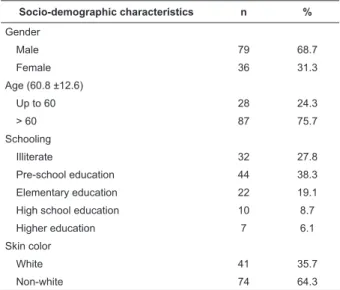
The sample was composed of 115 individuals. The
majority (94.8%) of the interviewees lived in brick built
houses, with a mean of 3.8 inhabitants per domicile,
outside the municipality of Recife, and had a mean
monthly income of 1.7 minimum wages (Table 1).
Table 1 - Distribution of the evaluated patients by
socio-demographic characteristics. Recife, PE, Brazil, 2009
Socio-demographic characteristics n %
Gender
Male 79 68.7
Female 36 31.3
Age (60.8 ±12.6)
Up to 60 28 24.3
> 60 87 75.7
Schooling
Illiterate 32 27.8
Pre-school education 44 38.3
Elementary education 22 19.1
High school education 10 8.7
Higher education 7 6.1
Skin color
White 41 35.7
Non-white 74 64.3
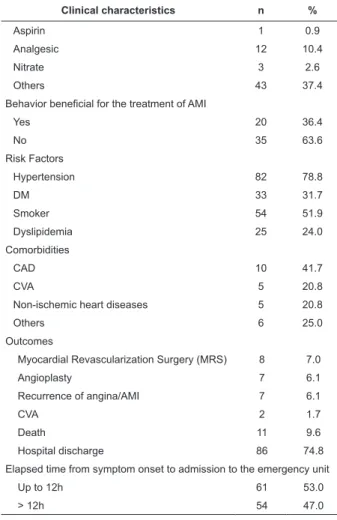
The individuals that interpreted the symptoms
as unrelated to cardiovascular disease, most often
attributed them to the following sources: digestive
system (38%), musculoskeletal system (29.7%), food
and/or medication poisoning (8.5%) and the respiratory
apparatus (6.3%). A small percentage (9.6%) opted for
two or more behaviors simultaneously or in sequence
faced with the symptoms presented. Only 18.7%
of the individuals chose, at least, one behavior that
really resulted in beneit for their health condition. An
use of medications without cardiovascular effects and
teas, bath, local massage, performing physical exercise,
prayer, ingestion of water, induction of vomiting, topical
application of alcohol, ingestion of alcoholic spirits, and
measurement of arterial pressure.
About 90% of the sample had at least one
risk factor for cardiovascular disease and 20% of
the participants had at least one comorbidity. The
duration from the onset of symptoms to the arrival
at the emergency unit varied from 30 minutes to ive days. This disparity justiies the mean travel time of
53 hours, although 61 patients (53%) arrived within
12 hours. The analysis of the outcomes presented by
the individuals up to the hospital discharge revealed
that 3.5% of the interviewees presented more than
one outcome. During a short period of time in which
the institution had no thrombolytics, some of the
86 patients who received hospital discharge were
transferred to other hospitals or discharged to perform
the procedure(s) later (Table 2).
Clinical characteristics n %
Interpretation of the symptoms
Cardiovascular origin 42 36.5
Other origins 47 40.9
Did not have an opinion 26 22.6
Behavior
None 52 45.2
Rest 17 14.8
Table 2 - Distribution of the evaluated patients by clinical
characteristics and behaviors adopted faced with the
predictor symptoms of AMI. Recife, PE, Brazil, 2009
(continue...)
Table 2 - (continuation)
Clinical characteristics n %
Aspirin 1 0.9
Analgesic 12 10.4
Nitrate 3 2.6
Others 43 37.4
Behavior beneficial for the treatment of AMI
Yes 20 36.4
No 35 63.6
Risk Factors
Hypertension 82 78.8
DM 33 31.7
Smoker 54 51.9
Dyslipidemia 25 24.0
Comorbidities
CAD 10 41.7
CVA 5 20.8
Non-ischemic heart diseases 5 20.8
Others 6 25.0
Outcomes
Myocardial Revascularization Surgery (MRS) 8 7.0
Angioplasty 7 6.1
Recurrence of angina/AMI 7 6.1
CVA 2 1.7
Death 11 9.6
Hospital discharge 86 74.8
Elapsed time from symptom onset to admission to the emergency unit
Up to 12h 61 53.0
> 12h 54 47.0
AMI: Acute Myocardial Infarction; M: Diabetes Mellitus; CAD: Coronary Artery Disease; CVA: Cerebrovascular Accident.
Although not statistically signiicant, a higher
proportion of women with low monthly incomes and
without anyone present during the AMI presented more
travel time to the emergency unit and a higher proportion
and major outcomes (Table 3).
Table 3 - Distribution of the evaluated patients by socio-demographic and clinical characteristics according to elapsed
time from symptom onset to admission to the emergency unit. Recife, PE, Brazil, 2009
Socio-demographic and clinical characteristics
Elapsed time from symptom onset to admission to the emergency unit
p-value Up to 12h > 12h
n % n %
Gender
Male 42 53.2 37 46.8
Female 19 52.8 17 47.2 1.000
Age
Up to 60 19 67.9 9 32.1
> 60 42 48.3 45 51.7 0.084
Skin color
White 26 63.4 15 36.6
Non-white 35 47.3 39 52.7 0.120
Region of residence
Table 3 - (continuation)
Socio-demographic and clinical characteristics
Elapsed time from symptom onset to admission to the emergency unit
p-value Up to 12h > 12h
n % n %
Recife 23 60.5 15 39.5
Outside the city of Recife 38 49.4 39 50.6 0.322
Monthly Income
Up to 1 M.W. 30 46.9 34 53.1
> 1 M.W. 31 60.8 20 39.2 0.188
Others present during the AMI
Family members 36 50.0 36 50.0
Others 16 69.6 7 30.4
None 9 45.0 11 55.0 0.191
Interpretation of the symptoms
Cardiovascular origin 25 59.5 17 40.5
Other origins 25 53.2 22 46.8
Did not have an opinion 11 42.3 15 57.7 0.384
Behavior
None 29 47.5 23 42.6 0.595
Rest 9 14.8 8 14.8 0.992
Aspirin 0 0.0 1 1.9 0.470
Analgesic 3 4.9 9 16.7 0.040
Nitrate 0 0.0 3 5.6 0.100
Others 24 39.3 19 35.2 0.645
Behavior beneficial for the treatment of AMI
Yes 8 40.0 12 60.0
No 22 62.9 13 37.1 0.101
MW.: Minimum Wage; AMI: Acute Myocardial Infarction.
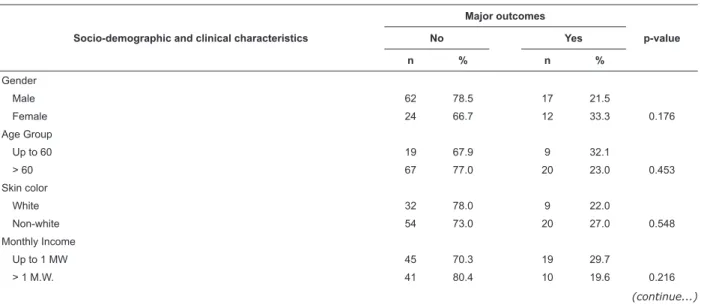
The proportion of individuals who arrived at the
emergency department after more than 12 hours was
signiicantly higher among those who self-medicated
with analgesics (p=0.040). A higher percentage of
individuals who interpreted the symptoms as not arising
from the heart and did not engage in any conduct when
the symptoms presented arrived later at the emergency
unit, presenting a higher proportion of major outcomes
(Table 4).
Table 4 - Distribution of the evaluated patients by socio-demographic and clinical characteristics according to the
major outcomes. Recife, PE, Brazil, 2009
Socio-demographic and clinical characteristics
Major outcomes
p-value
No Yes
n % n %
Gender
Male 62 78.5 17 21.5
Female 24 66.7 12 33.3 0.176
Age Group
Up to 60 19 67.9 9 32.1
> 60 67 77.0 20 23.0 0.453
Skin color
White 32 78.0 9 22.0
Non-white 54 73.0 20 27.0 0.548
Monthly Income
Up to 1 MW 45 70.3 19 29.7
> 1 M.W. 41 80.4 10 19.6 0.216
Table 4 - (continuation)
Socio-demographic and clinical characteristics
Major outcomes
p-value
No Yes
n % n %
Witnesses during the AMI
Family members 58 80.6 14 19.4
Others 15 65.2 8 34.8
None 13 65.0 7 35.0 0.182
Interpretation of the symptoms
Cardiovascular origin 32 76.2 10 23.8
Other origins 34 72.3 13 27.7
Did not have an opinion 20 76.9 6 23.1 0.880
Behavior
None 42 48.8 10 34.5 0.179
Rest 13 15.1 4 13.8 1.000
Aspirin 0 0.0 1 3.4 0.252
Analgesic 11 12.8 1 3.4 0.290
Nitrate 2 2.3 1 3.4 1.000
Others 28 32.6 15 51.7 0.065
Behavior beneficial for the treatment of AMI
Yes 16 80.0 4 20.0
No 23 65.7 12 34.3 0.262
MW.: Minimum Wage; AMI: Acute Myocardial Infarction.
Discussion
AMI episode and presented more atypical symptoms(13).
These data may in part account for the high female
intra-hospital mortality after the irst 24 hours of
hospitalization for AMI and the delay in introducing
thrombolysis(14-15).
Even without a statistically signiicant association,
the majority of patients who arrived at the emergency
unit within 12 hours were residents of the city of
Recife, white, and had better inancial conditions. These indings are similar to those of studies that evaluated the
difference in the perception of the symptoms between
black and white people and between people of different
inancial conditions(16). A multicentric study showed that
patients in Australia and New Zealand took less time
to arrive at the emergency unit, when compared with
Brazilians and Argentineans(17).Among those individuals
who arrived earlier at the emergency unit, a large
percentage were accompanied by people unrelated
to them. Conversely, authors who have studied the
inluence of the interpretation of the symptoms on the time taken to arrive at the hospital, veriied that family
members more often suggest attitudes that delayed the
time of arrival at the emergency unit, when compared to
people unrelated to the victim(18).
The majority of the patients who interpreted the
symptoms as cardiovascular disease (CVD) managed
to arrive at the emergency unit within 12 hours. These Socio-demographic and clinical factors are able to
interfere with the interpretation and choice of behavior
by the patients, thus inluencing the time for seeking
care and the start of thrombolysis and, therefore, the
prognosis and survival of the individuals(2,9-10). The low
level of education and the limited inancial conditions identiied in this sample may have limited the access of these individuals to health education, inluencing the
time to search for health services of high complexity
conirming the indings of other authors(10). The majority
of the people interpreted the symptoms as problems of
gastrointestinal origin. These data are consistent with
studies conducted in England and in Sweden where the
majority of the patients interpreted the symptoms as
indigestion or of musculoskeletal origin(11-12).
Although the majority arrived in the emergency
unit within 12h, few adopted pre-hospital behavior that
would result in beneit to the AMI condition. A qualitative
study performed in England, with a sample of ten women,
evaluated the perception of the symptoms of AMI. The
results showed that there was consistency between
the interpretation of the symptoms and the behavior
adopted by the patients(12). Similar to the indings of
the present study, another study showed that men and
younger people took less time to seek health services
when compared with women and the elderly, who had
data are similar to the results of other studies where
the majority of the individuals who interpreted the
symptoms as being of another origin took more time
to seek assistance(19). In a multicenter study that
evaluated 228 patients it was veriied that only 25%
of them recognized the symptoms as CVD and that the
faster decisions were taken by those who interpreted
the symptoms correctly(19). Another study carried out
in Japan showed that the patients who associated the
symptoms with CVD, sought the emergency services
more quickly and arrived with more chance of undergoing
mechanical thrombolysis(20).
The delay in seeking care can be inluenced by
the location of the AMI, age, duration of symptoms,
negative experience with previous hospital treatment,
fear, changes in pain perception, deiciency in the
autonomy of self-healthcare, cultural factors/popular
beliefs, dificulties in the access to education and health
services due to unfavorable geographical location and/
or limited inancial conditions, and low education level,
among others(14,21). The majority of the patients who
used nitrates and aspirin arrived at the emergency unit
after 12 hours. These behaviors may have contributed,
in part, to the delay in the decision to go to the hospital.
This hypothesis can be conirmed by a statistically signiicant association between the use of analgesics
and the prolonged time to arrive at the emergency unit.
Individuals that arrived at the emergency unit earlier
adopted less appropriate measures to deal with the
symptoms and, perhaps due to this, went more rapidly
to the emergency unit, since the behaviors adopted
did not produce a beneicial effect or may have even
contributed to the worsening of clinical condition.
Among the patients who had major outcomes a
higher proportion of females was observed, aged up to
60 years, with low levels of education, non-white skin
color, with a monthly income of up to one minimum
wage and with no one present during the episode. Some
studies have shown that individuals with white skin color,
with better inancial conditions and more education
were quicker in seeking clinical care in relation to
non-white people(22). This might be explained by the fact that
individuals with unfavorable social conditions take longer
to access emergency services, delaying the time to the
start of thrombolysis. It is possible that the small sample
size may have inluenced the lack of statistically signiicant
association, and that measurement bias in relation to
the variable outcome occurred due to deiciencies of the
service, which did not always offer all the procedures in
the different levels of complexity. In addition, for a short
period of time the institution had no thrombolytics. Thus,
some patients were transferred to other hospitals or
discharged to perform the procedure(s) later.
Popular education is one of the fundamental tools
of health promotion. Knowledge about the symptoms
of a disease can inluence the interpretation of these
and consequently the behavior adopted by the patient
and, in the majority of cases, this will be consistent
with the interpretation that the patient attributes to
the symptoms. Therefore, it is necessary to guide the
population through educational campaigns, rationally
and backed by scientiic data, and to disseminate the
symptoms of AMI, especially among the elderly and women, as these groups presented greater delay in
searching for healthcare. While performing health
education activities, it is important that the professionals
adopt strategies that can encourage and respect the
notion of the patient as an individual responsible for
their own health, this can start the process that leads
to improvement, recognizing in themselves the need to change their attitude when faced with the predictive
symptoms of the disease(23). In this perspective, the
health professionals are democratizing knowledge,
respecting autonomy, and potentializing the self-care
capacity in the patients, contributing to the reduction of
mortality from AMI.
Conclusion
Individuals with unfavorable socioeconomic
conditions, who interpreted the symptoms incorrectly
and did not adopt any behavior when the symptoms
presented, arrived later at the emergency unit and
presented worse intra-hospital outcomes.
References
1. Sociedade Brasileira de Cardiologia. III Diretriz sobre
Tratamento do Infarto Agudo do Miocárdio. Arq Bras
Cardiol. 2004;83(supl 2):1-86.
2. Moser DK, Kimble LP, Alberts MJ, Alonzo A, Croft JB,
Dracup K, et al. Reducing delay in seeking treatment by
pacients with acute coronary syndrome and stroke. A
scientific statement from the American Heart Association Council on Cardiovascular Nursing and stroke Council.
Circulation. 2006;114(2):175-89.
3. Lovlien M, Schei B, Hole T. Prehospital delay,
contributing aspects and responses to symptoms
among Norwegian women and men with first time
acute myocardial infarction. Eur J Cardiovasc Nurs.
4. Ottesen MM, Dixen U, Torp-Pedersen C, Kober L.
Prehospital delay in acute coronary syndrome – an
analysis of the components of delay. Int J Cardiol.
2004;96(1):97-103.
5. Mensah GA, Hand MM, Antman EM, Ryan TJ Jr,
Schriever R, Smith SC Jr. Development of system of care
for st-elevation myocardial infartion patients: the patient
and public perspective. Circulation. 2007;116(2):33-8.
6. Caldwell MA, Miaskowski C. Mass media interventions
to reduce help-seeking delay in people with symptoms
of acute myocardial infarction: time for a new approach?
Patient Educ Couns. 2002;46(1):1-9.
7. Santos FLMM, Araújo TL. Vivendo infarto: os significados
da doença segundo a perspectiva do paciente. Rev.
Latino-Am. Enfermagem. 2003;11(6):742-8.
8. Moser DK, McKinley S, Dracup K, Chung ML. Gender
differences in reasons patients delay in seeking treatment
for acute myocardial infarction symptoms. Patient Educ
Couns. 2005;56(1):45-54.
9. Antman EM, Hand M, Armstrong W, Bates ER, Green
LA, Halasyamani LK, et al. 2007 Focused update of
the ACC/AHA 2004 guidelines for the management
of patients with st-elevation myocardial infarction.
Circulation. 2008;117(2):1-34.
10. Masoudi FA, Bonow RO, Brindis RG, Cannon CP,
DeBuhr J, Fitzgerald S, et al. ACC/AHA 2008 Statement
on performance measurement and reperfusion therapy.
J Am Coll Cardiol. 2008;52(24):2100-12.
11. Henriksson C, Lindahl B, Larsson M. Patients’ and
relatives’ thought and actions during and after symptom
presentation for an acute myocardial infartion. Eur J
Cardiovasc Nurs. 2007;6(4):280-6.
12. MacInnes JD. The illness perceptions of women
following symptoms of acute myocardial infartion:
A sef-regulatory approach. Eur J Cardiovasc Nurs.
2006;5(4):280-8.
13. Arnetz JE, Arnetz BB. Gender differences in patient
perceptions of involvement in myocardial infarction care.
Eur J Cardiovasc Nurs. 2008;17(3):393-405.
14. Jneid H, Fonarow GC, Cannon CP, Hernandez AF,
Palacios IF, Maree AO, et al. Sex differences in medical
care and early death after acute myocardial infarction.
Circulation. 2008;118(25):2803-10.
15. Passos LCS, Lopes AA, Esteves FP, Santos
FMO. Diferença de letalidade hospitalar do infarto
agudo do miocárdio entre homens e mulheres
submetidos a angioplastia primária. Arq Bras Cardiol.
1998;71(4):587-90.
16. Goldberg RJ, Gabriel P, Sadiq I, Granger CB, Jackson
EA, Budaj A, et al. Extent of, and factors associated with,
delay to hospital presentation in patients with acute
coronary disease (The GRACE registry). Am J Cardiol.
2002;89(7):791-6.
17. Goldberg RJ, Spencer FA, Fox KAA, Brieger D, Steg
G, Gurfinkel E, et al. Prehospital delay in patients with
acute coronary syndromes - from the global registry
of acute coronary events [GRACE]. Am J Cardiol.
2009;103(5):598-603.
18. Perkins-Porras L, Whitehead DL, Strike PC, Steptoe
A. Pre-hospital delay in patients with acute coronary
syndrome: factors associeated with patient decision
time and home-to-hospital delay. Eur J Cardiovasc Nurs.
2009;8(1):26-33.
19. Buckley T, McKinley S, Gallagher R, Dracup K, Moser
DK, Aitken LM. The effect of education and counselling
on knowledge, attitudes and beliefs about responses to
acute myocardial infarction symptoms. Eur J Cardiovasc
Nurs. 2007;6(2):105-11.
20. Fukuoka Y, Dracup Kathleen, Kobayashi F, Froelicher
ES, Rankin SH, Ohno M, et al. Trajectory of prehospital
delay in patients with acute myocardial infarction
in the Japanese health care system. Int J Cardiol.
2006;107(2):188-93.
21. Pinto DS, Kirtane AJ, Nallamothu BK, Murphy SA,
Cohen DJ, Laham RJ, et al. Hospital delays in reperfusion
for ST-elevation myocardial infarction. Circulation.
2006;114(19):2019-25.
22. Mcginn AP, Rosamond WD, Goff DC, Taylor HA,
Miles JS, Chambless L, et al. Trends in prehospital delay
time and use of emergency medical services for acute
myocardial infarction: experience in 4 US communities
from 1987-2000. Am Heart J. 2005;150(3):392-400.
23. Mussi FC. O infarto e a ruptura com o cotidiano:
possível atuação da enfermagem na prevenção. Rev.
Latino-Am. Enfermagem. 2004;12(5):751-9.
Received: July 24th 2010