COMPLI CATI ONS OF I NTRA-AORTI C BALLOON I N A COHORT OF HOSPI TALI ZED
PATI ENTS: I MPLI CATI ONS FOR NURSI NG CARE
1Renat a Bacelar Silv a de Assis2 Kar in a Azzolin3 Mar t a Boaz4 En eida Rej an e Rabelo5
Assis RBS, Azzolin K, Boaz M, Rabelo ER. Com plicat ions of int r a- aor t ic balloon in a cohor t of hospit alized pat ient s: im plicat ions for nursing care. Rev Lat ino- am Enferm agem 2009 set em bro- out ubro; 17( 5) : 658- 63.
Obj ect iv es: To descr ibe com plicat ion s associat ed t o t h e u se of in t r a- aor t ic balloon pu m ps ( I ABP) , an d t h eir r el a t i o n sh i p w i t h d w el l i n g t i m e, p r esen ce o f r i sk f a ct o r s/ co m o r b i d i t i es, a n d n u r si n g r eco r d s. Met h o d s: Ret r ospect iv e coh or t st u dy , in w h ich m edical r ecor ds w er e an aly zed t h r ou gh t h e com plet ion of specif ically design ed for m s. Resu lt s: I n t ot al, 1 0 4 pat ien t s w er e in clu ded, w it h m ean age 6 5 ± 1 1 y ear s, 5 2 % m en ; 2 6 ( 25% ) of t hem present ed vascular com plicat ions, m ore frequent ly ischem ia ( 25% ) ; peripheral vascular disease w as t he r isk fact or / com or bidit y m or e fr equent ly r elat ed t o com plicat ions ( 56. 3% ; p= 0. 003) . Nur sing r ecor ds show ed t hat t he use of cat het er w as r ecor ded in 30 cases ( 29% ) , and t he pat ient ’s clinical sit uat ion aft er it s rem oval in 28 cases ( 27% ) . Conclusion: This st udy showed t hat t he frequency of com plicat ions relat ed t o I ABP is high. Consider ing r isk fact or / com or bidit y fact or s, per ipher al v ascular disease w as significant ly associat ed t o com plicat ions. Nur sing r ecor ds w er e sub- opt im al.
DESCRI PTORS: cohor t st udies; int r a- aor t ic balloon pum ping; nur sing car e
COMPLI CACI ONES DEL BALÓN I NTRAAÓRTI CO EN UNA COHORTE DE PACI ENTES
HOSPI TALI ZADOS: I MPLI CACI ONES PARA LA ASI STENCI A DE ENFERMERÍ A
Est e est udio t uvo com o obj et ivos describir las com plicaciones provenient es de la ut ilización del balón int raaórt ico ( BI A) , r elacion án dolas con el t iem po de per m an en cia, con la pr esen cia de fact or es de r iesgo/ en fer m edades concom it ant es y con los r egist r os de enfer m er ía. Se ut ilizó com o m ét odo la cohor t e hist ór ica, con análisis de f ich as por m edio del llen ado de u n in st r u m en t o con st r u ido específ icam en t e par a el est u dio. Despu és de la ev aluación de 1 0 4 pacient es, edad pr om edio 6 5 ± 1 1 , 5 2 % sex o m asculino, los r esult ados m ost r ar on que 2 6 ( 25% ) pr esent ar on com plicaciones v ascular es, siendo la isquem ia ( 25% ) la m ás incident e; ent r e los fact or es de riesgo/ enferm edades concom it ant es, el que m ás se relacionó con com plicaciones fue la enferm edad vascular per ifér ica ( 5 6 , 3 % , p= 0 , 0 0 3 ) . En lo que se r efier e a las ev aluaciones de enfer m er ía, 3 0 ( 2 9 % ) pr esent aban r egist r o del uso del cat ét er , y 28 ( 27% ) r elat aban el est ado clínico del pacient e después de su r et ir ada. Se concluye que est e est udio dem ost ró que el índice de com plicaciones es t odavía alt o cuando relacionado al BI A. En t r e l o s f a c t o r e s d e r i e s g o / e n f e r m e d a d e s c o n c o m i t a n t e s , l a e n f e r m e d a d v a s c u l a r p e r i f é r i c a f u e significat iv am ent e r elacionada con com plicaciones. Los r egist r os de los enfer m er os no fuer on ex haut iv os.
DESCRI PTORES: est udios de cohor t es; cont r apulsador int r aaor t ico; at ención de enfer m er ía
COMPLI CAÇÕES DO BALÃO I NTRA- AÓRTI CO EM UMA COORTE DE PACI ENTES
HOSPI TALI ZADOS: I MPLI CAÇÕES PARA A ASSI STÊNCI A DE ENFERMAGEM
Est e est u do t ev e com o obj et iv os descr ev er as com plicações decor r en t es da u t ilização do balão in t r a- aór t ico ( BI A) , r elacion an do- as com o t em po de per m an ên cia, com a pr esen ça de f at or es de r isco/ com or bidades e com os r egist r os de enfer m agem . Ut ilizou- se com o m ét odo a coor t e hist ór ica, com análise de pr ont uár ios por m eio d e p r een ch im en t o d e in st r u m en t o esp ecíf ico p ar a o est u d o. Ap ós av aliação d e 1 0 4 p acien t es, id ad e m éd ia 6 5 ± 1 1 , 5 2 % sex o m ascu lin o, os r esu lt ad os m ost r ar am q u e 2 6 ( 2 5 % ) ap r esen t ar am com p licações vascular es, sendo a isquem ia ( 25% ) a m ais incident e; ent r e os fat or es de r isco/ com or bidades, o que m ais se r elacion ou com com p licações f oi a d oen ça v ascu lar p er if ér ica ( 5 6 , 3 % , p = 0 , 0 0 3 ) . Qu an t o às ev olu ções d e enfer m agem , 30 ( 29% ) apr esent av am r egist r o do uso do cat et er , e 28 ( 27% ) r elat av am o est ado clínico do pacient e após a sua ret irada. Conclui- se que est e est udo dem onst rou que o índice de com plicações ainda é alt o q u a n d o r el a ci o n a d o a o BI A. Den t r e o s f a t o r es d e r i sco / co m o r b i d a d es, a d o en ça v a scu l a r p er i f ér i ca f o i sign ificat iv am en t e r elacion ada com com plicações. Os r egist r os dos en fer m eir os for am su bót im os.
DESCRI TORES: est udos de coor t es; balão int r a- aór t ico; cuidados de enfer m agem
1Article extracted from specialization course conclusion m onograph; 2Specialist in Cardiology Nursing, e- m ail: [email protected] ; 3M.Sc. in Health Sciences,
Faculty, Centro Universitário Metodista I PA, Brazil, Faculty, I nstituto de Cardiologia, Fundação Universitária de Cardiologia, Brazil, e-m ail: [email protected] .br; 4M.Sc. in Healt h Sciences, Facult y, Universidade do Vale do Rio dos Sinos, Brazil, Faculty, I nst it ut o de Cardiologia, Fundação Universit ária de Cardiologia,
Brazil, RN, I nst it ut o de Cardiologia, Fundação Universit ária de Cardiologia, Brazil, e- m ail: m rboaz@t erra.com .br; 5Ph.D. in Biological Science, Adj unct Professor, Escola de Enferm agem , Universidade Federal do Rio Grande do Sul, Brazil, Facult y, I nst it ut o de Cardiologia, Fundação Universit ária de Cardiologia, Brazil, e- m ail: [email protected] .br
I NTRODUCTI ON
T
he use of int ra- aort ic balloon pum p ( I ABP) has been increasing year by year, as a hem odynam ic su p p o r t r e so u r ce f o r ca r d i a c p a t i e n t s w i t h l e f t v en t r icu lar d y sf u n ct ion . Th e u se of t h is d ev ice is increasingly frequent in heart surgeries, as well as in hem odynam ic units( 1). I ts m ain goals include: greaterox y gen flow t o t he m y ocar dium , r educed w or k load of t h e left v en t r icle an d im pr ov ed car diac ou t pu t . Mor eo v er, it in cr eases cor on ar y ar t er y p er f u sion pressure during diast ole( 2).
Alt h ou g h , on t h e on e h an d , t ech n olog ical adv ances hav e benefit ed t he incr ease in t he safer u se o f t h i s h em o d y n a m i c su p p o r t d ev i ce, so m e com plicat ions cont inue in pat ient s subm it t ed t o t his procedure. The m ost com m on com plicat ions include vascular inj ur y, lim b ischem ia and infect ion. Ot her possible event s include dissect ion or rupt ure of t he aort a, due t o balloon rupt ure, occurrence of clot s or e m b o l i o r a t h e r o m a p l a q u e s, h e m o r r h a g e s, a t hrom bocyt openia, besides cases of paraplegia, aft er I ABP use( 3).
I n t h e co n t e x t o f I ABP- r e su l t i n g com plicat ion s, a r et r ospect iv e st u dy in t h e Czech Republic reports that com plications occur in 11.5% of pat ient s, w it h lim b ischem ia as t he m ost fr equent ( 5 . 7 % )( 3 ). A r e t r o sp e ct i v e Eu r o p e a n st u d y t h a t
inv olv ed 911 pat ient s ident ified incidence lev els of I ABP- relat ed vascular com plicat ions ranging bet ween 8 . 7 an d 2 0 % . Th e sam e st u dy also an aly zed r isk fact ors like hypert ension, diabet es, earlier peripheral v ascu lar d isease, ag e, g en d er, sm ok in g , ob esit y, duration of I ABP therapy, presence of coronary artery disease, heart failure, m it ral insufficiency, pulm onary art erial pressure and ej ect ion fract ion. I n t he sam e research, it was ident ified t hat , am ong risk fact ors, the strongest relation existed between peripheral heart disease and the presence of vascular com plications( 4).
A recent study analyzed I ABP use in 662 patients and r epor t ed a 2 2 % int r a- hospit al m or t alit y r at e, w it h 10.3% of ot her com plicat ions( 1).
Anot her st udy carried out in Nort h Am erica, aim ed at evidencing nursing im plicat ions in pat ient s u sin g I ABP, d em on st r at ed t h at n u r ses can d et ect v a scu l a r co m p l i ca t i o n s e a r l y t h r o u g h p h y si ca l exam inat ion, m onit oring pat ient s’ t em perat ure, color, capillary perfusion and presence of dist al pulses( 5).
The lack of nursing studies in literature about t he ear ly det ect ion and pr ev ent ion of I ABP- r elat ed
com plicat ions and t he non- ex ist ence of dat a about com plicat ions deriving from t he use of t his approach at the authors’ place of work led to the developm ent of t his research.
OBJECTI VE
To identify com plications in patients who used I ABP and t heir relat ion wit h dwelling t im e, presence of risk fact ors/ com orbidit ies and nursing records.
MATERI AL AND METHOD
This historical cohort, carried out in May and June 2006, assessed t he files of adult pat ient s who used I ABP bet ween 2001 and 2005, at a specialized car diology hospit al in Por t o Alegr e, Rio Gr ande do Sul. All pat ient s ≥18 years of age who used clinical I ABP or w er e subm it t ed t o sur ger y w er e included; pat ient files wit hout any records on I ABP usage t im e were excluded. An instrum ent was elaborated for this r esear ch t o collect dat a on t he follow ing v ar iables: ag e, g en d er, p r esen ce of com or b id it ies ( d iab et es m ellit us, hypert ension, hist ory of peripheral vascular disease, severe coronary art ery disease and sm oking ( > 10 cigaret t es/ day) . The rem aining variables were relat ed t o t he presence of t he balloon cat het er and i n cl u d e d d w e l l i n g t i m e ( d u r a t i o n i n h o u r s) a n d insertion technique ( percutaneous or dissection) . Data on phy sical ex t r em it y ex am inat ion and r ecor ds on com plications were taken from the m edical and nursing evolutions; records on the presence of ischem ia were taken from the evolutions that described the reduction in tissue perfusion and/ or presence of cyanosis in the lim b where t he I ABP is insert ed. Vascular obst ruct ion w a s d e f i n e d a cco r d i n g t o t e a m r e co r d s o n t h e p r e se n ce o f o b st r u ct i o n ca u se d b y e m b o l i sm , t hrom bosis or gas.
Th i s st u d y w a s a p p r o v e d b y t h e Et h i cs Co m m i t t ee at t h e r esear ch i n st i t u t i o n ( ap p r o v al num ber 3819/ 06 and, due to the im possibility to obtain the patients’ inform ed consent, a term of com m itm ent about the use of patient file data was used.
St at ist ical analysis
variables were expressed as t ot al n and it s relat ive p e r ce n t a g e s, a n d co n t i n u o u s v a r i a b l e s w e r e described as m ean ± st andard deviat ion and 25 and 7 5 % p e r ce n t i l e s, d e p e n d i n g o n t h e i r n o r m a l dist ribut ion or not . The chi- square t est was used for cat egorical dat a com parisons. Quant it at ive variables w er e an aly zed u sin g St u den t ’s t, Spear m an ’s an d Wilcox on ’s t est , depen din g on w h et h er t h ey w er e param et ric or not .
RESULTS
Clinical and dem ographic charact erist ics
This r esear ch included 104 files of pat ient s subm itted to I ABP. Thirty files were excluded because they did not contain records on I ABP placem ent tim e. The patients’ m ean age was 65± 11 years, and 51.9% were m en. The m ean dwelling t im e in hours was 28 ( 1 2 - 5 7 . 5 ) . Risk f act or s, com or b id it ies an d u se of ant icoagulat ion t herapy are shown in Table 1.
Table 1 – Descr ipt ion of dem ogr aph ic an d clin ical charact erist ics of pat ient s ( n= 104) wit h I ABP, 2001-2005, at a specialized cardiology hospital. Porto Alegre, RS, 2006
* m ean ± standard deviation; § m edian and 25 and 75% percent iles.
I ABP- r elat ed com plicat ions
Table 2 illustrates I ABP- related com plications. Tw e n t y - si x ( 2 5 % ) p a t i e n t s p r e se n t e d v a scu l a r com plications like lim b ischem ia, followed by vascular obst r uct ion. A sm all num ber of ot her com plicat ions w er e found, such as hem or r hage and infect ion. No cases of dissect ion and/ or rupt ure of t he aort a were f o u n d . Th e m o st se v e r e co m p l i ca t i o n w a s t h e am putation of an affected lim b, which occurred in one case only.
Table 2 – Pat ient com plicat ions relat ed t o I ABP use ( n = 2 6 ) , 2 0 0 1 - 2 0 0 5 , a t a sp eci a l i zed ca r d i o l o g y hospit al. Port o Alegre, RS, 2006
* Categorical variables expressed as n ( % )
Com plications related to presence of risk factors and/ or com or bidit ies
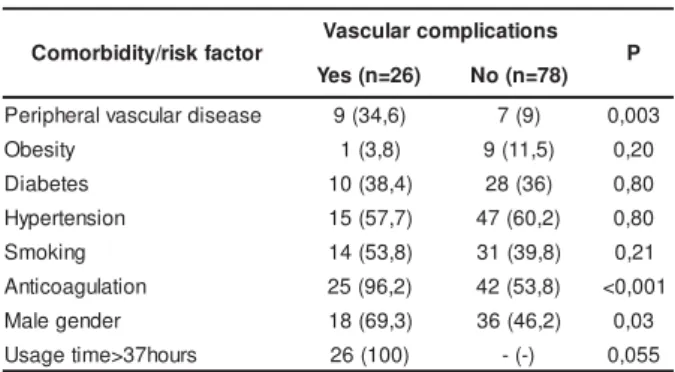
Of all com orbidities under analysis, peripheral v ascular disease w as m or e fr equent ly r elat ed w it h vascular com plicat ions and was found in 9 ( 34.6% ) patients. Sixty- seven patients received anticoagulation t herapy, of w hom 42 ( 63% ) displayed significant ly less com plicat ions t han t he ot her 25 ( 37% ) pat ient s who did not receive this therapy ( p< 0.001) . Moreover, m en p r esen t ed m o r e co m p l i cat i o n s t h an w o m en ( p= 0.03) . Mean I ABP dwelling tim e was 28 hours ( 12-57.5) , wit h pat ient s who used t he cat het er for m ore t h an 3 7 h ou r s ( n = 2 6 ) sh ow in g sign if ican t ly m or e com plications than patients with a m edian of 24 hours ( p < 0 . 0 5 ) . Th e r em ai n i n g v ar i ab l es p r o d u ced n o i n t e r g r o u p d i f f e r e n ce s. Th e se r e su l t s a r e dem onst rat ed in Table 3.
Table 3 – Vascular com plicat ions v er sus risk fact ors and/ or com orbidit ies in I ABP pat ient s, 2001- 2005, at a specialized car diology hospit al. Por t o Alegr e, RS, 2006
Variables expressed as n ( % ) .*Chi- square.
Medical records on I ABP use
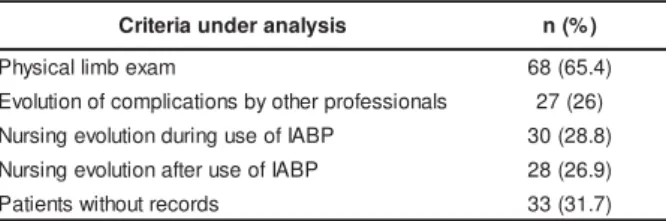
The analysis of m edical and nursing records show ed t hat 68. 3% cont ained som e descr ipt ion of I ABP use. Specifically for nursing records, of the 104
s c i t s i r e t c a r a h c c i h p a r g o m e d d n a l a c i n i l
C n(%)
* ) s r a e y ( e g
A 64.9±10.7 ) e l a m ( r e d n e
G 54(52)
s r u o h n i P B A I h t i w e m it n a i d e
M § 28(12-57.5)
e s a e s i d r a l u c s a v l a r e h p i r e
P 16(15.4)
y t i s e b
O 10(9.6)
s e t e b a i
D 38(36.5)
n o i s n e t r e p y h l a i r e t r a c i m e t s y
S 62(59.6)
g n i k o m
S 45(43.3)
y p a r e h t n o it a l u g a o c it n a f o e s
U 67(64.4)
s n o i t a c i l p m o c d e t a l e r -P B A
I n(%)*
a i m e h c s
I 26(25)
n o i t c u r t s b o r a l u c s a
V 13(12.5)
e g a h r r o m e
H 2(1.9)
n o i t a t u p m
A 1(1)
n o i t c e f n
I 1(1)
r o t c a f k s i r / y t i d i b r o m o C s n o i t a c i l p m o c r a l u c s a V P ) 6 2 = n ( s e
Y No(n=78)
e s a e s i d r a l u c s a v l a r e h p i r e
P 9(34,6) 7(9) 0,003 y t i s e b
O 1(3,8) 9(11,5) 0,20 s e t e b a i
D 10(38,4) 28(36) 0,80 n o i s n e t r e p y
H 15(57,7) 47(60,2) 0,80 g n i k o m
S 14(53,8) 31(39,8) 0,21 n o it a l u g a o c it n
A 25(96,2) 42(53,8) <0,001 r e d n e g e l a
M 18(69,3) 36(46,2) 0,03 s r u o h 7 3 > e m it e g a s
files under analysis, only 30 ( 28.8% ) cont ained t he evolution, describing the catheter use, and 28 ( 26.9% ) reported on the patient’s conditions after its rem oval. These dat a are dem onst rat ed in Table 4.
Table 4 – Descript ion of I ABP pat ient files ( n= 104) , 2001- 2005, at a specialized cardiology hospital. Porto Alegre, RS, 2006
* Cat egorical variables expressed as n ( % ) .
DI SCUSSI ON
Due t o t he high incidence of com plicat ions an d t h e n eed f or car ef u l assessm en t by t h e I ABP pat ient care t eam , t he researchers invest igat ed t his realit y at a specialized cardiology hospit al. I n t ot al, 104 pat ient files were evaluat ed, of which 26 ( 25% ) presented vascular com plications – m ore than current lit erat ure dat a. All of t hese present ed lim b ischem ia; only one present ed a severe and irreversible lesion, including the need for am putation of the affected lim b; no cases of aorta dissection of rupture were found. A retrospective cohort study that aim ed to assess I ABP-r elat ed vasculaABP-r com plicat ions dem onst ABP-r at ed 11.1% of com plicat ions, wit h ischem ia as t he m ost frequent vascular com plication and wom en as the m ost affected gender( 6). An Am erican study reported incidence levels
r a n g i n g b e t w e e n 7 . 2 a n d 4 7 % o f v a scu l a r com plications in cases of I ABP use( 5). I n 2000, a st udy
of 1,174 pat ient s who used I ABP dem onst rat ed 15% of com plications. I n this sam ple, 27% of patients had diabetes m ellitus, 52% arterial hypertension and only 8 % , p er ip h er al v ascu lar d isease. Th e com p ar ison bet w een t hose r esear ch dat a and t his m or e r ecent st udy show ed t hat t he pr esent sam ple consist ed of m or e sev er e pat ien t s in t er m s of t h e pr esen ce of com orbidities. The higher percentage of com plications is also attributed to the fact that the place of study is a referral institution in cardiology and receives a large num ber of severe patients, which m ay entail a greater pot ent ial for t he developm ent of com plicat ions.
Am o n g t h e r i sk f a ct o r s u n d e r a n a l y si s, i m p o r t a n t r e l a t i o n s w e r e f o u n d b e t w e e n t h e
appearance of vascular com plicat ions and peripheral v ascu lar d isease, I ABP d w ellin g t im e an d u se of ant icoagulat ion t herapy or not . I t was ident ified t hat 15.4% of pat ient s suffered from peripheral vascular disease; 36% did not receive anticoagulation therapy; and dwelling tim e was longer in 100% of patients with co m p l i ca t i o n s. Th e se f i n d i n g s u n d e r l i n e cu r r e n t l i t e r a t u r e a b o u t t h e a sso ci a t i o n b e t w e e n so m e com orbidit ies and t he em ergence of com plicat ions.
I n this study, as opposed to other sources(6-7),
f e m a l e p a t i e n t s r e v e a l e d f e w e r r i s k s o f com plicat ions t han m en. A st udy published in 2000 dem onst r at ed, using m ult iv ar iat e analy sis, t hat t he f e m a l e g e n d e r, p e r i p h e r a l v a scu l a r d i se a se a n d h i g h b o d y m a ss i n d e x ( BMI ) w e r e i n d e p e n d e n t p r ed ict or s f or t h e ap p ear an ce of com p licat ion s( 8 ).
This st udy, on t he opposit e, show ed no cor r elat ion b e t w e e n o b e s i t y a n d f e m a l e g e n d e r a n d t h e p r e s e n c e o f c o m p l i c a t i o n s , h i g h l i g h t i n g o n l y per ipher al v ascular disease as t he com or bidit y t hat pr edict s adv er se vascular event s. Mor eover, as dat a a n a l y si s w a s b a se d o n se co n d a r y so u r ce s, t h e r ecor d s d id n ot con t ain t h e p at ien t s’ w eig h t an d height for t he sak e of BMI calculat ions, but m er ely r ecor ds of obesit y. Eu r opean r et r ospect iv e coh or t s t u d i e s c a r r i e d o u t i n 2 0 0 0 a n d 2 0 0 5 a l s o e m p h a si z e t h e a sso ci a t i o n b e t w e e n p e r i p h e r a l v ascu l ar d i sease an d t h e u se o f an t i co ag u l at i o n t h e r a p y a s r i s k f a c t o r s f o r t h e o c c u r r e n c e o f co m p l i ca t i o n s; o p i n i o n s d i f f e r, h o w e v er, o n t h e r elat ion bet w een gen der an d adv er se ev en t s( 5 - 7 ).
I n all 1 0 4 cases u n d er an aly sis, cat h et er i n se r t i o n w a s p e r cu t a n e o u s. Ot h e r t e ch n i q u e s, in clu din g ar t er y ex posu r e ( dissect ion ) , h av e been appointed as predictors of further com plications, such a s d i ssect i o n a n d r u p t u r e o f t h e a o r t a , i n t en se hem orrhages and pat ient deat h( 8- 9).
I n this study, nursing records on the presence of I ABP were unsat isfact ory as t o t he descript ion of p er f u sion con d it ion s, sk in color an d p r esen ce of peripheral pulses in t he lim b t he I ABP was insert ed in. No art icles were found in lit erat ure t hat assessed nursing records and the use of I ABP. However, articles in Eu r op ean , Asian an d Nor t h Am er ican j ou r n als highlight t he im port ance of nursing care for pat ient s subm itted to this m echanical support device. Research em phasizes t hat nurses should be t rained as t o t he indications, benefits, risks and potential com plications deriving from t his approach. As a care st rat egy, an accurate physical exam ination of the extrem ity before,
s i s y l a n a r e d n u a i r e t i r
C n(%)
m a x e b m il l a c i s y h
P 68(65.4)
s l a n o i s s e f o r p r e h t o y b s n o it a c il p m o c f o n o it u l o v
E 27(26)
P B A I f o e s u g n i r u d n o it u l o v e g n i s r u
N 30(28.8)
P B A I f o e s u r e t f a n o it u l o v e g n i s r u
N 28(26.9)
s d r o c e r t u o h t i w s t n e it a
d u r i n g a n d a f t e r t h e ca t h e t e r i n se r t i o n i s necessary( 5,10). The deficient nursing records m ay be
relat ed t o t he access of t echnical and adm inist rat ive duties, as well as to the high num ber of patients under t he professionals’ responsibilit y, besides t he fact t hat t he inst it ut ion has not fully im plem ent ed t he nursing process and it s rout ine. Despit e a cert ain degree of consensus about the fact that the nursing process can contribute to a m ore autonom ous and evidence- based practice, in nursing, few institutions actually adopt all of it s st eps( 11). To under line t he im por t ance of t he
nursing process, a system ic review carried out in 2007 identified 14 studies that proved the better quality of nursing docum entation/ assessm ents when the nursing diagnosis w as applied( 12). The sy st em izat ion of t he
n u r si n g p r o ce ss su p p o r t s t h e d e v e l o p m e n t o f int erdisciplinary and hum anized care m et hodologies, se r v i n g a s a w o r k p r o ce ss. Ca r e m e t h o d s, independent ly of t heir denom inat ions, represent one of t h e m ost im p or t an t con q u est s in n u r sin g car e now adays( 13).
The t eam ’s act ions in t erm s of const ant and sy st em at ic pat ien t assessm en t ar e h igh ligh t ed as i m p o r t a n t f a ct o r s f o r t h e e a r l y d e t e ct i o n o f com plications and for planning interventions, as earlier studies indicate deficient recording of signs, sym ptom s and et iologies of nursing diagnoses( 12). The excessive
num ber of patients and the whole com plexity involved can often interfere in care, im pairing the identification of com plicat ions in earlier st ages. Pat ient s wit h I ABP are considered critical. Hence, nurses should be aware o f p o t e n t i a l p r o b l e m s a n d , t h r o u g h a d e q u a t e a sse ssm e n t , i d e n t i f y p a t i e n t s a t g r e a t e r r i sk . Strategies like follow- up during catheter insertion and p er f u sion m on it or in g of p at ien t s’ ex t r em it ies an d hem odynam ic st at e, using a prot ocol wit h increasing assessm en t in t er v als, g u ar an t ee car e( 1 4 ). I n t h is
cont ext , t raining on t he t hem e and recycling on care associat ed wit h t he creat ion of specific nursing care pr ot ocols w ou ld con st it u t e im por t an t st r at egies t o guide professionals in t heir daily pract ice( 15).
FI NAL CONSI DERATI ONS
Th e m o st f r eq u en t co m p l i ca t i o n s a m o n g I ABP pat ient s w er e vascular, including lim b ischem ia ( 2 5 % ) an d v ascu l ar o b st r u ct i o n ( 1 2 . 5 % ) . Wh en r elat ed t o cat het er dw elling t im e, it w as ev idenced t hat pat ient s w ho used it for m or e t han 3 7 hour s p r esen t ed si g n i f i ca n t l y m o r e co m p l i ca t i o n s t h a t pat ient s w it h a m edian usage t im e of 24 hour s. As f o r r i sk f a ct o r s a sso ci a t e d w i t h co m p l i ca t i o n s, higher incidence lev els w er e found in m ale pat ient s an d w it h a h ist or y of per iph er al v ascu lar disease. W i t h r e g a r d t o n u r s i n g r e c o r d s , o n l y 2 8 . 8 % descr ibed t he use of I ABP.
Despit e t he lar ge t echnological evolut ion in t his area, com plicat ion rat es rem ain high, m ainly of v a scu l a r co m p l i ca t i o n s. Ne v e r t h e l e ss, t h e im pr ov em en t in car diac ou t pu t as a r esu lt of t h is treatm ent is undeniable. I n this scenario, the relation bet ween t he risks and benefit s of t he m et hod should b e a sse sse d a g a i n st t h e b a ck g r o u n d o f f a ct o r s associat ed wit h possible fut ure com plicat ions.
T h e m a i n r i s k s f o r I A B P p a t i e n t s a r e b l e e d i n g , b a l l o o n r u p t u r e , i n f e c t i o n a n d s k i n br eak dow n. The occur r ence of t hese com plicat ions can be m inim ized by per iodical clinical assessm ent , in addit ion t o t he m onit or ing of labor at or y r esult s f o r h e m a t o c r i t a n d h e m o g l o b i n , p l a t e l e t a n d c o a g u l a t i o n m a r k e r s . B e s i d e s , b a c k , f l a n k o r abdom inal pain com plaint s should be assessed and r ecor d ed , an d d ist al p u lse ch ar act er ist ics sh ou ld be obser v ed. Cont r ol of body t em per at ur e, as w ell as r ed n ess, w ar m t h , sw ellin g or d r ain ag e at t h e in ser t ion sit e is m an d at or y. Fin ally, in t er v en t ion s t o r e d u c e p r e s s u r e a r e a s a n d h y d r a t i o n a n d nut r it ion cont r ol sur v eillance ar e im por t ant aspect s in t he daily assessm ent of t hese pat ient s( 15). Som e
ot h er st r at eg ies, su ch as t h e f u ll im p lan t at ion of t he nur sing pr ocess and t he use of pulse ev aluat ion pr ot ocols can add benefit s t o t his t r eat m ent .
REFERENCES
1. Lew is PA, Mullany DV, Tow nsend S, Johnson J, Wood L, Co u r t n e y M, e t . a l . Tr e n d s i n i n t r a - a o r t i c b a l l o o n cou n t er pu lsat ion : com par ison of a 6 6 9 r ecor d Au st r alian dat aset w it h t he m ult inat ional Benchm ark Count erpulsat ion Out com es Regist ry. Anaest h I nt ensive Care 2007 February; 3 5 ( 1 ) : 1 3 - 9 .
2. Lewis P. Underst anding int raaort ic balloon pum ping. Nurs N Z 2005 June; 11( 5) : 16- 7.
3 . Ma n d a ´ Ák J, Lo n sk y V, Ja n D , Z á ce k P. Va scu l a r Com plicat ion s of Th e I n t r a Aor t ic Ballon Con t r apu lsat ion . Angiology 2 0 0 5 Januar y ; 5 6 ( 1 ) : 6 9 - 7 4 .
revascularizat ion: analysis of 911 cases. Eur J Cardiot horac Sur g 2002 Decem ber ; ( 21) : 741- 7.
5. Molnar HM. I nt ra Aort ic Ballon Pum p: Nursing I m plicat ios For Pat ient s Wit h An I liac Art ery Approach. Am J Crit Care 1 9 9 8 Ju ly ; 7 ( 4 ) : 3 0 0 - 5 .
6. Sanfelippo PM, Baker NH, Ewy HG, Moore PJ, Thom as JW, Br ah os GJ, et . al. Vascu lar Com plicat ion s Associat ed w it h t he use of I nt ra Aort ic Ballon Pum p. Tex Heart I nst J 1987 Ju n e; 1 4 ( 2 ) : 1 7 8 - 8 2 .
7. Elahi MM, Chet t y GK, Kirke R, Azeem T, Hart shorne R, Spyt TJ. Com plicat ion s Relat ed t o I n t r a Aor t ic Ballon Pu m p in Cardiac Surgery: a Decade Lat er. Eur J Vasc Endovasc Surg 2 0 0 5 Febr uar y ; ( 2 9 ) : 5 9 1 - 4 .
8 . Sir b u H, Bu sch T, Alek sic I , Fr ied r ich M, Dalich au H. I schaem ic com plicat ions w it h int r a aor t ic balloon count er -pulsat ion: incidence and m anagem ent . Depart m ent of Thoracic a n d Ca r d i o v a scu l a r Su r g e r y, Ge o r g - Au g u st Un i v e r si t y, Go t t i n g e n , Ge r m a n y. Ca r d i o v a sc Su r g 2 0 0 0 Ja n u a r y ; 8 ( 1 ) : 6 6 – 7 1 .
9. Mueller DK, St out M, Blakem an BM. Morbidit y an Mort alit y of I nt ra- aort ic Ballon Pum ps Placed Through t he Aort ic Arch. Ch est 1 9 9 8 Ju ly ; 1 1 4 ( 1 ) : 8 5 - 8 .
10. Díaz CL, Arroyo ÀL, Blanco BB. Pacient es com balón de
cont rapulsación int aaórt ico. Cuidados de Enferm ería. Rev Rol Enfer m er ia 2 0 0 0 ; 2 3 ( 5 ) : 3 3 1 - 3 .
11. Vaz AF, Macedo DD, Mont agnoli ETL, Lopes MHBM, Grion RC. I m plem ent at ion of nursing process in a radiot herapy unit : creat ion of a Record card. Rev Lat ino- am Enferm agem 2002 m aio- j unho; 1 0 ( 3 ) : 2 8 8 - 9 7 .
12. Muller- St aub M, Lavin MA, Needham I , Van Acht erberg T. Nursing diagnoses, int ervent ions and out com es- applicat ion and im pact on nursing pract ice: a syst em at ic lit erat ure review. Pflege 2 0 0 7 Decem ber ; 2 0 ( 6 ) : 3 5 2 - 7 1 .
13. Nascim ent o KC, Back es DS, Koer ich MS, Er dm ann AL. Sist em at ização da assist ência de enferm agem : vislum brando um cuidado int erat ivo, com plem ent ar e m ult iprofissional. Rev Esc Enfer m USP 2 0 0 8 ; 4 2 ( 4 ) : 6 4 3 - 8 .
14. Reid MB, Cot t rell D. Mary Bet h Reid and Dam on Cot t rell. Nu r sin g Car e of Pat ien t s Receiv in g : I n t r a- aor t ic Balloon Cou n t er p u lsat ion . Cr it ical- Car e Nu r ses. Cr it Car e Nu r se 2 0 0 5 ; 2 5 : 4 0 - 9 .
1 5 . A n d r a d e JS , V i e i r a M J. Pr á t i c a a s s i s t e n c i a l d e e n f e r m a g e m : p r o b l e m a s, p e r sp e ct i v a s e n e ce ssi d a d e d e s i s t e m a t i z a ç ã o . R e v B r a s En f e r m a g e m 2 0 0 5 ; 5 8 ( 3 ) : 2 6 1 - 5 .