IMPORTANCE OF FORMAL EDUCATION AND FAMILY
INCOME IN THE ACCESSION PROCESS TO THE USE
OF HEARING DEVICES IN CHILDREN UNDER 12 YEARS
Importância da educação formal dos responsáveis
e renda familiar no processo de adesão ao uso de próteses
auditivas em menores de 12 anos
Karla Anacleto de Vasconcelos (1), Maria Dolores Gonçalves Amâncio Pereira (1)
(1) Hospital Universitário Clementino Fraga Filho da Universi-dade Federal do Rio de Janeiro, Rio de Janeiro, RJ, Brasil.
Conlict of interest: non-existent
this population, the Ministério de Saúde (Ministry of
Health) determined, in 2004, that the Secretaries of
Health of individual states were henceforth respon
-sible for the organization and implementation of the
“Redes Estaduais de Atenção à Saúde Auditiva”
(State Networks for Attention to Auditory Health). The Actions for Auditory Health in Basic Attention take actions to promote auditory health, prevention and early identiication of auditory problems together with
the community, as well as informative and educa
-tional actions, family orientation and the re-direction of cases, when necessary, to the Medium – and High – Complexity wings of the Auditory Health Attention
Service (Serviço de Atenção à Saúde Auditiva na
Média ou Alta Complexidade). These actions are
to be taken in health care establishments which
INTRODUCTION
A deaf individual is one who lacks, partially or completely, the ability to comprehend spoken word through the auditory system. There are many causes of deafness and they are classiied by the means of acquisition: pre-natal causes, natal causes, or post-natal causes1.According to the Instituto Brasileiro de
Geograia e Estatística – IBGE (Brazilian Institute of Geography and Statistics), 5.7 million Brazilians experience some type of hearing loss2. To serve
ABSTRACT
Purpose: to determine if the level of education and income of the guardians of children seen at the
Hearing Health University Hospital, inluences on the adherence to the use of hearing aids. Methods:
a retrospective study using a survey of secondary data in Supplementary Examination Laboratory University Hospital was conducted. Data on the type and degree of hearing loss, type of adaptation, family income and education of parents or guardians were veriied. Adherence to the use of hearing aids was veriied by the presence in annual consultation after discharge. Results: 105 patients
were analyzed. 35(10,47%) cases reported to receive a minimum wage as a single income family, 54(51,4%) between one and three minimum wages, 4(3,8%) from three to 10 minimum wages and 12(11,4%) cases the information was not reported in the interview. Regarding the level of education of parents or guardians, 51(48,5%) had no formal education or at most elementary school, 39(37,1%) began or completed high school, 5(4,7%) began or completed a university degree and in 10(9,7%) cases there was no information. 94 patients adhered to the hearing aids, and 11 did not. There was no statistical signiicance between family income or education and the adherence to the use of hearing aids in children treated at University Hospital. Conclusion: the family income or education of parents
or guardians does not inluence the adherence to the use of hearing aids in children up to 12 years
seen in University Hospital.
minimum wage to the disabled person8,9. According
to Bittencourt (2011) 8, “social rights are dificult to
maintain in commitments between the state and the society, and immediate implementation is not guaranteed. The families of deaf individuals seek to overcome the barriers of auditory disability by taking advantage of varied resources, with varying levels of success. For professionals that work with these families, it is necessary to know how the parents and relatives deal with the repercussions and demands tied to hearing loss. This is an issue of social protection, whether in the context of the state or the civil society6,7,10,11.
This study aims to verify whether the level of formal education of those responsible for the treatment of children inluences the success of the adaptation of auditory prostheses, like the factors of family income and degree of auditory loss, in the Auditory Health department of the University
Hospital (HUCFF).
METHODS
A retrospective study was conducted by means of a secondary data survey at the Complementary Exam Laboratory (LEC) of the Speech Therapy Service at the Clementino Fraga Filho University Hospital (HUCFF) from the Federal University of Rio de Janeiro (UFRJ), approved by the CEP of the
same institution under number 166.156.
The database was developed and is fed by the only social worker of the Auditory Health Program of the Speech Therapy Service of the HUCFF/UFRJ, as part of the social interview carried out with all users of the program. The following data was collected: age, gender, degree of hearing loss (classiied according
to the British Society of Audiology’s recommenda
-tions), itting of hearing aids (uniaural or binaural), returning for speech therapy follow-up visit after
medical discharge (adhesion), education level and
income of the patient’s family, number of residents at their residence (socioeconomic proile). All persons under the age of 12 who received hearing aids unilaterally or bilaterally between July 2007 and July 2011 were included. 12 patients were excluded from the statistical analysis for not presenting complete data of interest of the study.
The statistical analysis aimed to determine the
association between two variables. Possible associ
-ations between the degree of hearing loss and adherence to the use of hearing aids were analyzed; between family income and adherence to the use of hearing aids and, inally, between the schooling of parents or guardians and the adherence to the use of hearing aids. The Mantel-Haenzel test with signiicance less than 0,05 was used.
have been pre-registered in the National Register (Sistema de Cadastro Nacional--SCNES) by the
teams responsible for basic attention, considering the auditory health of several different segments of the population: pregnant women, newborn children, toddlers, children/adolescents, young adults, adults,
and seniors3.
Those with auditory problems are included in auditory health services with the objective of improving their auditory functions and, therefore, their cognitive ability, and their social and emotional health. When treatment is provided, whether through the use of hearing aids or through rehabilitation (or through both), the effectiveness of the treatment must be veriied continually. Through veriication, the professional can systematically evaluate any gains and beneits. The role of the auditory health team in the process of training or rehabilitation is to orient those responsible for the treatment and to offer adequate services for the success of the
treatment4-6. This condition depends on the progress
of the patient, for the effective use of the hearing aid, which becomes viable through the periodical checks with the Auditory Health Attention Program
(Programa de Atenção a Saúde Auditiva). The
participation of family members is a determining factor in the success of the adaptation process of hearing aids. Issues relating to the comprehension of the process and of the social condition of the families can interfere in the larger goal of the auditory
health program: communication5-7.
The social worker, who composes the technical chart of the Auditory Health Attention Programs, is responsible for attending the families, and particu
-larly for identifying potentially compromising situa
-tions for the adaptation process of the patients8.
In the cases of juvenile and/or disabled patients, orientation for the patients’ parents or guardians is imperative to its success. Dificulties in the compre
-hension of the adaption process are common to
the populated attended by Hospital Universitário Clementino Fraga Filho – HUCFF (Clementino
Fraga Filho University Hospital). The hospital serves a majority-low-income population with little formal educational instruction. Financial dificulties are frequently cited by patients as an important restrictive factor in the treatment process of minors and those with disabilities.
The “ Lei Orgânica da Assistência Social – LOAS” (Organic Law of Social Work) provides the
“Benefício de Prestação Continuada – BPC” (Beneit
RESULTS
Data was retrieved for 105 patients with the mean age of six years, being 54 (51.4 %) males. In relation to the degree of hearing loss, 13 (12.3%) patients presented a mild degree of hearing loss, 30 (28.5%) presented moderate hearing loss, 22 (21.0%) presented severe hearing loss, 39 (37.2%) presented profound degree of hearing loss and, in one case (1.0%) it was not possible to check the exact degree of hearing loss due to the child’s age (under one year old) (Figure 1). In only two cases (1.9%) adaptations of unilateral hearing aids were implemented and in 103 (98.1%) cases, bilateral.
Level of adherence was checked for 94 (89.5%) cases. The statistical association between adherence and the degree of hearing loss was checked only in the cases of profound degree of hearing loss, wherein the value of p was 0.011
(table 1).
Table 1 – Relationship between the degree of hearing loss and accession fewer than 12
Degree of hearing loss
Adherence to the use of hearing aids
Yes No Total
p
n % n % n %
Slight
Yes 13 100.0 0 0.0 13 100
0.187
No 80 87.9 11 12.1 91 100
Moderate
Yes 28 93.3 2 6.7 30 100
0.411
No 65 87.8 9 12.2 74 100
Severe
Yes 21 91.3 2 8.7 23 100
0.630
No 71 87.7 10 12.3 81 100
Profund
Yes 31 79.5 8 20.5 39 100
*0.011
No 62 95.4 3 4.6 65 100
Mantel-Haenzel test with signiicance value less than 0.05.
Figure 1 - Percentage distribution of different degrees of hearing loss in the population studied.
In relation to the number of people living at the residence, 25 (23.8%) declared that only two people
live in the residence (child and guardian), 57 (54.2%) declared that between 3 and 4 people live in the residence, 19 (18.2%) between 5 and 6 people and 4 (3.8%) 7 or more people.
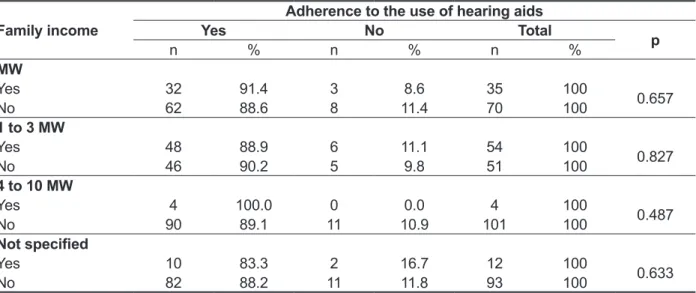
In 33 (31.4%) cases, respondents reported up to a minimum wage as the only family income, 52 (49.5%) cases reported between one and three minimum wages, 4 (3.8%) reported between four and 10 minimum wages and in 10 (9.5%) this data was not provided during the interview.
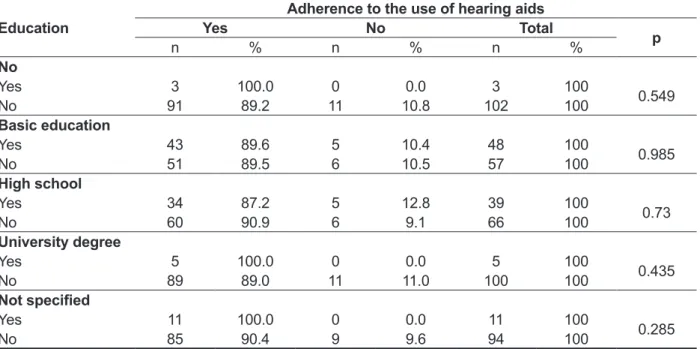
Regarding education levels of the children’s guardians, 3 (2.8%) reported having no education, 48 (45.7%) reported having primary education, 39 (37.1%) initiated or completed high school, 5 (4.7%) initiated or completed a university degree and, in 10 (9.7%) interviews this information was not provided.
MW:Minimum wage
Figure 2 - Distribution of family income patients enrolled in the Program Hearing Health Care University Hospital.
Table 2 – Relationship between family income and membership in fewer than 12
Family income
Adherence to the use of hearing aids
Yes No Total
p
n % n % n %
MW
Yes 32 91.4 3 8.6 35 100
0.657
No 62 88.6 8 11.4 70 100
1 to 3 MW
Yes 48 88.9 6 11.1 54 100
0.827
No 46 90.2 5 9.8 51 100
4 to 10 MW
Yes 4 100.0 0 0.0 4 100
0.487
No 90 89.1 11 10.9 101 100
Not speciied
Yes 10 83.3 2 16.7 12 100
0.633
No 82 88.2 11 11.8 93 100
Mantel-Haenzel test with signiicance value less than 0.05. MW:Minimum wage
possible to verify that the families were shown to be more involved with the adaptation process, especially with the expectation that this resource would bring demonstrable beneits in the better development of speech. In the period of adaptation, it was possible to verify that the parents or guardians sought the service more often than the families of the children with other audiometric conigurations. In the return consultations, the main questions were related to the change of behavior in the child due to the presence of auditory stimuli. Many questions also referred to doubts in relation to use, care, and handling of the auditory device.
The families attended at PASA at the aforemen
-tioned hospital possess sociocultural and economic characteristics common to the urban strata of low-income and poorly-educated populations, as shown in graphics II and III. This data corroborates the information of the literature when compared to
the populations at attended by the SUS through
Ordinance 2.073/20043.
Even considering the well-known limitations of a retrospective study, particularly in terms of the unreliability of the information provided through interviews, it was possible to verify that the PASA of the referred hospital has met the objectives described in Ordinance number 2.073/2004, given
that, in the mentioned period, PASA adapted and
followed more than 110 children up to the age of 12
in a multidisciplinary way, improving the communi
-cation by means of the residual hearing.
DISCUSSION
The Sistema Único de Saúde – SUS (Single Health System) instituted the Política Nacional
de Atenção à Saúde Auditiva (National Auditory
Health Policy) through Ordinance 2.073/2004. The University Hospital had the Auditory Health
Attention Program (Programa de Atenção à Saúde Auditiva – PASA) implemented in 2007 to serve
medium- and high-complexity patients in Rio de Janeiro. Patients with varying degrees of hearing loss are included in this program with the objective of receiving Individual Sound Amplifying Devices (AASI), improving auditory abilities and, as a result, the cognitive performance, social and emotional, with the goal of better communication. The program provides the adaptation of continuous-lux hearing aids, with speech/hearing therapy and medical and social assistance.
The degree of hearing loss is an aggravating factor in the development of speech of children. The more compromised the hearing, the more dificult it is to develop speech6,8,9. Therefore, AASI’s are a
demonstrably essential tool in the development of speech of children with hearing loss. In the present study, the degree of hearing loss was not proven to be a limiting factory in the adherence to the use of
hearing aids9-11. The adherence to the use of AASI’s
was associated to the degree of hearing loss only in cases of high-degree loss. Although they were not the object of this study, in these cases, it was
Table 3 – Relationship between the level of formal education of responsible and accession fewer than 12
Education
Adherence to the use of hearing aids
Yes No Total
p
n % n % n %
No
Yes 3 100.0 0 0.0 3 100
0.549
No 91 89.2 11 10.8 102 100
Basic education
Yes 43 89.6 5 10.4 48 100
0.985
No 51 89.5 6 10.5 57 100
High school
Yes 34 87.2 5 12.8 39 100
0.73
No 60 90.9 6 9.1 66 100
University degree
Yes 5 100.0 0 0.0 5 100
0.435
No 89 89.0 11 11.0 100 100
Not speciied
Yes 11 100.0 0 0.0 11 100
0.285
No 85 90.4 9 9.6 94 100
conducted, the process of raising the guardian’s awareness starts with the reception with the speech therapist in the speech therapy service. A team composed of a social worker, speech therapists and doctors ensures that the guidelines regarding the full development of the child are clearly and objec
-tively transmitted. The non-association of the family income or the degree of formal education of the guardians (Tables 2 and 3), successfully adapted, in this study, relects the effectiveness of this team’s guidelines, so that even in families with very low income and education levels, cases of successful adaptation of the AASIs in the people studied were prevalent. The success was veriied by the patient’s attendance in the follow-up visits in the period of a year after the donation of the AASIs, portraying the awareness, the perception and the commitment of the guardians to the process of full development of their children’s hearing.
CONCLUSION
The family income or education level of the guardians of the children attended at HUCFF/UFRJ did not inluence the adhesion to the use of hearing
aids.
The provision of hearing aids by the government does not guarantee that the adaptation of the user will be successful. An understanding of the cognitive, social and emotional gains from auditory stimulation with the use of personal hearing ampliication devices (AASI), must be guaranteed so there is involvement and commitment on the part of the user. In the case of children, this understanding must be created primarily with the parents or guardians. According to Lichtig (2004), cited by Goldield6, the awareness of
the children’s guardians about the speciic needs of a deaf person is very important6. The child lacks the
maturity and autonomy to guarantee the continuous and daily use of the hearing aids and the adherence to the therapeutic process involved.
According to Frota and Goldield (2006)6, each
family has its own private story, in which the pain, attitudes and reactions of each member of the family can not be generalized, and the socioeconomic and family background of the guardian(s) for the deaf child have to be taken into consideration due to the asymmetry of values and perceptions. Yet according to the authors, these values and perceptions vary according to the degree of formal education and
economic conditions, making support and orien
-tation fundamental in the the language development process6. In the hospital where this research was
RESUMO
Objetivo: veriicar se o nível de educação formal dos responsáveis pelas crianças atendidas no ser
-viço de Saúde Auditiva de um Hospital Universitário, assim como a suas rendas familiares e o grau
das perdas auditivas das crianças, inluencia na adesão ao uso de próteses auditivas. Métodos:foi
realizado um estudo retrospectivo por meio de um levantamento de dados secundários contidos em ichas técnicas no Laboratório de Exames Complementares do referido Hospital. Foram veriicados os dados sobre o tipo e o grau das perdas auditivas, tipo de adaptação, renda familiar e escolaridade dos pais ou responsáveis. A adesão ao uso de próteses auditivas foi veriicado por meio da presença
em consulta anual após alta. Resultado:foram veriicados dados de 105 pacientes. Em 35 (10,47%)
casos, os entrevistados relataram até um salário mínimo como única renda familiar, 54 (51,4%) entre um e três salários mínimos, 4 (3,8%) entre três e 10 salários mínimos e em 12 (11,4%) casos esse dado não foi informado na entrevista. Em relação à escolaridade dos responsáveis pelas crianças, 51 (48,5%) responsáveis relataram ter no máximo, ensino fundamental I, 39 (37,1%) iniciaram ou completaram o ensino médio, 5 (4,7%) iniciaram ou completaram um curso superior e em 10 (9,7%) entrevistas não constava essa informação. Em 94 casos foi encontrada adesão e em 11, não adesão. Não houve signiicância estatística entre a renda familiar ou escolaridade dos responsáveis com o
sucesso na adesão de crianças atendidas no Hospital Universitário. Conclusão:a renda familiar ou
a escolaridade dos responsáveis não inluencia na adesão em crianças de até 12 anos atendidas no
Hospital Universitário.
6. Frota S, Goldfewld M. Enfoques em Audiologia e Surdez. O ouvir e o falar. 1ª Ed. São Paulo: Editora AM3, 2006. p. 344-72.
7. Suma P, Blasca WQ, Ferrari DV. Avaliação subjetiva da expectativa quanto ao uso do aparelho de ampliicação sonora individual: correlação com aspectos auditivos, sociais e econômicos. Distúrb Comum. 2008;20(1):107-14.
8. Bittencourt ZZLC, Françozo MFC, Monteiro CR, Francisco DD. Surdez, redes sociais e proteção social. Ciênc Saúde Coletiva [periódico na internet]. 2011 [Acesso em: 16 jan 2012]; 16(supl 1):[8]. Disponível em: http://www.scielo.br/pdf/csc/v16s1/ a07v16s1.pdf. 16/01/2012.
9. Negrelli MED, Marcon SS. Família e criança surda. R Ciência, Cuidado e Saúde. 2006 [Acesso em: 05 jun 2012]; 5(1): 98-107. Disponível em: http:// periodicos.uem.br/ojs/index.php/CiencCuidSaude/ article/viewFile/5146/3332
10. Batalha S, Zarcos MM. Surdez Infantil: A realidade de uma Unidade de Surdos. Acta Pediatr Port [periódico na internet] jan-fev 2010 [Acesso em: 26 dez 2012]; 41(1):[4]. Disponível em: http://www.spp. pt/Useriles/File/App/Artigos/20/20100521153320_ Casuistica_Batalha_S_41(1).pdf.
11. Aurélio NHS, Torres EMO, Lopes AS, Costa MJ. Avaliação do benefício com o uso da ampliicação sonora em crianças e adolescentes. Intl. Arch. Otorhinolaryngol. [periódico na internet] Jan-Fev-Mar 2012. [Acesso em 26 jan 2013];16(1):[8] Disponível em: http://www.scielo.br/pdf/aio/v16n1/12.pdf.
REFERENCES
1. Katz J. Tratado de audiologia Clínica. 4ª ed. São Paulo: Manole, 1999.
2. Russo ICP. Editorial II: A relevância da pesquisa cientíica na audiologia brasileira. Rev CEFAC [periódico na internet]]. 2009;1(11):Supl1,1-134. [Acesso em: 05 jun 2012] http://www.scielo.br/pdf/ rcefac/v11s1/v11s1a02.pdf.
3. Brasil. Ministério da Saúde. Secretaria de Atenção à Saúde. Instrutivo Deiciência Física. Portaria nº 587, out 2004 [Acesso em: 05 jun 2012]; http:// bvsms.saude.gov.br/bvs/saudelegis/sas/2004/ prt0587_07_10_2004.html.
4. BP Lanzetta, S Frota, M Goldfeld. Acompanhamento da adaptação de próteses auditivas em crianças surdas. Rev CEFAC [periódico na internet]. mai-jun 2010 [Acesso em: 03 jun 2012]; 12(3):[10]. Disponível em: http://www.revistacefac. com.br/fasciculo.php?url=1&form=http://www. scielo.br/scielo.php?script=sci_arttext&pid=S1516-18462010000300002&lng=pt&nrm=iso&tl ng=pt
5. Mohr EP, Feldman JJ, Dunbar JL, McConkey-Robbins A, Niparko JK, Rittenhouse RK, Skinner MW. The societal costs of severe to profound hearing loss in the united states. Int J Technol Assess Health Care. 2000;(16):1120-35.
Received on: November 04, 2013 Accepted on: March 11, 2014
Mailing address:
Karla Anacleto de Vasconcelos
Rua Botucatú, 460 – bloco 4 apt 305, Grajaú Rio de Janeiro – RJ – Brasil
CEP: 20541-340