Levothyroxine absorption and diicult management
of hypothyroid patients in the intensive care unit:
two case reports and a literature review
Interferências na absorção de levotiroxina e diiculdades no
manuseio de pacientes com hipotireoidismo na unidade de
terapia intensiva: relato de dois casos e revisão de literatura
INTRODUCTION
Levothyroxine (LT4) replacement is a widely accepted hypothyroidism therapy. It has recently been studied both alone or combined with triiodothyronine (T3) in the outpatient setting.(1,2) Initial LT4 replacement with gradual dose
escalation is classically recommended for outpatients. On the opposite end, myxedematous coma patients require more aggressive replacement(3), both
because the condition is life-threatening and because of likely diicult intestinal absorption. Between these two extremes are critically ill hypothyroidism patients (without myxedematous coma) who are in an intensive care unit for non-hypothyroidism causes. Management of these patients is poorly studied, but is an important clinical practice challenge. Appropriate hypothyroidism therapy may be determinant for intensive care patients’ recovery, particularly with regard to hemodynamic conditions and mechanical ventilation-dependent respiratory failure. Another group of patients are those without a diagnosis of hypothyroidism who may have critical illness adaptive changes that resemble hypothyroidism (euthyroid sick syndrome). LT4-compensated hypothyroidism patients should be managed carefully, as they rely on ixed LT4 oral doses and may eventually not be able to “self-adjust”.
Ana Lúcia Marinho Vinagre1,
Marcus Vinícius Leitão de Souza1
1. Instituto Estadual de Diabetes e Endocrinologia Luiz Capriglione – Rio de Janeiro (RJ), Brazil.
ABSTRACT
Levothyroxine absorption in hypo-thyroid patients can be inluenced by several factors, particularly medica-tions and concomitant food admi-nistration. his is especially evident in intensive care unit patients, where a con-tinual enteral diet and the admi nistration of multiple medications changes its absorption. Changes or adapta tions in the hypothalamic- pituitary-thyroid axis, in conjunction with clinical abnormalities possibly related to under-treatment of hypo thyroidism, render levothyroxine replacement therapy very challenging . Here, we report two
inten-sive care hypothyroidism patients and their respective levothyroxine replace-ment managereplace-ment issues, focusing on a number of controversial issues, such as the optimal replacement dose, how fast the levothyroxine doses should be increased, triiodothyronine require-ments, the interference of an enteral diet with absorption, and inally, the possible consequences of undertreated hypothy-roidism and levothyroxine replacement monitoring useful clinical/laboratory parameters.
Keywords: Absorption; Levothyroxine/ pharmacokinetics; Hypothyroidism; Critical care; Case reports
his study was conducted at Instituto Estadual de Diabetes e Endocrinologia Luiz Capriglione – Rio de Janeiro (RJ), Brazil.
Conlicts of interest: None.
Submitted on August 16, 2010 Accepted on December 2, 2010
Corresponding author: Marcus Vinicius Leitão de Souza Travessa Maria Elmira, 32 - casa 33 - Santa Rosa
Zip Code: 24240-260 - Niterói (RJ), Brazil.
Two cases of hospital-acquired pneumonia and respiratory failure in hypothyroidism patients are presented here, together with our choices for LT4 and eventually triiodothyronine (T3) replacement. A review of the factors interfering with drugs absorption in critically ill patients is presented, including a discussion on how critically ill patients’ adaptive mechanisms can inluence their replacement dose management.
CASE REPORT Case 1
J.M.S., an 80-year-old man, was seen at the outpatient clinic in August 2006 with decompensated hypothyroidism due to disordered therapy. He was diagnosed with primary hypothyroidism in 1994. He had been managed at the outpatient clinic with levothyroxine 100 μg/day (1.1 μg/kg/day), but discontinued the therapy for 70 days. he patient reported drowsiness, asthenia, constipation and myalgias and had drawled speech. His physical examination showed discoloration (+/++++), eupnoea, periorbital edema, bradycardia, a blood pressure of 150/70 mmHg, a weight 90 kg and a height 1.75 m. Hypophonetic heart sounds were heard and lower limb edema was present; no other relevant physical indings were present. he patient was admitted to the endocrinology ward and started on LT4 replacement for the associated comorbidities.
He was taking 10 mg/day glibenclamide for diabetes mellitus and 100 mg/day acetylsalicylic acid. He reported untreated hypertension and pulmonary emphysema. he patient was a long-term smoker with a 50 pack-year history.
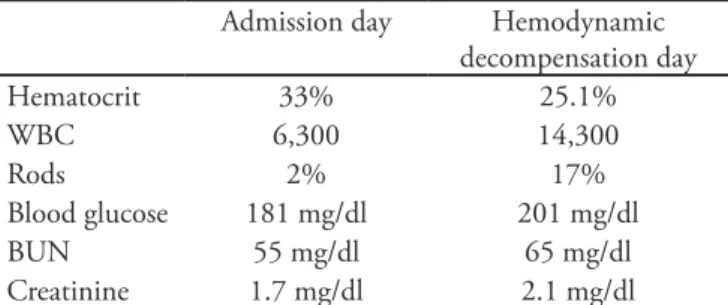
An admission laboratory panel showed decompensated hypothyroidism, with a thyroid stimulant hormone (TSH) of 88.02 μU/mL (reference value: 0.4-4.5), a free T4 (FT4) of 0.08 ng/dL (reference value 0.8-1.9), anemia of chronic illness with a hematocrit (Htc) of 33% and a hemoglobin (Hgb) of 11 g/dL, a white blood-cell count that was negative for infection, a blood glucose of 181 mg/dL, and a creatinine of 1.7 mg/dL. No other laboratory values were remarkable (Table 1).
LT4 replacement was started at 12.5 μg/day, with progressive dose increments for 15 days up to 62.5 μg/ day. On the 16th hospital day, after he was clinically
compensated, the patient experienced hemoptysis and had crackling at the right pulmonary base, so he was started on oral antibiotics. Five days later he showed no improvement and had dyspnea at rest, fever peaks,
difuse crackles, a white blood cell count of 14.3 thousand/mm3 with a left shift (bands 17), and his Na+
was 131 mMol/L, K+ 5.5 was mMol/L and creatinine was 2.1 mg/dL (Table 1). he chest X-ray showed difuse bilateral iniltrates. he patient progressed to ventilator-support-requiring respiratory failure and also required hemodynamic and enteral nutritional support. he LT4 replacement dose was increased to 200 μg/day (2.2 μg/ kg/day) via enteral administration, and corticoid therapy was started (hydrocortisone 200 mg/day) along with antibiotics and an intravenous proton-pump inhibitor (omeprazole).
hree days later, he had a clinical improvement while still on respiratory support; the sedation was reduced, and the LT4 replacement was increased to 300 μg/day (3.3 μg/kg/day). After four days on high-dose LT4 his hormone levels were FT4 0.96 ng/dL, and TSH 2.07 ng/dL (Table 2). Next, he underwent daily sedation withdrawal as proposed by Schweickert et al.,(4) and was
ready to wake in less than 30 minutes, assuring us that he had no hypothyroidism-related consciousness level issue.
Table 2 – Hormone dosages
Laboratory progression
Admission day – LT4
started
7 days after LT4 escalation to 200 μg/day)
LT4 300 μg/day for 7 days
LT4 300 μg/day for
20 days
TSH 88.02 2.07 0.1
FT4 0.08 0.96 1.24 1.38
TSH – thyroid-stimulating hormone; LT4- levothyroxine; FT4 - free T4.
His condition remained critical during the entire stay in spite of the laboratory hormone improvements. His last laboratory levels after 20 days on LT4 300 μg/day were FT4 1.38 ng/dL and TSH 0.10 ng/dL (Table 2). The patient progressed to septic shock with a pulmonary focus and eventually died 30 days after his admission.
Table 1 – Case 1 patient laboratory data
Admission day Hemodynamic decompensation day
Hematocrit 33% 25.1%
WBC 6,300 14,300
Rods 2% 17%
Blood glucose 181 mg/dl 201 mg/dl BUN 55 mg/dl 65 mg/dl Creatinine 1.7 mg/dl 2.1 mg/dl
Case 2
E.F.W., a 76-year-old female, had a height of 1.78 m and a weight of 90 kg and had been diabetic for 35 years, with microvascular complications including sensitive motor neuropathy, mild gastroparesis, and nonproliferative retinopathy. She had compensated hypothyroidism treated at the outpatient clinic and had been taking 125 μcg LT4 (1.38 μcg/kg). Her hypothyroidism resulted from a surgery on a suspect thyroid nodule (histology confirmed that it was a benign follicular adenoma). Until March 2008, she was taking 16 units of insulin glargine once daily, with appropriate blood glucose control. She was also taking 80 mg/day valsartan, 20 mg/day pantoprazole, and 10 mg pre-prandial bromopride during post-meal vomiting phases.
One year earlier the patient sustained a right femoral neck fracture after a fall. Her postoperative antibiotic therapy was maintained for 21 days due to mild wound dehiscence. She completed her ciprofloxacin course as an outpatient after she was discharged from the hospital. Two months later she had a symptomatic Klebsiella urinary tract infection (extended-spectrum β-lactamase-producing – ESBL) and underwent ambulatory intra-muscular ertapenem therapy.
In April 2008, she was admitted for diverticulitis, which progressed to sepsis, but was discharged 10 days later after meropenem antibiotic therapy. Fifteen days later, she was unusually drowsy and had fever and hypotension; she was admitted to the hospital with a pneumonia diagnosis and progressed to septic shock. After the infection was brought under control, she could not be weaned from mechanical ventilation (mainly due to a recurrent 600-800 mL pleural effusion in each hemi-thorax). The pleural effusion was confirmed to be a transudate in two evaluations. She was continued on an enteral diet, and she was already taking 200 μg (2.2 μg/kg) LT4, supporting the hypothesis that her hypothyroidism could be contributing to the pleural effusions. New laboratory evaluations showed a TSH of 12.0 μU/mL (reference 0.4-4.5) and an FT4 of 0.7 ng/ dL (reference 0.8-1.9). At this point, she had not received corticoids, as she had shown an appropriate response to vasopressors (noradrenalin), which were required for only 5 days. Thus, 20 μg /day T3 was added to her T4 therapy. Two Wayne catheters were inserted to drain both sides of the chest, retrieving about 1,000 mL every three days. The drainage
frequency and volume were progressively reduced until the catheters were draining 300-400 mL/week, at which time the patient was finally weaned from mechanical ventilation and discharged from the intensive care unit (ICU).
DISCUSSION
Sodium levothyroxine is commonly prescribed for physiological hypothyroidism replacement. The typical ambulatory replacement dose is 1.6 to 1.8 μg/kg/day;(5) this translates to about 75 to 112 μg/
day for females and 125 to 200 μg/day for males. Some patients may require higher or lower doses due to their individual absorption characteristics or other associated factors that can change their LT4 needs, such as gastrointestinal diseases or the use of certain dietary supplements and drugs. Many thyroid hormone absorption trials have been conducted since 1960. Hormone absorption analysis methods have been developed to allow for evaluation of LT4 bioavailability changes. Hays(6) developed
a compartment model based on gastrointestinal transport parameters, and LT4 absorption was identified at the duodenum, jejunum and ileum, but mainly in the two latter sites, where 80% of an oral dose is absorbed. In the first few hours following oral intake, LT4 is distributed mainly to the vessels and splanchnic organs before circulating to peripheral tissues, peaking within 2 to 4 hours.(7) Therefore, the
total serum T4 increase should be proportional to the T4 absorbed at several different times during the first six hours after intake.
Therefore, several issues need to be considered for T4 absorption in critically ill patients, such as intestinal edema, hypoalbuminemia, continued enteral diet, and hypothalamic-pituitary-thyroid (HPT) axis adaptive changes. These may lead to additional LT4 replacement management challenges both for hypothyroidism patients undiagnosed before the critical illness and for previously diagnosed hypothyroidism patients. This is true both for decompensated patients in the outpatient clinic, as in case one, and those considered compensated, as in case two.
Efects of gastrointestinal diseases on levothyroxine absorption
T4 is mainly absorbed at the jejunum and upper ileum, and critically ill hypothyroidism patients may have a number of diseases at these sites. Celiac disease, pancreatic insufficiency, short bowel syndrome, inflammatory bowel disease and other conditions (including those affecting normal stomach acid secretion such as chronic atrophic gastritis
and Helicobacter pylori infection) all can cause
reduced LT4 absorption. This is often evidenced by increased TSH while taking an LT4 dose that would otherwise keep TSH normal. Celiac disease antibody measurements were proposed to be useful for patients requiring FT4 doses ≥ 2 μg/kg/day,(8) as
reported by Silva and Souza on an untreated celiac disease patient requiring a dose greater than 6 μg/kg/ day.(9) However, no recommendations are available
for replacement doses in critically ill patients, mainly due to the lack of laboratory parameters for dosage decision making.
Effects of food on LT4 absorption
The interference of food with LT4 absorption was shown by Benvenga et al.(10) based on absorption
curves and serum T4 level changes. Coffee delayed absorption by at least one hour after LT4 intake, resulting in TSH level normalization. However, additional evaluations are required to support the recommendation that LT4 should be taken with an empty stomach one hour before a meal. Some food components, such as fibers and soy beans, may reduce LT4 bioavailability.(11,12) Even when LT4
is given alone or parenterally, dietary fibers may interact with T4 during its intestinal recycling in the T4 enterohepatic cycle. T4 clearance may also be increased independently of LT4 and dietary fiber intake. Thus, in outpatients, TSH concentration monitoring is recommended in patients taking LT4 who change their diets to include increased fibers and/or soy beans.(11,12) In the continued enteral
diets of critically ill patients, some drug absorption is estimated to be reduced by about 50% due to the diet infusion. Associated hypothyroidism may be an additional factor seen in conjunction with other changes normally seen in critically ill patients (such as fluid retention, renal failure, bowel edema, and vasoactive amines). However, no data on levothyroxine use in this group of patients is currently available. Thus, a logical, but also
speculative, suggestion would be to double the full dose recommended for outpatient clinic therapy to about 3 mcg/kg/day. In both cases here, the replacement was clearly above outpatient levels (3.3 μg/kg for case 1 and 2.2 μg/kg for case 2), and in case 2, this was not enough to stabilize her ICU TSH levels, even with additional T3.
Effects of drugs on thyroid hormones levels Many drugs have been reported to affect LT4 absorption, including ferrous sulfate, aluminum hydroxide, calcium carbonate, cholestyramine, sucralfate, and more recently, proton pump inhibitors, which in addition to affecting absorption may increase clearance.(8,13) Among the mentioned
drugs, only the proton pump inhibitor omeprazole was taken by both patients. Patients should be instructed to take LT4 at least 3 hours after taking any of these drugs.(7) Overall, the required LT4 increase
is less than twice the usual replacement dose.
In ICU patients, two drugs frequently reported to change the thyroid axis are glucocorticoids and sympathicomimetic amines (dopamine). Acute glucocorticoid doses inhibit the pulse TRH release, which reduces TSH levels and the T3/T4 ratio and concomitantly increases the rT3 (reverse T3)/ T4 ratio, suggesting that glucocorticoids increase Type 3 deiodinase activity.(14) These changes are
seen both in normal and hyperthyroidism patients, including LT4-taking hypothyroidism patients. Dopamine inhibits TSH release, also resulting in reduced T4 and T3 levels.(15) The case 1 patient was
given corticoids at recommended dosage levels for sepsis,(16) which may have contributed in part to the
relatively fast TSH level reduction in the setting of normal FT4 levels. The case 2 patient was given no corticoids but relatively short-term treatment with norepinephrine; however, given her critical status, hormone laboratory levels showed insufficient thyroid hormone replacement.
hormone (TRH) reduction, which is peripherally evidenced by low T3 and T4 levels and increased reverse triiodothyronine (rT3) levels. These changes, collectively called euthyroid sick syndrome, progressively worsen with the patients’ clinical status, and can be classified into three stages:
1. Stage 1: reduced circulating T3 of up to 50%; modest rT3 increase; no serum FT4, TT4 (total T4) or TSH changes.
2. Stage 2: significantly reduced T4 clearance still maintaining pulse TSH release, leading to a modest FT4 increase; more serum T3 reductions and rT3 increases.
3. Stage 3: changes are accompanied by a lack of pulse TSH release and a drop in T4 and T3 levels. The patients are severely ill, and the changes may be seen as a severe disease pre-agonic phase, given the high mortality rates in these patients.
In compensated primary hypothyroidism patients with LT4 replacement who are hospitalized for non-thyroidal acute disease, some natural T3, T4, rT3 and TSH changes have been observed. As shown by Wadwekar and Kabadi,(17) T3 and T4 levels
drop to a trough level and an rT3 increase is seen on the 3rd hospital day; TSH is initially reduced,
but increases by the 7th day before normalizing,
probably secondary to transient thyroidal hormone metabolism changes. Additionally, recovery from critical illness is preceded by a circulating TSH level increase.(18) In the case 2 patient, TSH levels
were increased during the critical illness course, and remained high even during her recovery phase, rendering it difficult to discriminate the above-described phases.
Other highly relevant changes are those critical illness peripheral thyroid hormone metabolism changes that occur during the acute phase in addition to other thyroid axis changes. Type 1 deiodinase (D1), considered the main circulating T3 source, has its activity markedly reduced during critical illnesses compared to healthy subjects; however, this is a reversible reduction and is restored after TRH infusion, with T4 and T3 level normalization.(18)
Based on this, we chose to aggressively increase the LT4 doses, without fearing any heart or coronary disease deterioration, as the patient was already on sympathicomimetic amines. Liver T4 capture is also reduced and is an additional factor causing reduced T3 production in these patients. Other peripheral changes include increased sulfated T4
(inactive), reduced thyroid hormone binding protein concentrations, and reduced nuclear receptor binding. In contrast to acute phase changes, chronic phase changes are unlikely to represent an adaptive response.(19) During this phase, thyroid hormone
levels are inversely correlated with hypercatabolic chemical markers (urea production and bone degradation), which may be reduced when the hormones are restored to physiological levels by continuous TRH infusion in combination with growth hormone (GH) secretagogues.(19,20) So far,
T4 administration has failed show clinical benefit for these patients, perhaps due to the T4 to T3 conversion impairment.(18) However, T3 replacement
doses after congenital heart defect corrections have been associated with improved postoperative heart function.(18) So far, however, there is no favorable
evidence for treatment of the low T3 levels that are typical of prolonged chronic illness.(21)
CLOSING REMARKS
he proposed LT4 doses for both cases’ patients were about two-fold the usual replacement dose: 300 μg/day (3.3 μg/kg/day) for case 1 and 200 μg (2.2 μg/kg/day) plus T3 for case 2. his approach considered likely hormone absorption impairments such as proton-pump inhibitor use, gastric atonia and bowel mucosal edema, a continued enteral diet, and, in case 2, the diiculty of handling pleural efusions with contributing hypothyroidism. Withholding the diet one hour before and after LT4 dosing is one way of attempting to optimize absorption, but in critically ill patients this is still an unproven treatment. Similarly, questions regarding the interference of some enteral diet components with LT4 absorption and clearance still need to be answered. Hormone dose escalation is not required to be as slow as in outpatients, as deiodinase increase (the much-feared cardiac efect after “excessive” replacement) is clearly reduced. Additionally, the critically ill patient is already exposed to many myocardial stressful factors, such as the trauma metabolic response and the use of sympathicomimetic amines. As critically ill patients’ adaptive changes may provide protein catabolism prevention (especially during the acute phase), the physician must decide whether T4 and T3 replacement is appropriate, particularly in hypothyroidism patients, as this is known to impair critically ill patient management with efects including slowed awakening from sedation and pleural efusions interfering with mechanical ventilation weaning. he schedule we used was based on objective LT4 absorption data, but was still only a guess at the critically ill hypothyroidism patients’ actual LT4 (and eventually T3)
replacement needs. he patient’s thyroid phase should also be studied, as replacements similar to physiological pulses have clearly been shown to be positive in studies on critically ill patient anabolic strategies. We suggest that special attention should be given to awakening after sedation withdrawal as a parameter for replacement appropriateness, and we suggest that free T4 levels should be monitored, given the well-known ICU inluences on TSH levels.
RESUMO
Inúmeros fatores podem inluenciar a absorção da levotiro-xina nos pacientes hipotireoideos, especialmente medicações e administração concomitante com alimentos. Nos pacientes in-ternados em unidade de terapia intensiva, estes fatores são mais evidentes, principalmente em função da dieta enteral contínua além de diversas medicações que podem interferir na sua absor-ção. Alterações adaptativas no eixo hipotálamo-hipóise-tireóide e alterações clínicas comumente presentes em pacientes críticos que podem ter contribuição de um hipotiroidismo não tratado se associam tornando ainda mais difícil o manuseio da reposição de levotiroxina. Relatamos dois casos de pacientes com hipoti-roidismo internados em unidade de terapia intensiva, com suas respectivas abordagens para reposição de levotiroxina, levantan-do questões controversas como: qual a levantan-dose ideal de reposição, velocidade no incremento das doses, necessidade de associação com triiodotironina, interferência da dieta enteral na absorção, e inalmente as possíveis conseqüências de um hipotiroidismo não tratado e as formas clínicas e laboratoriais para monitorizar as doses hormonais administradas.
Descritores: Absorção; Levotiroxina/farmacocinética; Hipotireoidismo; Cuidados críticos; Relatos de casos
Table 3 – hyroid hormone replacement in hypothyroidism patients in three diferent clinical settings
Hormone replacement Outpatient ICU Myxedematous coma
Intravenous LT4 --- 200 µg* 300-500 µg/day
Oral LT4 1.6 – 1.8 µg/kg 3 µg/kg 4 µg/kg
↑ dose 25 µg/ 2-4 weeks ↑ 50-100 µg Full dose
Oral T3 ? ? ?
*As used in our service; ICU – intensive care unit; LT4- levothyroxine; T3 – triiodothyronine; ? - unknown.
REFERENCES
1. Sawka AM, Gerstein HC, Marriott MJ, MacQueen GM, Jofe RT. Does a combination regimen of thyroxine (T4) and 3,5,3’- triiodothyronine improve depressive symptoms better than T4 alone in patients with hypothyroidism?
Results of a double-blind, randomized, controlled trial. J Clin Endocrinol Metab. 2003;88(10):4551-5.
alone. Ann Intern Med. 2005;142(6):412-24.
3. Wartofsky L. Myxedema coma. Endocrinol Metab Clin North Am. 2006;35(4):687-98, vii-viii.
4. Schweickert WD, Gehlbach BK, Pohlman AS, Hall JB, Kress JP. Daily interruption of sedative infusions and complications of critical illness in mechanically ventilated patients. Crit Care Med. 2004;32(6):1272-6.
5. Larsen PR., Davies TF - Hypothyroidism and hyroiditis, in: Williams Textbook of Endocrinology. 10. ed., USA: Elsevier Science , 2003. pp442
6. Hays MT, Nielsen KR. Human thyroxine absorption: age efects and methodological analyses. hyroid. 1994;4(1):55-64.
7. Mandel SJ, Brent GA, Larsen PR. Levothyroxine therapy in patients with thyroid disease. Ann Intern Med. 1993;119(6):492-502. Review.
8. Singh N, Hershman JM. Interference with the absorption of levothyroxine. Curr Opin Endocrinol Diabetes. 2003;10(5):347-52.
9. Silva CM, Souza MV. Hipotiroidismo autoimune refratário a altas doses de levotiroxina e hipocalcemia grave. Arq Bras Endocrinol Metab. 2005;49(4):599-603.
10. Benvenga S, Bartolone L, Squadrito S, Lo Giudice F, Trimarchi F. Delayed intestinal absorption of levothyroxine. hyroid. 1995;5(4):249-53.
11. Liel Y, Harman-Boehm I, Shany S. Evidence for a clinically important adverse efect of iber-enriched diet on the bioavailability of levothyroxine in adult hypothyroid patients. J Clin Endocrinol Metab. 1996;81(2):857-9. 12. Bell DS, Ovalle F. Use of soy supplement and resultant
need for increased dose of levothyroxine. Endocr Pract. 2001;7(3):193-4. Review.
13. Centanni M, Gargano L, Canettieri G, Viceconti N, Franchi A, Delle Fave G, Annibale B. hyroxine in goiter, Helicobacter pylori infection, and chronic gastritis. N
Engl J Med. 2006;354(17):1787-95.
14. Re RN, Kourides IA, Ridgway EC, Weintraub BD, Maloof F. he efect of glucocorticoid administration on human pituitary secretion of thyrotropin and prolactin. J Clin Endocrinol Metab. 1976;43(2):338-46.
15. Debaveye YA, Van den Berghe GH. Is there still a place for dopamine in the modern intensive care unit? Anesth Analg. 2004;98(2):461-8.
16. Dellinger RP, Carlet JM, Masur H, Gerlach H, Calandra T, Cohen J, Gea-Banacloche J, Keh D, Marshall JC, Parker MM, Ramsay G, Zimmerman JL, Vincent JL, Levy MM; Surviving Sepsis Campaign Management Guidelines Committee. Surviving Sepsis Campaign guidelines for management of severe sepsis and septic shock. Crit Care Med. 2004;32(3):858-73. Erratum in: Crit Care Med. 2004;32(6):1448. Dosage error in article text. Crit Care Med. 2004;32(10):2169-70. 17. Wadwekar D, Kabadi UM. hyroid hormone indices
during illness in six hypothyroid subjects rendered euthyroid with levothyroxine therapy. Exp Clin Endocrinol Diabetes. 2004;112(7):373-7.
18. Mebis L, Debaveye Y, Visser TJ, Van den Berghe G. Changes within the thyroid axis during the course of critical illness. Endocrinol Metab Clin North Am. 2006;35(4):807-21, x. 19. Van den Berghe G. he neuroendocrine response to stress
is a dynamic process. Best Pract Res Clin Endocrinol Metab. 2001;15(4):405-19. Review.
20. Debaveye Y, Ellger B, Mebis L, Van Herck E, Coopmans W, Darras V, Van den Berghe G. Tissue deiodinase activity during prolonged critical illness: efects of exogenous thyrotropin-releasing hormone and its combination with growth hormone-releasing peptide-2. Endocrinology. 2005;146(12):5604-11.