Rev. bras. oceanogr., 44(1):9-21, 1996
Effects of habitat complexity on the structure of macrobenthic
association in a
Spartinaaltemifloramarsh
Maurea Nicolctti FLYNN*; Airton Santo TARARAM & Yoko WAKABARA Instituto Oceanográfico da Universidade de São Paulo
(Caixa Postal 66149,05389-970 São Paulo, SP, Brasil)
. Abstract:The structure and seasonal variability 01'macrobenthic associations in four different patches on aSpartilla altemiflorabed at Arrozal Point, Canan6ia, São Paulo State are described and compared. Inthe local intertidal marsh, densities 01'S. a!temiflora plants appear in sparsely or densely arranged patches, both in tall and short forms. Thc infaunal polychaetes Capitella capitata, Isolda plllchella, Ncreis oligohalinaandLaconereis aClltaaccounted for 44.0% 01'the total individuais while epifaunal forms such asHeleobia allstralis, Littorina anglllifera, Tholozodiu11l r/wmbofrolltalis and Sphaeromopsis l1l011reiwere the second most abundant components with 39.5%. Classification analyses 01'sampling time in the same sampling patch indicated that species groups were formed basically by spatial similarity and peak densities aI' macrofauna and secondarily by temporal patterns. Temporal variations were evident with higher number 01'species in colder months (winter and spring). Specics diversity and evenness did not show c\ear seasonal patterns, although they were signilicantly diffcrcnt in sampling patches and time. Heleobia allstralis, Littorina allguliferaand Allomalocardia brasiliellsiswere dominant in tall sparse S. altemiflora with density peaks occurring in wintcr/spring periods. 17wlozodium r/lOmbofrolltalis
andSphaeromopsis n!ourei were dominant in short sparse S. altemiflora with dcnsity peaks in summer. Intall, densely distributed S. altemifloraplants the higher densities occurred in winter and the dominant species were Nereis oligo/wlilla, [solda plllchella and Capilella capitata. The species H. allstralis, L. allgllliferaandA. brasiliellsis predominated in the short S. altemiflora
plants densely distributed, with faunistic peaks recorded in spring. The results suggest that differenccs in form and aggregation 01' S. altemiflora impart changes in the structure 01' macrobenthic fauna associated to this vegetation.
. Resumo: A estrutura e variação temporal de associações macrobentÔnicas de marismas de
Spartilla altemiflora,estruturalmente diferentes com relação à forma (baixa ou alta) e ao grau de agregação (esparsa ou agregada), foram descritas e comparadas, na Ponta do Arrozal, re~ião de Cananéia, costa sul do Estado de São Paulo. Representantes da infauna como os poltquetos
Capitella capitata, Isolda plllchella, Ncreis oligo/wlinaeLaeonereis acuta perfizeram 44,0% da fauna coletada, enquanto que formas epifaunais como Heleobia aw,tralis, Littorilla allgulifera, 17wlozodium rhombofrontaliseSphaeromopsis mOllreiatingiram 39,5%. Análises classificatórias dos períodos de amostragem indicaram que os agrupamentos de espécies foram formados basicamente pela similaridade espacial e picos de densidade da macrofauna seguidos pelos padrões de variação temporal. Os maiores valores de diversidade ocorreram no inverno e primavera. Os índices de diversidade e equitatividade, embora significativamente diferentes entre locais de amostra e tempo, não mostraram um padrão sazonal muito claro.Heleobia allstralis, Littorina angllliferaeAnomalocardia brasilie"sisforam dominantes entre as plantas altas de S.
altemiflora,esparsamente distribuídas, com picos de densidade faunística ocorrendo nos períodos de inverno e primavera. Entre as plantas baixas csparsamente distribuídas as espéeÍcs dominantes foram17lOlozodil/l1!rllOmbofronta/iscSphacromopsis mOI/rei,com maior densidade no verão. Nas plantas altas e agregadas as maiores densidades ocorreram no inverno e as espécies dominantes foram Nereis oligohalina, 1m/da plllchel/a c Capitel/a capitata. As espécies H. australis, L. angllliferaeA. brasiliensisdominaram nas marismas baixas e agregadas, apresentando os maiores valores de densidade na primavera. Os resultados sugerem que diferenças na forma e agregação de S. altemiflora provocam mudanças na estrutura da fauna maerobentÔnica associada a esta vegetação.
. Descriptors:Habitat complcxity, maerobenthic association,Spartina a/temiflora marsh, Southern coast 01'São Paulo State, Brazil.
. Descritores:Complexidade de hahit~t, Assoeiações macrobentônicas, marisma de Spartilla altemiflora,Costa sul do Estado de São Paulo, Brasil.
(*) Bolsista de pÓs-doutorado do CNPq
Introduction
It has been amply dcmonstrated that struetural elements sueh as plant eover strongly influenee macrobenthic associations and ean lead to remarkable faunistic differenees betwecn vegetated and bare sites or between habitats with different types of vegetation. Evidenee has been provided by studies comparing sites with different species of seagrass (Lewis, 1984; Virnstein & Howard, 1987);vegetated and unvegetated habitats (Lewis & Stoner, 1983;Lana & Guiss, 1991) and sitcs with seagrass and maeroalgae (Sehneider & Mann, 1991). The majority of works on grassy bottoms deals with seagrass habitats. Although intertidal marshes and subtidal seagrass meadows are believed to exhibit similarities in their funetional and struetural roles (Orth et a/., 1984),
eontradietory patterns of maerobenthie organi7.ation have been deseribed for those environments, fully justifyi1Íg more studies of the salt marsh habitat.
Changes in the density or size of artificial plants lead to varied responses from macrobenthic communities( Gunnil, 1983; Edgar, 1990). These alterations are normally attributed to the effect of macrophyta on physical characteristics such as current speed and sediment stability (Peterson et a/., 1984) or modifications in biological interactions such as predation (Virnstein, 1977; Nelson, 1979; Heck & Thoman, 1981; FIynn, 1993). Densities of macrobenthic organisms in a salt marsh system often fluctuate greatly with season (Tararam & Wakabara, 1987; Lana & Guiss, 1991; FIynn, 1993), the same is also true to plant biomass, which makes the study of salt marsh structures more difficult.
Over the Cananéia intertidal marsh, densities of
Spartilla a/temif/ora plants appear in sparsely or densely arranged patches, both in talI and short forms. In this paper, we describe and compare the structure and seasonal variability of macrobenthic associations in such patches of a S.altemif/ora bed at Arrozal Point.
Material and methods
Cananéia lagoon estuarine region is located in the southern coast of São Paulo state (25°02'S
-
47°56'W). At Arrozal Point (Fig. 1), the marsh investigated presents average salinity values highcr than 28%0, surface water temperature around 20°C in winter and 32°C in summer. Local tides are characterizcd by diurnal incqualities. A complete description and characterization of the system is givcn by Schaeffcr-Novclli et aI. (1990).At this shore, there is onc of the largest marshes in the region with patches of plants loosely aggregated (6
plants/O.03m2) comprising groups of scattered individuais, and others with plants densely aggregated (12 plants/O.03 m2).Inboth situations S.altemif/ora can be found in both forms, tall (100 em) and short (40 em).
Four intertidal stations were established, comprising patches with tall and short S. a/temi flora sparsely distributed (Ptl and Pt2), and densely distributed (Pt3 and Pt4).
Faunal and environmental samples were taken once each season, in July 1988 (winter), October 1988 (spring), January 1989 (summer) and April1989 (autumn). Surface water temperature was determined by a thermometer. Salinity was determined using a hand refractometer and dissolved oxygen was analyzed according to Strickland & Parsons (1968). SeQiment samples were analyzed for silt-clay percentage, mean grain size (Suguio,1973) and organic matter by the H202 digestion method.
Faunal samples consisted of 3 replicates for each S.
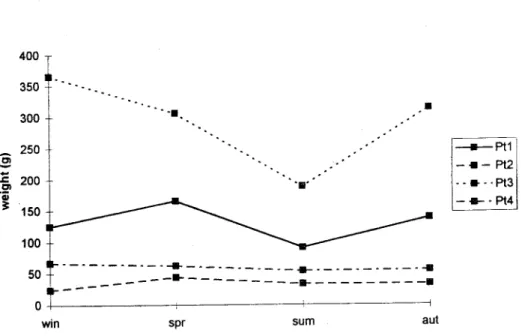
a/temif/orapatch (Ptl, Pt2, Pt3 and Pt4) taken by a corer 20 em in internal diameter penetrating the sediment to a depth of 10 cm. TweIve samples were taken in each season. S. aitemiflora leaves were clipped at ground leveI and searched for epifaunal organisms. Sediment samples were sieved through 1 mm and 0,5 mm meshes, fixed in 10% formalin and then preserved in 70% ethanol. AlI specirnens were identified at the lowest practical taxonomic levei and counted. S.a/temif/oraplants of each sample were dried for 24 h in a shady place and weighted in a normal scale. The number and size of plants per corer were counted and measured.
Ali species with at least 2 individuais per sample (Jackson, 1972) were included in a matrix of log(x + 1) transformed data for subsequent quantitative analyses.
The structure of the macrobenthic associations was evaluated by the total number of individuais (n), species richness (s), diversity (H') and evenness (J'). Species richness was evaluated by the total number of species per sampled patch. Shannon index (H') was used for measuring diversity.
One-way analyses of variance (ANO VA) were used to test for differences in water parameters such as temperature, salinity and dissolved oxygen. Two-way analyses of variance with replication were used to determine differences in sediment (grain size, silt-clayand organic content), community (n, s, H', J') and plant parameters (aggregation levei and size), taking into account habitat type and sampling season, as independent factors. A 5 per cent leveI of confidence was assumed.
FI...YNN et aI.:EffC'('tsofhahitat complC'xitynn mac.rohenthk association 11
0.5 o ao I
"'r
":,}"
, .
, . ". ","
0,, . ....
" ~.,,: t",:,,:,,"
o..:'
. ..'.'
:
:;.):; .:,;,.b:.:,:'i:'::,.:',..,;'" TRAPÀNDt BAY
47°58'W 51'
~
112iE Q. ~ o u
3'
4'
56 55' 54'
Fig. 1. Location of sampling site (Arrozal) in Cananéia Lagoon estuarine region, São Paulo State, southeastern Brazil.
reduce the multivariate nature of the data to a few interpretable dimensions.
Results
Temporal variations in temperature, salinity and dissolved oxygen of surface water are shown in Figure 2. Table 1 summarizes the variations of these parameters with
ANO VA results. These parameters reveal a significant temporal variation.
30 T _ ....
I ...
~
I ...25 T
..
-
---...--20
r
151
10
+
I / ...~
..-5
I
I ...-..._o J
~
T8 o
win spr sum sul
Fig. 2. Temporal variation in temperature (T"C), salinity (5%0) and dissolved oxygen (ml/l) of the superficial water.
Table 1. Variation range of superficial water variables and results of one-way ANOVA
(*) = significant difference at 5% levei of confidence
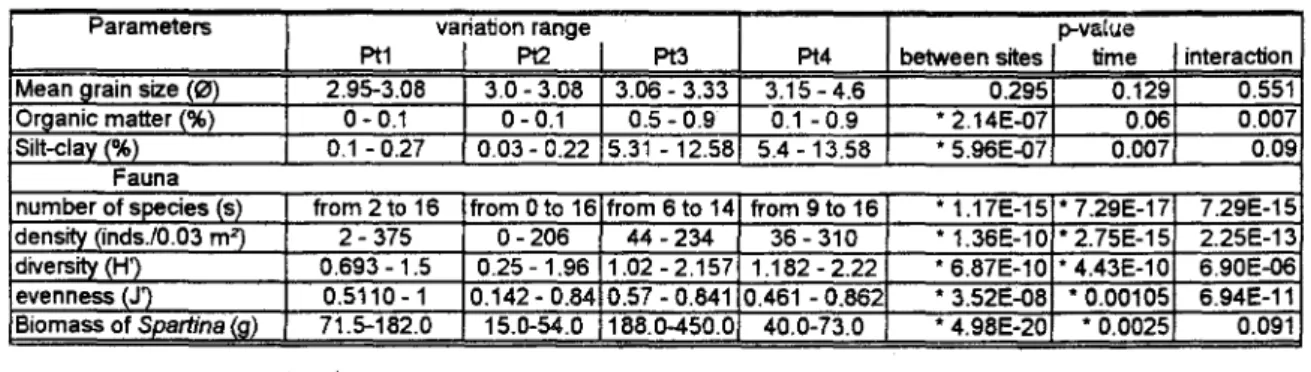
Sediment parameters were statistically different when different patches were considered, but were similar among sampling times (Table 2). Silt-clay porcentage and sediment organic content were found to have higher values at the dense S.altemiflorapatches.
A total of 2,023 macrobenthic animaIs belonging to 31 species were considered, referring to the mean values of species abundance of the three replica of each different patch sample (Table 3). The infaunal polychaetes Capitella capitata,Isolda pulchella, Nereis oligohalinaandLaeonereis acuta accounted for 44.0% of all individuaIs, while
'. '.
... ...
___
Pt1]
Pt2
- . .. ..Pt3
- .. .
Pt4~ ~
~
t
---.---.---
or---win spr sum sul
Fig. 3. 5easonal variation in biomass of Spartina for each sampling patch (Pt). Parameters variation range p-value
Salinity (%o) 22.4 - 28.1 * 3.19E-7
Temperature (0C) 20
-
28 * 0,00012Dissolved Oxygen (mltl) 2.53 - 6.80 *1.15E-07
400T 350
300
_
250EDI 200
'iij :t 150
FL YNN ('f aI.:EffC'ctsof hnhitnt compkxity on mncrohenthic association 13
Table 2. Variation range of variables and results of wo-way ANOVA with replication evaluating effect of sedlment parameters, fauna parameters and plant blomass
(*) = significantdifferenceat 5% levei of confidence
epifaunal forms such as Heleobia ausfralis, Littorina anglllifera, Tholozodillm rhombofrontalis and
Sphaeromopsis mourei accounted for 39.5% of the total. The 13numerically dominant spccics accounted for 92.5% of all individuaIs. The other 18 spccies were not included in quantitative analyses (Table 3).
Inverse analyses of data from sites in all seasons (Fig. 4) yielded four group species: group a, the infaunal polychaetes 1.pulche/la, N. oligohalina and C.capitata;
group b, the epifaunal amphipods Parhyalehawaiensisand
Platorchestia sp; group c, the molluscs H. allstralis, L. angllliferaandA. brasiliensis; and group d, the epifaunal isopods T. rombofrontalisand S.mourei
.
Hydrobiidae and S. grubii were not grouped probably due to their discontinuous temporal occurrence. L. aClltawas the only species more abundant in short S.altemif/ora forms.Classification analysis of sampling times indicated that groups in the same sample patch were formed primarily by spatial similarity and peak densities of macrofauna and secondarily by temporal patterns. Three groups were identified at 60% similarity levei (Fig. 5); the first one comprising samples from the four patches in cold periods, mainly winter; the second, samplcs collected from dense S.
a/temif/ora (Pt3 , Pt4); the third, samplcs from sparsely distributed S.a/temif/ora(PU, Pt2).
Species or group of species showed a strong seasonal component (Fig. 6). In winter, polychaetes from group a(N. o/igolla/ina,J.plllclle/la and C.capitata)were the dominant species in tall S. alternif/ora and L. aClltain sparsely distributedS. altemif/ora. T.rhombofronta/is andS.mourei
(group d), P. hawaiensis andPlatorcllestiasp (group b) were also abundant in winter.H. allstralis,L. angll/iferaand
A. brasi/iensis(group c) appeared with higher densities in sparse S. altemif/ora (Ptl, Pt2). In spring, polychaetes (group a) were restricted to densely distributed S.
altemif/ora(Pt3 and Pt4). Mollusc species (group c) were
abundant in alI sampling patches. AlI species exhibited lower densities in summer. Isopod species (group d) dominated in short sparse S.a/ternif/ora,while polychaete species (group a) remained restricted practically to dense S. a/temif/ora patches. In autumn , sparse patches of S.
a/temif/orawere practicalIy devoid of associated fauna, with molluscs of group c predominating in densely distributed patches, followed by L. acuta and polychaete species (group a).
Species richness differed statisticalIy between habitats, with higher values in talI S.altemif/ora patches (Fig. 7). Temporal differences were evident at the sampled patches, with higher number of species in colder months, winter and spring. Species diversity and evenness, although significantly different betwcen sampling patches and time, did not show any distinct seasonal patterns. Although the rare species which greatly influenced the Shannon index were withdrawn, this information index was still greatly affected by the evenness component, disguising any spatial or seasonal pattern.
In terms of the faunal components associated to the S.
a/temif/orapatches observed, it was noticed that in the tall sparse S. altemif/ora patch (Ptl), group c species, H. allstra/is, L. anguliferaand A. brasiliensiswere the most abundant; the first two are epifaunal grazers and the third species an infaunal suspension fceder, followed by the infaunal deposit feeders polychaete species (group a). Density peaks in tall sparse S.a/ternif/orapatch occurred in winter/spring periods. In the short sparse S. alternif/ora
patch (Pt2), the dominant species were,T. rhombofrontalis
and S.mourei,both grazers, followed byL. acuta.Density peak in the talI sparse S. a/ternif/orapatch occurred in summer. In the tall dense S.a/temif/orapatch the dominant species were polichaetes of group a , followed by the mud mollusc Hidrobiidae. Density peak in this patch was in winter. In the short dense S.a/temif/orapatch the dominant
Parameters variation range p-va(ue
Pt1 Pt2 Pt3 Pt4 between sites time interaction
Mean grain size (0) 2.95-3.08 3.0 - 3.08 3.06 - 3.33 3.15 - 4.6 0.295 0.129 0.551
Organic matter (%) 0-0.1 0-0.1 0.5 - 0.9 0.1 - 0.9
.
2.14E-07 0.06 0.007Silt-clav (0",,) 0.1 - 0.27 0.03 - 0.22 5.31 - 12.58 5.4 - 13.58 * 5.96E-07 0.007 0.09 Fauna
numberotspecies (s) trom 2 to 16 trom Oto 16 trom 6 to 14 trom 9 to 16 * 1.17E-15 * 7.29E-17 7.29E-15
density (inds./0.03 m2) 2 - 375 O- 206 44 - 234 36 - 310 * 1.36E-1O . 2.75E-15 2.25E-13
díversity(H') 0.693 -1.5 0.25 - 1.96 1.02 - 2.157 1.182 - 2.22 * 6.87E-10 * 4.43E-10 6.90E-06
evenness (J') 0.5110-1 0.142 - 0.84 0.57 - 0.841 0.461- 0.862 * 3.52E-08 *0.00105 6.94E-11
Table 3. Denslty (inds./O.03m2) of the species in each sampllng locatlon. ()
= species number used In quantitatlveanalyses.
species were molluscs of group c, followcd byL. aClItaand graup a species. Density pcak in this patch occurrcd in spring (Fig. 6 ).
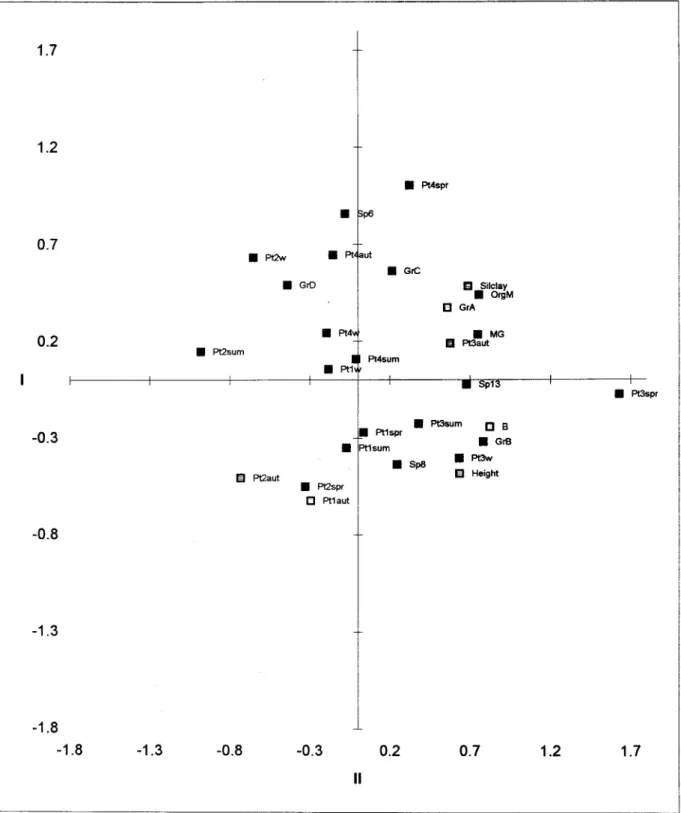
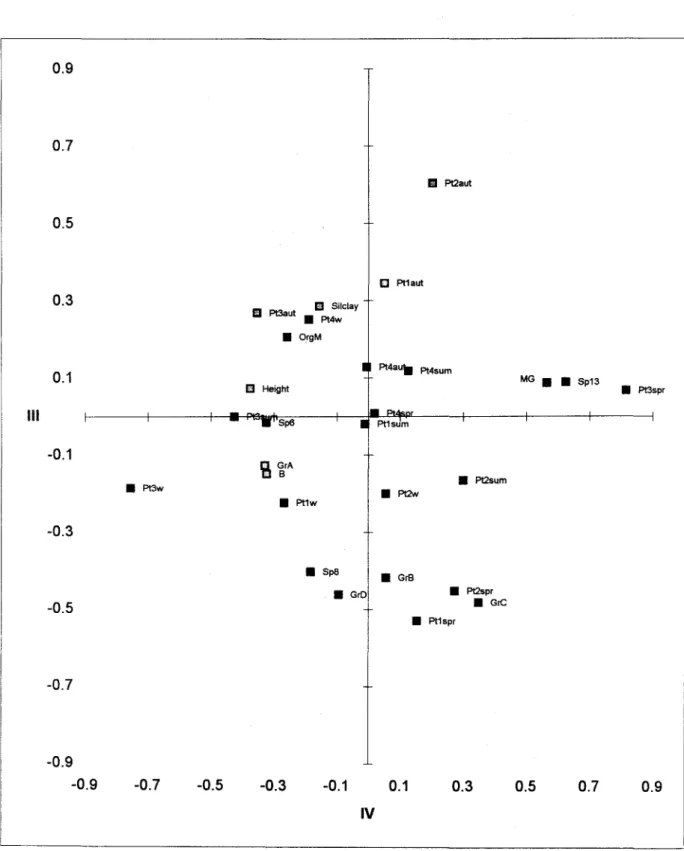
Sample and paramcter points of principal components analyses were projccted simultancously in the factorial space (Fig. 8 a and b). Thcrc was a broad match with the pattem of responses exhibitcd by c\ustcr analysis. The first componcnt accountcd for 36.6% of the total variance. Spccics of infaunal polychaetes (group a), epifaunal amphipods (graup b), molluscs (group c) and S.gntbii,with positive coordinates, werc opposcd to isopod species (group d) andL. acutawith ncgative coordinates. The first species were related to higher S.alterniflorabiomass. The first axis ais o distinguished locations with dense S.
alterniflora fram locations with sparscly distributed S.
alterniflora.Physical-chemical parametcrs, such as silt-clay percentage and organic mattcr, besidcs form growth and biomass plant, showed positive coordinates. Species and site positions on the first axis can be regarded as a response
to the aggregation levei of S. a/temiflora. The second component (20.7% of data variance) separated species with higher densities from those with lower densities. Besides, this axis also separated tall S. a/terniflora patches fram shortS. a/terniflorapatches. The third component (11.9 % of data variance) separated infaunal species, with negative coordinates related with the rhizome and roots, fram epifaunal species. Interpretation of the fourth component was not c\ear.
Discussion
The results suggest that differences in form and aggregation of S.a/temiflora plants impart changes in the structure of macrobenthic fauna associated to this vegetation. There was a similar composition of species among marsh locations with marked differences in the relative abundance of the dominant components. Each
Species Pt1 Pt2 Pt3 Pt
Acteocina canaliculata 3 1 O 4
Bittiumvarium 3 4 O 4
CostoanachisSP 2 1 o 3
Epitoniumsp O 1 O 1
Heleobiaaustralis (1) 153 40 37 260
Littorina angulifera (2) 25 5 13 1
Nassariussp 3 3 2 7
Neritinavírginia 7 O 3 6
TurboniUasp 2 1 O 2
Odostomiasp 2 O 8 1
Hvdrobiidae(13) O O 5 2
Anomalocardiabrasi/iensis (3) 15 7 7 21
Mytellaguyanensis 3 2 9 1
Sphenia antillensis 1 1 4 5
Capitel/acapitata 4) 253 3 191 68
Isoldapulchella (5 7 1 39 19
Laeonereis acuta 6) '15 39 12 59
Lumbrinerishebes O O O 7
Neanthes succinea 1 2 2 3
Nereis o/iqohalina (7) 43 3 53 51
Perinereisponteni 1 O 5 O
Perinereisvancaurica 3 O 8 O
Sigambra grubií (8) O O 14 1
Cassidinideatuberculata 1 O 5 4
Dies fIuminensis 1 1 2 O
Tholozodiumrhombofrontalis(10) 24 132 2 15
Sphaeromopsis mourei(11) 3 72 9 14
Parhyalehawaiensis (9) 8 O 19 3
Platorchestia SD(12) 12 7 21 4
Hyale media 1 1 2 2
Zeuxo sp O O 11 O
TOTAL 592 327 523 581
FLYNN C(01.:Effect~ of hahitat complcxity on macrohenthic association 15
J..O_____
sp5 sp7 sp4 sp9 sp12 spl sp2 sp3 splO spll sp6 sp8 sp13
Fig. 4. Dendogram of species. Species groups a (sp4
=
Capitella capitata,sp5 = Isolda pll/chella, sp 7 = Nereis oligohalina);b (sp9 = Parhyale
hawaiensis, sp12 = Platorchestiasp); c (sp1 = Heleobia allstralis,sp2 =
Littorina angulifera, sp3 = Anomalocardia brasiliensis); d (sp10
Tholozodill17lrllOmbofrontalis,sp11 = Sphaeromopsis mOllrei)and others (sp6
=
Laeollereisacuta,sp8 = Sigambragmbiiand sp13 = Hydrobiidae) indicated.lwin 4win 2win 4spr 3aut 3win 3rom 4sum 4aut 3spr lspr l~ lmt 2spr :;2$W11.
Fig. 5. Dendogram of sampling seasons at four different patches (Pt):1-4.(win
= winter,spr =
spring, sum = summer, aut = autumn).I
WP81'111
0.2
0.3
0.4
0.5
X " 0.6 'a
.5
.
0.7
001
1.7"
I
0.9
WPGMII
0.4
0.5 X
"
'a .5 0.6
0.7
0.8
0.9
Pt4w
Pt3w
Pt2w
Pt1w
o
Pt4sum
Pt3sum
PI2sum
Pt1sum
Wlnter Sprlng
Pt4spr
Pt3spr
PI2spr
Pt3aut
PI2aut
Pt1aut
Figo 60 Distribution and density of species or groups of species per 0.03 m2 at each patcho (GrA-D = species of groups A-D, sp06 = Laéoneréis acuta,sp08 = Sigambra grubii, sp13 = Hydrobiidae)o
Pt1 spr
-',':, : ' ".':';;: :\\i;:t\;tW1{f01TIVj;1EW\G'i:hS};:;r.f,gj:;:lb?t;*.:Jf.?t1tyt';:';*'{tf'w)A
50 100 150 200 250 o 20 40 60 80 100 120 140 160 180
Summer Autumn
1-Pt4aut
o 50 100 150 200 250 o 20 40 60 80 100 120
I
êlGrA
GrB
IJGrC
111
GrD
FLYNNet ai.:Effects of habitat complexity on macrobenthic association 17
16 U) 14
-;
12.!!! 10u
~
8U) 6
-
o 42: 2 O
350 300
E
250S
200!:2 150
~
100 50 O..
-_8..
__
- -
- - -
- -
...
;;
".-:-."":'.:--
-"'::...---.'- .
....
"
~..
~
-.
~..~
.---.-...
win
spr sumaut
...
"
..."
..."
......
--,,
-.
--.,-- "
"""---"
...~... '"
:<
-,
'"
-
.
"
.-
....
"
. -
.... . . --. ---
~----..
~ ...
spr sum aut
-
-
-"--, .-,:= :::::-, . .. :
::...-~-~~~....
--e-:-_:...:___
---..---..
",-" *
---e
---.
...
...... ...
....
. .
spr sum aut
O
-.--..
-~ : -.::..-- -. - - .: "..-;:::
. '. - -'
-
- -:::-~-.:.-
---.
...
'-. - '-. ;'-.
.... .
....-....
. .
win spr sum aut
Fig. 7. Temporal variation in number of species (s), diversity (H'), evenness (J') and mean density per 0.03 m2 of benthic macrofauna at each sampling patch (Pt).
win
1 0.8
U) Q) 0.6
:J (ij
> 0.4 ::.,
0.2 O
win
2.5 2 U)
1.5 (ij> J:
1.7
1.2
.
Pt4spr.
GrD.
GrC0.7
.
Pt2w
EI Silclay .OrgM [] GrA
. Pt2sum
li Pt3aut. MG
0.2
.Pt1
,p1
. Pt3spr
m Pt2aut
. Pt3sum [] B 11Pt1spr . GrB
· lPt1sum . Pt3w
m Height
. Sp8
-0.3
.
Pt2spro
Pt1aut-0.8
-1.3
-1.8 -1.8
1
-1.3 -0.8 -0.3 0.2 0.7 1.2 1.7
11
Fig. 8a. Principal components analysis of species, sampling seasons and physico-chemical parameters at each sampling station. Axes I and 11.(w
= wlnter,
sum = summer; aut = autumn; spr = spring; Pt = patch; Gr = groups; SilclayFLYNNet ai.:Effects of habitat complexity on macrobenthic association 19
0.9
0.7
m
Pt2aut0.5
-0.7
-0.9
-0.9 -0.7 -0.5 -0.3 -0.1 0.1 0.3 0.5 0.7 0.9
IV
Fig. 8b. Principal components analysis of species, sampling seasons and physico-chemical parameters at each sampling station. Axes 11Iand IV. (w =
winter, sum = summer; aut = autumn; spr
=
spring; Pt=
patch; Gr = groups;
Silclay= % silt-clay;OrgM= organicmatter;MG= mean grainsize).
[] Pt1aut
m Silclay
0.3
m
Pt3aut.
Pt4w .OrgMt -
_"mMG
. .
Sp13.
Pt3spr0.1
EI Height
I
. rtau;.Sp6
11I
-0.1
'8 GrA
I
.
Pt2sum... B
.
Pt2w.
Pt3w.
Pt1w-0.3
.
Sp6 I.
GrB
.
Pt2spr
.
GrO.
GrC
.
Pt1sprsamplcd patch displayed an alternation of dominance among the few numerically expressive species. Schneider & Mann (1991) attributed this heterogeneous response to vegetation type to the biology of individual species, with respect to suitability of macrophytes as food resource and living space. Bell & Westoby (1986) pointed out that community measures as well as total abundance of individuaIs are unreliable variables for testing the effects of height and densities of plants since component species can give opposite responses. These authors showed that preference for a particular plant was highly species-specific, indicating that no vegetation characteristic made it a suitable substratum for all animaIs.
Small-scaled aggregation of infaunal organisms exists in association with salt marsh vegetation (Rader, 1984; Lana & Guiss, 1991; Flynn, 1993). In the present study the infaunal polychaetes N. oligohalina, I. plllchella and C.
capitata preferred patches with higher vegetal biomass deriving mainly from S. altemiflora leveI of aggregation. Epifaunal amphipods grazers as .P. hawaiensis and
Platorchestiasp, in the other hand, were related to plant height, numerically more abundant between tall forms of S.
altemiflora. This fmding is in accordance with Stoner's (1980) conclusions that epifaunal amphipods select the vegetation on the basis of blade surface area.
The heterogeneous patterns of temporal variation were strongly influenced by the populational dynamics of the dominant species. The abundance and species richness of tall S.altemifloraassociations showed a pattern already documented by Flynn (1993) with high densities at cold months, followed by a sharp decline in summer and autumn. Associations related to short S.altemifloraforms presented peak densities in summer, when in sparsely distributed S.altemiflora patches, or in spring, when in dense S. altemiflora patches. These peaks reflect the populational fluctuations of the groups of dominant species, respectively, epifaunal isopods and molluscs.
Mobile organisms densities associated to salt marsh S.
altemiflora greatly fluctuate with season (Tararam & Wakabara, 1987; Lana & Guiss, 1991;Flynn, 1993). Rapid population increases are explained in terms of the settlement of planktonic larvae and rapid growth rates of brooding invertebrates (Edgar & Moore, 1986). But the factors responsible for the marked populational decline are not well understood. Normally this decline is explained by an increase in predatory activities, but in Cananéia macropredators activity does not justify the population decline (Flynn, 1993), since both, the cage experiment and control experienced this abrupt decline. Heck & Thoman (1981) and Edgar (1990), among others, concluded that their findings were not consistent with the hypothesis of macropredators controlling the fauna. So, it seems that
exploitative competition has to be fully investigated. Because the vaste majority of macrobenthic species are generalist feeders which can utilize a variety of detrital, plant and animal material, diffuse exploitative competition can therefore be widespread amongst the macrobenthos, contrasting with the widely held view that the role of competition in structuring macrobenthic communities is minor, especially in comparison with the role of predation.
As Reice & Stiven (1983) suggested, our results also seem to stress that the initial idea of homogeneity created by a monoculture of S.altemifloramasks the reality of a truly patchy ecosystem. The presence of S.altemiflora in different aggregation levels and growth forms, coupled with seasonal changes of species probably related to detritus availability, play an importante role on the abundance and maintainance of a macrofaunal association. Sediment parameters seem to exert a secondary influence. Further investigations on the feeding strategies of the associated fauna should be carried out to evaluate the effects of food competition in the organization of these communities.
Acknowledgements
This study was made possible through post-doc grant provided by CNPq (Conselho Nacional de Desenvolvimento Científico e Tecnológico)
-
Proc. 300.417.194-2 to the senior author. Sonia Maria Araújo Barreto provided invaluable assistance during the sampling and sorting of biological material.References
Bel~ J. D. & Westoby,M. 1986. Importance of local
changes in leaf height and density to fish and decapods associated with seagrasses. J. expl mar. Biol. Ecol., 104:249-274.
Edgar, G. J. 1990. The influence ofplant structure on the species richness, biomass and secondary production of macrofaunal assemblages associated with Western Australian seagrass beds. J. expl mar. Biol. Ecol., 137:215-240.
Edgar, G. J. & Moore, P. G. 1986. habitat for motile macrofauna. 4:255-277.
FLYNN rf 01.:Effcct~ of hahitat complcxity on maçrohcnthic a~~ociation 21
FIynn, M. N. 1993. Aspectos ecológicos das associações de espéeies e avaliação do efeito da predação sobre a estrutura da macrofauna bentônica de bancos de
Spartilla(Cananéia, SP, Brasil). Tese dé doutorado. Universidade de São Paulo, Instituto Oceanográfico. 84p.
Grasslc, J. F. & Smith, W. 1976. A simitarity measure sensitive to the contribution of rare species and its use in investigation of variations in marine benthic communities. Oecologia, 25:13-22.
Gunnil, F. C. 1983.Seasonal variations in the invertcbrate fauna ofPelvetiafastigiata(Fucaceae): cffccts of plant sue and distribution. Mar. Biol., 73:115-130.
Hcck Jr, K. L. & Thoman, T. A. 1981. Expcriments on predatory-prey interaction in vegetated aquatic habitats. J. expl mar. Biol. Ecol., 53:125-134.
Jackson, J. B. C. 1972. The ecology of the molluscs of
17101assiacommunities, Jamaica, Wcst Indians. 11. Molluscan population variability a)ong an environment stress gradient. Mar. Biol., 14(4):304-337.
Lana, P. C. & Guiss, C. 1991. Influence of SparlÍ110 altemiflora on the structurc and temporal variability of macrobenthic associations in a tidal flat of Paranaguá Bay (Southeastern Brazil). Mar. Ecol.-Prog. Ser., 73:231-244.
Lewis, F. G. 1984. Distribution of macrobenthic crustaceans assoeiated with 17lOlassia,Halodllle and -bare sand substrata. Mar. Ecol.-Prog. Ser.,18:101-113. Lewis, F. G. & Stoner, A. W. 1983. Distribution of macrofauna within seagrass beds: an explanation for patterns of abundance. BulI. mar. Sci., 33:296-304. Nelson, W. S. 1979. Experimental studies of selective
predation on amphipods. Consequences for amphipod distribution and abundance. J. expl mar. Biol. Ecol., 38:225-245.
000, Y. 1961. Ao ecological study of brachyuran commuoity 00 Tomioka Bay, Amakusa. K. Y. Usher. Rec. oceanogr. Wks Japan, 5:199-210.
Orth, R.J.; HeckJr, K. L. & Weiosteio, M. P.1984. Faunal rclatiooships in seagrass and marsh ecosystems. Estuaries, 7:273-274.
Pcterson, C. H.; Summerson, H. C. & Duocao P. B. 1984. The influence of seagrass cover on population structure and individual growth rate of a suspension-feeding bivalve, Mercellaria mercenaria.
J. mar. Res., 42:123-138.
Rader, D. N. 1984. Salt-marsh benthic invcrtcbrates: smalI-scalcpatterns of distribution and abundance. Estuaries,7:123-1380
Rcice, S. R. & Stiven, A. E. 1983. Environmental patchiness, litter decomposition and associated faunal patterns inSpartilla altemifloramarsh. Estuar. coagI. Shclf Sei., 16:559-571.
Schaeffer-Novclli, Y.; Mesquita, .H. S. L. &
Cintron-Molcro, B. 1990. The Cananéia lagoon estuarine system, São Paulo, Brazil. Estuaries, 13(2):193-203.
Schneider, F. I. & Mann, K. H. 1991. Speeies speeific rclationship of invertebrates to vegetation in a seagrass bed. I. Correlational studies. J. cxpl mar.Biol. Ecol., 145:101-117.
Stoner, A. W. 1980. The role of seagrass biomass in the organization of benthic macrofaunal assemblages. Buli. mar. Sei., 30:537-551.
Strickland,J. D. & Parsoos, T. R. 1968. A practical handbookofseawateraoalysis.J. Fish.Res.Bd Can., 197:1-311.
Suguio, K. 1973. Introdução a sedimentologia. São Paulo, Edgard Blücher/EDUSP. 312 p.
Tararam, A. S. & Wakabara, Y. 1987. Beothic fauna liviog 00 Spartina altemiflora of Cananéia estuarine lagoon (2S002'S
-
47°56'W). Bolm lost. oceaoogr., S Paulo, 35(2):103-113.Virnstcin, R. W. 1977. The importance of predation by crabs and fishes on benthic infauna in Chesapeake Bay. Ecology,58:1199-1217.
Virnstein, R. W. & Howard, R. K. 1987. The motile epifauna of marioe macrophytes in the Iodian River lagoon, Florida. II . Comparisons between drift algae and three speeies of seagrass. BulI. mar. Sei., 41:13-26.
(Manllscript received 24 November 1995;revised