Abstract
Objective: To verify the inluence of breastfeeding type and of maternal anemia on hemoglobin concentration in 6-month-old infants.
Methods: This was a cross-sectional study nested in a community-based, randomized and controlled intervention study that aimed to prolong the duration of exclusive breastfeeding during the irst 6 months of life. This study was conducted in four towns in the Brazilian state of Pernambuco and newborn infants were recruited from March to August of 2001. The hemoglobin concentrations of 330 mothers and infants were assayed and type of breastfeeding was assessed 6 months after delivery. Multivariate linear regression analysis was used to identify factors that independently contributed to the infants’ hemoglobin concentration.
Results: The type of feeding had no inluence on the hemoglobin concentration in the sample as a whole, however, there was a signiicant difference when the “exclusive + predominant breastfeeding” subset of infants was analyzed, with the children of anemic mothers exhibiting a reduction of 0.7g/dL in median hemoglobin. Mothers’ hemoglobin level, type of looring at home, type of delivery, and birthweight all signiicantly contributed to the variation in the infants’ hemoglobin concentration.
Conclusions: In contrast with type of breastfeeding, maternal anemia did have an inluence on the hemoglobin levels of 6-month-old infants, even when only children on “exclusive + predominant breastfeeding” were analyzed. These indings highlight the need to prevent maternal anemia before conception, during pregnancy and throughout lactation.
J Pediatr (Rio J). 2010;86(1):65-72: Anemia, infants, breastfeeding, risk factors.
O
RiginAlA
RtiCleJornal de Pediatria
Copyright © 2010 by Sociedade Brasileira de Pediatria
65 introduction
Nutrition is the most important factor in child health promotion, growth and development; especially during the irst 2 years of life, when the speed of neuropsychomotor growth and development is greatest.1 The health and nutrition of mothers and their children are intimately related. The effects of nutrition begin even before conception, promoting intrauterine growth and development, physical growth and mental development, with repercussions for adulthood.2
Iron deiciency anemia is the most prevalent type of food deprivation in the world and it particularly affects expectant mothers and infants in developing countries.2 Several factors can contribute to iron deiciency in infants. Of note during the irst year of life are conditions linked to pregnancy (maternal anemia) and delivery (premature ligature of the umbilical cord) and their effects on the child’s iron reserves, in addition to the increased need for iron from 6 to 12 months, due to the accelerated velocity of neuropsychomotor growth and
Inluence of breastfeeding type and maternal anemia
on hemoglobin concentration in 6-month-old infants
Maria de Lourdes P. D. Teixeira,1 Pedro I. C. Lira,2 Sonia B. Coutinho,3 Sophie H. Eickmann,1 Marília de C. Lima1
1. Doutora. Professora adjunta, Departamento Materno Infantil, Universidade Federal de Pernambuco (UFPE), Recife, PE, Brazil. 2. Doutor. Professor associado, Departamento de Nutrição, UFPE, Recife, PE, Brazil.
3. Doutora. Professora associada, Departamento Materno Infantil, UFPE, Recife, PE, Brazil.
This study was carried out at the Universidade Federal de Pernambuco (UFPE), Recife, PE, Brazil.
No conflicts of interest declared concerning the publication of this article.
Suggested citation: Teixeira ML, Lira PI, Coutinho SB, Eickmann SH, Lima MC. Influence of breastfeeding type and maternal anemia on hemoglobin concentration in 6-month-old infants. J Pediatr (Rio J). 2010;86(1):65-72.
Manuscript submitted Jun 08 2009, accepted for publication Nov 06 2009.
development, which exhausts reserves during this period if they are not adequately replaced.3
Children born full term have good iron reserves in the liver and hematopoietic tissues as a result of breaking down fetal red blood cells soon after birth, which deposits iron in these locations, especially if umbilical cord ligature is delayed until it has stopped pulsing.4 There is evidence that the transfer of iron to the fetus increases when the mother has reduced reserves. However, since the mother then becomes anemic, this transfer reduces, and the fetus becomes at risk of deiciency.5 There is evidence that even children with normal birth weights, but anemic mothers, will have low iron reserves at birth and are more likely to develop anemia.6
There is a lack of data in the literature on the prevalence of anemia among children less than 6 months old, because of the assumption that at this age breastmilk sufices to provide the necessary iron, irrespective of maternal nutritional status. Only in extreme cases of deprivation would maternal deiciency affect the child.7
There is consensus that there is no substitute for exclusive breastfeeding during the irst months of a child’s life; however, the duration of breastfeeding continues to be the subject of debate. In a recent review specialists concluded that the available evidence is suficient to recommend exclusive breastfeeding for the irst 6 months of life.8 Although the iron concentration of breastmilk is low, it has very good bioavailability (± 50% absorption), and breastmilk alone is enough to keep iron levels ideally balanced in children born full term for at least the irst 6 months of life.9
An intervention study aimed to promote breastfeeding conducted in the Zona da Mata Meridional in Pernambuco state achieved a signiicant increase in the percentage of children still on exclusive breastfeeding at 6 months, with an aggregated prevalence of 45% in the intervention group vs. 13% in the control group.10 This cohort offered the possibility of investigating the inluence of the type of breastfeeding and of maternal anemia on the hemoglobin levels of 6-month-old infants.
Methods
The study was carried out in the urban areas of the towns of Palmares, Agua Preta, Catende, and Joaquim Nabuco, all located in the Zona da Mata Meridional in Pernambuco, Northeast Brazil, and with a population of approximately 135,000 inhabitants. The region’s economy is based on sugar cane production, approximately 2/3 of the economically active population report an income of less than twice the minimum monthly wage and illiteracy among women is around 26%.
This was a cross-sectional study nested in a community-based, randomized and controlled intervention study that
aimed to promote and prolong the duration of exclusive breastfeeding by means of home visits from birth to 6 months.
From March to August of 2001, 350 mother-baby pairs were recruited at maternity units in the area and allocated at random into one of the two intervention study groups. All singleton children born full term were eligible, except if they had congenital anomalies, needed intensive care or if their mothers had severe morbidities or mental disease or intended to leave the study area within 6 months.10
Twenty children were lost to follow-up during the 6-month period, which is equivalent to 5.7% of the sample. The characteristics of these children did not differ from those who remained on the study, with 330 mother-child pairs completing the study. Considering that just 25% of this population of children were on exclusive/predominant breastfeeding at 6 months of age, a minimum sample size of 60 children+mothers was estimated (20 children of anemic mothers and 40 children of mothers without anemia) to be necessary in order to detect an expected difference in median hemoglobin of 0.8 g/dL, adopting a signiicance level of 5%, study power of 80% and an allocation ratio of 1:2, according to G*Power version 3.1 software.
At 6 months of age, all children and mothers had their hemoglobin concentration in capillary blood assayed with HemoCue, during home visits made by two research assistants who had been appropriately trained in advance. Children were deined as anemic if their hemoglobin level was below 11 g/dL, with severe anemia being < 7.0 g/dL; moderate from 7.0 to 8.9 g/dL, and mild from 9.0 to 10.9 g/dL. Mothers were deined as anemic if they had a hemoglobin level of < 12 g/dL.11
Data were collected at the maternity unit using a pre-coded structured questionnaire including questions on family income, living conditions (type of looring, water supply and WC), family size, literacy, and mother’s age, parity and prenatal care. Six months after delivery, the mothers were interviewed during a home visit by four research assistants, using a structured questionnaire that covered breastfeeding, and feeding with water, tea, other liquids, other milks or foods during the 24 hours prior to the interview, in addition to information on anemia during pregnancy.
was given breastmilk and other milks; and, inally, other milk if the child had not been fed breastmilk.
Prenatal care was deined as adequate if it included six or more consultations starting within the irst trimester; inadequate if there had been four or ive consultations starting by the sixth month of pregnancy, or six or more consultations started after the fourth month; deicient if the number of consultations was three or less and deicient if the mother had had prenatal care, but was unable to say how many consultations she had attended or in which month she had irst attended; and, inally, as no prenatal care if the mother had not attended any consultations. This classiication was based on the minimum criteria adopted by the Brazilian Ministry of Health (MS)13 adapted by the authors of this study.
Children were weighed within 24 hours of birth. At 6 months, weight and length were measured by two duly trained research assistants using the standardized equipment, techniques and procedures recommended by the WHO.14 Nutritional status was classiied using the WHO software Anthro 2006, version 2.0, on the basis of z scores for weight/age and length/age. The cutoff point chosen for malnutrition was < -2 z scores.
The data collected were coded and recorded on dedicated forms, then double-input on Epi-Info, version 6.04, after weekly reviews to check for inconsistent coding. Statistical analyses were carried out using the Statistical Package for the Social Sciences (SPSS), version 12. The t test and analysis of variance (ANOVA) were used to compare the children’s mean hemoglobin levels. Since the hemoglobin concentrations of children on exclusive/predominant breastfeeding were asymmetrical, medians were used to measure central tendency and the Wilcoxon test was used to compare it with maternal hemoglobin concentration. The level of statistical signiicance was set at p ≤ 0.05.
Variables with statistical signiicance of less than 0.20 in the bivariate analyses were analyzed using hierarchical multivariate linear regression. Model 1 contained the socioeconomic variables (type of looring, WC and water supply), model 2 included variables related to the children (birth weight and type of delivery) and model 3 analyzed maternal hemoglobin concentration.
The study was approved by the Research Ethics Committee at the Instituto Materno Infantil de Pernambuco (IMIP) (Protocol number 079). Consent was obtained from the mother, or the person responsible for the child, who were invited to participate after the study objectives and procedures had been explained.
Results
The frequency of anemia among the 330 infants assessed at 6 months of age (hemoglobin < 11 g/dL) was
65.2% [95% conidence interval (95%CI) 59.9-70.2], with 26 children (7.9%; 95%CI 5.3-11.2) having hemoglobin below 9.0 g/dL and just one with hemoglobin < 7.0 g/dL. Mean hemoglobin was 10.5 g/dL (standard deviation = 1.2 g/dL) and the frequency of maternal anemia (hemoglobin < 12 g/dL) was 31.5% (95%CI 26.8-36.9).
The majority of families (82%) had monthly family income per capita of less than or equal to half the minimum monthly wage (the minimum wage was R$ 200.00). Around 23% of the mothers were illiterate or could only read with dificulty and 32% were adolescents. Just 5% of the mothers had not attended prenatal consultations, but only 37% had received prenatal care considered adequate.
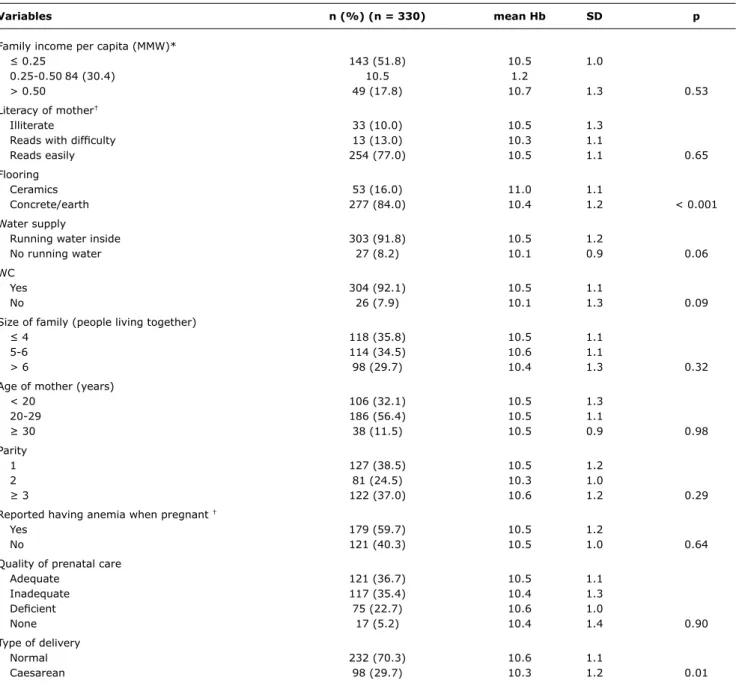
Table 1 shows that mean hemoglobin was lower among children who lived in homes with low-quality looring and among children born by caesarean.
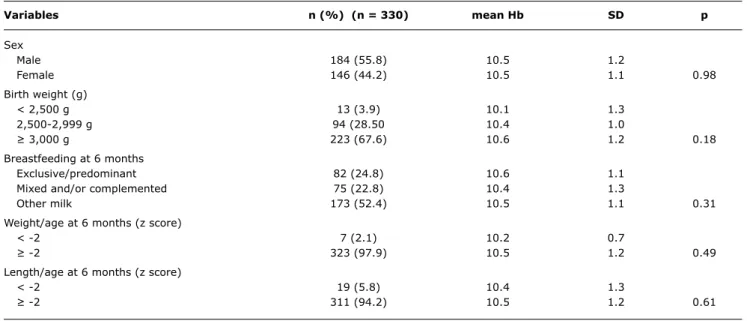
Table 2 illustrates that more than half of the children had stopped breastfeeding by 6 months and that just 25% were being breastfed exclusively/predominantly. There was no signiicant association between type of feeding and children’s hemoglobin concentration.
Table 3 demonstrates that mean hemoglobin among children of anemic mothers was lower than for children whose mothers were not anemic (p = 0.04). In the group of children on exclusive/predominant breastfeeding, median hemoglobin was 0.7 g/dL lower among the children of anemic mothers when compared with the children of mothers without anemia (p = 0.03).
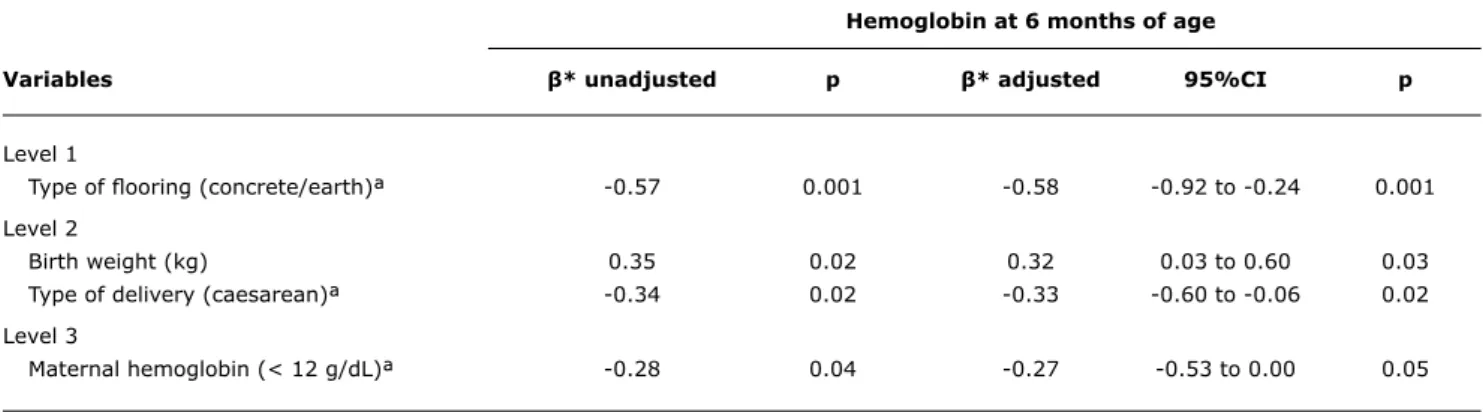
The effect of maternal anemia on the hemoglobin concentration of children at 6 months of age remained signiicant after adjustment of the multivariate linear regression models. Socioeconomic conditions, represented by type of looring at home, birth weight and type of delivery, also made a signiicant contribution to the children’s hemoglobin (Table 4).
Discussion
Variables n (%) (n = 330) mean Hb SD p
Family income per capita (MMW)*
≤ 0.25 143 (51.8) 10.5 1.0
0.25-0.50 84 (30.4) 10.5 1.2
> 0.50 49 (17.8) 10.7 1.3 0.53
Literacy of mother†
Illiterate 33 (10.0) 10.5 1.3
Reads with dificulty 13 (13.0) 10.3 1.1
Reads easily 254 (77.0) 10.5 1.1 0.65
Flooring
Ceramics 53 (16.0) 11.0 1.1
Concrete/earth 277 (84.0) 10.4 1.2 < 0.001
Water supply
Running water inside 303 (91.8) 10.5 1.2
No running water 27 (8.2) 10.1 0.9 0.06
WC
Yes 304 (92.1) 10.5 1.1
No 26 (7.9) 10.1 1.3 0.09
Size of family (people living together)
≤ 4 118 (35.8) 10.5 1.1
5-6 114 (34.5) 10.6 1.1
> 6 98 (29.7) 10.4 1.3 0.32
Age of mother (years)
< 20 106 (32.1) 10.5 1.3
20-29 186 (56.4) 10.5 1.1
≥ 30 38 (11.5) 10.5 0.9 0.98
Parity
1 127 (38.5) 10.5 1.2
2 81 (24.5) 10.3 1.0
≥ 3 122 (37.0) 10.6 1.2 0.29
Reported having anemia when pregnant †
Yes 179 (59.7) 10.5 1.2
No 121 (40.3) 10.5 1.0 0.64
Quality of prenatal care
Adequate 121 (36.7) 10.5 1.1
Inadequate 117 (35.4) 10.4 1.3
Deicient 75 (22.7) 10.6 1.0
None 17 (5.2) 10.4 1.4 0.90
Type of delivery
Normal 232 (70.3) 10.6 1.1
Caesarean 98 (29.7) 10.3 1.2 0.01
Table 1 - Mean hemoglobin at 6 months of life, broken down by maternal socioeconomic and reproductive variables
Hb = hemoglobin; MMW = multiples of minimum wage (R$ 200.00 per month); SD = standard deviation. * Information missing on 54 cases.
† Information missing on 30 cases.
found a signiicant association between the prevalence of anemia among mothers and among their children less than 36 months old.18
Despite the increase in the prevalence of exclusive breastfeeding at 6 months in the area studied,10 the number of children in this category was small and so they were analyzed together with the group of children on predominant breastfeeding. Even so, there were no signiicant associations between type of feeding and mean hemoglobin. However, when just the group of children on
Hemoglobin (g/dL)
n (%) Concentration p
Entire sample (n = 330), mean ± SD*
Maternal hemoglobin ≥ 12 g/dL 222 (68.5) 10.6±1.1
Maternal hemoglobin < 12 g/dL 102 (31.5) 10.3±1.3
Difference -0.3 0.04
Children on exclusive/predominant breastfeeding (n = 82), median (25-75%IQ)†
Maternal hemoglobin ≥ 12 g/dL 61 (75.3) 10.8 (10.0-11.3)
Maternal hemoglobin < 12 g/dL 20 (24.7) 10.1 (9.8-10.6)
Difference -0.7 0.03‡
Variables n (%) (n = 330) mean Hb SD p
Sex
Male 184 (55.8) 10.5 1.2
Female 146 (44.2) 10.5 1.1 0.98
Birth weight (g)
< 2,500 g 13 (3.9) 10.1 1.3
2,500-2,999 g 94 (28.50 10.4 1.0
≥ 3,000 g 223 (67.6) 10.6 1.2 0.18
Breastfeeding at 6 months
Exclusive/predominant 82 (24.8) 10.6 1.1
Mixed and/or complemented 75 (22.8) 10.4 1.3
Other milk 173 (52.4) 10.5 1.1 0.31
Weight/age at 6 months (z score)
< -2 7 (2.1) 10.2 0.7
≥ -2 323 (97.9) 10.5 1.2 0.49
Length/age at 6 months (z score)
< -2 19 (5.8) 10.4 1.3
≥ -2 311 (94.2) 10.5 1.2 0.61
Table 2 - Mean hemoglobin at 6 months of life, broken down by children’s biological and nutritional characteristics
Hb = hemoglobin; SD = standard deviation.
Table 3 - Hemoglobin concentration at 6 months, broken down by maternal anemia, for entire sample and for infants on exclusive/pre
-dominant breastfeeding
25-75%IQ = 25-75% interquartile range, SD = standard deviation. * Information missing on 6 cases.
† Information missing on 1 case. ‡ Wilcoxon test.
A study conducted in Indonesia with breastfeeding children aged 3 to 5 months found an elevated prevalence of anemia and observed that maternal hemoglobin was an important associated factor.17 Maternal anemia therefore emerges as a fundamental factor in infant anemia, since its onset is generally before the start of breastfeeding. Evidence demonstrates that the iron content of breastmilk is independent of the mother’s iron status.19
Data in the literature on the association between breastfeeding and anemia are conlicting. Some authors have not detected any association,20 as observed in this study, while others identify breastfeeding, especially exclusive, as an important factor of protection in infants less than 6 months old.21,22
Hemoglobin at 6 months of age
Variables β* unadjusted p β* adjusted 95%CI p
Level 1
Type of looring (concrete/earth)ª -0.57 0.001 -0.58 -0.92 to -0.24 0.001
Level 2
Birth weight (kg) 0.35 0.02 0.32 0.03 to 0.60 0.03
Type of delivery (caesarean)ª -0.34 0.02 -0.33 -0.60 to -0.06 0.02
Level 3
Maternal hemoglobin (< 12 g/dL)ª -0.28 0.04 -0.27 -0.53 to 0.00 0.05
95%CI = 95% confidence interval. * Regression coefficient.
ª Reference categories = ceramic (type of flooring), vaginal delivery (type of delivery), maternal hemoglobin > 12 g/dL. Level 1 = adjusted for type of water supply and WC.
Level 2 = adjusted for the variables on this level and by the level 1 variable. Level 3 = adjusted for the variables on levels 1 and 2.
Table 4 - Multivariate linear regression of factors associated with hemoglobin concentration in 6-month-old infants
on breastfeeding and artiicial feeding, respectively, when compared with those who were exclusively fed breastmilk, irrespective of socioeconomic conditions or birth weight.21 Another study, conducted with children on exclusive breastfeeding in the same age group, found that they had higher hemoglobin levels when compared with children on different feeding regimes.22 Another study identiied breastfeeding as a risk factor for anemia in infancy; although it deined children as on breastfeeding if they were given formula less than four times a day, which could have impacted on the results.23
Recently, considerable advances have taken place in scientiic knowledge of the basic mechanisms related to the beneits of breastfeeding, and its clinical management.24 The impact on infant mortality of exclusive breastfeeding with 90% coverage has also been documented.25,26 Countless advantages of breastfeeding and human milk for child nutrition, have been described for children, their mothers and families and for society.24 Despite this, several different studies of childhood anemia have not correctly analyzed the role of breastmilk as an important factor in its control and prevention.27
With relation to other determinants of anemia in infants, our study found that, in addition to maternal anemia, there was a signiicant association with the type of looring at home, which is an indicator of a family’s socioeconomic conditions, and also with type of delivery and birth weight.
Mean hemoglobin concentration was signiicantly lower among children who were born by caesarean. This could be related to the position in which the baby is removed during a caesarean (higher than the mother) and also to the fact that the ligature of the cord occurs earlier in a surgical
delivery. Delaying clamping the cord could beneit the baby by a placental transfusion of 35 mL of blood per kg of weight and 30 to 50 mg extra iron reserves.7 A randomized study demonstrated that 3 months after delivery, mean serum ferritin and hemoglobin were signiicantly greater in a delayed clamping group in children born to anemic mothers.28 In another study of delayed clamping of the umbilical cord, signiicantly higher levels of ferritin were observed at 3 months of age when compared with those whose cords were clamped immediately.29
Birth weight had a significant and independent association with the concentration of hemoglobin, which is similar to data observed by other researchers.16,22,30 The direct relationship between mean hemoglobin and birth weight indicates that the iron reserves of children born full term with low birth weight put them at risk of developing anemia during infancy.9
There was no relationship between the hemoglobin levels of the child and the mother’s educational level or with the quality of prenatal care. Although the majority of mothers had attended prenatal consultations, only one third met the minimum quality expected. In Brazil, prenatal coverage has been widened, but the available data demonstrate that the quality of care has been compromised.13 The high frequency of low quality care may explain why there was no association between quality of prenatal care and mean hemoglobin levels in the infants.
References
1. World Health Organization (WHO), UNICEF. Planning guide for national implementation of the global strategy for infant and young child feeding. Geneva: WHO; 2006.
2. United Nations, Sub-Committee on Nutrition (ACC/SCN); International Food Policy Research Institute. Nutrition throughout the life cycle. 4th report on the world nutrition situation: Geneva: United Nations, Sub-Committee on Nutrition (ACC/SCN); 2000. 3. International Nutrition Foundation and Micronutrient Initiative
UNICEF/UNU/WHO/MI Technical workshop. Preventing iron deiciency in women and children: background and consensus on key technical issues and resources for advocacy, planning and implementing national programmes. New York; INF; 1998. 4. World Health Organization, UNICEF, United Nations University.
Iron deiciency anemia: assessment, prevention and control. A guide for programme managers. Geneva: WHO; 2001. prevalence of exclusive breastfeeding resulting from the recent intervention,10 it remains well below the 90% that is desirable to have an impact on children’s health. The frequency of anemia among the mothers is also elevated, with evidence that it is long-term, which may have had repercussions for the iron status of their children at birth. The quality of prenatal care was deicient, which probably did not have a positive inluence on the health of these women and their children.
Since the etiology of anemia is multicausal and complex, involving socioeconomic, geographical, biological and cultural factors, an effective and sustainable strategy to prevent it must be based on nutritional education of the population and a fairer distribution of resources. The iron status of children at birth is a fundamental factor in the development of anemia among infants and is inluenced by their mothers’ iron status, going back to the pre-conception period. It is therefore necessary to guarantee good nutritional status and adequate iron reserves for all women, from adolescence onwards, so that they are prepared for the demands of pregnancy, maintaining a good supply during pregnancy and lactation.
The prevention of iron deiciency anemia in infants should be based on an integrated approach, including delayed clamping of the umbilical cord and support for breastfeeding. This, according to WHO recommendations, should be exclusive up until 6 months and then maintained at least up to 2 years. We suggest that studies of anemia in children, especially in infants, should evaluate the iron status of mothers as being an important risk factor, in addition to the type of feeding given during the irst 6 months of life.
Acknowledgements
We are grateful to the families who took part, to the professionals at the maternity units in the area, to the Hospital Regional de Palmares, run by the Pernambuco Department of Health, and to CNPq, for research grants to professors Marília Lima and Pedro Lira.
5. Fall C. Iron requirements and iron status during infancy. In: International Nutritional Anemia Consultative Group. Report of the 2004 symposium. Iron deiciency in early life: challenges and progress. Lima; 2004. p. 13-6.
6. Colomer J, Colomer C, Gutierrez D, Jubert A, Nolasco A, Donat J, et al. Anaemia during pregnancy as a risk factor for infant iron deiciency: report from the Valencia Infant Anaemia Cohort (VIAC) Study.Paediatr Perinat Epidemiol. 1990;4:196-204.
7. Moy RJ. New approaches to the detection of iron-deiciency anaemia.J Trop Pediatr. 1999;45:320-1.
8. Kramer MS, Kakuma R. Optimal duration of exclusive breastfeeding. In: The Cochrane Library, Issue 1, 2002. Oxford: Update Software.
9. Faldella G, Corvalia L, Lanari M, Salvioli GP. Iron balance and iron nutrition in infancy.Acta Paediatr Suppl. 2003;91:82-5. 10. Coutinho SB, Lira PI, de Carvalho Lima M, Ashworth A. Comparison
of the effect of two systems for the promotion of exclusive breastfeeding. Lancet. 2005;366:1094-100.
11. DeMaeyer EM, Dallman P, Gurney JM, Hallberg L, Sood SK, Srikantia SG. Preventing and controlling iron deiciency anaemia trough primary health care: A guide for health administrators and programme managers. Geneva: WHO; 1989.
12. World Health Organization (WHO). Division of child health and development. Indicators for assessing breastfeeding practices. Reprinted Report of an Informal Meeting. Geneva: WHO; 1991. p.11-2.
13. Brasil. Ministério da Saúde. Secretaria de Atenção à Saúde. Pré-natal e puerpério: atenção qualiicada e humanizada. Manual técnico. Série A: Normas e manuais técnicos. Série Direitos sexuais e reprodutivos – Cad. 5. Brasília; 2005.
14. World Health Organization: Expert Committee on Physical Status. The use and interpretation of anthropometry. WHO Technical Report Series 845. WHO Technical Report Series 854. Geneva: WHO; 1995.
15. Osório MM, Lira PI, Batista-Filho M, Ashworth A. Prevalence of anemia in children 6-59 months old in the state of Pernambuco, Brazil. Rev Panam Salud Publica. 2001;10:101-7.
16. Lima AC, Lira PI, Romani SA, Eickmann SH, Piscoya MD, Lima MC. Fatores determinantes dos níveis de hemoglobina em crianças aos 12 meses de vida na Zona da Mata Meridional de Pernambuco. Rev Bras Saude Matern Infant. 2004;4:35-42.
17. De Pee S, Bloem MW, Sari M, Kiess L, Yip R, Kosen S. The high prevalence of low hemoglobin concentration among Indonesian infants aged 3-5 months is related to maternal anemia.J Nutr. 2002;132:2215-21.
18. Silva SC, Batista-Filho M, Miglioli TC. Prevalence and risk factors of anemia among women and their children in the State of Pernambuco. Rev Bras Epidemiol. 2008;11:266-77.
19. Domellöf M, Lönnerdal B, Dewey KG, Cohen RJ, Hernell O. Iron, zinc, and copper concentrations in breast milk are independent of maternal mineral status. Am J Clin Nutr. 2004;79:111-5. 20. Silva DG, Priore SE, Franceschine S do C. Risk factors for anemia
in infants assisted by public health services: the importance of feeeding practices and iron supplementation.J Pediatr (Rio J). 2007;83:149-56.
21. Monteiro CA, Szarfarc SC, Mondini L. Tendência secular da anemia na infância na cidade de São Paulo (1984-1996). Rev Saude Publica. 2000;34:62-72.
22. Assis AM, Gaudenzi EN, Gomes G, Ribeiro, RC, Szarfarc SC, de Souza SB. Hemoglobin concentration, breastfeeding and complementary feeding in the irst year of life. Rev Saude Publica. 2004;38:543-51.
23. Tantracheewathorn S, Lohajaroensub S. Incidence and risk factors of iron deiciency anemia in term infants. J Med Assoc Thai. 2005;88:45-51.
25. Jones G, Steketee RW, Black RE, Bhutta ZA, Morris SS; Bellagio Child Survival Study Group. How many child deaths can we prevent this year?Lancet. 2003; 362:65-71.
26. Edmond KM, Zandoh C, Quigley MA, Amenga-Etego S, Owusu-Agyei S, Kirkwood BR. Delayed breastfeeding initiation increases risk of neonatal mortality. Pediatrics. 2006;117:e380-6.
27. Allen L, Shrimpton R. The International Research on Infant Supplementation Study: implications for programs and further research. J Nutr. 2005;135:666S-9S.
28. Gupta R, Ramji S. Effect of delayed cord clamping on iron stores in infants born to anemic mothers: a randomized controlled trial.
Indian Pediatr. 2002;39:130-5.
29. Venâncio SI, Levy RB, Saldiva SR, Mondini L, Alves MC, Leung SL. Effects of delayed cord clamping on hemoglobin and ferritin in infants at three months of age. Cad Saude Publica. 2008;24 Suppl 2:S323-31.
Correspondence:
Maria de Lourdes Perez Diaz Teixeira Rua Ernani Braga, 503/902 - Madalena CEP 50610-350 - Recife, PE - Brazil Tel.: +55 (81) 3445.6385
E-mail: [email protected]