Abstract
Objectives: To explore the use of the neonatal near miss concept as a tool to evaluate the quality of neonatal care, as 3 million early neonatal deaths occur every year around the world and the majority of these deaths are avoidable and take place in developing countries.
Methods: This is a secondary analysis of the 2005 WHO Global Survey on Maternal and Perinatal Health, a cross-sectional study, using data from 19 randomly selected Brazilian hospitals. A pragmatic deinition of neonatal near miss was developed and tested. Near miss indicators were calculated.
Results: Among the 15,169 live born infants included in this analysis, 424 presented at least one of the following conditions: very low birth weight, less than 30 gestational weeks at birth or an Apgar score at the 5th minute of life less than 7. According to the operational deinition, these survivors from life-threatening conditions were considered neonatal near miss cases. The early neonatal mortality rate was 8.2/1,000 live births, the neonatal near miss rate was 21.4 neonatal near miss cases/1,000 live births. Substantial variations in the mortality among neonates with life-threatening conditions at birth were observed suggesting intra-hospital quality of care issues.
Conclusion: The near miss concept and indicators provided information that could be useful to evaluate the quality of care and set priorities for further assessments and health care improvement for newborn infants.
J Pediatr (Rio J). 2010;86(1):21-26: Neonatal near miss, early neonatal mortality, quality care evaluation.
ORiginAl ARtiCle
Copyright © 2010 by Sociedade Brasileira de Pediatria21
introduction
The reduction of infant mortality is one of the Millennium Development Goals. Approximately 10.5 million children younger than age 5 years die every year around the world. The absolute majority of these deaths are avoidable and occur in developing countries.1 Thirty-eight per cent of infant deaths occur during the neonatal period and 3 million deaths take place in the irst week of life. Thus, prematurity and birth asphyxia, major causes of early neonatal deaths, must be addressed in order to reduce infant mortality.2
Since the 1990’s, Brazil has been experiencing a progressive improvement in development indicators. From
1997 to 2005, infant mortality dropped from 31.9 to 21.2 per 1,000 live born infants. In 2005, the early neonatal mortality rate was 10.9 per 1,000 live born infants, the late neonatal mortality rate was 3.3 per 1,000 live born infants and the postnatal infant mortality rate was 7.0 deaths per 1,000 live born infants. However, despite the recent development, a total of 36,000 early neonatal deaths still occur every year in Brazil.3
In Brazil, the absolute majority of deliveries take place at hospital facilities and half of infant deaths take place during the irst week of life, therefore issues related to quality of
neonatal near miss approach
in the 2005 WHO global Survey Brazil
Cynthia Pileggi,1 João P. Souza,2 Jose g. Cecatti,3 Anibal Faúndes31. MD. Independent consultant, Perinatology and Newborn Health, Geneva, Switzerland.
2. PhD. United Nations Development Program (UNDP), United Nations Population Fund (UNFPA), World Health Organization (WHO), World Bank Special Programme of Research, Development and Research Training in Human Reproduction (HRP), Department of Reproductive Health and Research, WHO, Geneva, Switzerland.
3. Department of Obstetrics and Gynecology, School of Medical Sciences, Universidade Estadual de Campinas (UNICAMP), Campinas, SP, Brazil. Centro de Pesquisas em Saúde Reprodutiva de Campinas, CEMICAMP, Campinas, SP, Brazil.
This study was conducted at World Health Organization (WHO), Geneva, Switzerland.
No conflicts of interest declared concerning the publication of this article.
Suggested citation: Pileggi C, Souza JP, Cecatti JG, Faúndes A. Neonatal near miss approach in the 2005 WHO Global Survey Brazil. J Pediatr (Rio J). 2010;86(1):21-26.
Manuscript submitted Sep 2 2009, accepted for publication Nov 16 2009.
care in health facilities may also be relevant for further reductions of infant mortality. Health facilities caring for sick babies or neonates experiencing severe complications at birth or during the irst week of life can be evaluated using scoring systems to estimate the neonate severity status and calculate an overall risk of dying. Facilities observing an early neonatal mortality higher than the estimated by the scoring systems estimates may be facing issues related to quality of care. In Brazil, some initiatives attempted to evaluate the quality of neonatal intensive care using this methodology.4-7 However, the use of individual-based scoring systems for health system evaluations with a large number of health facilities may not be feasible.
On the other hand, the near miss concept is being increasingly used in medicine and epidemiology as a tool to evaluate and improve the quality of care, especially in maternal health.8-10 As in maternal health, the application of the near miss concept to the neonatal context could be useful to identify quality of care issues and strengthen health systems. However, there is no standard deinition or internationally agreed identiication criteria for neonatal near miss cases. The term neonatal near miss has been used inconsistently in the few existing literature.11,12 Similarly to the maternal near miss concept,10 a neonatal near miss case would refer to a neonate that presented a severe complication during the irst days of life, nearly died, but survived the neonatal period. In practical terms, a neonatal near miss case would be an infant that survived a life-threatening condition at birth or an organ dysfunction during the neonatal period. This analysis aims to test the applicability of the neonatal near miss concept and its indicators in the context of Brazilian health facilities.
Methods
This is a secondary analysis of the Brazilian dataset of the 2005 World Health Organization (WHO) Global Survey on Maternal and Perinatal Health. The Global Survey was primarily designed to explore the relationship between mode of delivery and maternal and perinatal outcomes in a worldwide network of randomly selected health facilities. The detailed methodology of the WHO global survey has been described elsewhere.13,14 Briely, this was a study conducted in randomly selected health facilities. A stratiied multistage cluster sampling design was used to obtain a sample of health institutions. Initially, the Federal District and two other states were selected with probability proportional to the population size. Then, in each selected federative unit and based in an oficial hospital census, seven health facilities were selected with probability proportional to the annual number of deliveries. Two selected health facilities could not participate in the survey. The study population consisted of all women admitted for delivery and their respective newborns over a 3-month period in institutions
with up to 6,000 deliveries per year, and over a 2-month period for those institutions with more than 6,000 deliveries per year. Individual information was extracted from the medical records by trained data collectors for the period that the women/neonates were in the hospital up to the seventh postpartum day. Information collected included demographic characteristics, maternal risk indicators, mode of delivery, and maternal and newborn outcomes up to hospital discharge or 7 postpartum days if still in the hospital. There was no follow-up after the seventh postpartum day and hospital discharge. Thus, data refer exclusively to intra-hospital early neonatal mortality. In Brazil, this project was implemented in 19 health facilities. The ethics committee of each participating institution, the Brazilian National Ethical Review Board (Comissão Nacional de Ética em Pesquisa, CONEP) and the Scientiic and Ethical Review Group of the United Nations Development Program (UNDP), United Nations Population Fund (UNFPA), WHO, World Bank Special Programme of Research, Development and Research Training in Human Reproduction (HRP), Geneva, Switzerland, approved the study. For primary data collection, maternal individual informed consent was obtained. Ethical approval for the present secondary analysis was considered not applicable, once it complies with the WHO Global Survey Data Use Regulations.
In the present analysis, a two-step strategy was developed to achieve the proposed objective. The irst step was an individual level analysis. Records of live born infants with known vital status at the seventh day of life or at hospital discharge were selected. A pragmatic, operational deinition of neonatal near miss was developed based on two major causes of early neonatal death, prematurity, and birth asphyxia. Selected life-threatening conditions at birth were tested as proxies for prematurity and birth asphyxia. We veriied the associations of low birth weight, preterm birth, and low Apgar score at 5 minutes of life with early neonatal deaths. We also tested the ability of these conditions in identifying early neonatal deaths. Odds ratios, sensitivity, speciicity, and positive likelihood ratios, with 95% conidence intervals, were calculated. A similar approach to validate a pragmatic deinition of maternal near miss has been used elsewhere.15 Conditions at birth highly associated with early neonatal deaths and very likely to be present in fatal cases were selected as criteria for identifying near miss cases. Infants that presented and survived these life-threatening conditions were considered as neonatal near miss cases.
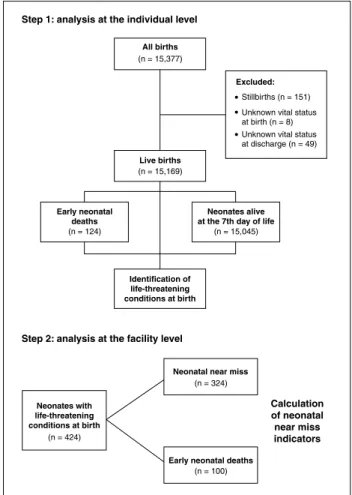
Figure 1 - Study analysis lowchart 1,000 live births. The SNOR refers to the number of neonatal
near miss cases plus the early neonatal deaths per 1,000 live births. Both indicators would provide an estimation of prevalence and the amount of care that would be needed in the facility and the respective catchment area. The ENMI refers to the number of deaths of neonates during the irst week of life among those with life threatening conditions at birth, divided by the total number of neonates with life threatening conditions at birth. This indicator is designed to provide a preliminary evaluation of quality of care and is expressed as a percentage. Low ENMI would indicate high quality of care offered to neonates with life-threatening conditions at birth, whereas very high ENMI could suggest existing opportunities to improve quality of care. These indicators were calculated for each health facility. The Epi-Info 3.5.1 statistical package (Centers for Disease Control and Prevention, USA) and the Microsoft Excel 2007 software (Microsoft, USA) were used for conducting the analysis.
Results
During the data collection period, 15,377 births occurred in the 19 Brazilian facilities included in the 2005 WHO Global Survey on Maternal and Perinatal Health. Stillbirths and neonates with missing information on the vital status at birth or at hospital discharge were excluded. The study proile is summarized in Figure 1.
Table 1 shows the associations of preterm birth, low birth weight, and low Apgar score at the ifth minute of life with early neonatal deaths. Very low birth weight or less than 30 gestational weeks at birth or an Apgar score at the ifth minute of life less than 7 was highly associated with early neonatal deaths. Table 2 presents the ability of this set of life-threatening conditions at birth to identify/predict early neonatal deaths. The vast majority of infants that died in the irst week of life presented at least one of the three above mentioned conditions at birth. Overall, elevated sensitivity, speciicity, and positive likelihood ratio were observed. Tables 1 and 2 provide the basis for assuming as a neonatal near miss case a neonate that survived a life-threatening condition at birth (i.e., very low birth weight or less than 30 gestational weeks and those who presented an Apgar score at the ifth minute of life less than 7). Information about the selected conditions was highly available in the hospital records (> 96%).
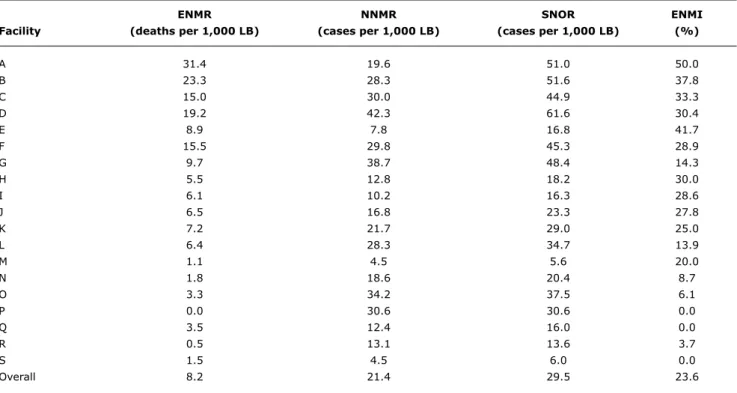
Among the 15,169 live born infants included in this analysis, 424 presented at least one of the selected life-threatening conditions at birth. There were 124 early neonatal deaths and 100 of them presented at least one of the selected life-threatening conditions at birth. A total of 324 infants survived the selected life-threatening conditions at birth and were considered as neonatal near miss cases. Table 3 presents the neonatal near miss indicators by facility. The overall early neonatal mortality rate (ENMR) was 8.2
deaths per 1,000 live births, ranging from 0 to 31.4 deaths per 1,000 live births. The overall NNMR was 21.4 neonatal near miss cases per 1,000 live births, ranging from 4.5 to 42.3 cases per 1,000 live births. The overall SNOR was 29.5 severe cases per 1,000 live births, ranging from 5.6 to 61.6 severe cases per 1,000 live births. The overall ENMI was 23.6%, ranging from 0 to 50%. Substantial variations of mortality were observed between health facilities regardless of the prevalence level of neonates with life-threatening conditions at birth.
Discussion
Characteristics Rate of enM, n (%) Alive at 7th day, n Odds ratio (95%Ci)
All live births 124 (0.8) 15,045 –
Gestational age at birth
< 30 weeks 52 (43.0) 69 415.65 (242.60-712.15)
< 37 weeks 89 (7.1) 1,164 42.17 (26.76-66.45)
37-41 weeks 24 (0.2) 13,237 1.00
> 41 weeks 3 (1.0) 286 5.78 (1.73-19.32)
Birth weight
< 1,500 g 74 (34.9) 138 331.08 (198.26-552.91)
< 2,500 g 102 (6.6) 1,437 43.83 (27.31-70.31)
2,500-4,000 g 21 (0.2) 12,966 1.00
> 4,000 g 1 (0.2) 598 1.03 (0.14-7.69)
Apgar score at 5 minutes
< 7 66 (25.4) 194 99.54 (67.14-147.59)
≥ 7 50 (0.3) 14,630 1.00
table 1 - Life-threatening conditions at birth, other neonatal characteristics and early neonatal deaths
95%IC = 95% confidence interval; ENM = early neonatal mortality.
Availability of
early Positive the information
neonatal likelihood in the medical
deaths Sensitivity Speciicity ratio records
+ -
Condition + a b a/(a+c) d/(b+d) sensitivity/ (a+b+c+d)/
- c d 1-speciicity 15,169
Gestational age + 52 69 44.8% 99.5% 95.4 97.6%
at birth < 30 weeks - 64 14,618 (36.1-53.9) (99.4-99.6) (70.0-130.1) (97.3-97.8)
Very low birth weight + 74 138 59.7% 99.1% 64.9 99.7%
- 50 14,863 (50.9-67.9) (98.5-99.2) (52.0-80.9) (99.6-99.8)
Apgar 5’ < 7 + 66 194 56.9% 98.7% 43.5 98.5%
- 50 14,630 (47.8-65.5) (98.5-98.9) (35.2-53.7) (98.3-98.7)
Any of the above + 100 324 82.6% 97.8% 37.0 96.4%
- 21 14,175 (74.9-88.4) (97.5-98.0) (32.3-42.3) (96.1-96.7) table 2 - Performance of neonatal life-threatening conditions with 95% conidence intervals
In the present analysis, the near miss cases were subject to factors that are major causes of early neonatal deaths. According to the identiication criteria applied, three near miss cases were identiied for each neonatal death. Expanding the number of cases with the same underlying risk factors as fatal cases is a strong positive characteristic of the near miss concept. In addition, these survivors are still rare enough to provide useful information without excessive data collection. More abundant cases allow either more robust analyses or robust analyses performed in a shorter period of time. This characteristic also enables the use of the near miss concept in individual facilities.
The use of this pragmatic deinition was feasible in Brazil, a country with very high coverage of deliveries in health facilities and widespread use of scales for birth weight assessment, estimation of gestational age through obstetric or neonatal methods, and Apgar score evaluation. In the set of hospitals where the study was carried out (randomly selected health facilities from randomly selected geographical areas), the information was readily available in routine hospital records (> 96% of the hospital records had the needed information).
enMR nnMR SnOR enMi
Facility (deaths per 1,000 lB) (cases per 1,000 lB) (cases per 1,000 lB) (%)
A 31.4 19.6 51.0 50.0
B 23.3 28.3 51.6 37.8
C 15.0 30.0 44.9 33.3
D 19.2 42.3 61.6 30.4
E 8.9 7.8 16.8 41.7
F 15.5 29.8 45.3 28.9
G 9.7 38.7 48.4 14.3
H 5.5 12.8 18.2 30.0
I 6.1 10.2 16.3 28.6
J 6.5 16.8 23.3 27.8
K 7.2 21.7 29.0 25.0
L 6.4 28.3 34.7 13.9
M 1.1 4.5 5.6 20.0
N 1.8 18.6 20.4 8.7
O 3.3 34.2 37.5 6.1
P 0.0 30.6 30.6 0.0
Q 3.5 12.4 16.0 0.0
R 0.5 13.1 13.6 3.7
S 1.5 4.5 6.0 0.0
Overall 8.2 21.4 29.5 23.6
table 3 - Indicators of neonatal near miss
ENMI = early neonatal mortality index; ENMR = early neonatal mortality rate; LB = live births; NNMR = neonatal near miss rate; SNOR = severe neonatal outcome rate.
services in providing health care. This is the foundation of several scores used in critical care medicine, including some that are used in neonatology (e.g. Clinical Risk Index for Babies).16 In the current analysis, facilities with high prevalence of neonates with life-threatening conditions at birth (i.e. SNOR > 45 cases per 1,000 live births) presented mortality index that ranged from 14.3 to 50%. Considering that all neonates were born in the evaluated health facilities, this variation could suggest intra-hospital quality of care issues.
The use of the neonatal near miss concept in these 19 health facilities exempliies the application of this concept for health system strengthening. In a certain geographical region (e.g. a large health district, a municipality, a region, or even a country), identifying facilities with elevated prevalence of neonates with life-threatening conditions at birth and those with high early neonatal mortality in the speciic population may be useful to set priorities for further assessments and facility strengthening. Therefore, based on this analysis a general approach for quality of care assessments using the near miss concept is proposed. This would include a preliminary evaluation based on the neonatal near miss case identiication and near miss indicators calculation followed by in-depth analyses. More detailed analyses could be performed, for instance, through audit and feedback strategies at the facility level. The availability and use of evidence-based interventions (e.g.
availability and use of antenatal corticosteroids for preterm birth, surfactant for infant respiratory distress syndrome, incubators, ventilators, etc) could also be used as part of a criterion-based clinical audit and mapping opportunities for improving health care. If necessary, the SNOR (which gives an estimation of resources needed and the impact of a given mortality) could be used in conjunction with the ENMI for prioritizing the facilities requiring further assessments and additional investments. It is important to notice that the intra-hospital quality of care evaluation should include only the infants that were born in that speciic facility. The mortality of infants referred from other facilities would provide more information on the referral process than the referral facility itself.
Correspondence: Cynthia Pileggi
5, Chemin de La Voie-Creuse; Genève, 1202, Switzerland E-mail: [email protected]
References
1. UNICEF. State of the world’s children 2005. New York: UNICEF 2004.
2. Lawn JE, Cousens S, Zupan J. Lancet Neonatal Survival Steering Team. 4 million neonatal deaths: when? Where? Why? Lancet. 2005; 365:891-900.
3. Brazil. Estimates of mortality. Brazil: Ministry of Health; 2008. [website] http://tabnet.datasus.gov.br/cgi/idb2007/matriz. htm#mort. Access: 20/02/2009
4. Araújo BF, Bozzetti MC, Tanaka AC. Early neonatal mortality in Caxias do Sul: a cohort study. J Pediatr (Rio J). 2000;76:200-6. 5. Sarquis AL, Miyaki M, Cat MN. The use of CRIB score for predicting
neonatal mortality risk. J Pediatr (Rio J). 2002;78:225-29. 6. Sarinho SW, Filho DA, Silva GA, Lima MC. Risk factors for
neonatal death in Recife: a case-control study. J Pediatr (Rio J). 2001;77:294-8.
7. Castro EC, Leite AJ. Hospital mortality rates of infants with birth weight less than or equal to 1,500 g in the northeast of Brazil. J Pediatr (Rio J). 2007;83:27-32.
8. Say L, Pattinson RC, Gülmezoglu AM. WHO systematic review of maternal morbidity and mortality: the prevalence of severe acute maternal morbidity (near miss). Reprod Health. 2004;1:3. 9. Pattinson RC, Hall M. Near misses: a useful adjunct to maternal
death enquiries. Br Med Bull. 2003;67:231-43.
10. Say L, Souza JP, Pattinson RC. WHO working group on Maternal Mortality and Morbidity classiications. Maternal near miss: towards a standard tool for monitoring quality of maternal health care. Best Pract Res Clin Obstet Gynaecol. 2009;23:287-96. 11. Skinner JR, Chung SK, Montgomery D, McCulley CH, Crawford J,
French J, et al. Near-miss SIDS due to Brugada syndrome. Arch Dis Child. 2005;90:528-9.
12. Avenant T. Neonatal near miss: a measure of the quality of obstetric care. Best Pract Res Clin Obstet Gynaecol. 2009;23:369-74. 13. Villar J, Valladares E, Wojdyla D, Zavaleta N, Carroli G, Velazco A
et al. WHO 2005 global survey on maternal and perinatal health research group. Caesarean delivery rates and pregnancy outcomes: the 2005 WHO global survey on maternal and perinatal health in Latin America. Lancet. 2006;367:1819-29.
14. Shah A, Faundes A, Machoki M, Bataglia V, Amokrane F, Donner A, et al. Methodological considerations in implementing the WHO Global Survey for Monitoring Maternal and Perinatal Health. Bull World Health Organ. 2008;86:126-31.
15. JP Souza, Cecatti JG, Faundes A, Morais SS, Villar J, Carroli G, et al. WHO 2005 global survey on maternal and perinatal health research group. Maternal near miss and maternal death in the 2005 WHO global survey on maternal and perinatal health. Bull WHO, 2009. [website] http://www.who.int/bulletin/volumes/88/2/08-057828.pdf. Access: 19/08/2009.
16. Parry G, Tucker J, Tarnow-Mordi W. The CRIB (Clinical Risk Index for Babies) Score: a tool for assessing initial neonatal risk and comparing performance of neonatal intensive-care units. Lancet. 1993;342:193-98.
populations that had the opportunity to be into a neonatal intensive care unit. And inally, basing the evaluation on gestational age and Apgar score may have been appropriate for settings in Brazil, but may be considered inappropriate in more developed or less developed settings.
In this context, uniform, standardized and validated criteria for near miss case identiication could minimize bias related with selection criteria and reduce the burden of data collection and analysis. The principles for developing criteria for near miss cases identiication have been described elsewhere.10 These criteria would have to be simple, usable at the individual facility and at the health system level, meaningful for clinicians, managers, and health care professionals, stable in terms of severity, and applicable in all settings regardless of the development level. Organ dysfunction indicators have been suggested as an alternative.12 Thus, the development and validation of a comprehensive set of clinical and laboratory markers of critical, life-threatening neonatal conditions and life-saving interventions would be recommended.
In conclusion, reducing neonatal deaths is a mandatory action to achieve the Millennium Development Goals. A signiicant proportion of these neonatal deaths could be prevented by the appropriate management of the neonate presenting complications. In this context, the neonatal near miss concept could be an adjunct tool for assessing quality in health systems and improving health care towards the reduction of infant mortality.
Acknowledgements