Association between participation and compliance with
Continuing Medical Education and care production by
physicians: a cross-sectional study
Associação entre participação e cumprimento de um programa de
Educação Médica Continuada e produção assistencial dos médicos: estudo transversal
Renato Melli Carrera1, Miguel Cendoroglo Neto1, Paulo David Scatena Gonçales1, Flavio Rocha Brito Marques1, Camila Sardenberg1, Milton Glezer1, Oscar Fernando Pavão dos Santos1, Luiz Vicente Rizzo1,
Claudio Luiz Lottenberg1, Cláudio Schvartsman1
1 Hospital Israelita Albert Einstein, São Paulo, SP, Brazil.
Corresponding author: Renato Melli Carrera – Avenida Albert Einstein, 627/701 – Morumbi – Zip code: 05652-900 – São Paulo, SP, Brazil – Phone: (55 11) 2151-1403 – E-mail: [email protected]
Received on: May 29, 2014 – Accepted on: Oct 30, 2014
Conflict of interest: the preparation of English version of this manuscript was financially supported by Edanz Group Global.
DOI: 10.1590/S1679-45082015AO3189 ABSTRACT
Objective: Physician participation in Continuing Medical Education programs may be influenced by a number of factors. To evaluate the factors associated with compliance with the Continuing Medical Education requirements at a private hospital, we investigated whether physicians’ activity, measured by volumes of admissions and procedures, was associated with obtaining 40 Continuing Medical Education credits (40 hours of activities) in a 12-month cycle.
Methods: In an exclusive and non-mandatory Continuing Medical Education program, we collected physicians’ numbers of hospital admissions and numbers of surgical procedures performed. We also analyzed data on physicians’ time since graduation, age, and gender. Results: A total of 3,809 credentialed, free-standing, private practice physicians were evaluated. Univariate analysis showed that the Continuing Medical Education requirements were more likely to be achieved by male physicians (odds ratio 1.251; p=0.009) and who had a higher number of hospital admissions (odds ratio 1.022; p<0.001). Multivariate analysis showed that age and number of hospital admissions were associated with achievement of the Continuing Medical Education requirements. Each hospital admission increased the chance of achieving the requirements by 0.4%. Among physicians who performed surgical procedures, multivariate analysis showed that male physicians were 1.3 time more likely to achieve the Continuing Medical Education requirements than female physicians. Each surgical procedure performed increased the chance of achieving the requirements by 1.4%. Conclusion: The numbers of admissions
and number of surgical procedures performed by physicians at our hospital were associated with the likelihood of meeting the Continuing Medical Education requirements. These findings help to shed new light on our Continuing Medical Education program.
Keywords: Quality improvement; Education; Medicine; Surgery; Education, medical, continuing; Practice management, medical
RESUMO
que idade e número de admissões estiveram associados ao cumprimento das metas estabelecidas. Cada admissão aumentou a chance de atingir a meta em 0,4%. Entre os que realizaram procedimentos cirúrgicos, a análise multivariada mostrou que médicos do sexo masculino eram 1,3 vez mais propensos a atingir a meta estabelecida que seus pares do sexo feminino. Cada procedimento cirúrgico realizado elevou a chance de atingir a meta em 1,4%. Conclusão: O número de admissões e de procedimentos cirúrgicos realizados por médicos em nosso hospital foi associado à probabilidade de alcançar a meta de Educação Médica Continuada. Estes achados lançaram uma nova luz sobre o nosso programa de Educação Médica Continuada.
Descritores: Melhoria de qualidade; Educação; Medicina; Cirurgia; Educação Médica Continuada; Administração da prática médica
INTRODUCTION
Physicians are continuously challenged to maintain
their clinical competence.(1) Their knowledge needs
to be kept up-to-date, and new concepts should be incorporated into their practice. Continuing Medical Education (CME) programs are designed to foster and evaluate the educational needs of the medical community by focusing on keeping physicians updated
on the ever-increasing body of medical knowledge.(2)
Another important challenge is the translation of knowledge into practice, and in this regard the effectiveness of CME programs has been under discussion.(3) It has been difficult to determine the impact
of CME programs on physicians’ knowledge(4) and
professional practice,(5) and on healthcare outcomes.(3-7) New CME models seek not only to impart knowledge but to change physicians’ behavior and even play a role in facilitating organizational improvement.(8) The change in physician behavior that leads to improved
practice and outcomes is the important metric.(9)
At Hospital Israelita Albert Einstein (HIAE), a
non-mandatory local CME program has been offered in 12-month cycles since 2002. A preliminary study revealed that compliance with the CME program has increased over time. However, a number of physicians have shown resistance to participating in the program and have failed to achieve the minimum requirements.(10)
A number of factors may influence physician participation in a CME program. Identification of these factors is crucial for improving the program and increasing compliance.
OBJECTIVE
To better understand the factors associated with achieving the Continuing Medical Education program
requirements at our hospital we investigated whether care production (number of hospital admissions and number of surgical procedures), gender, age, and time since graduation, were related to the likelihood of achieving the Continuing Medical Education program requirements.
METHODS
HIAE is a private, non-profit, general hospital, comprising 610 beds. It is located in the city of São Paulo (SP), Brazil, and provides healthcare services for a population of nearly 1 million. These patients usually have insurance plans that grant them the right to choose among many hospitals and physicians.
From August 2009 to July 2010, all 3,809 credentialed, free-standing, private practice physicians using our hospital, who were enrolled in the program, were evaluated. All 830 physicians employed by the hospital also participated in the CME program during this time period, but were not included in this analysis because of their contractual obligation to achieve the annual CME program requirements.
The CME program is based on a credit system that was established for medical educational activities offered at hospitals and other places, such as universities.(11) These activities include participation in educational meetings and workshops, publications (books, chapters, articles in national and international journals indexed in various databases), teaching (undergraduate and graduate), participation in the production of institutional policy documentation and protocols, and other individual and group learning activities. Since the beginning of the program, the goal has been for each individual to complete at least 40 credits (40 hours of study), per 12-month cycle. This requirement did not change during the study period. A wide range of accredited educational activities is available at the hospital for all physicians. Although it is not mandatory, participation in the CME program is recognized in many ways, with privileges and benefits.
Credits are registered via the hospital website(12)
We analyzed the association between achievement of CME program requirements and the number of hospital admissions for each physician, and the number of surgical procedures performed by physicians. We also analyzed the effect of some physician characteristics, such as time since graduation.
Statistical analysis
Qualitative data are presented as frequencies, and quantitative data as mean and standard deviation. Univariate and multivariate logistic regression analysis were used to identify factors associated with achievement of the CME program requirements. Variables with a p value <0.10 in the univariate analyses were included in the multivariate models. Two models were constructed: one to analyze the impact of the number of hospital admissions on the achievement of CME program requirements and the other to analyze the impact of the number of surgical procedures performed on the achievement of CME program requirements. All analyses were performed using Statistical Package for Social Science (SPSS) software, version 17 (SPSS Inc., Chicago, IL). A p value <0.05 was considered statistically significant.
Ethics committee approval
No ethical approval was required for this study according to our current laws. However, the Research Ethics Committee of the HIAE reviewed the study protocol and determined that there was no potential harm to participants. We guaranteed anonymity of participants.
RESULTS
Of the 3,809 eligible physicians registered, 1,029 (27%) achieved the goal of completing at least 40 credits during the study period.
Table 1 shows the results of univariate analysis of variables to determine their relation with achievement
the of CME program requirements. Male physicians and physicians with a higher number of hospital admissions were more likely to achieve the requirements. Physicians who met the CME program requirements were slightly
older than those who did not (51.70±10.64 years versus
50.76±11.38 years; p=0.021) and were more experienced with a longer time since graduation (26.19±10.19 years
versus 25.20±10.73 years; p=0.010).
Variables with a p value <0.10 in the univariate analysis were included in the multivariate analysis (Table 2). Three variables were shown to be independently associated with achievement of the CME program requirements number of hospital admissions (each hospital admission increased the chance of achieving the CME program requirements by 0.5%), age, and gender in association with age (for female physicians, each year of age increased the chance of achieving the CME program requirements by 0.3%). We studied the possibility of interference between gender and age. The results of the multivariate regression analysis showed the interaction of these variables. It was not possible to analyze them separately.
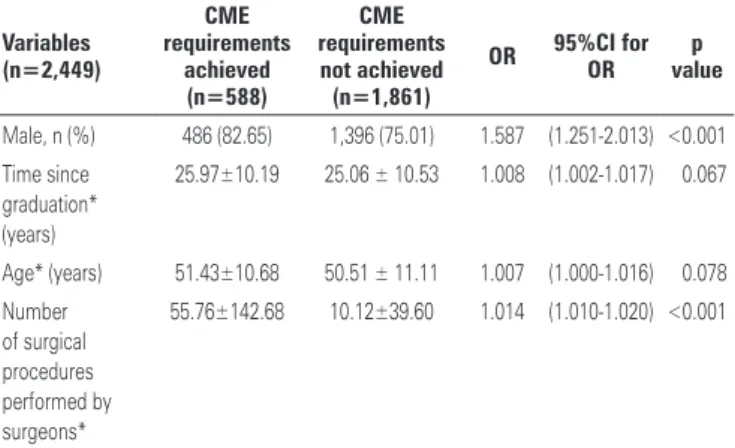
To analyze the relation between variables and achievement of the CME program requirements among the 2,449 physicians who performed surgical procedures during the study period, we used a similar model (Tables 3 and 4). Univariate analyses showed that male physicians and physicians who performed a higher number of surgical procedures were more likely to meet the CME program requirements. As in the analysis described above, older and more experienced physicians were more likely to achieve the CME program requirements. The other variables were not associated with achievement of the CME program requirements. Multivariate analysis showed that the estimated odds of achieving the CME program requirements 1.3 time higher for male physicians than female physicians. Each surgical procedure performed increased the chance of achieving the CME program requirements by 1.4%.
Table 1. Univariate analysis of factors associated with achievement of the Hospital Israelita Albert Einstein Continuing Medical Education program requirements
Variables (n=3,809) CME requirements achieved (n=1,029)
CME requirements not achieved
(n=2,780) OR 95%CI for OR p value
Male, n (%) 799 (77.65) 2,044 (73.52) 1.251 (1.056-1.481) <0.009
Time since graduation* (years) 26.19±10.19 25.20±10.73 1.010 (1.002-1.016) <0.010
Age* (years) 51.70±10.64 50.76±11.38 1.010 (1.001-1.014) <0.021
Number of hospital admissions* 37.0±85.2 7.1±25.9 1.022 (1.019-1.025) <0.001
DISCUSSION
Physicians are now formally required to keep abreast
with their professional education.(13) Systematic ways
of acquiring the necessary information have been developed as part of CME programs all over the world. Each country and, in some countries, each state mandate the number of hours of CME that health professionals must accumulate every year to maintain their licenses.(14)
In December 2004, participation in a national CME program became mandatory in Brazil. The Brazilian Medical Association and the Federal Council of Medicine adopted resolution 1,755/04, which considered the importance of CME and determined that new medical graduates must achieve a minimum set of credits every 5-year period to maintain their
specialist status.(15) This resolution has since been
revoked, and replaced with two new resolutions. The legal requirement for participation to obtain renewal of medical licenses is currently suspended.(16) Participation in a CME program by a physician who works at a private hospital, even though it is not legally required, is therefore an indicator of loyalty.
In our CME program, physicians are not paid to participate and do not get any direct incentives to do so. However, they are aware that their performance is evaluated annually, and that the achievement of CME program requirements is an essential component of that evaluation. According to the results of the evaluation, and following meritocratic principles, physicians may be given some benefits, such as discounted hospital services for the physician and their first degree relatives, discounted courses and training, patient referrals by the hospital, and preferential renting of office space in the hospital. Although participation is not mandatory, physicians may not be eligible for some benefits if they do not comply with the CME program requirements. Physicians are therefore encouraged to achieve the requirements mainly because the hospital recognizes the value of this achievement. This makes our hospital an interesting place to study the factors that encourage physicians to pursue CME program goals, and to document and monitor their participation over time.
In this study of 3,809 physicians at a general hospital, we found that achieving the CME program requirements was associated with physicians’ practice volumes. That is, the higher the number of surgical procedures and admissions, the higher the chance of achieving the CME program requirements. To our knowledge, this is the first time such an association was described.
It was unexpected to find that the number of hospital admissions and number of surgical procedures performed were associated with an increased likelihood of meeting the CME program requirements. We had previously assumed that busier physicians would be less likely to spend time on CME program activities, document CME program activities, and organize and submit CME program documentation. These findings may indicate that some physicians are busier as a consequence of the quality of their work and accumulated knowledge. It could also be that practice volumes are an indication of loyalty to the hospital and an increased likelihood of meeting the goals set by the hospital. An important practical implication of these findings is that further strategies should be devised to foster participation in our CME program by physicians with a low number of hospital admissions or surgical procedures.
In this study, we found an effect of age and gender on the likelihood of achieving the CME program requirements
Table 3. Univariate analysis of factors associated with achievement of the Hospital Israelita Albert Einstein Continuing Medical Education program requirements among physicians who performed surgical procedures
Variables (n=2,449)
CME requirements
achieved (n=588)
CME requirements not achieved (n=1,861)
OR 95%CI for OR valuep
Male, n (%) 486 (82.65) 1,396 (75.01) 1.587 (1.251-2.013) <0.001 Time since
graduation* (years)
25.97±10.19 25.06 ± 10.53 1.008 (1.002-1.017) <0.067
Age* (years) 51.43±10.68 50.51 ± 11.11 1.007 (1.000-1.016) <0.078 Number
of surgical procedures performed by surgeons*
55.76±142.68 10.12±39.60 1.014 (1.010-1.020) <0.001
* Mean ± standard deviation. 95%CI: 95% confidence interval; OR: odds ratio; CME: Continuing Medical Education.
Table 4. Multivariate analysis of factors associated with achievement of the Hospital Israelita Albert Einstein Continuing Medical Education program requirements among physicians who performed surgical procedures
Variables OR 95%CI for OR p value
Number of surgical procedures performed by surgeons
1.014 (1.011-1.013) <0.001
Gender (female) 1.293 (1.013-1.652) 0.036 95%CI: 95% confidence interval; OR:odds ratio.
Table 2. Multivariate analysis of factors associated with achievement of the Hospital Israelita Albert Einstein Continuing Medical Education program requirements
Variables OR 95%CI for OR p value
when considering all physicians who admitted patients to the hospital. Female physicians had a higher likelihood of achieving the CME program requirements as they got older. Previous studies have also found that gender may influence the practice patterns of doctors.(17) Working time (part-time or full-time) could be linked to achievement of the CME program requirements. However, this study focused on our credentialed, freestanding, private practice physicians. All these physicians had the same opportunity to admit patients and perform surgical procedures. Others authors have also reported that female physicians were more likely to comply with
CME program requirements than male physicians.(18)
Although still not fully understood, these findings may become increasingly relevant in the future as the prevalence of female physicians continues to grow in our country and in other parts of the world.(19) However, among physicians who performed surgical procedures, males had a 30% higher likelihood of meeting the CME program requirements than females.
A systematic review of empirical studies focused on the relation between clinical experience and performance suggested that physicians who have been in practice for more years possess less factual knowledge, are less likely to adhere to appropriate standards of
care, and may also have poorer patient outcomes.(20)
On the other hand, the experience of another group(21)
reveals that there were no associations between age or time since graduation and CME program performance. In our study, age and gender interacted. Therefore, it was not possible to analyze them separately.
Some limitations of this study were identified. The main limitation is that only a few factors were evaluated for association with achievement of the CME program requirements. Gender, age, and time since graduation could be used to divide patients into groups for further analysis.
We cannot conclude whether compliance with the CME program requirements is cause or effect in this
cross-sectional study design. As in other CME programs,(22)
the HIAE program is based on a time-based credit system. Our HIAE program requires 40 hours of study in 12 consecutive months. A previous study showed that a credit system should measure CME program activities according to their value in improving the physician’s knowledge base, competence, and performance, and not just the amount of time spent on the activity.(9,23) To address this issue, a new and improved CME program is being developed, which considers CME credits according to these values.
CONCLUSION
In summary, the number of admissions and the number of surgical procedures performed were associated with achievement of the Continuing Medical Education requirements in our hospital-based program. These findings help to shed new light on our Continuing Medical Education program.
REFERENCES
1. Silver I, Campbell C, Marlow B, Sargeant J. Self-assessment and continuing professional development: the Canadian perspective. J Contin Educ Health Prof. 2008;28(1):25-31.
2. Brown HJ, Miles PV, Perelman RH, Stockman JA 3rd. A continuum of competency assessment: the potential for reciprocal use of the Accreditation Council for Graduate Medical Education toolbox and the components of the American Board of Pediatrics Maintenance-of-Certification Program. Pediatrics. 2009;123 Suppl 1:S56-8.
3. Lloyd JS, Abrahamson S. Effectiveness of continuing medical education: a review of the evidence. Eval Health Prof. 1979;2(3):251-80.
4. Forsetlund L, Bjørndal A, Rashidian A, Jamtvedt G, O’Brien MA, Wolf F, et al. Continuing education meetings and workshops: effects on professional practice and health care outcomes. Cochrane Database Syst Rev. 2009;(2): CD003030: Review.
5. Neily J, Mills PD, Young-Xu Y, Carney BT, West P, Berger DH, et al. Association between implementation of a medical team training program and surgical mortality. JAMA. 2010;304(15):1693-700.
6. Parkes J, Hyde C, Deeks J, Milne R. Teaching critical appraisal skills in health care settings. Cochrane Database Syst Rev. 2001;(3):CD001270. Update in Cochrane Database Syst Rev. 2011;(11):CD001270.
7. Freemantle N, Harvey EL, Wolf F, Grimshaw JM, Grilli R, Bero LA. WITHDRAWN: Printed educational materials: effects on professional practice and health care outcomes. Cochrane Database Syst Rev. 2007;(2):CD000172: Review. 8. Shojania KG, Silver I, Levinson W. Continuing Medical Education and Quality
Improvement: A Match Made in Heaven? Ann Intern Med. 2012;156(4):305-8. 9. Davis NL, Willis CE. A new metric for continuing medical education credit. J
Contin Educ Health Prof. 2004;24(3):139-44.
10. Schvartsman C, Glezer M, Carrera RM, Paes AT, Paranhos Junior A, Lottenberg CL. Continuing medical education program: a credit system evaluation. einstein (Sao Paulo). 2008;6(4):473-7.
11. Hospital Israelita Albert Einstein. Tabela de créditos da Educação Médica Continuada – Hospital Israelita Albert Einstein. [Internet]. 2012. [citado 24/6/2014]. Disponível em: http://wwws.einstein.br/cadmedweb/con-tabela-emc.asp
12. Hospital Israelita Albert Einstein: Medicalsuite Website. [Internet]. 2012. [citado 24/6/2014]. Disponível em: http://medicalsuite.einstein.br/educacao continuada_princ.asp
13. Nylenna M, Aasland OG. Doctors’ learning habits: CME activities among Norwegian physicians over the last decade. BMC Medical Education. 2007; 7:10.
14. American Medical Association: Continuing Medical Education for Licensure Reregistration. [Internet]. 2012. [citado 24/6/2014]. Disponível em: http:// www.ama-assn.org/ama1/pub/upload/mm/40/table16.pdf
15. Conselho Federal de Medicina (CFM). Resolução CFM n. 1.755, de 14 de dezembro de 2004. Diário Oficial da República Federativa do Brasil, Brasília (DF); 2004 Dez 14;Seção 1:83. [Internet]. 2012. [citado 2014 jun 24]. Disponível em: http://www.portalmedico.org.br/resolucoes/CFM/2004/ 1755_2004.htm
2012 Março 14;Seção 1:146. [Internet]. 2012. [citado 2014 jun 24]. Disponível em: http://www.portalmedico.org.br/resolucoes/CFM/2012/1984_2012.pdf 17. Weizblit N, Noble J, Baerlocher MO. The feminisation of Canadian medicine
and its impact upon doctor productivity. Med Educ. 2009;43(5):442-8. 18. Harris JM Jr, Novalis-Marine C, Harris RB. Women physicians are early
adopters of on-line continuing medical education. J Contin Educ Health Prof. 2003;23(4):221-8.
19. Conselho Federal de Medicina (CFM). Conselho Regional de Medicina do Estado de São Paulo (CREMESP). Demografia médica no Brasil. Dados gerais e descrições de desigualdades, 2011. [Internet]. 2012. [citado 2014 jun 24]. Disponível em: http://www.cremesp.org.br/pdfs/demografia_2_dezembro.pdf 20. Choudhry NK, Fletcher RH, Soumerai SB. Systematic review: the relationship
between clinical experience and quality of health care. Ann Intern Med. 2005;142(4):260-73.
21. Durning SJ, Artino AR, Holmboe E, Beckman TJ, van der Vleuten C, Schuwirth L. Aging and cognitive performance: challenges and implications for physicians practicing in the 21st century. J Contin Educ Health Prof. 2010; 30(3):153-60.
22. Peck C, McCall M, McLaren B, Rotem T. Continuing medical education and continuing professional development: international comparisons. BMJ. 2000; 320(7232):432-5.