AR
TICLE
1 Departamento de Vigilância de Doenças e Agravos Não Transmissíveis e Promoção da Saúde, Secretaria de Vigilância em Saúde, Ministério da Saúde. SAF Sul lotes 05/06 ed. Premium/Torre I/sala 14, Asa Sul. 70070-600 Brasilia DF Brasil.
[email protected] 2 Centro Latino-Americano de Estudos de Violência e Saúde Jorge Careli Escola Nacional de Saúde Pública Sérgio Arouca, Fundação Oswaldo Cruz.
Hospitalizations due to self-inflicted injuries
–Brazil, 2002 to 2013
Abstract The scope of this article is to describe hospitalizations resulting from intentional-ly self-inflicted injuries attended by the Unified Health System (SUS) for the 2002-2013 period. It is an observational, descriptive study of hos-pital admissions in the SUS arising from inten-tionally self-inflicted injuries in Brazil between 2002 and 2013. A decreasing trend was observed for the rate of hospitalization in individuals aged 10 and above. Hospitalizations were concentrat-ed between 30 to 49 years of age for men, while for women it was between 20 to 29 years of age. The highest rates of hospitalization and hospital deaths were in the Southeast. The main cause of hospitalization was intentional intoxication with medication and unspecified biological substanc-es. Studies of this type provide input for defining prevention strategies taking into consideration the most vulnerable groups and the complexity of fac-tors associated with suicidal behavior.
Key words Violence, Self-inflicted injury, Suicide,
Epidemiological surveillance, Hospitalization
Rosane Aparecida Monteiro 1
Camila Alves Bahia 1
Eneida Anjos Paiva 1
Naíza Nayla Bandeira de Sá 1
M
o
nt
e
Introduction
In 2002, the World Health Organization (WHO) classified violence into three broad categories: in-terpersonal, collective, and self-inflicted. The lat-ter, also known as self-harm, is violence a person inflicts upon him/herself and can be subdivided into suicidal behavior and self-injury. Suicidal behavior is characterized by suicidal thoughts, suicide attempts, and suicide itself, whereas self-injury includes acts of self-mutilation, rang-ing from milder forms such as scratches, cuts, and bites to more severe forms such as amputa-tion of limbs1,2.The International Statistical Clas-sification of Diseases and Related Health Prob-lems (ICD-10) considers intentional self-injury or self-poisoning and suicide attempts as inten-tional self-harm3.
Currently, suicide is the second leading cause of death worldwide among people aged be-tween 15 and 29 years. In 2012, the global sui-cide mortality rate was equal to 11.4 deaths per 100 thousand inhabitants, reaching 803,894 in-dividuals, representing one death every 40 sec-onds from this cause4. In Brazil, approximately 10,000 people died from suicide in 2011, at a rate of 5.1/100,000 inhabitants5. In 2012, the rate was equal to 6/100,0006.
In Brazil, as in many parts of the world, the suicide mortality rate represents only a small part of the problem of intentional self-harm because there remains a large number of hospital admis-sions due to these causes that do not result in death, and an even greater number of individuals seek outpatient treatment or do not seek treat-ment for their injuries at all1,4. Deaths, damage caused by suicide attempts, injuries, physical and emotional trauma, and ideations represent the impact of the suicide phenomenon for the Bra-zilian health sector7.
In Brazil between 1998 and 2007, the Unified Health System’s (Sistema Único de Saúde - SUS) expenditure on hospital admissions resulting from suicide exceeded thirty-five million Bra-zilian Real (BRL), varying according to gender, age, and geographic region8.Data from hospital admissions relating to self-harm underestimate the true prevalence of these injuries (a minority of individuals who self-harm seek hospital care)1, and there is potential for misclassification of the cause of hospitalization in cases such as self-harm through drug overdose.
Information regarding hospitalization in Bra-zil is available in the SUS Hospital Information System (Sistema de Informações Hospitalares –
SIH/SUS). This information is based on hospital admissions authorization (Autorização de Inter-nação Hospitalar – AIH) and provides demo-graphic and clinical data, making it possible to ascertain the morbidity and the mortality rate in regard to SUS’s own services and the people in-sured by it. It also provides data on amounts paid and the length of hospital stays. This information serves to establish the costs involved in hospital-ization funded by the SUS9. The SIH/SUS uses ICD-10 to standardize records of diseases and external causes and elicit information on hospi-tal admissions, which represent the most severe cases in the injury pyramid10.For intentional self-harm, especially in hospitalized cases, it is possi-ble to obtain data on its nature through the main diagnosis and on the circumstances of attempted suicide by secondary diagnosis7.
The national average of SIH/SUS coverage is approximately 80% of hospital admissions, varying between Brazilian regions and states, de-pending on the user population of private health plans9. Studies on this occurrence therefore pres-ent a very broad view of these conditions in the Brazilian population towards guiding health pro-motion policies. Notwithstanding the fragility of the information, analysis of these data is clearly important11 given the scarcity of information re-garding hospital admissions resulting from such injuries. Such information will allow the extent of the problem to be evaluated, groups at risk to be identified, and the effects of prevention pro-grams to be monitored.
The objective of this study is to describe hos-pital admissions resulting from intentional self-harm, of patients who received care within the SUS, in the period of 2002-2013.
Method
This work was a descriptive observational study of hospital admissions in the SUS due to inten-tional self-harm, using the Brazilian regions as the unit of analysis.
The data source was the Hospital Informa-tion System (SIH/SUS), with data available on the website of the Information Technology De-partment of SUS (DATASUS) corresponding to the period of 2002-2013, which was divided into three time periods, 2002-05, 2006-09, and 2010-13,for comparison.
Dis-e C
ole
tiv
a,
20(3):689-700,
2015
eases (ICD-10) were selected. The categories were grouped as follows: intentional self-poisoning by drugs and unspecified biological substances (X60-X64); intentional self-poisoning by alcohol (X65); intentional self-poisoning by pesticides and chemicals (X68-X69); intentional self-harm by firearm discharge (X72-X74); intentional self-harm using knives and blunt objects (X78-X79); intentional self-harm by hanging and strangu-lation (X70); intentional self-harm by jumping from a high place (X80); intentional self-harm by unspecified means (X84); and other categories (X66, X67, X71, X75-X77, X81-X83). Long-term AIH data were excluded.
The analyzed variables were categorized ac-cording to gender and age group (10-19 years, 20-29 years, 30-39 years, 40-49 years, 50-59 years, 60-69 years, 70-79 years and over 80 years), for the three periods analyzed. Children were ex-cluded from this study because the literature indicates that suicide deaths in this age group hardly exist, or when they do, they are difficult to classify because the majority are recorded as accidental causes12. A study on visits to urgent and emergency services found that the frequency of visits due to attempted suicide corresponds to only approximately 1% in children13.
Crude measures of the frequency of hospital admissions for attempted suicide were calculat-ed, along with the average length of hospital stay, the average amount of total AIH paid, admission rates (number of hospital admissions for inten-tional self-harm/resident population x 100,000 inhabitants)14, and hospital mortality rate (num-ber of admissions for self-harm with discharge due to death/total admissions for self-harm x 100). The SPSS software was used for data anal-ysis.
The proportion of the number of hospital admissions due to external causes of undeter-mined intent (codes Y10-Y34 of ICD-10) was also analyzed to assess the possibility of losses in the records of attempted suicides.
The databases used are publicly accessible through the Datasus site. The databases do not identify individuals, respecting the ethical prin-ciples in human research, in accordance with Resolution No. 466 of December 12, 2012, of the National Board of Health15.
Results
In the years 2000-2013, there were 105,097 hos-pital admissions in the SUS in Brazil due to
in-tentional self-harm (288 cases per day) by people older than nine years of age, of whom 63,468 (60.4%) were male and 41,628 (39.6%) were fe-male. Hospitalization rates were 5.6 per 100,000 inhabitants in the study period, 6.9/100,000 in-habitants among men and 4.4/100,000 inhabi-tants among women (Table 1).
The distribution of hospitalization rates over the years reveals a downward trend, with the low-est figures recorded in 2008 and 2012 (Figure 1). In the three periods studied, the age groups with the highest hospitalization rates in the country were 30-39 years (8.3 admissions per 100,000 inhabitants between the years 2002 and 2005; 6.9 admissions per 100,000 inhabitants be-tween the years 2006 and 2009; and 6.1 admis-sions per 100,000 inhabitants between the years 2010 and 2013). The next highest age range was the 40-49 year group (7.8 admissions per 100,000 inhabitants between the years 2002 and 2005; 6.7 admissions per 100,000 inhabitants between the years 2006 and 2009; and 5.9 admissions per 100,000 inhabitants between the years 2010 and 2013) (Table 1).
This scenario remained similar among men. However, among women, the most common age group for the period of 2002-2009 was 20-29 years (6.0 admissions per 100,000 inhabitants between the years 2002 and 2005, 5.1 admissions per 100,000 inhabitants between the years 2006 and 2009; and 4.5 admissions per 100,000 in-habitants between the years 2010 and 2013). In general, all age groups showed a decline in hos-pitalization rates for both males and females. Be-tween the years 2002 to 2009, the age group with the highest male: female ratio was 50-59 years (the hospitalization rate was 2.6 times higher among men than among women in the period of 2002-2005 and 2.2 times higher among men than women in the period of 2006-2009). Between the years 2010 and 2013, the age group with the highest male: female ratio was 60-69 years (the hospitalization rate was 2.4 times higher among men than among women), as noted in Table 1.
In regard to total admissions, in the three pe-riods analyzed, the region with the highest hos-pitalization rate due to self-harm was the South-east, followed by the Northeast in the initial and final study periods and the North in the 2006-2009 range.
M
o
nt
e
Figure 1. SUS Hospitalization Rate due to Intentional Self-harm (per 100,000 inhabitants), according to gender.
Brazil, 2002-2013*.
Source: Hospital Information System – SIH/SUS. * Patients under 10 years of age were not included. Hospitalizations due to intentional self-harm – Brazil, 2002 to 2013.
2002 2003 2004 2005 2006 2007 2008 2009 2010 2011 2012 2013
Male Female 0,0 1,0 2,0 3,0 4,0 5,0 6,0 7,0 8,0 9,0
10,0 Rate per 100,000 inhabitants
Period 2002-2005 2006-2009 2010-2013 Age group 10-19 20-29 30-39 40-49 50-59 60-69 70-79 80 e +
10-19 20-29 30-39 40-49 50-59 60-69 70-79 80 e +
10-19 20-29 30-39 40-49 50-59 60-69 70-79 80 e +
Table 1. SUS Hospitalizations due to Intentional Self-Harm (number and rate per 100,000 inhabitants),
according to age group and gender. Brazil. 2002-2013.
Source: Hospital Information System - SIH/SUS.
e C ole tiv a, 20(3):689-700, 2015
and in the Southeast and South between 2010 and 2013.
The average length of hospital stay (in days) was higher in the South and Southeast regions during the study period. However, from 2010 to 2013, the Northeast region had the same av-erage length of stay as the Southeast. As shown inTable 2, the North region had the highest
aver-age amount paid for hospital admissions result-ing from intentional self-harm in the 2002-2005 period; the Southeast region from 2006 to 2009; and the South from 2010 to 2013.
Intentional self-poisoning by drugs and un-specified biological substances (X60 to X64) accounted for the largest total hospitalization rates and female rates across the three periods
Place of residence and indicators
Total hospitalizations, nº (%) North Northeast Southeast South Midwest Brazil
Total hospital deaths, nº (%) North Northeast Southeast South Midwest Brazil
Hospital mortality (per 100) North Northeast Southeast South Midwest Brazil
Average hospital mortality rate North Northeast Southeast South Midwest Brazil
Average length of hospital stay (days) North Northeast Southeast South Midwest Brazil
Average amount paid per admission (BRL) North Northeast Southeast South Midwest Brazil
Table 2. Indicators of SUS Hospitalizations due to Intentional Self-Harm [number, proportion (%), rate per
100,000 inhabitants, and value in Brazilian reals] according to region and gender. Brazil. 2002-2013*.
Source: Hospital Information System - SIH/SUS. *Patients under 10 years of age were not included.
M
o
nt
e
studied. All other means used for self-harm were more frequent among men. The second highest total hospitalization rate was for self-poisoning by alcohol, and the third was for self-poisoning by pesticides and chemicals. The lowest hospital-ization rates were for self-harm by hanging and strangulation (X70) in the three periods studied
and for both genders. Admissions due to injuries by firearm discharge had the highest male: female ratio across the three periods (8.5 times higher among men than women from 2010 to 2013), as noted in Table 3.
The North Region had an unstable propor-tion of undetermined cases in the study period,
Types (CID10) X60-X64 X65 X68-X69 X70 X72-X74 X78-X79 X80 X84 Others Periods 2002-2005 2006-2009 2010-2013 2002-2005 2006-2009 2010-2013 2002-2005 2006-2009 2010-2013 2002-2005 2006-2009 2010-2013 2002-2005 2006-2009 2010-2013 2002-2005 2006-2009 2010-2013 2002-2005 2006-2009 2010-2013 2002-2005 2006-2009 2010-2013 2002-2005 2006-2009 2010-2013
Table 3. SUS Hospitalizations due to Intentional Self-Harm (number and rate per 100,000 inhabitants),
according to injury type and gender. Brazil. 2002-2013*.
X60-X64 - Intentional self-poisoning by drugs and unspecified biological substances; X65 -
Intentional self-poisoning by alcohol; X68-X69 - Intentional self-poisoning by pesticides and chemical products; X72-X74 - Intentional self-harm by firearm discharge; X78-X79 - Intentional self-harm by knife or blunt object; X70 - Intentional self-harm by hanging or strangulation ; X80 - Intentional self-harm by jumping from high place; X84-X84 - Intentional self-harm by unspecified means. Source: Hospital Information System - SIH/SUS.
* Patients under 10 years of age were not included.
N 12,081 13,040 10,564 8,986 7,551 6,556 6,686 5,346 5,673 151 178 150 1,778 687 1,114 2,613 2,261 2,256 197 376 1,490 3,724 3,370 1,665 240 1,022 2,608 Total 2.05 2.08 1.59 1.52 1.20 0.99 1.13 0.85 0.85 0.03 0.03 0.02 0.30 0.11 0.17 0.44 0.36 0.34 0.03 0.06 0.22 0.63 0.54 0.25 0.04 0.16 0.40 Male 1.56 1.85 1.29 2.63 2.08 1.65 1.12 0.90 0.90 0.04 0.05 0.04 0.52 0.19 0.30 0.70 0.59 0.56 0.04 0.08 0.36 0.87 0.74 0.33 0.38 0.31 0.42
Rate per 100,000 inhabitants M/F
e C
ole
tiv
a,
20(3):689-700,
2015
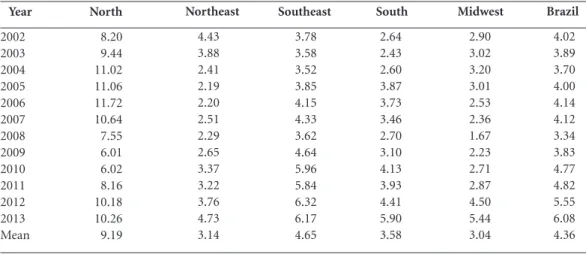
with a steady increase from 2002 and a fall be-tween 2008 and 2010, returning to 10% of exter-nal causes of undetermined intent. This region has the highest average of undetermined cases for the entire study period (9.19%), corresponding to more than twice the average of admissions in the same period in Brazil (4.36%)16, as shown in Table 4.
Discussion
This study shows a decreasing trend in the hos-pitalization rate due to self-harm in individuals aged 10 or above in Brazil, with a higher rate ob-served in males than females. Hospitalizations are concentrated on the male population in the 30-49 year age group. Among women, the pre-dominant age group for hospitalizations is 20-29 years. The highest rates of both hospital admis-sions and deaths were found in southeastern Brazil. The main cause of hospitalization (total and for females) in the three periods studied was intentional self-poisoning by drugs and unspeci-fied biological substances (X60 to X64), followed by intentional self-poisoning by alcohol and pes-ticides.
Self-harm is considered a major public health problem, as it is a sign of the discomfort and suf-fering of individuals. The act is generally related to a feeling of inability to identify viable alterna-tives for ending conflict and suffering, and such
people opt to take their own life in response1. Both in regard to population size and in abso-lute figures, suicide attempts are more common among young people8,14,17. However, among the elderly, there is a closer relationship between at-tempted and completed suicidal acts7.
It is estimated that a suicide directly affects at least six other people and can affect hundreds when the event occurs in a school or workplace18. It therefore has a strong impact on health ser-vices18-21. A number of social, microsocial, emo-tional, medical, and environmental factors are associated with the risk of suicide, including disabling physical diseases, mental disorders (particularly depression), mental illness, abuse of alcohol and other drugs, and family, communi-ty, institutional, emotional, and socioeconomic problems7,22.
One of the main risk factors for suicide, in addition to mental disorders, is a history of pre-vious ideations and attempts to cause one’s own death. Botega et al.23 note that 15-25% of people who attempt suicide will repeat the attempt with-in a year, and 10% of these people will die from this cause over a 10-year period. The WHO also considers that for each adult (18 years old) whose cause of death is suicide, there are 20 suicide at-tempts4.
The decreasing trend in the hospitalization rate due to intentional self-harm found in this study can be explained by the fact that only a few suicide attempts result in injury or poisoning re-quiring medical treatment.4 Suicide attempts are
Year
2002 2003 2004 2005 2006 2007 2008 2009 2010 2011 2012 2013 Mean
Table 4. Proportion (%) of SUS Hospitalizations for Injuries due to external causes of undetermined intent
(CID10-Y10-Y34) by region. Brazil. 2002-2013*.
* Patients under 10 years of age were not included.
North
8.20 9.44 11.02 11.06 11.72 10.64 7.55 6.01 6.02 8.16 10.18 10.26 9.19
Northeast
4.43 3.88 2.41 2.19 2.20 2.51 2.29 2.65 3.37 3.22 3.76 4.73 3.14
Southeast
3.78 3.58 3.52 3.85 4.15 4.33 3.62 4.64 5.96 5.84 6.32 6.17 4.65
South
2.64 2.43 2.60 3.87 3.73 3.46 2.70 3.10 4.13 3.93 4.41 5.90 3.58
Midwest
2.90 3.02 3.20 3.01 2.53 2.36 1.67 2.23 2.71 2.87 4.50 5.44 3.04
Brazil
M
o
nt
e
more likely to result in death among men than among women, and as age increases, so does the severity of resulting injuries24,25. Kodu et al.26, in
a study of 1,348 individuals who in 2008 sought the psychiatric emergency services of a
hospi-tal in Morioka in Japan after a suicide attempt,
found a male:female ratio of 1:2. In Minas Gerais, from 1998 to 2003, the total number of hospital admissions in the SUS due to self-inflicted vio-lence was equal to 14,443, of whom 55.4% were
men, thus corroborating our findings14.
Souza et al.27 conducted a study in Bahia, in the period from 2006 to 2011, and noted that suicide attempts were more frequent in the 20-39 age group (57.7%). Almeida et al.28 found the 15-34 years age group to be the most frequent among subjects who attempted suicide, while Pordeus et al.17 reported the greatest frequency in the 10-19 age group. The findings in regard to the 10-19 age group in the country are similar to the data found among adolescents in Minas Gerais (1998-2003)14 and Brazil (1998-2007)8. The hy-pothesis that suicide attempts among older peo-ple are more likely to lead to a fatal outcome7 is also addressed and could explain the lower hospi-talization rates observed in this age group, partic-ularly in the last three years analyzed in this study (2010-2013), while mortality rates due the same group of causes in this age group have a grow-ing trend. Although hospital admissions data for children under 10 were excluded from this analy-sis, it can be observed that the prevalence of self-harm in this age group is an important figure and that further analysis is required to clarify whether such admissions are due to misclassification of the primary or secondary diagnosis or whether they actually refer to intentional self-harm, a top-ic not covered in this study.
The distribution of hospital admissions by region of the country corroborates the results demonstrated in a previous study8 that also uses SIH/SUS data, covering the period 1998-2007, in which the highest percentages were found for the Southeast region, followed by the Northeast, with a growing trend in the North region. However, in this study, after the increase between the period 2002-2005 and 2006-2009 for this region, the per-centage for the 2010-2013 period decreased by approximately 50%, which raises questions about the reliability of the records of hospital admission for self-harm in the region. It should be noted that the South-Southeast axis accounted for 65.22% of deaths, a fact that may be associated with a larger number of inhabitants in these regions as well as other social and environmental factors24.
Studies on hospital morbidity due to self-harm have indicated self-poisoning as the most frequent method of suicide attempts for both genders14,17,28. The data observed in this study point to a greater frequency of self-poisoning by drugs and biological substances across the coun-try and for females and of self-poisoning by al-cohol for males as the leading causes of hospital admission for self-harm during the period. These data are similar to the results found by Santos et al.29, who found drug use to be the main cause of hospital admission due to self-harm among women between 1998 and 2009,while alcohol intake was the main cause among males during the same period . These authors discuss measures to limit the main means of suicide attempts by self-poisoning.
Regarding the methods used for intention-al self-harm resulting in hospitintention-alization, a high frequency of intentional self-poisoning by drugs and unspecified biological substances was ob-served. Similar data were also found in other studies8,16,28,29. A study conducted by Marín-León and Barros16 found that poisoning was most used in cases of suicide attempts among women, while among men, hanging was the most frequent method. These findings confirm that men use more lethal irreversible tools and weapons, re-sulting in higher death rates, compared to wom-en.
Conclusions
Materi-e C
ole
tiv
a,
20(3):689-700,
2015
als (Tabela Unificada de Procedimentos, Medica-mentos, Órteses, Próteses e Materiais Especiais), according to Ordinance GM/MS no. 2,848 of No-vember 6, 200731. This change in the information system had the same effect on all hospitalization causes.
This study found a hospitalization rate due to self-harm of 5.6 per 100,000 inhabitants, with the highest rates in the 30-39 years age group and the largest proportion in the Southeast region. The primary means used for self-harm that led to hospitalization was self-poisoningby drugs and biological substances. In the analyzed period, there was a downward trend in hospitalization rates due to self-harm in the SUS.
The phenomenon of self-inflicted death and injury, with all its consequences, increasing-ly calls for special attention from public health agencies aroundthe world1,23. There is evidence that society, families, and the health system can effectively prevent this self-harm, and con-crete proposals now exist on the correct
proce-dures to follow. The WHO has published several handbooks with guidelines for primary care and mental health professionals and educators and to guide media behavior, all of which have been translated into Portuguese32-35. The Ministry of Health (based on these WHO publications) also prepared a National Suicide Prevention Plan in 200636. However, despite these documents, proac-tive measures in favor of people most vulnerable to self-inflicted injury and death are still almost non-existent. Monitoring concrete prevention actions in health care networks at many different levels is very important to reduce the suffering of people who try to kill themselves because, as the literature notes, there is a close relationship between self-destructive ideation and attempt-ed and completattempt-ed suicide1,7,14. This relationship underlines the importance of studies on hospi-tal admissions for self-harm that can help define prevention strategies, considering the most vul-nerable population groups and the complexity of associated factors.
Collaborations
M
o
nt
e
Brasil. Ministério da Saúde (MS). Conselho Nacional de Saúde. Resolução nº 466, de 12 de dezembro de 2012. Diário Oficial da União 2013; 13 jun.
Marín-Leon L, Barros MBA. Mortes por suicídio: di-ferenças de gênero e nível socioeconômico. Rev Saude Publica 2003: 37(3):357-363.
Pordeus AMJ, Cavalcanti LP, Vieira LJES, Coriolano LS, Osório MM, Ponte MSR, Barroso SMC. Tentativas e óbitos por suicídio no município de Independência, Ceará, Brasil. Cien Saude Colet 2009; 14(5):1731-1740. Werneck GL, Hasselmann MH, Phebo LB, Vieira DE, Gomes VLO. Tentativas de suicídio em um hospital ge-ral no Rio de Janeiro, Brasil. Cad Saude Publica 2006; 22(10):2201-2206.
World Health Organization (WHO). Preventing suicide – a resource for general physicians. Geneva: WHO; 2000. World Health Organization (WHO). The World Health Report 2003: Shaping the future. Geneva: WHO; 2003. Brasil. Ministério da Saúde (MS). Organização Pan-A-mericana de Saúde (OPAS). Universidade Estadual de Campinas (Unicamp). Prevenção de suicídio: manual dirigido a profissionais das equipes de saúde mental. Bra-sília: MS; 2006.
Cavalcante FG, Minayo MCS. Autópsias psicológicas e psicossociais de idosos que morreram por suicídio no Brasil. Cien Saude Colet 2012; 17(8):1945-1954. Botega NJ, Mauro MLF, Cais CFS. Estudo multicêntri-co de intervenção no multicêntri-comportamento suicida - Supre-Miss. In: Organização Mundial da Saúde. Comporta-mento suicida. Porto Alegre: Artmed; 2004. p. 123-140. Jansen E, Buster MCA, Zuur AL, Das C. Fatality of sui-cide attempts in Amsterdam 1996-2005. Crisis 2009; 30(4):180-185.
Miller M, Azraek D, Hemenway D. The epidemiology of case fatality rates for suicide in the Northeast. Inj Prev Res 2004; 43(6):723-730.
Kudo K, Otsuka K, Endo J, Yoshida T, Isono H, Yambe T, Nakamura H, Kawamura S, Koeda A, Yagi J, Kemuya-ma N, Harada H, Chida F, Endo S, Sakai A. Study of the outcome of suicide attempts: characteristics of hospita-lization in a psychiatric ward group, critical care center group, and non-hospitalized group. BMC Psychiatry. 2010; 10:4.
Souza VS, Alves MS, Silva LA, Lino DCSF, Nery AA, Casotti CA. Tentativas de suicídio e mortalidade por suicídio em um município no interior da Bahia. J Bras Psiquiatr 2011; 60(4):294-300.
Almeida SA, Guedes PMM, Nogueira JA, Almeida J, França UM, Silva ACO. Investigação de risco para ten-tativa de suicídio em hospital de João Pessoa- PB. Rev Eletron Enferm 2009; 11(2):383-389.
15.
16.
17.
18.
19. 20. 21.
22.
23.
24.
25.
26.
27.
28. References
Krug EG, Mercy JA, Dahlberg LL, Zwi AB. World report on violence and health. Geneva: World Health Organi-zation; 2002.
Crosby AE, Ortega L, Melanson C. Self-directed violen-ce Surveillanviolen-ce: Uniform Definitions and Recommended Data Elements, Version 1.0. Atlanta (GA): Centers for Disease Control and Prevention, National Center for Injury Prevention and Control; 2011.
Centro Colaborador da OMS para a Classificação de Doenças em Português (Centro Brasileiro de Classifi-cação de Doenças). Classificação Estatística Internacio-nal de Doenças e Problemas Relacionados à Saúde. 10° Revisão. São Paulo, Brasília: Faculdade de Saúde Públi-ca da Universidade de São Paulo, Organização Mundial de Saúde, Organização Pan-Americana de Saúde; 2008. Volume I.
World Health Organization (WHO). Preventing suici-de: a global imperative. Luxembourg: WHO; 2014. Brasil. Ministério da Saúde (MS). Secretaria de Vigi-lância em Saúde. Departamento de Análise de Situação de Saúde. Saúde Brasil 2012: uma análise da situação de saúde e dos 40 anos do Programa Nacional de Imuni-zações. Brasília: Editora do Ministério da Saúde, 2013. Departamento de Informática do SUS (Datasus). Es-tatísticas vitais. [acessado 2014 jul 1]. Disponível em: http://www2.datasus.gov.br/DATASUS/index.php?a-rea=0205
Minayo MCS. Tendência da mortalidade por suicídio na população brasileira e idosa, 1980–2006. Rev Saude Publica 2010; 46(2):300-309.
Silveira RE, Santos AS, Ferreira LA. Impactos da Mor-bimortalidade e Gastos com o Suicídio no Brasil de 1998 a 2007. Rev Pesqui Cuid Fundam Online [periódi-co na Internet]. 2012 Out-Dez. [acessado 2014 jul 17]; 4(4): [cerca de 10 p.]. Disponível em: http://seer.unirio. br/index.php/cuidadofundamental/article/viewarticle /1859
Pepe VE. Sistema de informações hospitalares do Sis-tema Único de Saúde (SIH-SUS). In: Brasil. Ministério da Saúde (MS). A experiência brasileira em sistemas de informação em saúde. Brasília: MS; 2009. p. 65-86. Mathias TAF, Soboll MLMS. Confiabilidade de diag-nósticos nos formulários de autorização de internação hospitalar. Rev Saude Publica 1998; 32(6):26-32. Cassorla RMS. Debate sobre o artigo de Everardo Du-arte Nunes. Cad Saude Publica 1998; 14(1):28-30. Organização Mundial de Saúde (OMS). Departamento de saúde mental. Transtornos mentais e comportamen-tais. Genebra: OMS; 2000.
Sá NNB, Carvalho MGC, Mascarenhas MDM, Yokota RTC, Silva MMA, Malta DC . Atendimentos de emer-gência por tentativas de suicídio, Brasil, 2007. Rev Mé-dica de Minas Gerais 2010; 20(2):145-152.
Abasse MLF; Oliveira RC; Silva TC; Souza ER. Análi-se epidemiológica da morbimortalidade por suicídio entre adolescentes em Minas Gerais, Brasil. Cien Saúde Colet. 2009; 14(2):407-416.
1.
2.
3.
4. 5.
6.
7.
8.
9.
10.
11. 12.
13.
e C
ole
tiv
a,
20(3):689-700,
2015
Santos AS, Legay LF, Lovisi GM. Substâncias tóxicas e tentativas e suicídios: considerações sobre acesso e medidas restritivas. Cad Saúde Colet 2013; 21(1):53-61. Sistema de Informações Hospitalares – SIH/SUS (Da-tasus). Internações Hospitalares no SUS decorrentes de Causas Externas com intenção indeterminada (CID-10-Y10-Y34) segundo região. Brasil, 2002-2013. Brasí-lia: Datasus; 2014.
Brasil. Ministério da Saúde (MS). Portaria GM/MS nº. 2.848, de 6 de Novembro de 2007. Tabela Unificada de Procedimentos, Medicamentos, Órteses, Próteses e Ma-teriais Especiais do SUS. Diário Oficial da União 2007; 7 nov.
Organização Mundial de Saúde (OMS). Manual de Prevenção do Suicídio para profissionais da aten-ção básica. [acessado 2014 ago 6]. Disponível em: http://whqlibdoc.who.int/hq/2000/WHO_MNH_ MBD_00.4_por.pdf
Organização Mundial de Saúde (OMS). Manual de Prevenção do Suicídio para professores e educadores. [acessado 2014 ago 6]. Disponível em: http:// whqlib-doc.who.int/hq/2000/WHO_MNH_MBD_00.3_por. pdf?ua=1
Organização Mundial de Saúde (OMS). Manual de Prevenção do Suicídio para Profissionais de Saúde Mental. Genebra: OMS; 2006. [acessado 2014 ago 6]. Disponível em: http://www.who.int/mental_health/ media/counsellors_portuguese.pdf
Organização Mundial de Saúde (OMS). Manual de Prevenção do Suicídio para Profissionais da Mídia. Ge-nebra: OMS; 2000. [acessado 2014 ago 6]. Disponível em: http://whqlibdoc.who.int/hq/2000/WHO_MNH_ MBD_00.2_por.pdf?ua=1
Brasil. Ministério da Saúde (MS). Plano Nacional de Prevenção do Suicídio. Brasília: MS. [acessado 2014 ago 6]. Disponível em: http://www.portaldasaude.pt/ NR/rdonlyres/BCA196AB-74F4.../i018789.pdf/
Article presented on 10/15/2014 Approved on 11/24/2014
Final version presented on 11/26/2014 29.
30.
31.
32.
33.
34.
35.

![Table 2. Indicators of SUS Hospitalizations due to Intentional Self-Harm [number, proportion (%), rate per 100,000 inhabitants, and value in Brazilian reals] according to region and gender](https://thumb-eu.123doks.com/thumbv2/123dok_br/15211070.531447/5.905.135.720.368.1097/table-indicators-hospitalizations-intentional-proportion-inhabitants-brazilian-according.webp)