CLINICAL SCIENCE
Predictor variables for half marathon race time in
recreational female runners
Beat Knechtle,I,IIPatrizia Knechtle,IUrsula Barandun,II Thomas Rosemann,IIRomuald LepersIII
IGesundheitszentrum St. Gallen, St. Gallen, Switzerland.IIInstitute of General Practice and Health Services Research, University Hospital Zurich,
Switzerland.IIIINSERM U887, University of Burgundy, Faculty of Sport Sciences, Dijon, France.
INTRODUCTION:The relationship between skin-fold thickness and running performance has been investigated from 100 m to the marathon distance, except the half marathon distance.
OBJECTIVE:To investigate whether anthropometry characteristics or training practices were related to race time in 42 recreational female half marathoners to determine the predictor variables of half-marathon race time and to inform future novice female half marathoners.
METHODS:Observational field study at the ‘Half Marathon Basel’ in Switzerland.
RESULTS: In the bivariate analysis, body mass (r = 0.60), body mass index (r = 0.48), body fat (r = 0.56), skin-fold at pectoral (r = 0.61), mid-axilla (r = 0.69), triceps (r = 0.49), subscapular (r = 0.61), abdominal (r = 0.59), suprailiac (r = 0.55) medial calf (r = 0.53) site, and speed of the training sessions (r = -0.68) correlated to race time. Mid-axilla skin-fold (p = 0.04) and speed of the training sessions (p = 0.0001) remained significant after multi-variate analysis. Race time in a half marathon might be predicted by the following equation (r2= 0.71): Race time (min) = 166.7
+
1.7x (mid-axilla fold, mm) - 6.4x (speed in training, km/h). Running speed during training was related to skin-fold thickness at mid-axilla (r = -0.31), subscapular (r = -0.38), abdominal (r = -0.44), suprailiacal (r = -0.41), the sum of eight skin-folds (r = -0.36) and percent body fat (r = -0.31).
CONCLUSION: Anthropometric and training variables were related to half-marathon race time in recreational female runners. Skin-fold thicknesses at various upper body locations were related to training intensity. High running speed in training appears to be important for fast half-marathon race times and may reduce upper body skin-fold thicknesses in recreational female half marathoners.
KEYWORDS: Anthropometry; Body fat; Athlete; Endurance; Gender.
Knechtle B, Knechtle P, Barandun U, Rosemann T, Lepers R. Predictor variables for half marathon race time in recreational female runners. Clinics. 2011;66(2):287-291.
Received for publication onOctober 17, 2010;First review completedNovember 8, 2010;Accepted for publication onNovember 8, 2010
E-mail: [email protected]
Tel.: 41 0 71 226 82 82
INTRODUCTION
Running is a popular sports discipline and can be performed over several different distances.1,2An abundant variety of physiological, anthropometrical and training variables showed an association with running performances depending upon gender, the length and the duration of performance.3-5 Apart from physiological parameters, a number of different anthropometric variables were related to endurance running performance such as body mass,6,7 body height,8,9body mass index,10-12 body fat,10 the sum of skin-fold thickness6, single skin-fold thicknesses at the upper and lower body,6,13-16length of legs17,18and circum-ferences of limbs.7,12,18,19 These anthropometric properties
had different associations regarding running distances and gender. Body height was associated with race time in both male and female marathon runners,8body mass index was related to marathon running time in females,10and body fat was positively associated with marathon race times in females.10 The relationship between selected skin-fold thicknesses and running performance has been investigated in several studies. Haganet al.demonstrated that apart from
other variables, the sum of skin-fold thicknesses was correlated to marathon race time in males.20 Bale et al.
reported the sum of skin-fold thicknesses, the type and frequency of training and the number of years running were the best predictor variables for 10-km race time in males.6In recent studies, a relationship between the thicknesses of selected skin-folds and running performance has been demonstrated for high-level runners.13,14 In these studies, elite male and female runners of distances from 100 m to 10 km and the marathon had been investigated.13,14 High
correlations were found between the front thigh and medial calf skin-fold and 10-km race times for male runners, and
between iliac crest and abdominal skin-fold and marathon times for female runners.13 It was supposed that the reduced thickness of skin-folds of the lower limb were a result of high intensity in running training.14Legaz & Eston concluded from their study of high-level runners that running training led to a decrease in the sum skin-folds and the skin-fold thickness at the abdominal, front thigh and medial calf sites.14 Further, the lower limb skin-fold thicknesses might be a useful predictor variable of running performance.13,14
Apart from anthropometry, volume and intensity in training also seemed to influence running performance in long-distance runners up to the marathon distance. Regarding volume, in marathon finishers, the longest distance ran per training unit was the best predictor variable for marathon race time.21 Male runners completing more than 100 km per week had significantly faster race times over 10 to 90 km than athletes covering less than 100 km22 and elite runners with a higher training frequency, higher weekly training volume and longer running experience competed faster in a 10 km run.6In female marathoners, the number of weekly training sessions and the number of years training were the best predictors for race time.23 In long-distance runners, training units of moderate intensity were related to race performance.24 In female marathoners, a
faster marathon time was associated with higher aerobic capacity and years of training rather than with body dimensions.25Male and female top class marathon runners trained for more total kilometres per week and at a higher velocity than runners at a lower level,26and peak running
velocity during training was highly related to 5 km run times for both male and female athletes.27When training in runners was analysed in details, several parameters such as training days, total training sessions, total kilometres, mean kilometres per training session, longest mileage covered per training session, total training minutes, maximal kilo-metres ran per week, mean kilokilo-metres per week and mean kilometres per day, were related to marathon race time.10,20,21
What this background shows, is that the relationship between skin-fold thicknesses and running performance has been investigated in running distances from 100 m to the marathon distance, except the half marathon distance.13,14 The intention was therefore to investigate whether a relationship exists between selected anthropometric vari-ables including skin-fold thicknesses and training varivari-ables with half marathon race performance in recreational female runners. It was hypothesised that significant relationships would be found between upper body skin-fold thicknesses (suprailiacal and abdominal site) and half marathon race times for recreational female runners. We also intended to create an equation to predict a half marathon race time for future novice female half marathoners, based upon basic measurements any athlete could determine for himself without the need for highly sophisticated equipment.
MATERIALS AND METHODS
We performed a cross-sectional observational research at a half marathon race during the ‘Half Marathon Basel’ in Switzerland. The organiser contacted all participants of the ‘Half Marathon Basel’ in 2010 via a separate newsletter, three months before the race, in which they were asked to participate in the study. The study was approved by the
Institutional Review Board of the Canton of St. Gallen, Switzerland. The athletes were informed of the experimen-tal procedures and gave their informed written consent.
The Race
The ‘Half Marathon Basel’ took place on 12thSeptember 2010, in the City of Basel, Switzerland. The athletes started at 11:00 a.m. and had to run one flat lap on asphalt. The weather was fine and dry. The temperature was 13
˚
Celsius at the start and the relative humidity was at 63%. The organiser provided nutrition and drinks at eight aid stations. A total of 396 female athletes started in the half marathon; 42 female runners were interested in participat-ing in our investigation. All participants finished the ‘Half Marathon Basel’ within the time limit of 2:30 h:min.Measurements and Calculations
Before the start of the race body mass, body height, and thicknesses of skin-folds were measured. With this data we calculated body mass index and percent body fat using an anthropometric method. Body mass was measured to the nearest 0.1 kg using a BeurerH BF15 scale (Beurer GmbH, Ulm, Germany). Body height was determined to the nearest 1 cm using a stadiometer. Body mass index (kg/m2) was calculated from body mass and body height. Skin-fold thicknesses were measured by the same investigator at the following eight sites: pectoral, mid-axilla, triceps, subscap-ular, abdominal, suprailiac, front thigh and medial calf. Skin-fold data was obtained using a skin-fold calliper (GPM-Hautfaltenmessgera¨t, Siber & Hegner, Zurich, Switzerland) and recorded to the nearest 0.2 mm. The measurements were made three times on the right side and the mean of the three measurements was used for the analyses. The timing of the taking of the skin-fold measure-ments was standardised to ensure reliability. One trained investigator took all the skin fold measurements as inter-tester variability is a major source of error in skin-fold measurements. An intratester reliability check was con-ducted on 27 male and 11 female runners prior to testing. Intra-class correlation (ICC) within the two judges was excellent for both men and women for all anatomical measurement sites (ICC.0.9).28 Readings were performed
4 s after applying the calliper, according to Becqueet al.29
Percent body fat was calculated using the formula: Percent body fat = -6.40665+ 0.41946 (S3SF) – 0.00126 (S3SF)2
+
0.12515 (Hip)+0.06473 (age) using the formula of Ballet al.30
S3SF was taken as the sum of the three skin-fold thickness of the triceps, suprailiac and front thigh skin-fold thick-nesses. Hip was the circumference of the hip.
Volunteers were asked to maintain a comprehensive training diary during the 3-month period before the race. The training records consisted of the number of training units with duration, kilometres and pace, weekly kilometres ran, weekly hours ran, and minimal and maximal kilo-metres ran per week. The athletes recorded their running speed during training in min/km and reported on the number of years that they had actively participated in running.
Statistical Analysis
Normally distributed data are presented as mean and standard deviation (SD). The coefficient of variation of performance (CV% = 100 6SD/mean) for total race time
of anthropometry, training and pre race experience with total race time was investigated using bivariate correlation analysis. Given the multiple tests, Bonferroni correction was applied for n = 22 variables (p = 0.0022). In a second step, multiple linear regression analysis was used to further investigate the relationship of variables with significance in the bivariate analysis to race time. A probability value of less than 0.05 was accepted as significant for the multiple linear regression analysis.
RESULTS
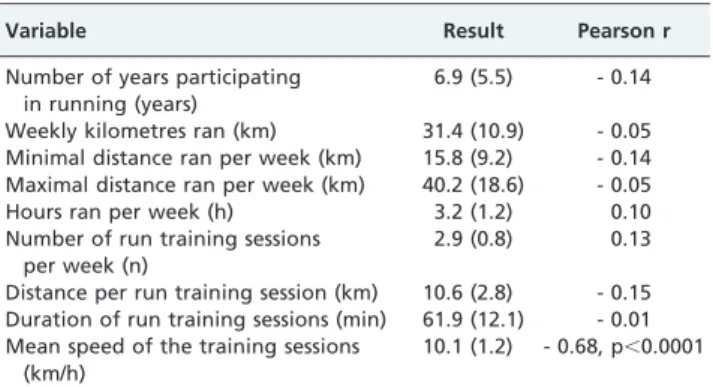
The 42 athletes finished the ‘Half Marathon Basel’ within 119 (15) min (CV = 12.6%), running at a mean speed of 10.8 (1.4) km/h. For the anthropometric characteristics, body mass, body mass index and body fat percentage (see Table 1) as well as pectoral, mid-axilla, triceps, subscapular, abdom-inal, suprailiac, and medial calf skin-folds (see Table 2) correlated to race time in the bivariate analysis. For the training characteristics, the mean speed of the training sessions was highly significantly and positively related to race time (see Table 3). When the variables with significant association in the bivariate analysis were inserted into a linear regression model (see Table 4), mid-axilla skin-fold and mean speed of the training sessions were related to race time. Race time in a half marathon might be predicted by the following equation (r2= 0.71) for recreational female run-ners: Race time (min) = 166.7+ 1.7x (mid-axilla skin-fold thickness, mm) - 6.4x (speed in training, km/h). Mean running speed during training was related to mid-axilla, subscapular, abdominal, and suprailiacal skin-fold thick-nesses, the sum of eight skin-folds and percent body fat (see Table 5).
Table 1 -Association of age and anthropometric variables with race time (n = 42).
Variable Result Pearson r
Age (years) 38.5 (8.9) 0.36
Body mass (kg) 58.7 (6.3) 0.60, p,0.0001
Body height (m) 1.66 (0.06) 0.27
Body mass index (kg/m2) 21.2 (1.9) 0.48, p = 0.0012
Body fat percentage (%) 27.2 (5.3) 0.56, p = 0.0001
Results are presented as mean and SD. P-value is inserted in case of a significant association after Bonferroni correction (p = 0.0022 for 22 variables).
Table 2 -Association of skin-fold thicknesses with race time (n = 42).
Variable Result Pearson r
Pectoral skin-fold (mm) 7.9 (4.9) 0.61, p,0.0001 Mid-axilla skin-fold (mm) 10.2 (4.8) 0.69, p,0.0001 Triceps skin-fold (mm) 12.7 (4.0) 0.49, p = 0.0010 Subscapular skin-fold (mm) 10.5 (4.7) 0.61, p,0.0001 Abdominal skin-fold (mm) 10.9 (7.0) 0.59, p,0.0001 Suprailiac skin-fold (mm) 20.5 (8.3) 0.55, p = 0.0002 Front thigh skin-fold (mm) 23.3 (8.5) 0.34
Medial calf skin-fold (mm) 8.6 (3.7) 0.53, p = 0.0003
Results are presented as mean and SD. P-value is inserted in case of a significant association after Bonferroni correction (p = 0.0022 for 22 variables).
Table 3 -Association of training and pre race experience variables with race time (n = 42).
Variable Result Pearson r
Number of years participating in running (years)
6.9 (5.5) - 0.14
Weekly kilometres ran (km) 31.4 (10.9) - 0.05 Minimal distance ran per week (km) 15.8 (9.2) - 0.14 Maximal distance ran per week (km) 40.2 (18.6) - 0.05
Hours ran per week (h) 3.2 (1.2) 0.10
Number of run training sessions per week (n)
2.9 (0.8) 0.13
Distance per run training session (km) 10.6 (2.8) - 0.15 Duration of run training sessions (min) 61.9 (12.1) - 0.01 Mean speed of the training sessions
(km/h)
10.1 (1.2) - 0.68, p,0.0001
Results are presented as mean and SD. P-value is inserted in case of a significant association after Bonferroni correction (p = 0.0022 for 22 variables).
Table 4 -Relationship of race time in the half-marathon to selected variables of anthropometry, training and pre race experience in the multiple linear regression analysis.
Variable ß SE p-value
Body mass 0.47 0.38 0.22
Body mass index - 0.38 1.26 0.76
Body fat percentage 0.68 0.71 0.34
Pectoral skin-fold 0.92 1.88 0.07
Mid-axilla skin-fold 1.59 0.77 0.0474
Triceps skin-fold - 1.12 0.94 0.24
Subscapular skin-fold - 0.30 0.68 0.66
Abdominal skin-fold - 0.46 0.40 0.26
Suprailiac skin-fold - 0.21 0.34 0.54
Medial calf skin-fold 0.75 0.67 0.27
Mean speed of the training sessions - 5.99 1.36 0.0001
Associations between race time as dependent variable and the athletes’ characteristics using multiple linear regression (n = 42); all characteristics showing a significant bivariate association with race time according to Tables 1-3 have been included in the model as covariates. ß = regression coefficient; SE = standard error of the regression coefficient; Coefficient of determination (R2) of the model was 78%.
Table 5 -Association between skin-fold thicknesses and training variables.
Variable
Mean weekly kilometres run
Mean weekly hours run
Mean speed in running during training
Pectoral skin-fold - 0.05 - 0.02 - 0.20
Mid-axilla skin-fold - 0.22 - 0.05 - 0.31, p = 0.044
Triceps skin-fold - 0.25 - 0.13 - 0.22
Subscapular skin-fold - 0.18 - 0.02 - 0.38, p = 0.013 Abdominal skin-fold - 0.14 - 0.06 - 0.44, p = 0.004 Suprailiac skin-fold - 0.26 - 0.16 - 0.41, p = 0.007
Front thigh skin-fold - 0.20 - 0.06 - 0.13
Medial calf skin-fold - 0.29 - 0.11 - 0.30
Sum of eight skin folds - 0.24 - 0.09 - 0.36, p = 0.019
Percent body fat - 0.26 - 0.10 - 0.31, p = 0.044
DISCUSSION
The aim of this study was to find predictor variables for half marathon race time in recreational female runners in order to create an equation to predict race time for novice future runners. We hypothesised that, according to the existing literature of Arrese & Osta´riz, significant relation-ships will be found between the upper body skin-fold thicknesses at suprailiacal and abdominal site and the half marathon race times of recreational female runners.13As we hypothesised, an association between upper body skin-fold thicknesses and race performance was found in the bivariate analysis; pectoral, mid-axilla, triceps, subscapular, abdom-inal and suprailiac skin-folds were related to half-marathon running times. Arrese & Osta´riz described in their 11 female high-level marathon runners a significant relationship between iliac crest (r = 0.62, p = 0.042) and abdominal skin-fold thickness (r = 0.61, p = 0.046) with marathon race times.13We can confirm their findings and in addition, we also found for pectoral, mid-axilla, triceps, and subscapular sites significant associations. These additional sites might be due to the anthropometry of our subjects. The female top class marathoners of Arrese & Osta´riz with a body mass of 45.6 kg and a body height of 1.58 m had a body mass index of 18.3 kg/m2compared to the 21.2 kg/m2of our subjects.13 We must assume that our recreational females with a higher body mass index also had a higher body fat percentage, and consequently thicker skin-folds compared to the high-level marathoners of Arrese & Osta´riz.13
In the bivariate analysis, mean speed of the training sessions was highly significantly and negatively correlated to half marathon race times. These findings confirm recent findings where peak running velocity during training was highly related to 5 km run times for both male and female athletes.27 According to Hagan et al., however, both
variables of anthropometry and training seem to account for marathon race time in females.10In their sample of 35
female distance runners, marathon performance time was related to body mass index, maximal oxygen uptake, previous marathons completed, number of weekly training sessions, training session per two days, total number of training sessions, total training duration, training pace and distance in training. We can confirm their findings that both variables of anthropometry and training were associated with half marathon running times in our subjects after multivariate analysis and not only anthropometric or training variables.
Based upon previous studies of runners up to the marathon distance, we expected to find an association between lower body skin-fold thicknesses and variables of training. Legaz & Eston described in a sample of 24 male and female endurance runners a significant association between the decrease in front thigh skin-fold thickness and improvement in performance due to training (r = -0.74, p,0.001).14 We found, however, an association of
mid-axilla, subscapular, abdominal and suprailiac skin-fold thickness with running speed during training. These disparate findings might be explained by the sample of athletes. Legaz & Eston investigated 16 male and eight female Spanish high-level runners covering distances between 100 m and the marathon.14Their athletes trained six or seven days a week, for 20 to 25 hours. In contrast, our recreational runners trained for only three hours a week. Also in the study of Arrese & Osta´riz, where iliac crest and
abdominal skin-fold thicknesses were related to marathon performance in females, high-level runners had been investigated.13 Furthermore we must assume that our
runners were older and had a higher body fat percentage compared to the elite runners in Legaz & Eston14and Arrese & Osta´riz.13The subjects in the study of Arrese & Osta´riz were between 21 years (100 m) and 30 years (marathon).13
The mean age of our subjects was 38 years, and we might expect that older runners would have more body fat. However, age and percent body fat were not related in our subjects.
Limitations of the study
A cross-sectional study is limited regarding the influence and effects of anthropometric and training characteristics on race time in runners, since only an intervention trial can answer this question. Other limitations are the lack of fitness evaluation of these athletes. We focused this investigation on anthropometry and training. Other aspects such as nutrition and influence of environment were not consid-ered. Unfortunately we have no data about energy deficit31
or disorder in fluid or electrolyte metabolism32which also might affect performance. The small sample size might limit the statistical calculations. However, in existing literature, smaller samples were investigated. In the study of Arrese & Osta´riz,1311 female marathoners were included and Legaz & Eston14 investigated a total of eight female endurance
runners.
CONCLUSION
To summarize, both variables of anthropometry and training were related to half marathon race time in these recreational female runners and an association between upper body skin-fold thicknesses and speed in running during training was found. Intensity in training seemed to be of importance for a fast half marathon race time and high training intensity may lead to reduced thickness of upper body skin-folds in recreational female half marathoners.
REFERENCES
1. Nettleton S, Hardey M. Running away with health: the urban marathon and the construction of ‘charitable bodies’. Health (London). 2006;10:441-60, doi: 10.1177/1363459306067313.
2. Marti B, Abelin T, Minder CE. Relationship of training and life-style to 16-km running time of 4000 joggers. The ’84 Berne ‘‘Grand-Prix’’ Study. Int J Sports Med. 1988;9:85-91, doi: 10.1055/s-2007-1024984.
3. Anderson T. Biomechanics and running economy. Sports Med. 1996;22:76-89, doi: 10.2165/00007256-199622020-00003.
4. Morgan DW, Martin PE, Krahenbuhl GS. Factors affecting running economy. Sports Med. 1989;7:310-30, doi: 10.2165/00007256-198907050-00003.
5. Saunders PU, Pyne DB, Telford RD, Hawley JA. Factors affecting running economy in trained distance runners. Sports Med. 2004;34:465-85, doi: 10.2165/00007256-200434070-00005.
6. Bale P, Bradbury D, Colley E. Anthropometric and training variables related to 10km running performance. Br J Sports Med. 1986;20:170-3, doi: 10.1136/bjsm.20.4.170.
7. Knechtle B, Duff B, Welzel U, Kohler G. Body mass and circumference of upper arm are associated with race performance in ultra-endurance runners in a multi-stage race – the Isarrun 2006. Res Q Exerc Sport. 2009;80:262-8.
8. Loftin M, Sothern M, Koss C, Tuuri G, Vanvrancken C, Kontos A, et al. Energy expenditure and influence of physiologic factors during marathon running. J Strength Cond Res. 2007;21:1188-91.
9. Maldonado S, Mujika I, Padilla S. Influence of body mass and height on the energy cost of running in highly trained middle- and long-distance runners. Int J Sports Med. 2002;23:268-72, doi: 10.1055/s-2002-29083. 10. Hagan RD, Upton SJ, Duncan JJ, Gettman LR. Marathon performance in
11. Hoffman MD. Anthropometric characteristics of ultramarathoners. Int J Sports Med. 2008;29:808-11, doi: 10.1055/s-2008-1038434. 12. Lucia A, Esteve-Lanao J, Oliva´n J, Go´mez-Gallego F, San Juan AF,
Santiago C, et al. Physiological characteristics of the best Eritrean runners-exceptional running economy. Appl Physiol Nutr Metab. 2006;31:530-40, doi: 10.1139/H06-029.
13. Arrese AL, Osta´riz ES. Skinfold thicknesses associated with distance running performance in highly trained runners. J Sports Sci. 2006;24:69-76, doi: 10.1080/02640410500127751.
14. Legaz A, Eston R. Changes in performance, skinfold thicknesses, and fat patterning after three years of intense athletic conditioning in high level runners. Br J Sports Med. 2005;39:851-6, doi: 10.1136/bjsm.2005.018960. 15. Legaz Arrese A, Gonzalez Badillo JJ, Serrano Ostariz E. Differences in
skinfold thicknesses and fat distribution among top-class runners. J Sports Med Phys Fitness. 2005;45:512-7.
16. Knechtle B, Rosemann T. Skin-fold thickness and race performance in male mountain ultra-marathoners. J Hum Sports Exerc. 2009;4:211-20, doi: 10.4100/jhse.2009.43.03.
17. Larsen HB, Christensen DL, Nolan T, Søndergaard H. Body dimensions, exercise capacity and physical activity level of adolescent Nandi boys in western Kenya. Ann Hum Biol. 2004;31:59-73, doi: 10.1080/ 03014460410001663416.
18. Tanaka K, Mimura K, Kim HS, Kawabata T, Tajima M, Nakadomo F, et al. Prerequisites in distance running performance of female runners. Ann Physiol Anthropol. 1989;8:79-87.
19. Knechtle B, Knechtle P, Schulze I, Kohler G. Upper arm circumference is associated with race performance in ultra-endurance runners. Br J Sports Med. 2008;42:295-9, doi: 10.1136/bjsm.2007.038570.
20. Hagan RD, Smith MG, Gettman LR. Marathon performance in relation to maximal aerobic power and training indices. Med Sci Sports Exerc. 1981;13:185-9.
21. Yeung SS, Yeung EW, Wong TW. Marathon finishers and non-finishers characteristics. A preamble to success. J Sports Med Phys Fitness. 2001; 41:170-6.
22. Scrimgeour AG, Noakes TD, Adams B, Myburgh K. The influence of weekly training distance on fractional utilization of maximum aerobic capacity in marathon and ultra marathon runners. Eur J Appl Physiol. 1985;55:202-9, doi: 10.1007/BF00715006.
23. Bale P, Rowell S, Colley E. Anthropometric and training characteristics of female marathon runners as determinants of distance running perfor-mance. J Sports Sci. 1985;3:115-26.
24. Hewson DJ, Hopkins WG. Specificity of training and its relation to the performance of distance runners. Int J Sports Med. 1996;17:199-204, doi: 10.1055/s-2007-972832.
25. Christensen CL, Ruhling RO. Physical characteristics of novice and experienced women marathon runners. Br J Sports Med. 1983;17:166-71, doi: 10.1136/bjsm.17.3.166.
26. Billat VL, Demarle A, Slawinski J, Paiva M, Koralsztein JP. Physical and training characteristics of top-class marathon runners. Med Sci Sports Exerc.2001;33:2089-97, doi: 10.1097/00005768-200105001-00096. 27. Scott BK, Houmard JA. Peak running velocity is highly related to
distance running performance. Int J Sports Med. 1994;15:504-7, doi: 10. 1055/s-2007-1021095.
28. Knechtle B, Joleska I, Wirth A, Knechtle P, Rosemann T, Senn O. Intra-and inter-judge reliabilities in measuring the skin-fold thicknesses of ultra runners under field conditions. Percept Mot Skills. 2010;111:105-6, doi: 10.2466/03.05.PMS.111.4.105-106.
29. Becque MD, Katch VL, Moffatt RJ. Time course of skin-plus-fat compression in males and females. Hum Biol. 1986;58:33-42.
30. Ball SD, Swan P, Desimone R. Accuracy of anthropometry compared to dual energy x-ray absorptiometry. A new generalizable equation for women. Res Q Exerc Sport. 2004;75:248-58.
31. Deutz RC, Benardot D, Martin DE, Cody MM. Relationship between energy deficits and body composition in elite female gymnasts and runners. Med Sci Sports Exerc. 2000;32:659-68, doi: 10.1097/00005768-200003000-00017.